Rong-Kai Chu, Tung-Ming Lee (2026). Reducing Cognitive Load in Expert Interviews: Interface Design and Application of a Spreadsheet-based CASI System. In: Usability and User Experience. AHFE Open Access, vol. 232, pp. 297–307. https://doi.org/10.54941/ahfe1008058
Traditional expert interviews in complex domains like kitchen cabinetry design often suffer from significant data collection errors and extraneous cognitive load for both the interviewer and interviewee. To address these bottlenecks, this study introduces a low-code Spreadsheet-native CASI (Computer-Assisted Structured Interview) tool. Developed under the principle of "Appropriate Design," the system leverages an End-User Development (EUD) approach to align functional requirements strictly with task objectives. By integrating real-time visual logic monitoring—such as immediate alerts for logical inconsistencies—and a unified interface, the tool shifts the researcher’s task from "recall" to "recognition" via preattentive processing. Validation through expert interviews confirmed that the tool achieved zero-error performance regarding data integrity and significantly reduced cognitive strain for both participants. Concurrently, the system successfully elicited a granular competency framework (seven competencies across five stages), revealing stage-wise shifts in professional requirements. These findings validate the efficacy of agile, researcher-led tool design in ensuring superior Task-Technology Fit without compromising methodological rigor. The study concludes by proposing a modular end-user development platform to build customizable, high-fidelity data acquisition tools for cross-disciplinary inquiry.
Kitchen cabinetry and space design is a complex, transdisciplinary domain requiring tacit expertise that shifts across the project lifecycle (Spencer and Spencer, 1993). Developing systematic competency frameworks for this profession necessitates expert interviews (Naeem et al., 2023); however, traditional tools—such as manual note-taking or fragmented digital documentation—often impose excessive human factors burdens and extraneous load (Schifano and Niederberger, 2025). During structured elicitation (e.g., multi-criteria assessments), fatigue and time pressure frequently trigger task overload and recording errors for the interviewer (Saaty, 1977). Furthermore, poor information visibility—such as excessive
298 Chu and Lee scrolling or ambiguous definitions—can disrupt an expert’s judgment process and compromise data integrity (Schifano and Niederberger, 2025).
To address this, we present a spreadsheet-native Computer-Assisted Structured Interviewing (CASI) system that is simultaneously interviewer- facing and interviewee-informative. By optimizing live workflows, the system mitigates the interviewer’s cognitive load and enhances interviewee engagement and elicitation quality, providing a verifiable foundation for establishing professional competency frameworks (Spencer and Spencer, 1993). The primary scope of this study is the methodological development and usability validation of a low-code, Spreadsheet-native CASI system designed to mitigate cognitive load during expert interviews. To empirically evaluate the system’s performance, the complex domain of kitchen cabinetry and space design was selected as a pilot case study. Specifically, the core contributions of this study are threefold:
Methodological Contribution: Developed and validated a low-code, Spreadsheet-native CASI tool. By integrating real-time visual logic monitoring, the system successfully achieved zero-error performance in multi-dimensional data collection.
Theoretical and Practical Contribution: Successfully applied Cognitive Load Theory (CLT) to interview interface design. The study empirically demonstrates that shifting error detection from active monitoring to preattentive processing, significantly mitigating extraneous cognitive load for both interviewers and interviewees.
Domain Contribution: Elicited a preliminary, granular competency framework for the kitchen cabinetry and space design industry, identifying a dynamic weighting matrix of seven core competencies (C1–C7) across five project lifecycle stages (S1–S5).
Design Rationale and Development Strategy From a Cognitive Load Theory (CLT) perspective, conventional recording methods impose significant extraneous load driven by the split-attention effect (Chen et al., 2023). For the interviewer, multitasking between conversation management and data mapping fragments mental resources (Frontzkowski et al., 2025), while the interviewee often faces cognitive strain attempting to grasp complex methodological intent, such as the underlying logic or definition of specific research method (Chen et al., 2023). To mitigate these barriers, research tool development must transition from passive recording to strategic guidance (Hanway et al., 2024). This requires replacing repetitive scrolling and page-switching with a unified view of the interview content. These necessitates a design approach where functional requirements align strictly with the user characteristics of both participants (Goodhue and Thompson, 1995).
Drawing on design principles to create user-friendly, intuitive, and useful solutions (Goodhue and Thompson, 1995), this study follows the concept of “Appropriate Design.” This ensures that interface configuration is highly matched with task objectives (Goodhue and Thompson, 1995), prioritizing the robustness of data logic over visual decoration (Bassano et al., 2022;
Reducing Cognitive Load in Expert Interviews: Interface Design and Application 299 Chen et al., 2023). To achieve this, low-code tools like Excel or Google Sheets are utilized for their prototyping advantages due to their superior interoperability and versatility, allowing for the agile iteration of formulas and logical expressions (Prinz et al., 2021) to systematically optimize cognitive paths.
Consequently, the proposed CASI interface addresses these dual bottlenecks. For the interviewer, conditional formatting provides real- time alerts, shifting error detection from active monitoring to preattentive processing (Hanway et al., 2024). For the interviewee, the system prevents disruption by consolidating descriptive content into a unified view (Chen et al., 2023). This configuration ensures that valuable mental resources are reserved for high-fidelity judgment rather than system operations (Chen et al., 2023; Frontzkowski et al., 2025).
METHODOLOGY
This study adopts a design-oriented approach to develop a Spreadsheet- native CASI interface through an End-User Development (EUD) perspective. Guided by the Appropriate Design principle, the tool balances complexity with task objectives to facilitate collaboration between the interviewer and the interviewee during knowledge elicitation.
The workflow begins by synthesizing competency indicators into structured evaluation units. During this process, models such as AHP and Kano are applied for data weighting and classification. In the implementation phase, the system design is guided by Cognitive Load Theory (CLT). The study leverages the high interoperability and agile prototyping advantages of spreadsheet environments. This approach effectively integrates indicator definitions, real-time computation formulas, and visual logic-checking mechanisms, thereby enabling systematic cognitive optimization.
Empirically, semi-structured interviews with 10 industry experts with extensive practical experience provide insights into the system’s performance. The data collection follows two dimensions: first, evaluating the impact of interface configuration on the workload of both participants through operation logs and field observations; second, gathering quantitative weight data and qualitative interview transcripts. Finally, through quantitative statistical testing and qualitative coding, the study aims to verify how this tool influences data accuracy and attention guidance, serving as a basis for subsequent design optimization.
Research Participants To ensure the competency framework reflects current industry demands, this study invited 10 senior experts from the kitchen cabinetry and space design and management sector. The selection criteria prioritized professionals with extensive practical experience and leadership roles. The participant pool boasts an average industry tenure of 22.7 years, with 80% currently or formerly serving as board members or directors in industry associations. The cohort included 4 on-site and 6 online participants. This high level of expertise ensures that the data collected via the CASI interface possesses high content validity and broad industry representativeness.
The interview phase was conducted from December 2025 to January 2026, involving ten industry experts. To accommodate the participants’ schedules, a hybrid approach was employed, consisting of four on-site and six online sessions (via Google Meet). All sessions were conducted through the CASI interface to maintain a unified data environment, following a structured three-step procedure: Phase1: Orientation and Ethical Clearance (3–5 minutes)
The session commenced with a brief overview of the interview’s objectives and the overall process. The interviewer ensured that the experts were fully briefed on their rights, obtaining consent for audio and video recording. Basic demographic data, including years of industry experience and current roles, were confirmed during this stage for the participant profile.
Phase2: Workflow Validation and Refinement (20–30 minutes) The interviewer presented a preliminary workflow for kitchen cabinetry and space design, synthesized from prior literature, industry standards, and established consensus. Experts were invited to critique and adjust the sequence or terminology of these stages. This step ensured that the subsequent evaluation was grounded in a realistic framework recognized by industry veterans.
Phase3: Competency Evaluation (20–25 minutes) Building on the workflow refined in the previous phase, this phase involved a detailed exploration of competencies across five distinct work stages. The process was repeated for each stage:
The interviewer guided the expert through the competency definitions displayed on the CASI interface.
Experts provided judgments for AHP-based importance ranking and responded to Kano questionnaires. To minimize the expert’s cognitive load, the interviewer performed all data entry into the spreadsheet while simultaneously monitoring real-time visual feedback and logic checks. Notably, the interface’s high learnability was evident; for instance, Expert I (an on-site participant) eventually took direct control of the interface after observing the interviewer’s initial manual operation during the first stage, completing the remaining four stages independently.
Design and Implementation of the CASI Interface In this study, the CASI interface was developed within the Google Sheets environment, utilizing a Spreadsheet-native approach to create a responsive, low-code interface tailored for expert interviews. The design strategy prioritizes two core dimensions: Spatial Navigation and Real-time Visual
Reducing Cognitive Load in Expert Interviews: Interface Design and Application 301 Feedback, ensuring that the complex data elicitation process remains intuitive for both the interviewer and the expert (as shown in Figure 1 and Figure 2).
Interface Layout and Navigation Control The interface utilizes a “fixed-frame layout” via the Freeze Panes function to anchor critical references, with the visual emphasis shifting according to the interview’s progression:
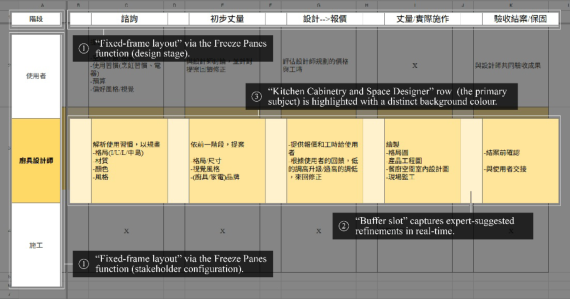
Workflow Validation Phase (Phase 2): During this phase, the leftmost column is structured as a stakeholder configuration comprising the User (Project Owner), the Kitchen Cabinetry and Space Designer (the primary subject), and the Construction Unit. To establish immediate visual saliency, the “Kitchen Cabinetry and Space Designer” row is highlighted with a distinct background colour, guiding the expert’s focus to the target role while maintaining the surrounding interaction context. Horizontally, the five design stages are distributed from left to right, separated by narrow interstitial “buffer slots.” These columns serve as visual affordances, allowing the interviewer to point to or insert new stages in real-time if an expert suggests a refinement, thereby preventing any conceptual misinterpretation between participants (Figure 1).
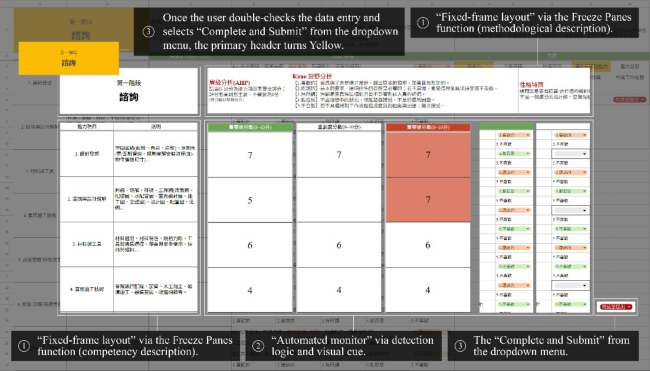
Competency Evaluation Phase (Phase 3): To maximize cognitive focus, the layout is organized around a primary contextual anchor in the top- left corner, which displays only the specific work stage currently under investigation. All evaluation components—including the competency definitions in the leftmost column and the corresponding AHP and Kano input fields—are positioned vertically beneath the AHP and Kano methodological description row. By fixing both the top row (containing the stage title and methodological description) and the leftmost column (containing indicator descriptions) via Freeze Panes function, the interface ensures that the evaluation context and criteria remain constantly visible even as the user navigates through the datasets. This spatial hierarchy effectively mitigates the split-attention effect, allowing the participants to maintain a continuous and focused on workflow context without losing track of the current evaluation stage (Figure 2).
Technical Implementation of Visual Cues Guided by Cognitive Load Theory, the interface employs Conditional Formatting to serve as an “automated monitor” for data integrity during the evaluation phase (as shown in Figure 2):
Error Detection (Red Alert): For AHP importance ranking, a duplicate detection logic is applied. By comparing the total count of entries against the count of unique values (utilizing COUNTA and COUNTUNIQUE functions), any repeated scores (1–10) trigger a red cell background. This immediate alert prevents the entry of logically inconsistent data during the conversation.
Progress Confirmation (Green Status): Once all seven competency items within a stage are assigned unique values or provided with complete functional/dysfunctional responses, the input category headers turn Green. This serves as a visual confirmation of data integrity without overwhelming the expert with excessive colour changes.
Workflow Transition (Yellow Indicator): A drop-down menu labelled “Complete and Submit” is integrated for phase completion. Once the interviewer double-checks the data entries and selects the label, the primary header of the current stage turns Yellow. This high-contrast shift provides a clear psychological “checkpoint” and confirmation for both participants before proceeding to the next interview phase.
Figure 1: Phase 2 CASI interface featuring stakeholder mapping and workflow validation.
Note. The screenshot has been anonymized and contains no identifiable personal information.
Figure 2: Phase 3 fixed-frame CASI interface with automated validation.
Note. The interface utilizes color-coded cues: Green (complete), Red (conflict), and Yellow (stage finalization).
Reducing Cognitive Load in Expert Interviews: Interface Design and Application 303 Data Processing and Analysis
This study employs a mixed-methods approach to analyse the multi- dimensional data collected during the interviews. The analysis strategy is divided into quantitative and qualitative streams to ensure both numerical precision and contextual depth.
Quantitative Data: Weighting and Attribute Classification The structured data captured via the CASI interface is processed to establish the mathematical foundation of the competency framework:
Weighting and Consistency Checks: The study utilizes Analytic Hierarchy Process (AHP) logic to determine the relative importance of competencies. To ensure logical consistency, the Consistency Ratio (C.R.) is monitored, with a threshold of C.R. < 0.1 for valid samples.
Kano Attribute Categorization: Expert responses to functional and dysfunctional question sets are mapped onto the Kano two-dimensional model to identify core attributes (e.g., Must-be, One-dimensional, Attractive).
Qualitative Data: Transcripts and Observation Logs Qualitative materials are categorized based on their role in validating the competency content or the tool’s performance:
Interview Transcripts: Audio recordings are transcribed and analysed using qualitative coding. This process focuses on expert feedback regarding indicator definitions to cross-reference with the quantitative rankings.
Interviewer Observation Logs (UX Log): This document is logged subjectively by the interviewer, including interviewer’s operational experience and the experts’ reactions (such as Expert I’s transition to manual operation) to the interface. The records focus on the interviewer’s efficiency in data entry, the clarity of real-time visual cues for the interviewer, and any spontaneous feedback from experts regarding the displayed results.
Data Triangulation for Competency Validation To ensure the robustness of the preliminary competency framework, this phase integrates quantitative rankings with qualitative insights from transcripts. By cross-referencing statistical weights with expert commentary, the study identifies potential discrepancies and ensures the framework is industry-relevant.
Evaluation of CASI Tool Performance Distinct from the competency analysis, this final research phase synthesizes observation logs and data integrity metrics (such as accuracy and missing
304 Chu and Lee data rates). This analysis forms the core of the results and discussion, providing a critical reflection on how the Spreadsheet-native CASI interface influences data acquisition, reduces cognitive load, and optimizes the interview workflow.
RESULT
This chapter presents the findings from ten expert interviews conducted to validate both the Spreadsheet-native CASI (Computer-Assisted Structured Interview) tool’s performance and the resulting kitchen cabinetry and space designer competency framework. Guided by the principle of Appropriate Design, the analysis specifically examines how the tool’s configuration influences data acquisition accuracy and the mitigation of extraneous load. Consequently, the findings are structured into two key sections to provide a comprehensive view of the research outcomes.
The researcher evaluated the Spreadsheet-native CASI tool’s performance. As shown in Table 1, the transition to real-time visual cues resolved early-stage data omissions (Expert B) and logic duplicates (Expert C), while effectively reducing the researcher’s extraneous load. Notably, Expert I demonstrated high learnability by independently operating the tool after observing only one stage.
Table 1: CASI system performance and UX observations.
Table available in the original PDF paper.
Version Exp. ID Completion UX Log Initial (No Visual Feedback) B, C <100% Data missed by Expert B; conflicts in Expert C.
Optimized A, D~I 100% Expert I operated independently; Visual cues ensure high data integrity.
Note. Total sample size N=10; ‘Initial’ phase (Dec 16 & 31) preceded the implementation of real-time visual logic monitoring.
With visual cues, users relied less on memory and more on in-context recognition. In the initial phase, the absence of monitoring led to omissions by Expert B and duplicate scores by Expert C, necessitating costly post- interview corrections. Conversely, the optimized CASI tool empowered Expert I to navigate the interface independently after minimal observation, confirming high learnability and a substantial reduction in the researcher’s extraneous load.
After validating the tool’s capability to ensure zero-error data collection, the study further analyzed the acquired multi-dimensional data to establish the industry competency framework. The finalized framework integrates the hierarchical weighting (W) and Kano attributes (K) for the research findings. To maintain conciseness within the page limit, the seven identified competencies are denoted as Competency IDs (C1–C7), and the project lifecycle is categorized into five Stage IDs (S1–S5) throughout the
Reducing Cognitive Load in Expert Interviews: Interface Design and Application 305 following analysis. As shown in Table 2, this matrix provides a quantified roadmap of professional requirements.
Table 2: Synthesized competency weightings (W) and kano attributes [W(K)].
Note. W (%) = Mean Weight; K = Kano Category: M = Must-be, O = One-dimensional, I = Indifferent.
Longitudinal analysis of Table 2 indicates that C7 consistently remains a primary focus, maintaining high weightings across all stages (approx. 17.5%–22.5%). During the initial phases (S1–S2), core competencies such as C1, C2, and C7 are categorized as Must-be (M), representing foundational baseline expectations. As the project progresses to S3, C7 transitions to a One-dimensional (O) attribute while C3 remains Must-be (M), suggesting that professional performance in spatial layout begins to directly drive expert satisfaction. By the final stage (S5), C5 and C7 emerge as dominant performance drivers, both classified as One-dimensional (O) with weightings of 21.3% and 22.4%, respectively. Notably, C5 evolves from an Indifferent (I) attribute in early stages to a high-impact requirement in S5, highlighting the tool’s efficacy in capturing stage-dependent shifts in perceived value. These findings confirm that the Spreadsheet-native CASI interface successfully facilitated the acquisition of granular, multi-dimensional expert insights.
DISCUSSION
The CASI tool optimized the interview process by minimizing extraneous cognitive load through preattentive visual feedback, effectively shifting the interviewer’s task from “recall” to “recognition”. This interface facilitated real-time logic validation, allowing for the immediate resolution of contradictions—such as AHP-Kano mismatches—while maintaining a 100% data entry completion rate. Notably, the tool functioned as a “stable script”, providing a psychological scaffold that reduced performative anxiety. Furthermore, the shared visual CASI interface fostered a transparent collaborative environment. While this transparency moderated the conversational pace, it allowed the interviewee to verify and correct data on the spot, thereby enhancing overall rigor.
Crucially, the analysis reveals a deliberate balance between efficiency and rigor: this is evidenced by an ethical constraint where, even if the CASI tool instantly marks a cell with logically inconsistent data, the operator (interviewer) cannot revise the answer without the interviewee’s consent. This prioritizes data validity over arbitrary speed. By adopting an EUD
306 Chu and Lee approach, the interviewer ensured a superior Task-Technology Fit, as the customized spreadsheet environment eliminated operational barriers and redundant data entry. Ultimately, the evolution from the initial version’s omissions to the optimized version’s robust data integrity validates the value of agile, researcher-led tool design in improving the accuracy and efficiency of complex industrial design research.
CONCLUSION
This study successfully validated a Spreadsheet-native CASI tool, prioritizing the reduction of technical implementation barriers to eliminate data collection errors in expert interviews. By integrating real-time visual logic monitoring and a fixed-frame layout, the tool achieved zero-error performance while effectively reducing the extraneous cognitive load for both the interviewer and interviewees. The resulting framework, quantified through seven competencies across five stages, provides a dynamic, stage-wise roadmap for professional competencies in kitchen cabinetry and space design. While the current study prioritizes the methodological validation of the CASI tool, the resulting competency framework is primarily representative of the pilot expert cohort. Therefore, future research can leverage this validated interface to facilitate larger-scale data collection across diverse project types to establish broader industry standards. Furthermore, while the implementation is highly accessible, its reliance on stable internet suggests opportunities for device-agnostic optimization to enhance the tool’s versatility and ensure broader applicability across various interaction contexts. Looking ahead, future work will focus on broadening the accessibility of this EUD approach by developing a modular, low-code platform. This will enable interviewers to build custom CASI interfaces with integrated analytical formulas, ensuring a superior Task-Technology Fit without high technical overhead.
ACKNOWLEDGMENT
We would like to thank the experts who participated in this study for their valuable time and insights.
REFERENCES
Bassano, C., Chessa, M. & Solari, F. 2022. Visualization and interaction technologies in serious and exergames for cognitive assessment and training: A survey on available solutions and their validation. IEEE Access, 10, 104295–104312. Chen, O., Paas, F. & Sweller, J. 2023. A cognitive load theory approach to defining
and measuring task complexity through element interactivity. Educational Psychology Review, 35, 63. Frontzkowski, Y., Krick, A. & Felfe, J. 2025. Harder, Better, Faster, but more Fatigued: The Impact of Multitasking on Videoconferences, Performance and Fatigue. Computers in Human Behavior Reports, 100736. Goodhue, D. L. & Thompson, R. L. 1995. Task-technology fit and individual
performance. MIS quarterly, 213–236.
Reducing Cognitive Load in Expert Interviews: Interface Design and Application 307 Hanway, P., Akehurst, L., Vernham, Z. & Hope, L. 2024. Who Said What? The
Effects of Cognitive Load on Source Monitoring and Memory for Multiple witnesses’ Accounts. Applied Cognitive Psychology, 38, e70011. Naeem, M., Ozuem, W., Howell, K. & Ranfagni, S. 2023. A step-by-step process of thematic analysis to develop a conceptual model in qualitative research. International journal of qualitative methods, 22, 16094069231205789. Prinz, N., Rentrop, C. & Huber, M. Low-Code Development Platforms-A Literature
Review. 2021 2021. Saaty, T. L. 1977. A scaling method for priorities in hierarchical structures. Journal of mathematical psychology, 15, 234–281. Schifano, J. & Niederberger, M. 2025. How Delphi studies in the health sciences find
consensus: a scoping review. Systematic Reviews, 14, 14. Spencer, L. M. & SPENCER, S. M. 1993. Competence at Work: Models for Superior Performance, New York, John Wiley & Sons.
LISTED IN THE AHFE DIGITAL BOOKSTORE CATALOGUE
Explore the complete digital volume
Usability and User Experience
Read this individual research paper free through the original publisher, or explore the full digital proceedings book.
ISBN 979-8-950676-08-6
Explore this ISBN in the AHFE Bookstore ↗Listed in the July 2026 bookstore catalogue; search by ISBN to confirm current availability · Digital book purchase optional