Wei-Ni Hsu, Bo Liu, Yang-Cheng Lin (2023). Rehabilitation of Data Web Application Design and Usability Evaluation for Elderly Users. In: Usability and User Experience. AHFE Open Access, vol. 110, pp. 345–357. https://doi.org/10.54941/ahfe1003208
As nations face aging populations, elderly individuals often resist seeking medical care, negatively impacting their physical and mental well-being. Current telemedicine solutions often present unfriendly interfaces, exacerbating seniors' difficulties comprehending these technologies. To address these challenges, we developed a web-based application enabling elderly users to access rehabilitation data on mobile devices, gain insights into their rehabilitation training, and obtain medical guidance.Our methodology combined semi-structured interviews with seniors, on-site observations, and expert consultations to understand user requirements. We then conducted usability task experiments to assess key usability metrics, such as satisfaction, efficiency, and error rates. Finally, we employed a usability questionnaire and semi-structured interviews to evaluate the application's usability and seniors' motivation.Analyzing the completion of five predetermined tasks and the results of the MAUQ questionnaire, our findings demonstrated good overall usability for elderly users, with an average score of 5.20 per question. Using an independent sample T-test, we found that although the total questionnaire score remained unaffected by respondents' education level, significant differences arose concerning ease of use and satisfaction among respondents with distinct educational backgrounds.Our study highlights that the web application enhances older adults' willingness to use mobile devices for rehabilitation. By integrating the application into geriatric rehabilitation training, healthcare providers can facilitate a deeper understanding of seniors' conditions, increase motivation for rehabilitation, and streamline the process, making it accessible, digital, and visually engaging.
Amid the evolution of economic landscapes and shifts in population age structures, numerous nations are transitioning towards an aging society. The increasing significance of healthcare resources and the challenges posed by their uneven distribution warrant attention. Diminishing skeletal muscle mass and functionality represent quintessential attributes of human aging, engendering restricted mobility, disability, and mortality (Shlisky et al., 2017). Experts term the loss of muscle mass and strength associated with aging
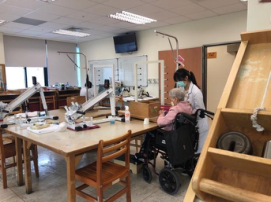
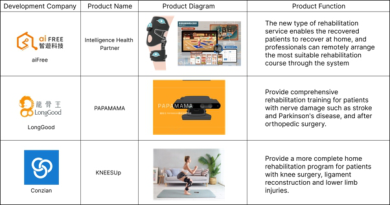
Figure 1: Current status of rehabilitation treatment.Figure 2: Products developed by Telehealth Medical.
as sarcopenia. (Fielding et al., 2011), which encompasses muscle degrada- tion attributable to diminished activity, malnutrition, or disease among older individuals.
Effectively addressing sarcopenia necessitates implementing regulated die- tary regimens and incorporating exercise and rehabilitation, with synergistic outcomes achievable through a combination of both approaches (Kakehi et al., 2022). Concerning rehabilitation, most patients currently undergo con- sistent and repetitive motor training, albeit older adults often exhibit a decre- ased willingness to persist with such regimens (see Figure 1). The COVID-19 pandemic has further catalyzed the emergence of intelligent medicine as a contemporary medical paradigm (see Figure 2). By leveraging artificial intel- ligence, healthcare professionals can optimize the management of patients afflicted with chronic conditions, provide precise treatment recommenda- tions for critical illnesses, and mitigate medical errors (Miller & Brown, 2018). Consequently, numerous enterprises are striving to develop products that facilitate telemedicine services. However, the physical constraints experienced by elderly individuals often pose difficulties or challenges when attempting to read and operate these technologies, leading to a diminished inclina- tion among seniors to embrace novel technological products. As a result, this study applies the “Intelligence Health Partner,” developed by aiFree Technology, to design a user interface tailored to this demographic. This interface enables real-time access to rehabilitation training medical records. It conducts a test experiment on its usability for seniors aged 65–80, assessing the user satisfaction and efficiency of the software. This study evaluates user
Rehabilitation of Data Web APP Design and Usability Evaluation for Elderly Users 347
satisfaction and efficiency while refining the interface design. The findings of this study will serve as a valuable reference for the future development of applications catering to the needs of the elders.
LITERATURE REVIEW
Seniors and New Technology In the wake of recent advancements in sophisticated products, various tech- nological solutions have emerged to accommodate the growing trend of aging societies, furnishing elderly individuals with intelligent software and hardw- are to enable self-sufficient lifestyles. Nevertheless, seniors’ use of mobile devices, e-readers, and tablets exhibits marked disparities contingent on their age. As delineated by a study conducted by the Pew Research Center, older adults may confront the subsequent impediments and obstacles when endeavoring to harness these cutting-edge technologies (Smith, 2014):
The physical challenges of using the new technologies
Skepticism about the benefits of the new technologies
Difficulty learning to use the new technologies Research suggests that the advent of information and communication technologies can reduce social isolation and improve health and activity participation among older adults (Baker et al., 2018).
Mobile Health Mobile health has been talked about a lot in recent years as one of the components of e-health, which typically uses mobile communication devices (e.g., cell phones, tablets, etc.) and wearable devices (e.g., smart watches, smart glasses, etc.) to deliver health services, information, and data collection—generating a new, convenient and novel healthcare system. It has been a driving force in healthcare over the past decades, from healthcare deli- very to low-cost tools for effective disease diagnosis, prediction, monitoring, and management (Iyawa et al., 2019). Thus, experts define it as using mobile computing and communication technologies in healthcare and public health. (Free et al., 2010). In the recent COVID-19 epidemic, mobile and zero-touch health care has gone from experimental to routine. Mobile medicine has been very effective at this time, allowing many people to use their mobile devices to see a doctor anywhere without traveling. In terms of long-term care, mobile health can save on service costs and reduce the overuse of medical resources. However, as intelligent technologies increasingly provide data for healthcare, the industry must address cross-platform data integration, systematic data governance, and empathetic privacy protection.
Usability Evaluation The primary purpose of conducting usability testing and evaluating a pro- duct is to assess whether it meets the user’s needs and operation. Nielsen argues that usability is not just a single assessment but is measured using
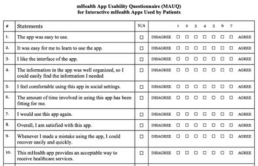
Figure 3: MAUQ questionnaires (Adapted from Zhou et al., 2019).
five attributes (Nielsen, 1996): 1. learnability, 2. efficiency, 3. memorabi- lity, 4. error rate, and 5. satisfaction. Qualitative interviews ask respondents for more information about their thoughts, while quantitative usability asses- sment questionnaires administer data from validation studies. The three most commonly used questionnaires in mobile health service utilization are the System Utilization Scale (SUS), Overall Assessment of Utilization Questi- onnaire (PSSUQ), and Computer Systems Usability Questionnaire (CSUQ) (Hajesmaeel-Gohari et al., 2022). Zhou et al. developed the Mobile Medical Application Usability Questionnaire (MAUQ) by combining the SUS and PSSUQ. The application in this study will refer to the MAUQ questionnaire with the type of interaction and the patient as the target user (see Figure 3) because it interacts with physicians, and the target users are patients and their family members (Zhou et al., 2019).
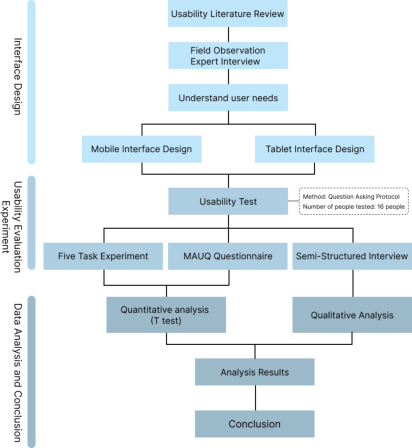
RESEARCH METHOD This investigation seeks to furnish elderly individuals with an application that expedites them to access their recuperation data upon engaging the reh- abilitation apparatus. Through a comprehensive usability appraisal, we shall discern the prerequisites of the elders when interacting with the application and refine the interface accordingly. Our objective is to propose an optimally tailored interface design for elderly users to peruse the data effectively. We have divided this segment into three distinct sections: (1) User Requirements Analysis, (2) Interface Design and Development, and (3) Usability Evaluation Experiment Planning and Test Content. Figure 4 below depicts each phase.
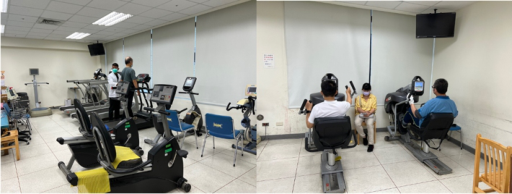
User Requirements Research The participants in this study comprise 65 to 80 years old elders. Consequently, we interviewed elderly individuals undergoing rehabilitation to discern potential issues related to the user interface and their functional needs in accessing their physiological rehabilitation data. We performed on- site observations of existing rehabilitation environments (refer to Figure 5) and engaged in expert consultations to better understand the current reh- abilitation process. The methods therapists employ for record-keeping, patient-therapist interactions, and electronic records’ efficacy for patients and healthcare providers. Our findings can be summarized: (1) Rehabilitation physicians tailor rehabilitation plans according to the patient’s condition
Rehabilitation of Data Web APP Design and Usability Evaluation for Elderly Users 349
Figure 4: Research project flow chart.Figure 5: Current status of the rehabilitation area.
and needs. (2) Paper records are currently maintained alongside the patient. (3) Therapists communicate the scheduled activities and their respective dura- tions to patients before commencing the rehabilitation program, instructing patients to undertake the rehabilitation independently. (4) There is a lack of data that facilitates accurate recording of each movement by therapists, ena- bles patients to access rehabilitation information at their convenience, and mitigates the risks associated with paper loss, rehabilitation oversight, and real-time progress monitoring.
After the expert consultations, we engaged five seniors aged 65 to 80 and convalescing from illness to partake in semi-structured interviews concerning their prevailing visual preferences and functional requisites. The discourse centered around the proclivities, challenges, and necessities associated with the current data visualization interface. The data application furnished to the participants facilitated discerning which interface presentations were effortlessly legible and operable for the elderly demographic.
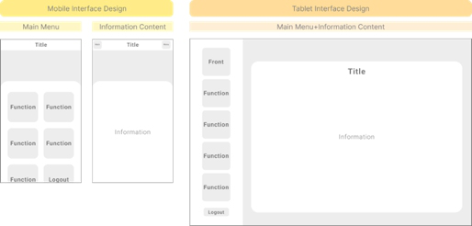
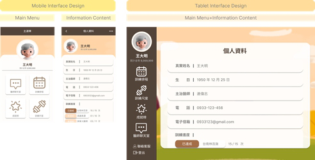
Interface Design This study aims to develop a web application facilitating real-time access to physiological data on internet-enabled devices. We create a user-friendly interface using responsive web design and adhering to Gandy’s seven web design elements. Target devices include tablets and mobile phones, with a functional layout based on Shitkova’s typographic specifications. The wireframe (Figure 6) reflects these specifications. From semi-structured inte- rviews, we incorporate user needs and preferences to design the app’s features and interface, catering to seniors’ operational preferences and functional requirements (Figure 7). The following are the main functions established for this application:
1. Rehabilitation Schedule: Dates, data, and future rehabilitation planning details. 2. Training Intensity: Physician-recommended frequency and resistance levels for various exercises, accompanied by a progress chart depicting exercise frequency and resistance. 3. Achievement Record: Accumulate exercise repetitions to earn badges and rewards, fostering rehabilitation motivation. 4. Physician Communication Portal: In real-time discussions with doctors through a dedicated chat room. 5. Personal Profile: Patient’s details and rehabilitation progress. 6. Customer Support: Contact information for assistance with system- related inquiries.
Rehabilitation of Data Web APP Design and Usability Evaluation for Elderly Users 351
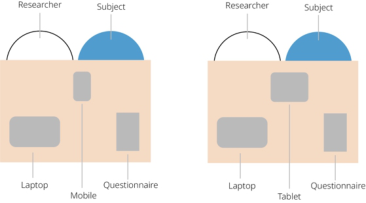
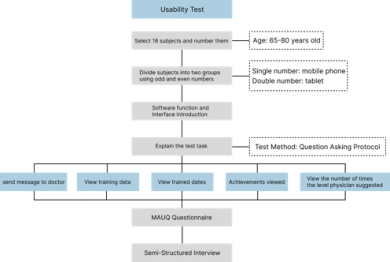
Figure 8: Location plan of the experimental site.Figure 9: Flowchart of rehabilitation data application testing.
Usability Test This investigation aimed to assess the usability of an application interface tailored to accommodate the requirements of elderly individuals. We enlisted a cohort of 18 participants, aged between 65 and 80 years, for the study. We divided the experiment into two distinct groups, with one group focusing on tablet interfaces and the other on mobile interfaces. The experimental design was delineated as depicted in Figure 8.
In this investigation, we employed an iPad 6 as the tablet model and an iPhone 8 Plus as the experimental apparatus, documenting the parti- cipants’ duration, error rate, and touch error rate. The participants were instructed to accomplish five predetermined tasks, as demonstrated in the operational illustration (refer to Figure 9): 1. transmitting a message to the physician, 2. examining the cumulative training time on a specific date, 3. verifying the training date, 4. determining the number of requisite achieve- ments, and 5. ascertaining the number of recommendations provided by the doctor for a particular level. We administered the MAUQ questionnaire upon task completion.
This study employed the interactive, patient-targeted user version of the Mobile Medical Application Usability Questionnaire (MAUQ) proposed by Zhou et al. in 2019. A seven-point Likert scale, ranging from 1 (strongly disagree) to 7 (strongly agree), assessed the significance of usability.
Table 1. MAUQ interaction, patient version questionnaire questions.
Table available in the original PDF paper.
Q1. This application is easy to use Q2. It is easy for me to learn to use this application Q3. I like the interface of the application Q4. The information provided in the app is well organized so that I can easily find the information I need Q5. I can use the app comfortably in public places Q6. It does not take me too much time to use the app Q7. I would use this app again Q8. I am satisfied with the app as a whole Q9. Whenever I make a mistake with this app, I can fix it easily and quickly Q10. The way the app provides health care services is easy for me to accept Q11. The app gives enough feedback and information to let me know where I am in my steps Q12. Web site browsing is consistent when I slide the screen Q13. The application’s interface allows me to use all the functions it provides (e.g., entering messages, viewing information) Q14. The application has the functionality and processing power I expect Q15. The app is useful for my health and well-being Q16. The app improves my access to medical services Q17. The app helps me to help manage my health more effectively Q18. The app makes it easier for me to communicate with health care professionals Q19. I have more opportunities to communicate with health care professionals by using this app Q20. I believe that health care professionals receive any messages I send using the app Q21. I feel comfortable using this app to communicate with health care professionals
We computed the score as the mean value of each inquiry, and a higher mean value approaching 7 indicated superior usability. To facilitate the usa- bility evaluation, screen, and audio recordings were utilized throughout the experiment, enabling observation of the subjects’ interface interactions.
RESULT
The quantitative investigation of this study encompassed task completion duration, task completion error frequency, contact error prevalence, and the MAUQ scale rating. We scrutinized qualitative information through semi-structured questionnaires and observational records. Data analysis will be executed utilizing SPSS software. Independent sample t-tests will be emplo- yed to ascertain whether disparate factors considerably influence task perfor- mance for distinct cohorts of elderly individuals. The significance threshold was established at 5% (p<0.05).
Usability Test Results A cohort of 18 participants, 13 females and 5 males, was enlisted for this investigation to evaluate the usability of the Web App devised for documen- ting rehabilitation data. The subjects’ ages spanned from 65 to 80 years, with
Rehabilitation of Data Web APP Design and Usability Evaluation for Elderly Users 353
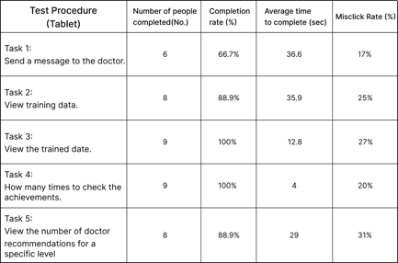
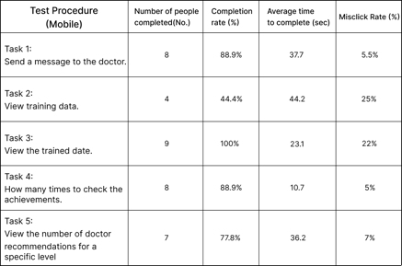
Figure 10: Tablet five task test results.Figure 11: Mobile five task test results.
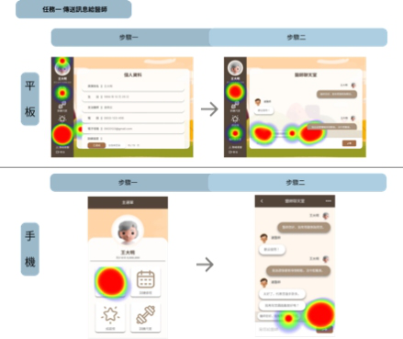
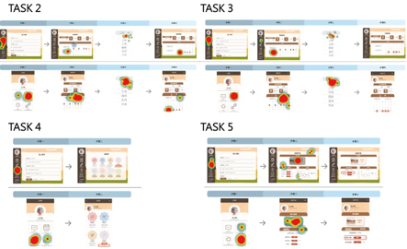
a mean age of 71.8 years. The average educational attainment amounted to 10 years (SD = 3.55). We collated the indicators documented during the usability assessment (refer to Figures 10 and 11) and examined the completion of the five pre- determined tasks. For Task 1, the data reveals that 6 out of 9 participants accomplished the task via the anticipated trajectory. Among tablet users, 66.7% completed the task, averaging 36.6 seconds, with a 17% error rate; conversely, 88.9% of smartphone users achieved completion, averaging 37.7 seconds and a 5.5% error rate (see Figure 12). The heat map depicting user interactions and interface pathways highlights the sequence and locations of clicks during the operational process.
We employed a consistent methodology to examine the quintet of user tasks, concentrating on those exhibiting diminished completion rates, ele- vated error frequencies, and lengthy completion durations. Interviews were conducted to ascertain the underlying causes and optimize and ameliorate these aspects functionally. The following illustration presents the click heat map delineating the interface trajectory for the quartet of tasks (refer to Figure 13).
In conclusion, most users could proficiently and seamlessly execute the five designated tasks by adhering to the anticipated trajectory. Nevertheless, spe- cific interfaces necessitate an expanded click area, resulting in a heightened
Figure 12: “Task 1” interface path click on the heat map.Figure 13: Another four task interface paths click on the heat map.
frequency of erroneous clicks. After the usability evaluation, the web applica- tion interface tailored for the elders exhibited minor shortcomings, including diminutive font size impeding legibility and occasionally undersized buttons compromising precise clicking. Concurrently, the interviewees extolled the application’s friendly and considerate approach to digitizing rehabilitation data and its subtle and pragmatic interface design.
MAUQ Questionnaire Results Upon completing the usability evaluation, participants were given the MAUQ questionnaire, assessing usability in user-friendliness, information organiza- tion, and system utility. The custom-designed interface achieved an average score of 5.20 per question, reflecting good usability for elderly users. All of the elderly respondents agreed that the application improved health- care accessibility enabled effortless communication with medical staff, and supported users in managing their well-being.
Within the MAUQ questionnaire, the average score for the ease of use and satisfaction segment amounted to 41.66. At the same time, the system information arrangement yielded a mean score of 31.05, and the system
Rehabilitation of Data Web APP Design and Usability Evaluation for Elderly Users 355
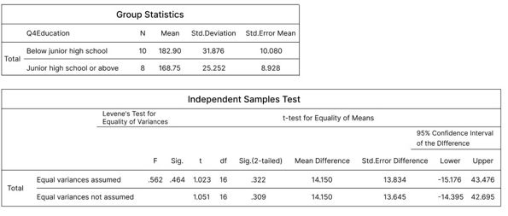
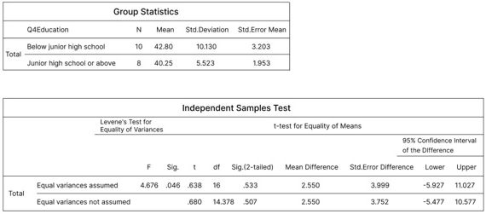
Figure 14: Independent sample t-tests for the results of MAUQ.Figure 15: Independent sample t-tests for the ease of use and satisfaction score of MAUQ.
usefulness segment scored a mean of 36.5. Additionally, this investigation explored the potential influence of educational background on the tested interface. As a result, we classified the participants into two groups based on their educational attainment, specifically their completion of junior high school. Independent sample t-tests scrutinized the scores across various secti- ons to discern whether significant discrepancies existed in task completion time relative to education level (refer to Figure 14).
The outcomes of the t-test analysis of the cumulative MAUQ scores revealed a significance exceeding 0.05 at 0.464, indicating no discernible distinction in the total MAUQ scores among respondents based on their edu- cational backgrounds (refer to Figure 15). Nevertheless, when evaluating the three dimensions of the MAUQ scores individually through t-tests, no sub- stantial disparities emerged regarding system information organization and utility. However, the significance in ease of use and satisfaction registered at 0.046, suggesting a variation among participants with diverse educational levels. We construe this finding to imply that respondents with higher levels of education possess a more comprehensive understanding of the applica- tion’s usage. Furthermore, we deduce that more educated individuals grasp the application’s content and find it relatively effortless to acquire proficiency in its utilization (see Figure 15).
CONCLUSION
In this study, we designed a data interface for elders and assessed the outcomes for usability. The MAUQ questionnaire explored facets of user
experience during the engagement. Field observations and expert dialogues identified user needs. Responsive Web Design was employed in creating the web application. We conducted a usability test and evaluated the question- naire results using qualitative and quantitative approaches. We conducted independent sample t-tests to determine if factors influenced the operation of the software by elder cohorts.
The findings will refine the interface design and serve as a benchmark for subsequent application development for the elders. The Web APP interface, designed by the Institute, may integrate into rehabilitation training processes, enabling elders to comprehend their conditions and augment motivation for rehabilitation. We aim to mitigate elders’ challenges by adopting new techno- logy, streamlining the rehabilitation process, and making it data-driven and visually intuitive.
REFERENCES
Baker, S., Warburton, J., Waycott, J., Batchelor, F., Hoang, T., Dow, B., Ozanne, E., & Vetere, F. (2018). Combatting social isolation and increasing social par- ticipation of older adults through the use of technology: A systematic review of existing evidence. Australasian Journal on Ageing, 37(3), 184–193. https: //doi.org/10.1111/ajag.12572. Ferre, X., Juristo, N., Windl, H., & Constantine, L. (2001). Usability basics for
software developers. IEEE Software, 18(1), 22–29. https://doi.org/10.1109/52. 903160. Fielding, R. A., Vellas, B., Evans, W. J., Bhasin, S., Morley, J. E., Newman, A. B., van Kan, G. A., Andrieu, S., Bauer, J., & Breuille, D. (2011). Sarcopenia: an undiagno- sed condition in older adults. Current consensus definition: prevalence, etiology, and consequences. International working group on sarcopenia. Journal of the American Medical Directors Association, 12(4), 249–256. Free, C., Phillips, G., Felix, L., Galli, L., Patel, V., & Edwards, P. (2010). The effe-
ctiveness of M-health technologies for improving health and health services: a systematic review protocol. BMC Research Notes, 3(1), 250. https://doi.org/10. 1186/1756-0500-3-250. Hajesmaeel-Gohari, S., Khordastan, F., Fatehi, F., Samzadeh, H., & Bahaadinbeigy, K. (2022). The most used questionnaires for evaluating satisfaction, usability, acceptance, and quality outcomes of mobile health. BMC Medical Informatics and Decision Making, 22(1). https://doi.org/10.1186/s12911-022-01764-2. Iyawa, G., Oduor, C., & Osakwe, J. (2019). mHealth: A Low-cost Approach for Effe-
ctive Disease Diagnosis, Prediction, Monitoring and Management. In (pp. 1–23). https://doi.org/10.4018/978-1-7998-0261-7.ch001. Kakehi, S., Wakabayashi, H., Inuma, H., Inose, T., Shioya, M., Aoyama, Y., Hara, T., Uchimura, K., Tomita, K., & Okamoto, M. (2022). Rehabilitation nutrition and exercise therapy for sarcopenia. The World Journal of Men’s Health, 40(1), 1. Meilich, Abe. (2008) INCOSE MBSE Initiative Status of HSI/MBSE Activity
(Presentation). Miller, D. D., & Brown, E. W. (2018). Artificial intelligence in medical practice: the question to the answer? The American journal of medicine, 131(2), 129–133. Nielsen, J. (1996). Usability metrics: tracking interface improvements. IEEE Softw-
Rehabilitation of Data Web APP Design and Usability Evaluation for Elderly Users 357
Shlisky, J., Bloom, D. E., Beaudreault, A. R., Tucker, K. L., Keller, H. H., Freund-Levi, Y., Fielding, R. A., Cheng, F. W., Jensen, G. L., & Wu, D. (2017). Nutritional consi- derations for healthy aging and reduction in age-related chronic disease. Advances in nutrition, 8(1), 17. Smith, A. (2014). Older Adults and Technology Use. https://www.pewresearch.org/
internet/2014/04/03/older-adults-and-technology-use/. Zhou, L., Bao, J., Setiawan, I. M. A., Saptono, A., & Parmanto, B. (2019). The mHealth App Usability Questionnaire (MAUQ): Development and Validation Study. JMIR mHealth and uHealth, 7(4), e11500. https://doi.org/10.2196/11500.
LISTED IN THE AHFE DIGITAL BOOKSTORE CATALOGUE
Explore the complete digital volume
Usability and User Experience
Read this individual research paper free through the original publisher, or explore the full digital proceedings book.
ISBN 978-1-958651-86-5
Explore this ISBN in the AHFE Bookstore ↗Listed in the July 2026 bookstore catalogue; search by ISBN to confirm current availability · Digital book purchase optional