Meng Xu, Bo Liu, Yue Shi (2022). AR Experimental Game Design of Children Character Based on Etymon Literacy Method. In: Affective and Pleasurable Design. AHFE Open Access, vol. 41, pp. 178–184. https://doi.org/10.54941/ahfe1001795
Purpose With the promulgation of China's "Three-child Policy", the cardinal number of children population has surged. The era of parent-child format arrives. Since ancient times, China has emphasized on education. With the development of the internet, people have improved the Chinese character position unprecedently. In recent years, the game education APP of mobile terminal has developed with irresistible force due to the development of the mobile devices and the influence of COVID-19. But due to its virtual property, offline interaction is weak, and it isn't easy to review and memorize. The preschool children at the age of 3-6 focus on the concrete thinking, and their recognition to external things mainly depends on the concretization and representation of things and the association of representation, accordingly constructing knowledge. Therefore, under the trend of reduction of excessive homework burden and off-campus tutoring, it is critical to inquire how to effectively build the popular online and offline "AR game gene" in design research. Method The significance and opportunity for etymon literacy method to be introduced to children Chinese game design is found through theoretical research; The AR technology is used in practice through technical research to build the design method of virtual and real interaction; The law of development of Children's cognition and motion interaction is researched and the characteristics of word root and grapheme of Chinese characters are split and combined to find the coherence point of Children's cognitive development and literacy method and design a set of suitable Chinese character formula, excavating the similarity of word formation thought and design thought, and enlightening children's thought with word formation; Results Chinese character laboratory aims at the children at the age of 3-6 [critical period of Whole Brain Development], is oriented by the development of multiple intelligence of children, and takes AR foundation as technological base. The whole design research is analyzed in this paper and the work formation process is summarized. Conclusions The etymon literacy method and AR experimental game are of important innovative significance in children's thinking development. Chinese character laboratory fully considers the uniqueness of children in social cognition in design through etymon literacy method, will utilize children's curiosity to introduce laboratory concept, namely experiment is game, and conducts series connection of commonly used characters in the form of Chinese character atlas from fragment to systematization. In the meanwhile, AR children's interactive games are characterized by the vivid and interesting virtual Chinese character model, entity Chinese character card, AR technology's unique interactivity, immersion and imagination, and utilize the computer technology to achieve interaction, conforming to the children's concrete thinking. In the future, technology will gradually replace mankind's left brain for calculation and analysis, but the creative thinking controlled by right brain can't be substituted by technology, because the knowledge is limited, but the imagination and creativity are limitless. This design breaks through the boundedness, singleness and fragmentization of current Chinese character literacy for children, which not only can promote the development of comprehensive quality and creative thinking, but also can help children learn Chinese characters in open thinking. So it is considered as a key to develop the potential of children in all directions.
AR Experimental Game Design of Children Character Based on Etymon Literacy Method 179
INTRODUCTION
In 2022, with population competition heating up and a new wind blowing to encourage childbirth, this is an era where population is valued more than ever, and with the promulgation of China’s “three-child policy”, the era of parent-child consumption has arrived. Since ancient times, China has always attached importance to education. In recent years, there has been an unstop- pable development of game education APPs for mobile terminals, but due to their virtual attributes, offline interaction is weak and does not facilitate review and memorization. Meanwhile, research has found that the age of 3–6 is a critical period for developing preschoolers’ reading skills, and “literacy” is an important component of children being able to read on their own (Hou, Yuanqi, 2017). Therefore, in the trend of reducing excessive homework bur- den and out-of-school tutoring, how to effectively construct popular online and offline “AR game genes” is the key in the design study.
THEORY AND RELATED WORKN Etymon Literacy Method
The method of “character literacy”is to analyze the structure of Chinese cha- racters by tracing the origin of the characters and using their structure and rationale. (Zhang Qing, 2009) It follows the properties of Chinese characters and the laws of children’s cognition, which is to infer the meaning of a chara- cter from its structure, composition, etc. It follows the properties of Chinese characters and children’s cognition, which is to infer the meaning of the cha- racter from its structure, composition, etc. Etymological literacy is not a new approach to literacy, as early as the Eastern.
During the Han Dynasty, Xu Shen, the pioneer of Chinese philology, wrote in the first Chinese dictionary “Origin of Chinese Characters” that “in the Zhou ritual, the ancient people entered elementary school at the age of eight, and Bao taught the country first with the six books”, which shows that stu- dents could already be taught to read and write according to the six books in the Zhou Dynasty. This shows that students could be taught to read and write according to the six books in the Zhou Dynasty. The subsequent “Cang Yan” and “Shuo Wen Jie Zi” are ancient books that consciously use the Yu Yuan literacy method to teach literacy (Ren Kexin, 2013 ).
It is not only effective in improving children’s reading ability, memory and observation, but it is also the most fundamental way for children to under- stand Chinese characters and the connotations behind them. When children use the etymological literacy method, they are also receiving the long history and cultural connotation of our country, which has a facilitating effect on the transmission of our excellent traditional culture. In terms of character construction, children learn Chinese characters by transforming figurative objects into abstract Chinese character construction features, thus deducing the meaning of the characters and thus understanding the meaning of the characters. Children may not know the pronunciation of the character in the process of learning it, but they are able to understand its meaning, and this is the advantage of the graphemic literacy method, which enables children to
read characters effectively. Therefore, I believe that the etymological literacy method is one of the most effective methods of teaching literacy.
Augmented Reality Technology Augmented reality (AR), is a technology that seamlessly blends the real world with the virtual world. The core elements of AR technology are instant interaction and the presentation of three-dimensional effects (Zhao Yanqin, 2016). With the help of various mobile devices, it allows users to immerse themselves in a virtual and realistic environment where they can feel a mul- tisensory experience of seeing, hearing, speaking, touching, and thinking. The preschool children aged 3-6 years old are mainly concrete thinking, and their knowledge of external things mainly relies on the concretiza- tion of things, representations and associations of representations to build knowledge accordingly, and AR technology is responding to this requirement.
“CHINESE CHARACTER LABORATORY” GAME DESIGN WORKSHOP This section was designed to understand children’s needs and considerati- ons for learning Chinese characters, and to derive design goals from this. We conducted a workshop with two professionals, a children’s educational game design expert with nearly 10 years of experience in children’s game development, and a Chinese language educator.
In the workshop, we introduced the concept of word root literacy and labs. Under this concept, two rounds of brainstorming were conducted, and at the end of this workshop, we came up with design requirements and considerations for the final design to be considered: (1) Avoid falling into the misconception of mere literacy. At present, the double reduction policy has made purely test-based education oppo- sed by the state, then pure literacy is not our purpose, according to the advice of children’s educational game designers, we can start from developing children’s creativity and thinking power to design. (2) Use multi-sensory feedback to engage children’s attention. Using new technology to achieve multi-sensory feedback of hearing, touch and vision can make children more immersed in the game and the Chinese character laboratory experiment. (3) Try to avoid out-of-the-way combinations of characters and start with the six animals of Chinese characters. In the user orientation we posi- tioned the user between 3–6 years old, because this time confirms the age of children’s figurative thinking, so we should pay particular atten- tion to the choice of Chinese characters, avoiding the choice of remote combinations of words.
DESIGN OF THE GAME Redesign of Hanzi Cards and Hanzi Charts Based on the Root Literacy Method (Material Level)
Studies have shown that babies who learn in a colorful environment are rela- tively better at observation and memory. However, color matching does not
AR Experimental Game Design of Children Character Based on Etymon Literacy Method 181
Figure 1: “Chinese Character Lab” Hanzi redesign (self-drawn).Figure 2: “Chinese Character Lab” Experimental formula for word building (self- drawn).
mean piling up all kinds of colors, putting too many flowery things in front of babies, or giving them too much color impact at one time, which will easily cause visual fatigue and is not good for their learning.
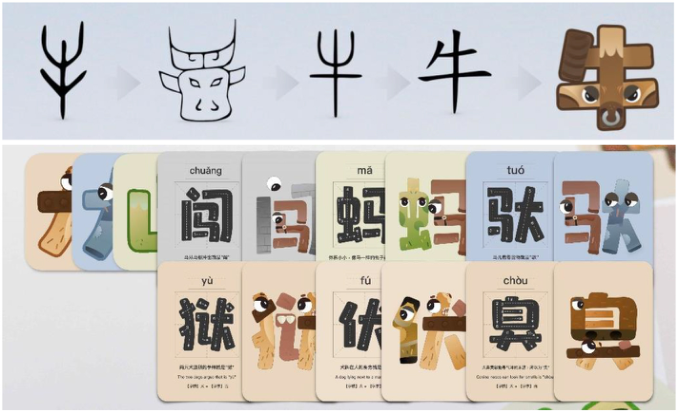
“Chinese Character Lab” is based on the image of Chinese characters to extract the main three natural colors, and outwardly derived from a small number of auxiliary colors. We choose a moderately saturated color as the middle color, and adjust the brightness to obtain the upper and lower deri- vative colors. In the visual processing, we keep the colors simple and layered, highlighting the main elements with clear colors, and weakening the back- ground elements with low saturation and high brightness colors, so that the visual focus is on the main process, as in Figure 1.
A new font design was reorganized to make every stroke of the Chinese characters traceable. We designed the special font mainly because: the fini- shed pinyin fonts available could not better show the story of the Chinese characters and could not meet the needs of the application to children’s vision. The redesigned font is rounded and smooth, balancing the weight of each let- ter, and can be better used in all visual aspects of hardware and software. At the same time, this font will also be applied to the design of hardware cards to keep the consistency of writing,as in Figure 2.
Figure 3: “Chinese Character Lab” Game Design.Figure 4: “Chinese Character Lab” Game part of the formula (self-drawn).
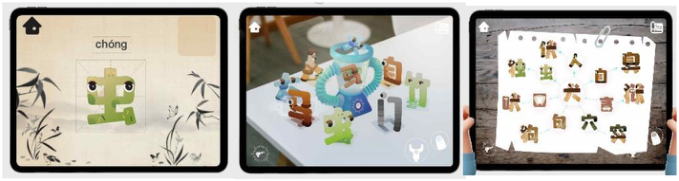
Progressive Multi-Scene and Voice Interaction Design (Behavioral Level) The “Chinese character laboratory “ consists of two main scenes: a basic literacy scene and an AR augmented reality machine experiment scene.
In the Basic Literacy Scene, children can learn basic pronunciation and character forms; in the AR Augmented Reality Machine Experiment Scene, they can play matching cards on a real tabletop and drag Chinese characters into the machine to synthesize new Chinese characters, as shown in Figure 3.
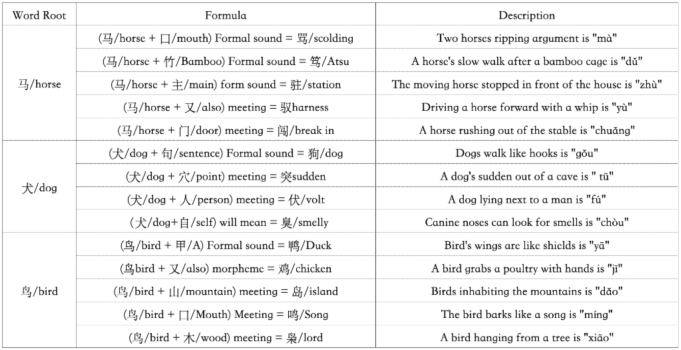
We have also designed a whole set of Chinese character formulas,as in Figure 4.
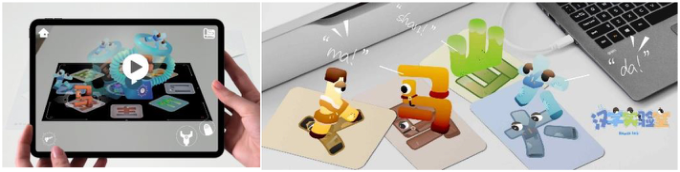
Functional Design and AR Foundation SDK (Cognitive Level) “Chinese Character Lab”based on Unity3D engine, it can run on IOS platform and use iPad for game experience, as in Figure 5.
Children’s language learning based on augmented reality technology inte- grates real learning environments with virtual learning environments, links solid paper resources with dynamic learning resources, further satisfies children’s needs for immediate, three-dimensional, vivid and personalized learning content, and lays the foundation for promoting children’s adaptation to mobile learning, ubiquitous learning and lifelong learning.
AR Experimental Game Design of Children Character Based on Etymon Literacy Method 183
Figure 5: “Chinese Character Lab” Game use chart (actual photo).
CONCLUSION
This study introduces the theory of character root literacy into the game design of children’s Chinese character education and enlightenment, and cre- ates the “Chinese Character Lab”. Completing the gap in the research of the word root literacy method in the field of children’s product design at the theoretical level. At the practical level, it brings into play children’s initia- tive through reasonable and effective design means to help them grow and develop better.
The Chinese character formulas, Chinese character diagrams, and Chinese character experimental methods produced by this design are innovative and interesting, and can provide some reference for subsequent related design studies, but they lack practical verification of whether they can ultimately improve the effectiveness of children’s creative development, and need to be further deepened and expanded.
FUTURE WORK
This project will continue to improve the subsequent Chinese character card design, model building and level enrichment, improve the medal reward system and Chinese character mapping, and hopefully launch on the App Store in the second half of 2022, so that more Chinese character lovers can experience the Chinese character lab soon.
ACKNOWLEDGMENT
The authors would like to thank BiBoBox Studio of Shanghai Jiao Tong University for their great support during the design and writing process.
REFERENCES
Li He. Whole-rest processing or feature analysis. glyph processing in Kangyu literacy of 3-6 young children [D. Changtai: Northeast Normal University, 2016. Li Tie-Meng, Su Li-Bo, Lu Fei, et al.-Augmented reality-based educational system
and experimental study on preschool children’s knowledge of Yu [J]. Software, 2015, 36(4): 44–49. Ministry of Human Resources and Social Security of the People’s Republic of China.2018 National Economic and Social Development Statistics Statistical Bulletin
Ren Kexin- An empirical study of the word source literacy ning method to promote the development of young children’s thinking: [Master’s thesis][D] Southwest University Tian Yuan, Xia Dan, et al. - Mobile augmented reality-based preschool children
rescue game research and design [ding. Electrochemical Education and Research, 2019, 40(4). 68–75. Wen Zhuo Fang. Augmented Reality (AR) in the Development of Integrated Learning Products for Children’s Hanwoo Application and Research in the Development of Integrated Learning Products for Children [D]. Xi’an: Shaanxi Normal University, 2019. Zhang Qing A study of the word origin literacy model A1.Zhang Qing’s anthology
(Coupon I) rcl: Nanjing: Jiangsu Education Press. 2009. Zhang, Lele. A study on the design of mobile media resources for west-oriented preschool children [D]. Xuzhou: Jiangsu Normal University, 2014. Zhao J, Li P. Development of Kangyu glyph cognition in 3-6 year old children [J].
Psychological Science, 2014,37(2):357–362.
LISTED IN THE AHFE DIGITAL BOOKSTORE CATALOGUE
Explore the complete digital volume
Affective and Pleasurable Design
Read this individual research paper free through the original publisher, or explore the full digital proceedings book.
ISBN 978-1-958651-17-9
Explore this ISBN in the AHFE Bookstore ↗Listed in the July 2026 bookstore catalogue; search by ISBN to confirm current availability · Digital book purchase optional