Hiromi Katsumata, Bo Liu (2022). A drawing system with an interface that can be used to impose limits and unleash creativity. In: Creativity, Innovation and Entrepreneurship. AHFE Open Access, vol. 31, pp. 20–26. https://doi.org/10.54941/ahfe1001503
In order to enjoy creativity, the creators need to be given environmental restrictions. For example, there are rules such as Japanese Haiku or Chinese Zeku for poetry, or musical grammar for music, and these rules are supposed to enhance the creativity of the creator. However, most existing drawing software focuses only on making the process of completing a work comfortable, and does not provide much support for the goal setting process that requires environmental restrictions. In this study, based on research on creativity, such as the idea method, we were able to show that developing a drawing system that imposes environmental restrictions, such as the appearance of obstacles on the canvas, causes changes in the creativity of the subjects. In conventional drawing software, it is common to start the creative process with a blank canvas so that the painter can paint freely. However, in our experiments, many of the participants said that they were able to come up with more ideas and enjoy painting more when obstacles appeared on the canvas. By creating obstacles, we succeeded in approaching the characteristics of human visual cognition and structuring the creative process. Digital creative activities give us more control than analog creative activities. This advantage can be used to make the first step of the creative process, the idea generation process, more convenient. In analog creation, you could not choose irreversible methods such as creating obstacles on the canvas. The drawing software of the future will emphasize the process of externalizing human images and make the creative process more enjoyable, without the need to stick to a blank canvas.
In this study, we have developed drawing software with an interface design that allows the user to exercise and enjoy creativity. The interface design that we are referring to here is one that places environmental restrictions on the artist. Drawing is an activity that “digests” human creativity. When we paint, we feel two things: the fun of externalizing images and the fun of physical exploration through the movement of a paintbrush. Aya Saito says that the difference between humans and great apes in this self-rewarding behavior is that great apes are not interested in the work that they have created, but only in the physical sensation of painting (Aya Saito, 2014).
A Drawing System with an Interface That Can Be Used 21
Based on this, the creative activity of painting can be divided into two processes: the first process of deciding what to create, and the second process of completing it. The first process is closer to the action of externalizing the image than the second process, and it can be said that it is the process where human creativity is more digested. However, many software programs are focused on making the process of completing a work more comfortable, and the process of defining a goal has not been digitized in drawing software. By digitizing the first process, it is possible to omit the time that many people have spent on generating ideas. It will also help those who have been hesitant to draw because they could not get to the second process due to lack of ideas.
In this study, we developed drawing software that can impose restrictions on the creative procedure by making obstacles appear on the canvas, and show that changes occur in the creativity of the subjects.
The first step in establishing an idea or concept and defining the goal of the work requires the ability to generate ideas. As a method for generating origi- nal ideas, the idea method has been studied (Reading Monkey, 2017). Typical examples include brainstorming and the KJ method. All of these methods have one thing in common: they combine multiple images. Many of the idea methods refer to how to make many “multiple images” exist at the same moment. For example, James Higgins focused on the idea method of making a list of categories unrelated to the subject, and then comparing them one by one to the subject to break the fixation of ideas and perspectives. Write as many things on the list as possible, and derail the subject while looking at them to get ideas. Edward Debono also focused on the idea method of dra- wing content that gradually moves away from the subject in a notebook. By recording the entire process of how an idea has shifted, an event can occur where a new idea is born, influenced by the idea that was evoked. Thomas Edison, the inventor of the light bulb, called his notebooks “idea notebooks” and left behind about 3,500 of them. It is said that he used the notebooks to record the things that came to his mind and the things that moved him, and combined them into new inventions.
Ronald Finke and his colleagues studied creativity through experiments based on cognitive psychological theories (Finke, 1999). Specifically, they conducted a “multiple image combination” experiment in which subjects were given 15 components and asked to perform creative activities. As a result, the following three data were calculated. (1) Rather than deciding what to make and then starting to make it, it is better to just make it and then decide what it is. (2) It is more likely to complete an original product if the parts used in the combination are chosen randomly and then imposed on the user rather than having the user choose the parts themselves. (3) They were more creative when they assigned a title to the shape they made than when they assigned a title to the shape someone else had made and asked what it was. They call their interpretation of this result the geneplore model. The idea is that the process of creative cognition consists of two stages: the generative stage and the exploratory/interpretive stage.
In addition to the idea method, many other mechanisms for not hesita- ting when exercising creativity can be found in educational drawing toys for young children. Typical educational drawing toys for young children often
22 Katsumata and Liu
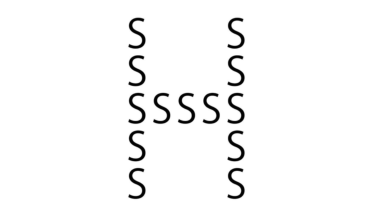
Figure 1: An example of human visual cognition as a holistic process. Although the partial information is S, it appears to be H because human visual cognition performs global processing.
come with stamps of circles and triangular shapes. In addition to educati- onal toys, coloring books are used in a variety of fields. In particular, art therapy, which is a part of occupational therapy, requires the patient to draw. In this case, since people who are not good at drawing may feel resistance to it (Nozue M, 2018), coloring books with outlines are used to eliminate hesitation in creative activities. The two have one thing in common: the envi- ronment allows for the combination of images that are not in the conscious mind of the painter. The presence of obstacles such as shapes and lines on a white canvas that restrict the creative method, in turn, stimulates the artist’s creativity.
Obstacles in creative activities also lead to stimulation of features of human visual cognition. Using a diagram (Figure 1) in which multiple elements cal- led S are grouped together in the form of H, Navon stated that when humans recognize hierarchical stimuli, they preferentially process the whole informa- tion over the partial information (David Navon, 1977). Research by Janina Marguc and her colleagues suggests that human visual cognition processes holistically, and that imposing a disability improves our ability to recognize the bigger picture (Marguc J, 2011).
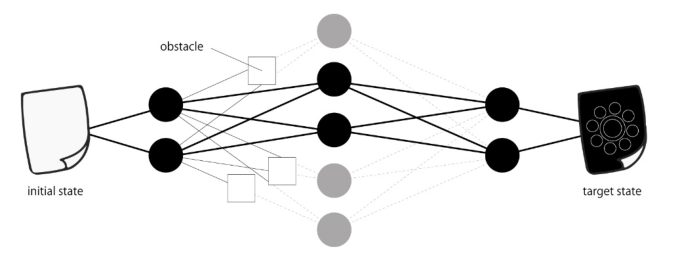
It is also said that constraining the creative process is important in the arts, such as literature and music. In poetry, there are rules such as Japanese haiku and Chinese zeku, and in music, there are rules such as musical grammar, and these rules are said to enhance the creativity of the author. In many creative industries, such as copywriting, advertising, filmmaking, and music compo- sition, constraints are an important part of the creative process, according to Kian Teck (Lee Kian Teck, 2017). Using as an example the web service “six word stories”, a derivative of the English haiku “Six Word Memoirs”, which creates sad stories with six English words, Kian Teck said that set- ting constraints has the effect of structuring problems and making people more creative. Structuring here refers to the systematic thinking introduced by Harvard Simon (Simon, 1999). In the same way, Patricia D. Stokes said that novel and original things are generated by selecting and solving some of the innumerable processes between the initial state and the target state, and that constraints have the effect of reducing the number of processes to be selected (Stokes, 2009). By creating an obstacle in a space with countless
A Drawing System with an Interface That Can Be Used 23
Figure 2: Structuring creativity through obstacles. By creating obstacles in the myriad of processes between the initial state and the target state, creativity is structured and brought closer to the target state.
processes, we can reduce the number of man-hours required to reach the target state and create a shortcut (Figure 2).
Contribution In the past, we have discussed the importance of having multiple images pre- sent that can be used in combination to generate ideas. We have also found that in many artistic disciplines, there is a focus on constraints that make problems structured. Based on the above, in this study, we will implement a system that influences creativity and conduct experiments to see what kind of influence it has had.
Specifically, subjects are asked to use drawing software that has a restricted environment that implements a system to make obstacles such as shapes and lines appear on the canvas. By making obstacles appear on the canvas, they can quickly generate “multiple images” to use for ideas. In addition to being able to stimulate the characteristics of human visual cognition, the system is also expected to structure the creative process.
By digitizing the idea method, which influences creativity, it is possible to omit the process that many people have spent so much time on in the past to come up with ideas. Creators, illustrators, and other people who need to keep coming up with ideas, as well as those who feel hesitant about their creative activities, can benefit from the effects of the self-rewarding behavior of drawing.
DEVELOPMENT OF DRAWING SOFTWARE TO ENHANCE CREATIVITY We developed a “Restricted Drawing System” in order to understand how environmental restrictions contribute to creativity. We will conduct an expe- riment in which we ask participants to perform creative activities using a drawing software in which obstacles appear randomly on the canvas, and observe whether there is a change in creativity depending on the presence or absence of obstacles. The hypothesis of this experiment is that subjects can be more creative in a restricted environment than in an unrestricted free
24 Katsumata and Liu
Table 1. Results of experiments.
Table available in the original PDF paper.
Information on subjects Unrestricted Restricted Impressions of Subject A: Subjects stated that they felt they could have been more creative if they had been restricted from the beginning.
The subject drew an illustration of a cat.
The subject looked a little confused and drew the obstacle as a kind of cane, with the cat’s hand on top of it.
The subject drew a post box and then, after some thought, drew a post office.
Impressions of Subject B: The subjects drew their favorite characters without restriction. He said that he enjoyed drawing pictures that he had never drawn before and never thought of drawing. Without hesitation, the subject drew Curo-chan, the mascot character of Morinaga’s Choco-ball confectionery.
Impressions of Subject C: None in particular
The subjects drew pictures in a shorter creative time than when there was no restriction.
The subjects looked at the color palette to decide what to draw, and then drew illustrations that matched the colors.
The subject drew an illustration of a cat.
Subjects drew illustrations with a timeline and a story.
Impressions of Subject D: The subject stated that he drew the cat without restriction not because he liked cats, but because he could not think of anything else to draw. He stated that he enjoyed the obstacles because they gave him a variety of images. He said that for someone like me who doesn’t draw at all, this little trick would be a great help.
environment. By placing obstacles on the canvas, we predict that the subjects will be able to exercise more creativity than in an environment where there are no obstacles. This “ability to exercise creativity” is defined as a feeling of self-rewarding meaning in the act of painting, and a situation in which the subject actively enjoys painting.
The “Restricted Drawing System”used in this experiment is a web applica- tion using JavaScript. In addition to the general drawing system, we defined a display none class in CSS and added/removed the display none class to the corresponding function by operating a checkbox in Html. The “Restri- cted Drawing System” implements a mechanism in which four skin-colored
A Drawing System with an Interface That Can Be Used 25
squares appear as obstacles in addition to a general drawing system. The appearance rules are random, and each time you click the checkbox, the placement changes.
The experiment was conducted at the SFC Open Research Forum (ORF), a forum where the results of research activities at Keio University Shonan Fujisawa Campus are made public. We were able to conduct the experiment and questionnaire to four people by asking visitors. In the experiment, we asked the participants to draw a picture, telling them only to “feel free to use your creativity. The subjects were asked to draw pictures in both unrestricted and restricted conditions. The amount of time and amount of drawing were noted. After the subjects finished drawing, we interviewed them about their feelings during the drawing.
CONCLUSION
The experiment turned out to be as hypothesized. Most of the subjects spent more time moving the pen when drawing on a canvas with obstacles than when drawing on an unrestricted white canvas. This is not because they were struggling to come up with ideas, but because they felt a sense of self-reward in the act of drawing, which naturally led to a longer action time. In fact, as shown in the results of the experiment, people who do not usually draw said that this kind of device was very helpful and enjoyable. As for subjects A and B, they mentioned that they drew different pictures than usual. Since it was difficult for them to create new ideas and externalize them on the white canvas without any restrictions, it can be assumed that they ended up painting what they usually paint or what they had already completed as ideas. The appearance of obstacles on the canvas provided an opportunity to generate unusual ideas, so both painters and non-painters were able to exercise their creativity more than when drawing on a blank canvas.
From the above results, it can be said that drawing software that has a mechanism to make obstacles appear on the canvas allows for more creati- vity. Because of the implementation of an opportunity to generate ideas, even people who feel hesitant to draw can get a sense of self-reward. In addition, the presence of obstacles on the canvas prevents those who normally paint from externalizing their usual images, and provides an opportunity for new ideas to emerge. For creators, illustrators, and other people who have to keep coming up with ideas, it is very valuable to be able to come up with new ideas just by using the system. One issue that needs to be addressed in the future is how to devise a pattern for the obstacles. In this experiment, we used an obstacle pattern in which four skin-colored squares randomly appeared in the canvas. However, we are concerned that if this “limited drawing system” is used over and over again, new ideas may not come to mind.
Currently, most drawing software starts its creative process with a blank canvas. Although there is a canvas like a grid paper, it only serves as an auxiliary line to complete the work. The digital creative process differs from the analog creative process in that it is easy to erase, to show or hide. It is very easy to treat obstacles that appear on the canvas as lower layers and make them invisible to the actual finished work. In order for drawing software to
26 Katsumata and Liu
place more emphasis on the process of externalizing human images, and to make the creative process more enjoyable, it is not necessary to insist on a clean canvas.
REFERENCES
Aya Saito. (2014). Why humans draw pictures: an invitation to the cognitive science of art/. Tokyo: Iwanami Shoten David Navon. (1977). Forest before trees: The precedence of global features in visual
perception. Cognitive Psychology 1977;9(3) Finke RA, Ward TB, Smith S, Kobashi Y. (1999). Creative cognition : an experimental investigation of the mechanisms of creative thinking. Tokyo: Morikita Shuppan Lee Kian Teck. (2017). Game design workshop: cultivating creativity from con-
straint. SA ‘17: SIGGRAPH Asia 2017 Symposium on Education Marguc J, Förster J, Van Kleef GA. (2011). Stepping back to see the big picture: when obstacles elicit global processing. J Pers Soc Psychol. 2011;101(5) Nozue M, Omi M, Nagao K. (2018). Changes in brain activity and mood by coloring.
Proceedings of the Annual Meeting of the Japanese Psychological Association, Vol. 82 Reading Monkey. (2017) Idea compendium: 42 tools for creativity and breakthroughs/. Tokyo: Forest Publishing Simon. (1999). HAA, Gen Inaba. Science of Systems/. 3rd ed. Tokyo: Personal Media Stokes PD. (2009) Using constraints to create novelty: A case study. Psychology of
Aesthetics, Creativity, and the Arts, 3(3)
LISTED IN THE AHFE DIGITAL BOOKSTORE CATALOGUE
Explore the complete digital volume
Creativity, Innovation and Entrepreneurship
Read this individual research paper free through the original publisher, or explore the full digital proceedings book.
ISBN 978-1-958651-07-0
Explore this ISBN in the AHFE Bookstore ↗Listed in the July 2026 bookstore catalogue; search by ISBN to confirm current availability · Digital book purchase optional