Alexander Kreis, Daniel Fragner, Mario Hirz (2023). User Experience in Modern Cars – Definition, Relevance and Challenges of Digital Automotive Applications. In: Usability and User Experience. AHFE Open Access, vol. 110, pp. 1–8. https://doi.org/10.54941/ahfe1003172
User experience (UX) is very contextual, and it's usually understood as an interaction between users and products or services. The term user experience is often used in the context of websites and apps, but also in view of physical use of products. UX encompasses all the effects and experiences, whether physical or emotional, that customers experience before, during and after using products. In an automotive context, UX may begin with the external appearance of cars and continues throughout the entire usage until the driver and passengers leave the cars. If this UX is experienced as positive and satisfying, perception improves leading to increasing recommendation rates and reputation of the specific product and the behind lying manufacturer. Exemplary product characteristics that support good UX include visually appealing design, the joy of using a car, but also whether the drivers and passengers can identify with the product. In addition, the enjoyment of a particular product is not dispensable for a good UX, which is limited to the use of the product, but also has effects beyond that. In many product areas, UX is well described. There are also various definitions of how to achieve a good UX in certain product areas, but these recommendations are not universally applicable and often cannot be directly applied to other products. Looking at UX in the automotive industry, there is no clear definition of which parameters must be considered to achieve a good UX and how these parameters are categorized. In this context, the presented research introduces a methodology for evaluating the UX of modern cars. There are four main research questions underlying this paper: (1) How to define UX in terms of cars. (2) How can these definitions be applied and evaluated? (3) How do car manufacturers try to provide a good UX in modern cars? and (4) How can aspects of UX be included in the development processes of new cars? Through empirical research, key parameters have been identified to provide a definition of UX of modern cars. These parameters are then weighted according to a scientific approach using various methods and empirical studies. Based on the introduced definition, an exemplary modern premium car is evaluated to classify the actual state of UX. Furthermore, the combination of state-of-the-art UX in modern cars and the novel scientific approach to weight the different parameters is applied in exemplary use cases to point out the potential of the method to improve automotive development processes by integration of UX – related aspects even in early vehicle conception sequences.
User experience (UX) has become an increasingly important factor for automotive suppliers and carmakers in the development process of new car models. UX in modern cars is no longer just about performance parame- ters, but is also influenced by the way how driver and passengers interact with interior, HMI, driving assistance systems, and other systems. Adva- nced technologies allow carmakers to create vehicles that are more user- and environmental-friendly and provide a better experience for drivers and passengers. This includes intuitive infotainment systems, advanced safety fea- tures, and autonomous driving functionalities, to name a view. Nevertheless, the term UX in context of modern cars and automotive engineering proces- ses has no clear definition. Currently, there are different versions used that include several parameters to define the term, but these are contextual descri- ptions rather than generally valid definitions. Since UX becomes increasingly important for drivers and passengers, the development of modern cars has to consider UX-related aspects from the early concept phase on. The pre- sent paper discusses the importance of satisfying UX in modern cars and how it impacts the overall driving experience. Furthermore, the aim of this paper is to make a clear statement about what are important parameters of UX in relation to the automotive industry. In doing so, it will be clarified how UX can be defined, how definitions can be evaluated and how automo- tive manufacturers try to provide a good UX in modern cars. Another focus of the paper relates to how UX-related parameters can be integrated into automotive development processes.
STATE-OF-THE-ART – DEFINITION OF UX IN GENERAL As prior mentioned, there are different definitions of the term UX. Alben, 1996 writes “All the aspects of how people use an interactive product: the way it feels in their hands, how well they understand how it works, how they feel about it while they’re using it, how well it serves their purposes, and how well it fits into the entire context in which they are using it”. Instead of obje- ctive usability criteria, in UX research subjective criteria and the individual experience with the product are important. But rather than objective usability criteria, which are important for the automotive context, Alben, 1996 put the focus on subjective criteria and the individual experience with the product. According to Hassenzahl, 2010, the interaction of products with people cor- responds to different qualities, namely pragmatic and hedonic. Products with a high pragmatic value are work-oriented, practical and goal-oriented. Aspe- cts of UX of these product types are measured by usability criteria. Hedonic interaction is provided by products, which focus on fun and entertainment. Both approaches, Alben, 1996, and Hassenzahl, 2010, are credible and valu- able to determine the definition of UX in a general context. Nevertheless, in order to evaluate UX in the automotive context and to implement it in deve- lopment and engineering processes, a more parametric-oriented approach should be pursued.
User Experience in Modern Cars – Definition, Relevance 3
STATE-OF-THE-ART – DEFINITION OF UX IN AUTOMOTIVE CONTEXT In addition to the definitions of several authors, there is also an ISO-definition (ISO 9241-210, 2019) of the term UX: “A person’s perceptions and responses that result from the use or anticipated use of a product, system or service”. But again, this definition is not tailored to the specific requirements of cars and their engineering processes. According to Gkouskos, 2015, interviews, reflexive photography, and a simplified version of UX curve (Sari, 2011) were used to obtain a sound understanding of UX in vehicles. The UX curve instrument is a method for evaluating long-term user experience. It invo- lves subjects drawing a curve that illustrates the extent to which the UX is met or only partially met when using a product over a period of time. The basis of Gkouskos’ work included contextual interviews in situations of use. Reflective photography was used to create a stimulus for conversation by discussing the photos that the subjects had taken of their car beforehand. In addition, UX curve was used to reconstruct the experience over time. From these interviews the following UX parameters emerged: the car as a space for transition, as space for relatedness, as space for stimulation and as a caretaker.
Körber, 2013, used three stories to find parameters for the definition of UX. Respondents evaluated and elaborated these stories based on different UX parameters. Each of these stories included a scenario of its own that was supposed to stimulate the respondents to experience feelings in certain situations. These interviews and elaborations resulted in the following UX parameters: Relatedness, Stimulation, Competence, Security, Physical form, Autonomy, Popularity and Competition. Pettersson, 2017, used a method to evaluate UX in the context of future cars, namely a qualitative experimental approach to ask users about future artifacts. Also, in this approach, the follo- wing UX parameters are inferred by deriving the answers of the respondents and explaining them in the paper: safety, comfort, being social in the car, emo- tion and energy management, freedom, novelty, relaxation, time management and efficiency.
USER EXPERIENCE IN MODERN CARS Before the research questions of how to define UX in the automotive context and how to integrate UX in development and engineering processes can be answered, interpretations of UX in cars that are currently on the market are carried out. Furthermore, the parameters obtained from experimental studies, which are important for the definition of UX in the automotive context, are listed and evaluated.
Evaluation and Classification of UX Parameters Based on empirical research, user surveys, and conducted studies that include several approaches (such as ISO 9241-210, 2019, Gkouskos, 2015, Körber, 2013, Pettersson, 2017), Table 1 provides a list of the most common UX parameters that are important to create an enjoyable UX in cars. Table 1 shows that the parameter “Safety” is the most frequently mentioned UX parameter in the studies conducted. This parameter in relation to the vehicle
Table 1. Most recurring UX parameters with automotive relevance.
industry is understood to mean the feeling of safety, which is conveyed, for example, with safety aspects such as airbags or crash tests to improve the safety of passengers. “Pleasure”was named as the second most frequent para- meter. This is understood to be the pleasure that is derived from the use of the vehicle. This includes not only the pleasure of driving, but also the plea- sure of using different areas, for example the infotainment system. The third most frequently mentioned UX parameter is “Trust”. Trust that users have in their vehicle to get from one place to another safely and without complicati- ons, for example due to a defect. One can also attribute this meaning to the parameter “Safety” but due to the research and frequency in which the para- meter “Trust” occurred it is listed as a separate UX parameter. The fourth most frequently named parameter is “Connectedness”. The study showed that it is important for many probands to be able to identify with their vehicle and to feel connected to their vehicle through the possible personal extras. A parameter of nearly equal importance is “Comfort”. Comfort describes the feeling of how relaxed users are when using a vehicle, or how pleasant. “Comfort”is also considered to be when the driving process is supported and facilitated. This can be realized, for example, by introducing driver assistance systems or by introducing suitable interfaces, e.g., vehicle/mobile phone, and the associated non-use of the cell phone while driving.
A less common parameter is “Useability”. This parameter refers to the ease of using systems or even an entire vehicle. The reason for the relatively low frequency is that after a short period of use, users learn how to control the vehicle and its systems, which increases or simplifies usability. The most rarely mentioned UX parameter in the conducted studies is “Popularity”. This means how popular or disliked society is towards a specific car type or vehicle manufacturers. It was found out that vehicle users are paying less and less attention to the popularity of a brand, thus this plays a subordinate role with regard to the UX in the context of modern vehicles.
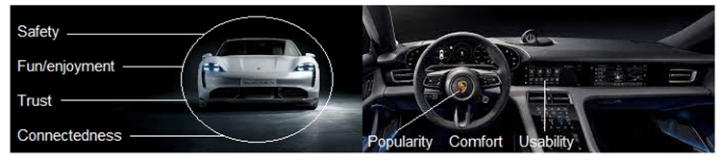
Interpretation of UX Based on a Premium Vehicle The previously described UX parameters are exemplarily applied to a pre- mium car, or rather, an attempt is made to assess the vehicle for the fulfillment of the introduced parameters (c.f. Figure 1).
User Experience in Modern Cars – Definition, Relevance 5
Figure 1: Exemplary porsche taycan UX parameter judgement, referred to Seitz, 2022.
As is to be expected from a premium manufacturer, great attention is paid to the parameter “Safety”of vehicle’s occupants, and there is a large selection of additional safety packages, some of which have to be paid for separately. Overall, it can be stated that this car is very focused on the UX parameter “Safety”. The only negative point is that not all safety packages are included in the standard version. Since this car has been developed for sporty driving and high performance but also offers high luxury features and a comprehen- sive infotainment system, the parameter “Pleasure”is also considered well. To ensure the “Trust” parameter, a high quality of workmanship must be given and also the quality of applied materials must be high, which also applies to this car. Through a variety of optional personalization options and extras, it is also possible to build up a bond with the vehicle under investigation, which means that the parameter “Connectedness” is almost completely ful- filled. The parameter “Popularity” is very well served and fulfilled by the marketing strategy, its drive type and also the reputation of the brand. How- ever, there are deductions for the parameter “Usability”. The infotainment system’s incredible customization options, which on the one hand benefit the “Connectedness” parameter, make the handling very complicated and overwhelming, which affects the “Usability” parameter. In addition, there are minimal deductions in the parameter “Comfort”, because despite the extensive infotainment system, there are limited options for communication standards, e.g., Android Auto, available. This rating refers to the technologi- cal state of the car at the time of presentation and sales launch and does not take into account any updates to the infotainment system or other changes that were made later.
UX IN AUTOMOTIVE DEVELOPMENT PROCESSES This section addresses the two research questions, (1) how to define UX in automotive context and (2) how to implement UX in automotive develo- pment processes. To address both questions, the findings obtained from the studies and derived from benchmarking cars serve as basis.
Definition of UX in Automotive Context Since a lot has already been said about definitions of UX, and some possible approaches have been given on how UX can be defined, this section spe- cifies a definition for the term UX in the automotive development context. In this way, the term UX is defined as the totality of feelings, needs, expe- ctations and experiences when interacting with an automobile. This can be
summarized in the fulfillment of the UX parameters: “Safety”, “Pleasure”, “Trust”, “Connectedness”, “Comfort”, “Usability” and “Popularity”.
Given these facts, the definition of UX in the automotive context refers to a person’s overall experience when using a vehicle. This includes the design and layout of the vehicle’s controls and displays, the usability of the vehicle’s features and technologies, and the overall comfort and convenience of the vehicle.
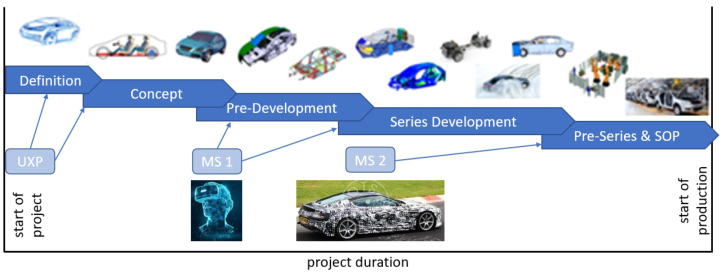
Implementing UX in Automotive Development and Engineering Processes Based on the listing of UX parameters that have an important role in auto- motive context, the following section introduces the incorporation of the parameters into automotive development processes. In order to provide a good UX in automotive products, a plan (named UX-plan, UXP) for fulfilling the individual UX parameters should be created in advance. In the beginning, it is important to conduct market research and customer surveys and to incor- porate customer demands in early stages of the development process. This means that the development of cars, e.g., defined according to Hirz, 2013, and Kreis, 2020, starts with requirements definition under consideration of findings of the customer survey in the early phases of development. Figure 2 shows the automotive development process and the individual phases.
The early phases of the automotive development, “Definition” and “Concept” (see Figure 2), have a great influence on subsequently performed processes. Since in the first phases of automotive development (c.f. Kreis, 2020) there is a great uncertainty regarding the parameters necessary for the complete definition of the car, the integration of UX parameters has impor- tant influence. In this way, consideration of desires of customers to reach good UX is of great relevance in the early phases of automotive development. First, according to Hirz, 2013, and Kreis, 2020 within the early phases it is easier and more cost efficient to change automotive products. This is under- pinned by the fact that changes in the early phases claim less resources than
Figure 2: Automotive development process, referred to Hirz, 2013, Kreis, 2020, Harman, 2019, and Autogespot, 2012.
User Experience in Modern Cars – Definition, Relevance 7
in later phases of engineering processes, where the main workload has alre- ady been fulfilled. Secondly, the variety of automotive products can easier be limited to a satisfying number of optional equipment, which is only necessary for a limited number of customers. Furthermore, integrating customer desires leads to a higher customer acceptance and satisfaction.
As already mentioned, a UX-plan (UXP) should be created, which descri- bes the integration process of UX parameters into the development process. UXP serves as a basis to ensure the integration of a responsive UX in the early phases “Definition” and “Concept”. This UXP can be developed using virtual methods, like virtual reality (VR), CAx-methods, etc. With the start of the phase “Pre-Development”, these virtual UX-based methods are avai- lable and can be evaluated by different customer groups, e.g., by use of virtual reality sequences (c.f. Figure 2, MS1). These evaluation results can then be incorporated into further development efforts, thereby also ensuring that UX parameter optimization flows into the entire development process, right through to detailed development, series development including supplier integration and SOP (start of production). Furthermore, a second evaluation milestone (c.f. Figure 2, MS2) is implemented with the start of the first physi- cal prototypes. At this stage the same customer groups perform an evaluation again. But this time, instead of using virtual methods, the evaluation is con- ducted with physical vehicles. Results can be used for detailed optimization and future development efforts, such as model maintenance, facelift, etc.
CONCLUSION
With increasing digitalization in modern cars, traditional user experience – related aspects, like styling, driving performance, comfort and luggage space, are extended with enhanced functionalities, e.g., infotainment, inter- net access, advanced driver assistance systems. In this way, modern cars represent highly complex systems that provide numerous interlinked functi- onalities, which are often difficult to understand for common users. In any case, satisfying user experience is very important to make driving enjoya- ble and stress-free, while a poor user experience can lead to frustration and dissatisfaction with the vehicle. Automotive UX designers strive to develop vehicles that are intuitive, easy to use, and comfortable for drivers and pas- sengers. It is important, that influencing parameters of user experience are defined comprehensively starting with the early phase of vehicle development, and that the different and partially conflicting factors are considered in an inclusive and correct way.
In this context, the article introduces a set of user experience – related parameters and discusses their relevance on the basis of a survey. This set of parameters can be applied for conception of new cars to involve the different aspects of user experience. As the balance of relevance of each parameter might vary depending on the actual car class and type to be developed as well as specific market characteristics, it is recommended to adjust the para- meter set according to the actual development project. The high degree of functionalities in modern cars challenges development processes in terms of complex systems integration. It is important to integrate user experience
investigations from the beginning and throughout the entire car development cycle. A structured procedure, represented in a so-called UX-plan, supports the integration of user experience – related factors in the vehicle develo- pment process, starting with requirements definition and vehicle conception, facilitating detailed development of the different systems, and representing an important part of system and vehicle verification processes. In this way, the presented research findings enable support of new car development by effective integration of user experience – related aspects.
REFERENCES
Alben, Lauralee. (1996). Defining the Criteria for Effective Interaction Design”, INTERACTIONS Volume 3 Issue 3. https://doi.org/10.1145/235008.235010 Autogespot. (August 6, 2012). Auto’s herkennen: mules en prototypes. Autogespot
Webpage: https://www.autogespot.nl/autos-herkennen-mules-en-prototypes Gkouskos, D., Pettersson, I., Karlsson, M. A., Chen, F. (2015). Exploring User Experience in the Wild: Facets of the Modern Car. DUXU 2015, Part III, LNCS 9188, pp. 450–461. https://doi.org/10.1007/978-3-319-20889-3_42 Harman, Rosie. (July 9, 2019). Virtual Reality Trends – 4 Big Virtual Reality Trends
to Watch Out. Toward Data Science Webpage: https://towardsdatascience.com/v irtual-reality-trends-2019-64003e2667ef Hassenzahl, Marc. (2010) “Experience design: Technology for all the right reasons” in: Synthesis Lectures on Human-Centered Informatics Volume 3 No. 1. https: //doi.org/10.2200/S00261ED1V01Y201003HCI008 Hirz, M., Dietrich, W., Gfrerrer, A., Lang, J. (2013). Integrated Computer-Aided
Design in Automotive Development – Development Processes, Geometric Fun- daments, Methods of CAD, Knowledge-Based Engineering Data Management, Springer. https://doi.org/10.1007/978-3-642-11940-8 ISO 9241-210:2019. (2019) “Ergonomics of human system interaction - part 210: Human-centered design for interactive systems”, International Organization for Standardization (ISO). Körber, M., Eichinger, A., Bengler, K., Monreal, C. O. (2013). User Experience Evalu-
ation in an Automotive Context, Proceedings of the 2013 IEEE Intelligent Vehicles Symposium (IV), pp. 13–18. https://doi.org/10.1109/IVS.2013.6629440 Kreis, A., Hirz, M., Rossbacher, P. (2020), CAD-Automation in Automotive Development – Potentials, Limits and Challenges, COMPUTER-AIDED DESIGN AND APPLICATIONS Volume 18 No. 4. pp. 849–863. https://doi.org/10.14733/cada ps.2021.849-863 Pettersson, Ingrid. (2017). Travelling from fascination to new meanings: Understan-
ding user expectations through a case study of autonomous cars. International Journal of Design Volume 11 No. 2, pp. 1–11. Sari, K., Virpi, R., Kaisa V.V. M., Evangelos, K., Arto, S.(2011). UX Curve: A method for evaluating long-term user experience, INTERACTING WITH COMPUTERS Volume 23, Issue 5, pp. 473–483. https://doi.org/10.1016/j.intcom.2011.06.005 Seitz (2022) Porsche – Der neue Taycan. Autohaus Seitz Website: https: //autohaus-seitz.de/wp-content/uploads/2020/08/2019-10_J1_Taycan_Haupt katalog_WSLT1901000210_v03_de.pdf
LISTED IN THE AHFE DIGITAL BOOKSTORE CATALOGUE
Explore the complete digital volume
Usability and User Experience
Read this individual research paper free through the original publisher, or explore the full digital proceedings book.
ISBN 978-1-958651-86-5
Explore this ISBN in the AHFE Bookstore ↗Listed in the July 2026 bookstore catalogue; search by ISBN to confirm current availability · Digital book purchase optional