Alexander Kreis, Mario Hirz, Karl Aumeier (2025). Evolution of the Human Factor in Forestry Automation: From Manually Operated Forestry Machinery to Fully Autonomous Systems. In: Human Factors in Robots, Drones and Unmanned Systems. AHFE Open Access, vol. 179, pp. 13–22. https://doi.org/10.54941/ahfe1006370
The advancement of robotics, drones, and unmanned systems has significantly transformed forestry operations, particularly through the mechanization and automation of crane systems, trucks, and other forestry machinery used for timber harvesting and transportation. This research examines the transition of forestry machinery from manual operation to full autonomy, discussing how different levels of automation will impact technological development, adoption, and societal acceptance. The shift from traditional forestry equipment, requiring skilled human operators, to semi-automated and fully autonomous systems is driven by innovations in sensors, machine learning and advanced system control. While automation enhances efficiency, safety, and sustainability, it also presents challenges related to operator adaptation, job displacement, and trust in AI-driven systems.A key human factor in this transition is the cognitive load on operators. Initially, semi-automated systems increased this burden due to complex control interfaces, but advancements in intuitive human-machine interaction have helped to mitigate these effects. Acceptance among forestry professionals depends on factors such as reliability, ease of use, and perceived safety. Resistance to fully autonomous systems remains, particularly due to concerns about loss of control, unpredictable forest environments, and the ability of AI systems to make appropriate decisions under variable conditions. However, automation also offers significant benefits, including improved efficiency, enhanced safety, and solutions to labor shortages caused by demographic shifts. Additionally, it increases the attractiveness of forestry careers for younger generations. This research assesses the current state of forestry machinery and their respective levels of automation. Using the timber value chain as a case study, it explores how increasing automation will shape the future of forest management and outlines strategies to improve acceptance among operators and society. Ultimately, the research highlights how technological advancements can align worker’s well-being with sustainable management of forest resources.
INTRODUCTION & MOTIVATION The forestry industry represents a crucial economic sector both in Austria and on a global scale. Despite Austria’s relatively small land area – ranking 18th
in Europe – it holds a significant position in the sector, ranking 4th in both the production and export of sawn timber within the continent (Lackner et al., 2023; Statista, 2023; Statista, 2024). However, the industry faces persistent and multifaceted challenges, including an aging workforce, a shortage of skilled labor, increasing climate change impacts, and stringent regulatory requirements. Demographic trends indicate a critical workforce shortage, with only 5% of European truck drivers under the age of 25, whereas one- third are over 55 years old (IRU, 2023). This labor shortage exacerbates operational difficulties, particularly in remote forestry sites characterized by limited mobile network coverage, hazardous loading conditions, challenging terrain, and forest roads prone to damage from rainfall. These factors contribute to a high accident rate, with 1,189 fatal incidents reported annually in Austria alone (Hoenigsberger et al., 2024).
In addition to safety concerns, the industry remains heavily dependent on fossil fuels, particularly for mechanized operations and transportation. Logistics and transportation are the primary energy consumers and the most significant contributors to emissions, with transport accounting for 77% of total industry emissions and truck transport alone responsible for 65% (Kühmeier et al., 2022). Moreover, compliance with evolving regulatory frameworks, such as the EU Deforestation Regulation (EUDR), presents further challenges, as it mandates the traceability of wood-derived commodities traded within or exported from the European Union (European Union, 2023).
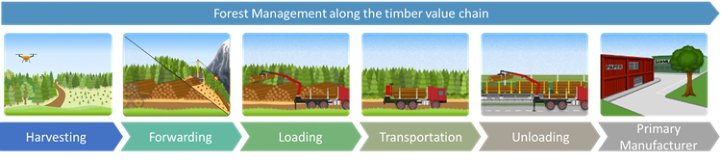
Figure 1: Individual steps of the timber value chain of round wood, referred to (Kreis et al., 2024).
Figure 1 illustrates the sequential process steps within the timber value chain, beginning with harvesting and forwarding. The harvesting phase encompasses tree felling, tree marking, and processing using harvester processor heads. In contrast, the forwarding stage primarily focuses on transporting felled trees from the harvesting site to the next storage facility, typically a woodpile located near forestry roads. The woodpile serves as a critical transition point for subsequent processes.
To facilitate harvesting, specialized machinery such as harvesters and processor heads are utilized, while forwarding operations rely on equipment such as forwarders and cable cranes. In alignment with sustainable forestry
Evolution of the Human Factor in Forestry Automation: From Manually Operated 15
practices, Austrian forests increasingly favor mixed-species planting over monocultures to enhance resilience against pests and climate change. During the loading process, logs are sorted by species to ensure homogeneity within each truckload. Given the challenging terrain, robust trucks equipped with high-powered propulsion systems and log decks are essential. Once loading is complete, the logs are securely placed on the log deck for transportation.
For long-distance transport, logs are typically transferred onto trains, whereas shorter-distance deliveries are conducted via trucks directly to primary processing facilities such as sawmills and paper mills. While acceptance criteria for round timber may differ between companies, the unloading process remains standardized: upon arrival, logs are offloaded using cranes. Following unloading, visual inspections or sampling procedures assess timber quality before temporary storage for further processing. Subsequent processing stages vary depending on industry-specific requirements and the intended end use of the logs, which lies beyond the scope of this study.
The objective of this research is to assess the level of automation (LoA) in current timber machinery used throughout the timber value chain. By identifying automation gaps across all process stages – ranging from harvesting, forwarding, loading, transportation including navigation, and final processing at primary manufacturing facilities – this study aims to explore opportunities for enhancing efficiency, safety, sustainability, and resource-efficient operations through increased automation and digitalization in forestry.
LEVELS OF AUTOMATION OF FORESTRY MACHINERY – CURRENT STATUS IN THE TIMBER VALUE CHAIN According to the timber value chain illustrated in Figure 1, each stage of the process is facilitated by the utilization of specialized timber machinery. At present, these machines are predominantly operated by human workers, either fully manually or with partial automation. To provide a comprehensive overview of the various LoA referenced throughout this study, Table 1 has been introduced within the context of this research. This table serves as a structured framework to classify and analyze the extent of automation integration in timber processing operations of the timber value chain.
Table 1: Levels of automation (LoA) of forestry machinery.
Table available in the original PDF paper.
Level of Automation Description LoA 0 Fully manual operation LoA 1 Standard machinery without any assistance systems LoA 2 Standard machinery supported by assistance systems LoA 3 Automated: Teleoperated in proximity LoA 4 Highly automated: Remote teleoperation from a control center LoA 5 Fully automated/Autonomous
The LoA within timber processing operations can be categorized into six distinct levels. At the lowest level (LoA 0), fully manual operation, all
tasks are performed by human operators without machine assistance. A step above (LoA 1), standard machinery without any assistance systems refers to conventional off-the-shelf machinery operated entirely by human control. With increasing automation (LoA 2), standard machinery with assistance systems incorporates supportive features that aid, but do not replace human operation. Moving further along the automation spectrum (LoA 3), automated machinery with teleoperation in proximity allows operators to control the equipment remotely while remaining within the immediate surroundings. At the next higher level (LoA 4), highly automated systems enable remote teleoperation from a centralized command center, significantly reducing the need for direct human presence on-site. Finally, at the highest level (LoA 5), fully automated respectively autonomous machinery operates independently with minimal or no human intervention, relying on advanced automation technologies and AI-driven decision-making.
Table 2 presents an overview of the forestry machinery currently in use and their corresponding LoA, categorized according to the individual steps of the timber value chain. This classification enables a structured analysis of automation implementation across different stages of the process, highlighting the technological advancements and human involvement at each level.
Table 2: Introduced levels of automation (LoA) of forestry machinery.
Table available in the original PDF paper.
Timber Value Chain Process Step Level of Automation
Standard Used Forestry Machinery
LoA 2 Forestry cranes
Harvesting LoA 2 Harvester Forwarding LoA 1 Forwarder and cable cranes Loading LoA 2 Forestry cranes Transportation LoA 2 Trucks Unloading/Transshipping from truck to truck or truck to train LoA 4 Industrial crane systems Unloading at primary manufacturer level
The Levels of Automation (LoA) presented in Table 2 are based on standard series machinery commonly used in the timber value chain across European forests. However, these LoA may vary slightly from those in Table 2, depending on the specific companies and organizations.
Historically, harvesting processes were carried out manually using simple hand saws (LoA 0). However, this approach has long been replaced by modern methods. Today, standard harvesting processes are typically performed using harvester vehicles equipped with mounted processor heads. This setup corresponds to LoA 2 – standard machinery with assistance systems – since it incorporates various support technologies, such as highly automated processor heads, among others. The next process step in the timber value chain, forwarding, is carried out using forwarders and cable cranes. However, standard off-the-shelf machinery in both categories generally operates at a relatively low automation level. While machinery supports this process, it incorporates little to no assistance
Evolution of the Human Factor in Forestry Automation: From Manually Operated 17
systems, classifying it as LoA 1. Loading and unloading/transshipping processes, whether from truck to truck or truck to train, are traditionally performed using forestry cranes operated by humans. These off-the-shelf forestry cranes are equipped with some assistance systems, resulting in an LoA 2 classification for these processes. The next process step, transportation, is typically carried out using specialized forestry vehicles and trucks. Both can be classified as LoA 2, as they rely on standard off-the-shelf machinery equipped with assistance systems, such as Advanced Driver Assistance Systems (ADAS). The final process step considered in this research – unloading at the primary manufacturer level – classifies industrial crane systems used in this step as LoA 4, c.f. (Andritz, 2023). In this context, LoA 4 represents a highly automated system that operates independently and requires human intervention only in case of errors or unexpected behavior. The operator does not need to be physically present on-site.
None of the mentioned systems in the timber transportation chain currently operates at a high LoA. While some processes, such as industrial crane systems, may reach LoA 4, the majority remain at lower levels, relying on human operation with limited assistance from automated systems. Despite advancements in automation, full autonomy has not yet been realized in these areas. The objective of this research is to explore and outline the pathway toward achieving LoA 5 for the systems discussed. This will involve transitioning from current semi-automated processes to fully autonomous operations, where human intervention is no longer required. By identifying technological advancements, challenges, and necessary developments, this research aims to contribute to the future implementation of fully automated solutions in the timber value chain.
PATHWAY AND APPROACHES TO INCREASE THE LEVEL OF AUTOMATION IN THE TIMBER VALUE CHAIN Achieving full autonomy (LoA 5) in the timber value chain and the associated forestry machinery requires a systematic and strategic approach that integrates advanced technologies, c.f. (Kreis et al., 2024) and (Visser et al., 2021), refined operational methodologies (Toth et al., 2019), and comprehensive testing protocols (Solovyev et al., 2022).
This section outlines a selection of key measures and approaches necessary for the transition from current semi-automated processes to fully autonomous operations.
Integration of Advanced Sensor Systems To enable fully autonomous operations, forestry machinery must be equipped with advanced sensor technologies. LiDAR and 3D vision systems are essential for real-time terrain mapping, obstacle detection, and precise positioning of machinery (Didari et al., 2023). Radar and ultrasonic sensors ensure the detection of objects even in low-visibility conditions, such as dense forests or adverse weather (Jacobs et al., 2023). Additionally, multispectral and hyperspectral imaging supports tree species recognition and health assessment, improving harvesting efficiency and sustainability. However,
all the mentioned forestry machinery in Table 2 must be equipped with multi-sensor approach to guarantee a functional operating behavior.
Implementation of AI-Based Decision-Making Systems Artificial intelligence (AI) and machine learning (ML) approaches play a pivotal role in enhancing autonomy. AI-driven algorithms – like (Kreis et al., 2022), (Sufi, 2022) and (Zhang et al., 2024) – analyze environmental data to determine optimal harvesting and transportation routes while dynamically adjusting machine operations based on sensor inputs. Moreover, they can detect anomalies in machinery performance, predicting potential failures before they occur. Furthermore, forwarding machinery and cranes must be also rely on AI and ML approaches to reach LoA 5.
Development of Robust Autonomous Navigation Navigation in forested environments presents unique challenges (c.f. Idrissi et al., 2022) due to unstructured terrain and dynamic obstacles. Autonomous forestry machinery must incorporate Simultaneous Localization and Mapping (SLAM) to create and update real-time maps. GPS and GNSS integration provide precise positioning and navigation support, while adaptive path planning algorithms enable machines to adjust routes dynamically in response to environmental changes. Integrating a robust navigation approach is particularly crucial for optimizing logistic processes from the woodpiles to the primary manufacturing industry. It also influences the user experience c.f. (Kreis et al., 2023) while driving.
Enhancement of Machine-to-Machine (M2M) Communication For a fully automated forestry operation, different machines within the timber value chain must interact seamlessly. Vehicle-to-Everything (V2X) – like in (Schiegg et al., 2020) – communication facilitates coordination between harvesters, forwarders, cranes and transport vehicles. Additionally, edge computing and cloud connectivity enable real-time data processing and decision-making, while distributed control systems manage operations efficiently and autonomously.
Advancement of Robotic Manipulation and Automated Handling A key aspect of autonomy is the ability to perform complex handling tasks without human intervention. Autonomous grasping and manipulation technologies – c.f. (Ortner-Pichler et al., 2025) – ensure precise handling of logs and timber materials. Force and torque sensors provide adaptive control during loading and unloading/transshipping processes, while automated crane and forwarding machinery facilitate seamless material flow.
Integration of Predictive Maintenance and Self-Diagnosing Systems To ensure reliability and efficiency in autonomous forestry machinery, predictive maintenance is crucial. IoT-based monitoring systems track machine health in real time, while AI-driven fault detection predicts and prevents mechanical failures. Additionally, autonomous repair and
Evolution of the Human Factor in Forestry Automation: From Manually Operated 19
self-healing technologies reduce downtime, further enhancing operational efficiency. The introduction of this measures is essential for all operating forestry machinery with LoA 5. The machinery must be capable of communicating with control centers to provide feedback on system failures, ensuring a rapid response and minimal downtime.
Regulatory and Safety Considerations Fully autonomous forestry machinery must comply with legal and safety standards, c.f. (Borodin et al., 2023). The development of standardized safety protocols ensures secure autonomous operations, while the integration of fail-safe mechanisms allows for emergency shutdowns and remote human intervention when necessary. Furthermore, compliance with environmental and occupational regulations guarantees sustainable and safe operations. Currently, autonomous forestry systems still face significant challenges, particularly from a legal perspective. To address this, a legal framework must be established to ensure that future LoA 5 machinery can operate seamlessly and in compliance with regulations.
Pilot Programs and Real-World Testing and Training Before full-scale implementation, rigorous testing and validation of autonomous systems are essential. Field trials – like in (Steinbauer-Wagner et al., 2024) and (Hirner et al., 2024) – in diverse forestry environments assess system robustness, while collaboration with industry stakeholders helps to refine autonomous solutions. Incremental deployment strategies allow for a gradual transition from assisted to fully autonomous operations, ensuring a smooth and effective implementation process. Additionally, employees must be trained to work with autonomous machines, particularly during the transition phase. This training ensures that personnel can effectively oversee and intervene in operations when necessary, facilitating a seamless integration of LoA 5 systems into the forestry industry.
CONCLUSION
The forest industry represents itself as growing sector with high relevance on environment care and protection, utilization of natural resources as well as important economic impact. Due to a considerable share of manual work, forestry labor is exhausting and risky for workers, who operate under dangerous conditions in often difficult to reach outlands (Toth et al., 2019). This leads to considerable number of accidents and negative impacts on the workers’ health and wellbeing.
In this context, the present research focusses on the automation of the different steps in timber handling, starting with harvesting and manipulation of the trees, continuing with loading and transportation processes and ending at the entrance to industrial further processing. In an initial investigation, several processes of the timber value chain have been analyzed in view of already introduced levels of automation and their potentials for further automation. Subsequently, pathways and approaches to increase the levels of automation have been introduced and
discussed. A transitioning to fully autonomous forestry machinery (LoA 5) requires a holistic approach that combines advanced sensor technology, AI-driven decision-making, autonomous navigation, machine-to-machine communication, robotic manipulation, predictive maintenance, regulatory compliance, and extensive testing. These measures have great potential to enhance the forestry sector to achieve higher efficiency, improved safety, and greater sustainability in timber processing operations. In this way, the findings of the present work represent a fundamental basis for the development of systems and technologies supporting automated, save and reliable processes in the forestry value chain.
Overall, the insights and approaches presented in this research provide a valuable foundation for the advancement of automation in forestry, enabling the development of intelligent, safe, and efficient systems across the entire timber value chain. By addressing both technological and operational challenges, this work supports the transition towards a more sustainable, resilient, and forward-looking forest industry that is better equipped to meet future demands while protecting both workers and natural resources.
ACKNOWLEDGMENT
The authors of this paper would like to express their gratitude to the Austrian Research Promotion Agency (FFG) for funding this work as part of the THINK.WOOD.INNOVATION program.
REFERENCES
Andritz AG (2023). “Andritz presents the world’s first autonomous logyard crane and many other innovations at LIGNA 2023”. Accessed: March 26, 2025. [Online]. Available: https://www.andritz.com/newsroom-en/pulp-paper/2023-05- 09-ligna-group. Borodin, N. A., Knyazev, A. V., Tkachev, V. V., Zimarin, S. V., Borovikov, R. G. and
Shcheblykin, P. N. (2023). “Overload protection for forestry machines when using pressed wood friction material”. IOP Conference Series: Earth and Environmental Science Volume 1231. https://doi.org/10.1088/1755-1315/1231/1/012016 Didari, H. and Steinbauer-Wagner, G. (2023). “LiDAR-Based Scene Understanding for Navigation in Unstructured Environments”. In T. Petriˇc, A. Ude, & L. Žlajpah (eds), Advances in Service and Industrial Robotics - RAAD 2023 Volume 135. https://doi.org/10.1007/978-3-031-32606-6_21 European Union (2023). “Regulation (EU) 2023/1115, on the making available
on the Union market and the export from the Union of certain commodities and products associated with deforestation and forest degradation and repealing Regulation (EU) No 995/2010”. Volume L150. Hirner, D. and Frauendorfer, F. (2024). “SAda-Net: A Self-supervised Adaptive Stereo Estimation CNN For Remote Sensing Image Data”. In: Antonacopoulos, A., Chaudhuri, S., Chellappa, R., Liu, CL., Bhattacharya, S., Pal, U. (eds) Pattern Recognition. ICPR 2024. Lecture Notes in Computer Science Volume 15310. Springer. https://doi.org/10.1007/978-3-031-78192-6_11
Evolution of the Human Factor in Forestry Automation: From Manually Operated 21
Hoenigsberger, F., Saranti, A., Jalali, A., Stampfer, K. and Holzinger, A. (2024).
“Explainable Artificial Intelligence to Support Work Safety in Forestry: Insights from Two Large Datasets, Open Challenges, and Future Work”, Applied Sciences Volume 14, No. 9. https://www.doi.org/10.3390/app14093911 Idrissi, M., Hussain, A., Barua, B. Osman, A., Abozariba, R., Aneiba, A.
and Asyhari, T. (2022). “Evaluating the Forest Ecosystem through a Semi- Autonomous Quadruped Robot and a Hexacopter UAV”. MDPI Sensors Volume 22, No. 15. https://doi.org/10.3390/s22155497 IRU (2023). “Driver Schortage Report 2023 Freight - global”. Accessed: March 26,
2025. [Online]. Available: https://www.tcemagazine.it/wp-content/uploads/2024/ 01/Truck-driver-shortage.pdf. Kreis, A. and Fischer, J. (2024). “Towards Sustainable Forest Management – Advancing Autonomy Approach in Forestry Operations for the Forests of the Future”. IEEE Xplore. 2024 9th International Engineering, Sciences and Technology Conference (IESTEC). Panama City, Panama, 2024. https://doi.org/ 10.1109/IESTEC62784.2024.10820235 Kreis, A., Fragner, D. and Hirz, M. (2023). “User Experience in Modern Cars –
Definition, Relevance and Challenges of Digital Automotive Applications”. Usability and User Experience AHFE Open Access Volume 110. https://doi.org/ 10.54941/ahfe1003172 Kreis, A. and Hirz, M. (2022). “Artificial Intelligence Supporting Early Automotive Engineering Processes”: IOP Conferences Series: Material Science and Engineering Volume 1311. The 32nd International Congress of SIAR of Automotive and Transport Engineering 26/10/2022–28/10/2022 Timisoara, Romania. https://doi.org/10.1088/1757-899X/1311/1/012028 Kühmaier, M., Kral, I. and Kanzian, C. (2022). “Greenhouse Gas Emissions of
the Forest Supply Chain in Austria in the Year 2018”. Sustainability Volume 14 No. 2. https://www.doi.org/10.3390/su14020792 Lackner, C., Schreck, M. and Walli, A. M. (2023). “Austrian forest report 2023”, Federal Ministry of Agriculture and Forestry, Regions and Water Management, Vienna, 2023. Accessed: March 26, 2025. [Online]. Available: https://info.bml.gv.at/dam/jcr:19b66d46-f3e6-4026-9aaa-b43e3da574e5/ Austrian_Forestreport2023_Einzelseite_web23nov2023.pdf. Jacobs, L., Veelaert, P., Steendam, H. and Philips, W. (2023). “On the Accuracy of Automotive Radar Tracking”. IEEE Xplore. 97th Vehicular Technology Conference (VTC2023-Spring), Florence, Italy. https://doi.org/ 10.1109/VTC2023-Spring57618.2023.10200523 Ortner-Pichler, A., Cichocki, M. and Landschützer, C. (2025). “FutureWoodTrans:
Entwicklung eines automatisierten Be-, Um- und Entladesystems in der autonomen Forstwirtschaft”. In A. Katterfeld (eds). 33. Internationale Kranfachtagung 2025: Kran 4.0: Zukunft der Digitalisierung. https://doi.org/ 10.25673/117821 Schiegg, F., Llaser, I., Bischoff, D. and Volk, G. (2020). “Collective Perception: A Safety Perspective”. MDPI Sensors Volume 21, No. 1. https://doi.org/10.3390/ s21010159 Solovyev, R., Cheranev, S., Kolomeichenko, A., Gerasimov, M., Zotov, P.
and Kiselyov, S. (2021). “Increasing agricultural automation in conditions of international integration”. IOP Conference Series: Earth and Environmental Science Volume 954. https://doi.org/10.1088/1755-1315/954/1/012077
Statista (2023). “Schnittholzerzeugung in Europa nach Ländern im Jahr 2023” (org.). “Sawn timber production in Europe by country in 2023” (engl.). Eurostat. Accessed: March 26, 2025 [Online]. Available: https://de.statista.com/statistik/ daten/studie/38055/umfrage/holzerzeugung-in-europa-im-jahr-2006/. Statista (2023). “Schnittholzexport in Europa nach ausgewählten Ländern im Jahr 2023” (org.). “Sawn timber exports in Europe by selected countries in 2023” (Engl.). Eurostat. Accessed: March 26, 2025 [Online]. Available: https://de.statista.com/statistik/daten/studie/195390/umfrage/ exportmenge-von-schnittholz-in-europa/. Statista (2024). “Largest country in Europe”. Eurostat. Accessed: March 26,
2025 [Online]. Available: https://www.statista.com/statistics/1277259/countries- europe-area/. Steinbauer-Wagner, G., Fürbaß, L., De Bortoli, M., & Travé-Massuyès, L. (2024).
“A Hierarchical Monitoring and Diagnosis System for Autonomous Robots”. In I. Pill, A. Natan, & F. Wotawa (eds.), 35th International Conference on Principles of Diagnosis and Resilient Systems. https://doi.org/10.4230/OASIcs. DX.2024.1 Sufi, F. (2022). “AI-GlobalEvents: A Software for analyzing, identifying and explaining global events with Artificial Intelligence”. Software Impacts Volume 11. https://doi.org/10.1016/j.simpa.2022.100218. Toth, D., Maitah, M. and Maitah, K. (2019). “Development and Forecast
of Employment in Forestry in the Czech Republic”. MDPI Sustainability Volume 11 No. 24. https://doi.org/10.3390/su11246901 Visser, R. and Francis, O. O (2021). “Automation and Robotics in Forest Harvesting Operations: Identifying Near-Term Opportunities”. Croatian Journal of Forest Engineering Volume 42, No. 1. https://doi.org/10.5552/crojfe.2021.739 Zhang, F. and Hu, J. (2024). “Research on logistics supply chain optimization
strategy based on machine learning”. SPIE Digital Library Proceedings Volume 13018. International Conference on Smart Transportation and City Engineering. https://doi.org/10.1117/12.3024778
LISTED IN THE AHFE DIGITAL BOOKSTORE CATALOGUE
Explore the complete digital volume
Human Factors in Robots, Drones and Unmanned Systems
Read this individual research paper free through the original publisher, or explore the full digital proceedings book.
ISBN 978-1-964867-55-7
Explore this ISBN in the AHFE Bookstore ↗Listed in the July 2026 bookstore catalogue; search by ISBN to confirm current availability · Digital book purchase optional