Eduarda Pereira, Daniela Arruda, Adriana Sampaio, Nuno Costa, Nelson Costa (2026). Beyond Physical Safety in Human–Robot Collaboration: Investigating Speed and Proximity Effects in Mental Workload. In: Neuroergonomics and Cognitive Engineering. AHFE Open Access, vol. 207, pp. 35–45. https://doi.org/10.54941/ahfe1007393
Human–robot collaboration (HRC) has improved flexibility and productivity in industrial environments; however, current safety standards primarily address physical risks, overlooking operators’ mental workload. This study adopts a neuroergonomic approach to examine how robot speed and human–robot proximity influence mental workload during collaborative tasks. Participants (N=25, n=21) performed a shelf-replenishment task with a collaborative robot under six experimental conditions combining three speed levels and two proximity levels. Mental workload was assessed using subjective ratings, performance indicators (error rate), and functional near-infrared spectroscopy (fNIRS) of pre-frontal cortical activity. Speed emerged as the primary determinant of mental workload. High speed significantly increased perceived demand and error rates, particularly under near proximity. Proximity alone did not produce significant global effects but amplified demand under high operational intensity. Physiological measures confirmed pre-frontal engagement during task execution compared to baseline; however, differentiation among graded task conditions was modest. These findings suggest that excessive operational intensity may compromise performance stability before strong neural amplitude differences emerge. Regulating robot speed may therefore represent an effective mechanism for maintaining mental workload within functional limits in collaborative environments. The integration of subjective, performance, and physiological indicators contributes to a more comprehensive neuroergonomic assessment of human–robot collaboration.
Human-Robot Collaboration (HRC) has reshaped industrial environments by enabling humans and robots to work in shared spaces, combining the adaptability and problem-solving capacity of humans with the precision, repeatability, and endurance of robots. Unlike traditional robots, which are
restricted to fenced work cells, collaborative robots (cobots) are designed to operate in closer proximity with humans, thereby increasing their flexibility, optimizing production processes, and improving ergonomics. This integration has changed the nature of industrial tasks, influencing not only workflow organization, but also the dynamics of human–machine interaction and overall working conditions (Caiazzo, Nestić, et al., 2023; Gualtieri et al., 2022). Ensuring safe collaboration is one of the major challenges in HRC. To regulate physical safety, international standards such as ISO 10218-1/2 (2011) and ISO/TS 15066 (2016) define requirements for robot motion in relation to human operators (International Organization for Standardization, 2011a, 2011b, 2016). These standards establish limits for force, speed, and separation distances, as well as biomechanical thresholds to minimize the mechanical risks (collisions, entrapments, or excessive loads on the human body).
These frameworks represent a significant advance for safety in collaborative settings. However, they remain limited in scope: the standards primarily address physical risks, while cognitive and emotional dimensions of HRC, such as mental workload, fatigue, attention, and stress, are not considered. This constitutes a critical gap, as evidence shows that cognitive factors can directly influence operator performance, error rates, and well-being (Gartner & Murphy, 1976; Hancock, 2000). Mental workload, for instance, refers to the level of mental effort required to accomplish multiple concurrent tasks (Costa et al., 2019). In dynamic production environments, interaction with cobots can impose different cognitive demands (mental workload), such as when operators need to adapt to robot speed, anticipate trajectories, or perform under time pressure. However, the most effective strategies to manage these cognitive factors remain under investigation. Pereira et al. (2026) concluded in their review that speed, distance, trajectory, and support are the most common adaptive parameters employed by robots to cope with fluctuations in workers’ mental workload. Empirical studies reinforce this perspective. Story et al. (2022) tested industrial UR5 robot arms at varying speeds and proximities, showing that mental workload increased with higher speeds, while proximity effects were less evident; notably, trust remained stable, likely due to the robot’s small size and consistent performance. Zakeri et al. (2023) identified task complexity and cobot speed as major drivers of stress, while Caiazzo, Savkovic, et al. (2023) reported reduced workload and improved task accuracy in robot-assisted conditions. Finally, Hostettler et al. (2025) provided strong evidence that robot speed and human–robot distance are critical variables impacting mental workload, comfort, and perceived safety, and suggested that adaptive systems capable of modulating speed and movement according to proximity or physiological state could mitigate the adverse effects of high speed and critical proximity. Collectively, these findings indicate that the research community is actively engaging with the cognitive challenges of HRC and exploring adaptive robot strategies to support performance, safety, and well-being.
The present study introduces an experimental protocol specifically designed to examine how variations in cobot speed and proximity affect mental workload in collaborative tasks. Grounded in the assumptions identified in the literature,
Beyond Physical Safety in Human–Robot Collaboration 37 we hypothesize that cobot behavior modulates mental demands, leading to the following operational hypotheses: H1) Cobot speed influences mental workload during HRC; H2) Cobot proximity influences mental workload during HRC; H3) The interaction between robot speed and proximity modulates mental workload. To address this gap, the present study integrates subjective, performance, and physiological indicators to obtain a multimodal assessment of mental workload during human–robot collaboration.
MATERIALS AND METHODS
Participants Twenty-five healthy adults voluntarily participated in the present exploratory study following written informed consent (N = 25). The protocol was approved by the Ethics Committee for Research in Social and Human Sciences of the University of Minho (reference CEICSH 054/2024). Participants reported no neurological or motor impairments. To reduce potential confounding factors, they were instructed to avoid caffeine and smoking three hours prior to the experiment and to ensure adequate sleep the night before testing.
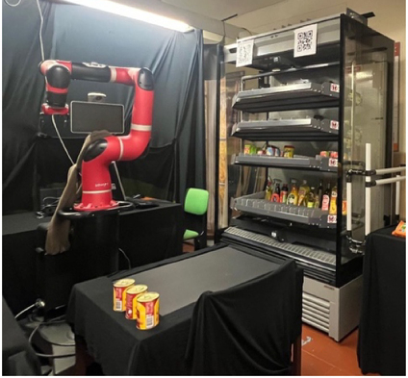
Experimental Design and Task The experiment was conducted in a controlled laboratory environment designed to simulate a collaborative retail scenario. Participants performed a shelf-replenishment task in cooperation with a Sawyer collaborative robot. The task required participants to verify product expiration dates of canned goods and place them on a table at predefined distances from the robot, following a sequence organized from the longest to the shortest shelf-life. The robot then autonomously grabbed the cans and completed the transfer. This setup was designed to reproduce a realistic yet controlled human–robot collaboration context involving coordination, temporal monitoring, and physical proximity (Figure 1).
Figure 1: Photo of the experimental setup.
Two operational parameters were systematically manipulated: robot speed and human–robot proximity. Speed was defined at three levels, specifically 0.3 m/s (V1), 0.5 m/s (V2), and 0.9 m/s (V3), representing progressively increasing dynamic interaction intensity. Proximity was defined at two levels based on individual anthropometric measures: a near distance (P1), corresponding to elbow reach, and a far distance (P2), corresponding to full arm extension.
The combination of the three speed levels and the two proximity conditions resulted in six experimental conditions. These were labeled as C1 (V1P1), C2 (V1P2), C3 (V2P1), C4 (V2P2), C5 (V3P1), and C6 (V3P2). Each participant completed all six conditions following a within-subject block design, with each trial lasting approximately two minutes. The order of conditions was randomized for each participant.
MEASURES Mental workload was assessed using the Subjective Workload Assessment Technique (SWAT) (Rubio et al., 2004), which evaluates temporal demand, mental effort, and stress. Internal consistency analysis indicated good reliability (Cronbach’s α = 0.847), supporting the use of a global mean workload score in subsequent analyses.
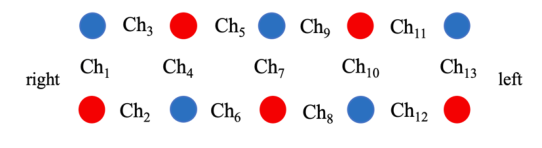
Cortical activity was recorded using a Brite II fNIRS system (Artinis Medical System), targeting frontal and pre-frontal regions associated with cognitive workload regulation (Figure 2).
Figure 2: fNIRS channel’s representation.
Signals were sampled at 50 Hz and resampled to 10 Hz for analysis. Pre-processing included optical density conversion, wavelet-based motion correction, band-pass filtering (0.01–0.5 Hz), and conversion to oxy- hemoglobin (HbO) and deoxy-hemoglobin (HbR) concentrations using the modified Beer–Lambert law.
Task performance was quantified through error rate, defined as incorrect sequencing or verification errors during the collaborative task.
PROCEDURES The mental workload experimental protocol followed a block design and comprised three main phases: baseline, task, and questionnaire. All experiments were conducted in a controlled laboratory environment, with noise, light, and thermal conditions measured to ensure comfort in the physical setting. The experimental schedule was outlined as follows: (1) a preliminary training session was conducted to ensure participants understood the
Beyond Physical Safety in Human–Robot Collaboration 39 sequence’s structure and requirements; (2) participants were then requested to engage in a period of relaxation spanning two minutes, to establish a physiological baseline; (3) a 2-minute trial was conducted; (4) following the trial, participants were required to complete the SWAT questionnaire. Each experimental session lasted approximately 30 to 40 minutes.
Statistical Analysis Non-parametric tests, including the Mann–Whitney U test, Spearman’s rank correlation, and the Kruskal–Wallis test, were applied to analyze demographic, subjective and performance data, with a significance threshold of p < 0.05.
The prototypical activation pattern observed in fNIRS data associated with a functional response consists of a substantial increase in oxy-hemoglobin (HbO2) accompanied by a decrease in deoxy-hemoglobin (HHb) relative to baseline (Pereira et al., 2025). In the present study, HbO2 chromophore concentration (μMol) was analyzed using a linear mixed model (LMM) to assess within-subject differences in the hemodynamic response function across the six experimental conditions and thirteen pre-frontal channels. Model comparisons were conducted using ANOVA, with statistical significance set at p < 0.05.
RESULTS
User Study Twenty-five participants (N = 25) were initially enrolled in the study. Four participants were excluded from the analyses due to sensor recording errors or excessive pruned channels identified during the fNIRS pre-processing pipeline (n = 21).
To explore individual differences in mental workload perception, demographic variables were analyzed. A Mann-Whitney U test revealed a significant difference between genders (p = 0.046). Additionally, a Spearman correlation showed a weak but significant negative association between age and mental workload (ρ = –0.212, p = 0.017).
Subjective Assessment Perceived mental workload differed significantly across speed levels (Kruskal– Wallis, p < .001), whereas proximity alone did not produce significant differences (p = .942). Post hoc comparisons indicated that high speed (V3) was associated with significantly higher mental workload compared to both low (V1) and medium (V2) speeds, while no significant difference was observed between V1 and V2.
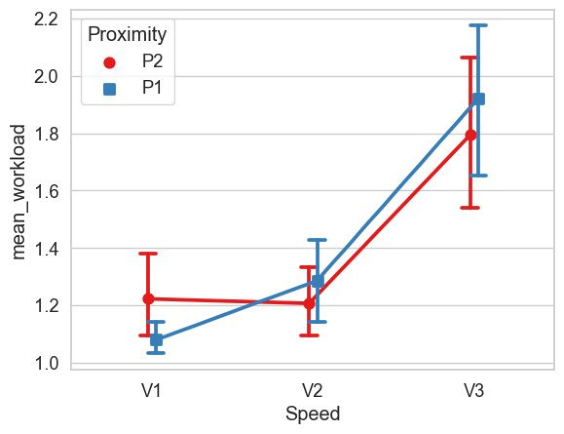
Analysis of the speed x proximity combinations revealed a clear interaction pattern (Figure 3). The condition combining high speed and near proximity (C5: V3P1) produced the highest mental workload scores and the greatest dispersion. In contrast, lower speed conditions, particularly those involving far proximity (C2 and C4), showed lower and more stable mental workload levels. At the dimensional level, speed significantly affected temporal demand, mental effort, and stress, whereas proximity influenced primarily temporal demand.
Figure 3: Interaction between speed and proximity on mean subjective workload (SWAT). Workload increased substantially at high speed (V3), particularly under near proximity (P1). Error bars represent standard error of the mean.
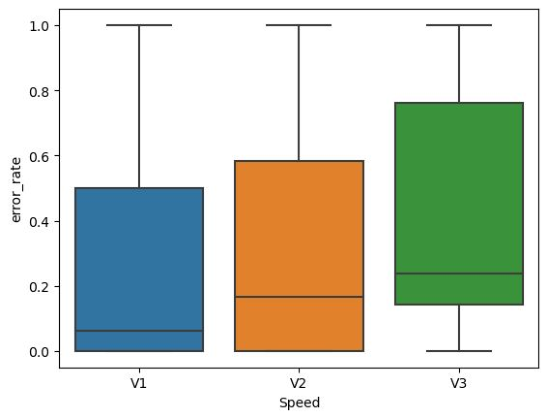
Performance Assessment Task performance analysis revealed a significant effect of speed on error rate (Kruskal–Wallis, H = 10.373, p < .05). Error rates increased progressively with speed, with V3 exhibiting the highest median error and the greatest variability. V1 showed the best and most stable performance, while V2 displayed intermediate behaviour (Figure 4).
Figure 4: Error rate across speed levels (V1–V3).
Beyond Physical Safety in Human–Robot Collaboration 41 Physiological Measures
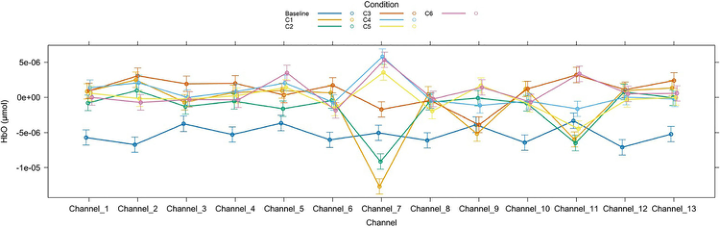
Linear mixed models effects were fitted for HbO. Allowing subject-specific random intercepts significantly improved model fit across all measures (p < .001), confirming substantial inter-individual variability. The inclusion of Condition and Channel as fixed effects further improved model fit in all cases (p < .001). However, despite statistical significance, the overall explanatory power of the model remained low (marginal R² ≈ 0.03–0.04; conditional R² ≈ 0.04–0.07). As illustrated in Figure 5, baseline-task contrasts showed clear increases in cortical activation across channels. However, differences among experimental conditions (C1–C6) were comparatively modest, and no systematic trend in mean hemodynamic amplitude was observed across conditions.
Figure 5: Mean HbO response (μMol) across channels for baseline and experimental conditions.
DISCUSSION
This study investigated how robot speed and human–robot proximity modulate mental workload during collaborative task execution using a multimodal framework integrating subjective, performance, and physiological indicators. Across measures, the findings of this exploratory study converge on a consistent pattern: speed represents the dominant operational driver of mental workload in this context. This pattern is consistent with the results reported by Story et al. (2022), who also identified robot speed as a primary determinant of perceived mental workload in collaborative settings.
Subjective ratings showed a clear increase in perceived mental workload under high speed, and this effect was amplified when combined with near proximity. Although proximity alone did not significantly affect overall mental workload, its interaction with speed suggests a contextual amplification effect, whereby spatial closeness becomes particularly relevant when dynamic demand is already elevated.
Performance results followed the same trend, with higher error rates and greater behavioral dispersion observed in high-speed conditions. These results indicate that increased operational intensity compromises both perceived mental workload and task accuracy. This pattern is theoretically consistent with resource-based models of mental workload, which
conceptualize workload as the proportion of limited cognitive resources allocated to meet task demands (Eggemeier, Wilson, Kramer, Damos, 1991). By increasing robot speed, task demands are intensified, requiring greater resource commitment; as demands approach capacity limits, performance degrades, manifesting in elevated error rates and behavioral variability.
Physiological observations obtained from the fNIRS recordings provide additional insight into the neural mechanisms underlying mental workload regulation in the collaborative task. Relative to baseline, the task elicited measurable modulation of pre-frontal hemodynamics, indicating cortical engagement during human–robot interaction. This finding is consistent with the established role of the pre-frontal cortex in attentional allocation, action monitoring, and executive control processes that support goal- directed behavior in dynamic environments (Parent et al., 2019). Within this framework, elevations in oxygenated hemoglobin (HbO) are interpreted as markers of increased mental workload. However, differentiation among graded task conditions was modest, and model explanatory power remained limited. Rather than demonstrating strong monotonic increases in mean hemodynamic amplitude, higher-demand configurations were characterized by increased inter-individual variability and dispersion across channels. This pattern suggests that escalating mental workload may initially manifest as reduced regulatory stability and increased variability before producing substantial uniform shifts in cortical activation. Thus, the physiological data suggest that the neural response may reflect adaptive regulation rather than linear overload. Participants may rely on different cognitive strategies or levels of anticipatory control when interacting with the robot, leading to distributed and variable patterns of pre-frontal recruitment rather than uniform increases in activation. This interpretation aligns with the concept of neural efficiency, whereby task performance can be maintained through optimized recruitment of cortical resources without necessarily increasing global activation levels (Neubauer & Fink, 2009). In collaborative environments where operators quickly adapt to predictable robot behavior, efficient processing may allow stable performance under moderate demands, while higher demands introduce variability in control strategies across individuals.
Consequently, the absence of strong amplitude differences across conditions should not be interpreted as a lack of physiological sensitivity. Instead, it could indicate that mental workload modulation in this context may manifest through changes in response stability and inter-individual dispersion, rather than through large mean shifts in hemodynamic activity. Further examination of hemodynamic responses and inter-individual differences could provide additional insight into these modulation mechanisms.
Several limitations should be acknowledged in the present study. First, multiple fNIRS channels were excluded during preprocessing due to excessive noise or poor signal quality, resulting in pruned channels and reduced spatial coverage for some participants. Motion artifacts and variability in optode– scalp coupling may have influenced signal robustness and contributed to the limited differentiation observed across conditions. Second, the study was
Beyond Physical Safety in Human–Robot Collaboration 43 conducted in a controlled laboratory setting, which may not fully capture the complexity and environmental stressors present in real industrial contexts. Finally, only speed and proximity were manipulated; other operational variables such as robot’ trajectory predictability, communication cues, or task complexity were not examined and may further influence mental workload dynamics.
CONCLUSION
This study examined the influence of robot speed and human–robot proximity on mental workload during collaborative task execution using subjective, performance, and physiological indicators. Results consistently indicate that robot speed is the primary operational factor affecting mental workload. Higher speed levels increased perceived mental workload and error rates, particularly under near proximity, suggesting that elevated interaction intensity challenges performance stability. Proximity alone showed limited effects but amplified demand when combined with higher speed. fNIRS measurements confirmed pre-frontal cortical engagement during task execution relative to baseline, reflecting the involvement of executive and attentional processes in human–robot collaboration. However, differences between task conditions were modest, with higher-demand configurations characterized mainly by increased variability in hemodynamic responses rather than large amplitude shifts.
These results highlight the importance of regulating operational parameters to maintain mental workload within a functional range during human–robot collaboration. In particular, robot speed emerges as a critical parameter that can be used to modulate interaction intensity and support stable and safe task performance. From a human–systems integration perspective, monitoring workload indicators and dynamically adjusting robot behavior represents a promising approach to maintaining cognitive demands within optimal limits during collaboration.
ACKNOWLEDGMENT
This work has received support from FCT - Fundação para a Ciência e Tecnologia within the PhD fellowship referenced as 2022.14626.BDANA (https://doi.org/10.54499/2022.14626.BDANA) and within the R&D Unit Project Scope UID/00319/2025 - Centro ALGORITMI (ALGORITMI/UM) https://doi.org/10.54499/UID/00319/2025
REFERENCES
Caiazzo, C., Nestić, S., & Savković, M. (2023). A Systematic Classification of Key Performance Indicators in Human-Robot Collaboration. In M. Mihić, S. Jednak, & G. Savić (Eds.), Sustainable Business Management and Digital Transformation: Challenges and Opportunities in the Post-COVID Era (Vol. 562, pp. 479– 489). Springer Science and Business Media Deutschland GmbH. https://doi. org/10.1007/978-3-031-18645-5_30
Caiazzo, C., Savkovic, M., Pusica, M., Milojevic, D., Leva, M. C., & Djapan, M.
(2023). Development of a Neuroergonomic Assessment for the Evaluation of Mental Workload in an Industrial Human–Robot Interaction Assembly Task: A Comparative Case Study. Machines, 11(11). https://doi.org/10.3390/ machines11110995 Costa, N., Costa, S., Pereira, E., & Arezes, P. (2019). Workload Measures—Recent Trends in the Driving Context. In Studies in Systems, Decision and Control (pp. 419–430). https://doi.org/10.1007/978-3-030-14730-3_45 Eggemeier, F.T., Wilson, G.F., Kramer, A.F., Damos, D. L. (1991). Workload assessment
in multi-task environments. In Multiple Task Performance (1st ed., pp. 207–216). CRC Press. Gartner, W. B., & Murphy, M. R. (1976). Pilot workload and fatigue: A critical survey of concepts and assessment techniques. Gualtieri, L., Fraboni, F., De Marchi, M., & Rauch, E. (2022). Development
and evaluation of design guidelines for cognitive ergonomics in human- robot collaborative assembly systems. Applied Ergonomics, 104. https://doi. org/10.1016/j.apergo.2022.103807 Hancock, P. A. (2000). Stress, Workload, and Fatigue. In M. Lawrence Erlbaum Associates (Ed.), Hancock, P.A., Desmond, P.A. (Eds.) (Vol. 11, Number 2). CRC Press. https://doi.org/10.1201/b12791 Hostettler, D., Mayer, S., Albert, J. L., Jenss, K. E., & Hildebrand, C. (2025, April
26). Real-Time Adaptive Industrial Robots: Improving Safety And Comfort In Human-Robot Collaboration. Conference on Human Factors in Computing Systems - Proceedings . https://doi.org/10.1145/3706598.3713889 International Organization for Standardization. (2011a). Robots and robotic devices
- Safety requirements for industrial robots - Part 1 (ISO Standard No. 10218- 1:2011). In International Standard Organization. https://www.iso.org/standard/ International Organization for Standardization. (2011b). Robots and robotic devices
- Safety requirements for industrial robots - Part 2: Robot systems and integration (ISO Standard No. 10218 - 2:2011). In International Standard Organization. https://www.iso.org/standard/ International Organization for Standardization. (2016). Robots and robotic devices - Collaborative robots (ISO/TS No. 15066:2016). https://www.iso.org/ standard/62996.html Neubauer, A. C., & Fink, A. (2009). Intelligence and neural efficiency. In Neuroscience
and Biobehavioral Reviews (Vol. 33, Number 7, pp. 1004–1023). https://doi. org/10.1016/j.neubiorev.2009.04.001 Parent, M., Peysakhovich, V., Mandrick, K., Tremblay, S., & Causse, M. (2019).
The diagnosticity of psychophysiological signatures: Can we disentangle mental workload from acute stress with ECG and fNIRS? International Journal of Psychophysiology, 146, 139–147. https://doi.org/10.1016/j.ijpsycho.2019.09.005 Pereira, E., Costa, N., Costa, N., & Sampaio, A. (2026). ML Based Models: The Path to Optimal Workload Management and Safety Assurance. In D. T. Matt, E. Rauch, P. Dallasega, L. Gualtieri, & M. De Marchi (Eds.), Manufacturing 2030 - A Perspective to Future Challenges in Industrial Production (pp. 179–189). Springer Nature Switzerland. Pereira, E., Sigcha, L., Silva, E., Sampaio, A., Costa, N., & Costa, N. (2025).
Capturing Mental Workload Through Physiological Sensors in Human–Robot Collaboration: A Systematic Literature Review. Applied Sciences, 15(6), 3317. https://doi.org/10.3390/app15063317
Beyond Physical Safety in Human–Robot Collaboration 45 Rubio, S., Díaz, E., Martín, J., & Puente, J. M. (2004). Evaluation of Subjective
Mental Workload: A Comparison of SWAT, NASA-TLX, and Workload Profile Methods. Applied Psychology, 53(1), 61–86. https://doi.org/10.1111/j.1464- 0597.2004.00161.x Story, M., Webb, P., Fletcher, S. R., Tang, G., Jaksic, C., & Carberry, J. (2022). Do Speed and Proximity Affect Human-Robot Collaboration with an Industrial Robot Arm? International Journal of Social Robotics, 14(4), 1087–1102. https:// doi.org/10.1007/s12369-021-00853-y Zakeri, Z., Arif, A., Omurtag, A., Breedon, P., & Khalid, A. (2023). Multimodal
Assessment of Cognitive Workload Using Neural, Subjective and Behavioural Measures in Smart Factory Settings. Sensors (Basel, Switzerland), 23(21), 8926. https://doi.org/10.3390/s23218926
LISTED IN THE AHFE DIGITAL BOOKSTORE CATALOGUE
Explore the complete digital volume
Neuroergonomics and Cognitive Engineering
Read this individual research paper free through the original publisher, or explore the full digital proceedings book.
ISBN 978-1-964867-83-0
Explore this ISBN in the AHFE Bookstore ↗Listed in the July 2026 bookstore catalogue; search by ISBN to confirm current availability · Digital book purchase optional