Rute Alexandra Silva, Iara Margolis, Isabel Lisboa, Eduarda Pereira, Bernardo Providência, Nelson Costa (2022). Emotional responses to motion sickness in autonomous driving. In: Affective and Pleasurable Design. AHFE Open Access, vol. 41, pp. 21–29. https://doi.org/10.54941/ahfe1001776
In future autonomous cars, users, free from the primary task of driving, will have time and space to engage in other activities while traveling, such as reading a book, working on a laptop or watching a movie. Although the option for these activities are one of the great advantages of autonomous cars, this will also likely increase motion sickness (MS) inside the car. MS affects numerous individuals, and it occurs when the information received through the eyes differs from what is perceived by the body and the inner ear. Plus, MS can have an impact on the emotional component of the individuals experiencing it, making the experience of traveling in autonomous cars uncomfortable and difficult. Emotional design studies focus on the emotional response of individuals to a product or service. These studies typically employ self-report scales as assessment tools, such as SAM (Self-Assessment Manikin) and PrEmo (Product Emotion Measurement instrument). We present the first study measuring emotional responses to MS using both SAM and PrEmo scales. In our study, we induced MS by asking participants to watch a highly dynamic video of a first-person car trip. We also asked subjects to answer to SAM and PrEmo before and after the visualization of the video. Our results showed a change in the answers in time, that is, before vs. after the experience of MS. MS significantly altered individuals' emotional responses, worsening their condition. These results support the need for studies that reduce MS to improve the experience and well-being of individuals in autonomous cars.
In the short/midterm, the world will likely experience the beginning of a huge transformation in the mobility sector: the generalization of autonomous or self-driving vehicles. This will bring a set of advantages, but also create new challenges for users.
In self-driving vehicles, drivers become passengers, thus, instead of keeping their eyes on the road, they will be free to engage in different tasks other than driving: from sit and relax, work in a laptop, or just swirl the front seat and have a face-to-face conversation with other passengers — self-driving cars are being thought as third living spaces (Diels & Bos, 2016). One critical issue,
common to all of these activities or scenarios, is that they will most likely increase the levels of motion sickness (MS) experienced inside the car (Diels & Bos, 2016; Iskander et al., 2019).
“Kinestosis”, also known as MS is a condition normally associated with contexts in which one’s perception of self-motion is not self-produced, but rather results from movement of the platform on which one is sitting or stan- ding, or from some vector inducing visual stimuli like virtual reality images (Dahlman, 2009). Possible symptoms of MS include nausea, dizziness, and other physical discomfort sensations.
Considering the aforementioned, it is critical for the future of self-driving cars to investigate and implement measures that might detect, reduce or miti- gate MS inside the car. Recent studies indicate that emotions are important and might play a role in reducing the level of MS (Keshavarz & Hecht, 2014). Studying the emotional responses to MS is, thus, relevant as it might contribute to a better generalization of autonomous vehicles.
Emotions are present in our everyday life and influence our thoughts and decision-making. The detection of emotions begins to gain more importa- nce in the automotive industry with the presence of autonomous cars since the systems need to be able to monitor the state of the human being, which includes their emotional state (Zezelj, 2020).
As previously mentioned, MS can induce different symptoms of discom- fort. In this sense, it is important to study how positive and negative emotions are present in passengers, and how they change when passengers experience MS.
Cardello and Jaeger (2016) addressed the diversity of questionnaire for- mats to capture human emotions. On one hand there are questionnai- res based on words, on the other hand questionnaires based on images (pictographic). The study presented here was developed within the frame- work of the “Easy Ride: Experience is everything” project and is intended to study the symptoms of MS and its influence on the emotional state of passengers. Thus, participants’ emotional responses before and after the experience of MS were analyzed using two pictographic scales named SAM (Self-Assessment Manikin) and PrEmo (Product Emotion Measurement instrument).
METHODOLOGY
The experiment had a homogenous sample with 23 individuals, healthy adults, aged between 24 and 57 years, 12 women, and 11 men. The sele- ction criteria were individuals who tended to get sick during car trips - in different scenarios, with normal or corrected to normal vision.
To simulate an autonomous driving context, stimulus consisted of a 15- minute video of a first-person car traveling at high speed on a winding path. Importantly, the contrast between the highly dynamic visual environment of the video and the static position of the observers is also intended to induce MS. Participants were informed of the purpose of the study. Instructions for the experiment were provided before signing the informed consent. After that, participants were invited to sit in front of a large screen in a dimly
Emotional Responses to Motion Sickness in Autonomous Driving 23
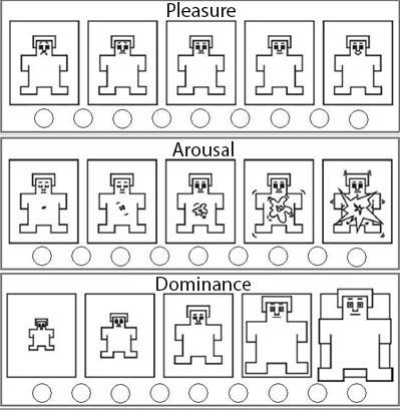
Figure 1: Three dimensions of humanoids - SAM (Bradley & Lang, 1994).
lit room with a dark background, so that there were no static visual cues and no distraction throughout the experience.
Before the onset of the MS induced video, subjects were asked to fill out an emotional response questionnaire that includes the SAM scale and the PrEmo (see the next sections for more information about the scales). After that, the participant watched a 2-minute baseline video (composed by a gray screen and a white fixation cross in the center), and then the MS induced video for 15 minutes. In the end, the subjects answered the initial questionnaire again, to record the emotional changes before and after the MS experience.
Since the experiment is intended to induce MS, participants were informed that they could interrupt the experiment at any time.
Self-Report Scales We applied, in two different time-points (before and after inducing MS), two self-reported pictorial scales (SAM and PrEmo).
SAM SAM evaluates three dimensions (pleasure, arousal and dominance) using a pictorial representation of a human (humanoids) (Bradley & Lang, 1994). The scale using a 9-point Likert scale, each point associated with a huma- noid - see Figure 1. The scale is based on the semantic differential between a positive humanoid on one side and a negative humanoid on the other (Figure 1).
Before the presentation of the scale, participants were instructed into how to fill the SAM, including with an initial exploratory image. For each of the dimensions (pleasure, arousal, dominance), participants were asked to indicate “which icon best represents you?”
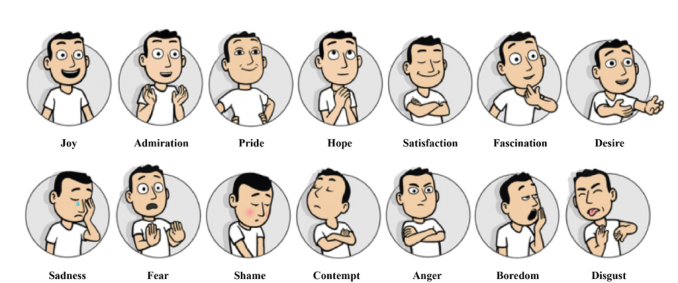
PrEmo The PrEmo scale was developed by Pieter Desmet, in 2002. The inspiration for its development was the creation of a pictorial scale that represents the different emotional expressions, allowing individuals to identify what they feel by choosing the illustration that best represents his/her emotions (Desmet, 2022). PrEmo is composed of 14 different emotions (Figure 2), half of which are positive and the other half negative (Desmet, 2003).
In PrEmo, participants were invited to select one or more images according to the following indication: “The illustrations below are related to the PrEmo tool. Please choose one or more images that best express what you feel at this moment”.
Well-Being As the experiment took place within a laboratory environment and in an uncomfortable situation (MS), the authors assessed the level of comfort/ well-being of each participant. This item aimed to correlate the participants’ perception of comfort/well-being with their emotional state. Hence, each par- ticipant was invited to answer the following question: “on a scale of 0 to 10, what is your comfort level with this experiment?”.
Data Analysis Data was analyzed according to three perspectives: (1) a global apprecia- tion of the experiment (herein referred to as experiment); (2) Relative to MS, analyzing who experienced MS with the visualization of the video and who did not; (3) On well-being, we analyzed participants that stated that were comfortable with the experiment and those that were not. In this last analysis, participants that remained neutral were not considered.
In the total of 23 participants: 11 presented moderate to severe MS (4 of them did not even manage to complete the experiment and 7 had signifi- cant MS symptoms); the remaining 12 participants did not experience MS symptoms. The data were processed in the Excel software. SAM data analy- sis was conducted according to Ribeiro (2020) and Margolis & Providência (2021). The PrEmo analysis consisted in counting the amount of emotional responses.
Emotional Responses to Motion Sickness in Autonomous Driving 25
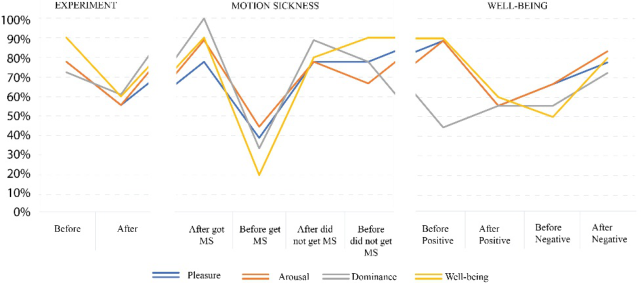
Figure 3: Trend of emotional responses from SAM and well-being.
RESULTS AND DISCUSSION
SAM Regarding the SAM tool, we found an association between the feeling of well-being with the responses on the three dimensions. However, subjects that initially stated that were uncomfortable with the experiment and parti- cipants that felt sick were the exception, having a perception of well-being below the SAM dimensions. In Figure 3, one can observe that the feeling of comfort/well-being in front of the 3 SAM dimensions (pleasure, arousal and dominance) tends - mainly - to accompany the perception of pleasure and arousal. Notwithstanding there is a difference between the SAM scales (from 9 points - from 1 to 9) and the well-being scale (from 0 to 10). Nonetheless, the plot presents the results in percentage, in which it is possible to perceive a convergence of the perception of well-being and the SAM scales.
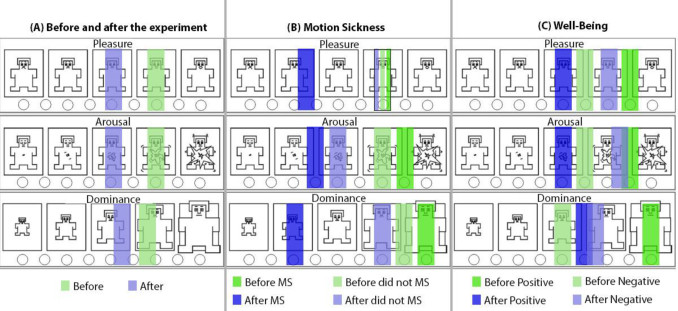
Figure 4 presents the analysis of the 3 dimensions: A - from the perspe- ctive of the experiment in general; B - the analysis of the 3 dimensions in the perspective of MS; C- the analysis of the 3 dimensions in the perspective of ratings of well-being.
From the global perspective of the experiment, it is possible to notice that the dimensions, predominantly, started high and had a fall at the end of the experiment, going to neutrality. Being a 2 point drop in pleasure and arousal, and a 1 point drop in dominance (see Figure 4-A).
From the MS perspective, it is possible to conclude that sick participants had the dimensions pleasure, arousal and dominance negatively affected, with emphasis on the last one, which went from maximum positive to negative. Also, noteworthy is the non-alteration of those who did not get sick in the pleasure dimension (see Figure 4-B).
Finally, in relation to well-being, it is possible to observe the inversion of those with a negative well-being perception, being the only one who had the SAM dimensions changed from a negative to a positive perspective (see Figure 4-C).
The Cronbach’s alpha of the SAM of the initial and final experiment was 0.85, which refers to a good reliability of the answers.
Figure 4: SAM dimensions.
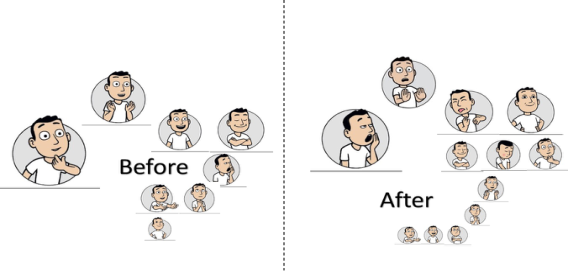
PrEmo Regarding PrEmo, it was possible to observe changes in emotions before and after the experiment. Having initially fascination, admiration, joy and sati- sfaction, boredom, desire and hope, and pride, in order of relevance. And at the end: boredom, fear, disgust and pride, fascination - satisfaction and shame, admiration, hope and anger - desire and joy. Contempt and sadness’ emotions did not appear in any of the two moments (see Figure 5).
From the perspective of MS, those who got sick lost admiration, fascina- tion, hope, joy, satisfaction, and desire, respectively. And the emotions of fear, disgust and shame appeared. Disgust, fascination and fear are the main emo- tions for sick participants. For those who didn’t get sick, boredom and pride significantly increased and fascination decreased (see Table 1).
It is important to highlight the difference in emotions of PrEmo before and after MS. Participants who got sick had fear, disgust and shame and boredom. Participants who didn’t get sick felt boredom first, then pride. The question here is whether these evoked emotions are related to the MS, or to the labora- tory context: the fear or shame of getting sick in front of the researchers? Or the boredom of the constant stimuli in a laboratory environment? After all,
Figure 5: PrEmo responses before and after the experiment. The size of the circles indicate the frequency of the emotion it represents.
Emotional Responses to Motion Sickness in Autonomous Driving 27
Table 1. Ranking of PrEmo.
Table available in the original PDF paper.
practically half of the participants did not get sick and watched the video until the end, and some mentioned the repetitiveness of the activity.
It is still evident that negative emotions (fear, disgust, shame and anger) were not present in participants who were not sick. Likewise, positive emo- tions (fascination, admiration, hope, desire and joy) were not mentioned by the participants who felt sick.
CONCLUSION
This study aimed to study the influence of MS levels on the emotional response of individuals through a practical case, in the autonomous driving scenario. The experiment gathered a sample of 23 subjects that participated in three distinct tasks: answering the questionnaires, observing the stimulus (a 15min video of a first person car travel that intended to induce MS), and answering the same questionnaires. The questionnaires measured the emoti- onal responses of subjects through their subjective assessment with the SAM and PrEmo scales. In practice, the three analyzed dimensions (pleasure, arou- sal and dominance) of the SAM scale fell from a positive activation to a neutral one at the end of the video. In addition, participants who got sick (n = 11) had significantly more changes on the scale, changing from a posi- tive activation to a negative one. In the perception of comfort, participants who got sick went from a highly positive perception to a highly negative perception of the situation the experiment simulated (an autonomous car trip). In the PrEmo scale, participants started with emotions of fascination, admiration, joy, satisfaction, and boredom and, in the end, they experienced emotions of boredom, fear, disgust, pride, fascination and satisfaction, for example. But when analyzed from the MS perspective, the change is even more representative, as participants who felt sick reported a set of negative emotions by PrEmo, in addition to a greater gap in the drop in SAM compa- red to people who did not feel sick. These data shows that the feeling of MS interferes negatively with human emotions.
One important limitation of this study is the induction of MS in a labora- tory environment, since it can affect both the induction of motion sickness and participants’ own emotions—not all participants got sick as we initially expected. Another point still to be questioned is the feeling of comfort in the face of the experiment, which generally followed the trend of emotions. For this reason, an analysis in a real context is suggested. In addition, given the points observed in the laboratory context, it is suggested for future work to analyze emotions in laboratory contexts in the same context, but with the use of artifacts to mitigate MS.
Main conclusion of this work is that MS impacts the emotional response of individuals that changed from positive to negative levels. Understanding the user experience and their emotions allows a better design of the service or pro- duct, to promote positive experiences and well-being for future autonomous cars.
ACKNOWLEDGMENT
This initiative was supported through the Multiannual Funding of the Land- scape, Heritage and Territory Laboratory (Lab2PT), Ref. UID/04509/2020, financed by national funds (PIDDAC) through the FCT/MCTES and the European Structural and Investment Funds in the FEDER component, through the Operational Competitiveness and Internationalization Pro- gramme (COMPETE 2020) [Project n° 039334; Funding Reference: POCI- 01-0247-FEDER-039334]. We would like to thank all subjects that partici- pated in the sample collection.
REFERENCES
Bradley, M. M., & Lang, P. J. (1994) “Measuring Emotion: The Self-Assessment Manikin And The Semantic Differential. Journal of Behavior Therapy and Expe- rimental Psychiatry”, 25(1), pp. 49–59. doi: 10.1016/0005-7916(94)90063-9 Cardello, A. V. & Jaeger, S. R. (2016) “Measurement of consumer product emoti-
ons using questionnaires”. In: Meiselman, H. L. (Org.). Emotion Measurement. Duxford: Elsevier, pp. 165–200. doi: 10.1016/B978-0-08-100508–8. 00008–4 Dahlman, J., Sjörs, A., Lindström, J., Ledin, T., & Falkmer, T. (2009) “Performance and autonomic responses during motion sickness”. Human factors, 51(1), 56–66. doi: 10.1177/0018720809332848 Desmet, P. (2003) “Measuring emotion: Development and application of an instru-
ment to measure emotional responses to products”. In Funology, Dordrecht: Springer, pp. 111–123. Desmet, P.M.A. (2018). Measuring emotion: Development and application of an instrument to measure emotional responses to products. In: M.A. Blythe & A.F. Monk (Eds.), Funology 2: from usability to enjoyment (pp. 391–404). Springer Publishing. Desmet, P. (Feb 14, 2022) Premotool. Emotion Studio Website, Rotterdam:
https://www.premotool.com/ Diels, C., & Bos, J. E. (2016) “Self-driving carsickness”. Applied ergonomics, 53, 374–382. doi: 10.1016/j.apergo.2015.09.009
Emotional Responses to Motion Sickness in Autonomous Driving 29
Iskander, J., Attia, M., Saleh, K., Nahavandi, D., Abobakr, A., Mohamed, S., ... & Hossny, M. (2019) “From car sickness to autonomous car sickness: A review”. Transportation research part F: traffic psychology and behaviour, 62, 716–726. doi: 10.1016/j.trf.2019.02.020 Keshavarz, B., & Hecht, H. (2014) “Pleasant music as a countermeasure against
visually induced motion sickness”. Applied ergonomics, 45(3), pp. 521–527. Margolis, I. ; Providencia, B. (2021) “Student Satisfaction through an Adaptation of the SAM Method? An Analysis from Consumption to Post-Consumption in Higher Education Degrees” IEEE Transactions on Education, pp. 284–288. doi: 10.1109/ICET52293.2021.9563155 Ribeiro, I. M. (2020) “Mapeamento da hedonomia e das experiências emocionais: A
percepção do aluno no ensino superior sob a perspectiva do design emocional”. Universidade Federal de Pernambuco, Recife. Zezelj, V. (2020, September, 8) “Automotive AI: Utilizing artificial intelligence in cars”. [Blog post]. Retrieved fromhttps://visagetechnologies.com/artificial- intelligence-in-cars/
LISTED IN THE AHFE DIGITAL BOOKSTORE CATALOGUE
Explore the complete digital volume
Affective and Pleasurable Design
Read this individual research paper free through the original publisher, or explore the full digital proceedings book.
ISBN 978-1-958651-17-9
Explore this ISBN in the AHFE Bookstore ↗Listed in the July 2026 bookstore catalogue; search by ISBN to confirm current availability · Digital book purchase optional