Nooshin Atashfeshan, Felix Dreger, Yannick Metzler, Fabian Rösler, Georgios Karantinakis, Georgios Athanassiou (2025). Shared Design Principles in Human-Robot Systems: A Work Domain Perspective. In: Human Factors in Robots, Drones and Unmanned Systems. AHFE Open Access, vol. 179, pp. 115–125. https://doi.org/10.54941/ahfe1006380
Amid the growing focus on integrating smart technologies in modern industries, human-centred design in human-robot collaboration (HRC) systems remains underdeveloped and largely research-oriented. Therefore, there is a need for practical approaches that assist designers in creating more effective human-centred HRC systems. In this regard, this study applies Work Domain Analysis (WDA) to interaction design in three multi-human, multi-robot (MH-MR) systems, including industrial assembly, construction, and agriculture, as part of the EU Horizon project SOPRANO. Separate WDAs for each use case, analyse the system from different abstraction levels, identify key interaction points between system components, and form the basis for initial sociotechnical requirements in interaction design. A thematic comparison of these requirements across four key areas— (1) user interfaces and communication systems, (2) control and authority sharing, (3) workflow synchronization, and (4) safety assurance—reveals shared design principles and system-specific considerations. These insights contribute to the development of advanced, human-centred collaborative robotics adaptable to diverse work environments.
The European Commission has recently outlined the key goals of Industry 5.0, which go beyond efficiency and productivity as the primary objectives. It highlights the role and contribution of industry to society, emphasizing a human-centric approach that requires technology to adapt processes based on users’ state and behaviour (European Commission, 2023). Achieving this vision requires integrating advanced collaborative robots that align with
human preferences and needs, particularly in terms of safety, ergonomics, and well-being, in industrial settings (Gualtieri et al., 2024).
In line with these objectives, the EU Horizon project SOPRANO (Socially Acceptable and Trustworthy Human-Robot Teaming for Agile Industries) launched in 2023, brings together 19 international organizations to develop the next generation of intelligent multi-agent systems for manufacturing, construction, and agriculture (EU Horizon Europe, 2023). Despite the increasing use of robotic platforms in these domains as well as in others, a comprehensive sociotechnical design guidance for Human-Robot Collaboration (HRC) in practice is still lacking. Most existing guidelines, such as Gualtieri et al. (2024) and Gualtieri et al. (2022), are rather rooted in scientific literature or lab experiments than validated through real-world applications.
Addressing this gap, the current study aims to establish sociotechnical guidelines for human-centred work design with real-world applications. To achieve this, the study employs a Work Domain Analysis (WDA) to analyse Multi-human, Multi-robot (MH-MR) systems at different abstraction levels.
The WDA is the initial stage of the Cognitive Work Analysis (CWA) Framework, supporting the design and evaluation of complex sociotechnical systems (Vicente, 1999). WDA focuses on understanding the fundamental objectives of a system and the means through which these objectives are achieved, independent of specific events. To accomplish this, WDA employs an abstraction hierarchy to decompose the system into different interconnected levels. These levels are linked through means- end relationships, illustrating how lower-level components contribute to higher-level objectives. By analysing these dependencies, WDA identifies critical interactions essential for system functionality. Furthermore, by anticipating constraints related to system objectives, necessary functions, and actor competencies for seamless joint task performance, WDA facilitates the extraction of baseline interaction requirements, providing a structured foundation for early system design.
Given the potential overlap in design requirements across different systems, it is expected that the results of WDA—including sociotechnical requirements—may mutually inform the design of other MH-MR systems. This raises the question of whether, and to what extent, applying WDA and related sociotechnical requirements can guide designers in developing systems with similar human-robot interaction objectives. To explore this, the study conducts a thematic comparison of the sociotechnical requirements across the three SOPRANO use cases, providing a basis for more effective and adaptable interaction design in HRC systems based on practical information.
HUMAN-ROBOT COLLABORATION: USE CASES IN INDUSTRIAL SETTINGS The SOPRANO project advances research and innovation in HRC within manufacturing, construction, and agriculture, with a focus on developing trustworthy and accepted MH-MR systems. These objectives are shaped by a comprehensive analysis of business needs of three key use cases, contributed
Shared Design Principles in Human-Robot Systems: A Work Domain Perspective 117
by three project partners, namely KUKA Assembly & Test, Centro Ricerche Fiat, and ETERRY, as detailed below.
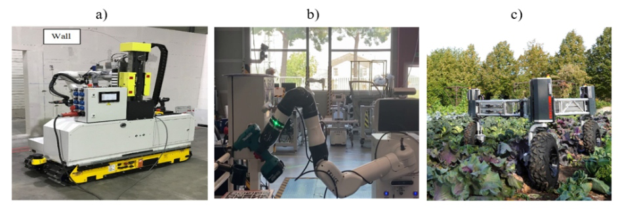
Use Case 1 (UC 1): Residential Building Renovation KUKA, a global automation machinery manufacturer, develops a versatile robotic platform for automating construction renovation tasks, including room measurement, drilling, milling, plastering, and plasterboard installation (Figure 1a). In the SOPRANO project use case, the focus is on installing electrical systems in collaboration with human workers.
The process involves a human operator remotely positioning the robot within the building and configuring operation parameters through a Human- Machine Interface (HMI). Once set, the robot autonomously navigates between rooms, performing complementary tasks to support the worker’s activities. The collaboration is sequential, requiring strong mutual spatial and temporal awareness to enhance efficiency. While the human can move freely around the robot, effective coordination is essential to maintain safety and productivity.
Use Case 2 (UC 2): Vehicle Door Assembly Centro Ricerche Fiat (CRF), as part of Stellantis — a motor vehicle manufacturing company—integrates a MH-MR team into its car door assembly line, which consists of 3 disassembly workstations dedicated to disassembling gaskets, carriers, rearview mirrors, glass panels, screws, and door panels. The system incorporates two robots: FELICE, an autonomous mobile robot developed by ACCREA (https://accrea.com), and a six-axis Universal Robot (UR). These robots collaborate with human workers to support component assembly/disassembly, material transport, and quality inspection.
FELICE robot, equipped with an interactive head that displays information to users and collect audio and video data from the environment (Figure 1b), can grasp and release objects within the industrial settings. Within the SOPRANO project, it is responsible for handing over and receiving tools required for the disassembly process. The UR robot is integrated with a DEPRAG Screwdriver Function Module end effector for automated unscrewing of the carrier, along with a camera and a machine vision algorithm to manage this phase. Effectively coordinating multiple robots and human workers is critical for optimizing assembly line efficiency.
Use Case 3 (UC 3): Symbiotic Farming E-TERRY, a German start-up specializing in symbiotic farming, has developed an autonomous agricultural robot designed to advance sustainable large-scale farming. The robotic platform features a highly agile carrier system with adjustable height and track width, allowing it to adapt to different crops and growth stages (Figure 1c).
The primary function of this robot is autonomous mechanical weeding; however, within the SOPRANO project, the robot is dedicated to assisting field workers during harvesting by transporting harvested crops to a central unloading location, where workers manually empty and reload the boxes. After completing the unloading process, the robot returns to the previously processed row and resumes its task.
Seamless interaction between field workers and the robotic platform is crucial for enhancing agricultural efficiency, reducing manual labor, and minimizing delays in harvesting.
Figure 1: Robotic platforms of the studied use cases.
WORK DOMAIN ANALYSIS AND SOCIOTECHNICAL REQUIREMENTS Providing the sociotechnical requirements typically begins with the creation of a functional description of the system using methods like WDA. This approach describes the system across five levels of abstraction: (a) Functional Purposes – the reasons for the system’s existence; (b) Values and Priority Measures – the criteria used to assess whether the system is achieving its purposes; (c) Purpose-related Functions – the essential functions needed to achieve the system’s goals; (d) Object-related Processes – the capabilities of physical objects within the system; and (e) Physical Objects – tangible entities involved in the system. Relationships between different levels are represented by means-end links, which describe the dependencies between system elements (Naikar, 2016).
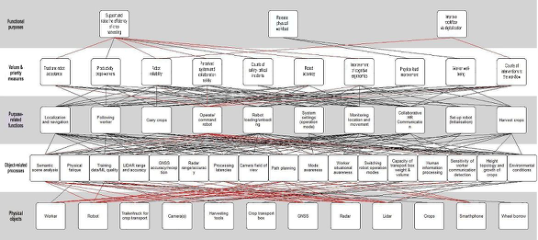
The WDAs for the three use cases were developed through multiple meetings and workshops with technical partners, human factors specialists, and use case owners of the SOPRANO project. Based on an analysis of different levels of WDA and their means-end relationships, the corresponding sociotechnical requirements were derived. Figure 2 and Table 1 present the WDA and the respective design requirements for the third use case.
Figure 2: Work domain analysis of the symbiotic farming use case (UC 3). Highlighted are the means-end links based on the WDA-node “Operate/command robot” (in red).
Shared Design Principles in Human-Robot Systems: A Work Domain Perspective 119
In Figure 2, the WDA for the symbiotic farming use case (UC 3) illustrates the key objectives of MH-MR collaboration in crop harvesting. The highest-level functional purpose is to ‘support and raise the efficiency of crop harvesting,’ supported by goals such as ‘releasing physical workload’ and ‘improving workflow via digitalization.’ The WDA identifies values and priority measures enabling these purposes, including human-related measures like ‘trust and robot acceptance,’ robot-specific measures like ‘robot reliability,’ and workflow-related values such as ‘counts of interventions in workflows.’ The diagram also maps purpose-related functions, object-related processes, and physical objects of this use case, highlighting interconnections through means-ends relationships. Red lines emphasize critical dependencies linked to the ‘Operate/command robot’ node, as an example. This figure focuses on UC 3, but similar WDAs have been developed for the other use cases as well (SOPRANO, 2024).
An analysis of WDA layers and their dependencies led to discover 89 sociotechnical requirements: 19 for UC 1, 36 for UC 2, and 34 for UC 3, reflecting the greater complexity of the system with a higher number of requirements.
These requirements follow the NASA Systems Handbook guidelines (Hirshorn et al., 2017), using ‘shall,’ ‘should,’ and ‘may’ to indicate priority and criticality. Table 1 presents sample requirements for the WDA illustrated in Figure 2, detailing key information. Alongside the ‘Requirement Description’, the ‘WDA Node’ defines the purpose-related function, while ‘Interaction Entities’ specify the entities involved in MH-MR collaboration. ‘Rationale’ explains the necessity of each requirement, ‘Constraints and Challenges’ highlight implementation obstacles, ‘Means of Resolution’ propose solutions, and ‘Means of Verification’ provide options for evaluating the implementation of these requirements in the SOPRANO use cases.
Table 1: Examples of sociotechnical requirements derived from the WDA of symbiotic farming use case (UC 3).
Table available in the original PDF paper.
WDA Node
Interaction Entities
Requirement Description
Rationale Constraints/ Challenges
Means of Verification
Means of Resolution
Worker/ Robot
Operate/ command robot
Improves mode awareness
Instructional and UI design
Task efficiency and Usability analysis
The robot shall display the current operation mode.
Definition of mode changes, Communication of mode capabilities, Coherent auditory or visual UI design.
Continued
Table 1: Continued WDA Node Interaction Entities Requirement Description
Table available in the original PDF paper.
Rationale Constraints/ Challenges
Means of Verification
Means of Resolution
Worker/ Robot
Set- up robot
Usability and instructional load evaluation.
The robot should confirm the correct initialization.
Test and design validation. Visual display and information design
Ensures safe and efficient deployment as well as possible guidance to the worker
Define correct system set-up under all conditions, Provide access to instructions prior to initialisation
During the requirement development stage, we observed consistent trends in the sociotechnical requirements across the three use cases. Identifying these trends and uncovering common design elements can significantly enhance the effectiveness of HRC system design. Therefore, by using Thematic Analysis (TA), we identified recurring themes and categorized the requirements accordingly. This method was employed to identify common themes within the qualitative data, offering greater flexibility compared to methods grounded in specific theoretical or epistemological frameworks (Yang et al., 2024). TA aims at highlighting shared interaction design principles that can be generalized and adapted for HRC applications in other domains, promoting more standardized and scalable system development.
RESULTS
Following the TA structure proposed by Braun and Clarke (Braun & Clarke, 2006), the coding and theme development were carried out after becoming thoroughly familiar with the data. The themes were identified manually by authors using an inductive approach. In applying this approach, four key themes were identified including (I) User Interface, Feedback, and Communication Systems, (II) Control and Authority Sharing, (III) Safety Assurance and Threat Detection, and (IV) Workflow Synchroniza- tion/Monitoring. The three use cases and their derived sociotechnical requirements from WDAs were analysed and compared within these thematic categories. Similar requirements were identified within each theme, offering valuable insights for HRC designers to design systems in a way that complements human abilities and needs, ensuring both sides work harmoniously. Additionally, differences in the number and priority of the requirements for each theme were observed, attributed to context-specific factors and the type of collaboration involved. It is worth mentioning that some themes, such as handover or training, appeared in the requirements of specific use case. However, since these themes were not consistently present across all use cases, they were excluded from the final analysis.
Shared Design Principles in Human-Robot Systems: A Work Domain Perspective 121
User Interface, Feedback and Communication Systems In HRC, interface, feedback, and communication systems play a crucial role in ensuring efficient, safe, and intuitive interactions. Interfaces allow users to interact with robots in a user-friendly manner. Feedback systems provide real-time updates on the robot’s status and actions, improving transparency and predictability. Effective communication systems facilitate seamless information exchange, reducing misunderstandings and enhancing coordination. By integrating these elements, HRC becomes more intuitive, reducing cognitive load, increasing situational awareness, and fostering trust, ultimately leading to safer and more efficient teamwork (Andronas et al., 2023). Across the SOPRANO use cases, common information exchanged includes the robot’s current status, robot’s next action, task status feedback, failure and error information, and alerts for potential spatial conflicts. However, the type and priority of some exchanged information vary based on contextual characteristics. Table 2 summarizes these differences. For example, in UC 3, where the agricultural robot collaborates with multiple field workers, a greater emphasis is placed on theme I to prevent conflicts and ensure seamless coordination. In UC 2, interaction requirements hold high priority due to the presence of multiple robots, where any miscommunication can impact both system performance and human well-being.
Table 2: Frequency and priority of the theme ‘User Interface, Feedback, and Communication Systems’ across three use cases and their specific design requirements.
Table available in the original PDF paper.
Theme UC 1 (Residential
UC 2 (Vehicle Door UC 3 (Symbiotic Building Renovation) Disassembly) Farming)
User Interface,
12 requirements (42% high priority)
13 requirements (92% high priority)
27 requirements (37% high priority)
Visual feedback for BIM Feedback on tool
Feedback on detection
Feedback, and Communication Systems
file updates; notify the user when a quality control check is required; inform the user of the need to relocate to meet task execution positioning requirements
handover readiness/ completion; Feedback on workflow deviation (screwdriver or the component is not present); Calling the robot to the workstation by the human; Requesting the robot to pass or receive an object
of the targeted worker; Feedback on Recognition of gestures; Information about available modes and how to change them; A set of clearly defined gestures for communication; Information on the distance and space where communication is possible
Control and Authority Sharing The human operator, as the final responsible agent in HRC systems, must maintain optimal control over the robots’ actions throughout the process to avoid an authority-responsibility mismatch. This mismatch could lead to increased workload due to more vigilant monitoring and confirmation/rejection tasks, or human out-of-the-loop issues in abnormal
situations, particularly during robot failures (Ma et al., 2022). Therefore, maintaining appropriate control can enhance human acceptance, trust, and efficiency when working with collaborative robots. Considering this, in the SOPRANO use cases, one of the key design principles is ensuring that humans have the authority to determine or reject robot actions, when necessary, as well as the ability to stop the robot or place it in standby mode. Furthermore, clearly defining roles and responsibilities supports cognitive processes such as decision-making in both routine operations and potentially critical non- routine situations. These principles are recognized as shared interaction requirements across all use cases. While adherence to these common design principles is essential, the level of authority granted to different agents varies depending on specific use case characteristics, as detailed in Table 3.
Table 3: Frequency and priority of the theme “control and authority sharing” across three use cases and their specific design requirements.
Table available in the original PDF paper.
UC 3 (Symbiotic
Theme UC 1 (Residential Building UC 2 (Vehicle
Farming)
Renovation)
Door Disassembly) 12 requirements (42% high priority) 9 requirements (88% high priority)
Clear transition
Requesting the
Approving transition to
4 requirements (50% high priority) Control and Authority Sharing robot to return the component at any time by the human of authority among multiple workers; Confirming the correct initialization by the robot
next task by the human; Controlling/changing the mounted end-effector in accordance with the planned task by the human; Easily control the robot to the designated position for autonomous robot execution
Safety Assurance and Threat Detection Every human-machine collaboration necessitates the prioritization of human safety, which must be integrated into both robot design and task structuring. Constantly monitoring the proximity limits with integrating the alert systems for the potential conflicting spatial proximities, emergency shut-off, and mutually aware of the dynamic positioning of the agents are the common requirements across three use cases. For UC 2, due to the presence of multiple robots, there are specific requirements for managing safety-related concerns in this use case, presented in Table 4.
However, it is worth mentioning that the requirements derived from WDAs mainly focus on sociotechnical factors, where safety is not just a standalone factor but an overarching principle shaping the design, implementation, and operation of HRC systems. Safety is a critical factor that affects all other aspects of HRC. While the most critical safety-related requirements are
Shared Design Principles in Human-Robot Systems: A Work Domain Perspective 123
considered here, a thorough analysis of this factor is beyond the scope of this study. Therefore, a separate study is warranted to explore this topic in depth.
Table 4: Frequency and priority of the theme “safety assurance and threat detection” across three use cases and their specific design requirements.
Table available in the original PDF paper.
Theme UC 1 (Residential
UC 2 (Vehicle Door UC 3 (Symbiotic Disassembly) Farming) Building Renovation)
Safety Assurance and Threat Detection
2 requirements (100% high priority)
4 requirements (50% high priority)
2 requirements (100% high priority) - (No specific
Avoiding
- (No specific
requirement)
requirement) unpredictable movements during handover; Determining spatial separation zones between the UR and FELICE robots by marking color-coded zones on the ground.
Workflow Synchronization/Monitoring Dynamic workflow improvements through interaction enhance system fluency by reducing human and robot idle times, resulting in a well- synchronized meshing of their actions (Hoffman, 2019). This aspect becomes particularly significant in tasks with high interdependence or sequential execution, such as those in SOPRANO’s manufacturing and construction use cases. In this regard, requirements such as synchronizing the speed and timing of robots and humans, as well as ensuring that workflow-related information is coherently structured, easily accessible to all collaborative elements, and intuitively understandable (e.g., through symbolic representations), serve as key design principles in these use cases (UC 1 and UC 2). Additionally, UC 2 includes specific requirements under this theme that account for the contextual characteristics of the case, as outlined in Table 5.
Table 5: Frequency and priority of the theme “workflow synchronization/monitoring” across three use cases and their specific design requirements.
Table available in the original PDF paper.
Theme UC 1 (Residential
UC 3 (Symbiotic
UC 2 (Vehicle Door Disassembly) Farming) Building Renovation)
0 requirements
2 requirements (100% high
4 requirements (50% high
Workflow Synchronization/ priority)
priority)
Monitoring
Continued
Table 5: Continued Theme UC 1 (Residential
Table available in the original PDF paper.
UC 3 (Symbiotic
UC 2 (Vehicle Door Disassembly) Farming) Building Renovation)
- (No specific
Ensuring the robot
-
requirement)
does not abandon the collaborative task until it is fully
performed and completed, avoiding unnecessary interruptions to the
human during the workflow; Ensuring the robot
follows a consistent schedule for handovers at the workstation.
CONCLUSION
This study identifies shared design principles for HRC systems by comparing sociotechnical requirements across three domains: manufacturing, construction, and agriculture. With the help of WDA, the systems were analysed at different abstraction levels, and by examining the relationships between these layers, critical system constraints were identified and subsequently translated into sociotechnical design requirements.
Through thematic analysis, these sociotechnical requirements were compared under four key themes: User Interface, Feedback, and Communication Systems; Control and Authority Sharing; Safety Assurance and Threat Detection; and Workflow Synchronization/Monitoring. Among these, user interface, feedback, and communication systems emerged as the most critical, emphasizing the importance of effective communication in HRC, particularly in multi-agent systems. Additionally, balanced control and authority sharing was highlighted as essential to prevent human-out-of-the- loop issues and ensure seamless collaboration. Despite shared principles, differences in sociotechnical requirements arose due to context-specific factors such as task-specific (e.g., task interdependencies), collaboration- specific (e.g., team composition), and technology-specific factors (e.g., robot capability), leading to variations within each theme.
While this study can serve as a starting point for providing a comprehensive guideline for HRC system design based on real applications, broader validation across additional real-world applications and domains would enhance its generalizability. Ultimately, this research lays a solid foundation for the development of human-centric, socially acceptable robotic systems that collaborate with humans, ensuring that emerging technologies integrate human factors and shape the future of HRC research and application.
Shared Design Principles in Human-Robot Systems: A Work Domain Perspective 125
ACKNOWLEDGMENT
This work has received funding from the European Union’s Horizon 2023 Research and Innovation program under GA No. 101120990.
REFERENCES
Andronas, D., Kampourakis, E., Papadopoulos, G., Bakopoulou, K., Kotsaris, P. S., Michalos, G., & Makris, S. (2023). Towards seamless collaboration of humans and high-payload robots: An automotive case study. Robotics and Computer- Integrated Manufacturing, 83, 102544. Braun, V., & Clarke, V. (2006). Using thematic analysis in psychology. Qualitative
research in psychology, 3(2), 77–101. EU Horizon Europe. (2023). SOPRANO. Socially-Acceptable and Trustworthy Human-Robot Teaming for Agile Industries (HORIZON.2.4.5 - Artificial Intelligence and Robotics, Issue. https://cordis.europa.eu/project/id/101120990, zuletzt geprüft am 08.01.2025. European Commission. (2023). Industry 5.0. https://research-and- innovation.ec.europa.eu/research-area/industrial-research-and-innovation/ industry-50_en Gualtieri, L., Fraboni, F., Brendel, H., Pietrantoni, L., Vidoni, R., & Dallasega, P.
(2024). Updating design guidelines for cognitive ergonomics in human-centred collaborative robotics applications: An expert survey. Applied Ergonomics, 117, 104246. Gualtieri, L., Fraboni, F., De Marchi, M., & Rauch, E. (2022). Development and evaluation of design guidelines for cognitive ergonomics in human-robot collaborative assembly systems. Applied Ergonomics, 104, 103807. Hirshorn, S. R., Voss, L. D., & Bromley, L. K. (2017). NASA systems engineering
handbook. Hoffman, G. (2019). Evaluating fluency in human–robot collaboration. IEEE Transactions on Human-Machine Systems, 49(3), 209–218. Ma, L. M., Ijtsma, M., Feigh, K. M., & Pritchett, A. R. (2022). Metrics for human-
robot team design: A teamwork perspective on evaluation of human-robot teams. ACM Transactions on Human-Robot Interaction (THRI), 11(3), 1–36. Naikar, N. (2016). Work domain analysis: Concepts, guidelines, and cases. CRC press. SOPRANO. (2024). D1.3 Early Prototype Framework Requirements for MH-
MRs https://www.soprano-project.org/_files/ugd/d3bb5c_88c9cb94c619477a94 a29df48f8c70d2.pdf. Vicente, K. J. (1999). Cognitive work analysis: Toward safe, productive, and healthy computer-based work. CRC press. Yang, X., Amtsberg, F., Sedlmair, M., & Menges, A. (2024). Challenges and
potential for human–robot collaboration in timber prefabrication. Automation in Construction, 160, 105333.
LISTED IN THE AHFE DIGITAL BOOKSTORE CATALOGUE
Explore the complete digital volume
Human Factors in Robots, Drones and Unmanned Systems
Read this individual research paper free through the original publisher, or explore the full digital proceedings book.
ISBN 978-1-964867-55-7
Explore this ISBN in the AHFE Bookstore ↗Listed in the July 2026 bookstore catalogue; search by ISBN to confirm current availability · Digital book purchase optional