Oliver Tian, Vesa Salminen, Bryon Tian (2026). Humans and Humanoids for Optimal Performance: Rethinking Work in the Age of Hybrid Intelligence. In: Human Factors, Business Management and Society. AHFE Open Access, vol. 215, pp. 1–14. https://doi.org/10.54941/ahfe1007580
Artificial intelligence is no longer abstract code running in cloud servers, but embodied agency walking among us. Humanoid robots, once the stuff of cinematic imagination, are now being tested in factories, hospitals, warehouses, and elder care facilities. They possess bipedal locomotion, dexterous manipulation, sensory perception, and increasingly, the ability to understand natural language and respond contextually. Their arrival signals not just a technological advancement, but a philosophical challenge: what does it mean to work alongside a machine that looks like us, moves like us, and learns like us—yet is fundamentally different?This research has used the approach of active-based and qualitative research. The data for analysis has been collected by making observations in real-world deployments and comparing them with theoretical frameworks in cognitive science, robotics, and organizational behavior. To analyze the development of continuously developing interaction with humans and humanoids, the following questions have been raised:•How does work-life change in the pressure of AI and robotics implementation?•How to define the balance of interaction between humans and humanoids in work-life?•How to specify the optimal performance when integrating humanoids in the workplace?•How to capture the developmental arc of human–robot teamwork as a progression model?The integration of humanoid robots into the workplace is redefining optimal performance, not through automation alone, but through human–humanoid collaboration. Optimal performance is achieved when efficiency, safety, innovation, and employee well-being are balanced with sustainability and human dignity. We can see that humanoids, designed with human-like form and AI-driven intelligence, are no longer mere tools but evolve into partners that extend human capabilities as force multipliers, cognitive extensions, and emotional buffers. We are just at the beginning stage of this journey.This study argues that optimal performance does not emerge from replacing human workers with machines, but from designing hybrid ecosystems where biological and synthetic agents co-evolve through mutual learning, calibrated trust, and role complementarity. We introduce the concept of the Learning Spectrum, a five-stage model tracing the progression from observation to reciprocal teaching, which captures the developmental arc of human–robot teamwork. It is important to illustrate how collaboration, must mature from observation to co-evolution, emphasizing bidirectional learning: humans teach context and values; robots teach precision and scalability. This synergy is set to foster the rise of the "AI Champion"—a new archetype who leverages AI not to compete, but to think deeper, adapt faster, and innovate better.This article introduces actionable recommendations for business enterprises seeking to navigate the transition to human–humanoid co-evolution. These include redesigning roles around complementarity, implementing adaptive handoff protocols, fostering explainable autonomy, and cultivating cultures of bidirectional trust. The profound outcome of the AI revolution may not be smarter machines, but wiser humans. By fostering conditions under which humans and humanoids learn together, organizations can transcend traditional performance metrics and move toward a future where technology serves not only economic goals, but human dignity and purpose.
As we stand on the cusp of a new era defined by the convergence of artificial intelligence and embodied robotics, the nature of work is undergoing a transformation as profound as the Industrial Revolution. The integration of intelligent humanoids, physically embodied, cognitively capable machines, into the workplace is no longer a speculative future but an unfolding reality. From manufacturing floors to healthcare facilities, from logistics hubs to customer service centers, humanoid robots are transitioning from research prototypes to operational partners. This shift demands more than technological adaptation; it requires a fundamental rethinking of organizational design, human competence, and the very definition of optimal performance. Their arrival signals not just a technological advancement, but a philosophical challenge: what does it mean to work alongside a machine that looks like us, moves like us, and learns like us, yet is fundamentally different?
Artificial intelligence (AI) has made the crossing of the critical threshold possible.
These machines are not merely tools; they are active participants in human environments, from automotive assembly lines and hospital wards to elder care facilities and logistics hubs. Their presence signals more than a technological leap - it poses a philosophical reckoning: What does it mean to work alongside a being that looks like us, moves like us, and learns like us—yet remains fundamentally other?
This question lies at the heart of a paradigm shift in organizational design, labor theory, and cognitive science. As humanoid robots transition from controlled industrial settings into dynamic, unstructured workplaces, they compel us to move beyond the outdated logic of automation-as-replacement. Instead, we must embrace a new vision: hybrid intelligence, where optimal performance emerges not from human or machine, but from their intentional, reciprocal collaboration.
Humans bring empathy, contextual judgment, moral reasoning, and abductive inference—the ability to generate plausible explanations from incomplete data. These qualities enable us to navigate ambiguity, build trust, and make ethically grounded decisions. However, humans are constrained by fatigue, cognitive bias, physical vulnerability, and limited bandwidth for processing vast data streams. In contrast, humanoids offer precision, endurance, scalability, and tireless data-processing power. They can operate in hazardous environments, perform repetitive tasks with unwavering consistency, and integrate information across multiple sensory inputs in real time. Yet, they lack intrinsic values, emotional intelligence, and the lived experience that underpins genuine understanding.
To navigate this emerging landscape, we introduce the Learning Spectrum - a five-stage model that traces the developmental arc of human–humanoid teamwork from passive observation to reciprocal teaching. We also identify a new professional archetype: the AI Champion, an individual who leverages humanoid partners not to outsource cognition, but to amplify strategic thinking, cross-domain creativity, and systemic problem-solving. Ultimately, this paper contends that the most profound outcome of the AI revolution may not be smarter machines, but wiser humans.
RESEARCH QUESTIONS AND METHODOLOGY APPROACH This research has used the approach of active-based and qualitative research. The data for analysis has been collected by making observations in real-world deployments and comparing them with theoretical frameworks in cognitive science, robotics, and organizational behavior. To analyze the development of continuously developing interaction with humans and humanoids, the following questions have been raised:
How does work-life change in the pressure of AI and robotics implementation?
How to define the balance of interaction between humans and humanoids in work-life?
How to specify the optimal performance when integrating humanoids in the workplace?
How to capture the developmental arc of human–robot teamwork as a progression model?
This research is partly constructive, conceptual, and analytical because it re-evaluates the concept of competency model and its adoption by organizations when they deal with the dynamic business opportunities in the marketplace coupled with accelerated emergence of proven technologies.
THE IMPERATIVE FOR INTEGRATION: WHY HUMANOIDS NOW?
The timing of humanoid integration is neither accidental nor speculative. It is the product of converging technological, demographic, and economic forces. Advances in sensor fusion, battery density, actuator efficiency, and large language models (LLMs) have collectively enabled a new generation of autonomous systems capable of operating in complex, unpredictable environments (Driess et al., 2023). Unlike fixed industrial arms of the 20th century, today’s humanoids, such as Tesla’s Optimus, Boston Dynamics’ Atlas, and Figure 1 as well as those from Unitree and Booster Robotics are designed for mobility, social interaction, and contextual learning. They represent a shift from automation as mechanization to embodied intelligence that can collaborate with humans in meaningful ways.
This evolution coincides with growing labor shortages, particularly in aging societies like Japan and South Korea, where demand for caregiving, logistics, and skilled trades outpaces supply. The McKinsey Global Institute estimates that up to 30% of global work hours could be automated by 2030, with physical tasks leading the charge. Yet despite these pressures, many organizations remain trapped in outdated paradigms, either fearing job displacement or pursuing fragmented automation initiatives focused on short-term productivity gains.
One of the most common arguments for bringing AI into the enterprise is the potential for AI to help humans by complementing the work they do. But leaders first must understand whether and when AI and humans can perform better together than either can on its own. The World Economic Forum (WEF, 2025) predicted that Al and related robotics will perform more
tasks than humans. By 2030 92 million jobs are displaced and 170 million new jobs created. Implication is that we are facing a structural break in the work-worth-value equation.
Agentic AI is spreading across enterprises faster than leaders can redesign processes, assign decision rights, or rethink the workforce models. Companies that master the art of managing artificial colleagues can scale specialized capabilities without the traditional constraints of human hiring, training, and retention. (Ransbothom et al., 2025).
The real challenge is not whether machines can outperform humans at specific tasks, a reality already demonstrated across domains, but how to structure collaboration so both agents play to their strengths. Humans bring empathy, moral reasoning, abductive inference, and contextual judgment; they excel at navigating ambiguity and building trust. However, they are constrained by fatigue, cognitive bias, and physical vulnerability. Humanoids offer precision, endurance, scalability, and tireless data processing, but lack intrinsic values, emotional intelligence, and lived experience. Only by combining these complementary capabilities can organizations achieve genuine optimality—outcomes neither could reach alone.
Many enterprises remain trapped in outdated paradigms of automation- as-replacement. There is widespread anxiety among workers about job displacement, fueled by narratives equating AI progress with obsolescence. Managers struggle to distinguish between short-term fads and long-term opportunities, often delaying investment due to uncertainty about return on investment (ROI) and cultural resistance. Organizations on the leading edge must focus on workflow integration over flashy demos, prioritize customization and continuous improvement, and empower frontline managers, not centralized AI labs, to lead adoption.
The critical question, and we emphasize again, is no longer whether machines can perform certain tasks better than humans - a fact already established in many domains. Instead, the focus has shifted to a deeper, more systemic issue: How can we structure work so that humans and machines each play to their unique strengths, thereby achieving outcomes that neither could accomplish independently This mindset is dangerously reductive.
Ultimately, the future belongs not to those who automate fastest, but to those who augment wisely. By shifting from replacement to co-evolution, organizations can harness hybrid intelligence to enhance safety, reduce burnout, and scale innovation, all while preserving human dignity in an age of intelligent machines.
DEFINING OPTIMAL PERFORMANCE: BEYOND EFFICIENCY Historically, performance has been measured through narrow lenses: output per hour, error rates, cost per unit. But in the age of hybrid intelligence, such metrics are insufficient. They ignore the human experience, the ethical implications, and the long-term sustainability of work itself.
Humans + Intelligent Humanoids for Optimal Performance 5 This is not merely a technical challenge. It involves profound considerations of organizational culture, psychological safety, ethical responsibility, skill development, and trust formation. Failure to address these dimensions risks creating dysfunctional hybrids: robots that are underutilized due to fear or mistrust; humans who feel shrivelled or deskilled; systems that optimize for narrow metrics at the expense of broader well-being. By weaving together insights from robotics engineering, cognitive psychology, systems theory, and organizational development, this paper aims to provide a multidisciplinary roadmap for navigating one of the most significant shifts in the history of work.
This framework reveals the limitations of purely human or purely machine approaches. Humans bring empathy, contextual judgment, and moral reasoning, but are constrained by fatigue, bias, and physical vulnerability. Machines offer precision, endurance, and data-processing power, but lack intrinsic values, emotional intelligence, and abductive reasoning (the ability to infer the best explanation from incomplete data).
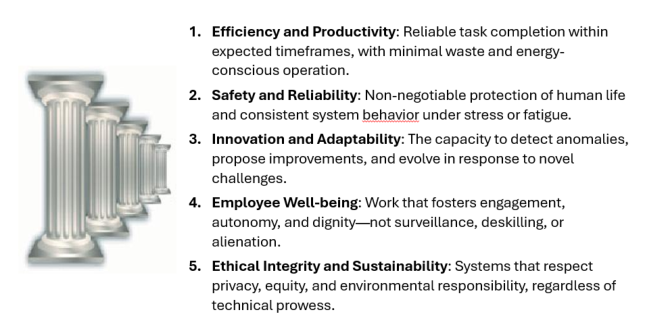
OPTIMAL PERFORMANCE: A MULTIDIMENTIONAL FRAMEWORK Before examining how humans and humanoids might collaborate effectively, it is necessary to define what we mean by optimal performance. In this paper, optimal performance is defined as a dynamic equilibrium across five interdependent pillars:
First, efficiency and productivity remain foundational. Tasks must be completed reliably and within expected timeframes. However, true optimization goes beyond raw throughput; it includes minimizing waste, reducing energy consumption, and ensuring resource-conscious operation.
Second, safety and reliability are non-negotiable, especially in high-stakes industries such as manufacturing, construction, and healthcare. A system that performs efficiently but endangers lives cannot be considered optimal. Reliability encompasses consistency over time, machines and humans must deliver predictable results even under stress or fatigue.
Third, innovation and adaptability reflect the capacity to evolve in response to changing conditions. An optimal system does not merely repeat successful patterns; it identifies anomalies, proposes improvements, and adapts to novel challenges. This requires both exploratory thinking and resilience in the face of uncertainty.
Fourth, employee well-being must be treated as a core performance metric. Work that degrades mental health, causes physical strain, or erodes autonomy may yield short-term gains at long-term cost. Optimal performance occurs when workers feel engaged, respected, and empowered, not replaced or monitored.
Finally, ethical integrity and sustainability serve as boundary conditions. Any system that compromises privacy, equity, or environmental responsibility fails the test of optimality, regardless of its technical prowess.
Figure 1: Five pillars of optimal performance framework.
When viewed through this lens, the limitations of human-only or machine- only approaches become apparent. Humans bring creativity, empathy, and contextual judgment, but are constrained by fatigue, bias, and physical vulnerability. Machines offer precision, endurance, and data-processing power, but lack intrinsic values, emotional intelligence, and moral reasoning. Only by combining these complementary capabilities can organizations approach genuine optimality.
HYPOTHESIS AND CONCEPTUAL FRAMEWORK As many of us will agree that digital transformation is not a one-off project, it is a continuous process which embraces digital introduction, digital improvement, and digital optimization. Ultimately, this transformation journey also needs to augment human performance and derive optimate efficiency. Digital fluency is the skilled level which will determine how well an organization can optimize its transformation.
This hypothesis rests on three interrelated premises. First, the principle of complementarity: humans and humanoids possess distinct cognitive and physical profiles that, when aligned strategically, produce synergistic effects greater than the sum of their parts. Second, the premise of engineered trust: unlike human teams, where trust develops organically through shared experiences, human–robot trust must be deliberately constructed through transparency, predictability, and accountability. Third, the imperative of co-learning: sustainable collaboration requires a two-way flow of knowledge, where humans teach context and values, and robots teach precision and scalability.
To operationalize this hypothesis, we propose a conceptual model comprising four interlocking layers. The first, cognitive architecture, examines differences in perception, reasoning, memory, and learning between biological and synthetic agents. The second, interaction design, focuses on communication modalities, including verbal, gestural, symbolic, and the usability of interfaces that mediate understanding. The team dynamics, analyzes constructs such as trust, role negotiation, workload sharing, conflict resolution, and group cohesion.
Humans + Intelligent Humanoids for Optimal Performance 7 The fourth, organizational enablers, includes leadership commitment, training infrastructure, incentive structures, and ethical governance frameworks.
Each layer influences the others, forming a nested system, where individual interactions scale into organizational transformation. This multi-level framework allows us to move beyond anecdotal case studies and consider the systemic conditions necessary for success. It enables cross-sectoral application, from manufacturing to healthcare to public services.
THERETICAL FOUNDATIONS – BRIDGING DISCIPLINES While a full systematic literature review is beyond the scope of this paper, our analysis draws upon several established bodies of knowledge to ground the argument in scholarly tradition. Our analysis draws on foundational theories from cognitive science, robotics, and organizational behavior. These frameworks collectively position human–humanoid collaboration not as a technical challenge, but as a deeply human endeavor requiring ethical foresight, systemic design, and mutual adaptation.
There are challenges in near future in enhancing the capabilities of humanoid robots, improving their versatility and adaptability, and making them more accessible and sustainable (Sheng et al., 2025). Recognizing that implementing the technology alone would not solve the problem, the leaders knew that they needed to fundamentally deconstruct the work, redeploy it, and reconstruct new ways of working to fully harness the platform’s capabilities. (Jesuthasan, 2025) One perspective by Edwin Hutchins’ (1995) is the concept of distributed cognition, which asserts that thinking extends beyond individual minds to encompass tools, environments, and other agents. In practice, a technician diagnosing a machine relies not only on personal expertise but also on robotic assistants, sensor data, and digital interfaces, illustrating that intelligence emerges from interaction, not isolation. This view reframes humanoids not as autonomous replacements, but as co-participants with shared cognitive process.
Complementing this is Knoblich et al.’s (2011) joint action theory, which highlights shared representations, mutual monitoring, and complementary roles as essential for effective collaboration. When a robot anticipates a worker’s need for a tool and proactively hands it over, it demonstrates more than mechanical precision - it exhibits social attunement, the ability to perceive and respond to human intentions.
From robotics, Rodney Brooks’ (1991) critique of symbolic AI gave rise to behavior-based robotics, emphasizing that intelligence arises through real- time interaction with the environment. Modern humanoids embody this principle, using sensory feedback to navigate complex spaces. The integration of large language models (LLMs) with robotic control—seen in systems like Google’s RT-2 and Figure-Maeve—marks a leap toward embodied language models capable of understanding and acting on natural language commands (Driess et al., 2023).
In organizational learning, Argyris and Schön’s (1978) distinction between single-loop and double-loop learning proves critical. Most current human– robot systems correct errors within fixed parameters (single-loop), but
Lee and See’s (2004) model of trust in automation identifies reliability, predictability, and controllability as key to user confidence. We extend this to calibrated trust, where reliance dynamically adjusts based on context and risk. Finally, Trist and Bamforth’s (1951) socio-technical systems theory remains vital: technological success depends on parallel social innovation. Deploying humanoids without addressing human concerns risks rejection, inefficiency, and ethical harm.
Together, these theories form the intellectual scaffolding for our analysis, allowing us to position human–humanoid collaboration not as a technical novelty, but as a deeply human endeavor requiring wisdom, foresight, and care. Given the nascent stage of humanoid deployment, traditional empirical methods such as randomized controlled trials are impractical. This study adopts an analytical case-based methodology, combining qualitative observation, comparative analysis, and conceptual modeling.
FINDINGS: MAPPING THE TERRAIN OF HUMAN-HUMANOID COLLABORATION Enabling natural emotional expressions is crucial for a humanoid robot. Natural emotional interaction also requires multimodal emotion perception— robots must read human emotions through visual, auditory, and tactile cues. Current emotion recognition lacks the accuracy and speed needed in complex situations, leading to imprecise emotional judgments. (Sheng et al., 2025)
Humanoid robots need to accurately perceive their surrounding environment, including objects, obstacles, and human emotions and intentions. These requirements necessitate that robots possess the ability to self-learn and adapt in various environments and tasks, ensuring safety during interactions with humans while also considering ethical and social implications. (Sheng et al., 2025). By addressing these challenges, humanoid robots can advance toward embodied intelligence, achieving higher levels of autonomy, flexibility, and human-robot collaboration.
Our analysis reveals several recurring themes that shape the effectiveness of human–humanoid teams. These findings are organized around five core dimensions: compatibility, trust, intellectual alignment, communication, and learning.
Compatibility: Engineering Synchronized Operation Compatibility refers to the degree to which human and robot workflows, rhythms, and spatial behaviors align. In early deployments, mismatches in pacing caused significant disruptions. Robots moved too slowly or paused unexpectedly, forcing humans to compensate and disrupting the natural flow of work.
Unlike human teams, which naturally synchronize through nonverbal cues such as eye contact or posture shifts, robots require explicit coordination mechanisms. Digital twins—virtual replicas of physical workspaces—have
Humans + Intelligent Humanoids for Optimal Performance 9 proven invaluable in simulating interactions before deployment, allowing fine-tuning of path planning, ergonomics, and handoff procedures.
Moreover, role fluidity enhances compatibility. When robots can switch functions, assisting with material transport during peak load and performing equipment inspections during downtime. They become adaptable teammates rather than rigid fixtures. This flexibility mirrors healthy human teamwork, where members step into different roles based on situational needs.
Trust: From Organic Growth to Engineered Assurance Trust is arguably the most fragile yet vital component of collaboration. In human teams, trust grows over time through shared experiences, vulnerability, and reciprocity. It is rooted in empathy and emotional connection. In contrast, human–robot trust must be earned through consistency, transparency, and safety.
Effective trust-building strategies include:
Predictable behavior: Clear pre-action signals (“I am lifting now”) reduce surprise and increase perceived reliability.
Explainability: Post-decision logs help users understand rationale - why actions were taken, thus, fostering confidence in the system’s logic.
Graceful degradation: When uncertain, robots should pause and request assistance, rather than guess, demonstrating humility and respect for human oversight.
Notably, once achieved, robot trust scales instantly across fleets, unlike human trust, which spreads slowly through personal relationships. This scalability offers a powerful advantage, provided the initial trust is well-designed.
Intellectual Alignment: Bridging Cognitive Worlds Intellectual alignment occurs when both parties share a common understanding of goals, logic, and priorities. Yet humans and humanoids operate in fundamentally different cognitive modes. Humans reason inductively and abductively, drawing on intuition, values, and metaphor. Humanoids rely on deductive and statistical reasoning, grounded in data patterns and rule sets.
Emerging solutions involve integrating large language models with robotic control. Systems like Figure-Maeve can now map phrases like “sticks when cold” to thermal contraction physics and apply the insight elsewhere. Such advancements enable true intellectual alignment, where robots not only follow commands but understand the underlying rationale.
Communication: Beyond Commands to Mutual Understanding Effective communication is the lifeblood of any team. Human communication is rich and multimodal, encompassing language, gesture, tone, facial expression, and body language. Humanoid communication, by contrast, is
structured and limited, relying on voice output, LED indicators, motion cues, and dashboard displays.
The future of human–robot communication lies not in mimicking human expressiveness, but in developing bilingual interfaces that allow seamless translation between cognitive worlds. Robots must communicate not just what they will do, but why, and humans must learn to interpret machine signals fluently.
Learning: The Heart of Co-Evolution Perhaps the most transformative finding is that learning is not one-directional. The traditional view that humans train robots, who then execute tasks is giving way to a new reality: humans and robots engage in continuous co-learning.
This insight forms the basis of the Learning Spectrum, a model that describes the evolutionary journey of human–robot teams. Education is the proving ground for a new challenge: learning to work with AI while preserving the integrity and visibility of human thinking. (Alshanetsky, 2025) THE LEARNING SPECTRUM: A COLLABORATIVE MATURITY MODEL
The Learning Spectrum is a five-stage model that traces the developmental arc of human–humanoid collaboration. It begins with observation, where one party watches the other perform a task. Humans demonstrate motions while robots record environmental data. This gives way to imitation, where the observer replicates the behavior, robots using vision and motor control, humans adopting efficient sequences discovered by robots.
Table 1: Proposed learning spectrum for collaborative maturity.
Table available in the original PDF paper.
Stage Description Example
1. Observation One party observes the other performing a task.
Human demonstrates valve replacement; robot records motion and context.
2. Imitation The observer replicates the behavior.
Robot mimics motion using vision and motor control; human adopts efficient sequences discovered by robot.
3. Adaptation Both adjust behavior based on feedback.
Robot modifies grip force after slippage; human changes stance to ease tool transfer.
4. Collaboration Seamless coordination emerges.
Roles become fluid; proactive assistance and shared situational awareness.
“Task X takes 23% longer after shift change due to lighting conditions.”
5. Teaching Back The robot contributes novel insights to human improvement.
This spectrum is cyclical: each cycle raises the collective intelligence of the team. Organizations should measure progress along this continuum, not just by uptime, but by increases in mutual capability.
As interaction deepens, adaptation emerges: both agents begin adjusting behavior based on feedback. Robots modify grip force after slippage; humans change stance to ease tool transfer. With continued engagement, seamless
Humans + Intelligent Humanoids for Optimal Performance 11 collaboration arises—roles become fluid, assistance becomes proactive, and shared situational awareness develops.
DISCUSSION: TOWARDS A HARMONY THROUGH COMPLEMENTARITY Harmony between humans and humanoids does not arise from similarity, but from complementarity. Machines excel at speed, precision, repetition, and data processing. Humans excel at contextual judgment, ethical reasoning, creativity, and empathy. The goal is not to make robots more human-like, nor humans more machine-like, but to orchestrate their differences into a cohesive whole.
Furthermore, intelligent disobedience, robots that respectfully challenge unsafe or unethical instructions, is essential. Statements like “I cannot proceed - this load exceeds my safety limit” reflect a system acting as a steward of the whole, not a mere executor. As routine tasks become automated, the value of human labor shifts.
AI in humanoids are not mere instruments of automation designed to cut costs but with them being co-workers, co-learners, and collaborators (Lim, 2025). This synergy allows us to delegate the computationally heavy and the physically repetitive to our synthetic partners - the intelligent humanoids, and we reclaim our roles as innovators and critical decision-makers.
The ultimate promise of this shift is the rise of the “AI Empowered Hybrid Intelligence Worker” a new set of archetypes of professional who doesn’t struggle to be smarter than AI but becomes infinitely more effective by working with it. We identify a new archetype: the “AI Champion”, someone who learns faster, sees further, connects wider, thinks deeper, adapts smarter, and innovates better by leveraging AI as a strategic partner.
The AI Champion is a new professional archetype who transcends mere AI tool usage by forging a strategic partnership with intelligent systems. This individual leverages AI not to replace their judgment, but to amplify it, using machine speed and data-processing to explore possibilities, challenge assumptions, and accelerate learning. The AI Champion thinks deeper, sees systemic connections, and innovates by combining human creativity, empathy, and ethical reasoning with AI, becoming a steward of hybrid intelligence rather than a passive consumer of automation, and exploring complex scenarios and synthesize insights across domains. A symbiotic relationship where humanoids handle precision and scale, while the human focuses on purpose, ethics, and transformative problem-solving.
JUST-IN-TIME LEARNING: PREPARING HUMANS FOR REAL-TIME COLLABORATION Traditional models of education assume linear progression: learn first, apply later. But in hybrid human–humanoid environments, problems emerge unpredictably, requiring immediate response and rapid sensemaking. Just- in-time learning - acquiring knowledge precisely when needed - becomes not just useful, but essential.
This mode of learning is powered by three modes of reasoning, each serving a distinct function in human cognition: Deductive reasoning starts with general rules and applies them to specific cases. When a worker knows that all metallic components expand under heat, and observes rising temperature, they deduce that clearance gaps may shrink. This mode supports consistency and compliance, especially in safety- critical contexts.
Inductive reasoning works in reverse: from specific observations to general conclusions. A technician notices that a particular joint wears faster after humid nights and infers a moisture related corrosion mechanism. Induction drives pattern recognition and hypothesis generation - skills vital for interpreting robot behavior and identifying anomalies.
Most powerful is abductive reasoning, that is inference to the best explanation. When faced with incomplete data, humans generate plausible hypotheses. If a humanoid pauses unexpectedly, the worker might infer sensor occlusion, low battery, or software glitch. Abduction enables rapid diagnosis in ambiguous situations - a capability machines lack.
Organizations must cultivate all three modes. Training programs should simulate edge cases, encourage reflective practice, and integrate real-time feedback from humanoid partners. China’s Education Project 101 exemplifies this approach, embedding AI literacy into curricula so that future workers understand not just how to use AI, but how to think with it. Other countries like Singapore are also evaluating to provide a baseline program on AI for all its students as a foundation program.
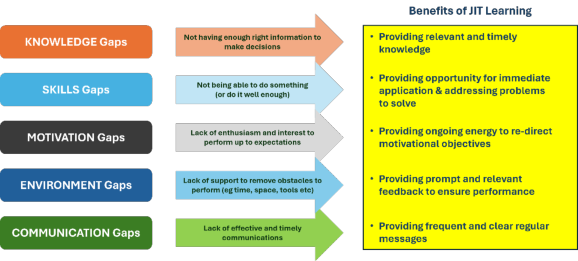
Figure 2: Benefits of JIT learning to narrow performance gaps.
RECOMMENDATION FOR BUSINESS ENTERPRISES TO PREPARE FOR HUMAN AND INTELLIGENT HUMANOID CO-EVOLUTION AGE Business leaders must move beyond viewing humanoids as cost-cutting tools and instead see them as catalysts for systemic transformation. To prepare for the age of human–humanoid co-evolution, organizations should:
Redesign jobs around complementarity, decomposing roles into human- suited (judgment, ethics, empathy) and humanoid-suited (precision, endurance, repetition) tasks.
Implement adaptive handoff protocols that enable robots to recognize limits and request human review.
Foster explainable autonomy by requiring AI systems to justify decisions in plain language.
Invest in just-in-time learning platforms that deliver microlearning at the point of need.
Cultivate AI Champions—individuals who use humanoids to solve complex problems, not just complete tasks.
Build ethical guardrails using frameworks like the EU AI Act and NIST guidelines.
Engage workers in co-creation to build ownership and surface hidden risks.
The future belongs not to those who automate fastest, but to those who augment wisely.
CONCLUSION AND FUTURE WORK An earlier version of this discussion was presented to the International Symposium on Robotics: Humans+Humanoids for Optimal Performance, co-organized by the International Federation of Robotics, held on November 5, 2025 (Tian, 2025)., where evidence began to coalesce around a transformative idea: that the synergy between humans and humanoids could redefine what we mean by “optimal performance.” Rather than framing intelligent robots as threats to employment or mere instruments of automation, the symposium proposed a vision of partnership for man and machine collaborate to achieve outcomes unattainable by either alone.
As such, we conclude that the future of work lies not in human versus machine, but in their synergistic co-evolution. Business leaders must shift from viewing intelligent humanoids as mere automation tools to recognizing them as partners in a hybrid intelligence ecosystem. Success hinges on intentional design: fostering complementarity, building bidirectional trust, and cultivating AI Champions. The ultimate goal is not efficiency alone, but optimal performance, where safety, innovation, well-being, and human dignity are elevated through wise augmentation, is critical in the process of rethinking work in the age of hybrid intelligence.
ACKNOWLEDGMENTS
We would like to take this opportunity to thank the guidance provided by the leadership team of the Global Robot Clusters (GRC) and the network of members from the International Alliance of Robotics Associations (IARA). We also appreciate the contributions from the Korea Association of Artificial Intelligence and Robot Industry (KAR) for their support and useful case discoveries.
REFERENCES
Alshanetsky, E. (2025) Where does human thinking end and AI begin? An AI authorship protocol aims to show the difference, October 30, 2025, https://doi. org/10.64628/AAI.3sjp9khqfS Brooks, R. A. (1991). Intelligence without representation. Artificial Intelligence,
47(1–3), 139–159. Driess, D., et al. (2023). PaLM-E: An embodied multimodal language model. arXiv preprint arXiv:2303.03378. Eastwood, B. (2025) When humans and AI work best together- and when each is
better alone. MIT Sloan Management Review, February, 2025, sloanreview.mit.edu. EY Germany. (2023). The Future of Work in Aging Societies. Ernst & Young GmbH. Knoblich, G., Butterfill, S. A., & Sebanz, N. (2011). Psychological research on joint action: Theory and data. Psychology of Learning and Motivation, 54, 59–101. Lee, J. D., & See, K. A. (2004). Trust in automation: Designing for appropriate
reliance. Human Factors, 46(1), 50–80. Lim S. Y. (2024), Harnessing AI and Innovation to Build High-Performance Collaboration Across Work Boundaries - A Transforming Teams in the Era of AI Playbook. 978-981-94-0. Lim, S. Y. (2025), Thriving in the SME World with AI as Your Co-Worker Quick
Read for the Busy Professional in Just 60 Minutes - Or Get the Essentials in 15 Minutes! 978-981-94-2437-5. McKinsey Global Institute, (November 2025) Agents, robots, and us: Skill partnerships in the Age of AI. Ransbotham, S., Kiron, D., Khodabandeh, S., Iyer, S., Da, A. (2025) The Emerging
Agentic Enterprise: How Leaders Must Navigate in New Age of AI. MIT Sloan Management Review and Boston Sheng, Q., Zhou, Z. Li, L., Mi, X., Xiang, P., Chen, Z., Xu, H., Jia, H., Cui, Y., Ye, S., Yu, Y., Du, Y., Zhai, S., Xu, K., Yang, Y., Lou, Z., Song, Z., Yin, Z, Sun, Y., Xiong, R., Zou, J., Yang, H. (2025) A Comprehensive Review of Humanoid Robots. Smart Bot, Wiley Publishing, 2025; 1:e12008 1 of 35 https://doi. org/10.1002/smb2.12008 Trist, E. L., & Bamforth, K. W. (1951). Some social and psychological consequences
of the Longwall method of coal-getting. Human Relations, 4(1), 3–38. Tian, O. (2025). Humans + Humanoids for Optimal Performance: Rethinking Work in the Age of Hybrid Intelligence. Presented at the International Symposium on Robotics, November 5, 2025.
LISTED IN THE AHFE DIGITAL BOOKSTORE CATALOGUE
Explore the complete digital volume
Human Factors, Business Management and Society
Read this individual research paper free through the original publisher, or explore the full digital proceedings book.
ISBN 978-1-964867-91-5
Explore this ISBN in the AHFE Bookstore ↗Listed in the July 2026 bookstore catalogue; search by ISBN to confirm current availability · Digital book purchase optional