Vesa Salminen, Matti Pyykkönen, Carita Salminen (2025). Human aspects in Situation Analysis, Resource Control, and Operation Command. In: Human Factors, Business Management and Society. AHFE Open Access, vol. 176, pp. 95–106. https://doi.org/10.54941/ahfe1006307
This research examines the human-centered aspects of natural disaster management using as a case study environment the Start-up company Husqtec Corp., which is focused on situation and operational management. The created and analyzed solution is an intelligent and innovative MobiJOPA™ product and service concept. This research concentrates on how human-based management of situation analysis, resource control, and operation command is organized during the management of a case study of a disaster. First, this study answers the question “how can user-centred design and modularity enhance the effectiveness and usability of disaster management systems? Second, it introduces how AI-based simulation pedagogy is arranged in an operative environment and how GenAI, VR/XR, and simulation technologies are able to improve training, decision-making, and teamwork for emergency and disaster management teams..The study highlights the critical role of user-centered design, AI-driven decision support, and team cohesion in fostering effective emergency response. This case study prioritizes user-centered design to address the needs of diverse user groups, ensuring inclusivity and accessibility in disaster scenarios. Modular and customizable features enhance the system's adaptability and user experience. AI-Powered Decision Support can be executed by AI tools that provide situational analysis, real-time data assessment, and personalized training to prepare better for responders. Strong cohesion within response teams is achieved through focused training and establishing both T-shaped (broad knowledge with expertise in one area) and X-shaped (interdisciplinary expertise) role profiles. Simulations and VR/XR exercises enhance coordination among agencies, fostering trust and efficient collaboration. This research emphasizes how cohesive teams improve crisis response through swift communication, high morale, and trust. These factors enable quicker, more effective decision-making during critical situations.
The role of artificial intelligence (AI) is emphasized in supporting team operations during start-up enterprise development. It is crucial to implement
all the opportunities of AI and generative AI throughout the start-up of new entrepreneurship and solution development.
Data is recognized as a valuable currency driving the data-driven innovation and start-up entrepreneurship process. This article suggests that a human-oriented approach is necessary for capturing data from various sources and using it in businesses. The strategic challenge is to apply a systematic approach using generative AI agents throughout all the phases of situation analysis, resource control and operation command during disaster management.
In this article an analysis has been conducted on the various aspects of the developed framework of situation analysis, resource control and operation command process as targeting for better disaster management. The analyzed case study company is Husqtec Corp., a start-up company concentrating on situation and operational management. The created and developed product is MobiJOPA™, a solution on which the functionality of situation analysis, resource control and operation command management is implemented. The other result of this research is a model of Gen AI- based simulation pedagogy operative solution environment.
The use case is natural disaster management. The article outlines the importance of human factors, team cohesion, artificial intelligence, and data-driven approaches in the solution development.
THEORETICAL FRAMEWORK ‘Situational awareness means understanding what is happening around us and recognized as a critical foundation for successful decision-making across a broad range of situations and leads to situation management’ (Stanton et al., 2009). ‘Situational awareness is presented as a predominant concern in system operation, based on descriptive view of decision making’ (Endsley, 1995). ‘Situational awareness is defined as the perception of entities in the environment, comprehension of their meaning, and projection of their status in near future’ (Munir et al., 2022).
‘To effectively integrate Gen AI, Baier (2024) proposes a new paradigm: Designing for Dialogue. It is rooted in the idea that technology and humans can share responsibilities dynamically. Gen AI Agent is treated like a coworker rather than a static technology because it behaves more like a colleague than previous software tools.’
‘Gen AI can potentially 1) reduce the time for research and development; 2) support real-time testing of new products (and more generally, validate business model propositions); and 3) compress development costs through the use of digital prototypes’ (Mariani & Dwivedi, 2024).
‘Gen AI can generate new information based on already collected information. It can imitate human-generated outcomes, and therefore it can be applied in various sectors such as academic research, learning, teaching as well as marketing and customer service’ (Gill & Kaur, 2023).
‘T-shaped individuals have deep knowledge and skills in a particular area along with the capacity to collaborate across disciplines with a broad understanding of other areas. X-shaped professionals have broad skills and
Human Aspects in Situation Analysis, Resource Control and Operation Command 97
strong leadership qualities and ability to drive collaboration and innovation across an organization An X-shaped person is actually a T-shaped person who has good leadership abilities (Rahman, 2024) ‘X-shaped persons are the right type to lead industries in the Industry 4.0 era’ (Baskoro, 2024).
‘Open communication, adaptability and regular situation assessment are key parameters in ensuring the alignment of roles and responsibilities with the evolving needs of the team, project, product and development of start-up entrepreneurship (Salminen et al., 2024/2).
‘Five actionable steps to improve organizational learning with AI include simultaneously improving organizational and AI-specific learning, exploring with AI, accelerating learning with AI, choosing projects that promote learning, and learning responsibly’ (Ransbotham et al., 2024).
RESEARCH QUESTIONS AND RESEARCH IMPLEMENTATION This research has concentrated on the management of situation analysis, resource control and operation command. The integration of generative artificial intelligence tools using agent technology is highlighted as essential for disaster situation management. The analyzed case study start-up company is Husqtec Oy. To analyze the development of the start-up enterprise, the following research questions have been raised:
How is a disaster situation understood and managed?
How is human-based management of situation analysis, resource control, and operation command organized?
How can user-centered design and modularity enhance the effectiveness and usability of disaster management systems?
How is GenAI-based simulation pedagogy arranged in an operative environment?
How can GenAI, VR/XR, and simulation technologies improve training, decision-making, and teamwork for emergency and disaster management teams?
This research has an action-based approach and uses a method based on grounded theory (Glaser, Strauss, 1999). It is partly constructive, conceptual, and analytical because it introduces a framework for Situation Analysis, Resource Control and Operation Command, supported by Gen AI. Data for this concept creation has been continuously collected from the innovation and development phase of the case study start-up company Husqtec Corp. The created solution MobiJOPA™is introduced on which the functionality of AI-based situation analysis, resource control and operation command management is implemented. This action-type research approach may be seen as a type of applied science.
FRAMEWORK OF SITUATION MANAGEMENT ‘Situation awareness is the understanding of an environment, its elements, and how it changes with respect to time or other factors and how it is used in effective decision making. It is formally defined as the perception
of the elements in the environment within a volume of time and space, the comprehension of their meaning, and the projection of their status in the near future’ (Endsley, 1995).
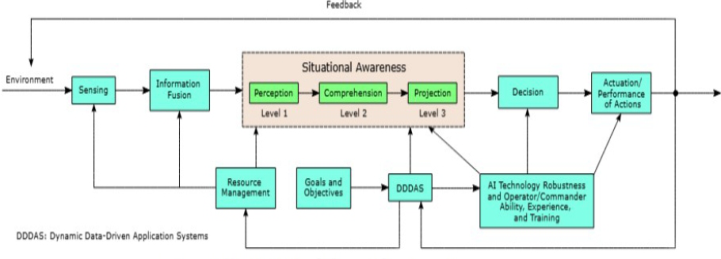
The decision-making process based on the situation analysis model consists of several steps that are integrated into a dynamic data-driven decision- making model (Figure 1) (Munir et al., 2022).
Figure 1: Model of situation analysis and dynamic decision making.
The situation analysis model has three key levels: perception, comprehension and projection, which form the core of situation analysis. The first level (perception) focuses on perceiving the state of the environment. The second level (comprehension) processes information and understands the current context. The third level (projection) can predict future events and states in the environment. Artificial intelligence (AI) plays a key role in supporting the implementation of these stages (Munir et al., 2022).
There are several factors that hinder dynamic decision-making during disaster situations, such as insufficient data utilization and data availability, the complexity of technology used or inadequate AI-integration which hinders effective management of disaster situation. Personal competence is sometimes underdetermined and leads to human factor neglection and to lack of team cohesion, which reduces collaboration and efficiency.
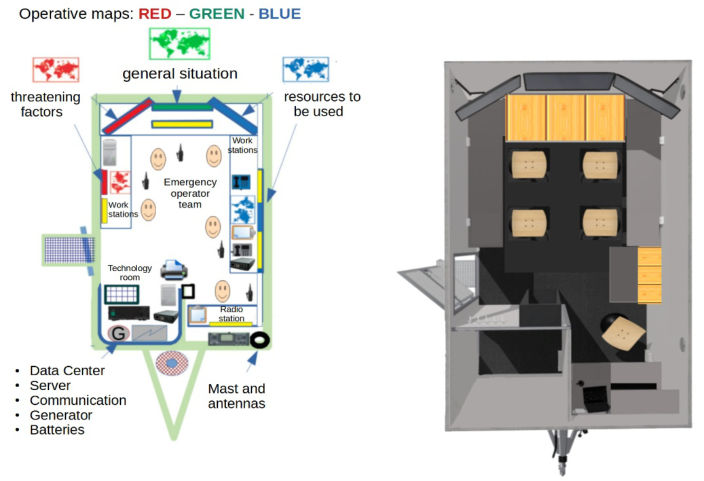
USER-CENTERED DESIGN OF A SITUATION MANAGEMENT UNIT The use case is the MobiJOPA™system developed by Husqtec Corp, which is a mobile and modular management unit (Figure 2).
The mobile and modular unit was designed for the management and control of various emergency situations such as natural disasters, search and rescue missions, and large public events. The most important features of the system include its own power generation capability, a data centre, and versatile communication tools that enable independent operation or connection to external networks (Salminen et al., 2024/1).
In user-centered design users and teams, and customer target groups are focusing on usability and effectiveness concentrating especially on the requirements of various functions. This is important to gain excellent user experience for all co-operating partners using the system and solution.
Human Aspects in Situation Analysis, Resource Control and Operation Command 99
Figure 2: The created MobiJOPA™modular concept.
The MobiJOPA™- product and service concept was designed according to user-centered design and by using versatile requirements of various user groups. It is emphasized for a system’s versatility and customization for different uses and scenarios.
The concept can be used by several target groups, including authorities, defense forces, police, rescue personnel and organizers of large events. The suitability of the system for training and simulations also refers to the consideration of training staff and practitioners. The modularity and customization of MobiJOPA™show that the system is meant to meet the individual needs and ways of working of different user groups.
MobiJOPA™, with its’ features and functions, is designed to meet the requirements of specific use situations, such as quick deployment, independent power generation, reliable communication, and real-time situational awareness. The system has been tested and analyzed to improve its efficiency and usability, which is a key element of user-centered design.
DECISION-MAKING SUPPORT (TRANSPARENCY, AUGMENTATION) During the decision-making phase, analyses of user needs, operating models and the requirements, technical solutions and modules were mapped in GenAI-assisted processes. Customer/user feedback was taken into account from the results of the test drive and the solutions were produced as features of the concept.
The description of the development process of MobiJOPA™concentrates on the concept description. AI and the decision-making support system (transparency, enhancement) is presented at this moment based on the
content of the concept description. The customization and modularity of the system is based on the needs analysis and operating models of different uses and it has influenced the design of the system. Various technical solutions and modules, such as GPS positioning, radio and satellite communication, data processing equipment and drones, are clearly mapped and integrated into the system.
The system includes features suitable for the use of AI in decision support systems. This includes algorithms that analyze data and produce real- time situational reports for the situation management team. Customer and user feedback is important, because they emphasize the suitability of the system for various purposes and user groups. More individual test runs will be arranged with various user groups and that is the key target during 2025.
TRAINING AND SKILL DEVELOPMENT Training for the operative teams of the MobiJOPATM situation management position was included in the service offering. Educational solutions use simulation pedagogy and VR/XR technology. The MobiJOPATM- concept is designed for multi-purpose use, and one form of use, along with operational activity, is educational use. GenAI solutions are developed also as part of the MobiJOPATM- concept, especially to support situational analysis but also in connection with the training and training environment.
MobiJOPA™training and training for operational teams includes several functionalities that support situation management and utilize technological solutions such as simulations and VR/XR technology. MobiJOPA™is designed to be capable for multi-purpose, and one form of use is education. The customization and modularity of the system enable the creation of different training and practice environments. Simulation pedagogy is used to practice different emergency situations, such as natural disasters or major accidents. The use of VR/XR technology is likely to improve the training environment and enable realistic exercises.
The integration of GenAI solutions into the MobiJOPA™concept, especially to support situational analysis and improve the training environment, is also a significant part of the training. AI-based analysis tools can help during exercises in real-time assessment of the situation, supporting decision-making and improving situational awareness. This contributes to the skill and ability of the situation management team to operate efficiently and effectively in disasters.
The training program ensures that the teams know how to use MobiJOPA™functions effectively and master the system’s features, such as integrated power generation, versatile communication systems, data center and customizable modules. With the help of simulations, rapid implementation, crisis management and cooperation with different parties are practiced. This ensures that MobiJOPA™users are ready to respond efficiently and effectively to various emergency and disaster situations.
Human Aspects in Situation Analysis, Resource Control and Operation Command 101
SITUATION TEAM AND GEN AI AS TRAINING SUPPORT GenAI agent technology can be applied to this MobiJOPA™- training model in numerous ways that improve training effectiveness and interaction. GenAI agents have been used to analyze and predict situations in real time, giving teachers and students up-to-date reports and suggestions on how to use resources. It can also be used to create realistic simulations and exercises that help students prepare for different situations and speed-up learning of problem-solving skills.
GenAI agents can provide personalized instruction and support to distance learners, analyzing learning outcomes and adapting the curriculum to individual needs. It is also possible to assess automatically the student performance and provide detailed feedback that helps students understand their strengths and areas for development. It possible to use GenAI agent- technology to help maintain and organize documents and records, making data discovery and management easier and more efficient. Communication is improving between different workstations, providing real-time messaging services and supporting the collaboration. GenAI agent technology can therefore enrich and improve the learning experience, interaction, and effectiveness of training.
TEAM COHESION BUILDING IN TRAINING In the multidisciplinary cooperative organization of Husqtec Oy, the formation of cohesion is a prerequisite for smooth operation. Training activities have focused on coaching teams and the formation of cohesion must be refined as part of the content of the training service.
In the planning of the MobiJOPA™training program, the cohesion and uniform operation of the teams has been in a central role. In the context of a multidisciplinary collaborative organization, cohesion is essential for smooth operations. The content of the training must include the unification of operating methods and the enhancement of teamwork.
Since MobiJOPA™is designed to be used in various emergency situations and exceptional circumstances, the training program should emphasize cooperation and coordination between different actors. This requires training of situation management teams, in which working together, and effective communication methods are practiced. The modular structure and comprehensive communication tools of MobiJOPA™-concept support this functionality, enabling efficient information flow and collaboration between different roles and experts.
Simulation exercises are an excellent tool for strengthening team cohesion and developing a uniform way of working. By simulating different scenarios and emergency situations, teamwork, crisis management and effective decision-making can be practiced. VR/XR- technology can be used to create a more realistic and effective training experience.
GenAI tools can also be used in training, which can support situation analysis and improve decision-making in stressful situations. AI-based tools can provide real-time situation information and support team coordination, which promotes both efficient and consistent operations. The feedback from
the users and the test results help to refine both the MobiJOPA™- concept and the training service, enabling the development and refinement of elements affecting cohesion into system features. This iterative development process ensures that training best meets the needs of teams and customers.
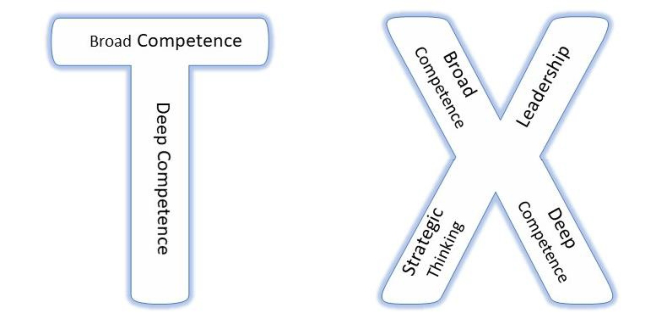
Formation of team cohesion was created by various profiles of knowledge carriers (Figure 3). A T-shaped person is defined as someone who capable in many things and an expert in one of them (Veenendaal, 2020). T- and X- profiles do have a significant impact on team functioning and cohesion at the situation management position. Specifically, smart service systems characterized by AI technologies would be wiser if people - as well as T-shaped professionals – effectively interact with these technologies for co-creating value through the right use of interpretative schemes directed by the humans’ values categories (Barile et al., 2023).
Figure 3: Talent profiles and AI influence.
In the following has been introduced some experiences of how AI influences talent development and cohesion building in teams with various profiles. People with the T- profile can act as specialists, providing deep knowledge and solutions in critical situations. The horizontal bar of the T-profile means they can easily collaborate with experts in other fields, improving communication between teams and problem-solving skills.
People with T-profiles can adapt to different situations and roles, which is particularly useful in a dynamic management environment. People with the X- profile often act as team leaders or as coordinators, combining deep expertise with extensive networking and communication skills. Their ability to understand the feelings and needs of others improves internal team cohesion and cooperation. They are normally strategic and goal oriented. People with X-shaped profiles are also capable of understanding and benefiting technology opportunities in teamwork and the co-evolution of interaction between human intelligence and artificial intelligence.
When analyzing team cohesion in a situation management position, X-profiles can take leadership responsibilities and coordinate between different functions, while T-profiles can delve into specific issues and provide
Human Aspects in Situation Analysis, Resource Control and Operation Command 103
expertise. X-Profiles can maintain and share a comprehensive picture of the situation, ensure a seamless flow of information and make strategic decisions. T-profiles, in turn, can provide precise analyzes and solutions to specific issues.
PERSONNEL AREAS OF EXPERTISE OF MOBIJOPATM IN DISASTER MANAGEMENT Specific roles of the operational situation management team and background actors were defined. A situation leader with an X-shape profile is responsible for maintaining the big picture and making strategic decisions. He/she coordinates team activities and ensures all parties understand their roles. He/she provides empathic communication and the ability to lead a team under pressure.
Specialists with T- shape profiles have deep expertise in certain critical areas such as technology, logistics, medicine etc. They provide specific information and solutions based on the situation. They work in collaboration with other experts and team members to solve problems. A logistics coordinator is responsible for resource management, including procurement, transportation and storage of supplies. He/she maintains a snapshot of available resources and their usage. A communications officer maintains communication within the team and with external stakeholders and ensures that information flows efficiently and is visible for everybody. An intelligence and analysis specialist collects and analyzes information about the situation, including weather forecasts, terrain information, and changes in the threat situation, and provides situational assessments and suggestions to the management team. A health and safety manager, also with T- profile expertise, is concerned of the health and safety of team members and victims. He/she develops and implements security plans and procedures for the whole team as well.
A training coordinator plans and organizes trainings and exercises for team members and ensures that the team is prepared to face various scenarios. A cooperation manager ensures that the team collaborates with various organizations and authorities. He/she manages collaboration processes and contracts.
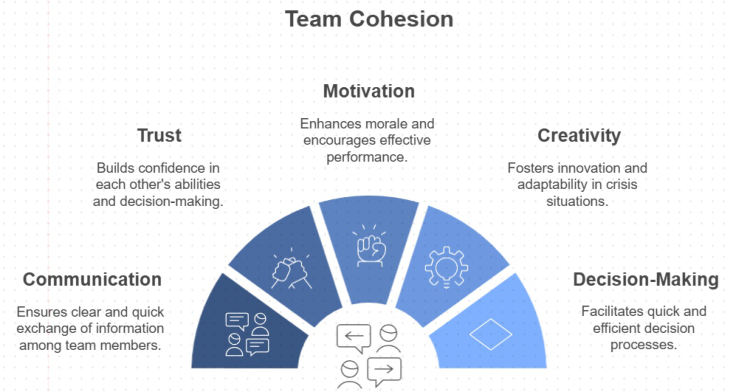
TEAM COHESION IN CRITICAL CIRCUMSTANCES Team cohesion is of crucial importance to the effectiveness and operational capability of a situation management team operating in a disaster area. In Figure 4 are introduced some experiences of how strong team cohesion is effective. It ensures that all team members are on the same page, understand common goals, and communicate quickly and clearly. It also reduces misunderstandings. When team members know each other well, they are able to anticipate each other’s needs and respond quickly to changing situations. Team cohesion builds trust among members of the team. This means that the members of the team trust each other’s abilities and decision-making. This
is critical in difficult situations in which you are under pressure. Members support each other, share information, and improve their efficiency.
When team members feel they are part of a unified group their motivation and morale are high. This improves their ability to perform their duties effectively. Strong cohesion reduces internal team friction and conflict, increasing togetherness. This helps the team maintain focus and its ability to function in crisis situations.
Figure 4: Parameters of team cohesion leading to successful disaster management.
A good team spirit and collaborative atmosphere encourage members to come up with new ideas and solutions. This is especially important in crisis situations where creativity and flexibility are needed. Strong team cohesion enables the team also to quickly adapt to new challenges and a changing environment. When team members know and trust each other, they are able to make decisions quickly and efficiently. This is essential when the situation requires a quick response. Strong cohesion ensures that team members commit to decisions and implement them efficiently and accurately. Team cohesion is fundamental to the effectiveness and performance of a situation management team to support each other and act unitedly in critical situations.
CONCLUSION
This research examines the human-centered aspects of natural disaster management. The start-up enterprise, Husqtec Corp, and their innovative and intelligent solution, MobiJOPA™- has been used as intelligent training environment for learning of making situation analysis, resource control and operational command.
The study highlights the critical role of user-centered design, AI-driven decision support, and team cohesion in fostering effective emergency
Human Aspects in Situation Analysis, Resource Control and Operation Command 105
response. This case study prioritizes user-centered design to address the needs of diverse user groups, ensuring inclusivity and accessibility in disaster scenarios. The advanced technology integration by using Generative AI (GenAI Agents) and VR/XR technologies improves training, decision- making, and teamwork during crises. Modular and customizable features enhance the system’s adaptability and user experience.
The research emphasizes how cohesive teams improve crisis response through flexible communication, high morale, and trust. These factors enable quicker, more effective decision-making during critical situations, and ensure better disaster management.
The MobiJOPA™- product and service concept turned out to be an efficient training environment, enabling fast learning of situation analysis and management. The used situation awareness process ensured that training was successful.
REFERENCES
Baier, P., DeLallo, D., Sviokla, J. (2024) Your organization isn’t designed to work with Gen AI. Harward Business Review, Spatial Issue, How to Thrive in a Gen AI, Fall 2024, November 5th, 2024. Barile, P., Barile, S., Bassano, C. Piciocchi, P, Saviano, M., Spohrer, J. (2023) T-Shaped
Professional (T-SP) Model to Support Human-Machine Interaction. The Human Side of Service Engineering, Vol. 108, 2023, 90–101. https://doi.org/10.54941/ ahfe1003110 Baskoro G. (2024) Towards the X-shaped Person, the Next (Industrial) Leader in the Era of Industry 4.0 and Society 5.0. Journal of Industrial Engineering: Application and Research, Volume 04, No. 02, December 2024 Journal homepage: www.sakti.machung.ac.idISSN: 2829–8519 (print) –ISSN: 2829–8748 (online) Endsley, M., (1995) Towards a Theory of Situation Awareness. Human Factors.
The Journal of the Human Factors and Ergonomics, March 1995, 37(1), 32–64. doi: 10.1518/001872095779049543. Gill, S. S. and Kaur, R. (2023) “ChatGPT: Vision and challenges”, Internet of Things and Cyber-Physical Systems, Vol. 3, pp. 262–271. Glaser, B., Strauss, A. (1999) Discovery of Grounded Theory: Strategies for
Qualitative Research. Aldine Transactions. Mariani, M., Dwivedi, Y. K. (2024), Generative artificial intelligence in innovation management: A preview of future research developments, Journal of Business Research 175, 114542, Elsevier, Science Direct, https://doi.org/10.1016/j.jbusre s.2024.114542. Marion, T., Srour, M., Piller, F. (2024) When Generative AI Meets Product
Development. MIT Sloan Management Review, Fall 2024, Boston. Munir, A., Aved, A., Blasch, E. (2022) Situational Awareness: Techniques, Challenges, and Prospects. AI · January 2022, MDPI., 3, 55–77. doi: 10.3390/ ai3010005. Ransbotham, S., Kiron, D., Khodabandeh, S., Chu, M., Zhukhov, L. (2024) Learning to Manage Uncertainty, With AI. MIT Sloan Management Review and Boston Consulting Group, November 2024, Boston. Rahman, A. (2024) The Landscape of Skill Sets: T-Shaped, X-Shaped, and I-Shaped
Professionals Retrieved from https://www.linkedin.com/pulse/landscape-skill- sets-t-shaped-x-shaped-i-shaped-abdul-rahman-6mwqf/ read 18.02.2025.
Salminen, V., Pyykkönen, M, Salminen, C. (2024/1) Co-Evolution of the Interaction of Human Intelligence and Artificial Intelligence in the Innovation Process. 30th International Conference on Engineering, Technology and Innovation, ICE/IEEE, 24–28 June, 2024, Funchal Madeira. Salminen, V., Pyykkönen, M., Salminen C., Pylvinen, J. (2024/2) Team, Unit, and
Networked Cohesion in Start-Up Entrepreneurship. Human Factors, Business Management and Society, Vol. 135, 2024, 65–73. https://doi.org/10.54941/ ahfe1004931 Salminen, V., Pyykkönen, M., Salminen, K., Tian, O. (2025) Human Intelligence and Artificial Intelligence Interaction in Start-Up Enterprise. 8th International Conference on Intelligent Human Systems Integration: Integrating People and Intelligent Systems (IHSI 2025), Sapienza Universita’ di Roma, Italy, February 24-26, 2025. doi: 10.54941/ahfe1005817 . Stanton, N., Jenkins, D., Salmon, P., Walker, G., Revell, K., Rafferty, L. (2009).
Digitizing Command and Control: A Human Factors and Ergonomics Analysis of Mission Planning and Battlespace Management. ISBN: 9780754677598. Veenendaal, E. Van. (2020) The T-shaped tester. Eurostar Huddle. Retrieved from https://www.erikvanveenendaal.nl/site/wp-content/uploads/Erik-van-Veenendaal -The-T-Shaped-Tester-eBook-2.pdf.
LISTED IN THE AHFE DIGITAL BOOKSTORE CATALOGUE
Explore the complete digital volume
Human Factors, Business Management and Society
Read this individual research paper free through the original publisher, or explore the full digital proceedings book.
ISBN 978-1-964867-52-6
Explore this ISBN in the AHFE Bookstore ↗Listed in the July 2026 bookstore catalogue; search by ISBN to confirm current availability · Digital book purchase optional