Matti Pyykkönen, Jorma Jokela, Vesa Salminen (2023). Human Factors in Managing Strategic Funnels of Innovation. In: Human Factors, Business Management and Society. AHFE Open Access, vol. 97, pp. 87–95. https://doi.org/10.54941/ahfe1003885
Nowadays business environment is influenced by continuous discontinuities and change. That leads to the need for a methodology that can be used to manage innovation activities in the longer run. For ensuring competitiveness in business, it is important to have more than one innovation project in funnel on various innovation phase running on it. Utilizing innovation funnels makes it easier to understand operations and allocate expertise to the right projects and manage the partnerships. Through systems thinking and conceptual progression model it is possible to manage several development projects interactively at the same time. The goal of this article has been to create a system model for continuous management of the outcomes of ideation and innovation activities. This article introduces strategic innovation methodology using innovation funnels executed by cohesion building opportunities in teamwork. A reference framework has been developed and used in implementation of innovation phases. This makes it possible to manage strategic innovation activities much better. Successful strategy- based innovation management by innovation funnels needs value- based approach and clear common innovation strategy, goal setting practice and innovation environment. Human centric aspect to teamwork and its workflow is essential in success. The article introduces as case study a proof-of-concept of the growth- based start-up business idea “Training of Working Dog's Handler” which was created in group- based free ideation. The digital twin and the gamified environment illustrate and present the training progression model, considering the needs of dog-specific training.
The prerequisite for the success of the innovation process is the identifica- tion of the level of requirements and the maturity level of team expertise. Innovation activities are full of the points of discontinuity. This encounter with constant change leads to the need for a methodology that can be used to manage innovation activities in the long term. It must also be remembered that innovation activities in the business world must take place from a stra- tegic point of view. For ensuring competitiveness in business, it is important to have more than one innovation tube open and innovation phase running on it.
Innovation funnels are the basis for the implementation of the innovation factory. With these, growth and scaling are possible. Utilizing innovation tubes makes it easier to understand operations and allocate expertise to the right projects. They also help in managing partnerships. They can be used to locate and allocate the investment of funding to an activity or allocate it also as a life cycle calculation. It is essential that the necessary know-how is built up within the team and that people commit to the joint development of the team through their self-organizing actions.It is essential that the necessary know-how is built up within the team and that people commit to the joint development of the team through their self-organizing actions.
The goal of this article has been to create a system model for continuous management of the outputs of ideation and innovation activities. The outputs of this process are input to product development projects.
This article introduces strategic innovation methodology using innovation tubes executed by cohesion building opportunities in teamwork. At the cen- ter of this is systems thinking and a conceptual progression model, through which it is possible to manage several development projects interactively at the same time. Diversity is an essential starting point for development acti- vities. Cooperation is managed on the principle of self-organizing teams. In connection with and within the framework of the research and the article, a reference framework has been developed. Using this framework in the implementation of innovation phases makes it possible to manage strategic innovation activities much better.
“Training of Working Dog’s Handler”- case study was created through experiences gathered from dog-specific training sessions. That piloting is supposed to lead as growth- based start-up business. In this article is also presented some ideas on how digital twin- technology and the gamified environment can be used in increasing the efficiency on training.
THEORETICAL FRAMEWORK ‘Managing the development funnel has the challenge to widen the mouth of the funnel and expand its knowledge base and access to information in order to increase the number of new product and new process ideas.’ (Wheelwright, 1992; Ciborra & Patriotta 1996.) ‘Lean Innovation process inside a com- pany or government agency consists of project phases, Innovation sourcing, curation, prioritization, solution exploration and hypothesis testing, incuba- tion, integration and refactoring.’ (Blank&Newill, 2017; Rutitis & Volkova 2021.) The innovation sprint is used in the Fuzzy Front End to deliver a result in a short period of time.
From problem/idea to a concrete concept in just five steps; problem fin- ding, solution finding, experimentation, business plan creation, development and delivery. The Innovation Sprint offers a short lead time with maximum, concrete results. (Kop, 2022; Sjödin, Parida, Kohtamäki & Wincent, 2020.)
The Innovation Funnel is divided into six phases ranging from the “widest” part of the funnel, which represents all the preliminary stages to the develo- pment of the innovative idea, to the “narrowest” one, which represents the realization of the winning idea (Talent Tarden Tag, 2022; Wang, 2017).
Human Factors in Managing Strategic Funnels of Innovation 89
Successful innovation management requires a structured innovation stra- tegy that nurtures innovation culture and enables efficient process flows to make sense of and manage the ever-increasing amount of data at every stage of innovation and strategic planning and execution. An end2end innova- tion process looks at everything from scanning a corporate environment to planning future innovation initiatives on a roadmap (Itonics, 2022).
RESEARCH QUESTIONS AND OBJECTIVE SETTING The goal of this article has been to describe a system model for continuous management of the outputs of ideation and innovation activities. The outco- mes of this process are input to product development projects. At the center of this is systems thinking and a conceptual progression model, through which it is possible to manage several development project interactively at the same time.
1. How to manage knowledge in the innovation process? 2. How to manage the outcomes of innovation during different stages of innovation? 3. How to manage the domain specific technical content of innovation? 4. What kind of system model will be used for management and leadership of continuous innovation?
This research is partly constructive, case- based conceptual and analyti- cal, because it introduces strategic innovation methodology using innovation tubes executed by cohesion building opportunities in teamwork. Data for this concept creation has been collected over a couple of years on the conti- nuous flow of co-creation from different research and development activities and during proof-of-concept and case- creation on foresight and scenario planning basis.
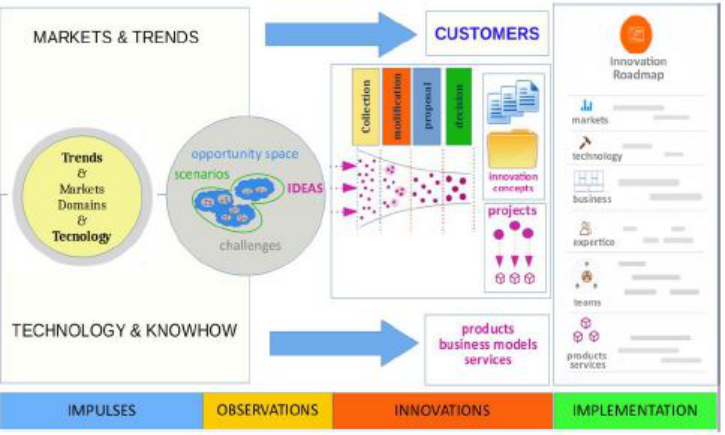
INNOVATION PROCESS When innovation activities are carried out, there are several stages going on at the same time. The timing of development during the stages is essential. It is possible to use an “open dialogue”-based approach to understanding customer needs. After strategy definition, the key periods are the impulse (impulse for the innovation process) and observation (opportunity and sce- nario building) phases. Next phases are innovation (collection, definition and decision) and implementation (verification, prototyping and implementation) (Figure 1, modified Itonics, 2022). The innovation roadmap manages various viewpoints of implementation and gives feedback to strategic considerations and then aligning strategy. Opportunity space is scanning market domains and created niches in a market. It also creates solution- oriented challenges. Innovation concepts are generated in innovation funnels and produce project portfolio innovation co-evolution. This enables the development of new pro- ducts, services and business models. Value creation is generated by benefiting knowledge, open data and pre-inventive data.
Figure 1: Systemic framework of innovation processing.
STAGES OF INNOVATION PROCESS A generic perception of this research is that successful strategy- based inno- vation management by innovation tubes needs value- based approach and clear common innovation strategy, goal setting practice and innovation envi- ronment. Human centric aspect to teamwork and it its workflow is essential in success. In the following is described the staged process of innovation:
a. IMPULSES
Opportunity space on the markets of special domain
Challenges in domain area
Technology and knowhow b. OBSERVATIONS
Scenarios how to use technology and knowhow making solutions, produ- cts and services c. INNOVATIONS
Idea collection by open dialogue by free ideation (max. 10 pers.)
Ideation group consist of domain specialists, technology and project experts
Modification valuable ideas of design teams
Workshops by small teams (3-4pers)
Working for the selection sets of collected ideas
Conceptual design, synopsis, description
Proposals to solutions by development teams
Idea valuation and selections
Mapping of expertise needs
Human Factors in Managing Strategic Funnels of Innovation 91
Presentations
Decisions about which of proposals selected as projects
Management team d. IMPLEMENTATION
ROADMAP - Timelines for development and building business
Marketing plan
Technology strategy
Business model canvas
HR: competence and expertise
Team cohesion building
Development and Production: Products and services
CONTENT MANAGEMENT IN INNOVATION PROCESS The article introduces as an example the core and concept of the growth- based start-up business idea “Training of Working dog’s Handler” which was born from free ideation. The training of working dog takes nor- mally three years. This novel training model shortens approximately the training time for halve of it. The dog handler special education and trai- ning takes a long time, and this gamification solution can increase the efficiency of training. In future digital twin technology enables a per- sonalized training with virtual environment and virtually behaved wor- king dog in different situations by keeping the training diary of the real working dog.
Human centric aspect to teamwork and its workflow is essential in success. Whole the innovation process is very domain specific and requires team cohesion between various aspects of personal competence on specific con- tent and implementation knowledge on virtuality technologies (animations and visualization of reality) and commitment on various team relation- ships in multidisciplinary environment. Most important in education and training execution is the domain field specific know-how (e.g. police, mili- tary, customs or boarder patrol security) and utilization of pedagogical knowledge.
Earnings of this training comes through product placement in connection with training guidance in a virtual environment, utilizing a digital twin. The digital twin and the gamified environment illustrate and present the training progression model, taking into account the needs of dog-specific training.
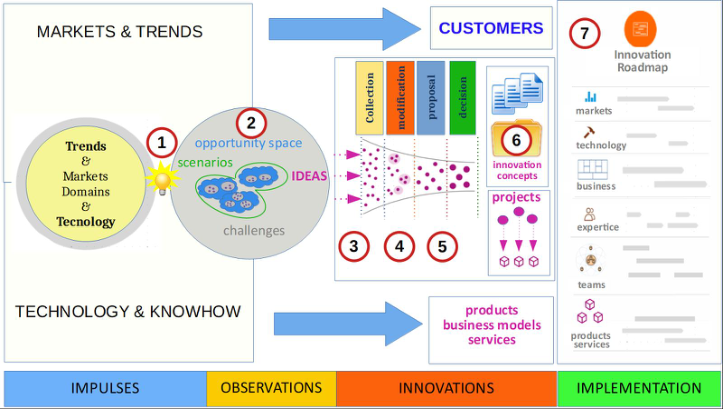
AN EXAMPLE OF INNOVATION PROCESS A generic perception of this research is that successful strategy- based inno- vation management by innovation tubes needs value- based approach and clear common innovation strategy, goal setting practice and innovation envi- ronment. Human centric aspect to teamwork and it’s workflow is essential in success. Figure 3 (modified Itonics, 2022) presents the innovation approach and in the following the stages of process on case study environment:
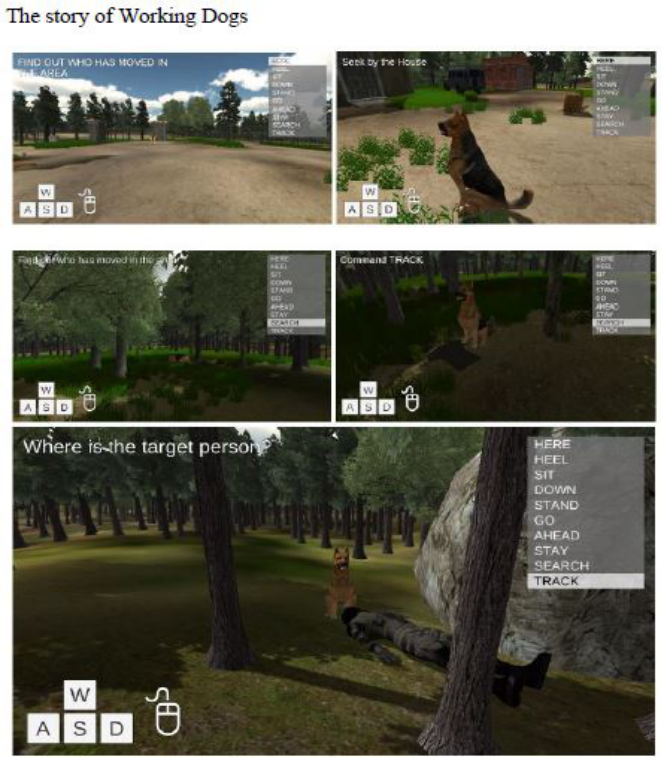
Figure 2: Working dog game demo: https://digitila.fi/DOGisle_en/.
1 - Personal Hobby: “Working Dogs Training” The idea of a virtual training environment for dog handlers was born after more than 10 years of volunteering. More than 10 years of personal experie- nce with service dogs and professional know-how in information technology made it possible to identify the needs and opportunities of the target area in question. The system must be specific to the target area and formed for real needs (Domain Specific Training System).
2 - Opportunity for the training system; Virtual reality, VR- Technology serious games & simulation Personal observations in versatile dog handling tasks, mainly related to rescue dog (SAR) operations and safety and security operations (K9), helped to iden- tify extensive training needs. Similarly, the handler and the dog must know a very wide range of tasks, training for which is a years-long project. This cre- ated an understanding of training needs. In information technology, learning about virtual 3D environments, the development tools related to modeling
Human Factors in Managing Strategic Funnels of Innovation 93
Figure 3: Innovation process and stages on continuous process.
dynamic 3D characters related to game development have developed a lot. Thus, the applicability of these technologies to real-world operations is now at a sufficient level from the point of view of beneficial use. The integra- tion of virtual gamified contents into digital learning platforms also enables consideration of the pedagogical point of view of the application, even the management of very large course sets, even highly specialized training programs for working dog handlers.
3 - Simple ideas: Synopsis description With the help of storytelling and describing scenarios according to usage situ- ations, the functional content began to take shape. Simple implementation ideas and modeling the real world as realistically as possible into a digital form were easily structured with a synopsis script draft. This was facilitated by the fact that the specifier had knowledge of both the domain area and the implementation technology.
4 - Content prototypes by UNITY 3D; Landscape, Dog with movement animations The practical feasibility in terms of the applicability of the technology was verified on the UNITY3D game development platform. Landscape, terrain and related objects and structures were modeled from the real world into a digital virtual world. The dynamic 3D model of the dog that was also acqui- red also contained the necessary movement animations. The results of this feasibility prototyping were transferable to further refinement.
5 - Requirements for MVP-Demo; command menu for VR-Dog Based on the experiments and practical implementation work, the user interface for commanding the virtual dog with menu-based commands was defined. The virtual dog is controlled by the scripts corresponding to each command, the dog executes according to the given command, and it is presented in the virtual world as a movement animation. This MVP-demo
(Minimum Viable Product) demonstrates the functionality of the educational training game.
6 - Conceptual design; Business Model, Products, Services The innovation concept consists of the business model (Business Model Canvas), product and service plans that are offered to users and sold to custo- mers. MVP products made for demonstration use are used to collect customer feedback and experiences, on the basis of which the actual business, product and service development projects are planned and formed. More detailed structural, functional, content and technology specifications are made for product development project.
7 - Implementation analysis; Markets, Technology, Business Model, Exper- tise Resources, Development and Business Team, Products and Services? - Founders and Core Team; Building Startup Business An Innovation Roadmap is drawn up for practical implementation and busi- ness development, where the practical measures to be taken and the resources and framework enabling operational activities are managed. This can be understood as timed resource management (roadmap in timeline).
DISCUSSION AND CONCLUSION The article introduces as case study the concept “Training of Working Dog’s Handler”, which was created through dog-specific training. It was a succes- sful case study and the proof-of- concept of piloting resulting on minimum viable product presentation and business model formulation. The digital twin and the gamified environment illustrate and present the training progression model, taking into account the needs of dog-specific training.
A generic perception of this research is that successful strategy- based inno- vation management by innovation funnels needs value- based approach and clear common innovation strategy, goal setting practice and innovation envi- ronment. Observing human centric aspect and factors in the teamwork and its workflow is essential in success. Innovation process is normally extremely domain specific and requires team cohesion between various aspects of per- sonal competence on specific content and implementation knowledge. Most important is to find mutual commitment on various team relationships in multidisciplinary environment.
REFERENCES
Blank, S., Newell, P. (2017) What Your Innovation Process Should Look Like.
Harvard Business Review, September 11, 2017. Ciborra, C. U. and G. Patriotta (1996) Groupware and Teamwork in New Product Development: the Case of a Consumer Goods Multinational in Ciborra, C. U. (ed.) Groupware and Teamwork: Invisible Aid or Technical Hindrance?, Chichester: Wiley, pp. 121–142. Itonics (2022 Innovation Defined: The Why, What & How.) https://www.itonics-
innovation.com/innovation-guide#end-to-end (read 27.1.2023). Kop, S. (2019) A Simple Guide to Organize Innovation. A logical and pragmatic way to an innovative organization. Creatieve Koppen. Published by Creatieve Koppen B. V. T.
Human Factors in Managing Strategic Funnels of Innovation 95
Rutitis, D. and Volkova, T. (2021) Model for Development of Innovative ICT Products at High-Growth Potential Startups. Eurasian Stud. Bus. Econ. 19, 229–241. Sjödin, D., Parida, V., Kohtamäki, M., Wincent, J. (2020). An agile co-creation
process for digital servitization: A micro-service innovation approach. Journal of Business Research, 112, 478–491. Talent Garden Tag (2022) https://talentgarden.org/en/innovation/innovation-funnelwhat-it-is-and-how-it-works/ (read 17.12.2022). Wang, J. (2017) Structuring innovation funnels for R&D projects under uncertainty.
R&D Management, 47, 127– 140. https://doi.org/10.1111/RADM.12183. Wheelwright. S. C. and Clark. K. B., 1992, Revolutionizing Product Development, The Free Press, New York. Wikipedia https://en.wikipedia.org/wiki/Working_dog (read 27.1.2023).
LISTED IN THE AHFE DIGITAL BOOKSTORE CATALOGUE
Explore the complete digital volume
Human Factors, Business Management and Society
Read this individual research paper free through the original publisher, or explore the full digital proceedings book.
ISBN 978-1-958651-73-5
Explore this ISBN in the AHFE Bookstore ↗Listed in the July 2026 bookstore catalogue; search by ISBN to confirm current availability · Digital book purchase optional