Ingrid Pappel, Josephine Lusi, Nora Hauptmann, Valentina Stadnic, Margus Mägi, Diana Sang, Sherman Kong (2023). Capacity building as an important key aspect to support countries' digitalization endeavours. In: Human Factors, Business Management and Society. AHFE Open Access, vol. 97, pp. 125–134. https://doi.org/10.54941/ahfe1003889
The digitalization of governments is a tremendously growing trend. One effective approach to managing digital transformation for the greater public good is to have government personnel who understand the technology, social ramifications, and legal frameworks that should be applied for the best possible outcome for all stakeholders. To this end, a robust capacity-building strategy is essential in preparing the leaders of tomorrow who will play a significant role in shaping the implementation of citizen-centric digital services in governments worldwide. Thus, this paper aims to suggest a framework for a capacity-building strategy that will support countries in their digitalization journey. The outcome of the research emphasizes the necessity of fostering a common understanding of the capacity-building process, which includes implementing a Learning Management System (LMS) and developing a skills matrix that promotes the acquisition of relevant competencies and skills, to ensure the successful and sustainable implementation of digital transformation projects.
The successful implementation of e-governance and digital transformation necessitates countries to consider sustained efforts to develop a long-term strategy for building the necessary capacities within a country’s digital teams. This entails considering both the short-term and long-term goals and working closely with key stakeholders from the public, private, and academic sectors to identify the skills, competencies, and knowledge required to achieve those
goals. According to Jackson (2019), academic support is a valuable asset in ensuring a fostering a country’s long-term capacities. Understanding how to build an effective capacity-building strategy to support digital skills is vital for creating citizen-centric digital public services.
The GovStack approach to capacity building is a systematic process that utilizes effective methodologies and fosters cross-cultural knowledge sha- ring within and across professional and academic institutions (Intezari et al., 2016). The interdisciplinary approach serves as an enabler of providing kno- wledge and skills at the intersection of technology, business and management, design thinking, and policy areas. This aligns with the inferences drawn by the OECD (2021) report and van Laar et al. (2017), which theorize that an interdisciplinary approach to capacity building guarantees that the require- ments of the labor market are addressed, while providing a holistic view of the skills and competencies needed for digital transformation.
Despite the sustained efforts of researchers and experts to identify the specialists needed for e-governance implementation, there is still a lack of information on how to build and sustain an effective digital transformation team (Clarke, 2020). Furthermore, Child & Shaw (2020) conceives that there is a need for clear guidelines on how to apply the skills and competencies defined in frameworks such as ESCO and eQF to drive the digitalization of public services. This paper aims to address this gap by exploring the GovStack approach to capacity building for public sector digitalization as a pilot case.
Capacity Building and How it Supports Countries’ Digitalization Endeavours Digital government services require a robust and active knowledge-sharing cycle that guarantees a continuous system where information is identified, created, shared, stored, utilized, and used within the capacity building appro- ach, (Intezari et al., 2016). The critical aspect of capacity building is the sharing of best practices as well information regarding success stories and failures. Sharing knowledge fosters innovation and improves the quality of work (Alvarenga et al., 2020), leading to an efficient learning organization where employees’ skills are continually evolving.
The capacity-building strategy relies on three critical pieces: people, pro- cess, and technology. The rapidly changing technology landscape demands a combination of knowledge and skills that is vastly different from what it was a few years ago (Ala-Mutka, 2011). Digital skills empower individuals to participate fully in their social and professional lives. For example, the “new normal” following the COVID-19 pandemic has highlighted existing chal- lenges in connecting households and people and the digital skills required to participate effectively in an increasingly digital world.
The demand for a digitally competent population and workforce has become even more critical (Hislop et al., 2018). A multi-disciplinary appro- ach should be taken in developing the capacity building strategy to increase learners’ strengths and address gaps in their knowledge in areas such as tech- nical skills, service design, ethics, creative problem solving, regulation of technologies, legislation, and digital transformation as a whole.
Capacity Building as an Important Key Aspect 127
The capacity building strategy for a country’s digitalization should enhance understanding of public service design through the use of new technologies (Kyriakopoulou et al., 2021). Through understanding co-creation, the design process, creative problem solving, a human-centric approach in public servi- ces, and prototyping, learners should be equipped to apply new ways to design and implement services along with the new technologies and pro- cess re-design. It is also crucial to continuously monitor industry trends and emerging technologies to sustain a digital society. Hence, establishing a digi- tal talent archive that guarantees the continuous sustainability of a country’s capacity is imperative.
SKILLS AND COMPETENCY FRAMEWORKS TO SUPPORT CAPACITY BUILDING Established competence and qualification frameworks support digital tran- sformation by establishing the required skills and qualifications needed for a specific career path involved in the digitalization journey. These frameworks are practical for educational institutions that are in the process of designing curricula to ensure learners acquire the necessary skills that support diffe- rent digitalization domains. This aligns with the findings by (Morze et al., 2021; Pappel et al., 2018), on the crucial role of capacity support in fostering
Table 1. Common competency frameworks for skills profiling.
Table available in the original PDF paper.
Standard Description The International Standard Classification of Occupations (ISCO) Widely used by organizations seeking to build a robust and effective Information and Communication Technology (ICT) workforce, the framework provides a comprehensive set of job descriptions for ICT positions within organizations, E-competence Framework (e-CF)
Designed to communicate the competencies required by ICT professionals, it supports the development and assessment of ICT professionals by establishing a common language and understanding of the skills and competencies needed for these roles. UK Skills Framework for Information Age (SFIA)
Provides a comprehensive set of skills and competencies for the ICT industry. The framework includes 97 skills across six categories and introduces seven different levels of responsibility at which skills can be exercised. French CIGREF Information Systems (IS) job profiles framework
Offers a systematic and standardized set of job specifications for IS positions within corporations. Aids organizations in determining the required capabilities and competencies for different IS positions. The German Advanced IT Training System (GAITS)
Aligned with the German Qualifications Framework, it provides a set of career profiles and qualifications for specialists in the IT sectors.
the development of digital leaders as well as ensuring the sustainability of capacity building efforts.
When formulating a nation’s capacity-building strategy, it is critical to con- sider practical considerations in addition to theoretical ones, such as labor market demands (Cukier, 2019), based on various competency and qualifica- tion frameworks. The most common frameworks, that can be employed by countries in the design process include.
Considerations for Adult Learning to Support the Capacity-Building Process One of the ultimate training goals is the transfer and application of know- ledge. The ability to apply knowledge is becoming a critical survival skill for adult learners in today’s rapidly changing job market, where employers expect employees to be critical thinkers, innovative, and lifelong learners (Tannenbaum, 1997). Governments must consider several factors when desi- gning adult learning programs to ensure that the transfer of knowledge takes place effectively.
Firstly, it is important to clearly articulate the learning objectives and understand the motivations of adult learners. Adults need to understand the understand the reason for learning something (Brookfield, 1986), and thus; instructors should make connections between the content presented through- out the sessions. As adults mature, they tend to prioritize knowledge that can be applied immediately to their life or work-related situations, making it more attractive to them than purely academic or theoretical approaches. Luka (2014) further builds on this argument by arguing that learning experiences should employ design-thinking and human-centric design methodologies. Thus, the exercises should focus on solving real-life problems.
Secondly, adult life experiences can be leveraged as a resource for learning. Mezirow (1981), asserts that over time, adults accumulate knowledge and experiences that can be used as a learning tool. In fact, cognitive science has shown that adults tend to resort to past knowledge as a primary learning tool (Jarvis, 1987). Furthermore, learning styles can be influenced by personality type, educational background, career choices, and current job role and asso- ciated tasks. These experiences can be harnessed through exercises, group discussions, and problem-solving activities. Designing capacity-building pro- grams that engage different learning styles and techniques and adapt to different contexts can effectively ensure that learning objectives are met.
Finally, effective training strategies should take into account the differences between adult and child learning styles. Research and practice have reco- gnized differences between how children and adults learn (Stephen, 1986). There is a need to review adult learning theories and techniques and design programs that engage different learning styles and are adaptable to different contexts. This will ensure that the learning objectives are met, and that adult learners can effectively implement digital building blocks in their work.
GOVSTACK APPROACH TO CAPACITY BUILDING GovStack places a strong emphasis on both the processes and people involved in digiting services. To ensure a successful implementation of the GovStack
Capacity Building as an Important Key Aspect 129
Building Block (BB) approach, capacity building is a crucial aspect. Capacity building is a process whereby individuals, organizations, and societies deve- lop, a main BB approach. This process is not a single intervention but rather, a co-creative and iterative process of design-application-learning-adjustment. To support this, GovStack recommends:
Conducting a training needs assessment to identify the specific skills and knowledge for a successful implementation of the BB approach.
Engaging all relevant internal and external stakeholders in the capacity building process to ensure ownership of the process
Assessing the capacity needs and assets of the organization to identify areas of strength and areas for improvement
Designing, iterating, and implementing different e-learning formats that address the identified capacity needs
Evaluating the capacity development plan to measure its effectiveness and pinpoint areas for improvement.
Establishing a Knowledge Management System that facilitates know- ledge sharing, storage, and reuse for continued improvement of the organization’s capabilities.
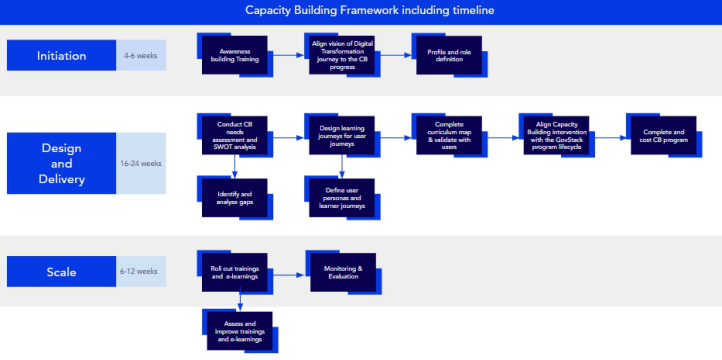
Organizations share information, skills, and best practices through capa- city development. GovStack’s methodology supports this as it is a highly iterative and co-creation-based approach. The GovStack Capacity Building (CB) Framework, as depicted in Figure 1, encompasses the process and timeline of enhancing the skills, abilities, processes, and resources neces- sary for organizations and communities to thrive, succeed, and adapt in an ever-evolving environment.
Figure 1: GovStack capacity building framework.
Eco-System to Support Capacity Building Process The GovStack Initiative is dedicated to supporting governments efforts in digitalization by providing various tools and resources. To facilitate internal
communication and co-creation, the team relies on channels like Microsoft Teams and SharePoint, Jira, and Confluence. Meanwhile, GitBook and GovStack LMS (that is currently hosted on Atingi) serves as platforms to disseminate Technical Specifications and training resources to the public.
The GovStack Initiative is guided by several critical questions, such as how to make governments more open and transparent while dealing with data sensitivity and which technologies are available to achieve these goals. The Initiative follows the principle of “reuse and improve,” (Principles for Digital Development, 2019); making use of existing resources from organi- zations in the government technology field, Open-Source communities, and governments to support the public sector’s digitalization efforts.
As part of capacity building objectives, the initiative focuses on several key aspects, including:
Designing new training resources, especially in the areas of whole-of- government approach and digital infrastructure.
Sharing e-learnings, guidelines, toolkits, or existing training materials from the public and private sectors.
Establish knowledge-sharing forums for sharing insights and best practices on the digital ecosystem.
Focus on training activities in the participating country and link GovStack to the institution(s) responsible for capacity building.
Foster openness to change management as digitizing government servi- ces necessitates significant changes to government processes and citizen- centered services.
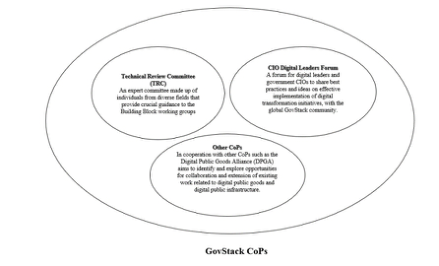
Specialized Communities of Practice The GovStack initiative recognises Communities of Practice as a platform for sharing knowledge and experiences among various stakeholders and countries’ leaders. The approach is based on the principles of best pra- ctices, experience, and knowledge exchange. The Communities of Practice (CoPs) are topic-specific or regional forums to share knowledge and experi- ences regarding the GovStack building block implementation approach. The current CoPs are listed in (Figure 2) below.
Figure 2: GovStack Communities of Practice.
Capacity Building as an Important Key Aspect 131
Excellence Center and Community-Driven Interactive Knowledge Sharing GovStack Excellence Center is a community-driven initiative that facilitates leadership, best practices, research, support, and training in specific areas that are aligned with the GovStack approach. In addition to fostering Com- munities of Practice, GovStack research group engages in research activities on topics that are expected to drive the adoption of digital transformation initiatives, while the GovStack Tech Community provides technical support, and offers both practical and theoretical perspective to knowledge-sharing efforts. Moreover, academic institutions such as TalTech are actively involved, and contribute a diverse range of research topics at both master’s and docto- ral levels, thus offering valuable insights and feedback for ongoing projects as well as supporting future roadmaps of GovStack initiatives. Consequently, this community-driven ecosystem plays a crucial role in promoting excellence and innovation, by presenting valuable insights that inform the develo- pment of strategic and policy-making standards in digital service design and transformation.
Main Skill Sets Needed for the Digitalization Journey Digital skills exist on an evolving continuum and refer to the capacities that allow an individual to use and create value through the use of technology. According to UNESCO, “digital skills refer to a range of different abilities, many of which are not only ‘skills’ per se, but a combination of behaviours, expertise, know-how, work habits, character traits, dispositions and critical understandings”. The proposed knowledge and skills are useful at various stages of a stakeholders’ activities lifecycle. Consequently, following van Laar et al., (2017) and the OECD (2022) categorization of digital skills, we have divided the necessary skills into various categories as outlined in Table 2.
Key Stakeholders Needed in the Country Digital Teams There are various types of stakeholders involved in supporting capacity building efforts during digital transformation processes. Each of these stakeh- olders may have unique perspectives, needs, and priorities, and it is important to engage with them effectively in order to ensure the success of capacity buil- ding programs. Joia (2005) asserts that these stakeholders include: legislators, politicians, top management civil servants, ICT-related civil servants, and all stakeholder groups in charge of delivering services to citizens and businesses, as depicted in Table 3. Mergel (2019) extends this analysis by delving into digital teams and their roles in the public sector digitalization process.
Training Delivery to Support Digital Services For the successful implementation of digital services, a comprehensive under- standing of the GovStack ecosystem is crucial. To this end, GovStack has partnered with Atingi to establish a Learning Management System (LMS) that delivers training resources to country digital teams involved in the digita- lization process. The LMS serves as a central hub for users to gain a thorough understanding of GovStack BB approach and implementation, familiarize
Table 2. Critical skills needed for the digitalization journey.
Table available in the original PDF paper.
Skills Role Technical skills The ability to use a smart mobile device or an application and to navigate online to accomplish a task. Professional technical skills The ability to understand various techniques involved in conceptualizing, designing, developing, testing, integrating, operating, and maintaining software products. Information management skills
The ability to access and use the information to make informed decisions. Online communication skills
The ability to effectively communicate across digital channels. Critical thinking and problem-solving skills
The ability to use ICT to make informed judgments, decisions, and solutions to problems. Enterprise Skills Includes communication, collaboration, project management, continuous learning, product management lifecycle, problem-solving, digital leadership, and design thinking skills. Supplementary skills These include proficiency in English or the working language, presentation skills, mindset, and behavior in terms of self-motivation to learn, interest in lifelong learning, and a “go the extra mile” mentality.
Table 3. Stakeholder groups who support capacity building.
Table available in the original PDF paper.
Stakeholders Role Legislators/Politicians The decision-makers in government entities and are in charge of the long-term planning for the government ministries. Top Management Civil Servants
The decision-makers in government entities in charge of the long-term planning for the government ministries. ICT-related civil servants/Service Designers
Are responsible for transforming the catalog of products and services delivered by different government departments. middle and lower level management
Are responsible for creating, preparing, and/or delivering capacity-building programs. other stakeholder groups All stakeholder groups in charge of delivering services to the citizens and businesses
themselves with relevant tools, artifacts, and templates used in the digita- lization journey, and access curated learning materials. The Moodle-based platform is accessible from any electronic device and is tailored to deliver a comprehensive and engaging online learning experience to government stakeholders.
Capacity Building as an Important Key Aspect 133
In order to effectively deliver the right training for digital transformation, it is prudent to initiate a strategic discussion with all key stakeholders invo- lved. This initial stage should focus on establishing a common understanding of the benefits of digitization and aligning all stakeholders’ focus towards a user-centric perspective of service transformation. Once this phase is com- plete, more extensive training sessions can be planned and delivered. These workshops can focus on specific digital technologies and tools, as well as on the processes and best practices needed to effectively implement and manage digital transformation projects.
CONCLUSION
In conclusion, the digitalization of governments is a growing trend that compels the need for a comprehensive capacity-building strategy to ensure success and sustainability. A highly skilled and competent digital team is imperative for delivering citizen-centered digital public services. To support a seamless implementation journey, it is imperative to formulate a unified capacity-building framework that incorporates all critical components neces- sary for fostering the development of skills and capacities. The proposed GovStack framework underscores the value of fostering a common under- standing of the capacity-building process, which includes implementing a Learning Management System (LMS) and developing a skills matrix that pro- motes the diffusion of relevant competencies and skills. While more research is needed to establish a long-term solution for sustained capacity develo- pment, this paper serves as a pilot case of the GovStack capacity building approach as a model for building capacity within the context of public sector digitalization.
ACKNOWLEDGMENT
The results of this research were supported by the Government of Ger- many through (Deutsche Gesellschaft für Internationale Zusammenarbeit), the Estonian government, Digital Impact Alliance (DIAL), International Tele- communication Union (ITU), and Tallinn University of Technology (TalTech).
REFERENCES
Ala-Mutka, K., 2011. Mapping digital competence: Towards a conceptual understanding. Sevilla: Institute for Prospective Technological Studies, pp. 7–60. Alvarenga, A., Matos, F., Godina, R. and CO Matias, J., 2020. Digital transformation
and knowledge management in the public sector. Sustainability, 12(14), p. 5824. Brookfield, S., 1986. Understanding and facilitating adult learning: A comprehensive analysis of principles and effective practices. McGraw-Hill Education (UK). Child, S. F. and Shaw, S. D., 2020. A purpose-led approach towards the develo-
pment of competency frameworks. Journal of Further and Higher Education, 44(8), pp. 1143–1156. Clarke, A., 2020. Digital government units: what are they, and what do they mean for digital era public management renewal? International Public Management Journal, 23(3), pp. 358–379.
Cukier, W., 2019, March. Developing Canada’s digital-ready public service. Public Policy Forum. Hislop, D., Bosua, R. and Helms, R., 2018. Knowledge management in organizati-
ons: A critical introduction. Oxford university press. Intezari, A., Taskin, N. and Pauleen, D. J., 2017. Looking beyond knowledge sharing: an integrative approach to knowledge management culture. Journal of Knowledge Management. Jackson, N. C., 2019. Managing for competency with innovation change in higher
education: Examining the pitfalls and pivots of digital transformation. Business Horizons, 62(6), pp. 761–772. Jarvis, P. 1987. Adult Learning in the Social Context (1st ed.). Routledge. Joia, L. A., 2005. A framework for developing regional e-Government capacity building networks. Information Technologies & International Development, 2(4), pp. 61. Kyriakopoulou, K., Kalogirou, V., Lobo, G., Manojlovic, K., Mayot, L., Casiano
Flores, C., Crompvoets, J. and Tan, E., 2021, October. Interoperability skills and competencies-the drivers for digital growth in Public Administrations. In Procee- dings of the 14th International Conference on Theory and Practice of Electronic Governance (pp. 270–274). Luka, I., (2014). Design thinking in pedagogy. The Journal of Education, Culture, and Society, 5(2), pp. 63–74. Mergel, I., 2019. Digital service teams in government. Government Information
Quarterly, 36(4), p. 101389. Mezirow, J., 1981. A critical theory of adult learning and education. Adult education, 32(1), pp. 3–24. Morze, N., Makhachashvili, R., Mosiashvili, G. and Pappel, I., 2021, December. Edu-
cating Future Digital Leaders: Developing e-Governance Curriculum in Estonia and Ukraine. In Digital humanities workshop (pp. 185–190). OECD, 2021. The OECD Framework for digital talent and skills in the public sector, OECD Working Papers on Public Governance, No. 45, OECD Publishing, Paris. OECD, 2022. Skills for the Digital Transition: Assessing Recent Trends Using Big
Data, OECD, Paris, France. Pappel, I., Oolu, K., Pappel, I. and Draheim, D., 2017. Driving forces and design of THE Ttü e-Governance technologies and Services Master’s Program. In Ele- ctronic Government and the Information Systems Perspective: 6th International Conference, EGOVIS 2017, Lyon, France, August 28-31, 2017, Proceedings 6 (pp. 278–293). Springer International Publishing. Principles for Digital Development, 2019. Principles for Digital Development.
[online] Available from: https://digitalprinciples.org/. Tannenbaum, S. I., 1997. Enhancing continuous learning: Diagnostic findings from multiple companies. Human Resource Management: Published in Cooperation with the School of Business Administration, The University of Michigan and in alliance with the Society of Human Resources Management, 36(4), pp. 437–452. UNESCO, 2017. Working Group on Education: Digital skills for life and work. Van Laar, E., Van Deursen, A. J., Van Dijk, J. A. and De Haan, J., 2017. The rela-
tion between 21st-century skills and digital skills: A systematic literature review. Computers in human behavior, 72, pp. 577–588.
LISTED IN THE AHFE DIGITAL BOOKSTORE CATALOGUE
Explore the complete digital volume
Human Factors, Business Management and Society
Read this individual research paper free through the original publisher, or explore the full digital proceedings book.
ISBN 978-1-958651-73-5
Explore this ISBN in the AHFE Bookstore ↗Listed in the July 2026 bookstore catalogue; search by ISBN to confirm current availability · Digital book purchase optional