Vesa Salminen, Matti Pyykkönen, Carita Salminen (2023). Spiral Innovation Automation and Team Cohesion. In: Human Factors, Business Management and Society. AHFE Open Access, vol. 97, pp. 78–86. https://doi.org/10.54941/ahfe1003884
The complexity of new innovation is dramatically increasing, and speed requirements of innovation phase are growing. New technology enables innovation opportunities in business environment. Speed requirements for innovation phase are growing. Knowledge and data is a valuable currency in the innovation phase and there is need for fast spiral innovation process. The role of human- oriented factors and understanding of human-technology interfaces is essential. Behavior culture of development teams requires better cohesion to manage self-organizing teamwork. The goal of this article is to identify and analyze team cohesion during spiral innovation automation, when innovation is made by a team of individual experts from various international and cultural backgrounds and with specialized competences. The article introduces an evolution framework for knowledge management in spiral innovation automation.From the many results and experiences gathered during this research, it appears that spiral innovation automation according to value driven approach with successful team cohesion is a long journey but will provide solutions for complex problems and situations.
New technology opportunities are arising and enabling new development in business environment. Knowledge management in the innovation phase is becoming more prominent, because of the complexity of new techno- logy. This influences how we manage innovation management and spi- ral innovation in our business environment. Understanding human factors and human-technology interfaces is essential in innovation and implemen- tation. There is a continuous need for human-centric innovation tech- niques. Development teams require cohesion to manage self-organizing teamwork.
In the innovation ecosystem and its techniques data is a valuable currency that fuels data driven spiral innovation. Capturing data from various sources and executing it in businesses requires a human-oriented approach. Strategic challenge is to apply systematic approach.
The goal of this article is to explain team cohesion during spiral innova- tion automation, when innovation is made by a team of individual experts from various international and cultural backgrounds and with specialized competences. New innovations are increasingly complex, and the speed requirements for innovation phase are growing.
This article attempts to develop an evolution framework for knowledge management in spiral innovation automation. For companies to achieve a competitive edge in today’s rapidly changing, complex environment, team cohesion is essential for self-organizing specialists sharing a common goal in spiral innovation.
A generic observation of this research is that successful spiral innovation automation needs clear innovation strategy and should set up a shared vision and evolutionary roadmap to serve as the basis for common value creation, cooperation, and innovation ecosystem leadership. During cohesion, all team members of innovation ecosystem should focus their attention in goal set- ting and the value propositions that are being pursued, not in corporate or individual identity. It is important to understand that innovation automation happens through a value driven approach. Cohesion of team members is defi- ned around the roles, positions, and flows across the individual experts that create the value proposition.
THEORETICAL FRAMEWORK ‘The world is in continuous transition with new discontinuities, and it is dif- ficult to form clear understanding of future challenges and opportunities. Innovation management techniques are critical to navigating volatility and uncertainty.’ (Skyttegaard et al, 2022).
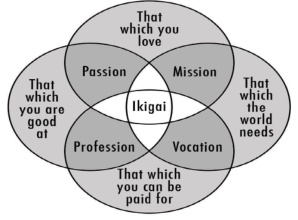
‘The Japanese word Ikigai (in English a reason for being) means the mea- ning of what you do and the purpose of your life, i.e., “why do I go to work in the morning”. The concept of Ikigai can be understood more broadly as subjective well-being. (Christopher 2008.)’ ‘With the help of the Ikigai fra- mework, a person may find meaning and values in his life, and for others it may mean a hobby, family or work (Figure 1). (Vallerand, 2008)’ ‘One can begin to outline one’s own competence with the help of the Ikigai frame of reference. In business life, the Ikigai concept is associated with the purpose of the company’s existence (Levy, 2002).’
Figure 1: Ikigai-framework on meaning for being.
Team Cohesion is a dynamic process which reflected in the tendency for a group to stick together and remain united in the pursuit of goals and objectives (Carron, 1982).
‘Most analyses have shown that there is a relationship between cohesion and performance. This is the case even when cohesion is defined in diffe- rent ways. When cohesion is defined as attraction, it is better correlated with performance (Beal, 2003).’
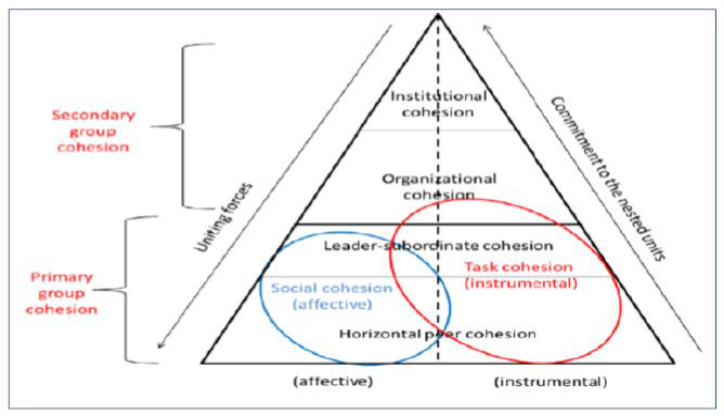
‘Unit cohesion is conceptualized as an ongoing process of integration and bonding that take place among group members, between followers and lea- ders, and within their larger secondary groups. The conceptual framework identified four components of cohesion: horizontal, vertical, organizational and institutional bonding and their affective and instrumental dimensions (Salo, 2011).
Innovation teams often try open innovation because everyone else is doing it and seeing what comes out of it. This, however, often ends up in ideas not being further pursued (and wasted time) (Itonics, 2022).
RESEARCH QUESTIONS The goal of this article is to identify and analyze team cohesion during spiral innovation automation, when innovation is made by a team of individual experts from various international and cultural backgrounds and with different competences. The complexity of innovation is dramati- cally increasing, and the speed requirements for the innovation phase are growing.
This article attempts to develop an evolution framework for the know- ledge management of spiral innovation automation. Team cohesion with self- organizing specialists having a common goal in spiral innovation is essential in today’s rapidly changing, complex environment, in order to achieve a competitive edge for companies. Diversity is an essential starting point for development activities. Cooperation is managed on the principle of self-organizing teams.
1. What does team cohesion mean during innovation? 2. How is team cohesion managed during the different stages of innovation? 3. How is a systemic framework of innovation processing structured? 4. How does the spiral innovation process work?
This research is partly constructive, conceptual, and analytical because it introduces a spiral innovation automation concept executed by cohesion building opportunities in teamwork.
Data for this concept creation has been collected over several years on con- tinuous flow from different research and development projects, which may be seen as a type of applied science. Data has also been gathered from inte- rviews and workshops executed during projects on a foresight and scenario planning basis.
Spiral Innovation Automation and Team Cohesion 81
TEAM COHESION AND SYSTEMIC HUMAN-ORIENTED INNOVATION Cohesion here refers to the mutual attraction of people and synergy. Cohesion holds the community together, i.e., resists its disruptive and dispersive forces. Cohesion is also born from community solidity and adhesion, through syner- gies among community members. Group cohesion and spirit reflect cohesion. Cohesion also affects individuals in workplace communities. If there is strong cohesion between members of a three-person team, and the members have clearly different roles, the members each form their own phase. In this case, the team is heterogeneous. The participants each form their own the phase according to their area of competence, role, and task field.
Unit cohesion refers to the social-relationship products of social inte- gration generated by positive social and task-related relationships among members (peers and leaders) and their shared, united experiences as members of specific groupings (nested group, organization and institution) (Figure 1). This places cohesion within a larger perspective and facilitates the identifica- tion of a significant model of cohesion (Salo, 2011).
Innovation culture is not the easiest thing in the world to understand. It is the soft side of the organization. There are typically too many variables to understand and master. The responsibility for building innovation culture lies at the top of an organization (Kop, 2019).
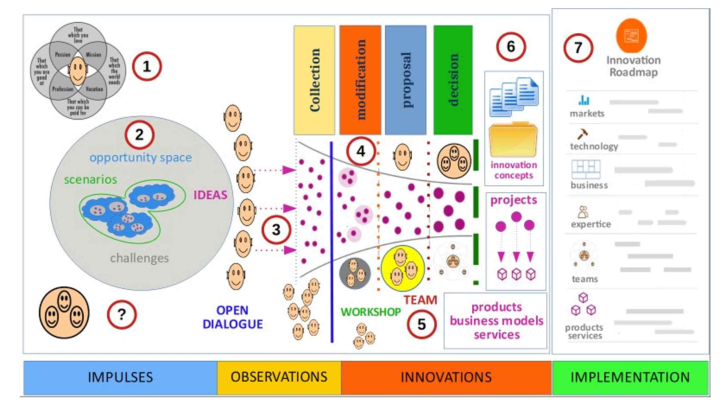
The objective is that innovation concepts are generated through team cohesion in innovation funnels (Figure 3). Managing a project portfolio ena- bles business co-evolution and development of new products, services, and business models. What an individual is doing and the purpose of their life (Figure 1) combined with team spirit and cohesion (Figure 2) leads to success in innovation. It is most important to have an opportunity space (Figure 3) that is continuously kept up to date. It gives fuel and new data for the creative process and concept creation of new innovations.
Figure 2: Components of cohesion (Salo, 2011).Figure 3: Systemic framework of innovation processing.
The innovation roadmap manages various viewpoints of implementation and gives feedback to strategic considerations, competence, and cooperatio- n/team cohesion requirements, thus aligning strategies.
Figure 3 (modified Itonics, 2022) presents the innovation approach from the viewpoint of human factors and in the following: 1 – Personal Idea Phase: “New Insight for Solution” From the viewpoint of Ikigai (Figure 1) the experiential and influential aspects are profession, passion, mission and vocation. A person creates a domain-specific idea of an opportunity. 2 - Opportunity for Solutions; “Opportunity Space and Scenario Creation” Challenges and scenarios of solution opportunities are brought up during this phase.
Scenarios are illustrated based on real world use cases. Requirements for inventions are figured out. To assess the quality of an invention, it is impor- tant to consider the following factors “ChatGPT- answer for a question: How can I assess the quality of an invention for solution (question made, Chat GPT, 2023)?”:
1. Originality: Is it an unique and novel idea? 2. Feasibility: Can it be realistically manufactured and marketed? 3. Demand: Is there a market need for the invention? 4. Functionality: Does it effectively solve the problem it was designed to address? 5. Usability: Is it user-friendly and accessible? 6. Patentability: Can it be patented and protected from infringement? 7. Cost-effectiveness: Can it be produced and sold at a competitive price?
It is important to gather as much information as possible about the inven- tion and its potential market before making a final assessment. It is possible
Spiral Innovation Automation and Team Cohesion 83
to question domain-specific problems and challenges and also the technolo- gical possibilities of the solution from an AI-related agent (e.g. ChatGPT). Innovation culture is changing via new opportunities provided by AI Agent technology. 3 – Open Dialog for Simple Ideation: Synopsis and Sketch Description With the help of storytelling and describing scenarios according to usage situations, the functional content and sketches take shape. Simple implemen- tation ideas and modeling the real world as realistically as possible into a digital form are easily structured with a draft or a concept for synopsis scri- pts. This is facilitated by the fact that the specifier has knowledge of both the domain area and the implementation technology. Motivation increases drive during this phase and unit cohesion starts to build up. 4 – Conceptual Design; Modeling conceptual and modular solutions (functi- onal and structural concepts) in workshop teams During the conceptual phase the practical feasibility in terms of the applicabi- lity of the solution is verified in a modeling and simulation environment (e.g Unreal or UNITY virtualization engine and platform). In this applied resea- rch phase, it is possible to use resources (e.g., Universities or research teams, Figure 4) to help arrange open dialog and workshop sessions with various development partners (solution provider-, user- and client-representatives) making proof-of-concept proposals to be evaluated for the possible solu- tion. The results of this feasibility prototyping are transferable for further refinement. 5 - Requirements for Minimum-Viable-Product (MVP); Team Performance Requirements (Personal Competence Portfolio, Forming of Team) Common team mission, forming cohesion, and objective definitions are cre- ated and defined during this phase. Based on the experiments and practical implementation work (virtual prototype), the proposal is defined from a user value point of view. This MVP-presentation/demo/prototype demonstrates the solution and the functionality of the product/service. A project portfolio is drafted during this phase and the decision is made to start selected projects
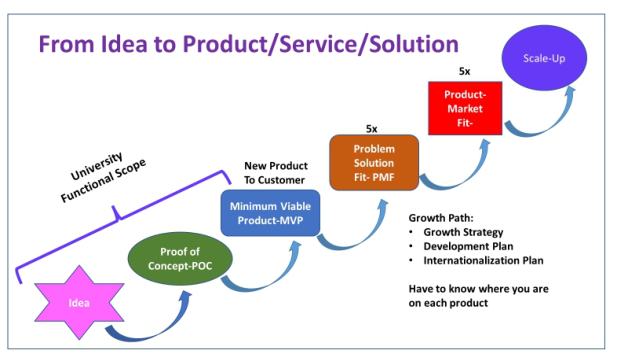
Figure 4: From idea to growth path.
(product, service, new business model). Depending on the created innova- tion, either a core team for start-up innovation or an operation team with engineering experts for project development is formed. 6 - Conceptual Engineering; Business Model, Products, Services In the case of start-up innovation, the core team is forming deep team coh- esion with each other when deciding on the business model (e.g., Start-up Lean Canvas, Blank, 2013). In the case of an operation team, in develo- pment projects, the required cohesion ought to be formed based on task structure (task cohesion, Figure 2). The selected operation team chooses an innovation concept which consists of product and service plans that are offe- red to users and sold to customers. MVP products made for demonstration are used to collect customer feedback and experiences, based on which the actual business, product and service development projects are planned and formed. More detailed structural, functional, content and technology speci- fications are made for product development projects which form the project portfolio. 7 - Implementation Task, Functional and Life-Cycle Phase; Virtual and Self-Organizing Teams According to strategic alignment, an innovation roadmap is drawn up for practical implementation and business development. Individual experts from network partners are embedded in task-based teamwork cohesion based on their roles. It is important to define roles because of ownership, trust, and security reasons (knowledge and data).
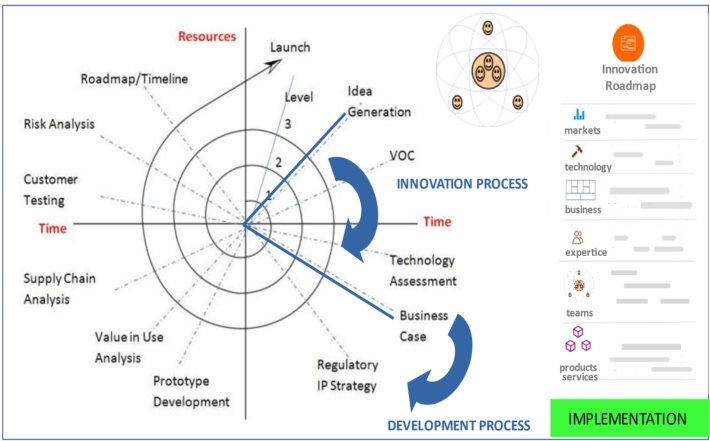
SPIRAL INNOVATION CO-EVOLUTION The co-evolution theory on management raises the need for a fundamen- tal understanding of the natural processes of continuously evolving and co-evolving individuals and the systems in which these individuals work. In this paradigm, essential focus areas are raised, such as co-evolution in human performance, business performance, and human-computer interaction. It is possible to execute spiral innovation (Figure 5) on this type of balanced and dynamic management situation:
Level 1 of the spiral process circle consists of creating a minimum viable product or service for concept implementation for key customer purposes. As result of this development is problem solution fit (Figure 4).
Level 2 of the circle enlarges reviews of products, services and business based on re-engineering for the purpose of product-market fit (Figure 4).
During the circle’s level 3, product realization, service offering, and the pursued business alignment are scaled up (Figure 4) A generic finding of this spiral innovation is that successful, strategy-based innovation management is dependent on the human-centric aspect of tea- mwork with scale-up and variation of formal and virtual teams. Spirals are generic, but new development spiral circles are presumed to grow according to new development objectives created in a dynamic way. This is essential for success.
Spiral Innovation Automation and Team Cohesion 85
Figure 5: Spiral innovation co-evolution.
DISCUSSION AND CONCLUSION New innovations are increasingly complex, and the speed requirements of the innovation phase are growing. It is important to select innovation project experts with right competences and cooperation capabilities to secure a smo- oth run of the project. During this research activity, team cohesion during the execution of six innovation projects has been identified and analyzed. Individual experts from various international and cultural backgrounds and specialists with different competences have taken part in these projects.
Management and leadership of business co-evolution through cooperative innovation in a spiral way results in innovation automation. Team and unit cohesion is the glue providing success when executing innovation automation and scaling up product and service offerings and aligning business. The expe- rience according to this research activity is that the innovation process can be automated more comprehensively with the help of AI-oriented technologies (e.g., ChatGPT and Open AI- Platform, (ChatGPT (2023)).
Spiral innovation automation with successful team cohesion may be a long journey but it will provide solutions for complex problems and situations.
REFERENCES
Beal, D. J., Cohen, R., Burke, M. J. & McLendon, C. L. (2003). Cohesion and performance in groups: A meta- analytic clarification of construct relation. Journal of Applied Psychology, 88, 989–1004. Blank, S. (2013) Why the Lean Start-Up Changes Everything. A faster, smarter meth-
odology for launching companies may make business plans, Harvard Business Review, May 2013.
Carron, A. V. (1982). Cohesiveness in sport groups: Interpretations and considerations. Journal of Sport Psychology, 4(2), 123–138. https://doi.org/10.1123/jsp.4.2.123. Chat GPT (2023) https://openai.com/blog/chatgpt/ (read and used 01.02.2023). Christopher, P. 2008. Ikigai and Mortality Individuals who believe their lives are worth living live longer. Psychology Today. 19.7.2008. (read 01.02.2023). https: //www.psychologytoday.com/intl/blog/the-good-life/200809/ikigai-andmortality. Itonics (2022) Innovation Defined: The Why, What & How. https://www.itonics-in
novation.com/innovation-guide#end-to-end (read 27.1.2023). Kop, S. (2019) A Simple Guide to Organize Innovation. A logical and pragmatic way to an innovative organization. Creatieve Koppen. Published by Creatieve Koppen B. V. T. Levy, B. R., Slade, M. D., Kunkel, S. R., & Kasl, S. V. (2002) Longevity increased by
positive self-perceptions of aging. Journal of Personality and Social Psychology,83. Malakar, N. (2023) Challenges in Open Innovation and How to Overcome Them. https://www.itonics-innovation.com/blog/challenges-in-open-innovation (read 22.1.2023). Markopoulos, E., Vanharanta, H. (2022) The Democracy Model- Creating Inno-
vation Democratic Work Culture for effective Organizational Knowledge- Based Management and Leadership. Routledge-Taylor & Francis Group, New York, USA. pp. 176. Poole, M. S., Hollingshead. A. B. (2004) Theories of Small Groups: Interdisciplinary Perspectives, edited by Marshall Scott Poole, and Andrea B. Hollingshead, SAGE Publications, Incorporated, 2004. ProQuest Ebook Central, http://ebookcentral.proquest.com/lib/jyvaskyla- ebooks/detail.action?docID=997219. Created from jyvaskyla-ebooks on 2023-01-29 16: 36: 07. Salo, M. (2011) United we stand- Divided we fall: A standard model of unit cohesion.
Publication of the Department of Social Research 2011:6. Helsinki University. Skyttegaard, P., Cearley, D, Fujiwara, T. (2022) Gartner Hype Cycles for Innovation ManagementTechniques. https://www.gartner.com/doc/reprints?id=1-2B MWIMB7&ct=221109&st=sb Published 26 July 2022 - ID G00771269. Strickland, S., Towler A. (2011) Correlates of Creative Behaviour: The Role
of Leadership and Personal Factors. Canadian Journal of Administrative Sci- ences / Revue Canadienne des Sciences de l Administration 28(1): 41–51 DOI: 10.1002/cjas.157. Vallerand, R. J. (2008) On the psychology of passion: In search of what makes people’s lives most worth living. Canadian Psychology, 49, 1–13.
LISTED IN THE AHFE DIGITAL BOOKSTORE CATALOGUE
Explore the complete digital volume
Human Factors, Business Management and Society
Read this individual research paper free through the original publisher, or explore the full digital proceedings book.
ISBN 978-1-958651-73-5
Explore this ISBN in the AHFE Bookstore ↗Listed in the July 2026 bookstore catalogue; search by ISBN to confirm current availability · Digital book purchase optional