Ryushun Oka, Jumpei Tahara, Ichiro Koshijima, Kenji Watanabe (2025). Blocking System for Autonomous Flight Drones. In: Human Factors in Robots, Drones and Unmanned Systems. AHFE Open Access, vol. 179, pp. 23–31. https://doi.org/10.54941/ahfe1006371
In recent years, the misuse of drones has emerged as a critical challenge. Drones use electromagnetic waves, such as GNSS (Global Navigation Satellite System), and remote control signals for navigation. When a malicious drone that intends to engage in criminal activities such as terrorism is detected, it is possible to neutralize drones using systems that generate high-power jamming signals, such as Drone-Buster. However, this approach requires continuous emission of strong jamming signals, which can interfere with nearby devices that rely on electromagnetic waves. Furthermore, it is challenging for a single unit to cover multiple intruder drones simultaneously. In order to address these issues, the following three mechanisms are proposed in this paper:1. Interference with Unauthorized Drone FlightsTypically, drones use GNSS to obtain positional information for navigation. If GNSS signal reception is interrupted, the drone will stop operating. This study proposes multiple array antennas deployed to emit directional signals to achieve this selected jamming. Each jamming signal from one array antenna is weak enough not to affect electronic devices in public areas. However, by concentrating multiple jamming signals within a confined area of a few cubic meters and aligning their phases, the interference intensity can be enhanced to a level that disrupts the regular operation of the drone. A "jamming grid" is created by rapidly scanning this interference area. This grid can then be moved vertically to cover a broader range.2. Safeguarding Authorized DronesThe method mentioned above affects all drones passing through the interference area. To ensure the secure operation of authorized drones, a local positioning system (LPS) that measures positional data locally is implemented. Drones compatible with this system can determine their location and continue operating safely. Additionally, the system employs encryption and authentication using pre-shared key information, preventing malicious drones from calculating positional data or impersonating legitimate drones.3. Provision of Positional Information and Assumption of the Attacker's PerspectiveIn addition to emitting jamming signals, the proposed system can receive and analyze signals reflected from flying objects to determine their position. This capability is especially useful for identifying drones that do not rely on GNSS.Moreover, by incorporating active defense that anticipates the attacker’s psychology and behavior, the system guides intruding drones into deliberately created gaps for interception and neutralization. The human-in-the-loop framework enables flexible, real-time responses.This proposed method can disable unauthorized drones that enter the interference area, and drone operators who do not want to spend time on attacks will inevitably choose to avoid the interference area. Therefore, by setting the interference area to guide drones into the area intended by the defender, it will be possible to effectively deploy more powerful defense devices such as Drone-Buster. Furthermore, the scalability of this approach may also make it possible to defend against large swarms of drones.This paper describes the concept of the proposed method and presents preliminary results from proof-of-concept experiments.
Drones are utilized in various industries due to their high versatility. On the other hand, there are growing concerns about their illicit use or so- called drone threats. Because of their versatility, drones can be exploited for terrorist attacks. For instance, one can imagine the damage that would result if a bomb or other hazardous material were attached to a drone, flown over Tokyo’s Shinjuku district, and dropped there. Additionally, a camera-equipped reconnaissance drone could steal information from critical infrastructure operators. Consequently, law enforcement agencies worldwide are now employing various devices to counter the threats posed by drones.
EXISTING COUNTERMEASURES To protect against drone threats, we must be able to detect them. There are many methods of drone detection, primarily using visible light or infrared, sound, or radio waves. However, each of these methods has its limitations.
Detection using visible or infrared light relies on visual observation or camera systems, making it greatly affected by obstructions and weather conditions, and there is also a limited range in which drones can be detected. Similarly, sound-based detection is limited by the properties of sound waves, which restrict the distance over which it can be effective (Abro et al., 2022) (Khan et al., 2022).
Radio wave-based detection employs radar systems, of which there are two types. The first type detects drones by transmitting radio waves and receiving the waves reflected from the drone. The second type detects drones by receiving the radio waves that control them. Both of these methods also have limitations in their detection range. For instance, if a drone is stealth- equipped or is an autonomous type that does not emit any radio waves at all, it may go undetected. Failing to detect such drones can gravely impact our ability to respond to these threats (Robin Radar Systems, 2022).
PROBLEM In summary of the previous chapter, two major countermeasures against drone threats have been implemented in the real world. However, both methods assume that the drone has already been detected.
1. Physically Capturing Drones with Nets
To physically capture a drone using a net, one must prepare the net in advance, which can be time-consuming to deploy (Yu et al., 2022).
2. Using a Jamming Gun
Much like operating a conventional firearm, a jamming gun can quickly emit jamming signals at the target drone. However, because it provides only a one-to-one countermeasure, it cannot address threats posed by swarms of drones. Furthermore, if the jamming signals need to be emitted for an extended period, there is a high risk of interfering with other systems (Jensen, 2024).
Related Research Research on GNSS jamming and spoofing has been conducted to disrupt drone flights through jamming. GNSS jamming can almost block location information in most drones, effectively turning off their “return-to-home” function. Meanwhile, GNSS spoofing has been reported to force a drone to land by guiding it into a designated “No-Fly Zone (NFZ)” (Zidane et al., 2024). However, it has also been suggested that jamming may interfere with legitimate communications, potentially affecting a wide area (Gummadi et al., 2007). Furthermore, from a fuzzing perspective, it has been pointed out that research focusing on GNSS-based drone security has not progressed significantly, which remains an issue (Malviya et al., 2025). Hence, there is still room for further investigation into the emission of jamming signals targeting GNSS.
Blocking System for Autonomous Flight Drones 25
Proposed Method In this study, we propose disrupting the flight of unauthorized drones by emitting radio waves that interfere with the reception of their GNSS and control signals. We employ multiple array antennas to transmit directional jamming signals to achieve disruption. Each jamming signal is weak, posing no impact on electronic devices used in public areas. However, by directing multiple jamming signals to a specific area and aligning their phases, it is possible to intensify the interference within that particular region to a level that disrupts the drone’s regular operation (Jiang et al., 2023). By scanning this targeted interference area at high speed, we can create an interference plane, and by further moving that plane vertically, we can generate a three- dimensional interference region.
Simulation and Validation In the previous chapter, we proposed a method to concentrate directional jamming waves (jamming signals) emitted from multiple array antennas onto a specific area and align their phases, thereby raising the interference level only within that target area to disrupt the regular operation of drones. To evaluate whether this is feasible, we conducted simulations.
In real urban environments, antenna installation heights are expected to vary due to differences in building elevations and terrain. The proposed system is designed such that each antenna is independently steered and beamformed. Even when antennas are positioned at different heights, phase adjustment maximizes the interference intensity at the target point. Furthermore, by integrating terrain data and building height information from a three-dimensional (3D) map, it is possible to implement an algorithm that dynamically recalculates the optimal interference location in real-time, enabling the system to adapt flexibly to complex and variable topographies.
The proposed system has a clear trade-off between the number of antennas, transmission power, and coverage area. Expanding the coverage area requires increasing the transmission power or deploying additional antennas. However, excessive power output may lead to unintended interference in non- targeted regions; therefore, increasing the number of antennas is generally preferred to achieve wider coverage while minimizing collateral effects.
This system utilizes beamforming technology to focus radio waves from multiple antennas onto a specific area. Adjusting the phase and amplitude of each antenna’s signal allows interference to be concentrated within the desired region while minimizing its impact outside the target zone.
Since implementing this system necessitates deploying multiple high-gain directional antennas, the balance between cost and feasibility must be considered. At this stage, leveraging existing infrastructure—such as public facilities and communication towers—is a viable strategy for reducing initial installation costs.
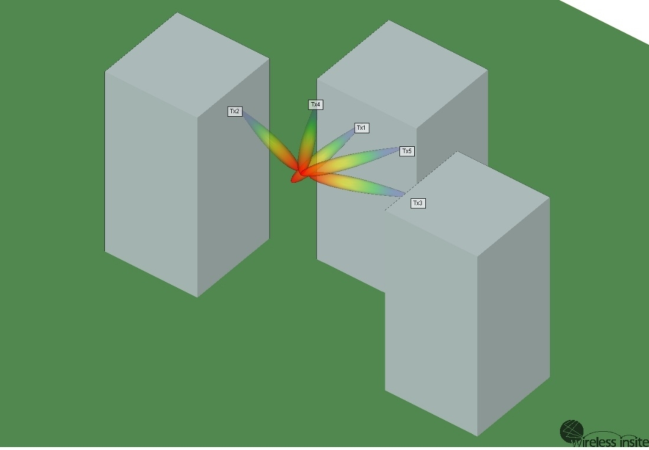
As illustrated in Figure 1, five transmission points (Tx1 through Tx5) emit signals (continuous waves at 1575.420 MHz, corresponding to GPS L1) from three buildings toward a single point. Each antenna is assumed to maintain an ideal directional pattern in this simulation.
Building: (X : Y : Z = 100 m : 100 m : 200 m) Antenna: Directional Antenna (Height: 180 m) Beamwidth (E-plane half-power and H-plane half-power): 5
Maximum Antenna Gain: 31.628dBi Receiver: Isotropic (Height: 180 m)
Figure 1: Antenna placement.
Simulation Results and Evaluation
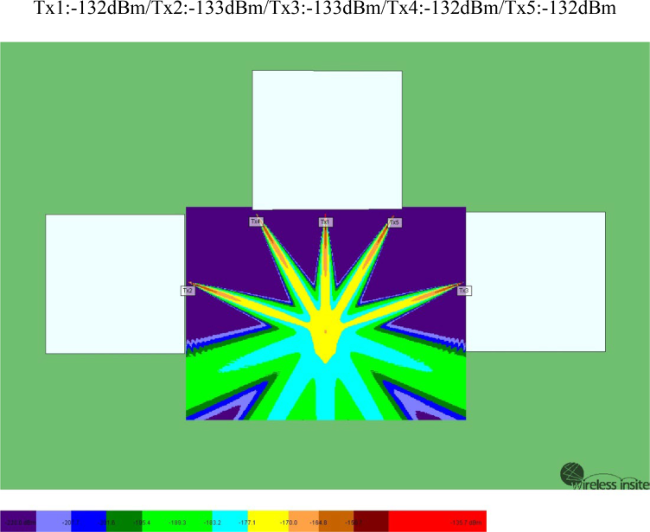
Figure 2 shows the simulation results when radio waves are transmitted from each transmission point at the power levels indicated below (Isotropic). In each simulation, the received power at isotropic receivers placed at 0.5 m intervals is visualized as a heatmap.
Figure 2 shows that the radio waves emitted from each transmission point intersect at a single location, increasing the power level at that intersection. Because the power level at this intersection exceeds the threshold required for jamming, it is possible to perform jamming only at that specific point. Assuming that GNSS interference becomes effective at around −170 dBm/Hz, any point on the heatmap displaying a value (color) above the brown range indicates successful jamming.
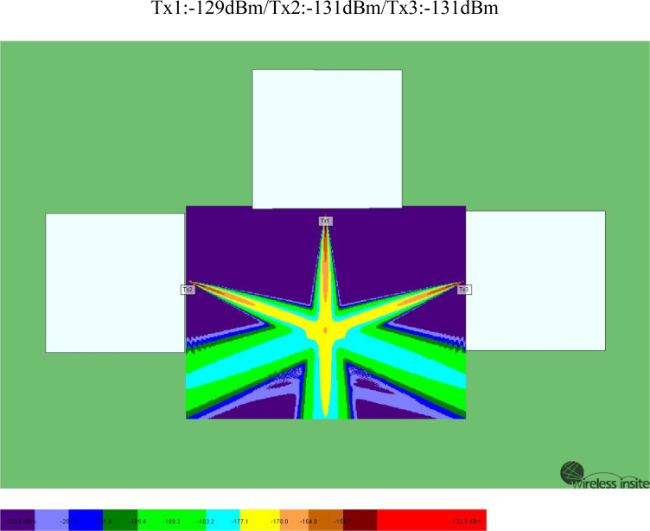
Figure 3 shows a simulation (visualized as a heatmap) where the number of transmission points has been reduced from five to three yet still exceeds the necessary power threshold to achieve jamming levels similar to those in Figure 2. The power levels transmitted from each point under these conditions are as follows.
Blocking System for Autonomous Flight Drones 27
Figure 2: Total power (Tx:5Ver).Figure 3: Total power (Tx:3Ver).
Because the power radiated from each transmission point has increased, each transmitter’s effective jamming range has been significantly extended.
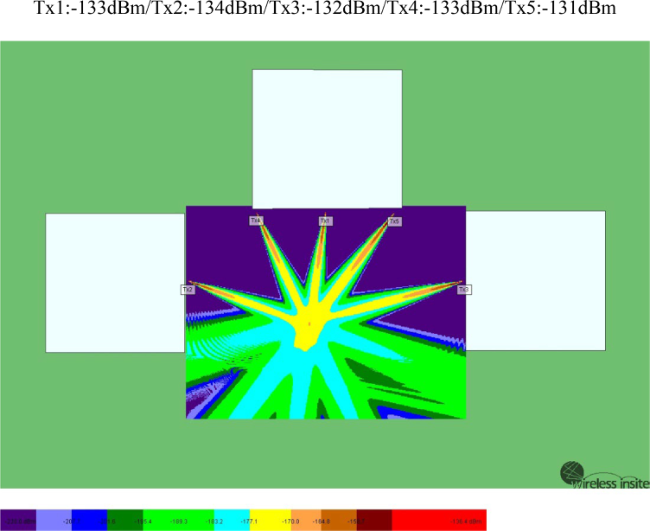
Figure 4 shows the case with five transmission points, as in Figure 2. The target point is scanned by controlling the antenna directivity so that the emitted signals exceed the power threshold necessary for jamming. Thus, it is possible to scan the jamming point by adjusting the antenna directivity.
Figure 4: Total power (Tx:5 move Ver).
The Human-in-the-Loop Approach The jamming-based drone countermeasure proposed in this study is a powerful technique capable of uniformly disrupting unauthorized drones across a wide area by emitting focused radio frequency interference. However, its high effectiveness introduces the potential risk of indiscriminately affecting unauthorized and authorized drones. In real-world environments, legitimate drones routinely operate in shared airspace, including those used for public services, logistics, and infrastructure inspections. Disrupting such drones, even unintentionally, can lead to significant social, operational, and legal consequences. To address this challenge, we integrate a human-in-the- loop framework that enables human operators to control and make real- time decisions. Rather than relying solely on static or automated jamming patterns, operators can dynamically adjust interference zones, implement strategic gaps, and respond to evolving threats based on situational awareness. This human-technology interaction enhances system safety and
Blocking System for Autonomous Flight Drones 29
adaptability and supports the implementation of deception-based tactics, as discussed in the following section.
Assumption of the attacker’s perspective Conventional drone countermeasures have traditionally been developed from the perspective of system operators, focusing primarily on defensive technical measures. However, from a human factors perspective, it is equally important to consider malicious actors’ behavioral patterns and decision- making processes, namely unauthorized drone operators, and how they might attempt to evade or exploit the system.
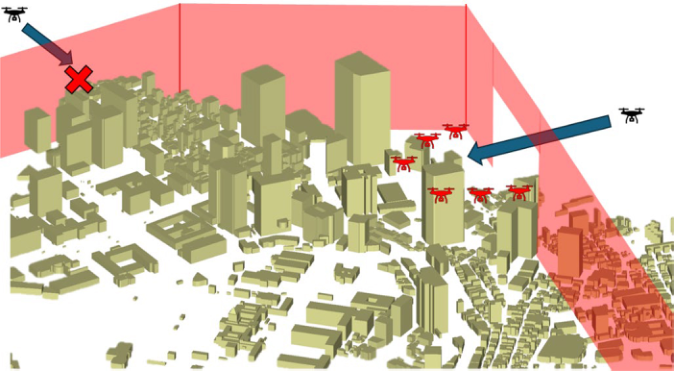
The proposed system incorporates the philosophy of active defense, whereby it not only disrupts unauthorized drones through broad-area jamming but also strategically manipulates the attacker’s behavior. Figure 5 illustrates a uniformly jammed area, within which a deliberate “gap” or “safe corridor” is intentionally left open. This gap is designed to appear as a weakness or blind spot in the system to entice the attacker.
Figure 5: Defense and deception points of the proposed system (Black drone: Malicious UAV, red drone: Defensive UAV).
Due to the highly constrained operational space imposed by jamming, the attacker is psychologically guided toward this gap, believing it to be a safe path through the interference zone. Once the hostile drone enters the gap, it can be neutralized through a secondary defense mechanism, such as interception by a counter-drone or physical disablement using dedicated response units.
This approach limits the range of available attack vectors and gives the defender strategic control over the engagement by shaping the attacker’s perception and choices. By integrating this tactic with a human-in-the-loop framework, system operators can dynamically adjust jamming parameters, activate or deactivate gaps in real-time, and respond adaptively to changing threats.
From a human factors standpoint, this strategy leverages both the system’s technological capability and adversaries’ psychological tendencies, enabling a more comprehensive and sustainable model of drone defense. *It should be noted that any physical countermeasures must comply with applicable legal and ethical guidelines.
Role of the Operator The operation of conventional jamming systems requires monitoring and real-time decisions. The final judgment of “friend or foe” is typically entrusted to human situational awareness and decision-making abilities.
However, modern drone technologies are advancing rapidly, often surpassing human judgment capabilities, and hesitation in decision-making can hinder the timely deployment of jamming.
Remedies for Drones Other Than Unauthorized Ones This method affects all drones passing through the target area, which may interfere with authorized drones. We propose introducing a local positioning system (LPS) that combines multiple positioning technologies to address this issue. For example, the transmitter (Tx) that emits the jamming signal can also be equipped with an LPS signal transmitter, allowing drones to calculate their position based on these signals.
With this approach, drones operating in jamming environments can still obtain their location data and safely continue flying. Furthermore, using pre- shared keys for encryption and authentication prevents unauthorized drones from calculating their location or impersonating authorized drones.
This approach also eliminates the need for the system operator to make direct jamming decisions, allowing for uniform interference against all non- authorized drones.
Detection and Provision of Drone Position Information While the system’s primary function is to emit radio signals toward drones, it can also receive reflected waves from flying objects and determine their positions. As a result, system operators can manage drones based on precise three-dimensional positional data that is independent of GNSS.
CONCLUSION
This study proposed a novel countermeasure method to prevent unauthorized drone flights by jamming GNSS signals and controlling radio waves. Conventional drone countermeasures, such as drone guns and physical capture methods, have issues, including one-to-one engagement constraints, time-consuming preparation, and the potential to interfere with surrounding electronic devices. By leveraging directional jamming technology using multiple array antennas, our approach focuses radio waves only on specific areas, providing a more efficient drone countermeasure.
Simulation results demonstrated that localized jamming is feasible by optimizing transmitter locations and that controlling the directivity enables
Blocking System for Autonomous Flight Drones 31
movement of the jamming area. This localized jamming makes it possible to deal with multiple drones while minimizing unnecessary radio interference.
However, this method may still affect legitimate drones, which remains challenging. To address this, we proposed using a local positioning system (LPS) so that authorized drones can continue to operate even in a jamming environment. We also examined combining encryption and authentication technologies to prevent spoofing by unauthorized drones.
Future tasks include conducting demonstration experiments in real- world environments and developing advanced techniques for controlling the jamming area. Additionally, jamming technology’s legal and ethical implications must be carefully considered. The outcomes of this research contribute to advancing drone countermeasure technologies, and further studies toward refinement and practical implementation are warranted.
REFERENCES
Abro, G. E. M., Zulkifli, S. A. B. M., Masood, R. J., Asirvadam, V. S. and Laouiti, A.
(2022) ‘Comprehensive review of UAV detection, security, and communication advancements to prevent threats’, Drones, 6(10), p. 284. Available at: https://doi. org/10.3390/drones6100284. Gummadi, R., Wetherall, D., Greenstein, B. and Seshan, S. (2007) ‘Understanding and mitigating the impact of RF interference on 802.11 networks’, Computer Communication Review (CCR), 37, pp. 385–396. Available at: https://doi.org/ 10.1145/1282427.1282424. Jensen, J. (2024) ‘Drone jammers: An inside look at counter UAS technology for
drone pilots’, UAV Coach, 25 July. Available at: https://uavcoach.com/drone-jam mer/. Jiang, Y., Zhou, L., Tang, Y., Tu, Y., Liu, C. and Shi, Q. (2023) ‘A collaborative jamming algorithm based on multi-UAV scheduling’, Proceedings of the 2023 IEEE 23rd International Conference on Communication Technology (ICCT), pp. 372–377. Available at: https://doi.org/10.1109/ICCT59356.2023.10419673. Malviya, V. K., Minn, W., Shar, L. K. and Jiang, L. (2025) ‘Fuzzing drones for
anomaly detection: A systematic literature review’, Computers & Security, 148, p. 104157. Available at: https://doi.org/10.1016/j.cose.2024.104157. Khan, M. A., Menouar, H., Khalid, O. M. and Abu-Dayya, A. (2022) ‘Unauthorized drone detection: Experiments and prototypes’, arXiv. Available at: https://arxiv. org/abs/2212.01436. Robin Radar Systems (2022) ‘The pros and cons of radio frequency analysers in
drone detection’. Available at: https://www.robinradar.com/blog/radio-frequenc y-analysers-drone-detection. Yu, D., Judasz, A., Zheng, M. and Botta, E. (2022) ‘Design and testing of a netlaunch device for drone capture’, AIAA SCITECH 2022 Forum. Available at: https://doi.org/10.2514/6.2022-0273. Zidane, Y., Silva, J. S. and Tavares, G. (2024) ‘Jamming and spoofing techniques for
drone neutralization: An experimental study’, Drones, 8(12), p. 743. Available at: https://doi.org/10.3390/drones8120743.
LISTED IN THE AHFE DIGITAL BOOKSTORE CATALOGUE
Explore the complete digital volume
Human Factors in Robots, Drones and Unmanned Systems
Read this individual research paper free through the original publisher, or explore the full digital proceedings book.
ISBN 978-1-964867-55-7
Explore this ISBN in the AHFE Bookstore ↗Listed in the July 2026 bookstore catalogue; search by ISBN to confirm current availability · Digital book purchase optional