Kurtis Riener, Vipashyana Patel, Lin Jiang, Behin Elahi, Mahima Suresh, Lesther Papa, Yue Luo (2025). Human-Robot Communication: Utilizing Light-Based Signals to Convey Robot Operating State. In: Human Factors in Robots, Drones and Unmanned Systems. AHFE Open Access, vol. 179, pp. 135–144. https://doi.org/10.54941/ahfe1006382
The field of human-robot interaction has been rapidly expanding but an ever-present obstacle facing this field is developing accessible, reliable, and effective forms of communication. It is often imperative to the efficacy of the robot and the overall human-robot interaction that a robot be capable of expressing information about itself to humans in the environment. Amidst the evolving approaches to this obstacle is the use of light as a communication modality. Light-based communication effectively captures attention, can be seen at a distance, and is commonly utilized in our daily lives. Our team explored the ways light-based signals on robots are being used to improve human understanding of robot operating state. In other words, we sought to determine how light-based signals are being used to help individuals identify the conditions (e.g., capabilities, goals, needs) that comprise and dictate a robot’s current functionality. We identified four operating states (e.g., “Blocked”, “Error”, “Seeking Interaction”, “Not Seeking Interaction”) in which light is utilized to increase individuals’ understanding of the robot’s operations. These operating states are expressed through manipulation of three visual dimensions of the onboard lighting features of robots (e.g., color, pattern of lighting, frequency of pattern). In our work, we outline how these dimensions vary across operating states and the effect they have on human understanding. We also provide potential explanations for the importance of each dimension. Additionally, we discuss the main shortcomings of this technology. The first is the overlapping use of combinations of dimensions across operating states. The remainder relate to the difficulties of leveraging color to convey information. Finally, we provide considerations on how this technology might be improved going into the future through the standardization of light-based signals and increasing the amount of information provided within interactions between agents.
beyond (Banzon et al., 2025; Chen et al., 2022). With the recent advances in artificial intelligence, the field stands to grow even more (Obaigbena et al., 2024). However, an ever-present obstacle facing the field is the development of accessible and reliable channels of communication between robots and humans (Li and Zhang, 2017). One essential aspect of such communication is the robot’s ability to indicate its current operating state, such as whether it is experiencing an error that requires human intervention or that it is seeking some form of interaction from nearby humans. It is often imperative to the efficacy of the robot and the overall human-robot interaction that a robot be capable of expressing information about itself to humans in the environment (Song and Yamada, 2018). For instance, a robot intended to serve as a mobile escort needs to convey that it is approachable and seeking interaction whereas an industrial cleaning robot may need to express that it does not want to be interfered with.
A promising way to communicate this information in a human-robot interaction paradigm could be through the use of light-based communication. Light-based communication effectively captures attention, can be seen at a distance, and is commonly utilized in our daily lives (Golmohammadi et al., 2021; Lu et al., 2021; Luo et al., 2021). In fact, inspiration for light-based signaling in human contexts can be drawn from nature. Bioluminescent animals, such as certain fish, use light to attract or deter other organisms (Haddock, Moline, and Case, 2010), offering a natural reference point for human-designed communication systems. One of the most familiar examples of using light as a form of communication comes from driving environments. Traffic lights employ a universal color code to control traffic flow. Car lights use turn signals, brake lights, and emergency flashers to communicate the driver’s intentions to other drivers and pedestrians. We also see light-based signals used to convey machine operation information in our homes. Smart speakers use LED light rings to indicate functions like listening, processing, and errors to reinforce user trust (Kunchay and Abdullah, 2021).
With the importance of robots’ ability to express their operating state and the efficacy of light-based communication established, we seek to explore how robots can effectively communicate their operating state to humans via lights; in particular, we present (1) the ways robots communicate operating state information using light-based signals, (2) the limitations of this technology, and (3) how it might be improved.
METHODS
For this scoping review, we’ve followed the Preferred Reporting Items for Systematic Reviews and Meta-Analyses (PRISMA) guidelines. The search for articles was conducted on November 8th, 2024. We used the search string: (“human robot interaction”) AND (“light”OR “lights”OR “lighting” OR “projector” OR “projection”). We chose this search string to cover the full range of widely used light-based communication methods utilized in human-robot interaction. We applied this search string to four databases: Engineering Village, Scopus, PubMed, and Web of Science. We chose these databases because they cover a wide range of domains in which robots are
commonly utilized. Searches were filtered to include articles with our chosen search string in the subject, title, or abstract and articles that were in English.
Our exclusion criteria excluded any articles that were not original research, utilized less than eight participants, did not include participants actively observing or interacting with a robot, and did not have some sort of quantitative or qualitative finding relating to how lighting features were used to improve some facet of human understanding of robot operating state.
After applying the search string to the four databases, we found 3,388 articles. This was narrowed down to 1,742 articles after duplicates and one retracted article were removed. The researcher KR then screened articles by title and then by abstract, bringing the count of articles to 142. These 142 articles were reviewed using a three-rater-system in which the third reviewer (YL) settled any disputes among the first two raters (KR & VP) on whether to include or exclude. In total, 10 articles were found worthy of inclusion after the entire process was completed.
FINDINGS All robots identified in the ten papers employed LEDs to convey light-based signals, with the majority utilizing programmable LED strips. Robots were able to vary their signal through three primary methods: color, pattern, and frequency-of-pattern (Table 1). Manipulations of pattern involved changing the sequence in which lights would activate on an LED strip/array (e.g., all lights blinking on and off). Manipulations of frequency-of-pattern dictated how fast an individual pattern would repeat (e.g., how fast or slow the lights would blink).
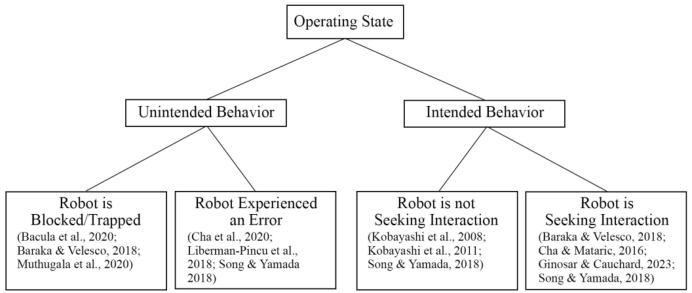
Robots featured in this review could have their operating states classified in four broad states which fell under two types of behaviors (e.g., “unintended behaviors”, “intended behaviors”; Figure 1). Two operating states (e.g., “blocked state”, “error state”) fell under “unintended behaviors” and another two operating states (e.g., “seeking interaction”, “not seeking interaction”) fell under “intended behaviors”.
Figure 1: Organization scheme of operating states.Table 1: Table of behavior/state/color/pattern/frequency (# of relevant studies). Communication of specific robot states occurs either while the robot is behaving as intended or unintended and the communication expressed via manipulations of lighting color, pattern, and frequency.
Table available in the original PDF paper.
Behavior State Color Pattern Frequency Unintended (6) Blocked (3) Red (3) Static (1), High (1), Unstated (1), Not Applicable (1) Blinking/Pulsing (1), Sweeping (1)
Unstated (1), Not Applicable (1) Not Seeking Red (3) Blinking/Pulsing (3) High (3) interaction (3)
Blocked State Dimensions of Lighting. Three studies featured robots that were capable of expressing when they were blocked by obstructions in the environment (Bacula, Mercer, and Knight, 2020; Baraka and Veloso, 2018; Muthugala et al., 2020). Each robot that was capable of expressing it was in a “Blocked” operating state used an LED strip around the circumference of the robot, however, in one robot the strip was wrapped around the vertical body of the robot to create a sort of “bar” of light that ran up the vertical body of the robot (Baraka and Veloso, 2018).
Color. Red was unanimously utilized when robots were expressing they were in a blocked state. Though, technically, one robot emitted a static display of color that would range from green (i.e., normal operation) to red (i.e., fully obstructed; Muthugala et al., 2020).
Pattern. As mentioned, one robot displaying a blocked state used a static pattern (Muthugala et al., 2020). The second robot utilized a pulsing pattern (i.e., similar to blinking, but with the light intensity fading without turning fully off; Baraka and Veloso, 2018). The final robot used a “sweeping” animation (i.e., two points of light would travel around the circumference of the robot in opposite directions) when displaying it was blocked (Bacula, Mercer, and Knight, 2020).
Frequency-of-Pattern. For the two robots that did not rely on static lighting, one used a high frequency pattern (i.e., the pulses would occur at a rapid rate; Baraka and Veloso, 2018) and the other left unstated what frequency its pattern swept at (Bacula, Mercer, and Knight, 2020).
Effects on Human Understanding. When looking at color in isolation, Muthugala et al. (2020) found that, on a 5-point Likert scale, more than 85% of participants agreed or strongly agreed that color variation was useful in identifying when the robot was blocked. Furthermore, more than 86% of participants agreed or strongly agreed that the color red was indicative of a blocked state and green was indicative of normal operation.
Other studies did not investigate the effect of a lighting dimension in isolation. Instead, their findings related to the overall effects of a specific combination of lighting dimensions. Baraka and Veloso (2018) provided a
multiple-choice questionnaire asking participants to discern the reasoning behind the robot’s actions in a blocked state. They found participants were significantly more accurate in discerning the reasoning behind the robot’s actions when a combination of [red]-[pulsing pattern]-[high frequency pattern] was used versus a no-lighting control.
Error State Dimensions of Lighting. Three studies featured robots capable of expressing or were perceived as experiencing an error state (Cha et al., 2020; Liberman- Pincu, Honig, and Oron-Gilad, 2023; Song and Yamada, 2018). Two studies featured robots that had LED strips along the circumference of the robot body (Cha et al., 2020; Song and Yamada, 2018) and one study assessed the commonalities among nine commercially available robots in which the locations of the lighting varied (Liberman-Pincu, Honig, and Oron-Gilad, 2023). Color. All three studies featured robots that used red when displaying an error state. Two of these studies also featured a robot expressing its error state with the color orange (Cha et al., 2020; Liberman-Pincu, Honig, and Oron-Gilad, 2023). A single study featured a robot that expressed its error state with the color yellow (Liberman-Pincu, Honig, and Oron-Gilad, 2023).
Pattern. All three studies featured robots that expressed the error state using blinking lights. A single study featured robots that expressed the error state using static patterns (Liberman-Pincu, Honig, and Oron-Gilad, 2023). A single study also experimented with the use of a sweeping pattern to display the error state (Cha et al., 2020).
Frequency-of-Pattern. Two studies featured robots using high frequency patterns when expressing the error state (Cha et al., 2020; Song and Yamada; 2018). One of those two also experimented with using low frequency patterns when displaying the error state (Cha et al., 2020).
Effects on Human Understanding. Looking at color, Cha et al. (2020) demonstrated various combinations of lighting dimensions to participants and used a unipolar, 5-point scale to measure how well certain combinations communicated various messages (ranging from “Not at all”to “Extremely”). They found that the colors red and orange were significantly better at conveying the message that a robot was experiencing an error than colors like blue or green. They did not find a significant main effect for pattern or frequency-of-pattern.
Song and Yamada (2018) did not look at any lighting dimensions in isolation. Instead, they examined two distinct combinations of lighting ([red]- [blinking pattern]-[high frequency pattern] and [green]-[pulsing pattern]- [low frequency pattern]) and a no lighting control. When surveying people’s perceptions of the robot’s behavior in each condition, only those in the [red]- [blinking pattern]-[high frequency pattern] explained that the robot may be experiencing an error.
Seeking Interaction Dimensions of Lighting. Four studies featured robots that were capable of expressing or were perceived as communicating that they were seeking interaction from a human in the nearby environment (Baraka and Veloso, 2018; Cha and Mataric, 2016; Ginosar and Cauchard, 2023; Song and Yamada, 2018). When effectively expressing this state, two robots utilized an LED strip on the circumference of the robot body (Ginosar and Cauchard, 2023; Song and Yamada, 2018), one utilized a front-facing LED tablet near the top of the robot (Cha and Mataric, 2016), and one featured LED strips wrapped around the vertical body of the robot (Baraka and Veloso, 2018).
Color. Three of the robots expressed their state of seeking interaction or were perceived as seeking interaction while displaying the color green (Baraka and Veloso, 2018; Ginosar and Cauchard, 2023; Song and Yamada, 2018). One robot expressed its state of seeking interaction by displaying a hue ranging from pink to red (Cha and Mataric, 2016).
Pattern. Three of the robots used a blinking or pulsing pattern when expressing this state (Cha and Mataric, 2016; Ginosar and Cauchard, 2023; Song and Yamada, 2018). One robot displayed a progress bar that progressively filled to show task progress (Baraka and Veloso, 2018).
Frequency-of-Pattern. Robots used varying light frequencies to signal a desire for interaction: some at high or low frequencies (Cha and Mataric, 2016; Song and Yamada, 2018), while others employed non-cyclical patterns or unspecified frequencies (Baraka and Veloso, 2018; Ginosar and Cauchard, 2023). Effects on Human Understanding. No study in this section examined the effects of a single lighting dimension in isolation. Bakaraka and Veloso (2018) found that participants were significantly more accurate in discerning the reasoning behind their robot’s actions when a combination of [green]- [progress bar pattern]-[not applicable] was used versus a no-lighting control. Ginosar and Cauchard (2023) demonstrated a search and rescue drone to participants and the various lighting combinations it used during its operations. After it had located a participant in the mock search and rescue task, it would display a combination of [green]-[blinking pattern]-[not stated] to signal it wanted to interact with the participant. Coded interview responses revealed that significantly more people perceived that the drone was seeking an interaction with this lighting combination when compared to a no lighting control. Song and Yamada (2018) found that when their robot displayed [green]-[pulsing pattern]-[low frequency pattern], participants provided explanations for the robot’s behavior such as: “communicating with [the person]” and “playing”.
Not Seeking Interaction Dimensions of Lighting. Three studies featured robots that were capable of expressing or were perceived as not seeking interaction from humans in the nearby environment (Kobayashi et al., 2008; Kobayashi et al., 2011; Song and Yamada, 2018). Two of these studies featured a robot that utilized a single LED diode mounted in the chest of the robot. The other study featured
a mobile cleaning robot with an LED strip around the circumference of the robot (Song and Yamada, 2018).
Color. All robots expressing a state of not seeking interaction used red lighting.
Pattern. All robots expressing a state of not seeking interaction used a blinking pattern.
Frequency-of-Pattern. All robots expressing a state of not seeking interaction used a high frequency pattern.
Effects on Human Understanding. No study in this section examined the effects of a single lighting dimension in isolation. Kobayashi et al. (2008) investigated how light-based signals could be used to smooth verbal turn taking behavior in a language game. They found participants made significantly less unwanted repetitions of speech when the robot used its light to express that it was processing speech versus a no lighting control. The same team conducted a similar study attempting to smooth verbal turn taking behavior in a mock hotel booking task. Participants engaged in the task multiple times with and without light-based signals. The team found that participants rated light-based signals as more useful on a 7-point Likert scale than when no lighting was used. Song and Yamada (2018) found that when their robot displayed [red]-[blinking pattern]-[high frequency pattern], participants provided explanations for the robot’s behavior such as: “warning the person” and “patrolling”.
DISCUSSION
For an area of human-robot interaction that is not standardized, there are a surprising amount of commonalities in how light-based signals are expressed across operating states. At a glance, the states of “Blocked”, “Error”, and “Not Seeking Interaction” seem to be represented very similarly. All three states rely primarily on the color red, often feature blinking or pulsing patterns, and tend to use high frequency patterns. Meanwhile, the state of “Seeking Interaction” tends to rely on the color green, still heavily utilizes blinking patterns, but does so at more variable frequencies.
An interesting observation is that the three former states use “warm”colors whereas the latter uses a “cool” color. Cool colors can be perceived as more comfortable or aesthetically pleasing than warm colors (Luo et al., 2024). Furthermore, the researchers’ use of warm and cool tones closely follows that of established color semantics. For instance, red is often associated with anger (Kuhbandner and Pekrun, 2013) or failure (Travis, 1991). On the other hand, green is often associated with positive qualities such as success (Kawai et al., 2023). It appears possible that color preferences and color semantics extend to or play a role in individuals’ understanding of light-based signals in human-robot interactions.
It is harder to determine specifically how pattern and frequency-of-patten influence individuals’ understanding of operating state due to there being little variation in how these dimensions were expressed. However, there is evidence to suggest pattern choice can affect how difficult it is to ignore a light-based signal (Cha et al., 2020). Furthermore, frequency-of-pattern can
influence individuals’ understanding of communication urgency (Cha et al., 2020; Cha and Mataric, 2016).
Challenges of Using Light-Based Signals A notable limitation of light-based signals is the significant overlap between states such as “Error,” “Blocked,” and “Not Seeking Interaction.” Currently no study has examined multiple overlapping states simultaneously, this becomes a concern as robots are expected to communicate a wider range of states. It underscores a broader issue: light signals, while effective for conveying simple messages, lack the nuance needed for more detailed communication.
The heavy utilization of the colors red and green also presents a problem. It is estimated that about 8% of Caucasian men and up to 6.5% of Chinese and Japanese men are red-green color deficient (rates of red-green color deficiency in women are lower; Birch, 2012). This impairment makes the significant impact of color on understanding operating state null for a notable percentage of the population. Furthermore, color semantics can vary from culture to culture (Kawai et al., 2022). Kawai et al. (2022) explain that red can have more positive connotations in Chinese culture and white is imbued with a more negative connotation. Furthermore, the decision of when and where to use the color red in certain domains is one that should be given careful consideration, such as in hospitals (Dalke et al., 2006).
Improving Light-Based Communication Light-based communication can be improved in a manner of ways. Standardization of light-based signals could increase people’s ability to learn signal meanings across robots and contexts without the need for prior training (Cha et al., 2020). Furthermore, adding additional context (e.g., robot movement, using light to highlight features in the environment) could potentially improve individuals’ understanding and the depth of information communicated (Bacula, Mercer, and Knight, 2020; Cha et al., 2020)
Limitations and Future Directions We faced a few limitations while conducting this review. First, the number of included articles was rather small. This could potentially be addressed by including more databases in a future replication. Furthermore, we did not systematically assess the quality of the included papers, nor did we systematically assess the findings of these studies due to large variations in experimental design and included measures.
In regard to next steps, this work is being used to inform the design of a virtual reality experiment investigating the use of light-based signals on autonomous robots in the hospital emergency department. We hope we can explore the effect of effective light-based communication on improving robot services within the hospital emergency department.
Our review explores the current state of effective uses of light-based signals to improve human understanding of robot operating state. In our work, we outline the three dimensions of these signals (e.g., color, pattern, frequency- of-pattern) and how they are expressed across operating states. We also discuss the role that color semantics plays in expressing operating state, the importance of frequency-of-pattern in expressing urgency, and why blinking and pulsing might be so prevalent. Additionally, we note the limitations of this technology due to the significant overlap in the expression of different operating states, as well as challenges associated with relying heavily on color cues, which may not be universally interpretable to all users. We propose a few considerations on standardization and added contextual information alongside light signals for better user understanding. We hope our work can be used to increase researchers’ and designers’ understanding of how light-based signals are leveraged in human-robot interaction and that our considerations may guide future designs.
ACKNOWLEDGMENT
This work was supported by the National Science Foundation (Grant No. 2431636) and the SJSU VPRI Teaming Grant (#24VTG-03-002). Any opinions, findings, and conclusions or recommendations expressed in this material are those of the author(s) and do not necessarily reflect the views of the National Science Foundation.
REFERENCES
Bacula, A. Mercer, J. and Knight, H. (2020). “Legible light communications for factory robots”, in: ACM/IEEE International Conference on Human-Robot Interaction. pp. 119–121. Banzon, A. J., Wang, E., Luo, Y., Jin, L., & Jiang, L. (2025). Integrating Motion Intention and Impedance Control in Teleoperated Robotic Rehabilitation for Upper Extremity Disorders. Journal of Engineering and Science in Medical Diagnostics and Therapy, Volume 8, No. 2. Baraka, K. and Veloso, M. M. (2018). Mobile service robot state revealing through
expressive lights: Formalism, design, and evaluation, International Journal of Social Robotics Volume 10, No. 1, pp. 65–92. Birch, J. (2012). Worldwide prevalence of red-green colour deficiency, Journal of the Optical Society of America Volume 29, No. 3, pp. 313–320. Cha, E. Fitter, N. T. Kim, Y. Fong, T. and Matari´c, M. (2020). “Generating expressive light signals for appearance-constrained robots”, in: Springer Proceedings in Advanced Robotics, Vol. 11, pp. 595–607. Cha, E. and Mataric, M. (2016). “Using non-verbal signals to request help during human-robot collaboration”, in: 2016 IEEE/RSJ International Conference on Intelligent Robots and Systems. pp. 5070–5076. Chen, Y., Luo, Y., Yerebakan, M. O., Xia, S., Behdad, S., & Hu, B. (2022).
Human workload and ergonomics during human-robot collaborative electronic waste disassembly. In 2022 IEEE 3rd international conference on human-machine systems (ICHMS), pp. 1–6. IEEE. Dalke, H., Little, J., Niemann, E., Camgoz, N., Steadman, G., Hill, S., and Stott, L. (2006). Colour and lighting in hospital design. Optics & Laster Technology Volume 38, pp. 343–365.
Ginosar, E. and Cauchard, J. R. (2023). “At first light: Expressive lights in support of drone-initiated communication”, in: CHI ’23: Proceedings of the 2023 CHI Conference on Human Factors in Computing Systems, Article No. 641. Golmohammadi, R. Yousefi, H. Khotbesara, N. S. Nasrolahi, A. and Kurd,
N. (2021). Effects of light on attention and reaction time: A systematic review, Journal of Research in Health Sciences, Volume 21, No. 4, e00529. Haddock, S. H. D. Moline, M. A. and Case, J. F. (2010). Bioluminescence in the sea, Annual Review of Marine Science Volume 2, pp. 443–493. Kawai, C. Zhang, Y. Lukács, G. Chu, W. Zheng, C. Gao, C. Gozli, D.
Wang, Y. and Ansorge, U. (2023). The good, the bad, and the red: Implicit colour-valence associations across cultures, Psychological Research Volume 87, pp. 704–724. Kobayashi, K. Funakoshi, K. Yamada, S. Nakano, M. Kitamura, Y. and Tsujino, H. (2008). “Smoothing human-robot speech interaction with blinking- light expressions”, in: Proceedings of the 17th IEEE International Symposium on Robot and Human Interactive Communication. pp. 47–52. Kobayashi, K. Funakoshi, K. Yamada, S. Nakano, M. Komatsu, T. and Saito, Y. (2011). “Blinking light patterns as artificial subtle expressions in human-robot speech interaction”, in: Proceedings—IEEE International Workshop on Robot and Human Interactive Communication. pp. 181–186. Kuhbandner, C. and Pekrun, R. (2013). Joint effects of emotion and colour on memory, Emotion, Volume 13, No. 3, pp. 375–379. Li, S. and Zhang, X. (2017). Implicit intention communication in human-robot interaction through visual behaviour studies, IEEE Transactions on Human- Machine Systems Volume 47, No. 4, pp. 437–448. Liberman-Pincu, E. Honig, S. and Oron-Gilad, T. (2023). “Why are you blinking at me? Exploring users’ understanding of robotic status indicators”, in: Communications in Computer and Information Science, Vol. 1996, pp. 282–294. Lu, X., Luo, Y., Hu, B., Park, N. K. and Ahrentzen, S. (2021). Testing of path-based visual cues on patterned carpet to assist older adults’ gait in a continuing care retirement community. Experimental Gerontology, Volume 149, 111307. Luo, Y., Lu, X., Grimaldi, N. S., Ahrentzen, S. and Hu, B. (2021) “Effects of light
conditions and falls concerns on older adults’ gait characteristics: A preliminary study”, in: Proceedings of the Human Factors and Ergonomics Society Annual Meeting, Vol. 65, No. 1, pp. 1332–1336. Sage CA: Los Angeles, CA: SAGE Publications. Muthugala, M. A. V. J. Vengadesh, A. Wu, X. Rajesh Elara, M. Iwase, M. Sun, L. and Hao, J. (2020). Expressing attention requirement of a floor-cleaning robot through interactive lights, Automation in Construction Volume 110, 103015. Obaigbena, A. Lottu, O. A. Ugwuanyi, E. D. Jacks, B. S. Sodiya, E. O. and Daraojimba, O. D. (2024). AI and human-robot interaction: A review of recent advances and challenges, GSC Advanced Research and Reviews, Volume 18, No. 2, pp. 321–330. Travis, D. (1991). Effective colour displays: Theory and practice. London: Academic
Press. Song, S. and Yamada, S. (2018). “Effect of expressive lights on human perception and interpretation of functional robot”, in: Proceedings of the Conference on Human Factors in Computing Systems. 2018-April.
LISTED IN THE AHFE DIGITAL BOOKSTORE CATALOGUE
Explore the complete digital volume
Human Factors in Robots, Drones and Unmanned Systems
Read this individual research paper free through the original publisher, or explore the full digital proceedings book.
ISBN 978-1-964867-55-7
Explore this ISBN in the AHFE Bookstore ↗Listed in the July 2026 bookstore catalogue; search by ISBN to confirm current availability · Digital book purchase optional