Christian Schmidt, Christina Pietschmann, David Sauer, Matthias Schmidt, Julia Zähr, Leif Goldhahn (2026). Transformation from manual arc welding to collaborative robot welding: Comparison of ergonomic and process-related influencing factors and effects. In: Industrial and Systems Engineering. AHFE Open Access, vol. 219, pp. 86–96. https://doi.org/10.54941/ahfe1007779
The increasing use of collaborative robots (cobots) in welding for small-batch production is changing both technical processes and the requirements for employees. This paper examines the transition from manual to cobot-based gas metal arc welding (GMAW). The focus is on ergonomic aspects and their evaluation, changes in job profiles, including the required qualification level, as well as process-related aspects such as processing time, post-processing effort, weld seam quality, and shift output.For the ergonomic analysis, a marker-based virtual reality (VR) system is used to record the work process in both scenarios, manual welding and cobot-based welding, and to evaluate it using a scientifically established ergonomic assessment method. Differences in physical strain (posture) and movement profiles between the two welding methods are discussed in order to highlight the potential effects on the health and performance of employees. In addition, the impact of the introduction of cobots on qualification requirements is investigated, as well as the new skills required for planning, programming, and interaction in automated processes. Finally, process-related key indicators are compared to identify possible changes in effectiveness and quality. The discussion addresses the question of the extent to which collaborative robotics can contribute to reducing manual strain while at the same time posing new challenges for work design, work organization, and qualification. The aim is to gain practical insights for the design of future workplaces in the welding sector and to highlight the importance of integrated socio-technical approaches that equally take technology, ergonomics, and qualification into account.
Automated welding with industrial robots is standard in mass production, while small-batch production still relies on manual processes. The advantages of automation are obvious: A shortage of skilled workers, increasing productivity requirements, and the need for consistently high quality are driving the transition to automated processes. At the same time, welders Received February 11, 2026; Revised March 31, 2026; Accepted April 19, 2026; Available online July 20, 2026
Transformation From Manual Arc Welding to Collaborative Robot Welding 87 are relieved from repetitive and physically demanding tasks, improving occupational safety and health protection.
Classical robot programming is complex and time-consuming, limiting its economic viability to large production volumes. Companies therefore need solutions for small-batch production that allow simple programming without extensive software knowledge. Intuitive user interfaces and simplified training procedures open new possibilities and allow the efficient use of cobots, even for low production volumes. This is particularly relevant for small and medium-sized enterprises (SMEs) that employ limited engineers and therefore prefer workshop-integrated planning and programming.
The introduction of welding automation fundamentally changes the required competencies. New tasks and roles emerge that are not fully covered by existing qualification models for traditional welders. The automation of small-batch welding tends to create two additional occupational roles: the setup technician, including programming tasks, and the machine operator.
Within the framework of the project “PerspectiveArbeit Lausitz” (PAL), changes in task structures and competency profiles are systematically analysed. The project examines how collaborative robotics can reduce manual workload and simultaneously create new challenges for work organization and qualification processes.
ERGONOMIC CONSIDERATION OF THE WELDING PROCESS The welding manufacturing process has high geometric and structural requirements and, due to these conditions, is predominantly carried out manually for small-batch production. Quality and efficiency depend largely on qualified welders. Process parameters such as current, voltage, and, in particular, welding speed, which is influenced by human factors, have a direct impact on seam quality (Mandal, 2017), making it a critical parameter for process stability and result quality. The level of training and performance of welders are key factors for the quality and efficiency of the overall process. In industrial work environments, however, significant ergonomic challenges associated with the job mean that performance levels are likely to fluctuate within a shift. Welding often requires workers to maintain forced body postures for long periods of time and perform physically demanding, repetitive, and partly static tasks, which can lead to fatigue and exhaustion in the long term (American Welding Society, 2023; Baek and Nam, 2021). Studies also show an increased risk of work-related health problems such as eye strain, hearing loss, lung diseases, and, above all, musculoskeletal disorders affecting the neck, back (especially the lumbar spine), hands and wrists, as well as the knees (Amani et al., 2017; Lourenço and Luís, 2021).
It can be expected that the ergonomic requirement profile will change significantly during the automation of small-batch production. The previously broad field of activity of the welder is increasingly divided into the roles of setup technician and machine operator. While conventional welding work has been characterized by high physical strain, especially due to manual handling of heavy components, and performing static holding tasks, as well as by a high level of manual and technical skills, these requirements are shifting in automated processes. Compared to welders, the physical demands
for setup technicians are significantly lower. At the same time, the cognitive demands are increasing due to tasks such as robot programming and the preparation of process-related work instructions. The operator’s work, on the other hand, continues to involve physical strain, especially during lifting, positioning, and feeding components, although exposure to welding fumes and dust is eliminated (Sauer et al., 2025).
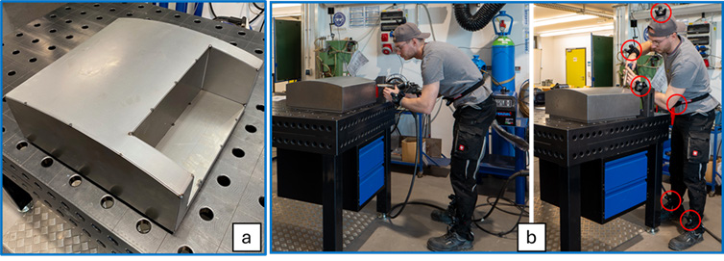
Marker-Based Data Acquisition Using a VR System As part of the preparatory work for the ergonomic analysis, the complete work processes for the three activities under consideration, including manual welder, setup technician, and operator, were first systematically recorded and documented using a demonstrator component, switch cabinet housing (Figure 1a). This process recording served as the basis for the subsequent ergonomic evaluation. In order to obtain an initial qualitative assessment of the ergonomic strain, the work processes were observed and discussed. Based on this, a marker-based motion analysis was carried out, which enabled a precise and objective recording of body postures and movement sequences under real working conditions. It provides reliable data for identifying ergonomically unfavourable postures during welding and supports integration into digital models, enabling targeted improvements to workstations and the programming of automated processes with adequate prior knowledge.
The marker-based data collection was carried out using mobile components of the VR system of the Institute InnArbeit and the IC.IDO software, which is an immersive real-time simulation tool for product, assembly, and ergonomics analysis. The interaction of SteamVR with an HTC Vive, six HTC Vive Trackers 3.0, and four Lighthouse base stations enables full-body tracking of a real person. Human calibration is achieved by placing trackers on the head, abdomen, hands, and feet. IC.IDO allows the visualization of computer-aided design (CAD) models in original size, supports extensive multi-CAD and product data management data, and thus largely replaces physical prototypes. Through interactive simulations with a kinematic chain of the human model, the system is suitable for early validation of assembly processes. They enable realistic simulations of complex processes without risk to humans or machines. VR can help identify potential hazards early on and develop appropriate action strategies. In addition, the virtual environment allows critical scenarios to be tested safely, which can significantly improve both process reliability and training quality. This is also possible in collaborative VR sessions (Eckardt and Goldhahn, 2026; Müller-Eppendorfer et al., 2025). To record data in the laboratory of Chair of Automated Joining Processes and Simulation, the first step is tracking using optical markers, which precisely record the movements of a real person. For this purpose, reflective markers are placed on anatomically relevant body segments according to a standardized protocol, as highlighted in red in Figure 1b. Afterwards, the real person is calibrated with a human model of same size. The standardized human model can be adjusted to the dimensions of the real person for this purpose. During the experiment, several synchronized cameras record the
Transformation From Manual Arc Welding to Collaborative Robot Welding 89 positions of these markers in three-dimensional space and use them to reconstruct their spatial trajectories, that is, the movement paths.
Figure 1: Data acquisition with marker-based VR system: a) Demonstrator component and b) Data acquisition manual welding on the demonstrator component.
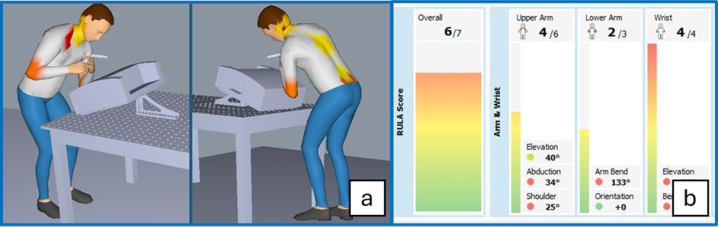
While the movements are being recorded, the marker paths are calculated in the software. The system then produces the actual evaluations of the individual body segments, e.g., how much an arm was bent or how the upper body rotated. This results in a complete, traceable movement model that precisely reflects the actual movement of the test person. The system thus enables ergonomic assessments of reach and accessibility, gripping and movement spaces, fields of view and visual restrictions, postures, and forced postures. Figure 2a shows the visualization of favourable and unfavourable postures based on stored static assessment methods, such as Discomfort or NASA. Red indicates highly unfavourable postures that should be avoided.
For dynamic ergonomic assessment, which is carried out in the IC.IDO system with RAMSIS sublicense according to the traffic light principle (Figure 2b), the RULA method (Rapid Upper Limb Assessment) (Kumar and Kamath, 2019; McAtamney and Nigel Corlett, 1993) is applied in this study. RULA is an internationally recognized method for the standardized assessment of musculoskeletal strain. The method evaluates the posture of the arms, shoulders, neck, and back, as well as the forces and repetition rates acting on them, and classifies them into risk levels using a points system that combines the posture assessments into an overall score, from which specific actions required can be derived. A score from 1 to 2 indicates a low risk, which normally does not require immediate action. Values of 3 to 4 indicate a medium risk, where a more detailed analysis is useful in order to reduce possible strain. If the score reaches 5 or 6, there is a high risk that requires prompt ergonomic optimization. Finally, a score of 7 or higher indicates a very high risk, requiring immediate action to significantly reduce physical strain and prevent damage to health.
Figure 2b illustrates the RULA assessment in the IC.IDO system, showing the scores and using coloured scales for the individual assessment areas, including upper arm, forearm, wrist, etc.
Potential deviations between the posture of the real person and the human model can be influenced by the positioning of the markers, especially in the head area. More precise measurement of the test person and exact placement of several markers can therefore contribute significantly to increasing measurement accuracy.
Figure 2: Ergonomic analysis and evaluation of manual welding using IC.IDO/RAMSIS software.
This approach creates a robust basis for deriving targeted optimization measures aimed at designing ergonomically favourable working conditions. The evaluation results serve as a basis for verifiable improvement potential, such as reducing physical strain and sustainably improving working conditions. This approach enables precise predictions and targeted improvements to workplaces. In addition, the method supports the design of automated processes by identifying and taking ergonomic risks into account at an early stage (Caporaso et al., 2022; Daria et al., 2018; Goldhahn, 2023; Guo et al., 2022; Müller-Eppendorfer, 2024).
Discussion of the Results of Ergonomic Considerations The ergonomic comparison between manual welding and cobot-based arc welding shows clear differences in physical strain and the distribution of work requirements. Manual welding is characterized by unfavourable postures, high static and dynamic loads, and repetitive movements. In particular, holding the torch, positioning heavy components, and working in forced postures create considerable physical strain on the body. The use of collaborative robotics significantly reduces these stresses.
The cobot takes over key welding-related movements, significantly reducing peak loads, for example during continuously guiding of the welding torch or when working in hard-to-reach welding positions.
The RULA-based time series analyses show relevant ergonomic strain for all three examined activities, but with significant differences in exposure to critical load situations (RULA score 7) (see Table 1).
Table 1: Comparison of RULA scores for manual welders, setup technicians, and operators.
Operator 3–7 19,9 % 71,1 % 9,0 % For manual welding, the largest contiguous measurement segment results in an overall score spectrum of 3 to 7 with a median of 6. The time-weighted action level distribution is particularly significant: 68.8% of the time falls within the range 5–6 (prompt intervention required) and 23.6% of the time is in the range 7 (immediate action required). These values demonstrate pronounced and recurring exposure to ergonomically highly critical postures during manual welding.
In contrast, the exposure profiles shift for activities that typically occur in the context of a cobot-based welding process, namely setup and operation/ monitoring. For the setup technician, the overall score is also between 3 and 7 (median 6). However, the decisive factor is the reduced time exposure in the most critical area of activity: Only 15.3% of the time is spent at score 7, while 71.8% lies in the range of 5–6 and 12.9% in the 3–4 range. This represents that the proportion of immediately critical postures is significantly lower than for manual welding (23.6% → 15.3%). At the same time, the data for the setup technician shows longer continuous periods of high stress, which indicates that setup activities also need to be optimized ergonomically.
The operator also has an overall score range from 3 to 7 with a median of 6. Compared to manual welders and setup technicians, critical exposure in particular is significantly reduced: 9.0% of the time falls within score range 7, while 71.1% is in the range of 5 to 6 and thus in the category “timely adjustments.” The frequency and duration of highly critical postures are therefore lowest for the operator (23.6% → 15.3% → 9.0%). Overall, it can be stated that replacing manual welding with cobot-based welding reduces highly critical postures. This improves the ergonomic conditions, especially for the operator role, while remaining stresses for the setup technician need to be further reduced in a targeted manner.
The three RULA evaluations provide a clear ergonomic argument: Manual welding has the highest exposure to postures requiring immediate action (score 7) and is therefore the most critical activity from the perspective of preventing musculoskeletal disorders. In the cobot-based scenario, the direct welding posture is eliminated during the welding process, but the setup technician is also exposed to high levels of stress. The proportion of highly critical postures is significantly reduced in cobot-based welding, decreasing from 23.6% at score 7 for manual welding to 15.3% for the setup technician and further to 9.0% for the operator. This not only reduces the frequency of immediately critical postures, but also shifts the ergonomic strain from continuous, process-dominant welding station to activities that are typically easier to design (e.g., by adjusting the working height, workpiece positioning,
fixtures, and supporting elements). At the same time, the data show that setup and operation continue to be predominantly in the 5–6 range and therefore also have potential for optimization.
Furthermore, the stress structure is also shifting setup, programming, and monitoring activities require greater cognitive skills and increased attention, but significantly less sensorimotor and force-intensive components (see section “Competence-Related Effect Dimensions of the Transformation to Cobot-Based Welding”). The operator remains involved in component handling and clamping processes, but benefits from reduced exposure times to welding fumes, heat, and sparks. Overall, the comparison shows that cobot-based welding processes can substantially reduce physical strain. At the same time, new ergonomic requirements emerge in the area of cognitive strain and the design of human-robot interactions.
The results indicate that the switch from manual hand welding to a cobot-based welding process enables a significant reduction in highly critical ergonomic exposure (RULA score 7). At the same time, there remains a need for optimization in terms of setup and operating tasks, which can be addressed through targeted workplace and process design.
COMPETENCE-RELATED EFFECT DIMENSIONS OF THE TRANSFORMATION TO COBOT-BASED WELDING The integration of AI-based assistance systems and digital workflows leads to profound changes in production, the effects of which are comparable to the automation of the welding process itself. Tasks that are characterized by manual dexterity and sensorimotor skills are increasingly evolving into tasks of configuration, monitoring, and situational decision-making when working with cobot systems. This creates new requirement profiles that are not adequately covered by classical task- or qualification-oriented competency models. As shown by Sauer et al., 2025, the focus of competence in cobot-based welding shifts, particularly for the setup technician role, from experience-based sensorimotor skills to higher cognitive, analytical, and communicative competence requirements. Effective competence management must therefore be directly linked to real tasks and systematically examine which skills and knowledge will be required in the future to perform activities safely, efficiently, and with consistent quality.
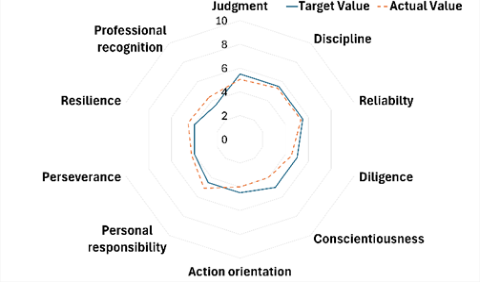
Practical task analyses confirm the functional division of the classic welder profile into the roles of manual welder, setup technician, and operator, and they illustrate different role-specific skill requirements. While manual welders continue to work in a highly experience- and action-oriented manner, setup technicians are characterized by tasks such as process planning, teach-in programming, and systematic fault diagnosis. The operator role is predominantly operational and includes component handling, process monitoring, and simple quality controls. Based on this, specific key competencies were identified and evaluated for each role, from which clearly distinguishable competence clusters can be derived (see Figure 3).
Figure 3: Competence requirement profile for cobot operator.
Analysing the difference between current competences of employees and the target competences of a job family highlights their development potential, particularly in the area of system-related action competences. The resulting competence development is consistently aligned with existing key activities and enables systematic classification in terms of digital competences.
Based on this, an expanded perspective on digital competencies shows that the target profiles described by Sauer and Schmidt, 2025, need to be specifically supplemented with digital competency dimensions. Studies on the development and protection of digital competencies in manufacturing SMEs illustrate that the success of digital transformation depends less on the technology used and more on the ability of organization and its employees to systematically develop and advance digital competencies. For the setup technician, digital literacy is becoming particularly important, while for the operator, the requirements expand to include competences in human- machine interaction, situational digital problem solving, and communication. Overall, the further development of role profiles requires integrative skills development that combines technical, ergonomic, and digital aspects.
Comparison of Process-Related Key Indicators To compare manual welding with automated welding using a cobot, the key indicators of reproducibility (quality), preparation effort, setup time, welding time, and payback period were selected using the demonstrator component as an example (Table 2). This component with dimensions of 467 mm × 458 mm x 199 mm made is of DC01 material with a thickness of 2 mm.
One of the main advantages of a manual welder is the flexibility to adapt to changing welding tasks or gap dimensions. A major disadvantage is reproducibility. This can be improved through automated production. Cobot welding systems that can be operated by an operator are particularly suitable for small-batch production. Setting up a cobot requires both welding expertise and basic programming skills. Operators must pass an operator examination in accordance with EN ISO 14732.
Table 2: Comparison of manual welding and cobot-based arc welding (using the demonstrator component as an example).
Table available in the original PDF paper.
Manual Welding Cobot-Welding Execution of welding process Welder Operator
Adjustment to dimensional and geometrical tolerances Yes No – only with sensor technology Reproducibility Medium High
Joint preparation effort Decreased Increased Setup time 8 min 15 min
Welding time 33 min 13 min Point of amortization for Demonstrator Not applicable 5 Workpieces
When comparing various process-related key indicators, manual welding requires less precise seam preparation. Automated welding requires more precise seam preparation in order to maintain defined gap dimension. In addition to setup times, meaning the positioning of the clamping device, automated welding also requires setup times such as teaching the welding program. The setup time for automated welding is longer because the clamping device must be set up at a predefined position to avoid repeated teaching of the welding positions. Since automated welding allows higher welding currents and thus higher welding speeds than the manual process, the welding time with a robot is shorter.
An economic assessment was carried out using the demonstrator component, comparing the manual welding time in the tungsten inert gas process (33 min) with the automated process time in the GMAW process. Automated production involves a teaching time of 90 min and a welding time of 13 min per component. Ignoring the investment costs, the break-even point is reached at as few as five components.
CONCLUSION
The results of the study show which skills will be essential for the roles of manual welder, setup technician, and operator in the future. The experts surveyed confirm that the identified skill characteristics are accurate, meaning that the derived profile descriptions form a sound basis for personnel development and structured development discussions.
At the same time, classical training and qualification patterns are only partly suitable for preparing employees to work with automation systems, such as welding cobots. Advancing automation requires a broader understanding of technical expertise that includes not only technical knowledge but also judgment, self-organization, and problem-solving skills. Companies must therefore focus their personnel development and training more strongly on promoting such interdisciplinary skills. Setup technicians increasingly take on tasks of planning, adaptation, and process optimization, while operators are primarily responsible for process monitoring and responding to malfunctions. Sensorimotor skills remain relevant but are losing importance compared to cognitive skills.
Transformation From Manual Arc Welding to Collaborative Robot Welding 95 In addition, the results show that collaborative robotics can significantly reduce manual physical strain, especially related to lifting, holding, forced postures, and welding fumes, but at the same time creates new requirements for work organization and training. The shift from physical to cognitive strain requires forward-looking task allocation, clear definitions of roles and responsibilities, and adapted qualification paths. Ergonomic advantages are particularly evident when technical design, organization, and qualification are coordinated in an integrative manner. In practice, an iterative approach is recommended with marker-based and manual ergonomic analysis, participatory work design, and target group-specific learning formats in order to design future welding workstations in a human-centred and efficient manner.
The combined consideration of manufacturing processes, work planning, and ergonomic aspects offers companies additional advantages such as accelerated role empowerment, higher process stability, and improved interdisciplinary collaboration between welders, robot setup technicians, and operators in AI-supported production environments.
ACKNOWLEDGMENT
The authors thank the Federal Ministry for Research, Technology and Space for its financial support and the Karlsruhe Project Management Agency (PTKA) for the supervision of the research project “PerspektiveArbeit Lausitz (PAL)”, grant number 02L19C300.
REFERENCES
Amani F., Bahadoram M., Hazrati S., 2017. Evaluation of occupational injuries among welders in Northwest Iran. Journal of Preventive Epidemiology (Volume 2, Issue 2). American Welding Society, 2023. Safety and Health Fact Sheet No. 13: Ergonomics in
the Welding Environment. https://aws-p-001-delivery.sitecorecontenthub.cloud/ api/public/content/ef46163a172449ca8c2b4b1c66db5fd1. Accessed 4 February 2026. Baek, S.-Y., Nam, J.-H., 2021. Physical Welding Factors for Reclassified Welding Positions in Shipbuilding Assembly Process Based on Muscle Activity Measured by Surface Electromyography. JMSE 9 (11), 1211. doi:10.3390/jmse9111211. Caporaso, T., Grazioso, S., Di Gironimo, G., 2022. Development of an Integrated
Virtual Reality System with Wearable Sensors for Ergonomic Evaluation of Human-Robot Cooperative Workplaces. Sensors (Basel, Switzerland) 22 (6). doi:10.3390/s22062413. Daria, B., Martina, C., Alessandro, P., Fabio, S., Valentina, V., Zennaro, I., 2018.
Integrating mocap system and immersive reality for efficient human-centred workstation design. IFAC-PapersOnLine 51 (11), 188–193. doi:10.1016/j. ifacol.2018.08.256. Eckardt, R., Goldhahn, L., 2026. Virtual training for operating and maintenance of machinery – opportunities, challenges and user feedback, in: Mrugalska, B. (Ed.), Modern Technologies in Ergonomics and Workplace Safety, 1st ed. Taylor & Francis Group, Milton.
Goldhahn, L., 2023. Entwicklung hybrider Arbeitssysteme. Scientific Reports. Guo, Z., Zhou, D., Hao, A., Wang, Y., Wu, H., Zhou, Q., Yu, D., Zeng, S., 2022.
An evaluation method using virtual reality to optimize ergonomic design in manual assembly and maintenance scenarios. Int J Adv Manuf Technol 121 (7–8), 5049–5065. doi:10.1007/s00170-022-09657-4. Kumar, A., Kamath, S., 2019. Rapid upper limb assessment (RULA) in ergonomic assessment: A comprehensive review. Rev Pesq Fisio 9 (3), 429–437. doi:10.17267/2238-2704rpf.v9i3.2465. Lourenço, L., Luís, S., 2021. Musculoskeletal Disorders in Portuguese Welders:
Effects on Bodily Pain and Health-Related Quality of Life. Frontiers in public health 9, 660451. doi:10.3389/fpubh.2021.660451. Mandal, N.R., 2017. Ship Construction and Welding. Springer Singapore, Singapore. McAtamney, L., Nigel Corlett, E., 1993. RULA: A survey method for the investigation of work-related upper limb disorders. Applied ergonomics 24 (2), 91–99. doi:10.1016/0003-6870(93)90080-s. Müller-Eppendorfer, K., 2024. Systematik zur Planung menschengerechter
Materialbereitstellung mit Hilfe von Virtual Reality. Dissertation, 1st ed., Cottbus. Müller-Eppendorfer, K., Roch, S., Schmidt, C., Zähr, J., Goldhahn, L., 2025. Wandel durch kooperative Automatisierung – Implikationen für die Arbeitsforschung im Spannungsfeld Mensch und Technik, in: Hoppe, A. (Ed.), Arbeit und Technik im Wandel. Mittelpunkt Mensch?! Shaker, Düren, pp. 169–178. Sauer, D., Ganßauge, R., Zähr, J., 2025. Kompetenzen für die menschzentrierte
Robotik in der Kleinserienfertigung. Zeitschrift für wirtschaftlichen Fabrikbetrieb 120 (10), 671–676. doi:10.1515/zwf-2025-1115. Sauer, D., Schmidt, M., 2025. Kompetenzanforderungen beim Einsatz kollaborativer Schweißroboter: Eine konzeptionelle Vorstudie, in: Hoppe, A. (Ed.), Arbeit und Technik im Wandel. Mittelpunkt Mensch?! Shaker, Düren, pp. 99–106.
LISTED IN THE AHFE DIGITAL BOOKSTORE CATALOGUE
Explore the complete digital volume
Industrial and Systems Engineering
Read this individual research paper free through the original publisher, or explore the full digital proceedings book.
ISBN 978-1-964867-95-3
Explore this ISBN in the AHFE Bookstore ↗Listed in the July 2026 bookstore catalogue; search by ISBN to confirm current availability · Digital book purchase optional