Robert Eckardt, Leif Goldhahn (2024). Virtual training for the maintenance of machine tools. In: Human Factors and Systems Interaction. AHFE Open Access, vol. 154, pp. 199–207. https://doi.org/10.54941/ahfe1005367
University of Applied Sciences Mittweida, Faculty Engineering Sciences, InnArbeit – Centre of Innovative Process Planning and Ergonomics, Professorship, Computer Aided Production, 09648 Mittweida, Saxony, Germany ↗
In the course of digital change, systems and processes are increasingly being planned, adapted and tested using computers. Innovative technical aids are needed to guide staff and relieve them physically and mentally in order to cope with flexibly changing work tasks such as the maintenance of machine tools.Virtual reality (VR) offers attractive opportunities for employee training and enables the practical acquisition of knowledge. The use of VR is based on the idea that experiences are sustainable and do not have to be learned in the abstract.The interaction between man and machine plays a decisive role in the operation and maintenance of machines. Efficient interaction is necessary to minimize errors and maximize efficiency. Traditional training methods reach their limits here, as they are often not realistic enough and employees find it difficult to apply what they have learned in practice.A virtual learning environment, which virtualizes a real work area, uses integrated, didactically prepared scenarios to clearly convey methodical knowledge and practical skills to increase operating safety on production systems. The virtual training thus enables employees to practice specific technical sequences of actions and sub-actions or hand movements in a realistic manner and to learn them in a sustainable way for later practical use. The focus is on typical operating actions such as deliberate, sequential actuation or disassembly for the maintenance of add-on parts on machine tools.In order to ensure the desired learning success (error-free, safe execution of the real work task) and employee acceptance, the correct structure of the operating sequences and an exact representation of the graphic interfaces are conducive to learning and acceptance.The advantages of using virtual learning environments were demonstrated using the example of the virtual commissioning of a machine tool. For example, after successfully completing the virtual learning scenario, the test subjects felt much more confident when carrying it out on the real machine.However, it also became clear that VR-based learning environments with complex virtual learning scenarios also require further development. For example, the use of VR hardware (VR glasses and controllers) and software has potential for improvement in terms of user-friendliness. Tests with users showed that handling the VR hardware was problematic at the beginning. The virtual learning scenarios often could not be completed because the virtual, user-induced movement and implementation of operating actions was not possible for the user in the scenario. For example, employees were asked to use the controller to perform various operating actions, such as virtually switching the machine tool on and off, which very often failed. Eight out of ten test subjects were unable to cope with the controls and navigation within the virtual learning environment, which meant that the actual training was not carried out at the user's request. This conflicts with the fact that the prerequisite for the acceptance of a virtual learning scenario is, on the one hand, the existence of a high recognition value between the virtual learning environment and the real environment and, on the other hand, the success of the training must be ensured in every case.Based on the findings described for the virtual commissioning of a machine tool, the article presents the methodical development of a virtual learning scenario that focuses on maintenance tasks for a lathe. This includes the initial development and two stages of improvement.The usability of virtual training in the field of maintenance is to be evaluated and improved using this learning scenario as an example. The article therefore describes the technical tests carried out on the feasibility, improvement and acceptance of the test subjects and discusses questions of usability and learning success.
Demands such as the increasing flexibility of work tasks, the handling of complex products, high follow-up costs in the event of misconduct or dynamic product variations within production, which place physical and mental demands on people, require innovative technical and organizational aids (DIN EN ISO 6385, 2016), (BMAS, 2016). In order to meet these requirements, digital technologies such as virtual reality (VR) open up new potential and approaches for self-directed and self-organized learning pro- cesses. In mechanical and plant engineering, efficient maintenance as well as the safe operation and use of machine tools are among the employee qualifi- cations that are critical to success. Maintenance tasks include the inspection, servicing and repair of lathes. Digital technologies provide new potential and approaches for knowledge transfer for learning these tasks (Dörner et al., 2013). For example, there are training simulators for learning how to operate aircrafts, which make it possible to train specific scenarios and the neces- sary operating maneuvers realistically and without risk, which are difficult to simulate in reality (e.g. landing in windy conditions). With the help of these scenarios, the pilot’s behavior can be analyzed, thereby uncovering possible misconduct and eliminating it prospectively (Foerst, 2020). The use of VR technology in civilian pilot training significantly reduces error rates as well
as training costs in real operations (Dörner et al., 2013). For machine tools, such as CNC-controlled lathes and their specific operating actions in the area of maintenance processes, such VR-based simulators are currently only avail- able to a very limited extent (Hirt et al., 2019). Here, too, the potential for damage to people, machines or tools in the event of accidents or operating errors in the process can be enormous. In addition, the efficient use of VR technology in the form of virtual training can significantly reduce unpro- ductive machine tool downtimes.These are caused, for example, by unsafe operation, operating errors or training processes on the real machine itself.
The virtual learning scenario for virtual training, which is presented in the article, takes up the approach of VR-based pilot training. It is then transferred to the requirements of machine tool maintenance in order to rule out incorrect behavior or operation on the real machine as far as possible. An exemplary use case on a lathe was analyzed and methodically processed for this purpose.
Basics Motivation Current learning applications such as blended learning support, among other things, basic employee qualification or the development and expansion of knowledge. “Blended learning is an integrated learning application in which networking via the internet is used in conjunction with “traditional”learning methods and media” (Goldhahn, Eckardt, 2021). In contrast to VR-based technologies, the main disadvantage of blended learning is that practical knowledge and skills can generally only be taught using real objects.The added value of VR-based technologies, as the basis of virtual training, lies in the temporal and spatial flexibility of the learning processes (Goldhahn et al., 2019), but also in the sustainability of what is learned as a result of virtual “doing”. Depending on the VR system used (hardware) and the VR application developed (software), VR enables a fundamentally realistic representation of specific work environments and the work tasks that occur in them, which makes it possible to practice on realistic objects (Goldhahn et al., 2019). A virtual learning environment, which virtualizes a real work area and forms the basis for virtual training, uses integrated, didactically pre- pared content to clearly convey methodical knowledge and practical skills to increase operating safety on production systems. The focus is on typical oper- ating actions such as the deliberate, sequential actuation or disassembly of attachments on machine tools. In order to ensure the desired learning success (error-free, safe execution of the real work task) and employee acceptance, the correct structure of the operating sequences and an exact representation of the graphic interfaces are conducive to learning and acceptance.
Virtual Reality (VR) and Virtual Operations The literature defines VR as the “visual presentation and manipulation of 3D data in real time” (Hirt et al., 2019). According to (Goldhahn, 2003), VR is characterized by three properties:
Virtual Training for the Maintenance of Machine Tools 201
Immersion (realistic presentation and perception)
Interaction (influence and change in real time)
Imagination (experience as a quasi-real world).
VR appeals to people’s visual, acoustic and/or haptic senses. The visual- ization and perspective changes ensure a realistic perception. Publications such as (Goldhahn, Eckardt, 2021) underline that the VR systems available on the market (e.g. Head Mounted Display (HMD)) differ in the degree of separation of the user from the real world and the integration into a vir- tual environment. An HMD, such as the HTC Vive pro, with a high degree of immersion (Engel, 2019) enables free interaction with both hands using controllers at a virtual workplace, allowing work tasks including operating actions to be trained in a targeted and repeated manner. A VR-based operat- ing action refers to a holistic virtual operating process for initiating, executing and completing a function on a virtual technical device, which can have an immediate effect on the virtual technical device, even in several stages, and thus supports virtual training.
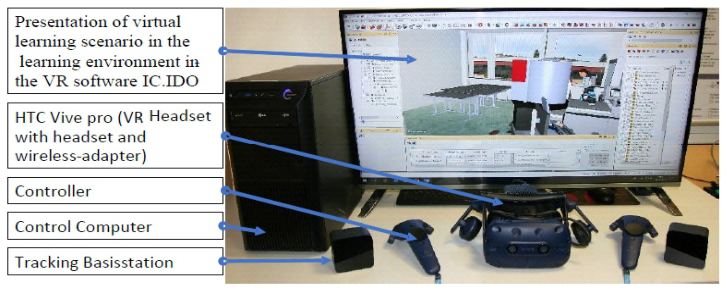
Virtual Training In virtual training, as many action situations as possible are pro- vided in the sense of problem-solving or action strategies (Hirschle, 2020). In the context of using VR for virtual training (also known as “learning-related interactivity”), the literature speaks of a high level of practi- cal relevance and “good results in terms of learning effectiveness” (Hirt et al., 2019) (Wannemacher et al., 2020). Virtual training supports the teaching of procedural and action-related skills and at the same time provides walk-in realistic environments (training worlds) that serve as orientation in real space and increase learning moti- vation and acceptance (Schwan, 2006). The virtual learning scenarios are based on the operating states of the machine tools (e.g. normal operation, start-up and shutdown (shift-related), commissioning and decommissioning) and activities required for part-specific machining such as set-up, insertion, operational activities, etc. (VDI, 2012) (VDI 3699) (Zühlke, 2012). Work tasks such as the commissioning of a machine can be mapped in a virtual learning scenario and subsequently trained within a virtual learning envi- ronment (Hirt et al., 2019) (Goldhahn et al., 2019). This reduces the number and severity of errors that occur during real commissioning and can endanger people and a real machine. In preliminary work, three types of virtual learn- ing scenarios were defined and developed in relation to the commissioning of a milling machine with different learning requirements for training with an HTC Vive pro. The employee training was then carried out on the hard- ware side with the VR glasses HTC Vive pro and on the software side with an in-house development of the Mittweida University of Applied Sciences (see Figure 1).
202 Eckardt and Goldhahn
Figure 1: Components of the VR-system as base of the virtual environment scenario (Goldhahn et al., 2021).
Development of the Virtual Learning Scenario Describe the procedure for developing a virtual learning scenario (Goldhahn, Eckardt, 2021). Based on dynamic 3D models, it allows virtual training courses to be developed in order to qualify users in the operation and exe- cution of activities on machine tools. The real test environment for which virtual training courses are developed was modeled on the data side using the CAD software SolidWorks and transferred to the VR software.
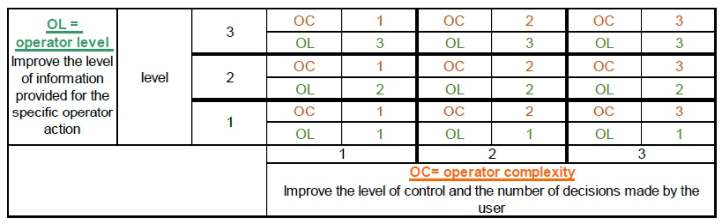
In order to be able to define the qualification required for the virtual learn- ing scenarios, the approach according to (Eckardt et al., 2020) is expedient. This approach uses a level model that provides adequate learning content for different levels of the required and existing skills of the respective employee (see Figure 2).
According to (Eckardt et al., 2020), the operating complexity (BK) and the operating level (BL) contained in the level model were defined in three stages. This is necessary in order to structure and classify the complexity of virtual training.
The operating level determines the amount of information conveyed for the successful implementation of the learning scenario that is entered by the user. Furthermore, the operating complexity includes the degrees of freedom and dependencies in the learning environment available for the respective virtual training.
Figure 2: Step-by-step model of VR-based operating actions for classifying learning scenarios (Goldhahn, Eckardt, 2021).
Virtual Training for the Maintenance of Machine Tools 203
Based on this approach and the step-by-step model developed, a virtual training course on the maintenance of a lathe and its required operating actions was developed.
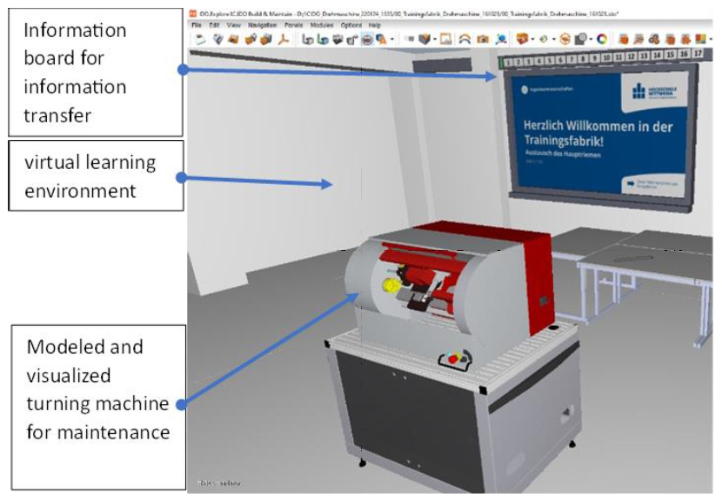
The virtual learning scenario includes information-based (visual, auditory and haptic support) guided operating actions. In this training, the user nav- igates themselves through the learning environment and works through the respective operating actions virtually in the predefined sequence. Errors in the sequence of operations are not possible, which basically ensures the suc- cessful completion of the training (operator level 2, operator complexity 2). Figure 3 below visualizes the lathe in the new virtual learning environment using the example of maintenance.
Figure 3: Virtual training using the example of the maintenance of a turning machine.
First Findings From Tests
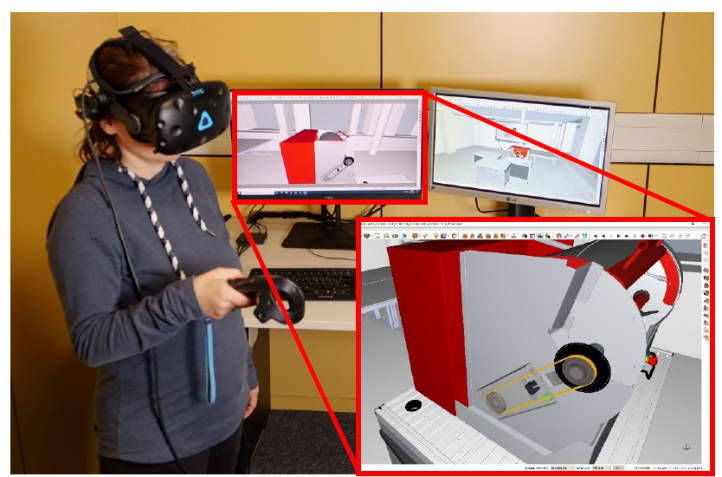
Figure 4 shows a test person carrying out the virtual training. In the figure, she has the task of changing the belt of the main drive of the lathe (marked in yellow in the screenshot of the virtual scene outlined in red). To do this, she is provided with sequential information via the information panel, which con- tains the operating action to be performed (What is to be done? Why? How?). The locations of the respective actions are shown by markings, e.g. boxes around screws. In the case of complicated procedures, animations illustrate the sequence of actions. A progress bar above the information board provides positive feedback for positive virtual execution. The board then displays the next process.
204 Eckardt and Goldhahn
Initial trials with four test subjects have already identified the advantages and disadvantages of virtual training.
Advantages
System-based, process-oriented guidance of learners through information boards
User can familiarize themselves with the learning environment without time pressure
Less effort required to explain the operating action to be performed in the real environment
Little effort required to explain the spatial position of the next operating action
Virtual animations can be easily integrated as video sequences on a multimedia interface (PC or tablet).
Figure 4: Virtual training using the example maintenance of a turning machine.
Disadvantages
Relatively high effort required to create, test and technically stabilize the virtual learning scenario
Special maintenance tasks and background information can be better described in multimedia and text form
Learning from mistakes in the event of an incorrect sequence of actions is not part of the virtual training.
Virtual Training for the Maintenance of Machine Tools 205
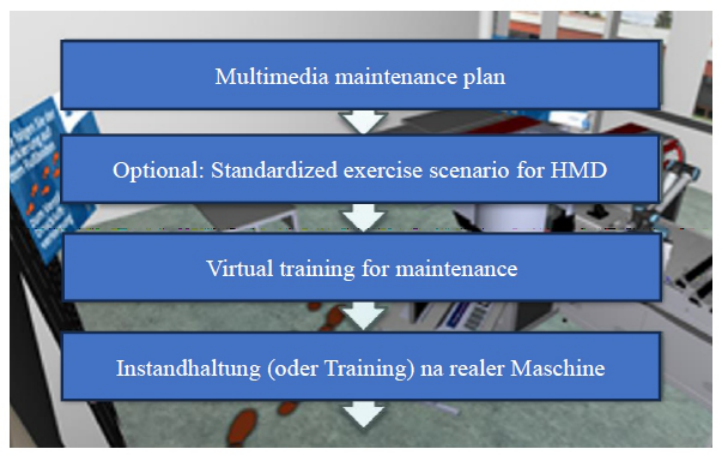
Outlook: Supplementing Virtual Training With a Multimedia Maintenance Plan and a VR Exercise Scenario As a consequence of the advantages and disadvantages of creating and using the purely virtual learning scenario, a multimedia maintenance plan is cur- rently being developed. This plan is structured hierarchically and sequentially in accordance with human action regulation. Data, photos, CAD representa- tions and video sequences from VR animations supplement and illustrate the necessary maintenance steps using the example of replacing the drive belt on a lathe. This belt is a flexible component. Its mechanical pre-tension is deter- mined by force measurement and deflection. As this process can hardly be depicted virtually, a purely multimedia description is a particularly suitable case here.
Previous tests have shown that untrained people should run through a standardized training scenario on the head-mounted display (HMD) with its controllers. This has already been created using the example of the sys- tem commissioning of the Training Factory 4.0 at Mittweida University of Applied Sciences (Goldhahn et al., 2021). It is necessary to check whether this scenario can be used across all subjects.
The virtual training in the VR environment is then followed by a practical exercise or the performance of maintenance on the real machine. This creates a holistic approach for a combination of multimedia maintenance plans with virtual training and real training of manual skills (Fig. 5).
Figure 5: Holistic approach to virtual training for the maintenance of machine tools.
In addition, the development of virtual training with components for the autonomous execution of maintenance operations is conceivable, whereby errors can also be made by the operator and lead to corresponding error
206 Eckardt and Goldhahn
information from the learning environment (operator level 3, operator compexity 3).
CONCLUSION
The current state of development of virtual training covers the steps required to maintain a lathe. Virtual training is effective when using suitable VR tech- nology and for learning essential operating actions on machine tools. Virtual training offers advantages such as:
Recognize your own mistakes and consciously avoid them
Virtual “practical” trial and error instead of abstract frontal teaching
Consideration of different levels of knowledge among employees.
The practical need for the development and application of virtual learning scenarios arises primarily from the targeted reduction of operating errors by employees, which avoids hazards to the machine/system or tools, but also to the employees themselves. Unproductive downtimes can also be reduced.
The existing state of development of virtual training must be supple- mented in future by further tests in combination with a guided interview. The interview specifies the needs-oriented learning content and, if necessary, the training requirements with regard to the basic VR application.
The holistic expansion of purely virtual training to include learning by means of a multimedia maintenance plan and practising manual activities on the real machine enables specific qualification in terms of knowledge, skills and abilities for the respective task. A virtual training scenario helps newcomers to the world of VR goggle technology and its controllers.
This creates a suitable method-based tool that is intended to improve learn- ing success and thus qualification and produce a robust learning outcome.
ACKNOWLEDGMENT
The authors would like to thank the Federal Ministry of Education and Research for its financial support and the Projektträger Karlsruhe (PTKA) for its support of the research project “PerspektiveArbeit Lausitz (PAL)”, funding code 02L19C300.
REFERENCES
Bundesministerium für Arbeit und Soziales; Digitalisierung am Arbeitsplatz (2016), S 16, Zugang am Jan 08, 2020, https://www.bmas.de/SharedDocs/Downloads/DE/ PDF-Publikationen/a875-monitor-digitalisierung-am-arbeitsplatz.pdf;jsessionid= 7C4EB42D0C7F765A2D22B10EF1832359?__blob=publicationFile&v=3. DIN EN ISO 6385, (2016), Grundsätze der Ergonomie für die Gestaltung von
Arbeitssystemen. Dörner, R., Geiger, C., Oppermann L., Paelke V., Interaktionen in Virtuellen Welten in Virtual und Augmented Reality (VR/AR), Springer-Verlag Berlin, Heidelberg, (2013), S. 157ff. Eckardt, R. Goldhahn, L. Pietschmann, C. Roch, S. Lernszenarien und Virtual
Reality-basierte Bedienhandlungen zur Mitarbeiterqualifizierung. In: Gesellschaft für Arbeitswissenschaft e. V. (Hrsg.): Digitaler Wandel, digitale Arbeit, digitaler Mensch? Bericht zum 66. Arbeitswissenschaftlichen Kongress vom 16.-18. März 2020. Dortmund: GfA Press, ISBN 978-3-936804-27-0, 2020, B1.1. pp. 1–6.
Virtual Training for the Maintenance of Machine Tools 207
Engel, B., Immersion oder Versinken in der virtuellen Realität – auch ein Thema für die Arbeitsmedizin? In: Zeitschrift für medizinische Prävention, vol. 54, n
09, Enligne: https://www.asu-arbeitsmedizin.com/node/ 30413/print. (2019), S. 604–607. FOERST GmbH, Effiziente Fahrsimulatoren für Pkw, Lkw und Busse. Zugang am
Jan 7, 2020, https://www.fahrsimulatoren.eu/de/. Goldhahn, L. 2003. Montageplanung und -ausführung – virtuell und real. 16 th International Scientific Conference Mittweida IWKM. Scientific Reports Nr. 2, 2003, S. 46–50. Goldhahn, L.; Eckardt, R.; Müller-Eppendorfer, K.: Standardisiertes Übungsszenario
für HMD-basierte virtuelle Lernumgebungen. In: Ökologische Transformation in Technik, Wirtschaft und Gesellschaft? Scientific Reports. 26. Interdiszi- plinäre Wissenschaftliche Konferenz Mittweida, ISSN 1437-7624, 2021, Nr. 2, doi.org/10.48446/opus-12300, pp. 105–108. Goldhahn L., Eckardt R., Pietschmann C., Roch S. Competency Profiles as a Means of Employee Advancement for a Resource-Efficient Chipping Production. In: Advances in Manufacturing, Production Management and Process Control, Proceedings of the AHFE 2019, 24–28 July 2019, Washington D. C., USA, pp. 146–157; doi: 10.1007/978-3-030-20494-5_14 (2019). Goldhahn, L.; Eckardt, R.: Learning Scenarios for the Improvement of Operating
Safety of Machine Tools. In: Black, N. L.; Neumann, W. P.; Noy, I. (eds): Proceed- ings of the 21st Congress of the International Ergonomics Association (IEA 2021). IEA 2021. Lecture Notes in Networks and Systems, vol. 223. Cham: Springer; doi.org/10.1007/978-3-030-74614-8_92, S. 749–760. Hacker, W. (1998), Allgemeine Arbeitspsychologie Psychische Regulation von Arbeitstätigkeiten, Huber Verlag. Hirschle, T. Lernszenario, Zugang Jan 07, 2020. https://bildungsserver.berlin-bran
denburg.de/fileadmin/bbb/unterricht/faecher/gesellschaftswissenschaften/ethik/ Lernszenario.pdf (2020). Hirt C, Spahni M, Kompis Y, Jetter D, Kunz A (2019) Alles rund um die Maschine – Begehbare virtuelle Schulung an Werkzeugmaschinen. In: VAR2 2019 – Realität erweitern, Hrsg. Putz M, Klimant P, Klimat F, Chemnitz, ISBN: 978-3-00-064420-7, S. 43–58. Klimant, P., Klimant, F., Putz, M., Allmacher, C., Trends der virtuellen und erweit-
erten Realität mit dem Fokus auf virtueller Inbetriebnahme. VAR2 2019 – Realität erweitern. Chemnitz, (2019), S. 7–26. Schwan, S., Buder, J., Virtuelle Realität und E-Learning, S. 7–9, Zugang Jan 7, 2020, https://www.e-teaching.org/didaktik/gestaltung/vr/vr.pdf (2006). VDI/VDE Richtlinie 3699 – Prozessführung mit Bildschirmen. Berlin, BeuthWannemacher K, Jungermann I, Scholz J, Tercabli H, von Vil- liez A, Digitale Lernszenarien im Hochschulbereich, S. 16 Zugang Jan 7, 2020, https://hochschulforumdigitalisierung.de/ sites/default/ files/dateien/HFD%20AP%20Nr%2015_Digitale%20Lernszenarien.pdf (2016). Wiendahl, HP. Fiebig, T. (2003) Virtual factory design – a new tool for a co-operative
planing approach Nr. 7: S. 535–540. Zühlke, D. 2012, Nutzergerechte Entwicklung von Mensch-Maschine-Systemen: Useware-Engineering für technische Systeme, 2. Aufl. Berlin: Springer.
LISTED IN THE AHFE DIGITAL BOOKSTORE CATALOGUE
Explore the complete digital volume
Human Factors and Systems Interaction
Read this individual research paper free through the original publisher, or explore the full digital proceedings book.
ISBN 978-1-964867-30-4
Explore this ISBN in the AHFE Bookstore ↗Listed in the July 2026 bookstore catalogue; search by ISBN to confirm current availability · Digital book purchase optional