Sarah Rudder (2024). Model-based Systems Engineering (MBSE) Enterprise Architecture Framework (EAF) with Human System Integration (HSI) – A Smart-City (SC) Case Study. In: Human Factors and Systems Interaction. AHFE Open Access, vol. 154, pp. 12–21. https://doi.org/10.54941/ahfe1005348
This paper researches and analyzes how Model-based Systems Engineering (MBSE) methods can be applied to the construction industry in developing an Enterprise Architecture Framework (EAF) for long-term success of the Operations and Maintenance (O&M) of emerging Smart-Cities (SC). A properly built EAF complements an organization’s Digital Transformation (DT) effort, enabling the construction of these human-focused urban developments that purport sustainable practices in response to environmental threats heightened by typical city infrastructure. The complexity of an SC is comparable to architecting a System-of-Systems (SoS) with the imperative need to identify and account for emergent properties between systems when making design decisions. From a Systems Engineering (SE) perspective, the re-usability of standardized Architecture Frameworks (AF) and libraries built within an MBSE environment will decrease rework, therefore reducing cost and improving reliability of similar projects in the future. This paper will (1) review existing literature related to MBSE EAF implementation and results within the construction industry with an emphasis on SCs, (2) propose a Reference Architecture (RA) that extends an existing MBSE framework with customizations for SC construction, and (3) architect and evaluate The Line in Saudi Arabia as a case study. This research will lay the foundation for conclusions regarding the efficacy of practicing MBSE in construction as the domain becomes increasingly interconnected to “smarter” applications that require additional considerations, constraints, and technologies.
Model-based Systems Engineering (MBSE) is the formalized application of Systems Engineering (SE) to support system requirements, design, analy- sis, verification, and validation activities beginning in the conceptual design phase and continuing throughout later lifecycle phases (INCOSE, 2010). SE is defined as the methodical, multi-disciplinary approach for the design, realization, technical management, operations, and retirement of a sys- tem (NASA, 2007). MBSE promises to deliver increased return on invest- ment (ROI) opposed to the traditional document-based approach (Delligatti,
Model-Based Systems Engineering (MBSE) Enterprise Architecture Framework (EAF) 13
2014). The key value of MBSE is the central repository that stores all system-related information to enable the interconnection of model elements (Madni & Sievers, 2018). Although the research and positive findings of this transition is overwhelming (Henderson & Salado, 2021), the biggest chal- lenge to MBSE adoption is gaining acceptance of SE and Project Management (PM) approval (Madni & Sievers, 2018). Other hurdles include the lack of clear organizational structure (Huldt & Stenius, 2018) or direction to assess how MBSE practices will affect current business processes (Friedenthal et al., 2015). SE has been widely accepted in the aerospace and defense sector to provide system solutions to technologically challenging and mission critical problems (Friedenthal et al., 2015) and has therefore this industry has been an early adopter of MBSE practices (Henderson & Salado, 2021). However, systematic MBSE methods can be scaled to solve problems of any complex system (Duprez, 2018).
Practicing MBSE requires a modeling language, tool, and approach (Delligatti, 2014). Many software tools are commercially available to sup- port model development based on standard modeling languages such as the Unified Modeling Language (UML) and the Systems Modeling Language (SysML) [Lambolais, 2016], but since these notations do not provide ade- quate guidance related to an approach or methodology, this information must be established and disseminated throughout an organization (Morke- vicius et al., 2016). Selection of an appropriate methodology is complicated by the infinite options since they are continuously adapted and improved to meet an organization’s specific needs (Jackson et al., 2021). Gao et al. (2019), published a thorough review of several MBSE methodologies applied by various companies that are specific to their needs as it relates to SE prac- tices. This research paper compares tailored approaches to the popular and generic INCOSE Object-oriented Systems Engineering Method (OOSEM), a top-down, scenario driven process that supports the analysis, specification, design, and verification of systems by presenting different views of the sys- tem including behavior, structure, properties, and requirements traceability (Friedenthal et al., 2015).
A system consists of a set of elements that interact with one another and its external environment to achieve an objective (Friedenthal et al., 2015). A system model is a digital representation of a physical system that integrates cross-discipline inputs for a defined purpose (Madni & Sievers, 2018) and captures relevant and necessary information within model element specifica- tions (Delligatti, 2014). This model serves as a central repository for design decisions represented as model elements and the resulting diagrams show specific views of the underlying model (Delligatti, 2014). A few examples of MBSE benefits summarized by Henderson & Salado, 2020, include increased precision, better data management and decision-making, and improved communication and information sharing compared to a document-based approach. A system model that consists of several system views may alter- natively be referred to as a system architecture where a framework defines the structure and content of Architecture Descriptions (AD) [Reichwein & Paredis, 2011] as a meta-model for constructing complex systems (Piaszczyk, 2011). The architecture structure represents the physical and/or logical com- ponents of a system design and respective internal and external connections
14 Rudder
whereas the architecture framework establishes conventions, principles, and best practices to describe the overall system architecture (ISO 24765:2017).
The Architecture Framework (AF) defines the structure, content, and the activities that build an adequate AD (Reichwein & Paredis, 2011). Imple- menting an AF ensures completeness, traceability, re-use, and justification of decisions throughout the system lifecycle (Gevorgyan & Spencer, 2016). A primary function of an AF in a digital environment is the organization and subsequent management of SoS information that supports a broader EAF (DiMario et al., 2008). As it relates to the construction industry, Axelsson et al. (2019), suggest treating a project as an SoS composed of sub- systems based on the AD defined by ISO 42010. This research will consider the System-of-Interest (SoI) as an SoS, which is comprised of several inter- dependent systems with interoperability relationships that form unexpected emergent behaviors (DiMario et al., 2008). According to a study by Szabo et al. (2014), emergence is the difference between the observed behavior of the entire system and that of individual components (or systems). An EAF describes the underlying system infrastructure, providing the groundwork for hardware, software, and network integration (Urbaczewski & Mrdalj, 2006). Another standard definition for the concept of an AF is given by ISO 42010:2022 as the prescription of a common structure or convention for ADs in a certain domain that includes a common set of viewpoints. The stan- dard distinguishes the related architecture description as a deliverable used to express an architecture which includes, but is not limited to, an analysis of stakeholder concerns, identification of relations between architecture ele- ments, summarization of views and how each perspective shows a different concern, and the viewpoints that establish the convention for how to present views. A best practice in MBSE is to create architectural viewpoints that eliminate having to understand the entirety of the system which inherently mitigates risk and eases decision-making (Russell, 2012). According to the Object Management Group (OMG) SysML Specification, Version 1.2, 2010, a view is a representation of a whole system and conforms to the perspective of a single viewpoint, which is a specification of the conventions and rules for constructing and using a view for the purpose of addressing stakeholder con- cerns. A valid viewpoint in accordance with SysML rules must include the following five properties: stakeholders, purpose, concerns, languages, and methods.
Smart-Cities (SC) Paroutis et al. (2014), describe the technology, system, and strategic views in detail when considering SCs based on the International Business Machine (IBM) Smarter Cities initiative. In the absence of a standardized approach to develop, model, and/or simulate SCs, Muvuna et al. (2019), expand on these fundamental views to include an integrated information platform capa- ble of representing interactions and information exchanges between any SC subsystems and components. Standardization of information formats within the system model is essential to ensure all stakeholders regardless of back- ground can communicate without ambiguity (Reichwein & Paredis, 2011). This research will focus on the systems view, which describes SCs as complex
Model-Based Systems Engineering (MBSE) Enterprise Architecture Framework (EAF) 15
systems comprising of multiple subsystems with key themes of adaptation and self-organization (Paroutis et al., 2014).
In the realm of urban development, the concept of Smart Cities (SC) has been recently introduced as a potential solution to slow effects of phenom- ena such as global warming and consequential climate and environmental changes (Lenk, 2020). Although there are numerous variations of the term, this research will use the following to define SCs – “an urban development environment that uses modern technologies to address business, institution, and citizen needs to enhance the overall quality of life by providing reliable, real-time services and promoting the local economy throughout the planning, development, and operational phases” (Piro et al., 2014), (Hussain et al., 2015), (Gascó-Hernandez, 2018), (Breetzke & Flowerday, 2016), (Khatoun & Zeadally, 2016). SCs employ Information and Communication Tech- nologies (ICT) to improve the quality of life for residents including aspects such as economy, transportation and traffic, environment, and government interaction (Ismagilova et al., 2015). The pervasive presence of advanced ICT exemplifies how various urban systems and domains are interrelated to safely control available resources for desired economic and social outputs (Bibri, 2018). Additional performance enhancements of urban services meant to reduce costs and resource consumption are Key Performance Indicators (KPI) of SCs and actively engaging citizens by gathering opinions to analyze interests and synthesize them during SC development (Laurini, 2017).
Lenk (2020), elaborates upon necessities of SCs to include concepts such as centralized sources of information, consistency of interconnected Informa- tion Systems (IS), use of a common data model for representation of exchange items, and a clear understanding of standards. Principle hardware and soft- ware elements comprise the city component architecture which includes networks, processes, applications, and associated activities (Al-Hader, 2009). Javidroozi et al. (2019), describe the necessity of using Enterprise Systems Integration (ESI) methods to treat an SC as an SoS to address the com- plexity of providing adequate services to citizens. Even with technological advancements, this novel SC infrastructure development has considerable implementation challenges related to issues such as policies and funding (Khan et al., 2020). To address the identified issues while keeping customer demands for sustainability as the primary objective in these fast-growing cities meant to handle deficiencies in services, SCs must change the overall method of performing urban activities and functions to provide efficiency to citizens in real-time (Javidroozi et al., 2019). Humans are considered the cen- ter of Smart City Development (SCD), but the use of knowledge technology techniques assist human reasoning by studying alternatives and evaluating the consequences of decisions (Laurini, 2017).
HSI Ontology as an MBSE Framework for Smart-City Design Human Systems Integration (HSI) is a management approach of SE applied to ensure technical, organizational, and human elements are appropriately addressed across the system lifecycle (INCOSE, 2023). SE processes address HSI aspects such as human engineering, personnel, training, safety, haz- ards, survivability, and habitability (Rountree & Thomas, 2021). An HSI ontology can be integrated into a system model to increase communications between all stakeholders (Orellana & Madni, 2014). Despite implementing
16 Rudder
a holistic SE approach, Boy & Narkevicius (2014), argue consistent failures still occur due to the required mindset change from technology and finance driven practices to human-centered methods. Ensuring human impacts are understood and considered within project decision-making is an HSI activity that supports management (INCOSE, 2023). However, Boy & Narkevi- cius (2014), expose a key flaw in SE regarding treating people as systems in the same way as machines when complexity in human systems must account for factors such as creativity, flexibility, and inductive cognition. Boy (2013), proposes a model for considering Human-Centered Design (HCD) that recognizes the philosophical distinctions for concurrent creation and development of artifacts with the understanding that people and technology behave differently.
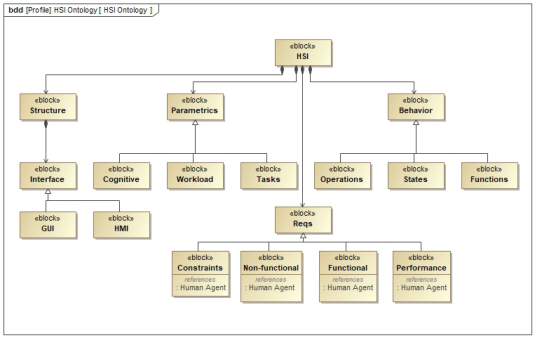
Although previous work has determined the subtle difference between a sustainable city and a smart city (Ahvenniemi, 2017), this research will con- tinue to use “sustainable cities” interchangeably with “smart-cities”. Given an SC is a vision of the future shared with its citizens (Chang et al., 2018), incorporating HSI methods is imperative to ensure resident satisfaction which is necessary to maintain a functioning economy. Both HSI and SE disciplines are moving towards modeling methods, and Rountree & Thomas (2021), identify potential benefits of establishing an approach beyond an HSI ontol- ogy into the system model to reduce likelihood of Human Factors (HF) related failures and the associated costs. Figure 1 represents an HSI ontology adapted from the work of Rountree & Thomas (2021) and how MBSE pil- lars (i.e., requirements, structure, behavior, and parametrics) are composed of HSI concepts referencing a Human Agent as an actor block. This research will continue to build upon this library of elements as the system model matures.
Figure 1: Adapted HSI ontology.
INCOSE SE Vision 2035 The INCOSE SE Vision 2035 gives a roadmap for the international SE com- munity for strategic direction in dealing with a changing global environment
Model-Based Systems Engineering (MBSE) Enterprise Architecture Framework (EAF) 17
including issues such as significant increases in population, urbanization, consumption, and waste. The seventeen United Nations (UN) Sustainable Development Goals (SDG) are specifically highlighted in the vision implor- ing countries to promote prosperity while protecting the planet. The UN goal most relevant to this research is SDG #11 – “to make cities and human set- tlements inclusive, safe, resilient, and sustainable” (United Nations, 2015). In addition to referencing the UN SDGs, the INCOSE SE Vision 2035 discusses a list separately generated by the National Academy of Engineering (NAE) of “14 Grand Challenges for Engineering in the 21st Century” that focuses on globally relevant engineering opportunities that address societal needs. The NAE “Challenge” most aligned to the goals of this research is “Restore and Improve Urban Infrastructure” which succinctly describes the problem, but does not offer a clear solution.
Several studies summarize successful “smart” additions to established city infrastructures in modern places such as Barcelona, ESP; Seoul, KOR; and London, ENG. The city of Barcelona is considered a successful case of imple- menting technological systems to convert into an SC and compete in the global economy (Bakıcı et al., 2013). This paper acknowledges the deficien- cies in previous strategic urban development planning leading to problems with housing, water, transportation, and energy. The long-term objective of transforming Barcelona into an SC was to increase the reliability of public ser- vices while providing transparency and accessible communication channels between governing bodies and citizens (Bakıcı et al., 2013). In contrast, a key aspect driving SC initiatives in Seoul was to develop and maintain “smart” tourism (Gretzel et al., 2018). London’s SC agenda focuses on increasing con- straints on urban resources such as transport, energy, and healthcare while planning for population growth and infrastructure load mitigation. (London City Hall – Greater London Authority (GLA), 2011). A promising future SC is The Line, a subset of the ambitious and innovative Neom smart city mega- project outlined to support the Saudi Arabia Vision 2030, a general plan and strategy to lead the country in a post-oil era (Altahtooh, 2018).
Integrating SC technology into established municipalities has failed in places such as New York City, NY, and Toronto, CAN. Although SC plan- ners predicted economic growth and environmental benefits, citizens rejected the notion due to privacy concerns that were not addressed by any govern- ment body (Sengupta & Sengupta, 2022). Perceived risks and vulnerabilities identified by Sengupta & Sengupta (2022), can provide the foundation for an EAF ubiquitously applied to SC construction.
Altahtooh (2018), asserts that each SC project has specific enterprise goals and objectives based on parameters and particular conditions. Publicly avail- able plans for implementation of constructed and planned transformations will be analyzed to determine commonalities of goals and objectives. On the basis of the above reflections on the state of the field, we can understand that there is a need for an EAF for the construction project data model for reference and design re-use in large organizations.
18 Rudder
CONCLUSION
While SCs and “smarter” subsystems and components are becoming increas- ingly pertinent in urban development, MBSE practices can be implemented throughout a project lifecycle in the construction industry to capture all relevant information in a single repository. These techniques assist with con- figuration management when changes are made in the field that result in a delta between design and actual installation. Although there is currently limited research regarding SE in the construction domain, the discipline is a natural extension of processes applied in project development. Imple- menting an RA as part of the organization’s baseline enables re-usability to reduce rework while establishing a common understanding across programs. A standardized reference EAF built specifically for construction initiatives with MBSE is a sustainable solution for SC operations and maintenance of the infrastructure, design, implementation, decisions, and overall resident satisfaction.
REFERENCES
Ahvenniemi, H., Huovila, A., Pinto-Seppä, I., & Airaksinen, M. (2017). What are the differences between sustainable and smart cities? Cities, 60, 234–245. https: //doi.org/10.1016/j.cities.2016.09.009 Al-Hader, M., Rodzi, A., Sharif, A. R., & Ahmad, N. (2009). Smart City Compo-
nents Architicture. 2009 International Conference on Computational Intelligence, Modelling and Simulation, 93–97. https://doi.org/10.1109/CSSim.2009.34 Al-sayed, A., Al-shammari, F., Alshutayri, A., Aljojo, N., Aldhahri, E., & Abouola, O.
(2022). The Smart City-Line in Saudi Arabia: Issue and Challenges. Postmodern Openings, 13(1 Sup1), Article 1 Sup1. https://doi.org/10.18662/po/13.1Sup1/412 Altahtooh, U. A. (2018). A Model of the Critical Success Factors for the Neom Project in the Context of a Project Management Information System. Journal of Management and Strategy, 10(1), Article 1. https://doi.org/10.5430/jms.v10n1p1 Axelsson, J., Fröberg, J., & Eriksson, P. (2019). Architecting systems-of-systems and
their constituents: A case study applying Industry 4.0 in the construction domain. Systems Engineering, 22(6), 455–470. https://doi.org/10.1002/sys.21516 Bakıcı, T., Almirall, E., & Wareham, J. (2013). A Smart City Initiative: The Case of Barcelona. Journal of the Knowledge Economy, 4(2), 135–148. https://doi.org/10. 1007/s13132-012-0084-9 Bibri, S. E. (2018). A foundational framework for smart sustainable city develop-
ment: Theoretical, disciplinary, and discursive dimensions and their synergies. Sustainable Cities and Society, 38, 758–794. https://doi.org/10.1016/j.scs.2017. 12.032 Boy, G. A. (2013). Orchestrating Human-Centered Design. Springer, U.K. Boy, G. A., & Narkevicius, J. M. (2014). Unifying Human Centered Design and Systems Engineering for Human Systems Integration. In M. Aiguier, F. Boulanger, D. Krob, & C. Marchal (Eds.), Complex Systems Design & Manage- ment (pp. 151–162). Springer International Publishing. https://doi.org/10.1007/ 978-3-319-02812-5_12 Breetzke, T., & Flowerday, S. V. (2016). The Usability of IVRs for Smart
City Crowdsourcing in Developing Cities. The Electronic Journal of Informa- tion Systems in Developing Countries, 73(1), 1–14. https://doi.org/10.1002/j. 1681-4835.2016.tb00527.x
Model-Based Systems Engineering (MBSE) Enterprise Architecture Framework (EAF) 19
Chang, D. L., Sabatini-Marques, J., Da Costa, E. M., Selig, P. M., & Yigitcanlar, T. (2018). Knowledge-based, smart and sustainable cities: A provocation for a conceptual framework. Journal of Open Innovation: Technology, Market, and Complexity, 4(1), 1–17. https://doi.org/10.1186/s40852-018-0087-2 Delligatti, L. (2014). SysML Distilled: A Brief Guide to the Systems Modeling
Language. DiMario, M., Coutier, R., & Verma, D. (2008). System of Systems Engineering Management Framework. Engineering Management Journal, 20(4), 6. Duprez, J. (2018). An MBSE modeling approach to efficiently address complex sys-
tems and scalability. INCOSE International Symposium, 28(1), 940–954. https: //doi.org/10.1002/j.2334-5837.2018.00526.x Friedenthal, S., Moore, A., & Steiner, R. (2015). A Practical Guide to SysML: The Systems Modeling Language. Gao, S., Cao, W., Fan, L., & Liu, J. (2019). MBSE for Satellite Communication
System Architecting. IEEE Access, 7, 164051–164067. https://doi.org/10.1109/ ACCESS.2019.2952889 Gascó-Hernandez, M. (2018). Building a smart city: Lessons from Barcelona.
Communications of the ACM, 61(4), 50–57. https://doi.org/10.1145/3117800 Gevorgyan, A., & Spencer, P. (2016). Operational Analysis of Virtual IP Multimedia Subsystem (IMS) Through a Model-Based Architectural Framework. In: Auvray, G., Bocquet, JC., Bonjour, E., Krob, D. (eds) Complex Systems Design & Management. Springer, Cham. https://doi.org/10.1007/978-3-319-26109-6_18 Gretzel, U., Ham, J., & Koo, C. (2018). Creating the City Destination of the Future:
The Case of Smart Seoul. In Y. Wang, A. Shakeela, A. Kwek, & C. Khoo-Lattimore (Eds.), Managing Asian Destinations (pp. 199–214). Springer. https://doi.org/10. 1007/978-981-10-8426-3_12 Hause, M., Hummell, J., & Grelier, F. (2018). MBSE Driven IoT for Smarter Cities.
2018 13th Annual Conference on System of Systems Engineering (SoSE), 365–371. https://doi.org/10.1109/SYSOSE.2018.8428705 Henderson, K., & Salado, A. (2021). Value and benefits of model-based systems engineering (MBSE): Evidence from the literature. Systems Engineering, 24(1), 51–66. https://doi.org/10.1002/sys.21566 Huldt, T., & Stenius, I. (2019). State-of-practice survey of model-based systems
engineering. Systems Engineering, 22(2), 134–145. https://doi.org/10.1002/sys. 21466 Hussain, A., Wenbi, R., Da Silva, A. L., Nadher, M., & Mudhish, M. (2015). Health and emergency-care platform for the elderly and disabled people in the Smart City. Journal of Systems and Software, 110, 253–263. https://doi.org/10.1016/j.js s.2015.08.041 International Council on Systems Engineering (INCOSE). (2010). Systems Engineer-
ing Handbook - A guide for System life cycle processes and activities. INCOSE, Version 3.2. International Council on Systems Engineering (INCOSE). Systems Engineering Vision 2035. International Council on Systems Engineering (INCOSE). (2023). The Human
Systems Integration (HSI) Primer. International Organization for Standardization (ISO). (2017). Systems and Software Engineering – Vocabulary. ISO Standard Number 24765:2017) International Organization for Standardization (ISO)/IEC/IEEE. (2022). Soft- ware, systems and enterprise Architecture description, ISO Standard Number 42010:2022.
20 Rudder
Ismagilova, E., Hughes, L., Dwivedi, Y. K., & Raman, K. R. (2019). Smart cities: Advances in research—An information systems perspective. International Jour- nal of Information Management, 47, 88–100. https://doi.org/10.1016/j.ijinfomgt. 2019.01.004 Jackson, A., Palmer, B., Cobb, D., & McCreless, J. (2021). Model of Models Method-
ology: Reuse Your Architectural Data. INCOSE International Symposium, 31(1), 1303–1318. https://doi.org/10.1002/j.2334-5837.2021.00902.x Javidroozi, V., Shah, H., & Feldman, G. (2019). Urban Computing and Smart Cities: Towards Changing City Processes by Applying Enterprise Systems Inte- gration Practices. IEEE Access, 7, 108023–108034. https://doi.org/10.1109/AC CESS.2019.2933045 Khan, H. H., Malik, M. N., Zafar, R., Goni, F. A., Chofreh, A. G., Klemeš, J.
J., & Alotaibi, Y. (2020). Challenges for sustainable smart city development: A conceptual framework. Sustainable Development, 28(5), 1507–1518. https: //doi.org/10.1002/sd.2090 Khatoun, R., & Zeadally, S. (2016). Smart cities: Concepts, architectures, research opportunities. Communications of the ACM, 59(8), 46–57. https://doi.org/10. 1145/2858789 Lambolais, T., Courbis, AL., Luong, HV., Phan, TL. (2016). Designing and Integrat-
ing Complex Systems: Be Agile Through Liveness Verification and Abstraction. In: Auvray, G., Bocquet, JC., Bonjour, E., Krob, D. (eds) Complex Systems Design & Management. Springer, Cham. https://doi.org/10.1007/978-3-319-26109-6_5 Laurini, R. (2017). Towards Smart Urban Planning through Knowledge Infrastructure. Lenk, U. (2020). Smart Cities and MBSE: Comparison of Concepts. 2020 IEEE 15th International Conference of System of Systems Engineering (SoSE), 169–174. ht tps://doi.org/10.1109/SoSE50414.2020.9130480 London City Hall – Greater London Authority (GLA). (2011). Smart London Plan.
https://www.london.gov.uk/sites/default/files/smart_london_plan.pdf Madakam, S., & Ramaswamy, R. (2016). Sustainable Smart City: Masdar (UAE) (A City: Ecologically Balanced). Indian Journal of Science and Technology, 9(6). https://doi.org/10.17485/ijst/2016/v9i6/87669 Madni, A. M., & Sievers, M. (2018). Model-Based Systems Engineering: Moti-
vation, Current Status, and Needed Advances. In A. M. Madni, B. Boehm, R. G. Ghanem, D. Erwin, & M. J. Wheaton (Eds.), Disciplinary Convergence in Systems Engineering Research (pp. 311–325). Springer International Publishing. https://doi.org/10.1007/978-3-319-62217-0_22 Matar, M., Osman, H., Georgy, M., Abou-Zeid, A., & El-Said, M. (2014). Evaluation of civil infrastructure sustainability A Model-Based Systems Engineering (MBSE) approach. In A. Mahdavi, B. Martens, & R. Scherer (Eds.), eWork and eBusiness in Architecture, Engineering and Construction (pp. 327–334). CRC Press. https: //doi.org/10.1201/b17396-57 Morkevicius, A., Bisikirskiene, L., Jankevicius, N. (2016). We Choose MBSE: What’s
Next?. In: Auvray, G., Bocquet, JC., Bonjour, E., Krob, D. (eds) Complex Sys- tems Design & Management. Springer, Cham. https://doi.org/10.1007/978-3- 319-26109-6_36 Muvuna, J., Boutaleb, T., Baker, K. J., & Mickovski, S. B. (2019). A Methodology to Model Integrated Smart City System from the Information Perspective. Smart Cities, 2(4), Article 4. https://doi.org/10.3390/smartcities2040030 National Aeronautics and Space Administration (NASA). (2007). NASA Systems
Engineering Handbook.
Model-Based Systems Engineering (MBSE) Enterprise Architecture Framework (EAF) 21
National Academy of Engineereing (NAE). (n.d.). NAE Grand Challenges for Engineering in the 21st Century. https://www.engineeringchallenges.org/File.aspx?id =11574&v=34765dff Object Management Group (OMG) Systems Modeling Language (SysML). (2010). Orellana, D. W., & Madni, A. M. (2014). Human System Integration Ontology:
Enhancing Model Based Systems Engineering to Evaluate Human-system Perfor- mance. Procedia Computer Science, 28, 19–25. https://doi.org/10.1016/j.procs. 2014.03.003 Paroutis, S., Bennett, M., & Heracleous, L. (2014). A strategic view on smart city technology: The case of IBM Smarter Cities during a recession. Technological Forecasting and Social Change, 89, 262–272. https://doi.org/10.1016/j.techfore .2013.08.041 Piaszczyk, C. (2011). Model Based Systems Engineering with Department of Defense
Architectural Framework. Systems Engineering, 14(3), 305–326. https://doi.org/ 10.1002/sys.20180 Piro, G., Cianci, I., Grieco, L. A., Boggia, G., & Camarda, P. (2014). Information centric services in Smart Cities. Journal of Systems and Software, 88, 169–188. https://doi.org/10.1016/j.jss.2013.10.029 Reichwein, A., & Paredis, C. (2011). Overview of Architecture Frameworks and
Modeling Languages for Model-Based Systems Engineering. Proceedings of the ASME Design Engineering Technical Conference, 2. https://doi.org/10.1115/DE TC2011-48028 Rountree, I., & Thomas, L. (2021). Expanding MBSE to Incorporate Human Systems Integration Modelling. https://doi.org/10.2514/6.2021-0096 Russell, M. (2012). Using MBSE to Enhance System Design Decision Making. Pro-
cedia Computer Science, 8, 188–193. https://doi.org/10.1016/j.procs.2012.01. 041 Saudi Vision 2030. (2016). Sengupta, U., & Sengupta, U. (2022). Why government supported smart city initiatives fail: Examining community risk and benefit agreements as a missing link to accountability for equity-seeking groups. Frontiers in Sustainable Cities, 4. https://www.frontiersin.org/articles/10.3389/frsc.2022.960400 Szabo, C., Teo, Y. M., & Chengleput, G. K. (2014). Understanding complex systems:
Using interaction as a measure of emergence. Proceedings of the Winter Simulation Conference 2014, 207–218. https://doi.org/10.1109/WSC.2014.7019889 United Nations (UN). (2015). Transforming our world: The 2030 Agenda for Sustainable Development. https://documents-dds-ny.un.org/doc/UNDOC/GEN/ N15/291/89/PDF/N1529189.pdf?OpenElement Urbaczewski, L., & Mrdalj, S. (2006). A Comparison of Enterprise Architec-
ture Frameworks. Issues In Information Systems. https://doi.org/10.48009/2_iis_ 2006_18-23
LISTED IN THE AHFE DIGITAL BOOKSTORE CATALOGUE
Explore the complete digital volume
Human Factors and Systems Interaction
Read this individual research paper free through the original publisher, or explore the full digital proceedings book.
ISBN 978-1-964867-30-4
Explore this ISBN in the AHFE Bookstore ↗Listed in the July 2026 bookstore catalogue; search by ISBN to confirm current availability · Digital book purchase optional