Tanja Boljanic, Milica Baljic, Strahinja Dosen, Matija Strbac (2024). The Role of Training Duration in Frequency Discrimination of Electrotactile Feedback. In: Human Factors and Systems Interaction. AHFE Open Access, vol. 154, pp. 114–122. https://doi.org/10.54941/ahfe1005359
Electrotactile feedback is a promising communication channel in various applications, from healthcare to human-machine interfaces. However, the time needed to train the users remains one of the main challenges. This study examines the impact of training duration on user performance when using frequency modulation to convey information through electrotactile stimulation. We have employed an electrotactile stimulation system that includes a custom-designed 32-pad electrode for the thigh and custom-developed software for psychometric evaluation. Software included two electrode activation regimes, i.e., single electrode pad and distributed stimulation with multiple pads, that were used for training, reinforced learning and testing of the discrimination between four frequency levels. The study involved 34 healthy volunteers subjected to short and long training protocols to evaluate the impact of learning. The results showed that longer training significantly improved the recognition, confirming that training duration is a crucial factor for effective electrotactile feedback based on frequency modulation. The training effects were especially pronounced in more complex task, when stimulation was delivered to a randomly selected pad of the electrode array. These findings provide valuable insights for optimizing training duration in electrotactile applications.
Electrotactile stimulation has been used across diverse domains, from medical rehabilitation to sophisticated human-machine interfaces to provide feedback to the users, thereby closing the control loop and improving performance. It works by delivering the electrical current pulses to the skin through sur- face electrodes, targeting the cutaneous afferents in the epidermis and dermis layers (Fares et al., 2018; Paredes et al., 2015). Electrotactile systems are advantageous over other tactile feedback mechanisms like vibration motors, as they are lightweight, less power-consuming, quieter, and faster (Pamungkas and Caesarendra, 2018). However, improper setup can lead to discomfort.
The Role of Training Duration in Frequency Discrimination of Electrotactile Feedback 115
Various sensations can be generated by adjusting the parameters such as amplitude, pulse width, frequency, electrode location, number of channels and stimulation duration (Boljani´c et al., 2022; Došen et al., 2017; Fares et al., 2018; Pamungkas and Ward, 2016; Wang et al., 2019). Each param- eter, alone or in combination, modulates specific aspects of the generated tactile sensations, emphasizing the importance of parameter selection. For instance, the frequency of stimulation determines the form of elicited tactile sensations, namely, as the frequency increases the sensations change from iso- lated tapping to continuous vibrations (Paredes et al., 2015). This has found applications in myoelectric protheses, where frequency modulation can be used to inform users about the magnitude of grasping force (Došen et al., 2017; Paredes et al., 2015; Štrbac et al., 2016) or the flexion level (Patel et al., 2016) of a particular Degree of Freedom (DoF). The same approach can also be used for stiffness recognition (Chai et al., 2022), encoding of differ- ent touch modalities (Fares et al., 2018) or in tele-operated robotics (Cheng and Zhang, 2017) to generate different feelings such as tickling, vibration and pressure. The present study was conducted within the context of NIMA project1, with the aim to investigate frequency recognition as a component of multi-modal feedback, for conveying the information about the position of the Supernumerary Robotic Limb (SRL) in three-dimensional (3D) space.
Specifically, the paper explores the impact of training duration on fre- quency discrimination in electrotactile feedback, which is an important requirement for correct use of this communication channel. Minimizing train- ing time while maximizing effectiveness is not just a matter of convenience, it is imperative for practical applications. It has been shown that noticeable performance gains in electrotactile systems can be observed within a few days of training (Kaczmarek et al., 1991; Riso et al., 1989; Štrbac et al., 2017). Shorter training period means faster adaptation and a quicker transition to proficient use, regardless of the applications. We focused on simple task with four distinct frequency levels instead of incorporating a higher number of variations. This enabled us to assess whether a short extension in training duration could yield significant benefits in simplified application scenarios. Additionally, the study examines the influence of training in two specific modes of system use: when stimulation is applied on a single electrode pad and when the stimulation location varies across the thigh.
METHODS
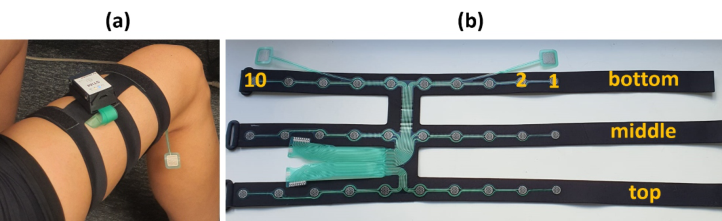
Setup The system consists of a custom-designed multi-pad electrode (Boljani´c et al., 2022), multi-channel programable stimulator unit, and a laptop running dedicated MATLAB R2019b (The MathWorks, Inc., United States). The elec- trode was designed to be positioned on the thigh to avoid interference with natural feedback, having in mind the SRL application. It had three arrays (6 cm edge-to-edge distance) with ten circular pads (1 cm diameter, 3.1 cm edge-to-edge distance) and two square pads (1.6 cm x 1.6 cm), as depicted in
1https://nima-project.eu/
116 Boljani´c et al.
the Figure 1(b). The electrode was heat transferred to the neoprene with the loop fabric for easier positioning. In this study, the active electrode always comprised a single pad, while the return electrode involved ten pads from the neighboring array. Therefore, depending on whether the active pad belongs to the bottom, middle, or top array, the return electrode configuration (array) varied.
The 32-channel stimulator unit (previously developed by Tecnalia Research & Innovations, ES within the TACTILITY project2) generated current-controlled rectangular symmetric biphasic pulses. The stimulator communicated with the laptop through Bluetooth, enabling online active pad selection and control of stimulation parameters (amplitude from 0.1 to 9 mA in 0.1 mA increments, pulse width from 30 to 4000 µs in 1 µs increments, and pulse rate/frequency from 1 to 500 Hz in 1 Hz increments). During the experiment, the pulse width remained constant at 300 µs, while the amplitude and frequency were modulated.
Figure 1: (a) Positioning of the electrotactile system comprising multi-pad electrode and stimulator, (b) multi-pad electrode with labelled pads.
Subjects The study involved 34 health volunteers (14 females, 20 males) with an aver- age age of 29.5 ± 8.1 years. Before participating, the subjects received an information leaflet detailing the study’s methods and objectives and signed an informed consent form. The study was conducted following the Declara- tion of Helsinki and the experimental protocol was approved by the ethics committee of University of Belgrade – Faculty of Medicine, Serbia (protocol code 1322/III-19, date of approval 17 March 2021).
Protocol During the experiment, the subject was comfortably seated in a chair and the electrode was placed around his/her right thigh, with the bottom array posi- tioned 10 cm above the knee’s upper edge (Figure 1(a)). The skin was moist- ened to enhance the electrode-skin contact. Two additional square-shaped pads were not used in the test.
2https://tactility-h2020.eu/
The Role of Training Duration in Frequency Discrimination of Electrotactile Feedback 117
The frequency discrimination experiment included short and long proto- col, differing only in the duration of the training. The subjects were divided in two matched groups with an equal number of participants (N = 17) assigned to perform short or long protocol. The experiment included two sessions: Single pad session (SPS) in which the same electrode pad was activated and Multi pad session (MPS) in which each of 30 pads was activated in a ran- dom order. In both sessions the subjects were asked to distinguish between four frequency levels (13, 27, 51, and 100 Hz). All subjects completed both sessions, with half of them starting with SPS and the other half with MPS.
Both SPS and MPS involved calibration, training (familiarization and rein- forced learning) and validation phases. In SPS, calibration determined the current amplitude at which the subject first perceived the stimulation (sensa- tion threshold, ST) for a single randomly assigned pad, which was then used in the subsequent test. Subjects gradually increased the current amplitude in steps of 0.1 mA until reaching ST. The localization threshold (LT) was then calculated as LT = 2.3 x ST according to the results of our previous study (Boljani´c et al., 2022). Subjects could test the selected amplitude level at all four frequencies. They could increase or decrease the amplitude to adjust the LT, and this was used as the amplitude in the remaining phases. MPS required calibrating all 30 pads, therefore significantly prolonging the cali- bration phase. ST was determined only for the first pad in the top row, and LT for all pads was calculated as LT = 2.3 x ST. Afterwards, subjects could test and adjust the amplitude for each pad separately using any of the four frequency levels. They were advised to consecutively activate all pads with the lowest frequency level and to adjust the amplitude to the LT that suits them, so that the sensation was similar for each pad. After that, they were advised to check all pads with the highest frequency level and to decrease the amplitude only if the sensation was uncomfortable.
The familiarization phase aimed to acquaint the subject with the sensations elicited by each frequency level. In the following reinforced learning phase, subjects were trained to discriminate between the four frequencies.
Short protocol: During the familiarization phase, the electrode pad was activated sequentially from the lowest (13 Hz) to the highest (100 Hz) fre- quency level and visual feedback was provided on the screen. Each frequency level was activated for 2 s with 1 s pause between the stimulation. This was repeated twice. In the reinforced learning phase, the subjects were asked to identify a randomly chosen frequency level by pressing the corresponding button on the screen. If the answer was correct, the button was coloured green, otherwise it was coloured red. The stimulation lasted for 2 s, and the subject could respond during or after the stimulus. A green/red light signalled correctness for 1 s after the response. The subject had the possibility to repeat the stimulus if he was not ready to answer. Each frequency level was repeated five times, resulting with 20 stimuli (4 levels x 5 repetitions). The same pro- tocol was used in MPS condition, with the only difference that the active pad was selected randomly in each trial.
118 Boljani´c et al.
Long protocol: The familiarization phase comprised 30 (instead of two) repetitions for each of the four frequency levels. In MPS, each frequency level was applied to all 30 pads, activated in random order. In SPS, all 120 stimuli were applied to the same pad. Currently active pad and frequency level were visualized on the screen. The reinforced learning phase involved 60 stimuli (4 levels x 15 repetitions).
In the final validation phase, subjects were asked to identify a randomly activated frequency level without visual feedback on the response accuracy. The protocol was the same as the reinforced learning phase, with the differ- ence that each frequency level was repeated 15 times (totaling 60 stimuli). In MPS, each of the 30 pads was activated twice, in a random order.
Data Analysis The main outcome measure in frequency discrimination was success rate (SR), calculated as the percentage of correctly recognized stimuli. Paramet- ric tests were used in the analysis as the data were normally distributed (Anderson-Darling test). The paired t-test was used to assess the differences in frequency recognition for single- and multi-pad stimulation. The two-sample t-test was used to compare the performance after short and long learning, as well as the influence of the test order (SPS or MPS). The threshold for sta- tistical significance was set as p < 0.05. All results are reported in the text as mean ± standard deviation.
RESULTS
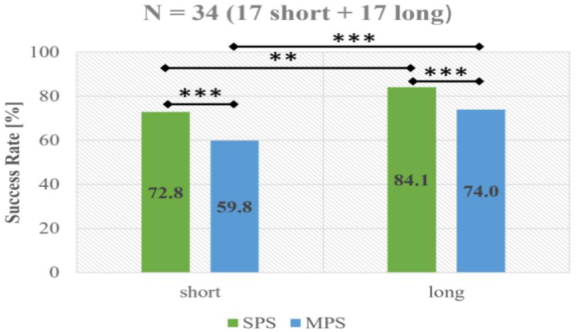
Figure 2 presents the success rate (SR) in recognizing four frequency levels, in different conditions (SPS vs MPS) for two groups (short vs long proto- col). The average SR in the long protocol was 84.1 ± 10.3 % for SPS, and 74.0 ± 9.3 % for MPS. In the short protocol, SR was 72.8% ± 11.6 % for SPS and 59.8 ± 11.9 % for MPS. SR was significantly higher for SPS in both the short (p < 0.001) and the long (p < 0.05) protocol. For both learning protocols, there were no statistically significant differences in SR regardless of whether subjects began with the SPS or the MPS. SR in the long protocol was significantly higher than in the short protocol for both SPS (p < 0.01) and MPS (p < 0.001). Longer training increased the SR relatively for 15.5% in SPS and even 23.9% in MPS. With extended training, participants in the MPS reached performance levels comparable to those achieved in the SPS after only a short training period.
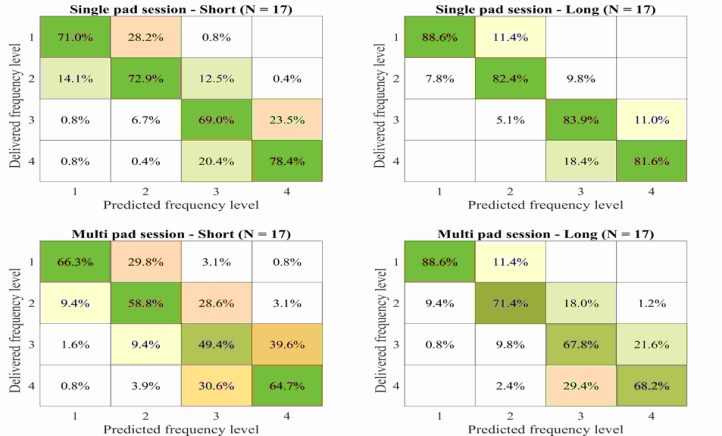
Confusion matrices presenting frequency discrimination for individual frequency levels, averaged across all subjects, are shown in Figure 3. The sub- jects tended to misinterpret consecutive frequency levels, with the confusion mainly occurring between the two highest frequencies.
Experiment duration of the SPS and MPS are presented in the Table 1 for both protocols.
The Role of Training Duration in Frequency Discrimination of Electrotactile Feedback 119
Figure 2: Success rate (SR) in recognizing four frequency levels for single pad (SR1) and multi pad (SR2) sessions, including both short and long protocols. (*, p < 0.05; **, p < 0.01; ***, p < 0.001).Table 1. Duration of each experiment averaged across subjects and reported as mean and standard deviations, as well as minimum and maximum values.
Table available in the original PDF paper.
Equation reproduced from the original PDF.
mean ± std [min – max] mean ± std [min – max] Single pad 9.3 ± 2.2 [7.1 – 14.7] 20.1 ± 2.6 [16.9 – 27.3] Multi pad 17.7 ± 8.1 [10.6 – 42.6] 28.4 ± 6.0 [20.6 – 44.1]
Figure 3: Confusion matrices for recognition of four frequency levels averaged across subjects in case of short and long protocols during both single and multi-pad sessions. N denotes the number of subjects tested in each condition.
120 Boljani´c et al.
DISCUSSION
The aim of the present study was to investigate the influence of training on frequency discrimination when using electrotactile stimulation. The protocol comprised two sessions involving the activation of a single pad or different pads across the electrode, to assess the impact of learning in both scenarios.
The results indicate that in both SPS and MPS, the SRs significantly improved when subjects performed longer training. This improvement was more pronounced in MPS, with 23.9% increase in SR compared to 15.5% for SPS. Although the extension of average experiment duration due to longer training was very similar for SPS and MPS (10.8 min and 10.7 min, respec- tively), relative increase was actually lower for MPS (60.4% vs. 116.1% in SPS). It should be noted that certain variations in the duration could be due to other phases of the experiment, especially calibration, which was longer in MPS. However, the duration of the whole experiment was considered and analysed, as this is the important matter in practical applications. The extension of less than 11 min in each session is an acceptable increase when considering both experimental and practical applications. Considering that the modest time increase yielded significantly higher SRs, especially in case of MPS, this represents a promising outcome.
The influence of training duration in electrotactile feedback has been explored in various studies (Anani et al., 1977; Kaczmarek et al., 1991; Riso et al., 1989; Štrbac et al., 2017), revealing consistent trends. For instance, in the study by Štrbac et al., 2017 focusing on feedforward control of a myo- electric prothesis with sensory feedback, subjects achieved an SR in spatial discrimination of > 85% on day 1, which further improved to 99% on days 4 and 5. Likewise, other studies (Anani et al., 1977; Riso et al., 1989) suggest that prolonged training enhances performance in frequency discrimination. In (Anani et al., 1977), the trained group showed a notable improvement, reaching an SR of 87.8%, compared to 72.5% in the untrained group. Fur- thermore, (Riso et al., 1989) demonstrated that three subjects practicing a frequency discrimination test improved over time, taking 3, 6 and 9 days, respectively, to reach a 90% accuracy rate in recognizing six frequency levels. These findings underscore the importance of extended training in different electrotactile feedback tasks, and they are in line with the results of the present study. Future research should explore the long-term effects of train- ing and the impact of sustained training on performance. The number of frequency levels should be increased to explore the real practical benefits of extended training. This could potentially allow us to develop more effective training protocols or even identify optimal training durations for different tasks (e.g., SPS or MPS) and populations.
Additionally, this study suggests that it is easier to identify the frequency levels when they are delivered always on the same pad compared to using dif- ferent pads. This is likely because the stimuli delivered to distinct locations evoke varying sensations. To minimize such variations, a dedicated effort in the calibration process might be necessary to adjust the stimulus amplitudes, aiming to equalize the sensations as much as possible across all locations. However, due to the varying distributions of cutaneous nerves across the leg,
The Role of Training Duration in Frequency Discrimination of Electrotactile Feedback 121
even this step cannot guarantee that the sensation will be uniform throughout. Nevertheless, we envision that the future closed-loop application will rely on dynamic encoding, including both spatial and frequency modulation. The fre- quency will be modulated continuously within one pad before activating the next pad, as opposed to discrete and static changes in the psychometric tests performed in this study. Therefore, the closed-loop performance is expected to exceed the highest SR achieved in this study (84.1±10.3 %).
ACKNOWLEDGMENT
The work in this study was performed within the NIMA project, which has received funding by European Union’s Horizon 2020 framework program for research and innovation H2020-FETOPEN-2018-2019-2020-01 under grant agreement no. 899626.
REFERENCES
Anani, A. B., Ikeda, K., Körner, L. M., 1977. Human ability to discriminate various parameters in afferent electrical nerve stimulation with particular reference to prostheses sensory feedback. Med. Biol. Eng. Comput. 15, 363–373. https: //doi.org/10.1007/BF02457988 Boljani´c, T., Isakovi´c, M., Maleševi´c, J., Formica, D., Di Pino, G., Keller, T.,
Štrbac, M., 2022. Design of multi-pad electrotactile system envisioned as a feed- back channel for supernumerary robotic limbs. Artificial Organs 46, 2034–2043. https://doi.org/10.1111/aor.14339 Chai, G., Wang, H., Li, G., Sheng, X., Zhu, X., 2022. Electrotactile Feedback Improves Grip Force Control and Enables Object Stiffness Recognition While Using a Myoelectric Hand. IEEE Trans. Neural Syst. Rehabil. Eng. 30, 1310–1320. https://doi.org/10.1109/TNSRE.2022.3173329 Cheng, S., Zhang, D., 2017. A wearable armband “iFeel” for electrotactile stim-
ulation, in: 2017 10th International Conference on Human System Interactions (HSI). Presented at the 2017 10th International Conference on Human-System Interactions (HSI), IEEE, Ulsan, pp. 120–124. https://doi.org/10.1109/HSI.2017. 8005012 Došen, S., Markovi´c, M., Štrbac, M., Beli´c, M., Koji´c, V., Bijeli´c, G., Keller, T., Farina, D., 2017. Multichannel Electrotactile Feedback With Spatial and Mixed Coding for Closed-Loop Control of Grasping Force in Hand Prostheses. IEEE Trans. Neural Syst. Rehabil. Eng. 25, 183–195. https://doi.org/10.1109/TNSRE. 2016.2550864 Fares, H., Seminara, L., Chible, H., Došen, S., Valle, M., 2018. Multi-Channel
Electrotactile Stimulation System for Touch Substitution: A Case Study, in: 2018 14th Conference on Ph. D. Research in Microelectronics and Electronics (PRIME). Presented at the 2018 14th Conference on Ph. D. Research in Microelectron- ics and Electronics (PRIME), IEEE, Prague, Czech Republic, pp. 213–216. https: //doi.org/10.1109/PRIME.2018.8430345 Kaczmarek, K. A., Webster, J. G., Bach-y-Rita, P., Tompkins, W. J., 1991. Electrotactile and vibrotactile displays for sensory substitution systems. IEEE Trans. Biomed. Eng. 38, 1–16. https://doi.org/10.1109/10.68204 Pamungkas, D. S., Caesarendra, W., 2018. Overview Electrotactile Feedback for
Enhancing Human Computer Interface. J. Phys.: Conf. Ser. 1007, 012001. https: //doi.org/10.1088/1742-6596/1007/1/012001
122 Boljani´c et al.
Pamungkas, D. S., Ward, K., 2016. Electro-Tactile Feedback Sys- tem to Enhance Virtual Reality Experience. IJCTE 8, 465–470. https://doi.org/10.7763/IJCTE.2016. V8.1090 Paredes, L. P., Došen, S., Rattay, F., Graimann, B., Farina, D., 2015. The impact of the stimulation frequency on closed-loop control with electrotactile feedback. J NeuroEngineering Rehabil 12, 35. https://doi.org/10.1186/s12984-015-0022-8 Patel, G. K., Došen, S., Castellini, C., Farina, D., 2016. Multichannel electrotactile
feedback for simultaneous and proportional myoelectric control. J. Neural Eng. 13, 056015. https://doi.org/10.1088/1741-2560/13/5/056015 R. R. Riso, Ignagni, A. R., Keith, M. W., 1989. Electrocutaneous sensations elicited using subdermally located electrodes. Automedica 11, 25–42. Štrbac, M., Beli´c, M., Isakovi´c, M., Koji´c, V., Bijeli´c, G., Popovi´c, I., Radoti´c, M.,
Došen, S., Markovi´c, M., Farina, D., Keller, T., 2016. Integrated and flexible multichannel interface for electrotactile stimulation. J. Neural Eng. 13, 046014. https://doi.org/10.1088/1741-2560/13/4/046014 Štrbac, M., Isakovi´c, M., Beli´c, M., Popovi´c, I., Simani´c, I., Farina, D., Keller, T., Došen, S., 2017. Short- and Long-Term Learning of Feedforward Control of a Myoelectric Prosthesis with Sensory Feedback by Amputees. IEEE Trans. Neu- ral Syst. Rehabil. Eng. 25, 2133–2145. https://doi.org/10.1109/TNSRE.2017. 2712287 Wang, W., Liu, Y., Li, Z., Wang, Z., He, F., Ming, D., Yang, D., 2019. Build-
ing multi-modal sensory feedback pathways for SRL with the aim of sensory enhancement via BCI, in: 2019 IEEE International Conference on Robotics and Biomimetics (ROBIO). Presented at the 2019 IEEE International Conference on Robotics and Biomimetics (ROBIO), IEEE, Dali, China, pp. 2439–2444. https: //doi.org/10.1109/ROBIO49542.2019.8961383
LISTED IN THE AHFE DIGITAL BOOKSTORE CATALOGUE
Explore the complete digital volume
Human Factors and Systems Interaction
Read this individual research paper free through the original publisher, or explore the full digital proceedings book.
ISBN 978-1-964867-30-4
Explore this ISBN in the AHFE Bookstore ↗Listed in the July 2026 bookstore catalogue; search by ISBN to confirm current availability · Digital book purchase optional