Harold Langezaal, Guido De Bruyne, Stijn Verwulgen (2024). VibroTactile Feedback application for correcting and guiding posterior knee flexion during the loading phase of a baseball swing. In: Human Factors in Sports, Performance and Wellness. AHFE Open Access, vol. 150, pp. 1–11. https://doi.org/10.54941/ahfe1005284
This research presents the function and validation of an innovative low-cost Vibrotactile feedback system that can be used to control rear knee flexion during the loading phase of a baseball swing. This new VTF system employs only two NOTCH® inertia sensors and two LRA actuators. It can be controlled by a coach or fellow player, making feedback individually applicable. The system is easy to use and compatible with the current NOTCH® Pioneer application. The system is tested on 12 participants who had an average of 14 years of baseball experience. As a control group, auditory feedback was used, the contemporary form of feedback to teach baseball players the correct body postures. During the tests, participants were guided to a predetermined posture using both feedback methods. This posture consisted of a 30° flexion of the posterior knee during the loading phase of a baseball swing. A margin of error of 5° was established, meaning that a flexion between 28° and 32° was considered correct. No further feedback was given once the correct position was adopted. A push metaphor was used to respond to the vibrotactile stimuli.During tis research, both feedback systems successfully guided the participant to the correct position in all 120 cases. Results showed that the new VTF system was significantly more efficient than auditory feedback in guiding participants correctly (p=0.01). On average, the VTF system was 16.99% or 0.89 seconds faster in guiding the posterior knee flexion than the auditory feedback. For 10 out of 12 participants, the VTF system was more efficient than auditory feedback in guiding the participant to the correct loading position. In particular, for eight participants, the VTF system was more than 20% faster. At maximum efficiency, the VTF system was 36% more efficient than the current auditory feedback. The functioning of this system opens up many new application possibilities in both baseball and other sports, as well as posture improvement and guidance in general.
To provide feedback and guiding batters to an optimal position, vibrotactile feedback (VTF) can be used. VTF systems have shown benefits in various sports applications. For instance, VTF is used to guide cyclists in maintain- ing an optimal aerodynamic position (Peeters, 2020). In golf, a sport with a similar swing movement, a novel feedback system using VTF was tested to provide feedback on weight balance and elbow bend, resulting in more accurate and useful body feedback (Wo´zniak et al., 2020).
Providing the vibrations, these are the two most common actuators in VTF: LRA and ERM. The eccentric rotating mass vibration motor (ERM) is an unbalanced mass that causes vibration parallel to the skin by rotating, while linear resonant actuators (LRA) create vibrations perpendicular to the skin through the resonation of the whole unit. Generally, LRA vibrations are more perceptible on the user’s skin and easier to attach to the body (Azadi and Jones, 2014; Texas Instruments, 2013). To guide a person to a certain posi- tion, it is recommended to use a vibration metaphor. Spelmezan et al (2009) describe two types of metaphors: push and pull. In push metaphors, the vibrations push the user away, whereas in pull metaphors, the vibrations pull the user towards the designated position. In general, there are two types of vibrations: continuous and staggered, with staggered vibrations being better perceived when exercising (Demircan et al., 2020).
The baseball swing is considered one of the most challenging moves in sports. Batters are under immense mental pressure and must make a split- second decision to hit a ball traveling at an average speed of 140 mph. The loading phase is a critical aspect of the swing, during which the batter times the approaching ball and prepares their body to hit with maximum power (DeRenne, 1993; Forthenbaugh, 2011). Coach Charley Lau describes the loading phase as a balanced posture, with feet parallel and shoulder-width apart. The posture should facilitate rhythm and movement, distributing weight in a way that allows the hitter to move without losing balance and to easily overcome the body’s inertia during the swing (Lau and Glossbren- ner, 1984). The loading phase is an individual posture that is influenced by several factors, such as body weight, body posture, personal swing, personal rhythm and timing, and weight distribution.
To express the loading of the body, it is important to shift your body weight towards the back knee. Maintaining a good loading and timing rhythm will help a batter feel comfortable during the swing, allowing the batter to focus solely on the visual information of the thrown ball (DeRenne, 1993). Posterior knee flexion plays an important role during the loading phase in becoming aware of body weight displacement. The flexion of the posterior knee also gives several beneficial effects during the swing itself: Proper exe- cution of the posture can enhance balance and stability during the swing (Signore, 2020). Additionally, posterior knee flexion can prevent the back leg from extending or collapsing suddenly before or during the swing, which could lead to energy loss, changes in swing plane, or head movement (Trahan, 2009). Furthermore, posture enables the front leg to block forward momen- tum and establish a solid front end, resulting in increased batspeed and exit
Vibrotactile Feedback Application for Correcting and Guiding Posterior Knee Flexion 3
velocity (Signore, 2020). The flexion of the rear knee is an individual phe- nomenon depending on different factors like the loading phase itself. Some righthanded batters lift their left foot during the loading phase which empha- sizes the posterior knee flexion, others do not lift the rear foot but still have a certain degree of posterior knee flexion. Welch et al. (1995) measured the flexion of the rear knee when the rear foot was off the ground (32
± 13
) and when the rear foot touched the ground (42
± 15
).
There is very little literature on the combination of VTF and baseball swing optimization. However, in his study, Gray (2009) emphasizes the importance of auditory and tactile feedback in baseball training. Often, auditory and tactile feedback are overlooked in training manuals that mainly emphasize visual cues. It can be said that there are many opportunities in this area of research.
RESEARCH QUESTION Research Question
Is this new VTF system more efficient than current auditory feedback in driv- ing and correcting posterior knee flexion to achieve correct loading position in a baseball swing?
Hypothesis Yes, the new portable VTF system will be more efficient than auditory feed- back for controlling and correcting posterior knee flexion during the loading phase of a baseball swing. Previous dry runs of this study with three partic- ipants (n = 3) showed VTF to be 1.22 seconds (23%) faster than current auditory feedback.
METHOD
Participants This study was conducted on 12 participants, consisting of 2 women and 10 men, with a mean age of 33 years. All participants are experienced baseball players (+5 years of experience) with an average of 15 years of experience. Two participants, 2 and 12, were left handed. They were provided with a modified VTF system to receive feedback on their left leg. Finally, two partic- ipants reported having undergone serious knee surgery within the three years prior to this study and experiencing occasional knee discomfort.
Procedure Before starting, the participants are informed about the study. The final posi- tion will not be communicated to avoid possible bias. Following the briefing, participants will undergo a short test period to become familiar with both feedback methods. In order to allow the participants to get used to the feed- back systems, different angles (squats) will be used then during the study itself.
During the study, participants will receive instructions on how to adopt the correct loading position using both vibro-tactile feedback (VTF) and the current method for providing feedback on the loading position, which is audi- tory feedback. Each participant will repeat the intervention five times for each feedback method (5 times VTF and 5 times auditory feedback). Both feedback methods will be provided by an independent coach who stands opposite the batter. In order to eliminate bias and a learning curve, half of the participants received VTF first and the other half received the auditory feedback first. The tests were taken in turns to avoid coach bias: Participant one received audi- tory feedback first and then VTF, while participant two received VTF first and then auditory feedback, and so on.
Intervention The participant is instructed to begin in a neutral batting position, assum- ing the personal load position of a baseball swing but then straightening the knees. Under the guidance of both feedback modalities, the participant then performs a 30
flexion of the posterior knee, taking into account a zone of no feedback of 5
(28
-32
), as a 5
zone of no feedback is positively applied by Verwulgen et al. (2017). This study required a standard angle to com- pare participants’ results. It is important to note that there is no universal knee flexion angle as it is a personal phenomenon with different factors. As mentioned in the introduction, knee flexion varies between 32
± 13
and 42
± 15
(Welch et al., 2009). We chose an angle of 30 degrees as it is easy to work with when providing feedback.
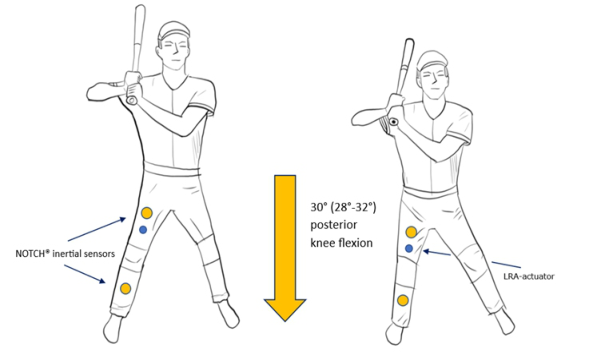
Figure 1 illustrates the intervention. The vertical flexion of the knee is assessed using NOTCH® to measure the intervention. The intervention will be considered complete when the participant can remain still within the des- ignated zone. The time it takes the participant to move from the neutral position to the zone is recorded. The angle at which the participant completes the intervention is used as evidence of success.
Figure 1: Intervention and material positioning.
Vibrotactile Feedback Application for Correcting and Guiding Posterior Knee Flexion 5
MATERIALS
Sensors and Software This study utilized NOTCH® inertial sensors and wearNOTCH® (Notch Interfaces Inc., USA) supporting software to measure slow, non-complex movements for scientific research. The NOTCH® application on an iPad provided real-time angle tracking, connected via Bluetooth at a 40Hz data transfer rate to the NOTCH® inertial sensors. The sensors are placed as shown on the wearNOTCH® application: halfway up the thigh and halfway down the shin, as shown in Figure 1. The IMUs have an accuracy of 2
for yaw, pitch, and roll rotations. optimizing the accuracy of the entire sys- tem is done by considering maintaining a steady pose, ensuring a tight fit of the sensors during measurements, and avoiding environmental magnetic interference.
Vibrotactile Feedback Vibrotactile feedback is provided by two LRA actuators, as vibrations per- pendicular to the skin propagate faster and are more perceptible on the user’s skin (Azadi and Jones, 2014; Texas Instruments, 2013). The feedback itself is provided by a coach who has completed a training session, reading the angles on the iPad screen using a circuit board and pushbuttons to control the vibro- tactile stimulations. A push metaphor was chosen as the vibration metaphor, meaning that the participant moves away from the vibrations. According to a preliminary study (n = 4) with three VTF intervention points and ten repeti- tions per intervention, using the push metaphor is on average 23% faster than using the pull metaphor. The vibration is delivered in a staggered manner, as staggered vibrations are better perceived than continuous vibrations (Demir- can et al., 2020). This study used vibrations below 5 Hz to avoid potential pain and other effects that could impact the test results (Sá-Caputo et al., 2018). The actuators are placed approximately 15 cm above the kneecap, on both the front and back of the thigh, as shown in Figure 1.
Auditory Feedback The independent coach provided auditory feedback to the participant, using the words ‘down’ and ‘up’ for larger adjustments and ‘bit down’ and ‘bit up’ for smaller adjustments when the participant was close to the correct angle.
Timing The time it takes the participant to move to the desired loading position was recorded using a stopwatch.
RESULTS
Effectivity When comparing the effectiveness of the two feedback methods, it can be seen that in both modalities the optimal angle interval was achieved 100% of the time (28-32
). From this data, we cannot demonstrate significance
between the two modalities. Both methods are suitable for providing feed- back on posterior knee flexion when correcting a correct loading position. To address the difference between the two feedback methods, the efficiency of the feedback methods will be examinated.
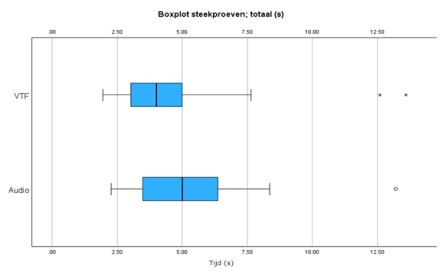
Efficiency In total, 60 pairs of results, 120 datapoints were conducted. A normality test showed that these results are normally distributed. Table 1 shows the paired samples statistics. The mean for auditory feedback over all 60 repetitions is 5.22 seconds with a standard deviation of ± 1.99 seconds. The sample of VTF has a mean of 4.33 seconds with a standard deviation of ± 2.09 seconds as shown in figure 2. The difference between the two samples is 0.89 seconds, representing 16.99% in favor of VTF.
Table 1. Paired samples statistics: Paired samples statistics: mean of auditory feedback is 5.22 seconds with a standard deviation of ± 1.99 seconds. The mean sample of VTF is 4.33 seconds with a standard deviation of ± 2.09 seconds.
Table available in the original PDF paper.
Paired Samples Test Paired Differences Significance
95 % Confidence interval of the Difference Lower Upper t df One-Sided p Two-Sided p
The two-sided t-test results indicate a significant difference between the two samples (p = 0.019), as shown in Table 1. Therefore, we reject the null hypothesis that both samples are equal and conclude that there is a signif- icant difference between them. To determine which feedback method has a significantly higher mean, we compare the one-tailed t-test results with the means. We conclude that the auditory feedback mean (5.22 ± 1.98s) is sig- nificantly higher than the VTF mean (4.33 ± 2.09s) (p = 0.01); d = 0.31, indicating a small effect (Lakens, 2013). Looking at the correlation between the two samples, we argue that there is a low correlation between the two samples with a correlation coefficient of 0.013.
Descriptive Results The results are intended to provide additional observations of the samples. They do not reject or accept the null hypothesis:
Out of the 12 participants, the VTF system helped 10 to adopt the correct posture faster than auditory feedback. For eight participants, the VTF system was more than 20% faster. Only two subjects showed faster results using auditory feedback (subject 5: 1.21 seconds (19.21%) and subject 8: 0.14 seconds (3.93%)). Subject 1 showed the largest average difference between the two modalities: VTF was on average 1.86 seconds faster than auditory feedback, representing a 36.21% advantage over auditory feedback. These data can be found in Table 2.
Vibrotactile Feedback Application for Correcting and Guiding Posterior Knee Flexion 7
Figure 2: Boxplot VTF and audio total results: Two feedback modalities on the vertical axes, time (s) on the horizontal axes.Table 2. Participants means and the difference in means in seconds and as a percentage.
Objective Observations The following participant observations are presented in numerical order. Only notable observations are included, whereas the remaining results may be considered ‘normal’.
In the first two trials participant 2 had difficulty with the auditory feed- back. In the first trial it appeared that the participant got the correct posture by chance. Subsequently the responses were smoother. There was no impair- ment in the VTF. Participant 5 responded jerkily to both feedback methods. Participant 5 responded with very large fluctuations to auditory feedback. Responses to VTF impulses were less jerky but rather expectant, requiring several vibration impulses before eliciting a response. During Test 4 of the VTF, the participant made an incorrect response to the vibrating stimulus. at too large an angle (40
), moving downwards instead of upwards in response
to the signal given to move upwards (vibration at the lower leg). The par- ticipant immediately noticed and corrected the error. Throughout the study, this was the only incorrect response to a VTF stimulus. An explanation for this can be found in the discussion. Participant 6 used fluid and non-phasic movements in response to both types of feedback. When in the no-feedback zone, the participant tended to move upwards. Prior to the study, partici- pant 8 reported regular knee pain. However, little or nothing of this was observed while testing. Participant 11 provided brief responses during the adjustments. Observations indicated that participant 11 responded fastest to the VTF stimuli. However, this did not result in the fastest average.
DISCUSSION
The vibration frequency can have different effects on the results, as stated in the methodology (Sá-Caputo et al., 2018). The chosen frequency of less than 5Hz had no effect on the results. In addition, none of the participants reported any pain or discomfort related to the vibration during the tests.
For participants 5 and 8, auditory feedback led to faster results than VTF (19.21% and 3.93%). The results of both participants, particularly partici- pant 5, affect the overall sample mean of VTF. Participant 5 reported feeling tired during the tests. This could be a reason for the results being so far out of line with (12.6 and 13.6 seconds) the other results, as well as the fact that participant 5 was the only one to respond incorrectly to the vibrotactile stimuli. The responses to both feedback methods were very jerky and not incremental as during the short training period prior to the study. We could tentatively argue that when a person is fatigued, it is more difficult to learn new postural feedback methods and one is more likely to fall back on the existing feedback method. A notable fact is that participant 5 set the fastest time (1.95 seconds) as the last test (VTF). This suggests that the VTF system would be more efficient than auditory feedback after five repetitions.
Participant 8 had reported before the study that he experienced occasional discomfort with the right knee. During the study, participant 8 reported “no discomfort”, which does not completely rule out the possibility that the con- dition of the knee may have influenced the final results. On the other hand, participant 11 also reported regular knee discomfort, but there is no evi- dence of this during the tests and in the results. On top of that participant 11 reported to be confident doing this intervention with his knee problems, “because it as a controlled and guided exercise”.
Disregarding the results of participants 5 and 8, we can say that VTF guided participants to correct posture 1.19 seconds or 22.84% more effi- ciently than auditory feedback (VTF: 5.27 seconds; auditory feedback: 4.08 seconds).
Participant 6 moved very dynamically and tended to move upwards while maintaining the correct position for the first 3 VTF trials. Remarkably, par- ticipant 6 received auditory feedback before VTF. The participant himself reported that he did not notice anything about this fact. In the last 2 VTF tests participant 6 responded smoothly to the vibration impulses, which also recorded faster results.
Vibrotactile Feedback Application for Correcting and Guiding Posterior Knee Flexion 9
All participants responded to the feedback methods in their own way. It is worth noting that all participants first spent 5 minutes practicing responding to the VTF stimuli. This gives an insight into each person’s perception and response to the new vibrotactile stimuli. In general, we can say that vibro- tactile feedback made participants more aware of the lying position than auditory feedback. Participants reported being more aware of their body position during the loading phase with VTF. In addition to this, in all cases the VTF was preferred as a feedback method because the VTF was subjectively perceived to guide the participant in a better way.
Current limitations This study is exploratory in nature. Therefore, the study design is not fully optimized. A logical next step in this area of research would be to conduct a follow-up study according to the guidelines outlined in Wuestefeld et al (2020).
The study’s results indicate that the samples are representative of the gen- eral population, but extreme values, such as those of participant 5, have a significant impact on the sample means. It is important to note that the study’s sample size is limited, and increasing the number of participants could result in a narrower range of results. The discussion section addressed the potential causes and consequences of the maximum values.
However, due to the limited number of replications per participant, this study was unable to demonstrate a significant difference between the two feedback methods per participant. A follow-up study with a higher number of replications per participant could provide more conclusive results. It is worth noting that a learning effect may occur after a certain number of replications, so alternative protocols should be considered. A follow-up study with a larger number of participants should also be considered as addressed above.
CONCLUSION
This paper describes an innovative low-cost VTF system using two NOTCH® inertial sensors and two LRA actuators. The system can be used to control and guide rear knee flexion during the loading phase of a baseball swing. It can be used by a coach or fellow player, making feedback individ- ually applicable. The system is easy to use and compatible with the current NOTCH® Pioneer application.
It can be concluded that the new VTF system is significantly more efficient than auditory feedback in guiding participants to correct posture (p = 0.01). On average, VTF is 16.99% or 0.89 seconds more efficient than the cur- rent feedback method (auditory feedback) in the control and guidance of posterior knee flexion to achieve an optimal load position during a base- ball swing. For ten out of twelve participants, VTF was more effective in getting them into proper postural alignment. In particular, for eight partici- pants, the VTF system was more than 20% faster. At maximum efficiency, the VTF system was 36% more efficient than the current auditory feedback. All participants expressed interest in future research and prototypes. This study
demonstrates the novelty of this VTF-application in sports and the opportu- nities in this research area. The functioning of this system opens up many new application possibilities in both baseball and other sports, as well as posture improvement and guidance in general. The results suggest further research and development in the same research area (baseball swing) and even in other sport applications such as golf.
REFERENCES
Azadi, M. and Jones, L. A. (2014) Vibrotactile actuators: Effect of load and body site on performance. 2014 IEEE Haptics Symposium (HAPTICS) [Preprint]. Available from: https://doi.org/10.1109/haptics.2014.6775480. Demircan, E. et al. (2020) Understanding human perception of vibrotactile feedback
in walking and running tasks. Advances in Science, Technology and Engineering Systems Journal, 5(2), pp. 537–544. Available from: https://doi.org/10.25046/aj 050267. DeRenne, C. (1993) High-tech hitting: Science vs. tradition. Fortenbaugh, D. (2011) The Biomechanics of the Baseball Swing. PhD dissertation.
University of Miami. Gray, R. C. (2009) How do batters use visual, auditory, and tactile information about the success of a baseball swing? Research Quarterly for Exercise and Sport, 80(3), pp. 491–501. Available from: https://doi.org/10.1080/02701367. 2009.10599587. Lakens, D. (2013) Calculating and reporting effect sizes to facilitate cumulative sci-
ence: a practical primer for t-tests and ANOVAs. Frontiers in Psychology [online], 4. Available from: https://doi.org/10.3389/fpsyg.2013.00863. Lau, C. and Glossbrenner, A. (1984) The winning hitter: How to play Championship Baseball. Hearst books. Peeters, T. et al. (2020) Vibrotactile feedback for correcting aerodynamic position
of a cyclist. Journal of Sports Sciences, 38(19), pp. 2193–2199. Available from: https://doi.org/10.1080/02640414.2020.1776814. Sá-Caputo, D. C. et al. (2018) Acute Effects of Whole-Body Vibration on the Pain Level, Flexibility, and Cardiovascular Responses in Individuals With Metabolic Syndrome. International Dose-response Society, 16(4), 155932581880213. https: //doi.org/10.1177/1559325818802139 Signore, N. (2020) How to Analyze Baseball Swing Mechanics in 15 Steps. https://ro
cklandpeakperformance.com/15-steps-to-analyzing-baseball-swing-mechanics/ [Accessed 10 December 2023]. Spelmezan, D. et al. (2009) Tactile motion instructions for physical activities. Association for Computing Machinery [Preprint]. Available from: https://doi.org/10. 1145/1518701.1519044. Texas Instruments (2013) Haptics Solutions for ERM and LRA Actuators. Trahan, D. (2009) Back leg and knee must stay flexed in backswing [online]. https://www.swingsurgeon.com/daily-video-tips/back-leg-and-knee-mu st-stay-flexed-backswing (Accessed 28 December 2023). Verwulgen, S. et al. (2017) Accuracy and efficiency Validation of a helmet mounted
vibrotactile feedback system for aerodynamic head position during cycling. Advances in intelligent systems and computing, pp. 85–93. Available from: https: //doi.org/10.1007/978-3-319-60639-2_9.
Vibrotactile Feedback Application for Correcting and Guiding Posterior Knee Flexion 11
Welch, C. M. et al. (1995) Hitting a baseball: A Biomechanical Description. Journal of Orthopaedic & Sports Physical Therapy, 22(5), pp. 193–201. Available from: https://doi.org/10.2519/jospt.1995.22.5.193. Wo´zniak, M. P. et al. (2020) Subtletee: Augmenting posture awareness for begin-
ner golfers. Proceedings of the ACM on Human-computer Interaction, 4(ISS), pp. 1–24. Available from: https://doi.org/10.1145/3427332. Wuestefeld, A. et al. (2020). Towards reporting guidelines of research using wholebody vibration as training or treatment regimen in human subjects—A Delphi consensus study. PLOS ONE, 15(7), e0235905. https://doi.org/10.1371/journal. pone.0235905
LISTED IN THE AHFE DIGITAL BOOKSTORE CATALOGUE
Explore the complete digital volume
Human Factors in Sports, Performance and Wellness
Read this individual research paper free through the original publisher, or explore the full digital proceedings book.
ISBN 978-1-964867-26-7
Explore this ISBN in the AHFE Bookstore ↗Listed in the July 2026 bookstore catalogue; search by ISBN to confirm current availability · Digital book purchase optional