Kwok Tung Hui, Yeok Tatt Cheah, Kit Lun Yick, Ho Ching, Joanne Yip, Sun Pui Ng (2024). Approach for evaluating breast motion for sports bra design. In: Human Factors in Sports, Performance and Wellness. AHFE Open Access, vol. 150, pp. 49–58. https://doi.org/10.54941/ahfe1005289
Traditional studies evaluating breast motion and bra performance have involved human subjects, but maintaining consistent results is challenging due to biomechanical limitations. Therefore, this study proposes an objective and reliable method to ensure consistent testing conditions for evaluating breast motion. This method involves designing a manikin with soft breast prostheses and incorporating with a commercial 6-degree-of-freedom robotic arm. Soft silicone rubber was used for fabrication of artificial breasts. Moreover, the robotic arm can replicate the movement of torso, and the soft breast prostheses can mimic that of female breast. The results show the breast prostheses of manikin close to the human breast in dynamic performance that was validated by the motion capture experiment. This new approach can be used for evaluating the sports bra to compare their supporting level.
A sports bra is an intimate garment to the women. It is one of the most complex engineered sportswear with multi-dimensional intricate construc- tion to achieve the unique fit of the body shape. A sports bra can provide the breast support for stability to reduce the breast movement in high intense exercise since the breast may be devastated or injured by excessive oscilla- tion (McGhee et al., 2013). A research stated that breast discomfort, pain and other injuries to breast tissue may be caused during bra-unsupported activities (Lu et al., 2016). Inappropriate sports bra with low support may cause breast pain and ptosis (Scurr et al., 2011). Thus, sports bras play a cru- cial role for women, offering essential support and ensuring optimal comfort during a wide range of activities, especially those that involve high-intensity movements.
In general, current research evaluate sport bras through subjective meth- ods. Typically the subject walks or runs on a treadmill while wearing the bra,
and then factors like breast movement and the perceived comfort level are assessed (Zhou et al., 2011). However, there are several limitations, namely it is difficult to ensure consistency and repeatability in human subject exper- iments for fair comparison between bras. Recruiting an adequate number of subjects can also be challenging due to variations in body shape, breast size, and health conditions. Personal embarrassment is also a key issue because the subjects should be braless to conduct the experiment.Lastly, even with pre- cise motion capture systems, variations in the movement of human subjects will affect the result of sports bra comparison.
To tackle these shortcomings, a manikin system for evaluating the breast support performance of bras was proposed by Lee et al. (Lee et al., 2021). It is a human-like silicone model with specific vertical motion to replace human participants and provide a gross measure of the breast motion at various bra conditions. Elastomers can undergo significant deformation under force and return to their original shape once the force is removed due to its elasticity and flexibility. Therefore, silicone elastomers Ecoflex 00–30 silicone rubber (Smooth-On, USA) mixed liquid PDMS were employed that their material behaviour, softness, and corresponding breast displacements were verified by human breast motion. Ecoflex 00–30, a platinum-catalysed silicone rubber, has gained significant recognition in the realm of biomedical research (Sparks et al., 2015), specifically for its applications in simulating skin and tissue. This material is renowned for its exceptional flexibility and remarkable elongation properties, positioning it as an excellent choice for replicating the mechanical characteristics of breast tissue. Nevertheless, due to lack of motion simulation technologies, the 6 degrees of freedom movements of the trunk and breasts, and their relationships with other sport activities have been largely neglected.
Industrial robotic arms have been widely used in various industries for their precision, efficiency, and ability to manage complex tasks. These mechanical marvels can tirelessly manage a multitude of industry tasks such as welding, assembly, and pick and place. This not only reduces the need for human labour, but also significantly cuts down production time and enhances quality. In the healthcare sector, given that surgical procedures require high precision and performance control, robotic arms have proven invaluable to meet the specific user requirements for optimal performance. The versatility of robotic arms can also be extended to personal use by patients with limited mobility.
This study therefore proposes the use of a robotic manipulator to replace the specific motion simulation device. It is anticipated that the versatil- ity of robots can readily replicate the varying body motion during sports activities in an objective and reliable manner. A medium-sized robotic arm, offering both long reach and high payload with the six degrees of free- dom, is integrated with the Vicon motion capture system (Vicon, UK). This allows the robotic arm to precisely simulate the 3D motion of human body in a continuous repeatable motion, mirroring the movements of human subjects during running. This setup enables an objective assess- ment and comparison of body and breast displacements under different bra conditions.
Approach for Evaluating Breast Motion for Sports Bra Design 51
MATERIALS AND METHOD Participant
A young woman (31 years old) was invited to conduct breast motion cap- ture experiment. The female participant had a body mass of 67 kg and a height of 1.68 m. Her under-bust measurement and full bust measurement was 79 cm and 94 cm, respectively, that indicates a UK bra size of 36C or an Asian bra size of 80C. She had not been pregnant, breastfed, or under- gone any breast surgery. Additionally, she kept a consistent exercise schedule every week, which included high intensity running. Ethics approval (ref. No. HSEARS20210305003) was obtained from the Human Ethics Committee of the Hong Kong Polytechnic University.
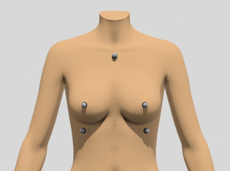
Acquiring Running Movement From the Participant Using a Motion Capture System During the in-vivo motion capture experiment, the female participant wear- ing a soft bra was instructed to run on a treadmill (FR20 Floatride, Reebok, USA). Soft bra provides minimal support for breasts preventing discomfort during high-speed running. A total of five reflective markers in diameter of 14mm were affixed to the skin surface of the participant. Key landmarks are the nipple points (LNIP & RNIP) of the participant. Supplementary land- marks were placed on the clavicle (CLAV), 10th left rib (LC1), and 10th right rib (RC1) to serve as reference points shown in Figure 1. These markers (CLAV, LC1, and RC1), formed a triangular plane, which played a signifi- cant role to mimic trunk movements by robot and facilitating the calculation of relative nipple displacement. The participant was asked to run on the treadmill at 8km/h and the motion was captured by motion cameras.
The treadmill was positioned at the centre of the Mocap laboratory sur- rounding by the motion cameras. A total of eight Vicon Vantage cameras were evenly mounted on the walls and three Vicon Vero cameras were positioned in front of the treadmill. The Vantage cameras and Vero cameras, calibrated to a sample rate of 100 Hz, were used to track the trajectory of these mark- ers in the X, Y, and Z directions. A 30-second segment of clean running data was recorded from a human subject, which subsequently underwent marker labelling and noise filtering for processing the motion data in Vicon Nexus 2.12 software. The resulting three-dimensional data was then exported as reference used for toros motion simulation by 6-DOF robotic arm.
Figure 1: Reflective markers positions on human subject.
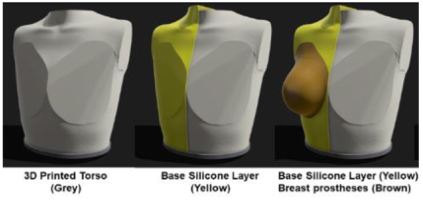
Mechanical Properties of Silicone Mixture An artificial torso model made of 3D printing technology and two breast prostheses were fabricated as seen in Figure 2. To mimic the breast soft tis- sues, Ecoflex 00–30 liquid silicone rubber and XIAMETER™PMX-200 Silicone Fluid 50 cSt were used. To achieve the stiffness of the female breast and mimic their self-deformation, silicone fluid was blended with Ecoflex 00–30 silicone rubber in specific proportions. Ecoflex series is a two-part liq- uid component silicone rubber, the mixing ratio of Ecoflex 00–30 suggested by manufacturer is 1:1 (part A and part B). In this study, silicone mixtures were fabricated by mixing Ecoflex 00–30 and silicone fluid in four specific ratios of 1:1:2, 1:1:4, 1:1:6, and 1:1:8. The specimens were abbreviated as 112, 114, 116, and 118. Their density and compressive Young’s modulus were measured and compared to that of the breast soft tissue in previous literature. The most desirable silicone mixture will be selected for making breast prostheses and its dynamic behaviours will be evaluated by the motion capture system.
Figure 2: Illustration of manikin with deformable breast prostheses.
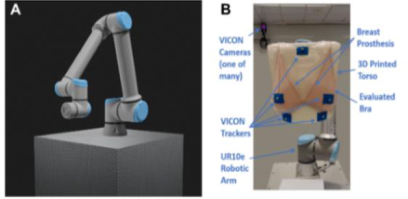
Motion Simulation of Torso by Robotic Arm As shown in Figure 3(A), an UR10e model from Universal Robots e-Series is employed. The upper torso movement is extrapolated from the position of motion capture markers on the clavicle (C) and the first left and right rib bones (A, B). Two more motion capture markers are used for evaluating the motion of the breasts (LNIP, RNIP). We define the reference frame for the upper torso with the x-axis pointing along AB, z-axis pointing from the midpoint of AB to C, and y-axis being the cross product of z-axis and x-axis. Unit vectors along the axes can be found through the following
cbz =
CCD ||CCD||,cbx =
CCB ||CCB||,cby = cbz = × cbx The three unit-vectors are concatenated together to form the rotation matrix that describes the pose of the upper torso
[Equation or mathematical symbol available in the original paper PDF]
Equation reproduced from the original PDF.
cbx1 cby1 cbz1 cx2 cby2 cbz2 cbx3 cby3 cbz3
Approach for Evaluating Breast Motion for Sports Bra Design 53
Equation reproduced from the original PDF.Equation reproduced from the original PDF.
xp, yp, zp
qr, qi, qj, qk
T. During the motion capture process, the subject’s position may drift slightly across the area of the treadmill. However, the robot has a limited working envelope. Hence, the extracted pose rp was first filtered by using a high-pass filter at 3Hz. We use the inverse kinematic solution from the Robotic Toolbox for Python (Corke and Haviland, 2021), and the resulting trajectory is validated in CoppeliaSim (Rohmer et al., 2013) and URSim from Universal Robots. The home pose selected is at [−0.5,0,0.5] and Euler rotation of [0,0,π] from the robot base. We control the real robotic arm using MATLAB and the Univer- sal Robots UR Series Manipulators Support from Robotics System Toolbox, running ROS Melodic and Ubuntu 18.04.
The movement of manikin including rigid torso and soft breast were recorded by the Vicon motion cameras with sample rate of one hundred frames per second. The validation of marker trajectory between human breast and breast prostheses will be assessed after finished data processing. These assessments encompassed measurements captured along the X, Y, and Z axes.
Figure 3: (A) An UR10e model of robotic arm. (B) Markers position, soft breast manikin with robot, and camera setup.
RESULTS AND DISCUSSION
Mechanical Properties of Silicone Mixtures The compression test was performed in accordance with the ASTM D575- 91 test standard, wherein compression pressure was applied to a cylindrical specimen. The specified dimensions for the compression test samples were a diameter of 28.6±0.1mm and a thickness of 12.5±0.5mm. These cylindrical samples were fabricated using the acrylic mould to ensure precise dimensions and uniformity. The testing procedure was conducted using a universal testing machine (Instron 5566, USA), equipped with a 50N load cell to measure the force exerted on the samples.
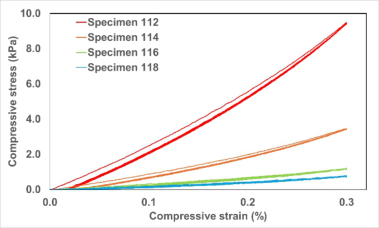
Figure 4 shows the typical stress-strain curve of four specimens subjected to ten cycles of compression. The results indicated that the specimens exhib- ited very similar deformation trends. They deformed easily, with the curves appearing almost linear below 10% strain. The slopes of all specimens showed a slight increase from 15% strain onward. This suggests that their deformation is not directly proportional to the applied load, resulting in a
non-linear curve during compression. It is also noted that the unloading paths of the four specimens did not coincide with their respective loading path, indi- cating the amount of energy dissipated within the material due to internal friction and other inelastic processes during cyclic compressive loading.
Figure 4: The compressive loading-unloading curves of four specimens after 10 cycles.
The hysteresis effect observed in the stress-strain curves of silicone mix- tures was minimal, indicating high material efficiency with negligible energy loss upon compression. The material’s behaviour, as depicted by the stress- strain curve, was close to linear during compression at small strains (10%), with stress increasing gradually at higher strains. This phenomenon can be attributed to the viscoelastic behaviour that occurs when the load- unload curve deviates from its expected path (Fung, 1993). The viscoelastic behaviours of the specimens make them suitable candidates for the fabrica- tion of breast prostheses with adequate deformation and bouncing during motion. The compressive strength of the silicone mixtures shows that a very low pressure is required to compress the sample thickness by one-third (see Figure 4). Moreover, the slope of the loading curves decreases as the weight ratio of silicone fluid increased. Overall, the four specimens were extremely soft and could be easily compressed by low pressure. This property allows for the simulation of the mechanical behaviour of breast tissue, which is also easily deformable under its own weight.
The elastic modulus and density of the silicone samples are presented in Table 1. The elastic modulus, a measure of stiffness, is one of the moduli of elasticity commonly used to characterize the stiffness of soft materials. The elastic modulus of the silicone mixtures was measured by using an indenta- tion test, which was conducted on Instron 5566, equipped with a load cell of 50N. The silicone mixture samples had a diameter of 100mm, with a thick- ness equal to one-fourth of the diameter. A rigid cylindrical indenter with a diameter of 5mm was used. The compression depth was set at 10% strain. The elastic modulus was calculated by using the equation (Krouskop et al., 1998). This modeled equation was validated by testing cylindrical gel samples as documented in the literature.
Equation reproduced from the original PDF.
1 −v2 qa w (1)
Approach for Evaluating Breast Motion for Sports Bra Design 55
where E is the elastic modulus; q is the stress; a is the radius of the loaded area; w is the maximum displacement in loading and v is the Poisson’s ratio. Silicone is assumed to be incompressible with an approximate Poisson’s ratio v = 1/2.
Table 1. Elastic modulus and density of silicone mixtures.
As the stiffness of breast tissue could not be obtained directly from our par- ticipant, the mechanical properties are referred to related clinical literatures. The elastic modulus of breast tissue has been extensively documented in vari- ous testing techniques, both in vivo and ex vivo settings (Ramiao et al., 2016). Factors such as age, test method, experimental conditions, and preload level can influence the stiffness of breast tissue. Consequently, the elastic modulus of normal breast tissue varies widely between normal fatty tissue and normal glandular tissue. There is no universally accepted standard value for the elas- tic modulus of soft breast tissues. Nevertheless, the Young’s modulus of the breast tissues is highly dependent on the preload level of compression. Ex vivo breast tissue tends to exhibit a higher Young’s modulus at high preload strains or stresses (Umemoto et al., 2014). Conversely, in vivo breast tissue, tested under small preload conditions, can have a very low Young’s modulus, which may even lower than 1kPa, as measured by in vivo magnetic resonance elas- tography without compression (Chen et al., 2013). Comparative studies of Young’s modulus values for both ex vivo and in vivo breast tissues show that the Young’s modulus of ex vivo fibroglandular tissue is measured at 3.24 kPa (Samani et al., 2007), while in vivo fibroglandular tissue has been reported at 3.04 kPa (Briot et al., 2022). The Young’s modulus of specimen 116 was therefore selected for fabricating breast prostheses in this study to compare with the mechanical properties of the tissues from recruited participant.
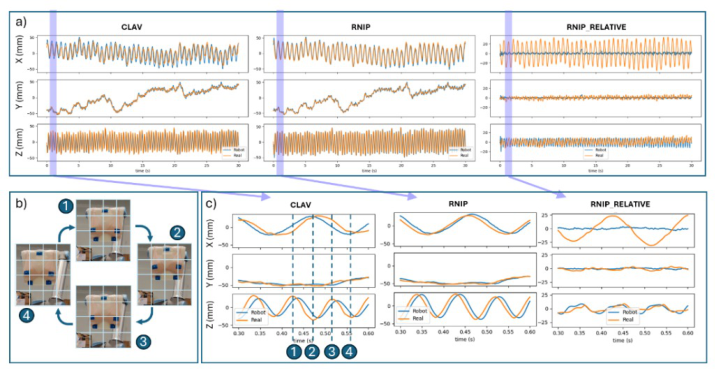
Nipple Marker Comparison Between Human and Manikin Breast prostheses composed of specimen 116 were utilized for comparison with the human breast. To validate the dynamic behaviours of breast pros- theses in comparison to that of the human subject, the nipple markers on the manikin and the human breast were compared. It is noted that the low- frequency components of the Y-direction of markers was not considered for comparison, as the robot’s motion in the Y-direction was eliminated for robotic workspace reasons. Given that the breasts of manikin are symmet- rical, the comparison was conducted on the right breast only. The marker locations and coordinates of the human subject and the robot were com- pared. The clavicle marker (CLAV), which was mounted on a rigid part of the manikin, and the right nipple marker on the deformable breast prosthesis,
were compared to the human breast by using a motion capture experiment. The error and similarity of the fabricated breast and the human breast were calculated and presented in Table 2. Although the markers exhibited very similar motions, the motion of the breasts may be influenced by several fac- tors, including the amplitude of the general locus of the motion, the recreation of finer motion details, and the phase shift between the robot’s and the human subject’s motion. These differences may arise from variations in damping, elasticity, or viscosity due to material and structural differences. We also per- form cross correlation between the robot and human motions and choose the peak as the phase difference as a function of time. The frequency of the sig- nals is estimated by finding the peak of the respective signals in the frequency domain through a fast Fourier transform. We can then normalize the phase difference according to the frequency to obtain phase shift. The errors are quantified in terms of phase shift and the amplitude’s mean absolute error (MAE) and root mean square error (RMSE).
Figure 5: Experimental results comparing human and robot marker motions. (A) shows the 30 seconds of cyclic motion visualized, (B) and (C) shows a 0.3 second segment of the exercise, illustrating the position of the torso in the x, y, and z axes during the cyclic motion.
Results showed that the motions of the nipple marker between the robot and the human subject is very similar, capturing even small details in the z-axis of the relative nipple motion (Figure 5). These small details are high- frequency and therefore high acceleration motions of the breasts at the extremities of the motion, which are key criteria when evaluating the effec- tiveness of bras. We also note that after matching the phase difference of the relative nipple motion on the z-axis, the relative nipple motion on the x-axis still differs by a significant margin. This may indicate need for future research regarding direction-specific elasticity and damping of breasts, which are beyond the scope of this study.
Approach for Evaluating Breast Motion for Sports Bra Design 57
Table 2. Experiment results between human and robot markers.
Table available in the original PDF paper.
CLAV RNIP
X Y Z X Y Z MAE (mm) 12.79 3.90 13.64 6.71 2.88 13.56 RMSE (mm) 14.74 4.63 15.60 7.67 3.50 15.21 Phase shift (rad) 0.79 0 −0.79 −0.35 −0.01 −0.70
CONCLUSION
In this paper, a new objective approach to evaluate the bra performance that can serve as a substitute for human subjects was developed. This approach involves a physical device consisting of a manikin with soft silicone breasts and a robot. The breast prostheses made from soft silicone are designed to simulate the deformation and movement of human breast. The stiffness of the artificial breast is like that of human breast tissue, as referenced in the literature, and the dynamic behaviours of the artificial breasts closely approx- imates that of the human breast, as validated by motion capture experiment. A limitation in this study is that the breast prostheses were validated with only one female subject, meaning the prostheses can currently only be considered for subject-specific studies.
ACKNOWLEDGMENT
We acknowledge financial support from the Laboratory for Artificial Intel- ligence in Design (Project: RP1-2), Innovation and Technology Fund, Hong Kong and The Hong Kong Polytechnic University (WZ21) for funding this research project.
REFERENCES
Briot, N., Chagnon, G., Connesson, N. & Payan, Y. (2022). In vivo measurement of breast tissues stiffness using a light aspiration device. Clin Biomech (Bristol, Avon), 99, 105743. Chen, J., Brandt, K., Ghosh, K., Grimm, R. C., Glaser, K. J., Kugel, J. & Ehman, R.
(2013) “Non compressive MR elastography of breasts”, Proceedings of the inter- national society for magnetic resonance in medicine. International Society for Magnetic Resonance in Medicine, Salt Lake City, USA. Corke, P. & Haviland, J. (2021) “Not your grandmother’s toolbox–the robotics toolbox reinvented for python”, 2021 IEEE international conference on robotics and automation (ICRA). Fung, Y. C. (1993). Biomechanics: Mechanical properties of living tissues, New York,
Springer-Verlag. Krouskop, T. A., Wheeler, T. M., Kallel, F., Garra, B. S. & Hall, T. (1998). Elastic moduli of breast and prostate tissues under compression. Ultrasonic Imaging, 20, 260–274. Lee, C. W., Yick, K. L., Ng, S. P. & Yip, J. (2021). Analysis of dynamic vertical
breast displacement for the design of seamless moulded bras. Journal of the Textile Institute, 113, 637–646.
Lu, M. Y., Qiu, J. Y., Wang, G. D. & Dai, X. Q. (2016). Mechanical analysis of breast-bra interaction for sports bra design. Materials Today Communications, 6, 28–36. McGhee, D. E., Steele, J. R., Zealey, W. J. & Takacs, G. J. (2013). Bra-breast
forces generated in women with large breasts while standing and during treadmill running: Implications for sports bra design. Appl Ergon, 44, 112–8. Ramiao, N. G., Martins, P. S., Rynkevic, R., Fernandes, A. A., Barroso, M. & Santos, D. C. (2016). Biomechanical properties of breast tissue, a state-of-the-art review. Biomechanics and Modeling in Mechanobiology, 15, 1307–1323. Rohmer, E., Singh, S. P. & Freese, M. (2013) “V-REP: A versatile and scalable robot
simulation framework”, 2013 IEEE/RSJ international conference on intelligent robots and systems. Samani, A., Zubovits, J. & Plewes, D. (2007). Elastic moduli of normal and pathological human breast tissues: An inversion-technique-based investigation of 169 samples. Phys Med Biol, 52, 1565–76. Scurr, J. C., White, J. L. & Hedger, W. (2011). Supported and unsupported breast
displacement in three dimensions across treadmill activity levels. J Sports Sci, 29, 55–61. Sparks, J. L., Vavalle, N. A., Kasting, K. E., Long, B., Tanaka, M. L., Sanger, P. A., Schnell, K. & Conner-Kerr, T. A. (2015). Use of Silicone Materials to Simulate Tissue Biomechanics as Related to Deep Tissue Injury. Advances in Skin & Wound Care, 28, 59–68. Umemoto, T., Ueno, E., Matsumura, T., Yamakawa, M., Bando, H., Mitake, T. &
Shiina, T. (2014). Ex vivo and in vivo assessment of the non-linearity of elasticity properties of breast tissues for quantitative strain elastography. Ultrasound Med Biol, 40, 1755–68. Zhou, J., Yu, W. & Ng, S. P. (2011). Methods of studying breast motion in sports bras: A review. Textile Research Journal, 81, 1234–1248.
LISTED IN THE AHFE DIGITAL BOOKSTORE CATALOGUE
Explore the complete digital volume
Human Factors in Sports, Performance and Wellness
Read this individual research paper free through the original publisher, or explore the full digital proceedings book.
ISBN 978-1-964867-26-7
Explore this ISBN in the AHFE Bookstore ↗Listed in the July 2026 bookstore catalogue; search by ISBN to confirm current availability · Digital book purchase optional