Qi Long Liu, Kit Lun Yick, Kam Ching Chan, Sin Tung Wong, Sun Pui Ng (2022). Sports Bra Pressure: Effect on Core Body Temperature and Comfort Sensation. In: Ergonomics In Design. AHFE Open Access, vol. 47, pp. 627–634. https://doi.org/10.54941/ahfe1001991
Background: Sports bras are engineer designed to enhance sports performance, which means that they need to provide an excellent fit, and offer adequate support and protection of the breasts to optimize their functionality. To effectively reduce breast motion during different intensity levels of exercise, the materials of sports bras are generally rigid which exert compressive forces onto the soft tissues of the breasts. However, these materials may still restrict air flow and inhibit body heat loss, while the pressure from the bra exerted onto the skin may also increases physiological strain and wear discomfort. This excessively high exerted pressure is known to produce an inhibitory effect on the sweating rate and associated with a significant rise in the axillary and core temperatures. This preliminary study therefore investigates the influence of bra pressure on the upper body temperature and thermal comfort following a short duration of treadmill running. Objective: The purpose of this study is to investigate the effect of increased bra pressure on thermal response following exercise. The findings provide bra designers with insight into bra pressure and related bra design features necessary for optimal wear comfort during physical activities. Methods: A total of 12 young women have participated in this study to don a changeable sports bra that allows adjustment of tension or replacement of the bra components. The skin and body core temperatures as well as heart rate for four bra conditions during treadmill running for 15 minutes at 8 km/h are recorded by using temperature and heart rate sensors. The subjectively perceived thermal and pressure comfort are evaluated by using a visual analog scale with ratings of 1 to 10.Results: Following exercise, there is no change in core temperature for all of the bra conditions studied. Even though the body core temperature may increase due to the higher rate of heat production with muscular work done during treadmill running, the increase in heat dissipation tends to balance the increase in rate of metabolic heat production to maintain a stable core temperature. After a short duration of treadmill running, the change in skin temperature ranges from 0.22oC to 3.56oC amongst the 4 bra conditions. The shoulder strap area shows a slight change in skin temperature during exercise, and the participants are particularly sensitive to the increased pressure in this area, thus adversely affecting their ratings of the thermal and pressure comfort. Conclusion: In this study, the increased bra pressure does not show significant change in core temperature and heart rate during short duration exercise. Even though the results are not statistically significant, the shoulder strap pressure is found to be related to the changes in skin temperature and subjective ratings of thermal and pressure comfort.
The current growing concerns around health and fitness have given activew- ear an important boost in popularity globally. The shift to use of activewear for sports and athleisure wear during everyday activities, however, has further changed expectations around wear comfort and garment functionality. Acti- vewear and athleisure wear designs are not merely fashionable or indicative of an active lifestyle, but designed for performance enhancement, and therefore should offer exceptional fit and support for optimal garment functionality. By using advanced materials and non-traditional assembly technologies, ath- leisure wear and activewear designs today can provide different levels of support, protection from injuries and many end-uses. With increased demand for innovative designs and wear comfort, the global activewear market is anticipated to reach US$423 billion by 2026 (Statista, 2020).
As a utility apparel for fitness-conscious women, sports bras are one of the key products in activewear, and anatomically engineer designed to sup- port the breasts and allow physical freedom during physical activities. Since the structure of the breasts provides little anatomical support, breast motion (induced by torso movement) causes the skin to stretch and the breasts show viscous damping and hyper-elastic behaviours. Bras are therefore designed to protect the structure of the breasts and reduce the risk of sagging, thus incre- asing confidence and improving sports performance (Starr et al. 2005, Page and Steele, 1999, White et al. 2009). To control excessive breast movement and related exercise-induced breast discomfort, compression sports bras are often worn, but they consist of rigid bra cups that uniformly flatten the two breasts together against the chest wall. The shoulder straps of the bras are often tight, and together, the bra cups and shoulder straps inevitably induce a high level pressure onto the body, which interferes with breathing, blood circulation and lymph flow with reinforced motion during high intensity exe- rcises. Previous studies have suggested that the acceptable range of pressure is 1.5 to 3.2 kPa when designing a sports bra. Local laboratory studies (Zhang et al. 2021, Liang et al. 2019) however, have shown that compression sports bras exert an extraordinarily high magnitude of pressure of 4.5-7.3 kPa at the underband and shoulder straps, which is associated with wear discomfort, stress or health disorders.
When sports bras are tightly worn on the chest, the exchange of air beneath the clothing with the environment is greatly reduced, which negatively affects thermoregulation and thermal comfort (Havenith and Holmer, 2002, Ayres et al. 2013, Leung et al. 2021). Sports bras may prevent the body from redu- cing the skin temperature via sweat evaporation, and reduce heat transfer. The literature has indicated that during resting, the body maintains a con- stant core temperature of about 37oC regardless of the external conditions due to the balance between metabolic heat production and heat dissipation to the environment (Tanda, 2018). At the onset of exercise, the increase of blood flow to oxygenate the active muscles leads to a reduction of the cuta- neous blood flow. When the body is exposed to a cooler environment, the skin vasoconstriction induces a reduction in the skin temperature. As exe- rcise progresses, heat accumulates in the body due to the intense metabolic
Sports Bra Pressure: Effect on Core Body Temperature and Comfort Sensation 629
heat production with a consequent increase in core temperature. The increa- sed internal body temperature leads to the body thermoregulation mechanism that activates heat dissipation by increasing blood flow to the skin and even initiating sweating. The skin temperature therefore increases with decreases in the core temperature. Nevertheless, the multiple layers of materials used in protective garments and prostheses have proven to restrict air flow and inhibit body heat loss. Mastectomy bras, for example, have shown to greatly prevent heat dissipation thus resulting in increased core body temperature during physical activities. Despite the popularity of sports bras, the choice of materials and the level of compression used in current designs are largely empirical and rely on costly trials and errors. The ambiguity in the evalua- tion of thermal responses to bra designs and pressure has led to inconclusive results, which have brought about significant challenges in advancing sports bra design processes. The purpose of this study is to therefore investigate the effect of increased bra pressure on the thermal response of the body follow- ing exercise. The findings provide bra designers with insight into bra pressure and related bra design features necessary for optimal wear comfort during physical activities.
EXPERIMENTAL Participants
A total of 12 healthy young women between 22 and 32 years old (mean ± SD: age 26.9 ± 3.8 years old, BMI 22.1 ± 2.0) were recruited for a treadmill run- ning experiment in various bra conditions. The event was promoted through posters and e-flyers. Their bra size is either a 75B or 75C, with a mean bust and underband circumference of 88.9 cm and 74.7 cm respectively. The subjects exercised a minimum of 3 hours per week throughout the past 6 months. Given that breast surgery could affect the natural breast shape, those who have had breast surgery were excluded. Ethics approval (ref. NO. HSEARS20210305003) was obtained from the Human Ethics Committee of the Hong Kong Polytechnic University. The subjects were informed of the experimental procedure, possible consequences and the purpose of collecting the experimental data. Written informed consent was obtained before the subjects participated in the experiment.
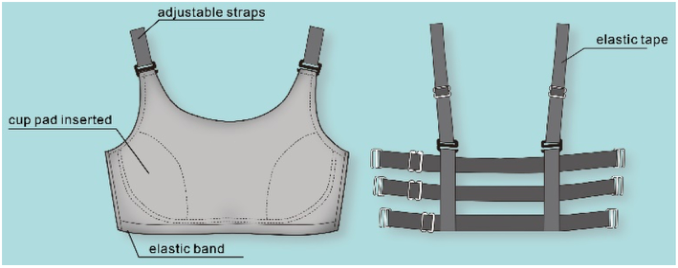
Changeable Bra Design A changeable sports bra design (Figure 1) that allows adjustment of tension or replacement of the shoulder straps in a flexible manner was used for the experiment (Lee et al. 2020). The length of the shoulder straps and bra band could also be adjusted by using the sliders during the experiment so that the effect of the bra tension and pressure on the thermal responses during exercise can be systematically evaluated.
By using the changeable sports bra, the bra conditions in this study include: an optimum fit (Condition A), a 15% reduction of the underband lengths (Condition B), a 15% reduction of the shoulder strap lengths (Condition C),
Figure 1: Changeable sports bra design.
and a cushioning shoulder strap design (Condition D). To obtain an appro- priate fit for Condition A, the recommended length of the underband should have an ease of 10 cm for an underbust girth of 75 cm (Shin, 2007). With the help of a professional bra fitter, the optimal shoulder strap length based on a fit trial was identified for a tailored fit. The Novel Pliance-X® pressure system, which has been validated for measuring interfacial pressure exerted by garments onto the soft tissues of the body, was used to measure the bra- skin pressure by placing the sensor between the skin and the bra components (Lee et al. 2020). The strip sensor used is 10 mm in diameter and 0.95 mm in thickness. Bra pressure at underband, shoulder strap and sideseam were measured before exercise.
Experiment Protocol Design The experiment was carried out in a conditioning room for four hours from 12:00 to 16:00 in ambient conditions at a temperature of 22 ± 1°C and humi- dity of 70 ± 5%. During the experiment, all of the participants wore standard cotton shorts. The participants were required to run for 15 min on a treadmill at 8 km/h in each bra condition. The core body temperature (Tc) and skin temperature (Tsk) were used to study their thermoregulation and physiolo- gical responses (Leung et al. 2021). In this study, a non-invasive wearable temperature sensor (greenTEG, UK) is used to continuously monitor the core body and skin temperatures during treadmill running. The heart rate was con- tinuously monitored throughout the experiment by using a heart rate monitor (Polar). The subjectively perceived thermal and pressure were recorded by using a visual analog scale (VAS) based on a Likert scale of 1 to 10.
To reduce fatigue and ensure full recovery, each participant completed one bra condition each time, so that all of the 4 bra conditions were completed within a period of 8-12 days. All subjects were invited to fit Condition A first, and then randomly wore one of the three bra conditions in the follo- wing experiments. Prior to each bra condition, all of the participants were instructed to rest and sit in a relaxed position for around 15 mins to stabilize their Tc and acclimatize (Figure 2). Then, the participants were required to walk at a speed of 5 km/h for 5 mins as a warmup. After that, they ran for 15 mins at a speed of 8 km/h, followed by walking slowly at a speed of 3 km/h
Sports Bra Pressure: Effect on Core Body Temperature and Comfort Sensation 631
Figure 2: Exercise protocol.
Figure available in the original PDF paper.
for 10 mins as active recovery. Finally, 15 mins was given for resting in a sit- ting position as passive recovery, and each bra experiment was 60 minutes in total time.
Statistical Analysis The statistical analysis was processed by using the Statistical Package for the Social Sciences program (SPSS® Statistics 21, IBM® Corporation, New York, USA). A repeated-measures analysis of variance (ANOVA) on all of the bra pressure data was conducted to evaluate the within-subject effect of the 4 bra conditions. A linear regression analysis was conducted to evaluate the effect of the bra conditions on the changes in the core and skin temperatures.
RESULTS AND DISCUSSION
The changes of the interfacial pressure between the bra and body for the four bra conditions and their corresponding VAS scores for subjectively perceived thermal and pressure comfort are presented in Table 1. The results show that the length and material properties of the shoulder straps have a major effect on the value of pressure between the body and bra, which was statistically significant (p>0.05). For Bra Condition A (with appropriate bra fit), the pres- sure measured at the shoulder ranges from 2.89 kPa to 7.7 kPa, with a mean pressure of 4.09 kPa among the 12 female subjects. A shorter length of the shoulder straps (Bra Condition C) leads to increased pressure from the bra onto the body with a mean pressure of 4.67 kPa. Changing the shoulder strap from an elastic material to foam for cushioning purposes (Bra Condition D) results in reduced pressure, with a mean of 3.57 kPa. Surprisingly, a shorter length of the underband does not result in an increase in the pressure from the bra onto the torso. The results indicate that the subjective sensation of the pressure from the bra onto the torso and on the shoulders in the 4 bra con- ditions are somewhat similar. That is, the subjects cannot tell the differences between the 4 bra conditions. A linear relationship can be found between the perceived thermal and pressure comfort for Bra Condition D (cushioning shoulder strap) only, with a correlation coefficient (r2) of 0.74.
As shown in Table 2, at the onset of running, the values of Tc remain at 37.1 ± 0.1 oC in all of the bra conditions. After 5 mins of running, the mean Tc increases slowly at the rate of 0.1% per minute, while the rate of change increases to 0.2% per minute after 10 mins of running. The increase in the rate of change reaches 0.4% per minute at 38.0 ± 0.1 oC at the beginning of the active recovery phase. The rate of increase of Tc steadily declines throu- ghout the slow-walking phase, and the maximum Tc is 38.2 oC. In the final phase in which the subjects are sitting, the mean Tc drops at a rate of 0.1%
Table 1. Interfacial pressure and VAS scores at various bra conditions.
Table available in the original PDF paper.
Condition A Condition B Condition C Condition D (unit: kPa) SS UB UB SS SS
Min Pressure 2.89 2.07 2.04 2.57 2.04 Max Pressure 7.70 5.30 4.98 7.56 5.29 Mean Pressure 4.09 2.82 3.00 4.67 3.57 Thermal VAS score 7.40 7.13 6.93 7.13 Pressure VAS score 7.47 7.33 7.00 7.47
Table 2. Core and skin temperatures in various bra conditions.
Table available in the original PDF paper.
Condition A Condition B Condition C Condition D
Core (Skin) Temperature (oC)
37.1 (31.4) 37.1 (31.8) 37.1 (31.6) 37.1 (31.8)
1st min of running (onset exercise)
38.0 (32.5) 38.1 (33.0) 38.0 (32.4) 38.0 (32.9)
6th min of running 37.3 (31.4) 37.4 (31.8) 37.3 (31.4) 37.2 (31.7) 11th min of running 37.6 (31.9) 37.7 (32.4) 37.6 (31.9) 37.8 (32.3) 15th min of running 37.9 (32.4) 37.9 (32.9) 37.8 (32.3) 37.8 (32.8) 1st min of walking (active recovery) 6th min of walking 38.2 (33.5) 38.2 (34.0) 38.1 (33.4) 38.1 (33.7) 10th min of walking 38.3 (33.6) 38.3 (33.9) 38.2 (33.4) 38.2 (33.7) 1st min of sitting (rest) 38.2 (33.5) 38.2 (33.9) 38.1 (33.4) 38.1 (33.6) 6th min of sitting 38.1 (32.7) 38.0 (33.0) 38.0 (32.5) 38.0 (32.8) 15th min of sitting 37.6 (32.1) 37.5 (32.3) 37.5 (32.0) 37.5 (32.2)
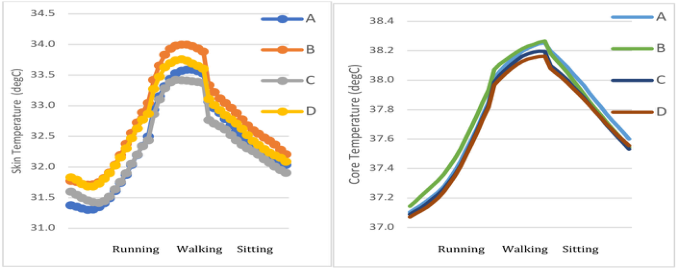
Figure 3: Core and skin temperatures throughout different activities for 4 bra conditions.
per minute until the subject is fully recovered. Regardless of the bra tension or material changes, no significant difference in Tc can be observed amongst the 4 bra conditions throughout the activities in this study.
In view of the Tsk, the initial Tsk of 31.4 oC for Bra Condition A is slightly lower than that of Bra Conditions B, C and D which range from 31.6 oC to 31.8 oC. The Tsk values slightly drop at the onset of running and increase
Sports Bra Pressure: Effect on Core Body Temperature and Comfort Sensation 633
after the first 3-4 mins of running in all of the bra conditions. As explained by Tanda (Tanda, 2018), the large demand for blood flow to oxygenate the active muscles leads to a reduction of cutaneous blood flow. While there is a skin-to-environment temperature difference, skin vasoconstriction causes a skin temperature reduction due to the exposure to a cooler environment. After heat builds up with physical activity, the heat is dissipated through the skin, thus leading to an increase in the skin temperature. Amongst the different bra conditions, the mean Tsk of Bra Condition C increases until the 6th min of running. The Tsk values then increase steadily at an average rate of 0.4% per minute, while Bra Condition B shows the highest rate of change throughout the running phase. The rate of increase reaches 1.3% per minute at the beginning of the active recovery phase. The rate of increase of Tsk drops halfway through the slow-walking phase, with a maximum Tsk of 33.4 (Bra Condition C) to 34.0 oC (Bra Condition B). In the final phase with sitting, the mean Tsk drops at the rate of 0.1-0.3% per minute until the subject is fully recovered.
As shown in Figure 2, the magnitude and rate of change in Tc is relatively small throughout the various phases of the experiment. As compared to Tc, the rate of change in Tsk is high in the running and the recovery phases. The mean rate of change in Tsk for Bra Condition B (shorter length of underband) is higher than that observed for Bra Condition A (optimum fit). Note that Bra Condition C (shorter length of shoulder strap) shows a lower rate of change in Tsk, while the duration of change of Tsk is also shorter than the other bra conditions, thus indicating a quicker recovery in Tsk. Even if the heart rate changes with activity level, no significant difference is observed between the bra conditions. With reference to the VAS scores, the subjectively perceived thermal comfort with Bra Condition C (high pressure exerted onto shoulders) is lower than the other bra conditions studied, even though the results are not statistically significant.
CONCLUSION
The changes in the Tc and Tsk of female subjects for various bra conditions during exercise in an indoor environment have been analyzed in this study. The Tc is relatively stable so that its rate of change during a short duration of treadmill running is small regardless of the different bra tensions and materi- als. The changes in Tsk, Tc, and perceived pressure and thermal comfort are relatively subtle in that the results do not show statistically significant diffe- rences. Nevertheless, the increased tension from the shoulder straps results in skin temperature changes during exercise, while the participants are relati- vely sensitive to the pressure, thus adversely affecting their rated thermal and pressure comfort. Understanding the effects of bra design features on wear comfort and pressure therefore provides bra designers with insight into the material properties and design parameters so that there is less compression.
ACKNOWLEDGMENT
This work is supported by the Innovation and Technology Fund (Project Number: ITS/043/20 and K-ZPCR).
REFERENCES
Ayres, B. White, J. Hedger, W. and Scurr, J. (2013) Female upper body and breast skin temperature and thermal comfort following exercise. Ergonomics, 56(7), p. 1194–1202. Havenith, G., Holmer, I. and Parsons K. (2002) Personal factors in thermal com-
fort assessment: clothing properties and metabolic heat production. Energy and Building, 34, p. 581–591. Lee, C.W. Yick, K.L. Ng S.P. and Yip J. Soft manikin as tool to evaluate bra features and pressure. Int. J. Fashion Design, Technology and Education, 13(2), p. 204–212. Leung, K. Shin, K. Han, F. and Jiao, J. (2021) Ergonomic mastectomy bra design:
effect on core body temperature and thermal comfort performance. Applied Ergonomics, 90, p. 103249. Liang, R.X. Yip, J. Yu, W. Chen, L.H. and Lau N. (2019) Numerical simulation of nonlinear material behaviour: application to sports bra design. Materials and Design, 183, p. 108177. Page, K.A. and Steele J.R. (1999) Breast motion and sports brassiere design. Sports
Medicine, 27(4), p. 205–211. Shin K. (2007) Patternmaking for the underwired bra: New directions. Journal of the Textile Institute, 98(4), p. 301–318. doi:10.1080/00405000701503006 Starr, C. Branson, D. Shehab, R. Farr, C. Ownbey, S. and Swinney, J. (2005) Bio-
mechanical analysis of a prototype sports bra. Journal of Textile and Apparel. Technology and Management, 4(3), 1–14. Statista (2020). Size of the activewear market worldwide from 2020 to 2026. Available online at https://www.statista.com/statistics/613169/size-of-the-global-spo rtswear-market/ Tanda G. (2018) Total body skin temperature of runners during treadmill exercise. J
Therm Anal Calorim, 131, p. 1967–77. White, J.L. Scurr, J.C. and Smith N.A. (2009) The effect of breast support on kinetics during overground running performance. Ergonomics, 52, p. 492–498. Zhang, S.C. Yick, K.L. Yu, W. and Tang, K.P.M. (2021) An understanding of bra
design features to improve bra fit and design for older Chinese women. Textile Research Journal, 91(3-4), p. 406–420.
LISTED IN THE AHFE DIGITAL BOOKSTORE CATALOGUE
Explore the complete digital volume
Ergonomics In Design
Read this individual research paper free through the original publisher, or explore the full digital proceedings book.
ISBN 978-1-958651-23-0
Explore this ISBN in the AHFE Bookstore ↗Listed in the July 2026 bookstore catalogue; search by ISBN to confirm current availability · Digital book purchase optional