Kapo Lee, Joanne Yip, Kit Lun Yick (2022). Investigating the Factors Affecting the Thermal and Tactile Comfort of Summer Undergarments. In: Human Factors for Apparel and Textile Engineering. AHFE Open Access, vol. 32, pp. 46–55. https://doi.org/10.54941/ahfe1001537
Hong Kong is often playfully called the “Frozen City” because the air-conditioning in many buildings operates at frigid temperatures during the summer. However, the large temperature differences between the external and internal environments could cause a large array of illnesses, especially children who are not aware of the temperature changes and are less likely to have self-care ability. Therefore, wearing appropriate undergarments or summer underwear could be one of the solutions. However, there are few studies that have investigated the thermal and tactile comfort of summer underwear. In this study, physical experiments, KES-FB measurements, and a wear trial are done to address the lack of studies. Seven conventional types of materials for undergarments are tested. The results indicate that lighter, thinner, and low stitch density fabrics constructed with uniform filaments increase breathability and enhance moisture wicking. Also, uniform fibres increase the thermal conductivity thus enhancing a cooler feeling. In regards tactile comfort, lighter and thinner materials with a higher percentage of elastane, finer yarn, and uniform and long fibres offer a softer, smoother, and cooler hand feel. In addition, the pure cotton material appears to more regulate body temperature as the resultant undergarment facilitates a higher rate of perspiration despite clinging. These results are a good reference for materials scientists, textile researchers as well as academics to further related research work.
Hong Kong has a sub-tropical climate, which means a hot and humid sum- mer, with mid-day temperatures that could exceed 36°C (Grundy, 2021). Therefore, air conditioners are a main staple to cool the indoor environment, but this could mean a large temperature difference, which would cause a large array of illnesses. This is especially an issue for children who are not aware of the temperature changes and less likely to have self-care ability. To main- tain thermal balance of the body, heat is transferred through perspiration (Qingqing et al., 2020). Therefore, it is important to wear appropriate and comfortable undergarments to regulate body heat and wick moisture effe- ctively, as well as prevent skin irritation. Otherwise, the result may be body odor, clinginess, and an itchy feeling.
Investigating the Factors Affecting the Thermal and Tactile Comfort 47
Thermal comfort is defined as perceived satisfaction with the thermal environment (Rupp et al., 2015). Previous studies have focused on thermal response to garment materials during the winter; for example, Tang et al. (2020) investigated the characteristics and thermal insulation properties of winter apparel for the elderly in China. Shaker (2018) studied the material characteristics of protective clothing for extreme cold weather. However, the literature has neglected the importance of thermal comfort of an undergar- ment for those who frequently alternate between environments with large temperature differences.
The tactile comfort of undergarments also affects consumer purchase intentions because it influences the product quality and the perceived comfort (Atalie et al., 2019). Besides, they are worn to enhance comfort and for hygi- ene purposes (Kar et al., 2011). However, the needs around undergarments could be unique depending on the season. For example, summer undergar- ments should be breathable and wick moisture, while winter inner wear needs to keep the wearer warm. Yet, many researchers focus on the tactile comfort of winter fabrics only. For example, McGregor et al. (2015) investigated the perceived moisture of next-to-skin winter wear, while Speijers et al. (2015) compared the perceived comfort of winter fabrics among Chinese and Austra- lian users. The importance of summer underwear has been largely ignored. To address the absence of such studies, this paper aims to investigate the factors that affect the thermal and tactile comfort of summer undergarments.
MATERIALS AND METHOD Seven conventional types of materials for undergarments were used as the sample, and all are knitted fabrics with a high degree of elasticity. Detailed descriptions are listed in Table 1, which include their fabric structure, areal and stitch densities as well as fabric and yarn thicknesses.
All the specimens were conditioned at a temperature of 20 ± 1°C and relative humidity (RH) of 65 ± 2% for at least 24 hours prior to condu- cting the experiments. Since thermal comfort is very much related to the moisture transport and thermo-regulation of textiles (Erdumlu & Saricam, 2017; Kulichenko, 2005; Lee et al., 2020), air and water vapour permeabi- lity tests (in accordance with ASTM 737 and ASTM E96) were conducted. Moreover, a Thermo Labo II apparatus was used to measure the thermal con- ductivity and the Qmax value (surface cool sensation) of the undergarment samples. In addition, the KES-FB measurement system was used to obtain objective evaluations of the hand feel.
The subject for the preliminary wear trial is a female 10-year-old primary school student with a normal BMI. A temperature logger was placed on her chest to record the RH and temperature of her skin. She was also instru- cted to walk (on a treadmill at 3 km/h and 1% inclination) for an hour and rest alternately between each undergarment sample. The aim is to examine how undergarments influence body temperature regulation under frequen- tly changing temperatures. The trial was conducted in 2 conditioned rooms: (1) 32°C with a RH of 70% to simulate summer outdoor conditions in
Table 1. Specifications of sample undergarments.
Table available in the original PDF paper.
Hong Kong, and (2) 24°C with a RH of 60% to simulate an air-conditioned environment.
RESULTS
In the physical experiments, Sample U2 is the most air permeable with an air resistance of 0.0148 kPa·s/m. Also, U4 and U3 showed the highest water vapor permeability (34.73g/h·m2) and thermal conductivity (0.0578W/(m·K)), respectively. In addition, U1 has the highest Qmax value (0.2486 W/m2). Besides, the tactile comfort values were objectively evalu- ated by using the KES-FB system, which include tensile, shearing, bending, compression, and surface properties tests (see Table 2).
All the samples are soft since their tensile rigidity (LT), is less than 0.6; see Table 2. Among them, U1 is the softest (0.09) material. Also, U3 and U2 have the highest tensile energy (WT; 41.55 gf.cm/cm2) and tensile reco- verability (RT:49.83%), respectively, which means that they are the most stretchable and elastic, respectively. Regardless of whether in the warp or
Investigating the Factors Affecting the Thermal and Tactile Comfort 49
Table 2. KES FB-Auto testing results.
Table available in the original PDF paper.
Table 3. Correlation between wear comfort and various fabric specifications.
Note: *, ** Significant at the 0.05 and 0.01 levels, respectively (2-tailed).
weft direction, U7 has the highest strain rigidity (G), elasticity for minute shear (2HG) and elasticity for minute shear (2HG5), which is in contrast to the results of U1. This means that U7 is more rigid with lower recove- rability compared to U1. Moreover, U7 is the stiffest and the least elastic because it has the highest mean bending rigidity (B; 0.0788 gf.cm2/cm) and bending hysteresis (2HB; 0.1680 gf.cm/cm). In addition, the compressional tests showed that the thinnest fabric, U2, has the highest compression rigi- dity (CL; 0.65), while the thickest fabric, U7, has the highest compression energy (WC; 0.501 gf.cm/cm2); and U5 has the highest compression recove- rability (RC; 56.08%). It appears that the results are correlated with fabric thickness. Moreover, the fabric warp appears to be smoother than the fabric weft because the friction coefficient (MIU), fluctuation of mean friction coef- ficient (MMD) and surface roughness (SMD) in the warp direction mostly have lower values than those in the weft direction. U1 has the smallest MIU (0.1750) and MMD (0.0046), which means that this sample has higher ten- dency to slip and smoothness. On the other hand, U4 has the lowest mean SMD (1.9670 µm), which implies a more even surface.
Table 3 provides the water vapor permeability, tensile, shearing, bending and compression test results and shows that they are influenced by the areal density, and fabric and yarn thicknesses.
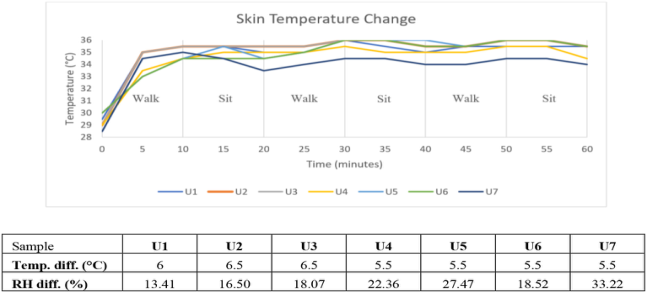
Figure 1: Changes in temperature of skin and RH during wear trial.
In the wear trial, the temperature of the skin immediately increased with the walking task, and then gradually decreased when the subject sat down to rest. The temperature difference of the undergarments before and after the wear trial ranged from 5.5°C to 6.6°C (a 18.3% to 22.4% difference). Among them, U7 facilitated a comparatively lower skin temperature, which was often below 35°C (see Figure 1). In addition, the RH of all the undergar- ments increased dramatically in the first 5 minutes of walking and became relatively stable (all above 90%) after 10 minutes.
DISCUSSION
Thermal comfort The main influential factors of material breathability are fabric porosity, areal density, fabric thickness and yarn properties. Usually, fabrics constructed with a lower stitch density or higher porosity are more permeable because hot air can easily pass through the garments. For example, the pores of U2 which is a mesh fabric (stitch density = 27 x 29) are much larger than those of U3, which is a single jersey fabric (stitch density = 48×38), so the airflow rate is higher. It is thus reasonable that the former has a higher air permeability. This result is supported in Chan (2019) and Yip and Ng (2008), who sugge- sted that fabrics with high porosity have a higher air permeability. Therefore, a lower stitch density can enhance air permeability.
Moreover, active water vapor transmission can enhance thermal comfort during hot summers because perspiration is an effective way to dissipate heat from the body (Lee et al., 2020; Qingqing et al., 2020). On the other hand, poor water vapor transmission causes a clammy and damp feeling due to the trapped heat and water vapor (Lee et al., 2020). The experiment in this study shows that the water vapor transmission is affected by the areal density, and fabric and yarn thicknesses, and their correlation is −0.825 and −0.860, and −0.764, respectively (see Table 3). This means that lighter and thinner fabrics made of finer yarn have better results. For instance, U4, the lightest and the thinnest sample (107 g/m2; 2260 microns), and U7, the heaviest and the thi- ckest sample (182 g/m2; 880 microns) showed the highest and lowest water
Investigating the Factors Affecting the Thermal and Tactile Comfort 51
vapor permeability, respectively. Moreover, yarn characteristics and proper- ties in terms of hairiness and hydrophilic properties respectively are crucial factors too. For example, the yarn hairiness of U7 which is fabricated with pure cotton is much higher than that of U4 which is fabricated with synthetic fibres, so the fibrils may reduce the pores and inhibit moisture transportation. Also, the high-water absorbency of the cotton fibres increases the thickness of the sample after absorbing moisture, which may reduce the pore size and inhibit water vapor transmission. On the other hand, the hydrophobic synth- etic fibres do not absorb much moisture so they would not result in the same degree of thickness as that of the cotton sample. Hence, undergarments made of light and thin synthetic materials which have low hairiness could provide higher water vapor permeability and breathability.
Typically, fabrics with high conductivity conduct heat away from the body to the external environment efficiently and thus imparts a cooling effect (Tong et al., 2015). Making use of high thermal conductivity fibres or coating with metals can improve the thermal conductivity of fabrics. Majumdar (2011) pointed out that this is related to fabric thickness because thicker fabric can trap more still air in the fabric structure. However, this may not be an appro- priate indicator for summer undergarments. For example, even though U3 is a thicker fabric made from thicker yarns, this sample has a higher thermal conductivity than U4, which is a thinner material. The result shows that the significance of thermal conductivity of the fibres. U3 is mainly cotton, while U4 is polyester. The thermal conductivity of the fibres are 0.243 W/(m·K) and 0.157 W/(m·K), respectively (Zhang and Wang, 2020). Moreover, it was found that the samples made from a natural material (cotton) have a higher thermal conductivity than those made from synthetic fibres. The mean values are 0.055 W/(m·K) and 0.040 W/(m·K), respectively. Therefore, it is predicted that undergarments that consist of cotton have a higher thermal conducti- vity than those that consist of pure synthetic fibres. This is also supported by Fujibo Holdings. INC. (2021), who indicated that cotton is the primary mate- rial for providing a cooling feeling in the market. Yip and Ng (2008) made a similar conclusion in that the thermal conductivity of fabrics is affected by the thermal conductivity of the yarns.
Moreover, the main attribute that affects the Qmax value are the material properties in terms of yarn hairiness and fineness, while the minor contributor might be the fabric thickness, which has a correlation coefficient of -0.636 (Table 4). Both Park et al. (2018) and Vivekanadan et al. (2011) agreed that the Qmax value is impacted by smoothness because smoothness increases the skin-to-fabric contact area, so the heat on the skin could be transferred to the fabric efficiently through conduction. For instance, the smoothest (U1) and the roughest (U7) samples have the highest and the lowest Qmax values, respectively. As a result, fabric smoothness still has a dominant role when evaluating a cool touch.
TACTILE COMFORT The tensile and shear properties may be affected by the areal density, and fabric and yarn thicknesses, as well as the percentage of spandex. According
to Table 3, RT is negatively proportional to the areal density, and fabric and yarn thicknesses, while G, 2HG, and 2HG5 show a positive correlation with them. This implies that lighter and thinner undergarments constructed with finer yarns are softer and have higher recoverability. For example, U2 is the lightest fabric, relatively thin, and fabricated with the finest yarn. This sample has the best tensile recoverability among all the undergarments. In addition, U1 and U7 showed a distinct performance in the shearing test because of their large variation in areal density, and fabric and yarn thicknesses. Their differe- nce is 42 g/m2, 480 microns and 50 microns, respectively (see Table 1). This shows that heavier and thicker undergarments made of thick yarns tend to be more rigid with less recoverability. Besides, it is predicted that fabrics with more spandex show higher tensile and shear recover abilities. The spandex can be stretched 4 to 7 times its original size (TORAY Group, 2020), which means only a small amount of spandex fibre can improve the fabric elasti- city and maintain fabric softness simultaneously. For example, U2 consists of the highest percentage of spandex (17%), and therefore it is reasonable that it has the highest RT. On the other hand, U7 is made of pure cotton and showed inferior shear recoverability although it has a rib structure, which offers excellent width-wise extensibility and elasticity. The results indicate that spandex probably plays a dominant role when assessing recoverability.
U7 appears to be far stiffer with poor bending recoverability than the other samples which might be that its bending properties are affected by the fabric thickness, fibre hairiness and smoothness. U5 and U7 are thicker pure cotton fabrics while the others are thinner fabrics made of synthetic fibres or cotton blend fibres. The mean fabric thickness of the pure cotton and synthetic fibre- /cotton blend samples is 830 microns and 405 microns, respectively; while their 2HB is 0.0499 gf.cm/cm and 0.0127 gf.cm/cm, respectively. Seemingly, the thicker pure cotton fabric has lower bending hysteresis. The cotton fibres have a much higher hairiness than the synthetic fibres, so they are more likely to be entangled, have higher friction, and show wrinkling problems. On the other hand, most of the synthetic fibres are uniform, so the resultant fabric is smoother with higher recoverability.
The compression properties are also greatly influenced by fabric thickness. Among them, WC is highly correlated with fabric thickness (0.946) (see Table 3), which means the thicker fabrics are more susceptible to com- pression. It is fair that thicker fabric can be pressed deeper, and therefore compression range can be wider. However, U7, the thickest fabric, cannot recover back to its original bulk right away because its RC is the lowest (33.19%). This probably affects the fabric softness too.
Fabric smoothness can be affected by the fabric structure, stitch density and yarn properties (e.g., fineness and hairiness) as well as length of the fibres. It is assumed that materials with a higher stitch density and made with fine filament yarns will be smoother. Apparently, U1 and U2 are the smoothest and the roughest samples, respectively due to their distinct mean MIU and MMD. U1 is a single jersey fabric with the highest stitch density, and fine and uniform filament yarns. This means that the yarns are packed tightly, so as to increase the surface area and provide a smoother hand feel. However, U2 is a high porosity micro mesh fabric, which has the lowest surface area, and
Investigating the Factors Affecting the Thermal and Tactile Comfort 53
thus associated with the highest friction and roughness. Besides, U7 showed an exceptionally high SMD in the weft direction because of its rib structure. These results show that material with a higher stitch density and made with fine filament yarns will be smoother.
WEAR TRIAL Heat dissipation through perspiration is an effective way to regulate the body temperature (Qingqing et al., 2020). Therefore, it is reasonable that U7, the thickest fabric made of pure cotton has the highest RH% difference (33.22%) and allows a low body temperature to be maintained when the subject fre- quently shifted between environments with a large temperature difference. However, sweat may dampen the undergarment and cause clinging, espe- cially when the undergarment is made of pure cotton, which has excellent water absorbency but cannot dry quickly. Besides discomfort, the saturated fabric may cause feelings of coldness easily due to the high latent heat of vaporization (22.6 × 10⁵J/kg). This means that the saturated undergarment will absorb a large amount of latent heat energy from the body and dissipate into the environment. Therefore, the wearer will have a lower body tempe- rature if s/he continues to wear the saturated undergarment and is in a low temperature area.
CONCLUSION
The above results show that the thermal and tactile comfort of undergar- ments are affected by the fabric structure, areal and stitch densities, fabric and yarn thicknesses as well as fibre content. Overall, thinner, and higher porosity materials made of filament fibres are more breathable, dry quickly, and provide a cooler feeling than the pure cotton undergarments. Yet, pure cotton thick undergarments can maintain a low body temperature due to a higher rate of perspiration but cause discomfort at the same time. However, a compromise is needed when manufacturing summer undergarments because some of the desired properties are conflicting. For example, high stitch den- sity fabric that uses fine filament yarn is softer, smoother and provides a greater cooling feeling because of the larger surface area. However, it is also associated with less breathability.
ACKNOWLEDGMENT
We would like to acknowledge the financial support for the research, auth- orship, and publication of this article: the Departmental Grant of Institute of Textiles and Clothing, The Hong Kong Polytechnic University (Grant No. PolyU RPPU).
REFERENCES
Atalie, D., Gideon, R. K., Ferede, A., Tesinova, P. & Lenfeldova, I. (2019). Tactile Comfort and Low-Stress Mechanical Properties of Half-Bleached Knitted Fabrics Made from Cotton Yarns with Different Parameters. Journal of natural fibers, pp. 1–13.
Chan, W. Y. (2019). Evaluation and enhancement of thermal and mechanical performance of posture correction girdle for adolescent idiopathic scoliosis (AIS). In: YIP, J. Y. K.-L., INSTITUTE OF, T. & CLOTHING (eds.). Erdumlu, N. & Saricam, C. 2017. Investigating the effect of some fabric parame-
ters on the thermal comfort properties of flat knitted acrylic fabrics for winter wear. Textile Research Journal, 87, pp. 1349–1359. Fujibo. Holdings. INC. (2021). Life Style Apparel Business [online]. Available from: http://www.fujibo.co.jp/division/textile/product06.html [accessed 20 May 2021]. Grundy, T. 2021. Hong Kong records hottest day in May since records began, as mercury hits 36.1
C on Sunday [online]. Available from: https://hongkongfp.com/2021/05/23/hong-kong-records-hottest-day-in-may- since-records-began-as-mercury-hits-36-7%E2%84%83-on-sunday/ [accessed 16 August 2021]. Kar, J., Fan, J., & Yu, W. (2011). 10 - Women’s apparel: knitted underwear. Elsevier
Ltd. Kulichenko, A. 2005. Theoretical analysis, calculation, and prediction of the air permeability of textiles. Fibre Chemistry, 37, pp. 371–380. Lee, K.-P., Yip, J., Kan, C.-W., Chiou, J.-C., & Yung, K.-F. (2020). Reusable
Face Masks as Alternative for Disposable Medical Masks: Factors that Affect their Wear-Comfort. International Journal of Environmental Research and Public Health, 17, pp. 6623. Majumdar, A. 2011. Modelling of thermal conductivity of knitted fabrics made of cotton–bamboo yarns using artificial neural network. The Journal of The Textile Institute, 102, pp. 752–762. McGregor, B. A., Stanton, J., Beilby, J., Speijers, J., & Tester, D. (2015). The influe-
nce of fiber diameter, fabric attributes and environmental conditions on wetness sensations of next-to-skin knitwear. Textile research journal, 85, pp. 912–928. Park, J., Yoo, H.-S., Hong, K. H., & Kim, E. (2018). Knitted fabric properties influencing coolness to the touch and the relationship between subjective and objective coolness measurements. Textile research journal, 88, pp. 1931–1942. Qingqing, W., Jianhua, L., Liang, Z., Jiawen, Z., & Linlin, J. (2020). Effect of tem-
perature and clothing thermal resistance on human sweat at low activity levels. Building and Environment, 183, 107117. Rupp, R. F., Vásquez, N. G., & Lamberts, R. (2015). A review of human thermal comfort in the built environment. Energy and Buildings, 105, pp. 178–205. Shaker, K. (2018). Clothing for Extreme Cold Weather. Material, Properties, Produ-
ction and Testing. National textile university,(1), pp. 1–12. Speijers, J., Stanton, J. H., Naylor, G. R., Ramankutty, P., & Tester, D. (2015). Skin comfort of base layer wool garments. Part 3: The effect of ethnicity on perceptions of comfort using Chinese and Australian wearers. Textile Research Journal, 85, pp. 1167–1180. Speijers, J., Stanton, J. H., Naylor, G. R., Ramankutty, P., & Tester, D. (2015). The
Effect of Laundering on the Thermal and Water Transfer Properties of Mass- produced Laminated Nanofiber Web for Use in Wear. Textile research journal, 80, pp. 99–105. Tang, Y., Yu, H., Wang, Z., Luo, M., Zhang, K., Jiao, Y., & Li, C. (2020). Typical winter clothing characteristics and thermal insulation of ensembles for older people in China. Building and Environment, 182, pp. 107–127. Tong, S.-f., Yip, J., Yick, K.-l., & Yuen, C.-w. M.. Exploring use of warp-knitted
spacer fabric as a substitute for the absorbent layer for advanced wound dressing. Textile research journal, 85, pp. 1258–1268.
Investigating the Factors Affecting the Thermal and Tactile Comfort 55
TORAY Group. (2020). LYCRA® [online]. Available from: https://www.toray.co.id/en/products/fibers/fib_0140.html [accessed 4 September 2020]. Vivekanadana, M. V., Raj, S., Suffixeenivasan, S., & Nachane, R. P. (2011). Parameters affecting warm-cool feeling in cotton denim fabrics. Indian journal of fibre and textile research, 36, pp. 117–121. Yip, J., & Ng, S.-P. (2008). Study of three-dimensional spacer fabrics:. Physi-
cal and mechanical properties. Journal of materials processing technology, 206, pp. 359–364. Zhang, C., & Wang, F. (2020). Comfort Management of Fibrous Materials.
Read this individual research paper free through the original publisher, or explore the full digital proceedings book.
ISBN 978-1-958651-08-7
Explore this ISBN in the AHFE Bookstore ↗Listed in the July 2026 bookstore catalogue; search by ISBN to confirm current availability · Digital book purchase optional