Liying Zhang, Kit Lun Yick, Joanne Yip, Sun Pui Ng (2022). Offloading performance of insole materials during walking for diabetic patients. In: Human Factors for Apparel and Textile Engineering. AHFE Open Access, vol. 32, pp. 177–185. https://doi.org/10.54941/ahfe1001553
Repetitive high pressure on the plantar of the foot along with loss of protective sensation is one of the key factors that result in diabetic foot ulceration. Orthopedic insoles have been proven to significantly reduce the peak plantar pressure. It is anticipated that the offloading performance of insoles is mainly influenced by the properties of insole materials. Therefore, the objective of this study is to compare the immediate offloading performance of 3D insoles designed with 4 different types of insole materials during walking. The PORON® Medical 4708 insole has the best offloading performance for each foot region compared to the other insole materials. Compared to the barefoot condition, the peak pressure with the use of the PORON® Medical 4708 insole is reduced by 37% on the entire plantar surface, 40% at the medial rearfoot, 42% at the lateral rearfoot, 12% at the lateral midfoot, 19% at the 1st metatarsal head (MTH), 59% at the 2nd - 4th MTHs, 46% in the 5th MTH, 4% at the hallux, and 7% at the other toes. Softer insole materials have better offloading performance compared to the harder materials during walking.
Diabetic foot ulcers (DFUs) are one of the most common and severe compli- cations of diabetes mellitus (DM). According to the International Diabetes Federation, there are approximately 537 million adults (20-79 years old) who were living with diabetes in 2021 which is anticipated to increase to 783 million by 2045 (IDF. 2022)IDF (2022). With the prevalence of diabetes in recent years, the treatment and prevention of ulcerations will constitute as an economic, social and public health burden, which then significantly affects the quality of life of those with DM. Abnormal foot plantar pressure is one of the underlying risk factors with the development of DFUs (Duan et al., 2021). Repetitive mechanical stress combined with loss of the protective sensation of the plantar of the foot have been consi- dered the most relevant factor in skin breakdown thus resulting in DFUs (Fawzy et al., 2014).
Orthopedic insoles are commonly used to manage the plantar pressure of diabetic patients. Removing pressure from an area or offloading is mainly the role of insoles and the effectiveness is determined by the insole structure and materials. Previous research on insole design have indicated that insole accessories (domes or extra support) reduce the pressure of the forefoot signi- ficantly (Guldemond et al., 2007). Compared with flat insoles, contoured insoles can better offload the local plantar pressure (Goske et al., 2006). Moreover, insoles designed based on the foot shape with half weightbearing can improve the fit and the pressure offloading performance of the insoles (Tsung et al., 2004). Insole materials absorb the force or increase the con- tact area depending on their properties, e.g., hardness, thickness, density, etc. Previous studies have also concluded that customized inserts with softer materials have better offloading effects than total contact insoles alone at spe- cific plantar regions which exert high levels of pressure (Actis et al., 2008). Healy et al. (Healy et al., 2011) found that both low and medium density polyurethane insole materials can increase the contact area across the foot regions. Nevertheless, due to uncontrollable and unavoidable insole differe- nces and subjective feelings, the results of these studies are rather inconsistent. This study therefore aims to conduct a systematic comparison of the offlo- ading performance of different insole materials. The findings can contribute to insole material selection and design for diabetic patients to offload the plantar pressure which will further reduce the risk of diabetic foot ulcers.
METHODOLOGY
Participants and Instruments A total of twenty female diabetic subjects between 56 and 75 years old (mean ± SD: age 64 ± 5 years old, BMI 24.0 ± 4.0) with early stages of Type 1 or 2 DM (self-reported a physician’s diagnosis) participated in the study. The inclusion criteria are subjects who have no history of ulcers or neurological disorders (except neuropathy) (Sacco et al., 2014), and able to walk 20 m repeatedly without a walking aid (Bus et al., 2009). Subjects who show the presence of active ulcers and severe foot deformities, such as cavus foot and Charcot arthropathy, have cardiovascular and vascular diseases, claudica- tion, retinopathy, nephropathy, lower limb surgery, and other orthopedic problems (e.g., fractures) or neurological (e.g., stroke) impairment that could affect gait were excluded (Sacco et al., 2014). The demographic information of the subjects involved in this study is shown in Table 1. The experiment was approved by the Human Subjects Ethics Sub-committee of The Hong Kong Polytechnic University (HSEARS20200128001). Written informed consent was obtained from all of the participants before the experiment commenced.
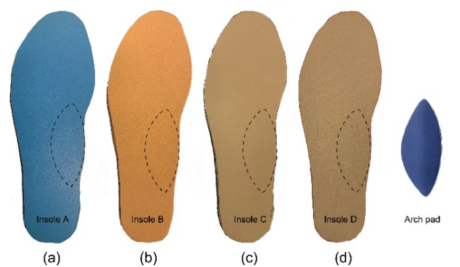
Insole Conditions A total of four experimental insole conditions are adopted and compared with the barefoot condition in this study. The insoles are constructed from PORON® Medical 4708 (Insole A), Pe-Lite (Insole B), Nora Lunalight A fresh (Insole C) and Nora Lunalastik EVA (Insole D), with a regular 3D arch pad.
Offloading Performance of Insole Materials During Walking for Diabetic Patients 179
Table 1. Descriptive statistics of participants (n=20).
Table available in the original PDF paper.
Variable Mean Standard Deviation Maximum Minimum Age (years old) 64 5 75 56 Body mass index (kg/m2) 24.0 4.0 33.4 18.2 Shoe size (EU) 38 1 42 37
Figure 1: Four experimental insole conditions: (a) Insole A. PORON®Medical 4708, (b) Insole B. Pe-Lite, (c) Insole C. Nora Lunalight A fresh, and (d) Insole D. Nora Lunalastik EVA.Table 2. Specifications and mechanical properties of 4 types of insole materials.
Table available in the original PDF paper.
Sample Insole A Insole B Insole C Insole D Density (g/cm3) 0.32 0.16 0.36 0.20 Thickness (mm) 2.91 3.17 4.09 3.12 Hardness (Shore A) 15.1 44.6 61 32.8 Energy absorption (%) 78.6% 73.0% 52.2% 75.3%
The arch pad is sandwiched between two layers of the insole material, as shown by the dotted line in Figure 1. For the barefoot condition, the pressure sensor was secured to the plantar of the foot with a donned cotton sock. A leather sports shoe was worn for each insole condition and subject. Table 2 shows the specifications and mechanical properties of the 4 types of insole materials.
Experimental Protocols Before collecting the pressure data, the participants were instructed to walk in their bare feet over a distance of 8 m on a concrete surface at their natural pace to establish the self-selected speed. A total of 10 trials were carried out to obtain the walking speed of each participant, which was calculated by dividing the distance walked (6 m) by the time needed to cover this distance (s). Two timing gates (Brower Timing Systems, Utah, USA) were placed at 1 m and 7 m to determine the duration. To minimize the effect on the plantar pressure due to the different walking speeds, the walking trials that exceeded 5% of the predetermined self-selected speed were rejected (Burnfield et al.,
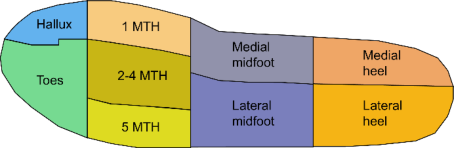
Figure 2: Nine plantar regions for the Pedar sensor.
2004). The walking speed set for all of the subjects ranged from 0.58 m/s to 0.89 m/s (Brach et al., 2008). The plantar pressure of the 5 conditions (5 foot/insole conditions × 3 trials) during walking was collected with the in-shoe Pedar® system. The partici- pants were instructed to walk a distance of 6 m on a concrete surface at their natural pace for all of the trials. Each experiment condition was recorded three times and the five conditions were randomized to minimize possible order effects.
Data Analysis The plantar of the foot was mapped into 9 regions for analysis: hallux, other toes, 1st metatarsal head (1st MTH), 2nd - 4th metatarsal heads (2nd - 4th
MTHs), 5th metatarsal head (5th MTH), medial/lateral midfoot, and medi- al/lateral rearfoot (Figure 2). The mean value of the 3 stance phases of the dominant foot in 3 trials under each experiment condition was analyzed. The dominant foot was determined by the procedure in which foot was used to kick a ball. The peak plantar pressure (PPP) and contact area of each region under the 5 experimental conditions are reported as follows.
IBM SPSS Statistics 21 software (SPSS®21, IBM® Corporation, New York, USA) was used for all of the statistical analyses and the level of significance was set at 0.05. The normality of the PPP and contact area of the 9 regions of the plantar of the foot under the 5 experimental conditions was tested by using the Shapiro-Wilk test. The results showed that all of the variables are normally distributed (P > 0.05). A one-way repeated measures analysis of variance (ANOVA) was used to compare these variables and determine whether there are significant (P<0.05) differences among the groups.
RESULTS
Overall Offloading Performance of Insoles
Table 3 shows the PPP obtained with various foot/insole conditions. As com- pared to the barefoot condition (333kPa), the use of an insole and footwear reduces the PPP by 37% with Insole A(211kPa) , 23% with Insole B (256kPa), 9% with Insole C (304kPa) and 33% with Insole D (225kPa). The one-way repeated ANOVA results showed that the decrease of the PPP with each insole is statistically significant, and the offloading effect is also significantly diffe- rent among the insoles. Amongst the 4 different types of insoles, Insole A shows the best offloading performance.
Offloading Performance of Insole Materials During Walking for Diabetic Patients 181
Table 3. Peak plantar pressure in insole and barefoot conditions (unit: kPa).
Table available in the original PDF paper.
Insole condition Barefoot condition Insole A Insole B Insole C Insole D Barefoot Peak plantar pressure 211 256 304 225 333
a Groups with significant differences at the 0.05 level are bolded.
Table 4. Contact area of plantar for insole and barefoot conditions (unit: cm2).
Table available in the original PDF paper.
Insole condition Barefoot condition Insole A Insole B Insole C Insole D Barefoot Contact area 131 131 131 131 113
a Groups with significant differences at the 0.05 level are bolded.
Table 4 shows the plantar contact area for each condition. The use of an insole and footwear apparently increases the contact area of the interface of the plantar of the foot. As compared to the barefoot condition (113cm2), the contact area is increased by 15% in all of the 4 insole conditions (131cm2). The one-way repeated ANOVA results showed that the larger contact area of the plantar of the foot is statistically significant for all of the insole conditions. Regardless of the substantial differences in material properties and the PPP obtained above, the contact area of all 4 insoles does not show significant differences.
Regional Offloading Performance Comparison of 4 Insoles
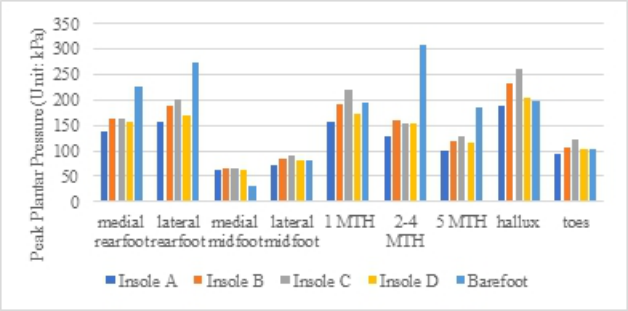
Figure 3 and Table 5 provide the regional PPP and comparison for the insole and barefoot conditions. Compared with the barefoot condition, the PPP is reduced in the medial/lateral rearfoot when the insoles are worn. For the midfoot regions, the PPP is increased at both the medial and lateral midfoot except with Insoles A and D at the lateral midfoot. The insoles also reduce the PPP of the MTH regions except at the 1st MTH with Insole C. The PPP at the hallux and toes is increased with the use of all of the insoles except for Insole A.
The one-way repeated ANOVA results showed that compared with the barefoot condition, the insole material causes a significant change in the regi- onal plantar pressure. Insole A offers higher offloading in most of the foot regions compared with the other insoles. Next is Insole D, but less optimal than Insole A in the rearfoot, hallux and toes but shows a better performance than Insoles B and C. For the medial midfoot, the PPP is increased significan- tly with the use of all of the insoles, and there is no significant change in PPP at the lateral midfoot when the insoles are worn. Amongst all of the insole conditions, Insole A offers the highest regional offloading. Compared with the barefoot condition, the PPP of Insole A is reduced by 40% at the medial rearfoot, 42% at the lateral rearfoot, 12% at the lateral midfoot, 19% at the 1st MTH, 59% at the 2nd - 4th MTHs, 46% at the 5th MTH, 4% at the hallux and 7% at the toes.
Figure 3: Regional peak plantar pressure: insole vs barefoot.Table 5. Peak pressure and percentage of change: insole vs barefoot (unit: kPa).
Table available in the original PDF paper.
Foot region A B C D BF A vs BF B vs BF C vs BF D vs BF Medial rearfoot 137 162 163 156 227 −40% −29% −28% −31% Lateral rearfoot 158 188 201 170 274 −42% −32% −27% −38% Medial midfoot 61 67 67 63 32 89% 107% 107% 95% Lateral midfoot 72 85 90 81 82 −12% 4% 10% −1% 1st MTH 158 193 220 172 195 −19% −1% 13% −12% 2nd−4th MTH 128 159 155 152 308 −59% −48% −50% −51% 5th MTH 101 119 128 115 184 −46% −36% −31% −38% Hallux 189 232 261 205 197 −4% 18% 33% 4% Toes 95 106 123 104 102 −7% 4% 20% 2%
a A (Insole A); B (Insole B); C (Insole C); D (Insole D); BF (Barefoot).
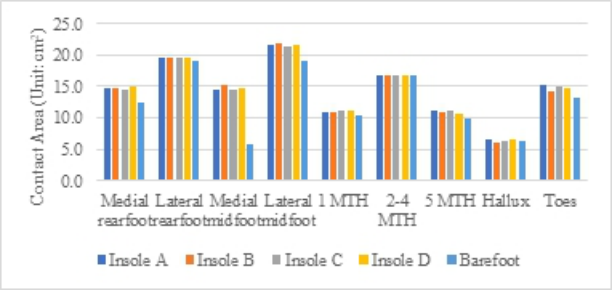
Figure 4 shows the regional contact area for the different foot/insole con- ditions. The contact area is increased for each foot region with the use of the insoles, except for the hallux with Insole C. Due to the increase in con- tact area, the magnitude of the plantar pressure changes with the different insole materials. The one-way repeated ANOVA results showed that compa- red with the barefoot condition, there is significantly increased contact of the medial rearfoot, medial/lateral midfoot, 1st MTH, 5th MTH and toes with the insoles. No significant increase is found for the lateral rearfoot and 2nd
- 4th MTHs. The contact area of the 4 insoles do not show significant diffe- rences for most of the foot regions except for the 5th MTH, hallux and toes. For the 5th MTH, the contact area of Insole A is significantly different from that of the other insoles.
DISCUSSION
Orthotic footwear and insoles are engineer designed to redistribute abnormal plantar pressure for diabetic patients during dynamic activities. The effective- ness of the insoles depends on their structure and material properties related to cushioning. Design features like arch supports, metatarsal pads and heel
Offloading Performance of Insole Materials During Walking for Diabetic Patients 183
Figure 4: Regional contact area: insole vs. barefoot conditions.
cups are commonly prescribed to relieve pain and change the contact area between the foot and insole.
In this study, the order of the offloading performance of the 4 contoured insoles with different material properties is: Insole A (37%) > Insole D (33%) > Insole B (23%) > Insole C (9%). It can be concluded that Insole A offers the highest offloading compared to the other insoles. This is consistent with a previous study in which insole material properties have major influence on the offloading performance of orthotic insoles. The use of a flat Poron insole can reduce the peak pressure by about 30-39% (García-Hernández et al., 2016). By increasing the contact interface between the foot and the footwear, the use of insoles can readily enhance wear comfort and relieve pain under the foot caused by abnormal plantar pressure distribution.
However, when the regional offloading performance is examined, the inso- les perform differently. As shown in Figure 4, the PPP of the four insoles is similar in most of the foot regions except for the lateral midfoot, 1st MTH, hallux and toes compared with the barefoot condition. Table 5 lists the PPP values for the insole and barefoot conditions and the percentage of change of the PPP compared to the barefoot condition for each foot region. Amongst the four insoles, Insoles A and D offer higher regional offloading than Inso- les B and C. The insole structure among the 4 insole conditions is consistent, so the difference can be attributed to their material properties. As shown in Table 2, Insoles A (15.1 Shore A) and D (32.8 Shore A) are less rigid than Insoles B (44.6 Shore A) and C (61 Shore A). The offloading effects of Insoles A and D are higher than Insoles B and C, which is consistent with the findings in Healy et al. (Healy et al., 2011), who concluded that softer and medium density materials can redistribute the plantar pressure by increasing contact of the foot with the insole. Speed et al. also concluded that the softness of insoles is associated with higher lower limb comfort rating scores, and inso- les made from softer materials such as EVA, Poron, PU and Plastazote offer higher wear comfort compared to harder materials (Speed et al., 2018). In addition, insole design features like arch pad, dome and metatarsal bar are effective in offloading plantar pressure with increased interface contact area
between the plantar and the insole (Collings et al., 2021). A suitable structu- ral insole design together with a combination of different materials at specific foot regions of high plantar pressure such as forefoot and heel are suggested for optimal offloading of plantar pressure.
CONCLUSIONS
The use of insoles and footwear can increase the contact area with the foot to improve the plantar pressure distribution during walking. The arch pad helps to increase the contact area of the plantar with insoles and transfer the load of the MTH and rearfoot to the midfoot. Materials with different properties have different offloading capacity in high-pressure regions, like the forefoot and rearfoot. It is concluded in this study that the insole designed with PORON® Medical 4708 and Nora Lunalastik EVA have higher regional offloading than the other materials, which can be adopted at forefoot and heel regions in design of orthotic insoles due to high plantar pressure and risk of foot ulcerations.
ACKNOWLEDGMENTS
This work is supported by the Laboratory for Artificial Intelligence in Design (Project code: RP1-2) under the InnoHK Research Clusters, The Government of the Hong Kong Special Administrative Region of the People’s Republic of China.
REFERENCES
ACTIS, R. L., VENTURA, L. B., LOTT, D. J., SMITH, K. E., COMMEAN, P. K., HASTINGS, M. K. & MUELLER, M. J. (2008). “Multi-plug insole design to reduce peak plantar pressure on the diabetic foot during walking”. Medical & biological engineering & computing, 46, 363-371. BRACH, J. S., TALKOWSKI, J. B., STROTMEYER, E. S. & NEWMAN, A. B. (2008).
“Diabetes mellitus and gait dysfunction: possible explanatory factors”. Phys Ther, 88, 1365-74. BURNFIELD, J. M., FEW, C. D., MOHAMED, O. S. & PERRY, J. (2004). “The influence of walking speed and footwear on plantar pressures in older adults”. Clin Biomech (Bristol, Avon), 19, 78-84. BUS, S. A., VAN DEURSEN, R. W., KANADE, R. V., WISSINK, M., MANNING, E.
A., VAN BAAL, J. G. & HARDING, K. G. (2009). “Plantar pressure relief in the diabetic foot using forefoot offloading shoes”. Gait Posture, 29, 618-22. COLLINGS, R., FREEMAN, J., LATOUR, J. M. & PATON, J. (2021). “Footwear and insole design features for offloading the diabetic at risk foot-A systematic review and meta-analyses”. Endocrinol Diabetes Metab, 4, e00132. DUAN, Y., REN, W., XU, L., YE, W., JAN, Y.-K. & PU, F. (2021). “The effects
of different accumulated pressure-time integral stimuli on plantar blood flow in people with diabetes mellitus”. BMC Musculoskeletal Disorders, 22, 554. FAWZY, O. A., ARAFA, A. I., WAKEEL, M. A. E. & KAREEM, S. H. A. (2014).
”Plantar Pressure as a Risk Assessment Tool for Diabetic Foot Ulceration in Egy- ptian Patients with Diabetes”. Clinical Medicine Insights: Endocrinology and Diabetes, 7, CMED.S17088.
Offloading Performance of Insole Materials During Walking for Diabetic Patients 185
GARCíA-HERNáNDEZ, C., HUERTAS-TALóN, J. L., SáNCHEZ-ÁLVAREZ, E. J.
& MARíN-ZURDO, J. (2016). “Effects of customized foot orthoses on manufa- cturing workers in the metal industry”. Int J Occup Saf Ergon, 22, 116-24. GOSKE, S., ERDEMIR, A., PETRE, M., BUDHABHATTI, S. & CAVANAGH, P.
(2006). “Reduction of plantar heel pressures: Insole design using finite element analysis”. Journal of biomechanics, 39, 2363-70. GULDEMOND, N. A., LEFFERS, P., SCHAPER, N. C., SANDERS, A. P., NIEMAN, F., WILLEMS, P. & WALENKAMP, G. H. (2007). “The effects of insole configu- rations on forefoot plantar pressure and walking convenience in diabetic patients with neuropathic feet”. Clin Biomech (Bristol, Avon), 22, 81-7. HEALY, A., DUNNING, D. N. & CHOCKALINGAM, N. (2011). “Effect of
insole material on lower limb kinematics and plantar pressures during treadmill walking”. Prosthetics and Orthotics International, 36, 53–62. IDF. 2022. Diabetes facts & figures [Online]. Available: https://idf.org/aboutdiabete s/what-is-diabetes/facts-figures.html [Accessed 11th March 2022]. SACCO, I. C., HAMAMOTO, A. N., TONICELLI, L. M., WATARI, R., ORTEGA,
N. R. & SARTOR, C. D. (2014). “Abnormalities of plantar pressure distribution in early, intermediate, and late stages of diabetic neuropathy”. Gait Posture, 40, 570-4. SPEED, G., HARRIS, K. & KEEGEL, T. (2018). “The effect of cushioning materials on musculoskeletal discomfort and fatigue during prolonged standing at work: A systematic review”. Applied Ergonomics, 70, 300-314. TSUNG, B. Y., ZHANG, M., MAK, A. F. & WONG, M. W. (2004). ”Effectiveness
of insoles on plantar pressure redistribution”. J Rehabil Res Dev, 41, 767-74.
LISTED IN THE AHFE DIGITAL BOOKSTORE CATALOGUE
Explore the complete digital volume
Human Factors for Apparel and Textile Engineering
Read this individual research paper free through the original publisher, or explore the full digital proceedings book.
ISBN 978-1-958651-08-7
Explore this ISBN in the AHFE Bookstore ↗Listed in the July 2026 bookstore catalogue; search by ISBN to confirm current availability · Digital book purchase optional