Kimmo Tarkkanen, Janne Siivonen, Jari Hietaranta, Antti Laatikainen, Pertti Ranttila (2026). Operationalizing Shipbuilding 4.0 Technologies for Material Management Sustainability. In: Industrial and Systems Engineering. AHFE Open Access, vol. 219, pp. 1–11. https://doi.org/10.54941/ahfe1007770
Shipbuilding faces pressure to improve efficiency and effectiveness while meeting rising disclosure requirements and environmental targets. This article approaches sustainability through the operational and competitive lens, focusing on practical digital solutions that make material management both leaner and greener in shipbuilding 4.0 context. We conduct a design science study that combines empirical site observations, interviews, and co creation workshops to build practical problem themes, such as project design and change management, logistics planning, material visibility, warehousing and last mile operations, and quality and rework. Based on these findings, we operationalize Shipbuilding 4.0 design principles through four software concepts: a mobile app for deviation capture, material route tracking, hybrid simulation for material flow analysis, and a shared KPI and maturity platform integrating data from previous. These are expected to cut rework, improve delivery to installers, reduce inventory related waste, and estimate CO₂ impacts along routes.
Industry 4.0 concept brings together connected information networks, shared data pools, sensor systems, visualizations, simulations and automation capabilities. Beyond traditional factories, these capabilities also suit shipbuilding, accelerating its move to digital, more automated production and digitally interconnected value chains, often referred as Shipbuilding 4.0. Literature highlights the transformative potential of these technologies in addressing sustainability challenges in shipbuilding, particularly in the domain of material management. At the same time, the ship manufacturing industry faces increasing pressure to adopt sustainable practices while maintaining operational efficiency and global competitiveness (Saarni et al., 2019). Recent sustainability reporting requirements across the entire shipbuilding ecosystem necessitate a certain degree of digital maturity to meet these reporting needs (Baumüller & Grbenic, 2021). There exist a clear application domain-pull (e.g. sustainability and productivity improvements) and technology-push (e.g. rise of artificial intelligence) that drive also shipbuilding industry towards the next revolution (cf. Lasi et al., 2014).
This article approaches sustainability through the operational and competitive lens, focusing on practical digital solutions that make material management both leaner and greener in shipbuilding 4.0 context. Cost- efficient solutions for operations and supply chain management that secure also sustainability dimensions have remained scarce in the shipbuilding industry (Strandhagen et al., 2022). Therefore, potential application areas and operationalizations of shipbuilding 4.0 technologies for sustainability purposes are needed (cf. Strandhagen et al., 2022). Recently, identified key enabling technologies in shipbuilding are rather scattered, rely on traditional approaches, and back mass production-like processes (Calvache et al., 2026) instead of engineering-to-order (ETO) practices. Moreover, only scarce percent of technologies that are specifically tailored for shipbuilding seem to achieve commercial phase (TLR 7 to 9) (ibid.).
This paper takes the perspective of operational improvement with digitalization to achieve sustainability objectives. We concentrate on material management related shipbuilding 4.0 operationalizations in the supplier network of shipbuilding industry. The research question is: How can shipbuilding 4.0 be operationalized to address emergent concerns of material management sustainability? We address this question by reviewing the literature about sustainable material management and digital tools in Chapter 2. In Chapter 3, we introduce design science research methodology (DSR), empirical data collection methods and resulting observations as problem statements for DSR. In Chapter 4, we suggest a palette of interrelated software concepts as solutions for emergent concerns of material management in the shipbuilding network and as operationalizations of shipbuilding 4.0 digital tools.
SHIPBUILDING 4.0 FOR SUSTAINABILITY Scientific literature highlights the transformative potential of Industry 4.0 technologies in addressing sustainability challenges in shipbuilding, particularly in the domain of material management. The concept of Shipbuilding 4.0 and related digitalization has evoked an extensive body of scientific research also from sustainability perspective (Ramirez-Peña, 2020; Strandhagen et al., 2022). While version 4.0 emphasizes a connection between digital models and physical products, the industrial transformation that bring especially sustainability and human-centricity into a focus is already referred to as Industry 5.0 and correspondingly Shipbuilding 5.0 (Seppälä, 2024).
Strandhagen et al. (2022) identify key digital tools—such as real-time data systems, sensor networks, and predictive analytics—that enable improved traceability, resource efficiency, and environmental monitoring across the shipbuilding supply chain. Salah et al. (2025) suggest leveraging digital tools such as building information modelling (BIM), RFID, and IoT for process monitoring to decrease material waste in the construction sector. Several other studies have recognized BIM as a central tool for minimizing material waste (Pierott et al., 2025) at the design stage (Liu et al., 2015), quantifying and estimating the waste (Quiñones et al., 2021), and enhancing material flow and coordination in general (Mitera-Kiełbasa & Zima, 2025). In a literature
Operationalizing Shipbuilding 4.0 Technologies for Material Management Sustainability 3 review by Ramirez-Peña et al. (2020), technologies supporting sustainability were big data analytics, cloud computing, blockchain, cybersecurity, artificial intelligence and simulation. Md Daud et al. (2024) states that automation is the most discussed topic in green shipyard context.
However, the modern shipbuilding application landscape seems to be broad but immature: Calvache et al. (2026) found 88 Shipbuilding 4.0 applications, of which only a small subset has reached a truly commercial phase. For example, transporting equipment digitalization solutions are rare (Calvache et al., 2026). Crucially, these applications are interdependent, and so is their deployment. Calvache et al. (2026) highlights the interconnected nature of these technologies and the need to support shipyards in deploying and prioritising them.
There exists design principles, explicit step-by-step methods and strategies to implement Shipbuilding 4.0 and related technologies. For example, Zhang and Chen (2024) propose a framework for shipbuilding 4.0, which integrates smart manufacturing, digital twins, and IoT infrastructures to optimize material flows and reduce waste. Seppälä (2024) discusses how the transformation from 4.0 to 5.0 in ship design process could realize by applying agile software development methodologies, functional and economic scenario building and analysis, stakeholder analysis and taking users’ perspective (UX) into account in ship and technology design. Design principles, on the other hand, can assist industry practitioners in identifying appropriate scenarios for Industry 4.0 implementation (Hermann et al., 2016). According to Hermann et al. (2016), these ‘how to do’ principles are: Interconnection, information transparency, decentralized decisions, and technical assistance. Interconnection-principle suggest connecting machines, devices and people over IoT. Due to interconnectedness, the fusion of the physical and virtual (i.e. digital twin) become available leading to information transparency -principle for all connected participants. In decentralized decisions -principle, participants and machines are given power to make decisions as autonomous as possible without delegating these to a higher level, thus improving overall productivity. Technical assistance-principle highlights humans as strategic decision-makers and systems that provide aggregated and visualized data.
RESEARCH METHOD The empirical research context in this paper is a supply network in a shipbuilding domain. The network, and its supply chains, consist of turnkey suppliers (TK), tier 1 companies and manufacturers and raw material suppliers. This research follows design science research (DSR) methodology (Hevner et al., 2007; Peffers et al., 2007). The research process is considered here as cycles of rigor, relevance and design as defined by Hevner (2007). In the rigor cycle, activities are based on scientific knowledge, existing artefacts and state-of the art expertise about the domain. In the relevance cycle, activities concern the analysis and interpretation of whether the desired improvements were achieved after the artefact has been exposed to the relevant environment and received feedback on this. In the design cycle,
activities are about iterative construction and evaluation tasks allowing the artefact to evolve.
In design science, the central purpose of evaluation “is to rigorously demonstrate the utility of the artefact” (Venable et al., 2012, p. 425). Such evaluation can be done in two phases (Peffers et al., 2007), of which the demonstration phase is a light-weight evaluation of artifact feasibility in at least one context and proof of solving some parts of problems. Evaluation proper is more formal and extensive and takes a positivistic stance collecting objective quantitative performance measures. Currently, only few of the software concepts presented next in this paper have achieved the demonstration phase. Research implications from our DSR study are thus rather conceptual than experimental.
DATA COLLECTION AND ANALYSIS The study involved qualitative data collection through user-centred and co-design principles. Research participants were drawn from turnkey (TK) suppliers, tier 1 manufacturers, consultants and field experts that were met on various occasions. We have conducted several informal interviews with representatives from companies on the supply network that have focused on the operative process and inefficiency of material management. We have organized and participated in four co-creation workshops with companies that were focused on both designing the focal content areas and related digital tools. Added to individual company visits and meetings in building sites, we have collected observational and contextual research data. Research material consists of audio recordings, transcribed discussions and free-form notes of visits and meetings.
We conducted a qualitative content analysis focusing on a pre-defined phenomenon of interest: material management–related problems. Audio recordings and field notes were revisited. We identified and extracted all segments referring to the focal phenomenon (i.e., any mention of a material management issue). These segments constituted the unit of analysis. Problem categorization was conducted inductively. Extracted problems were first assigned descriptive names/codes capturing the specific problem described (e.g., “design changes are not propagating to next production”). Codes were then compared and grouped to form higher-order themes that emerged from the data (e.g., “project design and change management”), resulting in a hierarchical category system. For each identified problem, we compiled (1) a theme (higher-level category), (2) an issue label (problem name), (3) a brief operational definition detailing the problem characteristics and relation to sustainability (problem description), and (4) a short illustrative case vignette summarizing how the issue manifested in practice. The following is an example of an illustrative case: Exit-sign had been installed correctly to the ceiling of the hallway according to 2D drawing. In the following inspection, however, it was observed that the sign was not visible from the end of the corridor due to a higher lightning bracket mounted on the ceiling blocking the view of the sign. This is against the quality system and standards, and either the exit sign or brackets had to be re-installed. In addition to items re-installed, the material and resource
Operationalizing Shipbuilding 4.0 Technologies for Material Management Sustainability 5 waste associated with the rework comprises of, for example, re-purchasing, recutting, and reinstalling the aluminium roof panels, and the subsequent change of 2D drawing by the designer. The actual amount of waste is case- specific and varies, for example, depending on the location, availability and area of the ship of the substitute material.
Depending on the cause, the above example could fall under the problem called “Late design changes”, which detailed description could be “Late decisions and changes to interior designs force re-cuts, replacing hatches, repeated ceiling installations, and extra orders”. Together with previous example (“design changes are not propagating to next production”) the problem would be categorized under the problem theme called Project Design & Change Management. The following list introduces the created five themes, and examples of problem descriptions in each theme:
Project Design & Change Management ∘ Late design changes: Late decisions to interior designs force repeated ceiling panel installations and material waste.
Logistics Planning & Scheduling ∘ Limited supplier buffer: Material deliveries to installers are behind the schedule causing waiting time and re-scheduling.
Material Visibility & Tracking ∘ Material locations are uncertain after the logistic hub: Lack of system entries result in temporary material loss.
Warehousing & Last Mile Operations ∘ Lifts are a bottleneck: Difficulties in lift capacity planning due to limited visibility to material flow leading to waste.
Quality, Inspection & Rework ∘ Late discovery of material defects: The difference in the colour of the material is only noticed when opening the package in the installation area.
Coding was conducted by a single researcher; therefore, no inter- coder reliability statistics are reported at this stage. A formal reliability assessment (e.g., internal consistency estimated with Cronbach’s alpha) will be performed only after the empirical material has been thoroughly coded and the final categorization structure has been achieved; at present, coding and aggregation are still in progress. This sequencing reflects also our agile methodology approach: from the earliest observations onward, we have prioritized iterative technology development and evaluation. In doing so, we follow design science logic by iteratively alternating between development activities, stakeholder discussions, and engagement with the literature to balance rigor and relevance. Accordingly, empirical observations are used primarily here in this paper to motivate the problem space for technological solution development and testing. Therefore, empirical observations are presented as illustrative examples for each problem area rather than as a comprehensive and fully analyzed list of findings.
These individual problem cases and intertwined problem themes have served as inspiration for technological development in our research project. Next, we describe what kind of technological operationalizations of Shipbuilding 4.0. were built based on these empirical problem statements.
DEVELOPED TECHNOLOGY OPERATIONALIZATIONS The following subsections show which material-management problem themes the software concepts address, how each concept works in practice, and how, together, they interconnect to a sustainability maturity model to be implemented as an IT platform for the shipbuilding network.
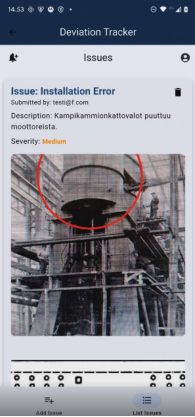
Material Deviations Tracking App (T1) The deviation recording application is designed to systematically capture and manage operational and design deviations across multiple ETO projects. Its primary purpose is to ensure that all deviations are structured and traceable to specific drawings and projects. The mobile app integrates photographic evidence and annotated drawings with pre-filled reporting templates to reduce ambiguity and improve accountability. Deviations are submitted in .json format, with images stored separately to reduce mobile resource usage; user authentication is handled with MSAL.
Figure 1: Recording a deviation (on the left) and list of deviations (on the right) views of the mobile application.
The tool replaces Excel-based workflows with an interactive solution enabling real-time logging and visual evidence (Fig. 2). This reduces forgotten corrections, thereby lowering material waste from re-ordering, rework, and refitting. For instance, correcting a single Exit-sign visibility deviation can range from 15 minutes to 12 hours, potentially triggering surface-material
Operationalizing Shipbuilding 4.0 Technologies for Material Management Sustainability 7 repurchases, transportation, cutting, and fitting; with dozens or hundreds of deviations per construction area, the environmental and economic gains are evident. In the future, the system would also detect recurring errors across similar projects, enabling root-cause analysis and proactive design adjustments that support continuous improvement in ETO environments. T1 supports decentralized decisions by empowering TK suppliers’ workers to capture deviations at source and trigger corrective workflows without hierarchical bottlenecks. Concurrently, structured evidence (photos/ metadata) strengthens information transparency and technical assistance (guided templates reducing ambiguity).
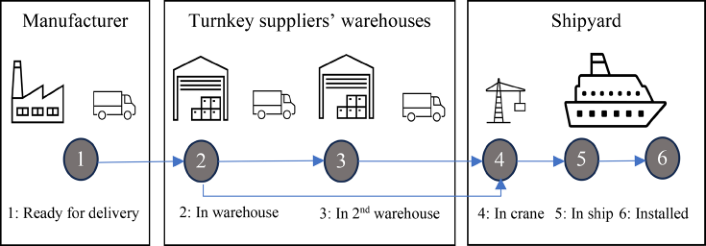
Material Route Tracking (T2) IoT integration enables real-time tracking of material flows and equipment performance. Sensors embedded in packages, storage, and transportation feed continuous cloud data, allowing early detection of failures and inefficiencies. We implement a 4-week pilot with six QR-based mobile scan points and GPS tracking at 5–15-minute intervals while in motion (Fig. 2). Primary data are package ID, timestamp, and location. Secondary data from ERP/material systems: pallet density, mode of transport, distances, inventory levels, target and total lead times. This reveal causes of inaccurate deliveries, delays, extended storage, and lost/unused materials, while enabling CO2 calculations. T2 primarily realizes interconnection by linking packages, warehouses, transport, and users through IoT (QR/GPS) to produce continuous route events. This end-to-end stream also advances information transparency for delays, storage, and waste effects.
Figure 2: Material routes and special tracking points for the system.
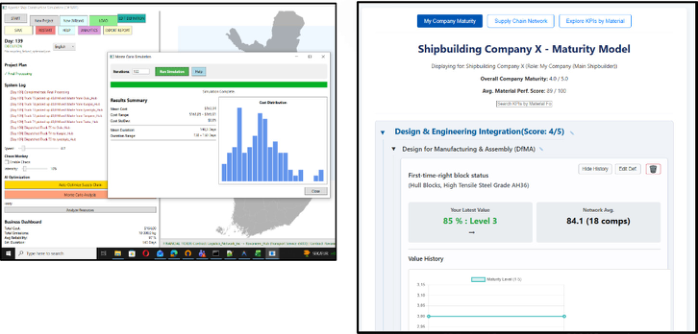
Material Flow Simulation and Optimization (T3) A hybrid simulation (ABM + DES) models, analyzes, and improves performance in a multi-actor network: agents represent companies with decision rules, while discrete-event logic governs timing and resource use. The current implementation concentrating on material flow and stock levels is represented in Figure 3 (on left).
We examine how material flows, supplier performance, and process deviations affect efficiency and waste formation in shipbuilding projects. Data integrates T1 deviation records, T2 real-time tracking, and ERP transactions (inventory, transfers, orders), so the model extends and complements existing tools. Especially real-time tracking can continue virtually and remain easy to adjust. Scenarios cover both baseline operations and disruptions (late deliveries, quality defects, process interruptions, tracking issues) to assess how effects propagate through the network, impacting timelines, availability, waste, and other KPIs. T3 supports information transparency by serving as a virtual (digital-twin) counterpart to T2’s tracked flows. In addition, technical assistance is supported by scenario and optimization capabilities that enable proactive controls that minimize waste and avoid unnecessary transport/ storage.
Figure 3: Visual representation of a simulation and optimization model for material flows and waste minimizing (on the left). On the right, the shared KPI platform consolidates maturity data and company-specific KPIs, providing tailored improvement actions for each supply chain and company type (e.g., Tier 1, HVAC).
Material KPIs Sharing Platform (T4) To connect T1–T3 to sustainable material management and maturity, we propose a maturity model combining selected indicators for processes (logistics, efficiency), people (capabilities), and technology (digital tools). In the supply network, knowledge diffusion, efficiency, and transparency are central to sustainability; the level of analysis is network value creation, combining network-specific metrics with LCA indicators. The software enables real-time KPI collection and monitoring, integrating quantitative and qualitative measures for self-assessment. The aim is to demonstrate cost and environmental improvements and workflow enhancements, supporting transparent reporting and strengthening competitive advantage by aligning operations with sustainability objectives. The digital version of the platform (from one individual company perspective) is presented in Figure 3 (right).
Operationalizing Shipbuilding 4.0 Technologies for Material Management Sustainability 9 T4 serves as an integrating web service and maturity layer that shares T1–T3 data for network-wide decision-making and common KPIs. Thus, it supports information transparency and interconnection, yet primarily T4 exemplifies technical assistance by aggregating and visualizing shared KPIs.
DISCUSSION AND CONCLUSION Together, these operationalizations create a data pipeline: T1 captures deviations, T2 exposes material events end-to-end, T3 assesses and optimizes their effects, and T4 shares KPI-level insights across the network. In Table 1, these tools are mapped to problem themes (e.g., Project Design & Change, Material Visibility & Tracking, Warehousing & Last-Mile, etc.) and to Shipbuilding 4.0 design principles (decentralized decisions, interconnection, information transparency, technical assistance).
Table 1: Empirical material management themes mapped onto digital tools and design principles of Shipbuilding 4.0.
Technical assistance Themes: Tools: T1 T2 T3 T4 Details:
Project Design & Change Management
X X T1 captures issues w/ photos and metadata; T3 scenario impact and corrective actions
Logistics Planning & Scheduling
X X T3 optimizing buffer sizing; T4 sharing lead-time KPIs
Material Visibility & Tracking
X X T2 material event visibility & real-time ETA; T3 simulating capacity implications
Warehousing & LastMile Operations
X X T2 geofencing & live location; T3 optimizing lift schedules in the shipyard
Quality, Inspection & Rework
X X T1 root-cause capture & quality NC; T4 incident and quality KPIs From a practical standpoint, the software concepts are expected to lower rework, improve on-time-to-installer performance, and support network orchestration through transparent KPIs and scenario-based optimization. These implications can be turned into managerial actions such as with T1 formalizing deviation capture with mandatory visual evidence to enable cross project learning and prevent recurrence of costly changes. From a scientific standpoint, the work contributes a traceable problem-artifact framework for ETO shipbuilding and a platform architecture that connects deviation data, tracking streams, and simulation outputs with sustainability metrics, thereby moving beyond single-tool case studies toward an integrated Shipbuilding
4.0 perspective. As a limitation of this research, the current work remains at design and partial demonstration stage. Field-level evaluation proper— with quantitative effect sizes on cost, lead times, rework, inventory days, and kgCO2e—is pending.
ACKNOWLEDGMENT
This work was supported by Business Finland.
REFERENCES
Baumüller, J., & Grbenic, S. O. (2021). Moving from non-financial to sustainability reporting: Analyzing the EU Commission’s proposal for a corporate sustainability reporting directive (CSRD). Facta Universitatis Series: Economics and Organization, 18(4), 369–381. Calvache, M., Pruyn, J., & Napoleone, A. (2026). Navigating shipbuilding 4.0:
analysis and classification of technologies for the digital transformation of the sector”. Ship Technology Research, 73(1), 10–26. Hermann, M., Pentek, T., & Otto, B. (2016). Design principles for industrie 4.0 scenarios. In 2016 49th Hawaii international conference on system sciences (HICSS) (pp. 3928-3937). IEEE. Hevner, A. (2007). A three cycle view of design science research. Scandinavian
Journal of Information Systems 19 (2007), 87–92. Lasi, H., Fettke, P., Kemper, HG. (2014) Industry 4.0. Bus Inf Syst Eng 6, 239–242. Liu, Z., Osmani, M., Demian, P., & Baldwin, A. (2015). A BIM-aided construction waste minimisation framework. Automation in construction, 59, 1–23. Md Daud, A. H., Harun, M., Jeevan, J., & Mohd Salleh, N. H. (2024). A systematic
review of the current trends and potential practices of green shipbuilding. Australian Journal of Maritime & Ocean Affairs, 16(1) Mitera-Kiełbasa, E., & Zima, K. (2025). Optimising Construction Efficiency: A Comprehensive Survey-Based Approach to Waste Identification and Recommendations with BIM and Lean Construction. Sustainability 17(9). Peffers, K., Tuunanen, T., Rothenberger, M. A., & Chatterjee, S. (2007). A design
science research methodology for information systems research. Journal of management information systems, 24(3), 45–77. Pierott, R.M.R., Soares, C., Qualharini, E.L., Haddad, A.N. (2025). Qualification of the Impact of BIM on Reducing Waste in Construction Rehabilitation. Lecture Notes in Civil Engineering, vol 769. Springer, Cham. Quiñones, R., Llatas, C., Montes, M. V., & Cortés, I. (2021). A multiplatform BIM-
integrated construction waste quantification model during design phase. The case of the structural system in a Spanish building. Recycling, 6(3), 62. Ramirez-Peña, M., Abad Fraga, F. J., Salguero, J., & Batista, M. (2020).
Assessing sustainability in the shipbuilding supply chain 4.0: A systematic review. Sustainability, 12(16), 6373. Saarni, J., Heikkilä, K., Kalliomäki, H., Mäkelä, M., Jokinen, L., & Apostol, O.
(2019). Sustainability in shipbuilding–observations from project-oriented supply network in cruise ship construction. FFRC eBooks, 5. Salah, M., Elbeltagi, E., Almoshaogeh, M., Alharbi, F., & Elnabwy, M. T. (2025).
Identifying Root Causes and Sustainable Solutions for Reducing Construction Waste Using Social Network Analysis. Sustainability, 17(17), 7638.
Operationalizing Shipbuilding 4.0 Technologies for Material Management Sustainability 11 Seppälä, L. (2024). Industry 5.0: Transforming ship design through human-centered
approach. In Proceedings of 15th International Marine Design Conference (IMDC-2024) Strandhagen, J. W., Buer, S. V., Semini, M., Alfnes, E., & Strandhagen, J. O. (2022).
Sustainability challenges and how Industry 4.0 technologies can address them: A case study of a shipbuilding supply chain. Production Planning & Control, 33(9–10), 995–1010. Venable, J., Pries-Heje, J., & Baskerville, R. (2012). A comprehensive framework for evaluation in design science research. In International conference on design science research in information systems (pp. 423–438). Berlin, Heidelberg: Springer Berlin Heidelberg. Zhang, X., & Chen, D. (2024). Shipbuilding 4.0: A Systematic Literature Review.
Applied Sciences, 14(14), 6363.
LISTED IN THE AHFE DIGITAL BOOKSTORE CATALOGUE
Explore the complete digital volume
Industrial and Systems Engineering
Read this individual research paper free through the original publisher, or explore the full digital proceedings book.
ISBN 978-1-964867-95-3
Explore this ISBN in the AHFE Bookstore ↗Listed in the July 2026 bookstore catalogue; search by ISBN to confirm current availability · Digital book purchase optional