Kimmo Tarkkanen, Esko Halonen, Elina Kontio, Niina Katajapuu (2024). Co-Creating Public Service: Development of Hobby Voucher for Youths and Sport Clubs. In: Human Dynamics, Product Evaluation and Quality. AHFE Open Access, vol. 131, pp. 90–100. https://doi.org/10.54941/ahfe1004867
The increasing sedentary lifestyle and decreased physical activity among children and youth have become a global concern. Public services, facilities and sports clubs play a significant role in supporting children's physical activity. This article describes the co-creation process of a physical activity support system - a digital tool for public financial support and management in the field of youth sport and hobbies - aiming at increasing involvement and continuation of hobbies after pandemic. We analyze the roles of stakeholders and mutually supportive ways they were involved in the co-creation process.
The increasing sedentary lifestyle and decreased physical activity among chil- dren and youth have become a global concern. More than 80% of adolescents and 27% of adults do not meet the World Health Organization’s recom- mended levels of physical activity (WHO, 2022). This trend is alarming as regular physical activity promotes both mental and physical health.
Sports clubs play a crucial role in promoting physical activity among youth, and many perceived benefits of organized sports participation has been observed (Logan & Cuff, 2019). Parents influence significantly to the extent which children engage in organized sports and the specific environ- ment in which they do so (Gustafson & Rhodes, 2006). Whereas the age of 6 years is appropriate for most children to start organized sports (Pur- cell et al., 2005), at the age of 15, already 75% has dropped out the hobby (Harris, 2000). As the competitiveness in organized sports leagues rises, indi- viduals who are not inclined to pursue higher levels of competition may opt to discontinue their involvement in sports. A research study has suggested that girls who do not engage in sports at an early age (before 8 years old) are less likely to participate as they grow older. In contrast, boys might join sports during adolescence, even if they did not participate earlier (Howie et al., 2016). During the recent pandemic, the dropping rates of participating
Co-Creating Public Service: Development of Hobby Voucher 91
in organized sports naturally grew, and most worrying the retention rates did not rise to the previous level.
Due to above reasons, the Sports Services in the City of Turku had looked for new ways to get children and young people more involved in sports hobbies and them to stay involved in these hobbies after the pandemic. Inspi- ration and an example were sought from Iceland, which was previously recognized due to the prevention model (Kristjansson et al., 2020) and offer- ing so called ‘hobby voucher’, a financial support to young people in the city of Reykjavik. The Sports Services of the City of Turku started to develop a financial hobby voucher, a new operating model, and a digital system, which would increase children’s involvement in sports hobbies and increase their physical activity.
In hobby voucher, 7–19-year-old residents would be offered a certain amount of money that can be used to pay for the fees of their chosen instructed sports hobby. The granted amount in Euros is yearly fixed, and thus depending on the pricing of the hobby it may cover one or more hobbies or just one hobby partly. Along with increasing children and young people’s participation in hobbies, the aim of the hobby voucher is to create more equal opportunities to start, or to continue regular and instructed physical activity, as well as to curb the rise in hobby costs.
The traditional top-down approach in public service design and deliv- ery often fails to meet the evolving needs of the youth and the community. Therefore, the development of the hobby voucher exploited co-creation, a process where citizens and public authorities work together to build better, more effective services. In this article, we describe the co-creation process of the hobby voucher in its early stages. The article concentrates on analysing the roles of stakeholders and involvement in the co-creation process and represents results from different methods used. Sharing these experiences, learning, and avoiding pitfalls in other cities and public services are valu- able for the successful implementation of similar initiatives. The insights and findings from this study will contribute to the growing body of knowl- edge on co-creation in public services and its impact on youth physical activity.
CO-CREATION OF PUBLIC SERVICES Co-creation is an activity of an open-ended search for innovative yet feasi- ble solutions that produce public value (Ansell & Torfing, 2021, p. 117). Public value co-creation can be considered as aiming at (1) administrative value (2) citizen value (3) societal value, and (4) economic value (Fuglsang et al., 2021). In the goals of hobby voucher, several types of public val- ues mix, although the economic value perspective is weighted, as it aims solving a wicked problem with new product and process development. Prob- lems of co-creation are often ‘wicked’ referring to having a unique character, contradictory goals, or a lack of emergent solutions (Ansell & Torfing, 2021, p. 110). Co-creation takes place in collaboration, which is an attempt to build a common ground for the management of differences to find joint solutions to
common problems, challenges, and tasks (Gray, 1989). The participants of co-creation are outside, non-typical stakeholders, who are involved in the ini- tiation, design, implementation, and/or evaluation of a public service (Toots et al., 2017).
In the domain of the hobby voucher, stakeholders in the co-creation of technology may include, in addition to children and young people them- selves, parents, schools, sports clubs and organizations operating leisure time activities, other services supporting physical activity and well-being in the society, research institutions and local companies implementing dig- ital solutions. The forms of involvement and influence of stakeholders can vary greatly. They can be involved as equal developer partners (Bødker & Iversen, 2002), or used as informants who are only allowed to react to solu- tions created by the designer (Bødker, 2009). Power asymmetries can be a problem in technology development (Tarkkanen et al., 2013), that must be managed by disempowering or constraining stronger stakeholders or by empowering weaker ones (Ansell & Torfing, 2021, p. 115). Stakeholder anal- ysis provides a way to identify the parties involved in a development project and understand their role in co-creation (Boonstra & Govers, 2009). The stakeholder typology developed by Mitchell et al. (1997) helps to identify development parties through three characteristics - power, legitimacy and urgency.
The complex and dynamic process of co-creating public solutions is divided to four phases (Ansell & Torfing, 2021 p. 108): (1) initiation; (2) design, (3) implementation; and (4) consolidation, upscaling, and dif- fusion. In the initiation stage, problems and challenges are described, rel- evant and affected stakeholders are identified and motivated to interact, and their collaboration is facilitated and managed to build trust among the participants (ibid., p. 109). In the design phase, problems and tasks are redefined, tentative solutions are designed, and last, the selected solu- tions are tested through experimentation (ibid., p. 121). Khan & Khrisnan (2021) divide the co-creation of e-government services to actions before, during and after co-creation. Before the co-creation implementation, the major step is to build motivation of the actors with intrinsic and/or extrin- sic incentives (Khan & Khrisnan, 2021, p. 1336). During the co-creation implementation, they divide the process to initiation, open participation, open collaboration and engagement, which, in this order increase the time and effort required from the participating stakeholders as well as increas- ing the technological and managerial complexity (Khan & Khrisnan, 2021, p. 1339).
We are focusing on initiation and design phases of co-creating public solu- tions due to the status of the hobby voucher, that is still ongoing in the implementation phase. The previous co-creation literature related to these two phases emphasize identifying, redefining and describing problems as well as identifying, motivating and facilitating stakeholders in the process. Next, we introduce our case study in more detail. The unit of analysis are stakeholders and their involvement strategies, and the results related to the development topic.
Co-Creating Public Service: Development of Hobby Voucher 93
CASE: CO-CREATION OF HOBBY VOUCHER Context
Hobby voucher is a new operating model between the Sport Services of the City of Turku, local sport clubs and families, to increase 7-19-year-old chil- dren and adolescent’s participation in organized sports. In practice, hobby voucher is a new financial support model for sport clubs: The city’s financial subsidies, which were previously granted directly to sports clubs, are now directed to the exercisers themselves (children and young people who par- ticipate in the hobby) and hopefully, eventually to the clubs organizing the hobbies. Therefore, the hobby voucher inevitably also changes the subsidy system from the clubs’ point of view.
The introduction of the hobby voucher and the related reform of the sub- sidy system are also part of the larger development plan of the city’s sports facility network and the reform of the rental pricing of facilities. In these other areas of the reform, various efforts are being made to achieve actions that complement the hobby voucher, such as 1) the aim of pricing sports facilities and increasing the rental subsidy for private facilities is to equalize payment practices and the use of sports facilities between different sports. 2) The aim of the coaching competence model is to enhance the coaches’ and instructors’ ability to guide and to improve the quality of activities so that children and young people can find and enjoy sports clubs for longer.
The Turku City Council decided on 12.12.2022 that the hobby voucher, the increase in the sports condition allowance for activities for under 20-year- olds and the updated pricing of sports facilities will be introduced in year 2025. The Sports Service of the City of Turku has led the development of the hobby voucher, and researchers of REDISOTE project at Turku University of Applied Sciences has participated in the co-creation at different stages.
In the next chapter, we take a step back in the process timeline. We describe what kind of co-creation practices and actions were taken in the process to initiate the development, how different stakeholders were involved and what type of design inputs and results for the hobby voucher development were co-created.
Iterative Stakeholder Involvement in Open and Multidisciplinary Workshops Two four-hour workshops were held in Turku in Autumn 2021 and Spring 2022 as part of the event organized by The Centre of Expertise in Physical Activity for Children and Youth. The purpose of workshops was not directly on the development of hobby voucher, but to identify problems, challenges and tasks related to increasing physical activity of children and young people that could be influenced by various sports technology solutions.
Workshops were open to participate and marketed through organizational email lists and social media platforms. A total of about 30 people participated in the workshops, and stakeholders ranged from the city’s school sports coor- dinators and elite sports organizations to technology companies and sports researchers. Of the core stakeholders, children and young people were not represented at the workshops.
Workshops recognized the potential of various mobile games to move chil- dren and young people. At the same time, the growing screen time of children and competing for it with the world’s largest corporations, which have enor- mous resources for developing applications that are as addictive as possible, was identified as a big challenge. Several previous projects have developed interesting and useful technological solutions, but the discussions brought up the fact that it is very difficult for them to compete against big tech giants. In addition, the lack of continuity in project work was seen as a major challenge for developing real solutions for the public services (Table 1).
Naturally, some of the participating stakeholders had more power over a wider group of stakeholders or decisions about city’s infrastructure. Looking at the broad whole of young people’s well-being, sport clubs and organization activities can be classified as waiting, dependent stakeholder groups. How- ever, it was interesting to observe how, in such an open, early-stage discussion event, individual companies and actors were able to use their expertise to take a leading role in advancing issues and requirements, perhaps changing their preconceived role of the stakeholder in question.
Table 1. The proposals collected in the workshops.
Table available in the original PDF paper.
Summary of Proposals Identifying past technology projects from which lessons can be learned for the benefit of physical activity support.
Encouraging all actors to commit to cooperation and co-creation of technology from the outset: Companies, young people, NGO sector.
Understanding the target group (reaching and inspiring physically inactive children and young people).
Launching individual technology experiments quickly, organized, and long-term. Placing emphasis on a human-centred approach to technology development
Training coaches who can influence the retention of hobbies. Making use of existing statistics and national annual surveys. Carrying out new surveys for a group of passive young people
Improving the marketing, communication and branding of the technology experiment to young people together with professionals
Direct Invitation-Based Involvement in a Sparring Group Parallel with workshops, and already for a longer period, the representatives of some sports clubs have collaborated with the Sport Services of the City of Turku. This group of sport club representatives has been called a “sparring group”(a form of focus group), referring to its role as providing views related to operating models of clubs. During the beginning of hobby voucher co- creation, the group was invited to occasional online or live discussions with the city’s sport services personnel, and researchers from the university. The participation in the sparring group was invitation-based yet voluntary and as a stakeholder it represented the wide variety of different sports offerings of the city, e.g. multi-sport clubs, athletics, swimming and football clubs. Along
Co-Creating Public Service: Development of Hobby Voucher 95
with their extensive knowledge about the diverse practices in the field, one of the main benefits of the sparring group has been the speed with which the feedback from the sports field has been possible to gather.
The sparring group raised concerns about equality in hobby prices between exercisers coming from other cities, and possible uncertainties in budgeting due to the loss of direct financial support and the change in the pricing of sport facilities. On the other hand, the benefits of hobby voucher for sport clubs and for city’s decision making was identified as well. Sports clubs would get rid of laborious manual reporting, which was a prerequisite for previ- ous direct financial support, and they would get support for improving and verifying the quality of their operations (e.g. coaching). Moreover, the finan- cial support based on actual numbers of enthusiasts would equal treatment between sports. The city, as an investor, wishes to receive information about the use of the hobby voucher, evaluate its effectiveness in increasing chil- dren’s physical activity, and make decisions based on that data. For example, decision making would benefit of information about how many children has adopted the voucher, how old are they, where do they live and how do they travel to the hobby, did they stop or continue going in the hobby after some period of time, how many times they have participated in the hobby, and the reason for possible stopping. Such information would help in e.g. placing new facilities, arranging sport groups in a certain sub-urban area, or organizing related travel lines and times.
During the meetings with the sparring group, we understood that clubs have different types of information systems in use and diverse invoic- ing and payment practices of hobby groups even within one club. This led to the need to learn more about these practices and systems at the level of individual clubs. Together with the sparring group we decided to continue with interviews and identified still undefined topics to be clarified: i. Scenarios for registration, billing, and payment of hobby ii. Scenarios for participation in the hobby groups and activities iii. Scenarios for coordination and adjustment of operations of clubs iv. Scenarios for increased well-being in the city
One-to-One Interviews of Sport Clubs and Software Vendors In autumn 2022, the researchers were offered to conduct interviews with the executive directors of sports clubs. The aim of the interviews was to under- stand the current state of club’s information management practices and IT systems in use, and to get an overview about differences between the clubs in the aforementioned scenarios (registration, payment, participation, etc.). The common goal of the co-creation was set earlier that the sport clubs would not have to do extra work because of the change, and they would be able to join the hobby voucher system with their current resources and IT infrastructure. Eight clubs representing different sports were interviewed and each interview lasted 1 to 2 hours.
Most of the clubs use a specific software system for registration, participa- tion logging and billing purposes, and systems are varied: Eight interviewed
clubs already use 4 different systems for above purposes and 17 other IT sys- tems in use were mentioned (beginning from universal cloud services to sport specific licence management systems). For the scenarios, we documented some options for operating model and sketch process blueprints for scenarios like “hobbies paid by invoice after the trial period”.
In Spring 2023, three IT system providers for sport clubs were contacted and interviewed in one-to-one online meetings. In addition, we met four IT providers external to sports, and one of which was currently an IT provider of the city. In the meetings, we were interested in co-creation, for example, with the following questions: How would you implement the described hobby voucher service? How do you see your own system as part of the service? How ready is your system to integrate with the service? Is there a need to make changes? Are there already changes in the backlog/roadmap? What kind of APIs exist?
At the same time, we were scanning fitting solutions from abroad and national development projects. For example, we familiarized with a blockchain-based payment system trialled by the Social Insurance Institution of Finland, that may become available nationally.
Specialized Co-Creation Groups for Technical Details A request for market dialogue was published in Spring 2023. Since, in the Autumn 2023, a specialized group of city’s IT personnel, current external IT system providers, system lead users and researchers have been look- ing for different alternatives to the practical implementation of the hobby voucher operations. This focused on the financial transactions, which form the core of the system and were with most priority to solve and design for software architecture. For example, the questions were: Should the club charge the city the amount the exerciser had informed? Could the city pay the grant directly to the exerciser? Different options were described in detail with process models, and their pros and cons were analysed. New problems aroused, for example, due to the high amount of pay- ment transactions and scheduling of transactions in the current financial systems in use.
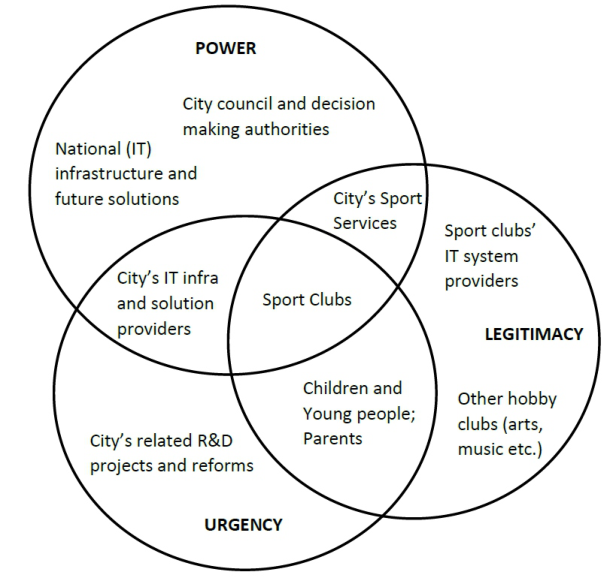
Conceptual Stakeholder Analysis for Overview Stakeholders involved in the development of hobby voucher were placed in accordance with the typology by Mitchell et al. (1997) (Figure 1). The clas- sification is not a comprehensive list of stakeholders or in the most detailed level, but the aim has been to place the type of stakeholder to a category, and at least one type to each category. It should also be noted that the classification was established at a specific point in time and both the num- ber and characteristics of the stakeholders may have changed since then. The classifications are not the views of the City of Turku, but they have been made solely based on the experiences of the researchers and their own analysis to support identification and involvement of stakeholders in the future.
Co-Creating Public Service: Development of Hobby Voucher 97
Figure 1: Stakeholders of co-creation of hobby voucher placed based on their char- acteristics of power, legitimacy and urgency (adopted from Mitchell et al., 1997).
The core target group has rightly been sports clubs, whose views have been listened to carefully in co-creation. The clubs have been able to express their concerns and demands for development. Other ancillary projects of the city have been presented as demanding stakeholders, as decisions related to, for example how much sport facilities usage costs, have an immediate and urgent impact on both sport club finances and the development of hobby vouchers. Other forms of hobbies and clubs, such as art and music hobby providers have not participated in the development so far and therefore have not made any claims (urgency feature) or gained or used power in the development of hobby vouchers. Their involvement has been discussed and is considered in the future plans.
For the time being, children and young people targeted by the hobby voucher have been placed in the dependent stakeholder group (i.e., legiti- mate and urgent). They have not yet been directly involved in development and indirect participation gives little influence and power. The IT suppli- ers of sports clubs have provided valuable insight and information on the possible implementation options for the hobby voucher and its integration into the clubs’ information management practices. However, because the hobby voucher is not intended to be developed with the clubs’ technology solution in mind, their IT suppliers have had significantly less power than,
for example, the city’s current system infrastructure, its administrators, and suppliers. The reason is that the digital solution of the hobby voucher must always be suitable for the city’s information management and financial man- agement systems, even if it does not fit into the system of an individual club. National IT solutions and other changes brought about through legislation and recommendations can now be seen as a sleeping, but power-wielding, stakeholder.
DISCUSSION
Stakeholder identification and engagement became concrete at least in three different ways: Directly identifying and involving stakeholders in a sparring group and interviews, iteratively identifying stakeholders in joint workshops, and conceptually identifying stakeholders and their current state of involve- ment by typology. The methods are not mutually exclusive, but a continuum where, for example, after direct identification of core stakeholders, coop- eration can proceed to identify new stakeholders, such as in snowballing process (see Ansell & Torfing, 2021, p. 113). Theoretical tools, such as stake- holder analysis, provided certainty about the role of stakeholders and their due consideration at any stage of the development project.
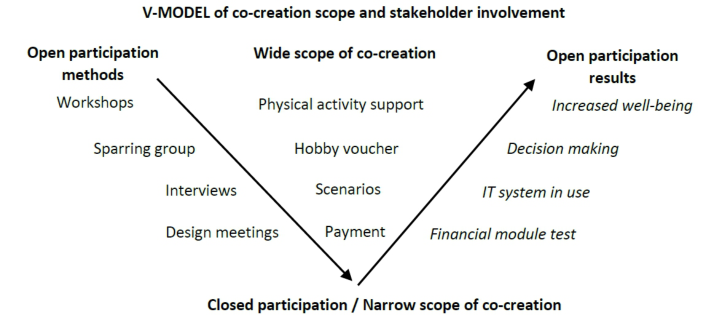
Figure 2: Illustration of the scope and focus of participation in the co-creation process.
Process of co-creation and its design phase turned gradually from open to closed participation of stakeholders, and from wide, well-being and decision- making topics, to narrower topics like technical integration or payment allocation (Fig. 2). Considering the future development of hobby voucher, after solving the technical details, co-creation should proceed back to more open participation methods and wider scope that affects more citizens. For example, to understand and measure the effectiveness of the scenario of increased well-being more citizens and actors in the field must be involved. In addition, parallel special groups of internal experts and external stakehold- ers are needed to design scenarios and solutions to other than payment. Such
Co-Creating Public Service: Development of Hobby Voucher 99
future actions and results are described on the right in the V-model (italic text).
ACKNOWLEDGMENT
The authors would like to acknowledge the support of City of Turku, Finland and EU/ERDF funded REDISOTE-project (A77593).
REFERENCES
Ansell C, Torfing J. (2021). The Complex and Dynamic Process of Co-creating Public Value. In: Public Governance as Co-Creation: A Strategy for Revitalizing the Public Sector and Rejuvenating Democracy. Cambridge Studies in Comparative Public Policy. Cambridge University Press; 2021: 107–135. Boonstra, A., Govers, M. J. G. (2009). Understanding ERP system implementation
in a hospital by analysing stakeholders. New Technology, Work and Employment 24:2. 177–193. Bødker, S., Iversen, O. S. (2002). Staging a Professional Participatory Design Practice – Moving PD beyond the Initial Fascination of User Involvement. In: Proceedings of the second Nordic conference on Human-computer interaction, NordiCHI’02. Århus, October 19–23, 2002. ACM: 11–18. Bødker, M. (2009). Performative artefacts: users “speaking through” artefacts in
collaborative design. In: Proceedings of the 21st Annual Conference of OzCHI, Melbourne, Australia. Fuglsang, L., Hansen, A. V., Mergel, I., Taivalsaari Røhnebæk M. (2021). Living labs for public sector innovation: An integrative literature review. Administrative Sciences, 11(2), 58. doi: https://doi.org/10.3390/admsci11020058. Gray, B. (1989). Collaborating: Finding Common Ground for Multiparty Problems.
San Francisco: Jossey-Bass. Gustafson S. L., Rhodes R. E. (2006). Parental correlates of physical activity in children and early adolescents. Sports Med. 2006;36(1):79–97. Harris S. (2000). Readiness to participate in sports. In: Sullivan JA, Anderson SJ,
editors. Care of the Young Athlete. Rosemont, Illinois: American Academy of Orthopaedic Surgeons and American Academy of Pediatrics; 2000. pp. 19–24. Howie E. K., McVeigh J. A., Smith A. J., Straker L. M. (2016). Organized sport trajectories from childhood to adolescence and health associations. Med Sci Sports Exerc. 2016;48(7):1331–1339. Khan, A., Krishnan, S. (2021), Citizen engagement in co-creation of e-government
services: A process theory view from a meta-synthesis approach, Internet Research, Vol. 31 No. 4, pp. 1318–1375. https://doi.org/10.1108/INTR-03- 2020-0116 Kristjansson A. L., Mann M. J., Sigfusson J., Thorisdottir I. E., Allegrante J. P., Sigfusdottir I. D. (2020). Development and Guiding Principles of the Icelandic Model for Preventing Adolescent Substance Use. Health Promotion Practice, 21(1): 62–69. doi: 10.1177/1524839919849032. Logan K., Cuff S., (2019). AAP Council on Sports Medicine and Fitness. Organized
Sports for Children, Preadolescents, and Adolescents. Pediatrics. 2019; 143(6). Mitchell, R., Agle, B. R., Wood, D. J. (1997). Toward a theory of stakeholder identification and salience: Defining the principle of who and what really counts. Academy of Management Review, 22 (4), 853–886. Purcell, L. et al. (2005). Sport readiness in children and youth. Paediatr Child Health.
2005;10(6):343–344.
Tarkkanen, K., Reijonen, P., Harkke, V. (2013). Roles and identification of stakeholders in health care IS development. Aalto University Publication Series: Science & Technology. Co-Create 2013. Harold, ed. (2003). Handbook of human systems integration. New Jersey: Wiley. Toots, M., McBride, K., Kalvet, T., Krimmer, R., Tambouris, E., Panopoulou, E.,...
Tarabanis, K. (2017). A framework for data-driven public service co-production. In Electronic Government: 16th IFIP WG 8.5 International Conference, EGOV 2017, St. Petersburg, Russia, September 4-7, 2017, Proceedings 16 (pp. 264–275). Springer International Publishing. WHO, (2022). The Global Status Report on Physical Activity 2022. https://www.who.int/teams/health-promotion/physical-activity/global-status -report-on-physical-activity-2022
LISTED IN THE AHFE DIGITAL BOOKSTORE CATALOGUE
Explore the complete digital volume
Human Dynamics, Product Evaluation and Quality
Read this individual research paper free through the original publisher, or explore the full digital proceedings book.
ISBN 978-1-964867-07-6
Explore this ISBN in the AHFE Bookstore ↗Listed in the July 2026 bookstore catalogue; search by ISBN to confirm current availability · Digital book purchase optional