Elina Kontio, Niina Katajapuu, Jussi Salmi, Juho Metsavuori, Mikko Pohjola (2024). Knowledge Management in Sport; Case MyE.Way Knowledge Management System. In: Human Factors, Business Management and Society. AHFE Open Access, vol. 135, pp. 227–236. https://doi.org/10.54941/ahfe1004949
Tracking performance and development of athletes and teams has been common in sports coaching for long. In the past, training log, stopwatch and measurement tape were easy and commonly available tools, whereas more complicated measurements such as heart rate, oxygen consumption, or power output used to require special equipment and protocols typically applied only in laboratory settings by trained experts. During recent decades, the development of technology has made the collection of data commonplace in everyday sporting contexts. Accordingly, data-driven approach to performance development has become possible. Performance tracking protocols of football teams can include daily data collection of training types and amounts, physical performance, skills and cognitive performance test results, game analysis data, psychosocial characteristics and match results and many other variables. However, mere collection of data does not guarantee the effective use of data. Instead, the amount of data can even be a burden for sports coaches and experts and make it difficult to recognize what is essential and what is not. Data from different sources must be integrated to enable holistic analysis. Furthermore, data must be turned into usable information. It needs to be provided for use in decision making about concrete actions aiming for desired outcomes. To make the data usable in changing decision-making contexts by different users, sophisticated data-analysis methods are needed. Machine learning (ML) and artificial intelligence (AI) can help in identification of essential variables, personalization, forecasting future development, and generating action recommendations. At best, knowledge management influences the knowledge and actions of human actors by means of technology. However, it is necessary to also develop the processes wherein the knowledge is applied. MyE.Way is a knowledge management system implementing the E.Way framework for holistic performance development. It is developed for and applied in football, futsal and floorball. Together MyE.Way and E.Way constitute a pragmatic knowledge service providing decision support, but also creating a platform for education of the actors engaging in the player development processes.
When developing performance of human action, collection and use of many kinds of data describing completed activities and characterizing different aspects of the state of performance is essential. The term performance devel- opment implies an attempt to cause an intentional change in performance towards a future state, which is valued as better than the current state. Therefore, understanding the current state, in all points of time, is necessary for identifying and choosing the actions driving and verifying the change. The more complex the phenomena in question are, the more important it is that the characterizations of the current and altered states are based on systematically collected data.
Data-driven approaches to performance development are becoming increasingly popular in the corporate world. For example, in financing busi- ness data-driven decision-making is seen as the process of using data and analytics to inform business decisions, and thereby improve the accuracy and efficiency of decision-making processes, reduce the risk of incorrect deci- sions, and gain a competitive advantage (Pisoni et al., 2023). It has even been stated that a revolution of transforming traditional organizations into knowledge-intensive data-driven organizations is taking place (Le Dinh et al., 2016). Data-driven approaches to performance development are not only possible in the corporate world, but they can also be used to develop the performance of athletes and sport teams. The relatively recent expansion of technology in sport has enabled an explosion in the amount of data collected and the range and variety of attributes that are measured and recorded (Dwyer et al., 2022). For example, training types and amounts, physical performance, skills and cognitive performance test results, game analysis data, psychosocial charac- teristics, match results and many other variables can be included in a regular performance tracking protocol of a football team.
Knowledge management has been used to refer to attempts of making data and information more usable by means of information technology at least since Vannevar Bush developed the Memex knowledge management system for organizing growing scientific literature in the 1940’s (Nyce and Kahn, 1989). In the modern context, knowledge management is seen to involve the systematic collection, organization, and dissemination of information and knowledge within an organization. (Pisoni et al., 2023).
Knowledge Management Systems are technologies that facilitate the gen- eration and sharing of knowledge to serve the needs of organizations in diverse sectors (Lee and Chen, 2012). They are IT-based systems developed to support and enhance the organizational processes of knowledge creation, storage/retrieval, transfer, and application (Alavi and Leidner, 2001). As vast amounts of data are routinely collected about athletes and players, coach- ing decisions and game events, the sports environment is ideal for knowledge management approaches (Schumaker et al., 2010).
Elite coaches, athletes and other experts in sports often use their expe- rience, knowledge and intuition to make successful decisions. Before mod- ern tools for data analysis and knowledge management became commonly
Knowledge Management in Sport; Case MyE.Way Knowledge Management System 229
available, it was believed that these domain experts could effectively con- vert their collected data into usable knowledge (Schumaker et al., 2010). However, many critical decisions can be very difficult because the number of factors to consider and their interactions are too complex.
As the collection and storage of data has become easier, it has brought about the challenge of how to deal with it. The large amount of data can be both a burden and an opportunity in trying to answer the important questions of performance development (Dwyer et al., 2022). Already in 1995, Lapham and Bartlett described AI as a technology that has the potential to support and improve decision-making in sports and speed up the analytic process to free up time and resources for experts (Lapham and Bartlett, 1995). Since then, the use of ML has been advocated to build such decision support systems (Robertson 2020). Where the right kind of data is available, ML methods can be used to create models that can support complex decision-making (Chmait and Westerbeek, 2021).
In recent years, the role of AI and ML in sports has been rapidly expand- ing and gaining more attention in both the academic sector and the industry. The use of AI and ML in sports analytics facilitates an informed decision- making process and is one of the top benefits of AI in sports (Dwyer et al., 2022). The application of AI and ML in sports is making the world smarter for athletes, broadcasters, advertisers, and viewers who can get real-time statistics (Chmait and Westerbeek, 2021). The continuous collection of high- quality data is a prerequisite for using modern ML and AI methods effectively. One-time data collection for a specific research project does not enable the routine everyday use of data, even though it can reveal some insights about a group of people. Personalized AI uses the rich data collected from the greater population to provide insights about an individual.
Anyhow, mere pushing of data, even when based on sophisticated meth- ods, does not guarantee achieving desired outcomes. Human performance development is pragmatic application of knowledge against practical needs. It requires not only collection, integration, and analysis of data for decision- making, but the decided actions must also be implemented to achieve the intended performance improvements. Along the value-chain of knowledge- based decision-making, knowledge becomes intertwined with social action (Simpson, 2009).
Knowledge management systems can be seen insufficient if their functions are not interactively linked to the activities of the social networks using the system (Jarjoui and Murimi, 2023). Knowledge management systems should be perceived as hybrid networks constituted by the technology and its users (Pohjola, 2009).
A framework for building cognitive knowledge management systems, where they form an integral part of decision systems, providing the infrastruc- ture and processes that enable organizations to collect, analyze, and consume knowledge in a timely manner, while providing a feedback mechanism for continuous improvement has been proposed (Jarjoui and Murimi, 2023). Here cognition refers particularly to intelligent information practices using advanced technologies and feedback mechanisms to improve the knowledge management system’s overall capabilities (Jarjoui and Murimi, 2023).
In a service-oriented architecture for knowledge management systems, knowledge management systems are seen to consist of different service layers (Le Dinh et al., 2016):
Data-as-a-Service (DaaS)
Information-as-a-Service (IaaS)
Knowledge-as-a-Service (KaaS)
Business-Process-as-a-Service (BPaaS) This model explicitly incorporates knowledge application and the users of the knowledge management system into the architecture on the BPaaS layer.
Knowledge management systems, as hybrids of technology and its use, can also be considered as pragmatic knowledge services, which are required to (Pohjola et al., 2011):
1. Enable collaborative knowledge creation 2. Support development and application of collaborative knowledge prac- tices 3. Support practical implementation of knowledge 4. Adapt to changing contexts, situations, and purposes.
This knowledge service approach emphasizes the application of knowledge and sets the technical properties and the content of the system conditional to the use purposes of the knowledge.
In the sports domain, the value-chain from data collection to implementa- tion of knowledge in practice and on to observable changes in performance, is often relatively short and direct. For example, individualization of team training based on data about players’ training loads and states of recov- ery can help to have the team both well-trained and well-recovered on the matchday. Sports domain is thus a good environment for developing and piloting knowledge management systems for effective human performance development.
However, in addition to tools and systems, also the processes, wherein the knowledge is applied, must be developed to make data and information con- nect with practical needs of performance development. The processes must be in line with the principles of Brunner’s pragmatic paradigm for policy practice which i) considers knowledge as intertwined with action, ii) devel- ops context-sensitive practical knowledge, and iii) evaluates knowledge and actions according to their purposes (Brunner, 2006).
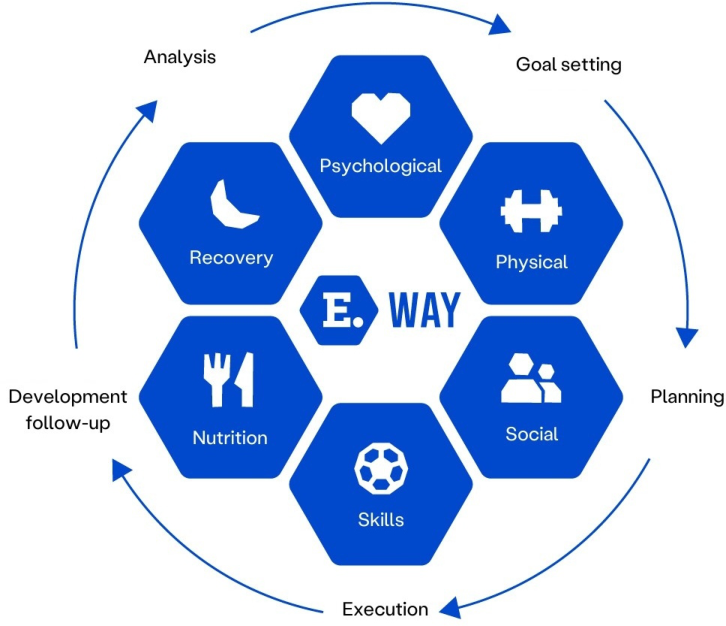
E.WAY – AN OPERATIONAL FRAMEWORK FOR HOLISTIC PERFORMACE DEVELOPMENT E.Way is an operational framework for holistic performance development (Figure 1). It is developed and applied by Eerikkilä Sport & Outdoor Resort, and it is a part of the organization’s culture and guides the skills and knowledge in improving holistic well-being and enabling success (www.eerikkila.fi/en/eerikkila-sport-outdoor-resort/e-way-philosophy-2/).
The E.Way framework consists of two main aspects:
Knowledge Management in Sport; Case MyE.Way Knowledge Management System 231
A holistic view to well-being and performance
Knowledge-cycle aiming for continuous improvement The holistic view considers well-being and performance in terms of six sectors: physical, psychological, social and skill characteristics together with the states of nutrition and recovery. Development of well-being and per- formance must always take account of all these sectors and their mutual balance. Accordingly, data from all sectors needs to be collected and used in the development of well-being and performance. In the E.Way framework the development of performance is perceived in connection with the development of overall well-being.
The knowledge-cycle starts with an analysis of the current situation, which is then compared against defined development goals. Actions aiming towards the goals are planned and then executed. With continuous collection of follow-up data, the changes resulting from these actions can be identified and evaluated resulting in an updated analysis of the situation. Through this iterative process, knowledge increases, actions become more effective, and well-being and performance improve.
Figure 1: E.Way framework for holistic performance development.
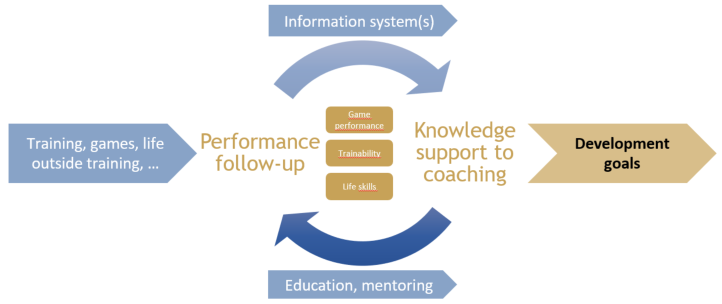
E.Way is a generally applicable operational framework, but it is specifically applied in the national player development programs in football, futsal and floorball in cooperation with the Football Association of Finland and Finland Floorball Federation. E.Way guides the design of data collection procedures, development of methods, tools and systems for data-analysis and decision support as well as education processes and other support to players, coaches and experts involved in the player development programs (Figure 2).
In the player development programs for football, futsal and floorball, the view into holistic well-being and performance is structured to characterize the state of development in three interlinked categories:
Game performance – the ability to perform in actual game situations
Trainability – the ability to develop game performance through training
Life skills – the ability to live a life, which supports effective training
Figure 2: Application of E.Way in the context of football player development.
These categories guide the integration of data and observations from all sectors of E.Way into contextually meaningful state of development charac- terizations of the player development program participants. They also help in identification of the relationships between the factors contributing, directly or indirectly, to the development of game performance on individual or group level. Ultimately, coaching decisions and actions can be more based on knowledge and more effective in aiming for the development goals.
MYE.WAY KNOWLEDGE MANAGEMENT SYSTEM FOR PERFORMANCE DEVELOPMENT MyE.Way is a knowledge management system, which implements the E.Way framework for holistic performance development. It is developed for and applied in player development programs for football, futsal and floorball in Finland. MyE.Way is maintained and developed by Eerikkilä Sport & Out- door Resort in cooperation with Turku University of Applied Sciences. Its users are primarily players, coaches, coaching directors, team managers and other experts from clubs, associations and other organizations operating in football, futsal, or floorball (Figure 3). MyE.Way can be adapted to many
Knowledge Management in Sport; Case MyE.Way Knowledge Management System 233
other areas in human performance development, but currently the primary use context is player development.
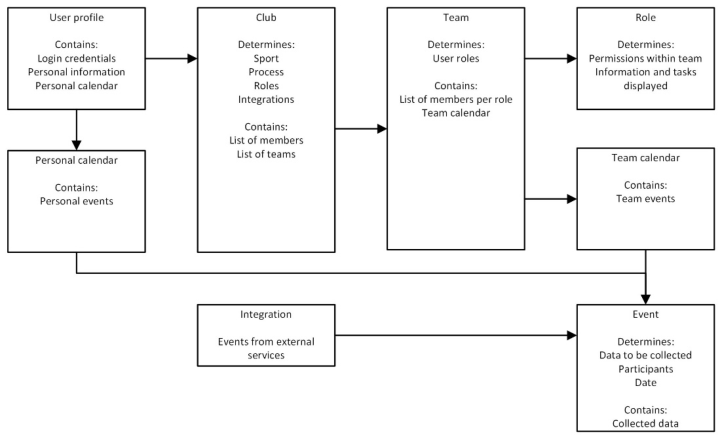
The system’s basic operational units are individual users and customer organizations, such as football, futsal, or floorball clubs. Customer orga- nizations can form groups, such as teams or training groups, and invite users to the groups. The users can be assigned different roles, such as player, coach, coaching director or team manager, in the groups. Events of different types, such as match, team training, individual training, or meeting, can be created and managed with the calendar function either on individual or group level. The roles, event types, terminology and user interface layouts are adapted to the needs of different sports or other use contexts.
Figure 3: Relationships between users, user groups, user roles and events in MyE.Way in an example case of a football, futsal or floorball club.
The data collected and stored in MyE.Way system consists of three types: user data, event data, and follow-up data (Table 1). All follow-up data is in relation to events via manual or automatic follow-up data collection tasks assigned to the events. Accordingly, the calendar function for creating and managing events is essential for using MyE.Way. The follow-up data is mostly collected on an individual level. Thereby, individual users can be invited as members of several customers and groups, for example two teams within the same club or a club team and a national team, simultaneously. The users can also adopt multiple roles, for example being a coach in one team and a player in another. The individual data is connected to the individual users while the groups, as aggregates of users, function primarily as layers of management and analysis.
Table 1. Data types in MyE.Way.
Table available in the original PDF paper.
Data type Purpose Examples User data Defines and describes the user.
Username, real name, club and team memberships, birthdate, email address. Event data Describes activities the users have engaged in.
Event type, event content description, date and time, location, participants. Follow-up data Describes performance characteristics of the users.
Body composition, physical test results, game performance assessment, recovery index.
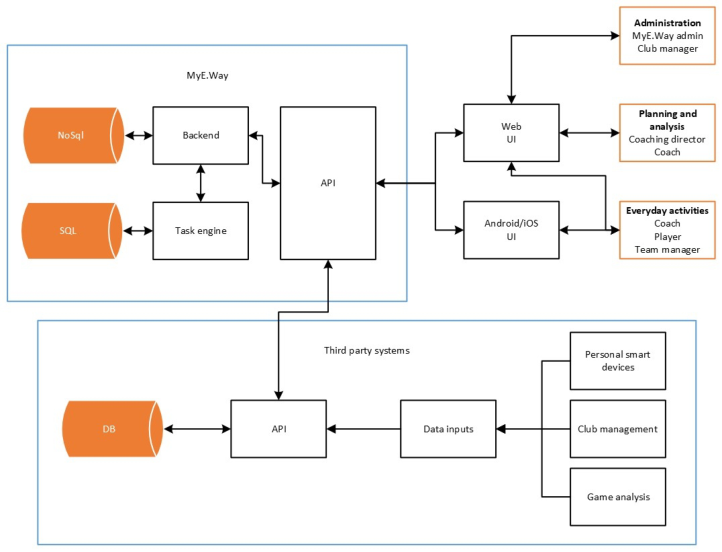
MyE.Way is an integrative system allowing input and transfer of data from various sources (Figure 4). The users in different roles input data through the web and mobile user interfaces, but data is collected also from third party sources such as competition management systems, game analysis systems, club management systems, training applications and measurement devices.
Figure 4: Overview of MyE.Way system architecture.
As the purpose of MyE.Way is to influence the behavior of its users to pro- mote performance development, the collected data is accessible to the users according to their roles and group memberships. Each user has ownership and access to his/her own data, but data is made available for display and
Knowledge Management in Sport; Case MyE.Way Knowledge Management System 235
analysis also to other users within the shared groups on individual or group level based on an informed consent.
The user data is available for display and editing on the user profile pages. Event data is available for display and editing in the calendar function, but essential event data summaries (e.g. training amounts and types) are also visualized on the frontpage of the user interfaces. Follow-up data is displayed and summarized on the frontpage and specific performance follow-up sub- pages (game performance, trainability, life skills) of the user interfaces. In addition, there is a data-analysis space where the users can, according to their roles and group memberships, make customized searches to the available data for analysis.
The views in the user interfaces are adapted according to different roles. For example, whereas a player can mostly view his/her own data, coaches can choose to view summaries on group levels or scrutinize individual level data of the users belonging to the groups. In the national player development pro- grams, also aggregated group-level data is shared between the participating clubs and teams.
The methods applied for integrating data and making it meaningful and usable for the users of MyE.Way are currently mainly based on visualization (tables, graphs, user interface layout), basic statistics, and manual analysis by users themselves. To better deal with big data accumulating from broad and continuous collection and be able to provide contextually and situation- ally useful information stimuli to its users, methods of AI and ML are being developed and tested. The aim is to enable automated role-specific personal- ized situational views to data and generation of action recommendations for performance development for all users.
DISCUSSION
The E.Way framework for holistic performance development and MyE.Way knowledge management system applying E.Way can be considered to con- stitute a pragmatic knowledge service in the context of player development in football, futsal and floorball. It connects the users and their activities with the system characterizing the users and informing their actions. As such it incorporates the (Business) Process-as-a-Service layer into the knowledge management system. It is also flexibly adaptable to different use contexts and purposes. Although the core of the knowledge service is in athlete performance development, the adapted E.Way approach for player develop- ment also creates an educational platform for actors engaging in the player development processes in different roles.
However, there is still remarkable space for improvement to make it a good pragmatic knowledge service. The functions of MyE.Way for supporting col- laboration within and by means of the system are still limited and need to be developed. In addition, the situational adaptation and practical implementa- tion of knowledge still relies mostly on the abilities and actions of the users and user groups of MyE.Way.
Currently the number of users in MyE.Way is approximately ten thou- sand and is expected to increase to several tens of thousands in the near
future as the player development programs in football, futsal and floorball are expanding to cover greater areas and more age groups. At the same time, more variables are included in the follow-up data collection procedures of all player development programs. Development of AI/ML-based functions for automated or semi-automated handling and display of data to provide prac- tical and personalized guidance to the users in their contextual and situational needs of knowledge support for performance development is in progress.
ACKNOWLEDGMENT
The authors would like to acknowledge Elina Pennanen and Laura Siren from Eerikkilä Sport & Outdoor Resort for helping with preparing Figure 1, and Ville-Pekka Inkilä from Football Association Finland for helping with preparing Figure 2 displayed in this paper.
REFERENCES
Alavi, M., Leidner, D. E. (2001). MIS Quarterly Vol. 25, No. 1, pp. 107–136. Brunner, R. D. (2006). A paradigm for practice. Policy Sciences 39, pp. 135–167. Chmait N., Westerbeek H. (2021). Artificial Intelligence and Machine Learning in Sport Research: An Introduction for Non-data Scientists. Frontiers in Sports and Active Living, 3–2021. Dwyer, D., Kempe, M, Knobbe A. (2022). Editorial: Using Artificial Intelligence to
Enhance Sport Performance. Frontiers in Sports and Active Living 4–2022. Jarjoui, S., and Murimi, R. (2023). “A Framework for Building Cognitive Knowledge Management Systems,” Communications of the IIMA: Vol. 21: Iss. 1, Article 6. Lapham, A. C., Bartlett, R. M. (1995). The use of artificial intelligence in the analysis
of sports performance: a review of applications in human gait analysis and future directions for sports biomechanics. J. Sports Sci. 13, 229–237. Le Dinh, T., Thuong-cang P., Trung B. (2016). “Towards an Architecture for Big Data-Driven Knowledge Management.” In Americas Conference on Information Systems. San Diego, CA: AMCIS. Lee, M. R., Chen, T. T. (2012). Revealing research themes and trends in knowledge
management: From 1995 to 2010, Knowledge-Based Systems, Volume 28, 2012, pp. 47–58. Nyce, J. M., Kahn, P. (1989). Innovation, pragmaticism, and technological continuity: Vannevar Bush’s memex. Journal of the American Society of Information Science, 40(3), 214–220. Pisoni, G., Molnár, B., & Tarcsi, Á. (2023). Knowledge Management and Data Anal-
ysis Techniques for Data-Driven Financial Companies. Journal of the Knowledge Economy, 1–20. Pohjola, P. (2009). Technical Things: An essay on the social constitution of technical artefacts. Cologne: Lambert Academic Publishers. ISBN: 978-3-8383-2113-4. Pohjola M. V., Pohjola P., Paavola S., Bauters M., Tuomisto J. T. (2011). Pragmatic
Knowledge Services. Journal of Universal Computer Science 2011, 17: 472–497. Robertson, S. (2020). Man and machine: Adaptive tools for the con- temporary performance analyst. J. Sports Sci. 13, 2118–2126. doi: 10.1080/02640414.2020.1774143. Schumaker, R. P., Solieman, O. K., Chen, H. (2010) Sports knowledge management and data mining. Annual Review of Information Science and Technology, 2010, 44.1: 115–157. Simpson, B. (2009). Pragmatism, Mead and the practice turn. Organization Studies
30, 1329–1347.
LISTED IN THE AHFE DIGITAL BOOKSTORE CATALOGUE
Explore the complete digital volume
Human Factors, Business Management and Society
Read this individual research paper free through the original publisher, or explore the full digital proceedings book.
ISBN 978-1-964867-11-3
Explore this ISBN in the AHFE Bookstore ↗Listed in the July 2026 bookstore catalogue; search by ISBN to confirm current availability · Digital book purchase optional