Marina Weck, Meri Jalonen, Heidi Kerkola (2024). Supporting Adoption of Circular Business Models in Small and Medium Enterprises: Circular Readiness Assessment Framework. In: Human Factors, Business Management and Society. AHFE Open Access, vol. 135, pp. 111–121. https://doi.org/10.54941/ahfe1004936
The circular economy (CE) is widely acknowledged as a highly promising and powerful alternative to the linear economy, representing one of the most significant advancements toward sustainability. Accelerating the transition to the CE requires the adoption of new circular business models (CBMs) by small and medium-sized enterprises (SMEs), given their central role in sustainable development and global economic growth. Despite extensive research on the CE and CBMs reported in the literature over the past decade, there have been limited publications focusing on the transition of SMEs to the CE through the adoption of CBMs. Specifically, there is a lack of frameworks, models, and practical tools for assessing the CE readiness of SMEs and supporting them in the adoption of CBMs. This paper presents an approach to conceptualizing and subsequently operationalizing the circular readiness assessment framework (CRAF), which provides a conceptual foundation for the development of a tool to assist SMEs, aiming to adopt new CBMs, in evaluating their current readiness to perform business processes and activities following CE principles. The framework consists of five key dimensions: sustainable use of materials, efficient utilization of capacity and resources, extended life cycle of machines and equipment, maximizing product and material value, and leveraging customer relationships. These dimensions represent the identified business process and activity areas essential for the effective adoption of CBMs but are often underperforming. The framework was operationalized by developing and testing the self-assessment tool through interviews with the most knowledgeable members of 19 Finnish SMEs across various manufacturing industry and service sectors. Subsequently, it was refined based on the findings, which complement previous research on challenges SMEs encounter in adopting CBMs. Although the 19 SMEs were already taking significant steps toward implementing CE principles in their processes, particularly in resource-efficient production development, many firms still faced difficulties in identifying a suitable CBM and aligning their processes with it. The findings also revealed that many SMEs, despite lacking in-depth expertise and familiarity with CE principles and related terminology, have integrated these principles into their processes and activities, indicating a strong motivation to renew their businesses with CBMs.
In the contemporary business environment, businesses grapple with unforeseen challenges, often exacerbated by rapid technological advance- ments and shifting market dynamics. Moreover, the linear produc- tion system imposes significant environmental burdens and economic disadvantages, compelling firms to adopt more sustainable approaches (Bocken et al., 2016; Merli et al., 2018). To navigate this complexity and address the evolving needs of the market, businesses must reassess their strate- gies and practices, particularly seeking those that align with sustainability principles. In this context, a new approach to sustainability, namely the Cir- cular Economy (CE), emerges as a promising, holistic, and solution-based framework focused on tackling global challenges and offering environmental, social, and economic benefits (Ellen McArthur Foundation, 2015).
The CE paradigm advocates for a shift from the linear take-make-dispose approach to circular and closed-loop systems, aiming to minimize waste and maximize resource efficiency (Hopkikinson et al., 2018; Ilic et al., 2018). This transition cannot be fully realized without the active participation of businesses of all sizes and sectors (Khan et al., 2022). Particularly, small and medium-sized enterprises (SMEs), accounting for over 90% of enter- prises and more than 50% of global employment (World Bank, n.d.), have a significant role in this changeover.
To effectively transition to the CE, businesses must innovate and upgrade their business models to incorporate CE principles (Pieroni et al., 2021). They are expected to develop new types of business models—circular econ- omy models, which are considered sustainable—by redefining their value propositions and reorganizing their value chains to enhance production effec- tiveness and cost efficiency (Rashid et al., 2013; Schulte, 2013). This pursuit seeks advantages such as improved economic performance, reduced resource utilization, and increased resilience (Camacho-Otero et al., 2018).
Despite the numerous advantages of circular business models (CBMs), some businesses encounter challenges when adopting CE strategies in prac- tice, leading to failures during the implementation process (de Angelis, 2021). It has been noted that SMEs face particular difficulties in engaging with the CE (Mura et al., 2020), as they often operate under significant stress to survive and function with limited resources. Nevertheless, recent studies have shown that SMEs in various countries are actively embracing CE ini- tiatives (Scipioni and Niccolini, 2021), and they are increasingly recognizing the urgent need to transition toward more sustainable business models such as CBMs.
However, empirical studies regarding the engagement of SMEs with CE are lacking. Hina et al. (2022) have emphasized the necessity for further empirical research to investigate the drivers and barriers influencing the implementation of CBMs. While this phenomenon has been extensively studied in large companies, research on the pres- ence of CE practices and their performance in SMEs is insufficient (Cantú et al., 2021; Dey et al., 2020; Sharma et al., 2020). Specifically, there is a shortage of frameworks, models, and tools for assessing the readiness of SMEs to transition to CE (e.g., Vinante et al., 2021) and supporting them in adopting new CBMs.
Supporting Adoption of Circular Business Models in Small and Medium Enterprises 113
To address the aforementioned gaps, this paper presents the outcomes of the two main objectives of this study: the first is to conceptualize the circu- lar readiness assessment framework (CRAF) as a conceptual foundation for a practical self-assessment tool designed to support SMEs in the adoption of new CBMs by evaluating their current CE readiness and enhancing their capabilities to perform business processes and activities with CE principles and the second is to operationalize the CRAF by developing and testing the self-assessment tool.
This paper is structured into the following sections: after this introduction, a conceptualization of the CRAF is introduced based on theoretical analysis, comprising two sub-sections. The result is well-established dimensions and explicit structure of the CRAF suitable for SMEs operating across various manufacturing industry and service sectors. The next section discusses the findings derived from self-assessment tool tests during interviews with the most knowledgeable members of 19 Finnish SMEs across various manufac- turing industry and service sectors. The paper concludes with a summary of key findings and some implications.
CONCEPTUALIZING CIRCULAR READINESS ASSESSMENT FRAMEWORK This section introduces the approach to conceptualizing the CRAF, which comprises two major stages. The objectives of the first stage were twofold: (1) to identify the main business process and activity areas essential for the effec- tive adoption of CBMs by SMEs and (2) to introduce the rationale behind the structure of CRAF. To ensure the effective and efficient performance of identified activities, they should be monitored and controlled. Therefore, the second stage focused on adopting the business process maturity model (BPMM) to assess the performance of the identified business processes and activities.
Readiness Assessment Supporting the Adoption of CBMs This paper highlights the importance of business models in driving the long- term success of the CE, as emphasized by Schulte (2013), who advocated for a shift in perspective. Although the concept of CBMs emerged rela- tively recently, initially mentioned in 2006 by Schwager and Moser (2006), it gained traction with increased promotion of CE principles by influential organizations such as the Ellen MacArthur Foundation and the World Eco- nomic Forum (EMF, 2012; WEF, 2014). A growing interest in the field is underscored by the emergence of prominent studies conducted by Bocken et al. (2016, 2019), Geissdoerfer et al. (2017), Murray et al. (2017), Díaz-López et al. (2019), Pieroni et al. (2019), Rosa et al. (2019), and several other researchers who have contributed to defining and classifying CBMs. For instance, Geissdoerfer et al. (2018, pp. 713–714) defined CBMs as “SBMs - which are business models that aim at solutions for sustain- able development by creating additional monetary and non-monetary value by the pro-active management of multiple stakeholders and incorporate a
long-term perspective - that are specifically aiming at solutions for the Cir- cular Economy through a circular value chain and stakeholder incentive alignment.” In terms of CBM typology, one of the most recognized and fre- quently used frameworks is the “ReSOLVE framework” developed by the Ellen MacArthur Foundation (2015). This framework delineates six dis- tinct approaches to circularity: regenerate, share, optimize, loop, virtualize, and exchange. The typology in focus in this paper, proposed by Sitra and Deloitte (2022, pp. 46–48), encompasses five CBMs: circular inputs, sharing platforms, product as a service, product life cycle extension, and resource recovery. By adopting these CBMs, firms can effectively transform inefficien- cies within their value chains into new value propositions, with each model offering unique business benefits, financial impacts, operational effects, and varying degrees of implementation ease (Sitra and Deloitte, 2022). In other words, these CBMs address inefficiencies and create value for firms (Sitra and Deloitte, 2022, p. 46):
1) Circular inputs: Using recycled and bio-based materials and renewable energy; designing sustainable, repairable, and recyclable products. 2) Sharing platforms: Facilitating increased utilization of goods and resources via digital platforms, including leasing, co-use, and sharing. 3) Product as a service: Paying for a particular function or performance rather than owning a product, with revenue from service or lease agree- ments. 4) Product life cycle extension: Achieving product life extensions through repair, maintenance, upgrading, resale, and remanufacturing. 5) Resource recovery: Recovering usable resources or energy from waste or byproducts.
As the objective is to create a practical tool to support SMEs in self- assessment and enhance their process capabilities essential for the adoption of new CBMs, addressing inefficiencies in the value chain is crucial as they may hinder the effective adoption of CBMs. The following inefficiencies were
Supporting Adoption of Circular Business Models in Small and Medium Enterprises 115
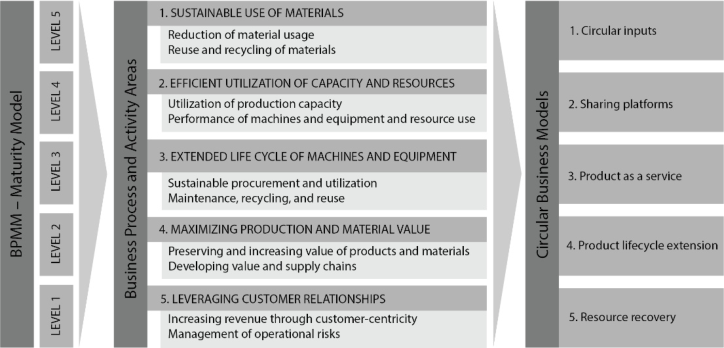
utilized (Sitra and Deloitte, 2022, s. 9): (1) unsustainable use of materials: materials are not recovered; (2) underused capacity: products and resources are not being used efficiently; (3) short product lifetime: products are not used to their full lifetime potential; (4) wasted end-of-life value: products and materials are wasted, for example, in landfills or incineration; (5) not deriv- ing the maximum out of customer relationships: for example, focusing on the quantity of products means missing opportunities for services and additional sales. These inefficiencies formed the basis for identifying five main areas of business processes essential for the effective adoption of CBMs by SMEs. Accordingly, they constitute the key dimensions of the CRAF (see Figure 1), serving as the conceptual foundation for developing the self-assessment tool.
Maturity Model for Circular Readiness Assessment Framework The effectiveness and efficiency of organizations in executing business pro- cesses are often assessed through process maturity, which serves as a relative measure of how thoroughly processes are defined, documented, standard- ized, and optimized to ensure greater predictability and reliability of results. This assessment has been widely facilitated by several maturity models. Thus, the original capability maturity model (CMM)—created to address issues within software development processes and evaluate the capabilities of soft- ware organizations (Paulk et al., 1995)—consists of five stages through which organizations progress to understand business process maturity from an immature to a mature level, thereby laying the groundwork for subsequent the most widely used process maturity models.
Table 1. BPMM - Maturity model for capability assessment (adapted from Gardiner et al., 2008).
Table available in the original PDF paper.
Maturity Levels Descriptions Level 5: Innovative Performance is constantly evaluated and developed to meet the requirements, standards and practices of CE legislation and regulations. Level 4: Predictable Performance is quantitatively controlled and predictable to enable the firm to achieve explicit CE objectives. Level 3: Standardized Performance is standardized and based on best practices aligning with the CE principles. Level 2: Managed Performance is systematically lacking well-established practices that promote CE principles. Level 1: Initial Performance is inconsistent without any initiatives to engage CE thinking and principles.
The extended version of CMM, namely capability maturity model integra- tion (CMMI), was designed to assist organizations in systematically assessing and improving their process capabilities across diverse industries (CMMI Product Team, 2002). The business process maturity model (BPMM) offers an alternative to CMM and CMMI for organizations aiming to evaluate the maturity of their business process capabilities and is applicable across various domains (Object Management Group [OMG], 2008).
To assess the performance of the identified business processes and activ- ities imperative for the effective adoption of CBMs by firms, the BPMM was adopted. It consists of five maturity levels associated with capability to perform business processes and activities as per CE principles. The pro- posed maturity levels of BPMM and their corresponding descriptions are introduced in Table 1 and integrated into the framework for the readiness assessment of SMEs to adopt CBMs (see Figure 1).
OPERATIONALIZING CRAF The CRAF was operationalized by developing and testing the self-assessment tool through interviews with managers of 19 Finnish SMEs across various industries and service sectors. The interviews were conducted between Octo- ber and December 2023. The developed tool consists of 5 main business process areas and 10 activity areas identified as essential for SMEs to effec- tively adopt CBMs (refer to Table 2). The 30 specific activities, which were determined and listed for assessment under the 10 activity areas, are not included in Table 2.
In the analysis of the interview data, capabilities of SMEs to perform business processes and activities as per CE principles and their development needs for adopting CBMs were evaluated. Table 2 summarizes these find- ings. The interviews also revealed that, despite lacking in-depth expertise and familiarity with CE principles and terminology, many SMEs instinctively inte- grate CE principles into their business processes and activities, indicating a strong motivation for ongoing development. While all firms shared motiva- tion toward transitioning their businesses to CE, they differed in terms of the activities already undertaken and the extent to which CE was integrated into their strategy and operations. Additionally, a significant variation in the way firms evaluated their CE capabilities and performance was observed. Whereas firms positioning themselves as CE pioneers in their field rated their maturity level as high in most dimensions, some firms rated their maturity level as low in key dimensions even though they were already operating according to CE principles.
Table 2. Current process capabilities and development needs for the adoption of CBMs.
Table available in the original PDF paper.
Current Process Capabilities Development Needs
1. Sustainable use of materials Reduction of material usage Many firms were already aware of the environmental impacts of various materials, carefully considered the materials to be used already in the product design and tried to use raw materials efficiently.
Some service firms found it difficult to assess materials use, reduce their use, and replace them with sustainable and environmentally conscious products and services.
(Continued)
Supporting Adoption of Circular Business Models in Small and Medium Enterprises 117
Table 2. Continued Current Process Capabilities Development Needs
Table available in the original PDF paper.
Reuse and recycling of materials Many manufacturing, waste management, design and engineering, and handicraft firms specialized in materials reuse and recycling.
Some service firms found it difficult to improve the reuse and recycling of materials since that was not central to their business operations. 2. Efficient utilization of capacity and resources Utilization of production capacity Some manufacturing, design and engineering, and handicraft firms have already optimized their processes and production capacity according to resource use.
Some manufacturing and handicraft firms were still developing their ability to optimize production processes. Performance of machines and equipment and resource usage Several firms aimed to ensure the efficient performance of machines and equipment throughout their entire life cycle and followed the resource efficiency of their operations.
Some manufacturing firms were still developing their ability to improve the utilization rate of resources. 3. Extended life cycle of machines and equipment Sustainable procurement and utilization Many firms aimed to extend the life cycle of their machines and equipment during procurement (e.g., preferring to buy them used) and utilization.
Some manufacturing firms were still developing their ability to extend the life cycle of their machines and equipment. Maintenance, recycling, and reuse Several firms carefully maintained their machines and equipment and recycled them at the end-of-life stage.
Some manufacturing firms were still developing their abilities to extend the life cycle of their machines and equipment. 4. Maximizing production and materials value Preserving and increasing value of products and materials Many manufacturing, waste management, design and engineering, and handicraft firms had circularity at the heart of their business model.
Most of the firms had already started looking for opportunities for preserving and increasing value through circularity. Developing value and supply chains Several firms have already started developing sustainability across the entire value and supply chain.
Many firms were still developing their capability to include sustainability in the value and supply chains. 5. Leveraging customer relationships Increasing revenue through customer centricity Many firms were already utilizing customer preferences and feedback to improve their products and services.
Many firms were only starting to develop their services offering to increase revenue.
(Continued)
Table 2. Continued Current Process Capabilities Development Needs
Table available in the original PDF paper.
Managing of operational risks Some manufacturing, waste management, design and engineering, and handicraft firms were already branding themselves as forerunners of CE to differentiate themselves from competitors.
Many firms struggled to communicate their sustainability actions to customers or to build long-term customer relationships.
CONCLUSION
Aligned with the main two objectives of the study, this paper presents an approach to conceptualizing and then operationalizing the CRAF. The main dimensions of the CRAF, namely the main business process and activity areas, were derived from inefficiencies in the value chain listed by Sitra and Deloitte (2022), which may hinder the effective adoption of CBMs by SMEs. The framework was conceptualized by utilizing these identified main business process and activity areas in addition to using the BPMM for assessing the capability maturity in performing these processes and activities according to CE principles.
The study contributes to theory and practice in three primary ways: First, the proposed CRAF provided a conceptual foundation for developing a prac- tical self-assessment tool designed to assist SMEs in evaluating their current readiness to perform business processes and activities as per CE principles. Second, the developed tool provides firms with a comprehensive roadmap to gain a deeper understanding of the complex process capabilities neces- sary for adopting CBMs and to determine the current maturity level and development needs of these capabilities. Third, the tool is also scalable for use by various SMEs across different industry sectors and feasible for self- assessment because of its robust and consistent structure, which supports the straightforward transition to CE through more sustainable CBMs.
The interview findings regarding the current CE readiness of 19 SMEs who participated in the study corroborate previous observations about the improving maturity level of CE, especially in the Nordic countries (Nordic Innovation, 2023). However, the transition to CE needs to be expedited to reach the sustainability targets. The findings also highlighted that despite lacking in-depth expertise and familiarity with CE principles and related terminology, many SMEs have already integrated these principles well into their processes and activities, taking important steps in adopting CBMs. For instance, most firms were already improving the resource efficiency of their production, but many of them still struggled to identify a suitable CBM and align their processes with it, especially in creating enduring value across the entire value chain, which appeared particularly challenging for SMEs. Impor- tantly, SMEs shared a strong motivation to continue their efforts to renew their businesses with CBMs.
In terms of practical implications and design of the developed self- assessment tool, the interviews revealed two main limitations. The first is
Supporting Adoption of Circular Business Models in Small and Medium Enterprises 119
related to its scalability in the service sector, as some of the process and activ- ity areas are more suitable for manufacturing firms and require features that are tailored for service-providing firms. The second limitation concerns the utility of all identified process and activity areas for each CBM separately. The interviews provided clear evidence of the further development needs of the tool, thereby offering avenues for future study.
ACKNOWLEDGMENT
This paper presents the intermediate results of the study conducted within the “KIITO - Renewing business with circular economy know-how” project, which aims at supporting Finnish SMEs in adopting and implementing new CBMs. The project is co-funded by the European Union through the Häme Centre for Economic Development, Transport, and the Environment (Fin- land). The authors would like to extend their gratitude to the managers of 19 SMEs who contributed to the development of the self-assessment tool by evaluating the readiness of their firms to transition to CE and providing feedback on it. The authors would also like to acknowledge the contribution of the faculty and students of two Finnish Universities of Applied Sciences (HAMK and LAB) in gathering data through the interviews.
REFERENCES
Bocken, N., de Pauw, I., Bakker, C. and van der Grinten, B. (2016) ‘Product design and business model strategies for a circular economy’, Journal of Industrial and Production Engineering,’ 33(5), pp. 308–320. https://doi.org/10.1080/21681015. 2016.1172124 Bocken, N., Strupeit, L., Whalen, K. and Nußholz, J. (2019) ‘A review and evalua-
tion of circular business model innovation tools’, Sustainability, 11(8), p. 2210. https://www.mdpi.com/2071-1050/11/8/2210 Camacho-Otero, J., Boks, C. and Pettersen, I. (2018) ‘Consumption in the Circular Economy: A literature review,’ Sustainability, 10(8), p. 2758. https://doi.org/10. 3390/su10082758 Cantú, A., Aguiñaga, E. and Scheel, C. (2021) ‘Learning from failure and success:
The challenges for circular economy implementation in SMEs in an emerging economy’, Sustainability, 13(3), 1–34. https://doi.org/10.3390/su13031529 CMMI Product Team. (2002) ‘CMMI for software engineering, Ver- sion 1.1, Staged Representation (CMMI-SW, V1.1, Staged)’, Software Engineering Institute, Technical Report No. CMU/SEI-2002-TR- 029. https://doi.org/10.1184/R1/6572408.v1 De Angelis, R. (2022) ‘Circular economy business models as resilient complex adaptive systems’, Business Strategy and the Environment, 31(5), pp. 2245–2255. https://doi.org/10.1002/bse.3019 Dey, P. K., Malesios, C., De, D., Budhwar, P., Chowdhury, S. and Cheffi,
W. (2020) ’Circular economy to enhance sustainability of small and medium- sized enterprises’ Business Strategy and the Environment, 29(6), pp. 2145–2169. https://doi.org/10.1002/bse.2492 Diaz Lopez, F. J., Bastein, T. and Tukker, A. (2019) ’Business model innovation for resource efficiency, circularity and cleaner production: What 143 cases tell us’ Ecological Economics, 155, pp. 20–35. https://doi.org/10.1016/j.ecolecon.2018. 03.009
Ellen McArthur Foundation (2015) Towards a Circular Econ- omy: Business Rationale for an Accelerated Transition. https://www.ellenmacarthurfoundation.org/assets/downloads/TCE_ Ellen- MacArthur-Foundation_9-Dec-2015.pdf (Accessed: 20 December 2023). Gardiner, T., Weber, C. and Curtis, B. (2008) Business process maturity model (BPMM) - Version 1.0. Needham: Open Management Group. Available at: https: //www.omg.org/spec/BPMM/1.0/PDF (Accessed 13 December 2023). Geissdoerfer, M., Morioka, S., De Carvalho, M., and Evans, S. (2018) ’Business
models and supply chains for the circular economy’ Journal of Cleaner Production, 190, pp. 712–721. https://doi.org/10.1016/j.jclepro.2018.04.159 Geissdoerfer, M., Savaget, P., Bocken, N., and Hultink, E. (2017) ’The Circular Economy: A new sustainability paradigm?’ Journal of Cleaner Production, 143, pp. 757–768. https://doi.org/10.1016/j.jclepro.2016.12.048 Hina, M. Chauhan, C. Kaur, P. Kraus, S. and Dhir, A. (2022) ‘Drivers and barriers
of circular economy business models: Where we are now, and where we are head- ing’, Journal of Cleaner Production, 333, 130049. https://doi.org/10.1016/j.jclepr o.2021.130049 Hopkinson, P., Zils, M., Hawkins, P. and Roper, S. (2018) ‘Managing a complex global circular economy business model: Opportunities and challenges’, California Management Review, 60(3), pp. 71–94. https://doi.org/10.1177/ 0008125618764692 Ilic, D. D., Eriksson, O., Ödlund, L. and Åberg, M. (2018) ‘No zero burden assump-
tion in a circular economy’, Journal of Cleaner Production, 182, pp. 352–362. https://doi.org/10.1016/j.jclepro.2018.02.031 Khan, S. A. R., Shah, A. S. A., Yu, Z. and Tanveer, M. (2022) ‘A systematic literature review on circular economy practices: Challenges, opportunities and future trends’, Journal of Entrepreneurship in Emerging Economies, 14(5), pp. 754–795. Merli, R., Preziosi, M. and Acampora, A. (2018) ‘How do scholars approach the
circular economy? A systematic literature review’, Journal of Cleaner Production, 178(3), pp. 703–722. https://doi.org/10.1016/j.jclepro.2017.12.112 Mura, M., Longo, M., and Zanni, S. (2020) ‘Circular economy in Italian SMEs: A multimethod study’, Journal of Cleaner Production, 245, 118821. https://doi.org/ 10.1016/j.jclepro.2019.118821 Murray, A., Skene, K. and Haynes, K. (2017) ‘The circular economy: An interdisciplinary exploration of the concept and application in a global context’, Journal of Business Ethics, 140(3), pp. 369–380. https://doi.org/10.1007/s10551-015-2693-2 Nordic Innovation. (2023) Circular Business Models in the Manufacturing Industry – Current Status and Development. Nordic Innovation. Avail- able at: https://www.norden.org/en/publication/circular-business-models-nordic- manufacturing-industry-current-status-and-development (Accessed: 12 February 2024). Paulk, M., Weber, C., Curtis, B. and Chrissis, M. (1995) The capability maturity
model: Guidelines for improving the software process. Boston: Addison-Wesley. Pieroni, M., McAloone, T., Borgianni, Y., Maccioni, L. and Pigosso, D. (2021) ‘An expert system for circular economy business modelling: Advising manufacturing companies in decoupling value creation from resource consumption’, Sustain- able Production and Consumption, 27, pp. 534–550. https://doi.org/10.1016/j. spc.2021.01.023
Supporting Adoption of Circular Business Models in Small and Medium Enterprises 121
Pieroni, M., McAloone, T. and Pigosso, D. (2019) ‘Configuring new business models for circular economy through product-service systems’, Sustainability, 11(13), p. 3727. https://doi.org/10.3390/su11133727 Rashid, A., Asif, F., Krajnik, P. and Nicolescu, C. (2013) ‘Resource conservative
manufacturing: An essential change in business and technology paradigm for sustainable manufacturing’, Journal of Cleaner production, 57, pp. 166–177. http://dx.doi.org/10.1016/j.jclepro.2013.06.012 Rosa, P., Sassanelli, C. and Terzi, S. (2019) ‘Towards circular business models: A systematic literature review on classification frameworks and archetypes’, Journal of Cleaner Production, 236, 117696. https://doi.org/10.1016/j.jclepro.2019.117696 Schulte, U. (2013) ‘New business models for a radical change in resource efficiency’,
Environmental Innovation and Societal Transitions, 9, pp. 43–47. http://dx.doi.o rg/10.1016/j.eist.2013.09.006 Schwager, P. and Moser, F. (2006). The application of chemical leasing business models in Mexico. Environmental Science and Pollution Research, 13 (2), pp. 131–137. http://dx.doi.org/10.1065/espr2006.02.294 Scipioni, S. and Niccolini, F. (2021) ‘How to close the loop? Organizational learning
processes and contextual factors for small and medium enterprises’ circular busi- ness models introduction’, Italian journal of management, 39(3), pp. 141–162. http://dx.doi.org/10.7433/s116.2021.08 Sharma, N., Govindan, K., Lai, K., Chen, W. and Kumar, V. (2020) ‘The transition from linear economy to circular economy for sustainability among SMEs: A study on prospects, impediments, and prerequisites’, Business Strategy and the Environment, 30(4), pp. 1803–1822. http://dx.doi.org/10.1002/bse.2717 Sitra and Deloitte. (2022) Sustainable growth with circular economy business mod-
els: A playbook for businesses. Helsinki: Sitra. https://www.sitra.fi/en/public ations/sustainable-growth-with-circular-economy-business-models/ (Accessed: 5 January 2024). Vinante, C., Sacco, P., Orzes, G. and Borgianni, Y. (2021) ‘Circular economy metrics: Literature review and company-level classification framework’, Journal of Cleaner Production, 288(3), 125090. http://dx.doi.org/10.1016/j.jclepro.2020.125090 World Economic Forum. (2014) Towards the circular economy: Accelerating the
scale-up across global supply chains. Geneva: World Economic Forum. Avail- able at: https://www3.weforum.org/docs/WEF_ENV_TowardsCircularEconom y_Report_2014.pdf (Accessed: 12 January 2024). World Bank. (n.d.) Small and medium enterprises (SMEs) finance: Improving SMEs’ access to finance and finding innovative solutions to unlock sources of capital. Washington DC: World Bank. Available at: https://www.worldbank.org/en/topic /smefinance (Accessed: 12 January 2024).
LISTED IN THE AHFE DIGITAL BOOKSTORE CATALOGUE
Explore the complete digital volume
Human Factors, Business Management and Society
Read this individual research paper free through the original publisher, or explore the full digital proceedings book.
ISBN 978-1-964867-11-3
Explore this ISBN in the AHFE Bookstore ↗Listed in the July 2026 bookstore catalogue; search by ISBN to confirm current availability · Digital book purchase optional