Eric Blake Jackson, Marina Weck, Ingrid Pappel (2024). The Role of Data Intermediaries for Small- and Medium-sized Enterprises in the Innovation Ecosystems of the Nordic-Baltic Silver Economy. In: Human Factors, Business Management and Society. AHFE Open Access, vol. 135, pp. 148–157. https://doi.org/10.54941/ahfe1004940
Data are a strategic asset for organizations in both the private and public sectors that spans multiple domains and sectoral boundaries. For innovation ecosystems, the ability to frictionlessly exchange data across borders between stakeholders for better decision-making, predictive capability, and automation represents a competitive advantage in the market. Data are also inputs for providing and receiving services online. Recent regulations such as the Data Governance Act (DGA) have placed the role of data intermediaries for cross-border data sharing at the forefront. However, the impact of the regulation on small- and medium-sized enterprises (SMEs) and the role of data intermediaries are still uncertain. This exploratory study investigated these dynamics by focusing on the perspective of SMEs in the Nordic-Baltic region through a sense-making policy and regulatory impact analysis. SMEs face significant legal uncertainties under the DGA, which impact cross-border uptake. The silver economy is a prime cross-sectoral market for cross-border data sharing, and established data intermediary solutions in the region could be leveraged to achieve innovation in this area.
With the digital transformation in the 21st century, society is witnessing an explosion of big data, artificial intelligence, and the increased notion of data- driven decision-making and business models, ushering in Industry 4.0. Data are a strategic asset for organizations in both the private and public sectors that spans multiple domains, sectoral boundaries, and national borders. In the European Union (EU), the Data Governance Act (DGA) regulates the ability of organizations to share, exchange and reuse data seamlessly and frictionlessly to achieve a digital single market (European Union, 2022).
This policy instrument shapes cross-border data governance by support- ing and promoting greater reuse and sharing of trustworthy datasets and safeguarding personal or nonpersonal data exchange between the private
The Role of Data Intermediaries for Small- and Medium-Sized Enterprises 149
sector, public sector, nongovernment organizations, and individuals (Euro- pean Commission, 2022). Inherently, these top-down policymaking decisions require interoperability capacity between societal stakeholders to receive and exchange information across borders to facilitate e-service provision, catalyze innovation, and garner data-driven insights on regional and EU-wide levels. Therefore, organizations must integrate or connect information systems to share data in compliance with EU regulations and service-level agreements (European Commission, 2017). This also means that organizations must have shared meanings for data objects and human capital to handle data appropriately (European Commission, 2017).
In an increasingly complex and interconnected world, market competition has shifted to more networked collaborative approaches between quadruple helix (QH) stakeholders (government, academia, private sectors, and civil society) to solve the most pressing issues in society and respond to economic needs and deficiencies (Moore, 1993). The concept of markets or indus- tries has been replaced by “innovation ecosystems,” which are characterized by multifaceted and dynamic artificial or self-regulating interactions and boundaries between various stakeholders, including small- and medium-sized enterprises (SMEs) (Colombo et al., 2019).
For SMEs, cross-border data flows play an integral role in spurring dig- ital innovation for Industrial 4.0s, particularly in providing new e-services, implementing AI, and leveraging big data and Internet of Things (IoT), among other digital trends. Despite the benefits of frictionless cross-border data exchange, SMEs face immense challenges compared with larger enterprises. Capitalizing on data value is a higher expense for SMEs, as they frequently need more human and technical resource capacity to operationalize value extraction (Meierhofer et al., 2022).
Thus, to actualize cross-border interoperability in the EU, as required by the DGA, secure and privacy-compliant data exchange must be facilitated across borders between a network of QH organizations, including SMEs, which is the focus of the QH stakeholders in this study. Data intermedi- aries fill this role by mediating trust and securing data-sharing connections between organizations through various technical architectures and business objectives.
However, the role of data intermediaries still needs to be clarified in the literature concerning cross-border innovation from the perspective of SMEs. In the EU, the current data intermediary environment for cross-border appli- cations is highly fragmented, with silos occurring because of the plethora and dynamic nature of digital architectures and solutions.
Furthermore, a greater understanding of how data intermediaries work in practice is needed. In particular, the QH perspective of SMEs regarding the role that data intermediaries can play in their business cases must be clarified, particularly under the legal framework of the DGA. Thus, the aim of this study was to examine how Nordic-Baltic SMEs can navigate top-down regulations such as the DGA, the impact of the DGA on SME operations and identify different data intermediaries service providers in the Baltic-Nordic that may have utility. A brief set of recommendations are given.
This initial exploratory study focused on cross-border data intermedia- tion for SMEs in a cross-sectoral domain, the Silver Economy, which is the product and service that targets the population aged 50 years and older. In the EU, projections show that this economic market will reach 5.7 trillion dollars by 2025 (Erlenheim, 2021). Aging affects societies of the Nordic- Baltic region acutely, which has a large proportion of older adults (United Nations Department of Economic and Social Affairs, Population Division, 2019). Additionally, the Nordic-Baltic region seeks to be the most integrated region in the EU by 2030, by promoting “cross-border by default”principle in the creation and deployment of digital services (Nordic Council of Ministers, 2023). One focus area of this initiative is “social sustainability”which encom- passes silver economy attributes like health and well-being, social cohesion, lifelong learning, and strong social networks.
The structure of this article is as follows. The next section describes the concepts of data intermediaries, their types, and their relationships with the DGA and SMEs. The third section provides a methodological description of the data collection. The fourth section presents the results, along with an accompanying discussion of the implications of data intermediation for cross-border data flows from the perspective of SMEs in the Nordic-Baltic region. Finally, we present the conclusion and brief future work in the final section.
DATA INTERMEDIARIES The literature and policy documents present various definitions of data inter- mediaries and their purposes. Janssen & Singh (2022) provide one of the most comprehensive definitions: “A data intermediary serves as a mediator between those who wish to make their data available, and those who seek to leverage that data. The intermediary works to govern the data in specific ways and provides some degree of confidence regarding how the data will be used” (Janssen & Singh, 2022, p. 2).
They further describe this interplay, in which data intermediary organiza- tions are the trusted conduit between stakeholders who supply and consume data for a broad spectrum of public and private usage, analytics, and inno- vation purposes (Janssen & Singh, 2022). Although the very premise of the Internet is on coordinated, protocol-based networks, data intermediaries have unique characteristics that are intended to reduce the power asymme- tries of big tech monopolies on data collection and use (Liu, 2022). One characteristic is fostering greater individual or collective data ownership through different technologies, architectures, and governance models and tools. Another essential attribute is the assurance of third-party neutrality, which means that the data intermediary organization has no business con- flict of interest with the data it governs responsibly and contractually. Thus, data intermediaries should be distinct from data brokers, as the latter is con- cerned with extracting monetary value from data by selling it to other parties without public innovation or inclusive data governance principles (Micheli et al., 2023).
The Role of Data Intermediaries for Small- and Medium-Sized Enterprises 151
DISPs in the DGA Framework The DGA is the guiding policy instrument in the EU that governs data exchange between various stakeholders. The implication of this regulation is the promoted use of DISPs. Article 2 of the DGA defines data interme- diaries as “a service which aims to establish commercial relationships for the purposes of data sharing between an undetermined number of data sub- jects and data holders on the one hand and data users on the other, through technical, legal, or other means, including for the purpose of exercising the rights of data subjects in relation to personal data” (European Union, 2022, Art. 2[11]).
Under the DGA, DISPs must fulfill several obligations. One requirement is that potential DISPs must first notify a competent authority. This author- ity must ensure that the application process is fair, that the DISP supplies all necessary information, and that it can deliver all data intermediation ser- vices through a separate legal entity (European Commission, 2022). After approval, the DISP will be included in an EU central registry of verified data intermediaries and can operate with an official EU recognized data intermediary designation.
Classifications of Data Intermediaries The vast heterogeneity of the digital landscape has given rise to various data intermediaries. Micheli et al. (2023) present six classifications, each with spe- cific defining attributes, but intersectionality may exist between key players, objectives, and outcomes. In the context of Nordic-Baltic SMEs participating in innovation ecosystems for the Silver Economy, data marketplaces (DMs) and data sharing pools (DSPs) may be the most relevant, as they focus on something other than individual data rights and align with commercial pur- poses as a driving impetus. The following section describes DMs and DSPs in the context of data intermediary service providers (DISPs) under the DGA framework.
DMs and DSPs Although not explicitly mentioned in the DGA, DMs and DSPs fall under broad regulatory parameters. DMs may differ in governance and structural arrangements according to various factors: accessibility, domain specificity, technical architecture, and business models related to pricing and revenue (Spiekermann, 2019).
However, in recent times, DMs have emerged to satisfy innovation pur- poses, connecting data sellers with buyers, and facilitating data exchanges and transactions. These innovation specificities tend to be more complex and data intensive, such as developing ML algorithms, IoT sensor-related data, and cross-border supply chain data. According to Azcoitia and Laoutaris (2022), DMs follow a four-tier architectural model. The first tier is a foun- dational infrastructure for general data security, storage, and processing services. The next layer is comprised of enablers for standardizing DM ser- vices by facilitating data exchange through API calls and responses. The third layer is comprised of a technical data processing pipeline from acquisition to
end delivery to relevant consumers or customers. Lastly, the top management layer orients toward business processes and functionalities, including setting prices, contractual obligations, invoicing, payment, and the more frequently performed data monitoring actions. DMs may also implement third-party orchestration and matchmaking algorithms to boost precision and synergies between data suppliers and consumers.
By contrast, according to Micheli et al. (2023), DSPs involve establishing collaborative and collective partnerships to achieve mutually shared goals, objectives, and successes. By their nature, DSPs explicitly champion the equi- table distribution of data value to all DSP stakeholders, alleviating concerns about unfair competitive advantages in the market and fostering cooperation.
The governance of DSPs is highly collaborative and incorporates wide- ranging stakeholder accessibility and usage. Subsequently, DSPs are well suited to health-care contexts because of the sensitivity of health-care data and strong embedded inclusive governance principles. In summary, both DM and DSPs have commercial interests in mind. However, DSPs are structured around collaboration, cooperation, and fair data usage. At the same time, DMs have specific matchmaking objectives to satisfy supply and demand, and the technical infrastructure to support data exchange between various organizations.
METHODOLOGY
The methodology used in this study involves a systematic review and analysis of previously conducted research to examine the dynamics of data sharing for SMEs within the legal framework of the DGA. This approach was used to systematically examine existing knowledge theories, models, and empirical findings related to data intermediation practices, challenges, and opportuni- ties among SMEs in the Nordic-Baltic region operating in the silver economy. We synthesized insights from various scholarly articles, academic papers, reports, and case studies. The results section will provide recommendations for how SMEs can leverage data intermediaries such as DMs and DSPs for solving their business cases and overcoming the cross-border challenges of their usage under the DGA legal framework.
RESULTS
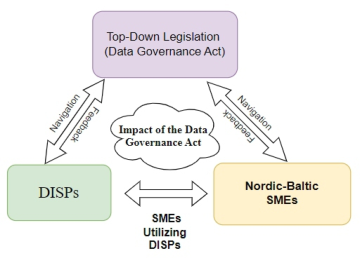
Figure 1 presents a lightweight framework for understanding the role of DISPs and the impact of the DGA on SMEs in the Nordic-Baltic Silver Econ- omy. The top-down Data Governance Act regulates and requires both DISPs and SMEs to navigate this legislation through various regional contexts, insti- tutional policy coordination and compliance mechanisms discussed in the next section. As the DGA regulates how Nordic-Baltic SMEs may utilize data intermediaries, SMEs and DISPs will need to establish feedback loops with policymakers, as shown in Figure 1.
The Role of Data Intermediaries for Small- and Medium-Sized Enterprises 153
Figure 1: Impact and navigation framework.
Navigation of Top-Down Regulations for SMEs Transformative top-down regulations such as the DGA will require bottom- up implementation. For SMEs, this means navigating inherent tensions between EU-level policy and on-the-ground regional contexts such as insti- tutions, infrastructures, capacity, capabilities, and established innovation ecosystems (Boschma, 2017). This may result in a gap between EU regions with mature regional innovation capacity to capitalize and actualize data intermediation compared with those that need to catch up. Consequently, transitioning from top-down regulations such as the General Data Protec- tion Regulation, which created friction in data exchange, to regulations that promote more open data sharing, such as the DGA, will potentially lead to enhanced regional innovation capabilities.
Thus, top-down policy coordination must be in tune with regional innova- tion ecosystem dynamics. This will include the emerging field of monitoring and evaluating the transformative implications of the DGA by establishing feedback loops that embed processes to facilitate continual improvements and the adaptation of regulations based on real-time insights (Ghosh et al., 2021). One noted EU-level policy coordination actor for SMEs in this space is the European Innovation Data Board (EIDB). SMEs have representation in the EIDB through a designated EU envoy appointed by a network of SME envoys. Currently, seven members were involved in the writing of this paper, of whom five are European-level organizations, including the European DIG- ITAL SME Alliance. The other two organizations are from Germany (the National Academy of Science and Engineering and the French Health Data Hub). This organizational membership list must scale and include members from other European regions to improve robustness and scalability. In the end, the top-down and bottom-up implementation of the DGA will require multilevel policy coordination and top-down actors who can ease the transi- tion from isolated data silos to scaled interoperability. The impacts of these actors’ roles and institutional structures are yet to be clarified, as their con- nection with innovation ecosystems is just beginning owing to the newness of the DGA and its implications.
Impact of the DGA on SMEs In contrast to the General Data Protection Regulation (GDPR), the impetus of the DGA is promoting interoperable data sharing for stimulating the Euro- pean digital economy and innovation and promoting such a concept. The DGA undoubtedly impacts SMEs, which can be data holders, data users, or DISPs. Nevertheless, the legal contradictions and uncertainty in the DGA pro- vide certain challenges to SMEs that face inherent disadvantages compared with resource-rich big tech companies and firms.
For SMEs that want to provide data intermediation services, the Euro- pean Commission has a lightweight application process that requires DISPs to notify their declaration of intent to provide data intermediation. After notification is given, it is up to competent member-state authorities to check whether the DISP is compliant with articles 11 and 12 of the DGA. However, the process of the compliance check is still undetermined, as is its intensity. For instance, it may just require surface-level investigation of the applicant’s materials related to technical infrastructure, organizational capacity, and structures for data security or direct auditing and inspection of the techni- cal and data assets of DISPs. How this evaluator process plays out will have important compliance cost ramifications for SMEs.
SMEs that are data holders or users face numerous technical, business, organizational, and legal challenges in the use of DISPs. As the name implies, SMEs generally have a lower resource capacity for investing in the appro- priate levels of data governance and protection, particularly if this requires technical infrastructures such as the installation of security servers or other mechanisms that also have a maintenance cost. From a business perspective, trust is a foundational component of for exchanging data. However, it is difficult for SMEs to build trust with larger partners or competitors, as it is unclear how the “neutrality” of DISPs will play out in practice. Under the DGA, DISPs are not allowed to combine the primary data-exchange function with additional services such as data storage, curation, conversion, anonymization, and pseudonymization. Therefore, DISPs must create a sepa- rate legal entity to provide these additional services so as not to cause conflicts of interest. However, this could lead to a legal loophole where “neutrality” is undermined by these separate legal entities. This could give competitors an advantage if they share sensitive data with one another, freezing SMEs to capture their market share.
Data protection from unauthorized access and distribution is fundamen- tal to the viability of data exchange for innovation ecosystems. SMEs may lack the necessary cybersecurity professionals and infrastructure capacity to adequately comply with the DGA as a data holder or user. SMEs may face heightened data security risks, as they may not have the same cybersecu- rity measures and protocols as larger organizations. Ensuring the security and integrity of data, especially sensitive or personal information, is crucial for compliance with the DGA but can be challenging for SMEs with lim- ited resources. From a legal aspect, navigating and interpreting a complex
The Role of Data Intermediaries for Small- and Medium-Sized Enterprises 155
top-down regulatory environment, especially if they operate in multiple juris- dictions, are a major barrier toward adapting to a fast-changing cross-border data exchange environment.
Nordic-Baltic SMEs Utilizing DISPs for the Silver Economy In terms of cross-border data flows, the Nordic-Baltic Council of Ministers declared that the region’s objective in 2021 was to develop digital services through the “cross-border by default” principle, which, in practice, may necessitate the use of data intermediaries for various purposes (Nordic Coun- cil of Ministers, 2023). The Silver Economy is a ripe cross-sectoral market for data intermediation, as it encompasses a large spectrum of domains such as mobility, healthcare, and the labor market, education.
Furthermore, these areas tend to have high intersectionality and public sector support, which lead to diverse stakeholder groups and complex data sharing for innovation. For instance, supporting smart living environments for the healthy and active aging of older adults entails the provision of e- services through IoT devices and ICT tools, and research on aging-related diseases and reskilling older adults requires multisectoral stakeholder col- laboration. The Nordic-Baltic region already has DMs, DSP, and DISPs for supporting cross-border data sharing and collaboration. Although these do not necessarily focus on the silver economy, they can be potentially leveraged in this area.
One data intermediary in the Nordic-Baltic region is the X-Road. The X-Road data exchange layer is the key technical backbone for cross- border data exchange between Estonia and Finland. It enables seamless and secure data exchange between systems and organizations. The governance of the X-Road core software is overseen by the nonprofit Nordic Institute for Interoperability Solutions (NIIS, 2024), which receives funding from the Estonian and Finnish Ministries of Finance. Estonia, Finland, and Iceland are all members of the NIIS. This indicates a broader regional collabora- tion in interoperability solutions. While the NIIS governs the overarching framework of the X-Road core software, the respective national authori- ties manage individual national X-Road instances. These national instances facilitate interoperable data exchange between public and private organiza- tions of each country, and they can be federated to handle cross-border data exchange. They ensure compliance with legal requirements, establish cen- tral trust services, manage organizational security servers, and facilitate the necessary agreements between service consumers and producers.
An important rising DM player for cross-border data sharing in the region are common European data spaces. These data spaces will incorporate a fed- erated, interoperable cloud data-sharing infrastructure with embedded data governance principles for eight sectors ranging from health care to cultural domains (Scerri et al., 2022). In addition, the next version of the X-Road has strategic plans to be compatible and interoperable with data spaces techni- cally and supportively. This could provide easier access for SMEs in the region to data spaces due to the geographical proximity of the X-Road ecosystem and its stakeholders. Particularly in the Nordic-Baltic region, where aging has
acute effects, the ability to harness data sharing for increasing innovation is still at a nascent level, and how SMEs can leverage some DISPs to increase business capacity remains to be determined.
Recommendations for Nordic-Baltic SMEs in the Silver Economy Nordic-Baltic SMEs face a plethora of challenges in cross-border data shar- ing, especially in a cross-sectoral domain such as the silver economy. To tackle these issues, SMEs must first familiarize themselves with the DGA and use compliance checklist tools that are tailored to organizational business pro- cesses. SMEs should also establish internal organizational data governance policies and protocols that not only protect data but also enable data sharing and data quality assessment. A data protection officer can be appointed to help facilitate these processes and implement such policies and protocols.
Contractual agreements between stakeholders are central to engendering trust in data intermediation. Contracts should be developed to be as transpar- ent as possible and clearly elucidate data-sharing purposes, types, protection measures, and liabilities if something goes wrong. Furthermore, engaging in Nordic-Baltic cross-border collaborative projects and partnerships such as the European Health Data Space can help SMEs find a legitimate entry point into data-sharing ecosystems for innovation. SMEs must have internal feed- back loops and auditing mechanisms for data management. Inherently, this requires a smart strategy for planning and allocating financial and human resources to achieve strong data governance mechanisms for extracting as much value as possible from data.
CONCLUSION
Ultimately, the concepts of data intermediation are novel; thus, the ramifica- tions of the DGA on SME business processes for data sharing are constantly evolving. Stimulating and integrating data sharing into the European data sharing ecosystem will be a difficult proposition for SMEs given their lim- ited resource and legal capacity. This study is an initial exploratory step to understanding the state of play for data intermediation in the Nordic-Baltic region for SMEs. Future work on this issue entails further investigation into policy interventions under the dynamics of the DGA and the creation of a holistic explanatory model that incorporates cross-border data-sharing inter- mediaries and data governance in relation to SME business processes and objectives.
REFERENCES
Azcoitia, S. A. and Laoutaris, N. (2022) ‘A survey of data marketplaces and their business models’, ACM SIGMOD Record, 51(3), pp. 18–29. Boschma, R. (2017) ‘Relatedness as driver of regional diversifica- tion: a research agenda’, Regional Studies, 51(3), pp. 351–364. doi: 10.1080/00343404.2016.1254767. Colombo, M. G., Dagnino, G. B., Lehmann, E. E. and Salmador, M. (2019)
‘The governance of entrepreneurial ecosystems’, Small Business Economics, 52, pp. 419–428.
The Role of Data Intermediaries for Small- and Medium-Sized Enterprises 157
Erlenheim, R. & Pappel, I. 2022, ‘The Role of Service Design in Increasing Regional Innovation in the Silver Economy’, in Chugunov, A. V., Janssen, M., Khodachek, I., Misnikov, Y., Trutnev, D. (eds), Electronic Governance and Open Society: Challenges in Eurasia. EGOSE 2021. Communications in Computer and Infor- mation Science, vol. 1529, Springer, Cham, viewed [March 25, 2024], https: //doi.org/10.1007/978-3-031-04238-6_2. European Commission (2017) European interoperability framework (EIF)—
boosting public service innovation across Europe. Available at: https://ec.europ a.eu/isa2/sites/default/files/eif_brochure_final.pdf (Accessed: March 25, 2024). European Commission (2022) Data Governance Act explained. Available at: https://digital-strategy.ec.europa.eu/en/policies/data-governance-act-explained (Accessed: March 25, 2024). European Union (2022) Regulation (EU) 2022/868 of the European parliament and
of the council of 30 May 2022, Data Governance Act. Available at: https://eur- lex.europa.eu/legal-content/EN/TXT/?uri=CELEX%3A32022R0868- (Accessed: March 25, 2024). Ghosh, B., Kivimaa, P., Ramirez, M., Schot, J. and Torrens, J. (2021). ‘Transformative outcomes: assessing and reorienting experimentation with transfor- mative innovation policy’, Science and Public Policy, 48(5), pp. 739–756. doi: 10.1093/scipol/scab045. Janssen, H. and Singh, J. (2022) ‘Personal information management systems,’
Internet Policy Review, 11(2). doi: 10.14763/2022.2.1659. Liu, J. (2022) ‘Social data governance: towards a definition and model’, Big Data & Society, 9(2). doi: 10.1177/20539517221111352. Meierhofer, J., Kugler, P., Vogt, H., Dobler, M., Benedech, R. A., Strittmatter, M. and
Treiterer, M. (2022) ‘Improving service value creation for manufacturing SMEs by overcoming data sharing hurdles in ecosystems’, Spring servitization confer- ence (SSC), Florence, Italy, 9–10 May 2022 (pp. 86–94). Birmingham, UK: Aston University. Micheli, M., Farrell, E., Carballa Smichowski, B., Posada Sanchez, M., Signorelli, S. and Vespe, M. (2023). Mapping the landscape of data intermediaries (No. JRC133988). Seville, Spain: Joint Research Centre. Moore, J. F. (1993) ‘Predators and prey: a new ecology of competition’, Harvard
Business Review, 71(3), pp. 75–86. NIIS (2024) ‘NIIS announces proof of concept for revolutionary X-Road 8 Spaceship’, NIIS, (January 8, 2024). Available at: https://www.niis.org/blog/2023/ 12/20/niis-announces-proof-of-concept-for-revolutionary-x-road-8-spaceship (Accessed: March 25, 2024). Nordic Council of Ministers (2023) Handbook of cross-border data exchange.
Available at: https://pub.norden.org/temanord2023-542/1-introduction.html (Accessed: March 25, 2024). Scerri, S., Tuikka, T., de Vallejo, I. L. and Curry, E. (2022) ‘Common European data spaces: challenges and opportunities’, in Curry, E., Scerri, S. and Tuikka, T. (eds.) Data spaces: design, deployment and future directions. Cham: Springer, pp. 337–357. Spiekermann, M. (2019) ‘Data marketplaces: trends and monetisation of data goods,’
Intereconomics, 54(4), pp. 208–216. United Nations Department of Economic and Social Affairs, Population Division (2019) Database on the households and living arrangements of older persons 2019. Available at: https://population.un.org/LivingArrangements/resources/Abo ut_UN_Data_base_on_the_Living_Arrangements_of_Older_Persons_2019.pdf (Accessed: March 25, 2024).
LISTED IN THE AHFE DIGITAL BOOKSTORE CATALOGUE
Explore the complete digital volume
Human Factors, Business Management and Society
Read this individual research paper free through the original publisher, or explore the full digital proceedings book.
ISBN 978-1-964867-11-3
Explore this ISBN in the AHFE Bookstore ↗Listed in the July 2026 bookstore catalogue; search by ISBN to confirm current availability · Digital book purchase optional