Mihkel Lauk, Janar Linros, Ragner Paevere, Madis Tapupere, Ingrid Pappel (2024). Revitalizing Technology Governance for the Post-COVID Era: A Strategic Framework. In: Human Factors, Business Management and Society. AHFE Open Access, vol. 135, pp. 33–42. https://doi.org/10.54941/ahfe1004928
The global landscape of technology governance has shifted significantly in response to the COVID-19 pandemic, necessitating a strategic recalibration of operating models. Unprecedented changes in the technological landscape have prompted a critical examination of existing governance structures. Addressing these challenges, this article proposes a strategic framework for technology governance tailored to the unique demands of the post-COVID era. Acknowledging the accelerated pace of digital transformation, the framework aims to guide organizations and governments in navigating the complexities of this evolving technological landscape. Estonia, renowned for its forward-thinking approach to digital governance, serves as a valuable case study. Despite being one of the most developed e-societies globally, Estonia faces global technology governance challenges that require adoption. The country's continued emphasis on digital solutions underscores the need for a strategic framework aligned with its technological advancements and the evolving global context.
The following discourse outlines the multifaceted reasons behind the poten- tial impact of the current macroenvironment, coupled with elevated inflation rates and the precipitous collapse of the IT labour market, on the strategic digitalization initiatives of governments and organizations.
The rapid escalation of IT costs has rendered previously viable business cases obsolete and raised the need for better IT governance (Brown & Grant, 2005) (Pappel, Tsap, & Draheim, 2021). Any proposition necessitating substantial human involvement in IT operations, development, or testing pro- cesses is no longer tenable. To address this, proactive measures are imperative. Corporate IT departments must expedite the automation of development and administrative functions (Krishnan & Ravindran, 2017) (Ayachitula et al., 2007) to mitigate the impending burden of personnel costs over the next 5 to 10 years.
IT budgets are experiencing a proportional decline, necessitating a fun- damental re-evaluation of priorities and commitments (Keil et al., 2000). It is highly probable that the growth trajectory of an organization’s IT budget will lag behind both wage increases and the inflationary surge in IT expenses. Notably, Gartner estimates a 6.8% global growth in IT spending for 2024, primarily attributed to deal with the continued wave of change fatigue from uncertain times, this includes keeping up with raising labour costs and the scarcity of skilled professionals (Gartner, Inc., 2024). More digitalised coun- tries face even bigger growth of the IT costs, i.e., Estonia has faced the growth of the IT costs at 20% per annum since 2018 (MEAC, 2022). Should an orga- nization aspire to outpace market growth to support ambitious objectives, resource acquisition may require premiums of 25% to 30% above prevailing market rates. These cost escalations predominantly stem from the supply- demand imbalance, as an increasing number of companies compete for the same pool of specialized skills.
The recent geopolitical upheaval, exacerbated by Russia’s invasion of Ukraine, has catalysed a significant shift in the preferences of information technology executives and corporations (Odulaja, Oke, Eleogu, Abdul & Daraojimba, 2023). Ownership-centric models are yielding to service- oriented paradigms (Rai & Sambamurthy, 2006). Dealing with uncertainties in ICT governance has widely been discussed in ICT management communi- ties and amongst scholars (Dawes, 2009) (Linkov, Trump, Poinsatte-Jones & Florin, 2018). Notably, cloud services have witnessed substantial investment growth, with a remarkable 18.4% increase in 2021 and a further 22.1% surge in 2022 (Mordor Intelligence, 2024).
Estonia, a small European country, has achieved remarkable success in e- governance. The results speak volumes, i.e., today, 99% of public services are accessible online, available 24/7; Estonia’s pioneering i-Voting system allows citizens to cast their ballots online - approximately 30% of Estonians exercise this digital democratic right, demonstrating trust in the secure process; the reduction in bureaucratic red tape has collectively saved an estimated 800 years of working time as of today (EAS, 2024). However, despite the success indicators presented above, in the local context similar to the global one, the Estonian government has underscored several critical challenges related to its information technology ecosystem. The table below outlines these challenges.
Table 1. Estonian e-State challenges (CheckIT, 2023).
Table available in the original PDF paper.
Challenge Description Resource-Intensive Information Systems The proliferation of information systems necessitates substantial resources for sustainable operation. However, the financial burden associated with managing these systems is becoming prohibitive. Project-Centric Development of E-Services
A significant portion of e-service development occurs on a project-by-project basis, primarily funded through European structural funds. Unfortunately, this approach results in lengthy and inflexible development processes, hindering rapid adaptation to evolving expectations. Duplicated IT Services Across ICT Entities
Within ICT settlements and units, analogous IT services are extended to the Ministry across various domains. These services encompass IT management, budgeting, project management, needs analysis, architectural design, information security, and system administration.
(Continued)
Revitalizing Technology Governance for the Post-COVID Era: A Strategic Framework 35
Table 1. Continued Challenge Description
Table available in the original PDF paper.
The evolution of e-services and other IT offerings, as well as modifications to existing services, is characterized by sluggishness, reduced flexibility, and resource-intensive efforts.
Challenges in E-Service Development and Adaptation External Dependency and Skill Imbalance
The absence of in-house development capabilities has led to a heavy reliance on external partners. Consequently, specific developers hold considerable influence, resulting in dependencies that warrant careful management.
In the imminent landscape, a pivotal transformation awaits the ICT organizations within ministries — an orchestrated consolidation of triv- ial fundamental services, encompassing workplace equipment and essential server infrastructure (PwC, 2020). This paradigm shift necessitates the seam- less transition of public authorities toward the utilization of these centralized services. Driven by the decision of the Ministry of Economic Affairs and Com- munications (MKM), the State Information Technology Centre (RIT) was formally instituted within the government’s purview on December 1, 2021. RIT’s mandate progressively entails assuming responsibility for organizing and provisioning basic ICT services, hitherto dispersed across various govern- mental domains and state institutions. As part of this consolidation process, these institutions now operate as clients of RIT (CheckIT, 2023).
In pursuit of addressing the challenges, the research question is defined as follows: what constitutes a comprehensive operating model for ICT business service delivery and development?
METHODOLOGY
Motivated by the aforementioned transformative shift and the attendant chal- lenges, the Ministries articulated a primary objective of the development of a comprehensive operating model for the provision and evolution of ICT business services across governmental sectors.
The methodology of the work based on a qualitative approach, i.e. case study, desktop research, CAWI study, as well as expert and group interviews. These methods have been the main input for mapping the current state of the operating models of selected institutions, including the mapping of selection criteria for considering success factors, strengths and weaknesses, risks and alternatives in selected cases.
The strategic framework was built based on the following state-of-the-art practices and standards that represent modern technology management prin- ciples with a focus on co-creation of value for end users: 1) ITIL® 4 (Service Value System and the four-dimensional model) (Axelos, 2019); 2) BIZBOK® version 11.0 (capabilities, maturity model for business architecture manage- ment, public sector reference model) (Business Architecture Guild®, 2022); 3) Business Process Management life-cycle (La Rosa, Mendling, Dumas, & Reijers, 2018); 4) ISO/IEC 38506:2020 Model of Strategic Governance and Management of Technology (ISO, 2020); 5) Multinational practices of the Information and Document Management (PwC, 2014).
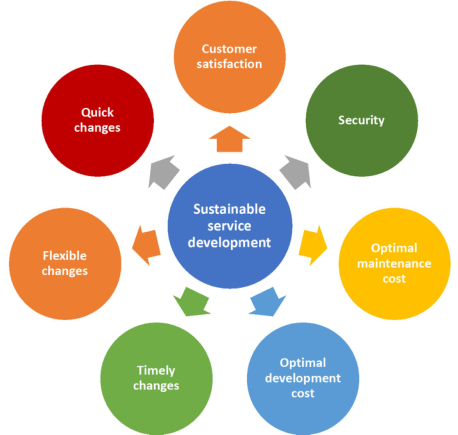
THE STRATEGIC FRAMEWORK: REFERENCE MODEL FOR THE PROVISION OF ICT BUSINESS SERVICES AND DEVELOPMENTS The research results were rich and provided good and valid input for map- ping today’s operating models of ICT developments as well as for developing an unified reference model. The case interviews provided rich input on the prerequisites for the success criterions of ICT developments in particular. The success criterions pattern throughout the cases, opinions and Authors’ opinions largely coincided, which provides an opportunity to argue that the reference operating model proposed is sufficiently substantiated to make decisions that change the future on its basis. The Figure 1 represents the expectations towards the strategic framework and reference operating model.
Figure 1: The desired attributes of the future ICT business service development and provision (CheckIT, 2023).
The successful deployment of the envisaged operating model aims to achieve the following outcomes: 1) Consumer Satisfaction: Service recipi- ents should experience a high degree of satisfaction with the functionality and reliability of the services provided; 2) Cybersecurity Assurance: The services must exhibit robust security measures, minimizing the risk of cyber- security incidents; 3) Resource Optimization: The investments maintenance of services should demand the optimal necessary allocation of both human resources and associated costs; 4) Agility in Service Adaptation: The abil- ity to introduce changes and enhancements swiftly and flexibly — whether driven by legislative modifications or evolving service requirements — is paramount; 5) Sustainable Modernization: To ensure service relevance and longevity, modernization efforts should be resource-efficient, focusing on essential updates, user-driven enhancements, and streamlined component
Revitalizing Technology Governance for the Post-COVID Era: A Strategic Framework 37
management. In summary, the proposed reference model seeks to harmo- nize efficiency, security, and adaptability within Estonia’s government ICT landscape, fostering a resilient and forward-looking digital infrastructure.
The process of digital transformation transcends mere incremental addi- tions of digital elements to existing services or the execution of major development projects. Instead, it entails a substantive and foundational re- evaluation, deconstruction, and, where necessary, reconstruction of services (including data utilization), processes, and architectural frameworks. The central focus should not solely be on technological aspects; rather, it should align with strategic business objectives set by governmental entities. By lever- aging modern digital technologies optimally, the goal is to enhance customer value. This shift necessitates moving beyond the confines of project-based management paradigms and adopting a holistic perspective that encompasses continuous field development, including considerations related to change management, independent of funding sources (CheckIT,2023). The following figure illustrates the paradigm shift in today’s technology governance.
Figure 2: The paradigm shift of the technology governance (CheckIT, 2023).
Figure available in the original PDF paper.
MAIN OUTCOMES OF THE RESEARCH The first outcome of the study was the Declaration of the Root Cause – the main challenge that must be addressed with the new operating model and action plan: the business side does not have sufficient control over the gover- nance and management of the technology. Due to that aspect, the paradigm shift shown in Figure 2 is possible only via development of the relevant capabilities.
The second outcome – Semantic & Organisational Interoperability Model – addressed the issue related to the different definition practices across the government authorities related to the management objects (i.e., service, process, product, value, portfolio, etc.), as well as roles and responsibili- ties. Enterprise interoperability is an inevitable prerequisite for enterprise integration and networking. This concerns any kind of organizations, includ- ing public organizations or large government agencies (Vernadat, 2010). Interoperability has been identified as a major issue to be addressed by every e-government initiative. The organisational issues relate to collabora- tion between different levels in the public administration – state, ministerial domain, and agency levels (Guijarro, 2009). Depending on the capability development sources (i.e., ITIL® 4 vs BIZBOK®), the organisational inter- operability may get negatively affected during the collaboration and result with the serious negative impacts for the public service delivery quality and value creation. The proposed model helps to develop the organisational interoperability maturity across all the government levels.
The third outcome – Desktop Research on the Legal Aspects of the Public Service Delivery and ICT Governance – reveals, that the Business Architecture and its components as objects of management is not a free choice of ministries and state institutions, but an obligation arising from the regulations. The responsibilities across different governmental levels are also defined, includ- ing the responsibilities for the Public Service Portfolio Management on the ministerial domain level (PwC, 2014). The current Estonian legal context greatly supports comprehensive and collaborative public service delivery in favour of the strategic goals of the “Digital Society Development Plan 2030” and “Estonia 2035”, and the launch of sectoral digital transformations in the public sector. The table below shows the interrelationships between the business expectations, methodologies, management objects and components of the business architecture.
Table 2. The relationships of the business expectations with the methodologies, objects of management and components of business architecture.
Table available in the original PDF paper.
Expectation Methodologies Management Objects
Business Architecture Components Service architecture
Consumer Satisfaction
User-centric service design
Value chain, value streams, service
Secure Services Information security standard (E-ITS)
Information assets Information architecture
Timely and flexible service development
Agile development Business process, product
Business process & IT architectures
Optimal costs and investments
BPM, portfolio management
Business process & product portfolios
Business process & IT architectures Data architecture
Data-driven decision-making
Data management Business process, data
The fourth outcome – 10 Success Criterions of the ICT Business Service Development – is the core outcome of the research. The success criterions form an important part of this reference model, which must be considered when applying the model.
Table 3. Success criterions of the ICT business service development.
Table available in the original PDF paper.
Success Criterion Description 1 Value co-creation The business side engages all stakeholders, including IT professionals, to create value for end-users through service-based management. 2 Service management integrity
In order to create value, it is necessary to apply appropriate tools in a comprehensive manner. Such tools are provided by the practices of managing business architecture. 3 Clarity of management system, roles, and responsibilities
Each participant in the value stream understands the responsibility that comes with their role and updates their skills and competences accordingly – through all levels of management.
(Continued)
Revitalizing Technology Governance for the Post-COVID Era: A Strategic Framework 39
Table 3. Continued Success Criterion Description
Table available in the original PDF paper.
4 Strategic focus and common objectives
The success of the service development must be defined and measured against the business objectives rather than functional and non-functional requirements. 5 Top level managers’ contribution
The involvement, participation and leadership of senior managers is critical as it supports a change in the organisation, gives mandates for the changes and measures the performance. 6 Liability of the business
A competent representative of the business side must be present - a service or product owner who takes responsibility and makes quick (sometimes risky) and business specific decisions. 7 Agile and iterative development
It is important that the results of developments are created as quickly as possible so that all parties, including the business stakeholders, can quickly implement them, gain experience and, as a result, make better decisions about subsequent iterations. 8 Good partner relationships
Partner relationships evolve in good communication, along with strategic focus and common objectives. Cooperation and discussions, even the scope changes in favour of the business objectives must prevail over obeying the orders. 9 Integrated teams Named also as fusion teams, composable teams as well as tribes – they all mean daily cooperation side-by-side without formal organisational boundaries. 10 Flexible budget Flexibility is ensured when the budgeting process is done comprehensively according to the prioritisation of the development needs on the ministerial domain level along with the service portfolio budgeting.
The fifth outcome – Minimum Viable Role Model (MVR) – is formu- lated as universal principles of the essential roles and responsibilities, their split between the business and IT, and therefore can be applied at all levels of management - the institution, the ministerial domain, or the state. These essential roles and responsibilities must exist in the organisations for assuring sustainability of the successful business service developments.
The sixth outcome – Action Plan – represents six important activities for the reference model implementation and achieving the third (defined) level of the Business Architecture Maturity Model® (Business Architecture Guild®, 2022).
Table 4. Action plan for the implementation of reference operating model.
Table available in the original PDF paper.
No. Activity 1 Define and enforce the official role and responsibilities of a business architect to manage the digital transformation both across ministry and in institutions/sectors. Appoint business architects, ensuring the appropriate skills according to the needs of the area of government and institutions. 2 Inventory the MVR and assign/enforce uncovered responsibilities; if necessary, recruit missing competencies.
(Continued)
Table 4. Continued No. Activity
Table available in the original PDF paper.
3 Inventory business services (create a portfolio of services) and conduct their evaluation against business goals. 4 Define a business services change plan that will cover the needs of the coming budgeting period as a minimum. Allocate the necessary budget to cope with new opportunities or existing constraints. 5 To convene and launch the work of the ICT Council of the ministerial domain. 6 Create an ICT strategy and implementation plan, an organisational plan and a risk plan to support the ministerial domain’s strategic objectives.
CONCLUSION
In conclusion, considering the global trends of growing demand for the digital services, boosting ICT budgets and cyber threats, invading AI and compos- able technologies, decreasing access to IT talents, organisations must develop their digital capabilities, in particular on the C-level. Estonia has started its new tiger leap – from IT-driven business development to business-driven IT development.
Every government globally can reuse and elaborate the reference model presented in this article and start with three concrete actions defined by Gartner: 1) Link digital investment plans to business and policy priorities, workforce development and citizen experience; 2) Balance modernization and transformation investments across areas like business intelligence, cloud, cybersecurity and AI/GenAI; 3) Seek synergies and partnerships to invest sus- tainably in the face of ongoing constraints, uncertainties and crises (Gartner, Inc., 2024).
FUTURE WORK
The following aspects of the proposed strategic framework are relevant for the further research in purpose of assessing the validity of the reference operating model: a) semantic & organisational interoperability, including national semantic frameworks, elaboration of the second outcome; b) valid- ity of the model by studying the Estonian progress; c) research on the similar Root Cause patterns and digital transformation initiatives in other countries.
REFERENCES
Axelos. (2019). ITIL® 4 Foundation. AXELOS Limited. Ayachitula, N., Buco, M., Diao, Y., Maheswaran, S., Pavuluri, R., Shwartz, L., & Ward, C. (2007). IT service management automation - A hybrid methodology to integrate and orchestrate collaborative human centric and automation centric workflows. IEEE International Conference on Services Computing (SCC 2007) (pp. 574–581). Salt Lake City, UT, USA: IEEE. Brown, A., & Grant, G. (2005). Framing the Frameworks: A Review of IT Gov-
ernance Research. Communications of the Association for Information Systems, 15(1), 38. Business Architecture Guild®. (2022). A Guide to the Business Architecture Body of Knowledge® version 11.
Revitalizing Technology Governance for the Post-COVID Era: A Strategic Framework 41
CheckIT. (2023). Analysis of the ICT domain of ministries and operating model for the provision of ICT business services and developments. Estonian Ministry of Finance. Dawes, S. (2009). Governance in the digital age: A research and action framework
for an uncertain future. Government Information Quarterly, 26(2), 257–264. EAS. (2024). Estonian Business and Innovation Agency. Retrieved from e-Estonia: https://e-estonia.com/facts-and-figures/. Gartner, Inc. (2024). Insights From the 2024 CIO Agenda. Gartner, Inc. (2024, January 17). Gartner Forecasts Worldwide IT Spend- ing to Grow 6.8% in 2024. Retrieved from Gartner, Press Release, News- room: https://www.gartner.com/en/newsroom/press-releases/01-17-2024-gartne r-forecasts-worldwide-it-spending-to-grow-six-point-eight-percent-in-2024. Geracie, G., & Eppinger, S. (2013). The Guide to the Product Management and
Marketing Body of Knowledge®. Association of International Product Marketing and Management. Guijarro, L. (2009). Semantic interoperability in eGovernment initiatives. Computer Standards & Interfaces, 174–180. ISO. (2020). ISO/IEC 38506:2020 Application of ISO/IEC 38500 to the governance
of IT enabled investments. Retrieved from ISO - International Organization for Standardization: https://www.iso.org/standard/56640.html. Keil, M., Tan, B., Wei, K.-K., Saarinen, T., Tuunainen, V., & Wassenaar, A. (2000, June). A Cross-Cultural Study on Escalation of Commitment Behavior in Software Projects. MIS Quarterly, 24(2), pp. 299–325 (27). Krishnan, G., & Ravindran, V. (2017). IT service management automation and
its impact to IT industry. 2017 International Conference on Computational Intelligence in Data Science (ICCIDS) (pp. 1–4). Chennai, India: IEEE. La Rosa, M., Mendling, J., Dumas, M., & Reijers, H. A. (2018). Fundamentals of Business Process Management. Springer-Verlag GmbH Germany. Linkov, I., Trump, B., Poinsatte-Jones, K., & Florin, M.-V. (2018). Governance
Strategies for a Sustainable Digital World. Sustainability, 10(2), 440. Mazzucato, M., & Kattel, R. (2020). COVID-19 and public-sector capacity. Oxford Review of Economic Policy, 36(Supplement_1), S256–S269. MEAC. (2022). Central counselling of IT projects. Estonian Ministry of Economic
Affairs and Communications. Mordor Intelligence. (2024). Cloud Computing Market Size & Share Analysis - Growth Trends & Forecasts (2024–2029). Retrieved from https://www.mordor intelligence.com/industry-reports/cloud-computing-market. Odulaja, B., Oke, T., Eleogu, T., Abdul, A., & Daraojimba, H. (2023, Dec.
7). Resilience in the Face of Uncertainty: A Review On the Impact of Supply Chain Volatility Amid OngoinG Geopolitical Disruptions. Open Journal Systems, Vol. 5(10). Pappel, I., Tsap, V., & Draheim, D. (2021). The e-LocGov Model for Introducing e-Governance into Local Governments: An Estonian Case Study. IEEE Transactions on Emerging Topics in Computing, vol. 9, no. 2, 597–611. PwC. (2014). Analysis of the current situation of document and information manage-
ment and international practices. Tallinn: Estonian Ministry of Economic Affairs and Communications. PwC. (2014). Public Service Portfolio Management. Estonian Government Office. PwC. (2020). Analysis of the arrangement of basic ICT services. Estonian Ministry of Finance.
Rai, A., & Sambamurthy, V. (2006). Editorial Notes—The Growth of Interest in Services Management: Opportunities for Information Systems Scholars. Information Systems Research, 17(4), 327–331. Vernadat, F. B. (2010, April). Technical, semantic and organizational issues of enter-
prise interoperability and networking. Annual Reviews in Control, pp. 139–144.
LISTED IN THE AHFE DIGITAL BOOKSTORE CATALOGUE
Explore the complete digital volume
Human Factors, Business Management and Society
Read this individual research paper free through the original publisher, or explore the full digital proceedings book.
ISBN 978-1-964867-11-3
Explore this ISBN in the AHFE Bookstore ↗Listed in the July 2026 bookstore catalogue; search by ISBN to confirm current availability · Digital book purchase optional