Taivo Kangilaski, Ingrid Pappel, Markus Sihvonen, Marina Weck (2022). Cross-Border Communication and Service Provision within Silver Economy Domain: How to Sustain a Collaborative Platform for Service Ecosystem. In: Human Factors, Business Management and Society. AHFE Open Access, vol. 56, pp. 244–253. https://doi.org/10.54941/ahfe1002275
The paper examines technological and organizational complexity related to cross-border data exchange and communication among public entities, private sector and seniors on the platform called Silver Hub. We need to look at challenges raised while designing architecture and business cases supporting service provision within the silver economy domain. In this project we have identified the main obstacles related to creation of the sustainable business strategy for the collaborative platform during its development. It is relatively easy to create a sustainable software architecture for the platform. However, creating a sustainable business model is much more complex. In addition to the business plan, it also requires a well-thought-out architectural vision which responds to stakeholders’ requirements. In order to be competitive, transparent and compliant, it makes sense to pursue ISO 9001, which in turn leads to the need for risk-based process management and continuous improvement. To make the platform sustainable, the external context must be analyzed to identify risks and opportunities. Based on the business plan, the organizational objectives and KPIs must be developed. Taking into consideration the business objectives, the strategic action plan will be created. Additionally, the business processes must be analyzed to determine the bottlenecks and main obstacles to achieve determined KPIs and objectives. Identified risks should be evaluated and mitigation action ought to be planned, as well as processes must be changed accordingly. As process-based risks are related to people, partners, customers, assets, IT, documents, resources, legislation, etc., the risk management approach must be determined via an internal control system, which monitors business functions. Thus, the organization and processes supporting the developed platform are much more complicated and quite often such complicity is underestimated.Moreover, in Enterprise Architecture management we need to focus on topics like sustainable process management and continuous improvement, organization and competence management, documented knowledge management, IT and risk management.In addition, there is a clear need to understand the problems a service user or a service provider could encounter. Developed Silver Hub platform helps to distribute innovative solutions to the problems faced by the aging population helping seniors live more independent and comfortable life with the use of digital means. However, we see the platform is tackling the challenges to meet the seniors needs that the governments are currently facing. Involvement of the seniors and their representatives more in their co-creative activities and wider participation during the implementation stages of service innovation helps overcome the gap.Thus, this experience research paper presents main findings that occurred during different project phases, based on what we derived recommendations with a relevant business plan, which contributes to the enterprise architecture designing cycle. That also includes the understanding of the country-based specifics with respect to cultural, political and legal context. Additionally, we have designed a framework as a structure for building collaboration and cross-border data exchange between innovation actors within the silver economy domain in the Baltic Sea Regions.
Aging population is well-known trend has a major impact for the world’s economy. Governments are currently facing common challenges of meeting the needs of aging people, particularly in the provision of such supportive services that enable aging with dignity and accessing public services in user friendly way. Thus, there is a need to enhance the public service collabora- tion between regions to offer better and more seamless public services to the end-users. Many challenges might occur while improving public services by developing, designing and piloting a platform for various service providers that is based on cross-border data exchange and meant to aid national and transnational service provision for the elderly. To ensure the development and functionality of the services requires seamless communication and committed
Cross-Border Communication and Service Provision within Silver Economy Domain 245
collaboration between all stakeholders of the service ecosystem within the silver economy domain. Additionally, to achieve that goal, there is a need to focus on the legal requirements and policies needed to implement cross- border standardization between countries in addition to mapping out and considering the potential challenges. The results of this paper were derived from the development of a collaborative digital platforms as a solution/tool for supporting the cross-border communication between all stakeholders/in- novation actors in service provision within silver economy domain in the Baltic Sea region. Thus, at the end of 2021, the EU funded ‘Supporting the Smart Specialization Approach in the Silver Economy to Increase Regional Innovation Capacity and Sustainable Growth’ – OSIRIS Interreg Baltic Sea Region Project (BSR) project1 was ended. The initial aim of the project was to create a platform to alleviate the problems associated with the depopula- tion of Europe’s working age population. Another focus was on creating a knowledge base, which is today available through the https://silverhub.eu/.
Estonia is well known in pioneering different digital services based on data exchange layer X-road (Tepandi et al., 2017) both in state and local level (Saputro et al., 2020). More attention has been paid also to the senior’s domain in the recent years. This also means that public and private sectors elements in Estonia have brought more information technology (IT) solutions for seniors to the market. Voluntary collaboration on the digital platform is very difficult to maintain in an environment that provides services and requi- res constant management and administration. Thus, there was a need for an organization that can generate revenue to cover the costs of renewing and maintaining the fee of the collaborative digital platform (Kangilaski and Butt 2021; Kangilaski et al., 2021). The EU OSIRIS Interreg (BSR) project 2019- 2021 established the consortium that created the initial physical IT solution. The consortium filled the solution with data from member countries to pro- vide seniors with a collaborative platform that supports the service ecosystem. Drawing on the analysis of the OSIRIS Interreg Baltic Sea Region (BSR) pro- ject results, the current article contributes to understanding how to design a collaborative platform that is capable of facilitating efficient cross-border communication in service development and provision.
The collaborative platform provides information to the service providers regarding market needs, financing possibilities and contacts needed to design, develop, and execute services on top of the platform. In addition to technical solution, there is a need for common rules and standards to be able com- municate in a cross-border way considering the involved innovation actors’ country-based backgrounds and capabilities. To this end, the authors exa- mine organizational complexity related to cross-border data exchange and communication among innovation actors present on the SilverHub colla- borative platform. The focus of this article is not on the business content. However, the usage of objects and its interconnections and related depen- dency on the organization is an important aspect to understand how the platform can become self-sustaining. Thus, the main goal is to model only the necessary items for the success of the project. Each connection represents 1https://www.osiris-smartsilvereconomy.eu/
responsibility and administration, which in turn can be costly to the orga- nization. Moreover, this article addresses aspects in the context of building up an organization that would run the collaborative digital platform focu- sing on cross-border communication between stakeholders of the service ecosystem or innovation actors involved in development and provision of supportive services for senior citizens. Based on the analysis of the OSIRIS project results, authors were able to develop recommendations on organiza- tional planning and business plan in particular, structure, and management system development process. As a result, this article contributes to understan- ding how to sustain a collaborative platform, which is capable of facilitating the efficient collaboration in service development and provision for seniors. Moreover, the essential baselines underlying organizational planning, stru- cture, and management system development process that need to be in place (Kitsios & Kamariotou 2019) to ensure the sustainability of the collaborative platform will be provided and discussed.
DESIGNING AND PLANNING ORGANIZATIONAL STRUCTURE FOR THE COLLOBORATIVE PLATFORM A strong and efficient business plan, which contributes to the enterprise arch- itecture (EA) designing cycle and gives an understanding of the country-based specifics with respect to cultural, political and legal context, is the most essential part of organizational planning. Further, in enterprise architecture management (Ahlemann et al., 2012) there is a need to focus on topics like sustainable process management and continuous improvement, organization and competence management, documented knowledge management, IT and risk management (Winter & Schelp 2008; Pulkkinen, 2006) which will be discussed below.
Development of a Business Plan to Sustain an Organization To establish the organization that ensures the sustainability of the colla- borative platform built to support cross-border communication in service development and provision, the development of a strong and efficient busi- ness plan is an essential first step (Sahlman, 2008) according to which the business plan should cover the following aspects:
Organization description that reveals the background of and the motiva- tions for establishing that entity
Business idea, ambition, mission, vision, goals - the organization’s mission and vision or ambition must be formulated and related goals to achieve them must be documented. Afterward the whole organization planning will be use that as a guidance.
Description of the business environment - analysis of the external and internal factors affecting the business environment
Processes - the organization’s main and/or service process must be descri- bed and their development must be planned.
Product and services - the organization’s main product or service must are described and their development must be planned. In addition, ancillary products and ancillary services, if any, are described
Cross-Border Communication and Service Provision within Silver Economy Domain 247
Customer, Market, Competition - gives an answer to how much and at what price it is possible to sell this product or service in competition with competitors in the markets described. It describes the customers, the current and potential market and the competitors operating there. A competitive advantage should be highlighted as well as SWOT analysis be prepared. It also describes the pricing principles of its products or services, sets initial marketing goals, which are the basis for the preparation of sales forecasts.
Strategy - this is a short-term action plan to achieve specific goals. The purpose of the action plan is to explain what is planned to be done and achieved in the coming time periods (months, quarters, year)
Risk analyses - potential risks are identified and mitigation is planned. Risk analysis allows a company to more critically assess the return on inve- stment calculations. It could cover strategic risks, operations risks (incl. safety, third party, financial, procurement, environment, HR, security, knowledge related, legislative, etc risks)
Financial plan and -forecasts - financial forecasts are forecasts of the income statement, cash flow and balance sheet. They consider the assum- ptions made in the financial plan and the calculations of the company’s income and expenses, break-even point, investments and financing.
Then, based on business plan, the real organization can be planned. Next, the company quality book should be prepared, which covers content from business plan, but which will be basement for enterprise management system. Additionally, it should keep tracking on information flow and records to maintain organizations’ information and preserve all for the future (Pappel et al., 2021)
DEVELOPING MANAGEMENT SYSTEM For an organization to function effectively, a well-thought-out manage- ment system is a foundation. In order to identify the components of the management system, it is necessary to consider architectural management methodologies such as The Open Group Architecture Framework (TOGAF) and supply chain operations (SCOR) that provide a better background for creating an enterprise architecture framework. The introduction of compreh- ensive frameworks does not seem sensible, as they are quite resource-intensive in terms of implementation and in operation. In addition to architectural management frameworks, it also makes sense to follow ISO standards (ISO - Standards) such as: 1) ISO 9001 - Quality management, 2) ISO14001 - Environmental management, 3) ISO 31000 – Risk management and 4) ISO 45001 - Occupational health and safety. Those standards give a good gui- dance and cover best practices which must be aligned into the processes that organization will design. Moreover, if processes are aligned with stan- dards requirements it is quite easy to prove company compliance for third party and external auditors which gives a signal to the customers, service providers and to the organization Council that organization is well mana- ged. From the technical point of view, it is reasonable to implement some
enterprise architecture (EA) management software tools (Wout et al., 2010) and there are many available like Sparx System Enterprise Architect, Software AG ARIS, LeanIX Enterprise Architecture Management, etc. Software tool gives the opportunity to model the organization knowledge. Software has its artefacts and connectors and based on that the organization can implement its own ontology and semantic for the architecture management. Common database with relation between the objects gives a valuable information for business analyses. For more mature organization the following loop is imple- mented a) process analysis and modelling, b) implementation of processes, c) process measurement, d) process simulation and mining to find areas for improvement and the cycle continues from the beginning. Position job descriptions, process description, risk/environmental aspects registers, risk- s/environmental aspects related action plans etc can then generated through process models. When versioning and workflow engines are implemented, the whole management system is digital, analyzable. As EA model is single point of truth, it must be up to date, but as all normative documentation is generated and visualized from model, all documentation is always up to date. Model based approach gives possibility to generate even employee-based job instructions if needed. Such approach avoids the problems related to paper or Microsoft Word (MS) Word document-based documentation, where auth- ors see quite common situation that document related documents are not updated, or there is a lack of information where and how the policy related requirements are implemented etc.
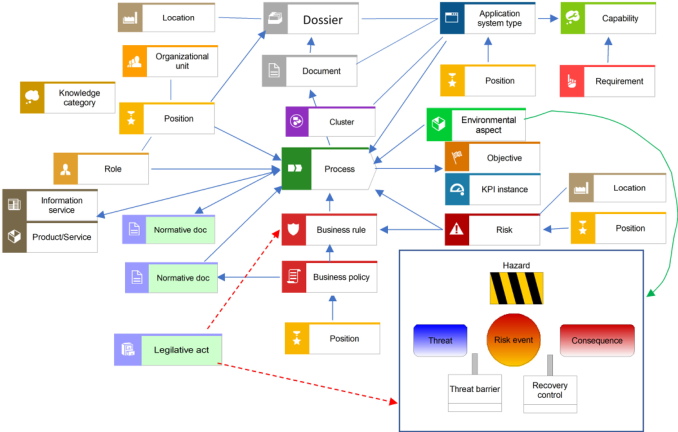
Components of Integrated Management System (IMS) According to definition, the Integrated Management System (IMS) integrates all of an organization’s systems and processes into one complete framework. That in turn enables an organization to work as a single unit with unified objectives (Abrahamsson et al. 2010). The management system components (see Figure 1) proposed for the projects organization can be divided into the following groups:
Targeting – includes object like vision, mission, ambition, goals and objectives
Organization – includes objects like location, organization unit, position, role and same objects for external companies as well
Resources – includes objects like operating resource, alternative operating resource, general resource, material, inventory
Documented knowledge metainformation management – includes objects like entity, data cluster, electronic, paper and normative document, based on which the company canonical information model can be built.
Competence and qualification management – includes object like compe- tence, knowledge category, mandate
Process management – includes objects like process, phase, activity, operation
Product service management – includes objects like product, service, information service
Cross-Border Communication and Service Provision within Silver Economy Domain 249
Figure 1: Integrated management system components.
Regulations and other restrictions – includes objects like policy, business rule, requirement, restriction
ICT architecture management – includes objects like application system, application system type, hardware type/component, interface etc.
Environmental management – includes object like environmental aspect, aspect characteristic
Risk management and internal controls – includes objects like risk, hazard, threat, consequence, risk event, escalation factor, threat barrier, recovery control
Change management – includes objects like iteration, architectural com- ponent, project, task Based on those objects majority of organization aspects related to mana- gement system can be modelled into integrated way (see Figure 1) if the connection types are properly described.
Organization EA model should be up to date because it will be pedigree for organization analyses, optimization and change management (Kangilaski et al. 2013).
Management System Documentation After establishment of the business plan along the company creation, the focus will be the hire the needed core team, build up the processes and rela- ted infrastructure including IT, staff processes, find customers and partner and start to develop the business. In startups (at the beginning of company life-cycle), when amount of employees is small, we could manage without documented and agreed principles, processes and job instructions. The auth- ors propose to have fixed structure for normative documentation, which should be distributed in document form to the interested parties supported
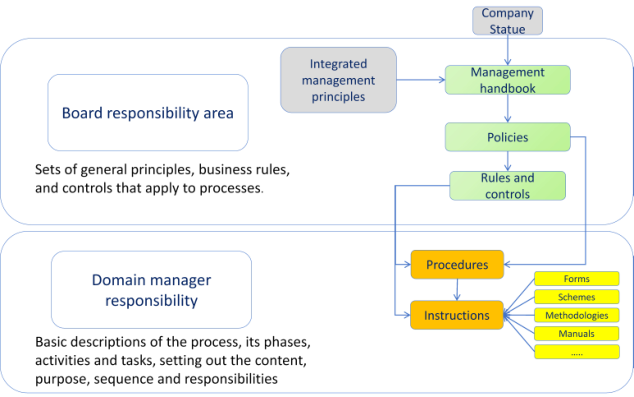
Figure 2: Hierarchy of normative documentation.
by document management systems as these systems can give a good founda- tion for information sharing, accessibility and workflows (Gupta et al., 2000; Sewdass, 2005; Valmohammadi & Ahmadi, 2015):
Integrated management principles – this is A4 type document which has all main management principles which covers quality-, environmental-, occupational health and safety and risk management related policies in integrated way
Management handbook – this document reflects a business plan and opens the management principles in more detail descriptive way. Identifies responsibility In addition, introduces the process landscape.
Policies – those are more detail description of policies grouped by topics which were introduced in management handbook (e.g. Human Resource management policies, Process Management Policies, Risk Management Policies, ICT Management Policies).
Rules and controls – when policy needs more precise description the rules and its related controls are documented. One policy document may have related more than one rules and controls documents.
Owned by top management mainly these documents cover requirements and constraints to the processes. In addition, the normative document type exist such as a) procedures – describes process and its phases flow in gene- ral, focuses the sequence of activities, controls, process interconnections and on inputs and generated value and identifies the ownership b) Instruction – describes the content of process phase activity. This level documentation covers risk identification and mitigation as well.
With operations quite frequently is related a lot of different normative documentation, such as manuals, methodologies, forms, etc., which content is not needed to model, but which meta-info and location must be documen- ted. Documents like strategy, project portfolio, etc. is not part of normative
Cross-Border Communication and Service Provision within Silver Economy Domain 251
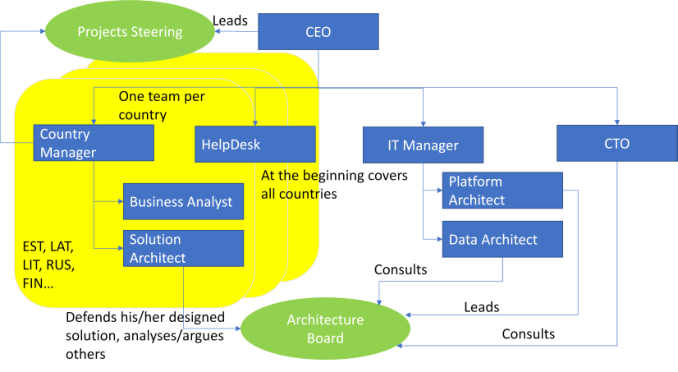
Figure 3: Hierarchy of normative documentation.
documentation, because those are outcomes of the processes not the require- ments for business processes. Business processes (Hammer M., 2015) bust be designed in a way that they allow to make a business according to the stra- tegy. While designing the strategy, the business processes will give valuable information whether the strategical objectives are achievable or not.
PROPOSED ORGANIZATION STRUCTURE Having defined how to document the organization, the structure of the orga- nization can be suggested (see Figure 3). As the focus of the organization to be created is first and foremost an IT platform on which to create, pro- mote and run services for the aging population, the main emphasis is on both country-based and transnational IT developments, which focus on IT architecture management. Attractive platform and customer base gives an opportunity to earn money. The structure of the organization is designed to be scalable, where each country having its own country-specific team – coun- try manager, business analyst and IT solution architect. Country manager will be responsible from business (but acts also as a project manager), IT solution architect for IT. Business analyst working as a gateway between manager and IT solution architect. The focus is to buy in it development.
To warrant sustainability core team involves IT manager, platform arch- itect and data architect were architects work as a team. When country has launched a new project for a new service, the solution architecture must be defended in architecture board, which is led by Platform manager. IT mana- ger is responsible IT management. Hardware related question will be a chief technology officer (CTO) responsibility. When platform runs services, there will be also need for end-user support. This will be organization strategic dire- ction to have direct contact with customers because it helps the organization better understand the market demands and availabilities.
CONCLUSION
The analysis of the OSIRIS project results and discussion presented in this article shed more light on how to design a collaborative digital platform that is capable of facilitating efficient cross-border communication in service development and provision. The challenges raised during designing the arch- itecture and business cases supporting service provision within the silver economy domain were addressed and the main obstacles related to crea- tion of the sustainable business strategy for the collaborative platform were identified. Additionally, authors have proposed a structure for building colla- boration and cross-border data exchange between innovation actors within the silver economy domain in the Baltic Sea Regions. Based on the project results the authors conclude that it is relatively easy to create a sustaina- ble software architecture for the collaborative platform. However, creating a sustainable business model is much more complex. Thus, the strong and efficient business plan is required to ensure the proposed establishment of the organization that ensure the sustainability of the platform. In order to be competitive, transparent and compliant, it makes sense to pursue ISO 9001, which in turn leads to the need for risk-based process management and con- tinuous improvement. Moreover, in the sections above, it was stressed that an organization should be established to ensure the self-sustainability of the collaborative platform instead of continued support by consortium members. The analysis of the OSIRIS project results indicated that there is a clear need for a preparation of the follow-up project, which focuses on providing a single gateway for senior citizens to access all supportive services and for service providers to expand market share and acquire benefit from market data collected in systematic way.
ACKNOWLEDGMENT
This work was conducted in the frame of the OSIRIS Interreg Baltic Sea Region Project (2019 – 2021) – Supporting the Smart Specialization Appro- ach in the Silver Economy to Increase Regional Innovation Capacity and Sustainable Growth (https://www.osiris-smartsilvereconomy.eu). The auth- ors gratefully acknowledge the contributions and knowledge shared by all project partners that enabled empirical investigation introduced in this article.
REFERENCES
Abrahamsson, S., Isaksson, R. & Hansson, J. (2010). Integrated management systems: advantages, problems and possibilities. 3th Toulon-Verona Conference, pp. 1–12. Ahlemann, F., Stettiner, E., Messerschmidt, M., & Legner, C. (Eds.). (2012). Stra-
tegic enterprise architecture management: challenges, best practices, and future developments. Springer Science & Business Media. Gupta, B., Iyer, L. S., & Aronson, J. E. (2000). Knowledge management: practices and challenges. Industrial management & data systems.
Cross-Border Communication and Service Provision within Silver Economy Domain 253
Hammer M. (2015) What is Business Process Management?. In: vom Brocke J., Rosemann M. (eds) Handbook on Business Process Management 1. International Handbooks on Information Systems. Springer, Berlin, Heidelberg. ISO - Standards, https://www.iso.org/standards.html, last accessed 10.02.2022 Kangilaski, T., Butt, S.A., Pappel, I., Kangilaski, E. (2021). Overcoming Challenges
in the Silver Economy by Connecting Services in the Silver Hub. ICEGOV 2021, October 06–08, 2021, Athens, Greece Kangilaski, T., Butt, S.A. (2021) Lessons Learnt - Developing the Digital Silver Hub: A Digital Collaborative Platform for the Silver Economy. NGGS 2021, September 14–15, 2021, Tallinn, Estonia Kangilaski, T., Polyantchikov, I., Shevtshenko, E. (2013). Partner Network and its
Process Management. ICINCO, 519–527. Kitsios, F., & Kamariotou, M. (2019). Business strategy modelling based on enterprise architecture: A state of the art review. Business Process Management Journal. Pappel, Ingrid; Butt, Sidra; Pappel, Ingmar; Draheim, Dirk (2021). On the Specific
Role of Electronic Document and Records Management Systems in Enterprise Integration. Proceedings of Fifth International Congress on Information and Communication Technology, ICICT 2020, London, Volume 2. Pulkkinen, M. (2006, January). Systemic management of architectural decisions in enterprise architecture planning. four dimensions and three abstraction levels. In Proceedings of the 39th Annual Hawaii International Conference on System Sciences (HICSS’06) (Vol. 8, pp. 179a–179a). IEEE. Sahlman, W. A. (2008). How to write a great business plan. Harvard Business Press. Sewdass, N. (2005). Interrelationship between document management, information
management and knowledge management. South African Journal of Information Management, 7(3). Tepandi, J., Lauk, M., Linros, J., Raspel, P., Piho, G., Pappel, I., Draheim, D. (2017).
The data quality framework for the Estonian public sector and its evaluation: establishing a systematic process-oriented viewpoint on cross-organizational data quality. In: Hameurlain, A.; et al. (Ed.). Transactions on Large-Scale Data- and Knowledge-Centered Systems XXXV (1-26). Berlin: Springer. (Lecture Notes in Computer Science; 10680). Valmohammadi, C., & Ahmadi, M. (2015). The impact of knowledge management practices on organizational performance: A balanced scorecard approach. Journal of Enterprise Information Management. Winter, R., & Schelp, J. (2008, March). Enterprise architecture governance: the need
for a business-to-IT approach. In Proceedings of the 2008 ACM symposium on Applied computing (pp. 548–552). Wout J., Waage, M., Hartman, H., Stahlecker, M., Hofman, A. (2010). Enterprise Architecture: Don’t Be a Fool with a Tool, Springer; 2010th edition, 264p
LISTED IN THE AHFE DIGITAL BOOKSTORE CATALOGUE
Explore the complete digital volume
Human Factors, Business Management and Society
Read this individual research paper free through the original publisher, or explore the full digital proceedings book.
ISBN 978-1-958651-32-2
Explore this ISBN in the AHFE Bookstore ↗Listed in the July 2026 bookstore catalogue; search by ISBN to confirm current availability · Digital book purchase optional