Janne Lahtiranta, Tero Reunanen, Elina Kontio (2022). Co-creation services boosting health technology potential – the case of Turku Finland. In: Creativity, Innovation and Entrepreneurship. AHFE Open Access, vol. 31, pp. 132–140. https://doi.org/10.54941/ahfe1001515
Especially in health technology, developing an idea into a marketable solution, is a long and winding role. More so in the case of medical devices, that play an essential role in healthcare delivery of today. These devices are solutions that are intended for medical use in “homes and hospitals”. Regulating their development ensures the devices are safe to use, and available to the end-users on global markets. As the regulatory framework expands beyond development to sales, regulatory compliance is of paramount importance for every organization working in the field. To enable the development of medical devices, and other solutions of health technology, we have created a platform called “Terttu” (engl. “Bunch” as in “bunch of grapes”) that brokers and facilitates regional co-creation services to companies in need of them. In our previous article, we created a theoretical framework for the platform. In this one, we take a deep dive into the actual results of our development.In the core, the Terttu service was developed using Service Design as the over-arching design principle. The service is an electronic platform used for matching the end-user (company) co-creation needs with the services available in the regional. “Under the hood”, the service is also used for combining different co-creation services together, in the case that a single service can’t meet the needs of the end-user. And, when there is a match between the need and the co-creation service(s), Terttu provides a way for advancing a contact into an actual agreement between the involved parties, and using a completed co-creation project as a reference in promoting the service.The actual work in developing the platform started with focus group interviews. In these interviews, the end-users’ (9 companies) needs, wishes, and ideas for the Terttu service were investigated. As the services is intended to be used in the healthcare sector, the companies were selected accordingly. In the interviews, the end-users were walked through the intended process of initiating co-creation from their perspective, and after that the users were given the floor; how the process worked, how it should have worked, and what would be an ideal process. On the basis of these interviews, an ideal version of the Terttu service was drafted, and presented to the co-creation service providers. These in turn, had an option to add their insights into the drafted version, that would eventually steer the development of the Terttu service.This collaborative work with the end-users and the service providers resulted in a shared vision of a service – the way it should look, and the way the promises to the end-users should be redeemed. However, it turned out that this was just the icing on the cake. There were still practical, and fundamental, issues to be addressed before the vision would could be done true. The development work brought to light a) problems associated with the ownership and management of the Terttu service, b) ambiguities in the way the service promise was initially formulated, and c) challenges in the marketing and pricing. All these would need hard work and making compromises from all service provider organizations. Future research aspects and practical recommendations will also be issued in the paper.
In the past, developing products with actual end-users was commonly done in facilities regarded as Living Labs (c.f. Leminen et al., 2012). These user- centered and open innovation ecosystems still exist, but the terminology has changed. Instead of living labs, many service providers prefer the term test- bed (c.f. Arora et al., 2021), as it is also used in different funding instruments especially in Europe (for example, Horizon 2020 programme “Open Innova- tion Test Beds”). While a difference between the two is hard to make, there are nuances that separate one from another. Living Labs of old were more open in terms of audience (who can participate in co-creation), and loosely restricted by their operating area (such as a town or campus). As comparison, it can be argued that Testbeds have become more restricted – by audience and operating area. Especially in the Finnish healthcare sector, Testbeds of
Co-creation Services Boosting Health Technology Potential – Case Turku Finland 133
today are more akin to closed testing facilities, with a restricted audience. We argue that the openness of the past is subjected to control and coordination of today; open innovation is replaced with a more service-oriented approach. This direction may have some benefits when considering concurrent engine- ering (CE) approach from the risk management point of view (Kayis et al. 2006). But CE approach can be utilized in highly demanding development cases such as aerospace industry (Loureiro et al 2018), so the CE approach can still be utilized in both approaches living labs and testbeds as anticipated in before (Reunanen et al. 2020) While the open innovation as a concept is important or academic research and industrial practice (Bogers et al., 2018), its applicability to the deve- lopment of health technology – or even more to medical devices – can be convoluted. Using citizens or “citizen sourcing” (Hilgers & Ihl, 2010) in the innovation process as highlighted by Bogers et al., (2018), or creating an open space where people, science, ideas, and organizations meet in a joyful bacchanal of co-creation, just might not work in special health care or similar delicate setting. A more closed approach is probably more “at home”with the healthcare sector and medical devices, with less room for experimentation. End-users that take part in co-creation are typically either healthcare profes- sionals, or actual patients – or they train future professionals that will work in a healthcare environment. It follows from this that the offered Testbed services mostly – if not solely – focus on clinical work, patient care and heal- thcare data. This is also the case in Southwest Finland, where Testbed services include drug development, diagnostics development, patient data analysis, and end-user testing of medical devices. As the Testbed services in the region are wide, and related to the wider field of life sciences, creating a single point- of-entry to the services can be challenging. More so in an environment, with multiple different service provider organizations.
Southwest Finland – The Service Providers The region of Southwest Finland refers to the region around the old capital of Finland, Turku. The region is known for its life sciences sector, especially for its diagnostics and pharmaceutical companies, that include healthcare related companies. Turku is also home for one of the five Finnish university hospitals, with a history that dates to 1756. In addition to the university hospital (and associated hospital district), there are four higher education institutes, that provide education to more than 40.000 students. These institutes and the hospital district offer the healthcare testbed services in the region. The service providers work in close collaboration with a regional development company that offers different services (such as growth programs) to the companies operating in the region.
In the past, the service providers operated on their own, each offering col- laboration services to a wide range of industries. In some cases, the offered services competed with those provided by the neighboring organizations. In the field of healthcare, this situation was remedied with the formulation of Health Campus Turku, a formal agreement between the healthcare testbed service providers and the regional development company. In the agreement,
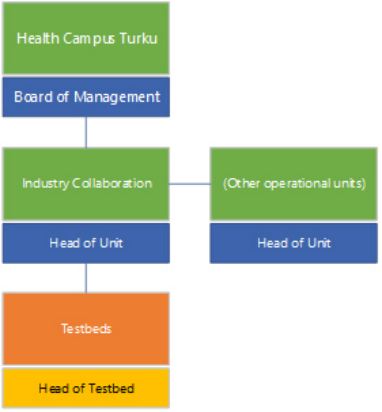
Figure 1: Testbed services in Health Campus Turku organization.
different operations (education, research, marketing, industry collaborati- on…) were organized into narrow operational units (or “baskets”), and a head of operations was assigned to each one of them. In this newly for- med structure, healthcare testbed operations were placed under Industry Collaboration unit (Figure 1).
Challenges of the Service Provisioning As discussed earlier, organizing testbed services by public sector organizations in Finland is not a straightforward or simple matter. There are three specific issues that have an impact on co-creation in healthcare sector. The first one, structural problem, refers to the way testbed services are typically organized in Finland. The services are provided by organizations with mandated core functions (e.g., teaching, or patient care) which do not include co-creation. The base funding of these organizations is intended for the core functions, and all other services need to be (partially) funded from external sources, such as projects. It follows from this that the services typically have a limited lifespan, and the personnel allocated to the services, will be re-assigned after a project is concluded. The second one, reachability problem, is a direct derivate from the structural problem. As testbed services are not core functions of the pro- vider organizations, they are not sufficiently promoted – or at least not on the same level as core functions. As a result, the companies will not be aware of the services. This again, leads to lack of customers and revenue, and degrada- tion of services. After a while, there might still be a web page somewhere on the Internet, but without actual references or customer testimonials. When combined, these two problems also contribute to a third problem that has not been previously discussed – maturity problem. As the testbed services are offe- red (outside core functions) in a piecemeal fashion, with a temporary staff, there is rarely any progress. Lifespan of a single project rarely contributes to
Co-creation Services Boosting Health Technology Potential – Case Turku Finland 135
long-term planning, collection of customer feedback, or implementation of more-than-rudimentary quality improvement processes.
Unless there is a champion, a person who takes inordinate interest in offe- red testbed services, they are offered “as-is” for the duration of a project. With a champion of reasonable caliber (such as a head of department), the “spark” of services may live between testbed-related projects without any tangible improvement. More often, the quality of the testbed services tends to regress between the projects, as the project staff is reassigned to other tasks between projects.
TERTTU COLLABORATION PLATFORM To provide a partial answer to the challenges of the service provisioning, a two-year European Regional Development Fund (ERDF) project “Healthcare Testbed Intermediary”(A75218) was launched. As the first version of the col- laboration platform (Terttu) was already in production, providing contacts from the potential customers to the Health Campus Turku member orga- nizations, the project focused on improving a) the customer experience, and b) service providers’ processes. While the actual technology development was excluded from the project, it was clear that the results would lead to changes in the platform after the project.
What is a Collaboration Platform?
In the context of the ERDF project, the collaboration platform has two pri- mary functions. Firstly, it acts as a single service point. The platform offers companies (and other interested parties) a centralized way for accessing test- bed services provided by the Health Campus Turku organizations. In the spirit of Stanford Biodesign method (Zenios et al., 2009), the starting point for collaboration is a well-documented need. In the first version of the colla- boration platform, the companies were expected to fill in their contact details, and a need for collaboration (with optional attachments). This was imple- mented as a single contact form in the collaboration platform, and it was intended to work as a low-threshold method; nothing detailed was requested – simply an answer to the question “how can we (i.e., Health Campus Turku organizations and associated testbeds) help you”.
Secondly, the platform operates as an equal and transparent way of delegating contacts to one or more testbeds. All Health Campus Turku orga- nizations assigned a representative to the group that evaluates contacts (i.e., needs) logged into the system. The evaluation work was done in two pha- ses. In the first phase the validity of the contact was evaluated (real contact or not), and in the second phase the actual content was evaluated by the assigned group. When the ERDF project started, all that happened after the two-step evaluation was done in a case-by-case manner (contact-validity check-evaluation).
Problems With the Method While the employed method acted as a low-threshold one, it attracted contacts outside the original scope of the collaboration platform. At the
approximate rate of 1 contact / week, nearly half of the overall contacts were sales contacts. Companies contacted Health Campus Turku organizations through the platform with a sole intention of selling their products. Especi- ally, the local hospital district was the target of sales the efforts. From the perspective of the service providers, this was one of the issues that needed remedying.
Another issue that was to be corrected with the ERDF project, was the underlying process. Instead of performing a case-by-case analysis on each contact, a formal process for performing the analysis was needed. In addition to a process that would serve the work by the entire multi-organizational evaluation group, organization specific processes were needed – and a generic process that would serve the new testbeds that would be integrated to the collaboration platform later.
Work Packages and Study Setup To address the identified issues, the ERDF project was split into the following work packages: WP1: administration, WP2: improvement of the collabora- tion platform, and WP3 testbed pilots. In the work packages that focuses on the collaboration platform the work was split into two: 1) work on internal processes, and 2) work on customer experience. In the following, these two (internal processes and customer experience) will be in the focus.
Work on Internal Processes The work on process development was initially done within the group that evaluates the contacts. This group had representatives from each of the Health Campus Turku organizations, and enough hands-on experience on what kind of contacts are typically filed into the collaboration platform. The work was conducted in a series of workshops, ERDF project meetings, and background work where the organization-specific issues were addressed.
The initial idea of two-step evaluation was the part of the process that was left intact. As some of the contacts (e.g., those sent by advertising spam bots) were not suitable for further work, removing them from the process early on was needed. The second stage, however, needed more work. While the low- threshold method was appreciated by all participants, it was not without problems. Practically every single contact led to a request for more informa- tion by the service providers. And, in most of the cases, the questions were the same; “who pays”, “who is the intended end-user”, “do you have evidence to support your claims”, and so on.
To save time in evaluating contacts, the process was refined to include a stage where a set of questions would be sent to the potential customer (or partner). These questions would be pre-selected, generic, and – when needed – customizable. The original collaboration platform already supported this function, but it was never put into use due to ad hoc nature of the evaluation work. After this refinement, the evaluators would not only have the free- form request for collaboration, but also more tangible answers to questions like “who”, “how”, and “what” (Figure 2).
Co-creation Services Boosting Health Technology Potential – Case Turku Finland 137
As the offered services covered a wide range of healthcare related aspects, the evaluation group also realized that the stage where appropriate questions would be selected and sent to the potential customer, could be more complex than it would initially seem. In the case of a very specific contact, the refining questions would have to be formulated with domain experts. These rare cases were considered and factored into the response time that was set accordingly.
The previous experiences of the evaluators also highlighted another issue that needed clarifying; what would happen after the evaluators have a well- formulated contact in their hands, with answers that would meet the demands of the service provider organizations. What should happen after that? The first thing the evaluation group would have to do, is to analyze if the contact was something that could be answered with a single testbed – or would there be a need for complementing services.
Complementing services – services where different testbeds need to colla- borate with single customer case – are challenging to make. More so when the service providers are from different organizations. Like in project mana- gement in general, the starting point for making complementing services starts with dismantling the original contact, decomposing it into manageable, controllable, and achievable chunks.
When reviewing the previous cases where complementing services were needed, it was concluded that new methods for this purpose were not nee- ded. The existing project management tools, techniques and methodologies cover these kinds of activities well enough. However, this stage – like the stage where refining questions were sent to the potential customer – could potentially slow down the overall process. And this was just the beginning as the hardest part, the processes of each partner organization, were yet to be defined.
The Health Campus Turku network covers 4 institutions of higher educa- tion, a university hospital (and the associated health care district), and the regional development company. All these Finnish public sector organizati- ons, excluding the development company, offer testbed services (and other co-creation services). Each of the organizations have organized their services differently and have different kinds of legal and innovation services units.
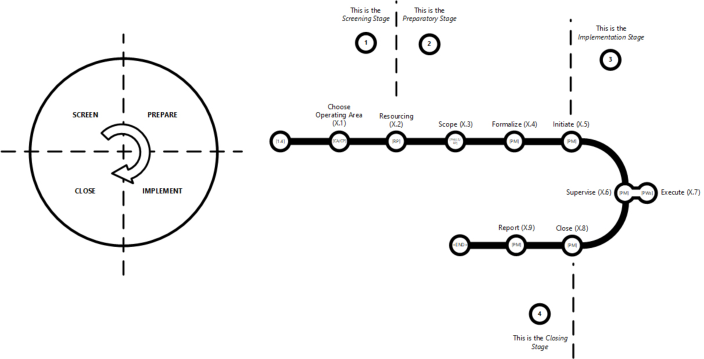
It followed from this diversity, that each partner organization started their own lengthy process definition work. While each of them had diffe- rent processes, there were even more diverse when investigated in detail, there were also similarities. These similarities were used for creating a gene- ric “X-Process” (Figure 3) to be used by the new testbeds when they are integrated to the collaboration platform.
Figure 3: The generic “X-process” used by the new testbeds as a baseline.
The generic process had four main stages: 1) Screen, 2) Prepare, 3) Imple- ment, and 4) Close. In the first stage, the contact is given an ownership in the testbed organization; a person who ensures that the contact is lead to completion in one form or another. In the second stage, the contact is for- malized into a project. This includes writing agreements, acquiring needed permissions (such as ethical clearance), and overall setting the stage (recrui- ting patients, etc.). The third stage is all about execution, supervision, and keeping all involved parties up to date. And the last stage is about delivery, reporting, and acquiring formal permissions for using the case as a customer reference.
Work on Customer Experience The primary work in customer experience was done in a series of focus group interviews. In these interviews end-user’s needs, wishes, and ideas for the next version of the collaboration platform were investigated. Total of 9 companies were recruited for the interviews that were held online due to the Covid-19 pandemic. As the testbed services (and other collaboration opportunities) were primarily intended for companies operating in the healthcare sector, the companies were selected accordingly.
In the interviews, the end-users were walked through the intended process of acquiring services from their perspective, and after that the users were given the floor; how the process worked, how it should have worked, and what would be an ideal process. Based on these interviews, an ideal version of the collaboration platform was drafted, and presented to the testbed service providers. These in turn, had an option to add their insights into the drafted version, that would eventually steer the development of the platform.
Interestingly, the interviews pointed out challenges that were deeper in the collaboration platform. Naturally, there were process level issues that would need polishing, but the actual challenges were in the ownership – not in the
Co-creation Services Boosting Health Technology Potential – Case Turku Finland 139
operation. The first identified challenge was raison d’être – the reason for existing.
The Health Campus Turku organizations had different view on the col- laboration platform. While some of the higher education instituted regar- ded the platform as a front for testbed services, others saw it as a way of promoting scientific excellence and all kinds of collaboration oppor- tunities in areas loosely linked with healthcare (hence the term, collabo- ration platform). This mismatch between service providers’ expectations resulted as confusion amongst the interviewed company representatives – “what the platform actually offers, and to whom” was a commonly asked question.
The confusion only deepened as the depicted services offered on the plat- form were investigated in detail. While some services were related to actual testing and co-creation, others were portrayed as an introduction to research groups operating in a higher education institute. All in all, even though the collaborative platform introduced real collaboration opportunities, it portra- yed a mixed image; was the service about academic research, teaching, and student work – or was it about offering industry-driven services that could be used in evaluating and improving products in actual and simulated healthcare environments?
It partially followed from this that the collaboration platform received mixed contacts. Some of the contacts were actual attempts for collaboration, and co-creation, while others were direct sales attempts.
CONCLUSION
The aim of this paper was described the collaboration platform we created and familiarize how it was perceived by the end-users – companies that need co-creation services in the healthcare sector, and public sector organizations that offer the services. Based on process descriptions, concrete cases, and interviews, it can be noted that the creation of the collaboration platform is challenging and demanding. To remedy the identified issues the next version of the collaboration platform will need restructuring. The first issue to be resolved, is the reason for existing. Will the restructured platform still host a variety of services, or will it be more focused to testbed services? When this is resolved, the next step in sharpening the focus is reformulating the service promise. With the chosen service portfolio, who the intended customers are, and what they can expect when they file their contact through the platform? After this, the branding of the platform must be implemented with the vision – the reason – in mind. Chosen services, pricing, and customer references, need to be presented in such a fashion that the platform will be a coherent whole.
In the case of a multi-organization network of different public organiza- tions, making these kinds of decisions is not simple. Each organization has an equal vote on the matters. To remedy overall fragmentation that follows from this kind of a structure, the management of the platform needs to be resolved. Who in the end of the day decides what kinds of services (within the chosen scope) are included in the platform, what are excluded, and how
the services are promoted? While the ownership is a key issue in terms of kee- ping the service coherent one, it is not the only one. Accompanying measures include defining proper metrics and measurement tools, that will show the owners whether the service exists for a right reason.
ACKNOWLEDGMENT
This research is partly funded by European Regional Development Fund co-funded project called “Terveysalan välittäjäalusta (TERVA)” “Healthcare Testbed Intermediary”(A75218). Funder has not affected the research results by any other means than making it possible. Lahtiranta and Kontio, who par- tly had worked in project, wishes to express sincere thanks to ERDF and all collaborators in that project.
REFERENCES
Arora, A., Wright, A., Cheng, M., (2021) Innovation Pathways in the NHS: An Introductory Review. Ther Innov Regul Sci 55, pp. 1045–1058 https://doi.org/10. 1007/s43441-021-00304-w Bogers M, Chesbrough H, Moedas C, (2018) Open Innovation: Research, Practices, and Policies. California Management Review. 60(2): pp. 5–16. doi:10.1177/0008125617745086 Hilgers, D. & Ihl, C.J., (2010) “Citizensourcing: Applying the Concept of Open
Innovation to the Public Sector,” International Journal of Public Participation, 4(1): pp. 67–88 Kayis, B., Arndt, G., Zhou, M., Savci, S., Khoo, Y.B., Rispler, A., (2006) Risk Quantification for New Product Design and Development in a Concurrent Engineering Environment. Annals of the CIRP, 55(1) Leminen, S., Westerlund, M., Nyström, A., (2012). Living Labs as Open-Innovation
Networks, Technology Innovation Management Review 2(9): pp. 6–11 Loureiro, G., Panades, W.F., Silva, A., (2018) Lessons learned in 20 years of application of Systems Concurrent Engineering to space products. Acta Astronautica, 151, pp. 44–52 Reunanen, T.J., Lahtiranta, J., Kontio, E., (2020) Concurrent Research and Decentra-
lized Decision Making as an Accelerator from Idea to Business – Case Turku Fin- land In: J. I. Kantola et al. (Eds.): AHFE 2020, AISC 1209, Springer, Switzerland pp. 209–216, Zenios, S., Makower, J., Yock, P., Brinton, T.J., Kumar, U.N., Denend, L.T., Krummel, T.M., (2009). Biodesign: The Process of Innovating Medical Technologies, Cambridge University Press
LISTED IN THE AHFE DIGITAL BOOKSTORE CATALOGUE
Explore the complete digital volume
Creativity, Innovation and Entrepreneurship
Read this individual research paper free through the original publisher, or explore the full digital proceedings book.
ISBN 978-1-958651-07-0
Explore this ISBN in the AHFE Bookstore ↗Listed in the July 2026 bookstore catalogue; search by ISBN to confirm current availability · Digital book purchase optional