Marvin Sieger, André Calero Valdez, Tim Schrills (2024). Quantifying Information Dissemination: Structured Review on Methods and Variables for Sharing Behavior on Social Network Sites. In: Human Dynamics, Product Evaluation and Quality. AHFE Open Access, vol. 131, pp. 1–10. https://doi.org/10.54941/ahfe1004858
The dissemination of misinformation on Social Network Sites (SNS) and the consequent emergence of radicalizing narratives present an increasingly societal problem. Empirically founded models on individual behavior of information dissemination in SNS are therefore necessary to improve our understanding of influential variables. The objective of the present research was to identify relevant variables and to provide an overview of how current research addresses the complex issue of information dissemination decision-making on SNS. To this end, we conducted a PRISMA-based structured literature review focused on variables and experimental designs used in the exploration of individuals' decision-making processes to share information on SNS. A special focus was on the usage of experimental tools that can be used for the simulation of SNS or a scenario based research approach, respectively. For our analysis we extracted 5195 articles published between 1990 and 20203, from four databases (Web of Science, PubMed, PsychInfo, Scopus) and selected them based on strict exclusion criteria like the mandatory use of empirical methods and the necessity of experimental manipulation. Those articles were reduced to 18 papers from which we extracted used variables, experimental design and the employed tools. We discuss constructs related to dissemination of false or misleading information on SNS and how they have been operationalized from previous research utilizing field theory to structure the present review.
The COVID-19 pandemic, the political rifts during the American elections and the Russian invasion of Ukraine have made it increasingly clear how much influence social media has on the development of discourse in soci- ety. More than half of US residents for example use social network sites (SNS) as a primary news source (Pew Research Center 2021 as cited in (Butler et al., 2023)). On these platforms, users interact not only with true information but also with “claims – well-intentioned or not - that are at odds with the best available empirical evidence” (Freiling et al., 2023), short misinformation. This kind of false information has the potential to foster the radicalization of political groups, increase the polarization of
the user base, and change the political agenda of users and their contacts (Simonov et al., 2022; van der Linden, 2022; van der Linden et al., 2020). Research on misinformation dissemination has focussed on the development of detection mechanisms for incorrect or misinformation e.g., (Abdulameer et al., 2022). However, while the detection of fake news and misinformation is important, it is of equal interest why people are sharing them. One way to examine the underlying mechanisms of SNS-sharing behavior is the usage of multi-agent simulations. These simulations allow the extrapolation of how misinformation is spread online based on existing data or assumptions about user behavior in general (Prandi & Primiero, 2022; Wei et al., 2021).
While this network-oriented approach is integral to the understanding of misinformation reception and transmission on SNS, research on psychologi- cal factors contributing to an individual’s behavior deserves equal attention. This is the case because only simulations based on these behavioral variables are able to produce a realistic representation of those conditions, which at the same time are clearly attributable to factors that can be influenced experimen- tally. We assume that in order for models to represent the decision-making process of individuals, psychological research on the comparison between different scenarios and thus an experimental manipulation of behavior is fundamental. It’s not only the working of recommendation algorithms but also how those things are perceived by an individual and what factors on a personality, situation, or communication level influence their decision to dis- seminate a given piece of information (Liu & Campbell, 2017; Mario Haim & Brosius, 2018; Özgüven & Mucan, 2013).
The objective of this literature review was to look at the existing publi- cations in psychology, sociology, and computer science on decision-making processes in the dissemination of misinformation on social media and to identify which variables and experiments are used to explain user behavior. This paper therefore presents a selection of psychological variables that are assumed to influence the behavior of individuals regarding the dissemina- tion of information on SNS. For this purpose, a field theory based structured overview of the variables was created, founded on the results of a structured literature review. The overview created in this way allows the identification of focal points in past research and shows a clear indication that preference was given to the analysis of personal variables in contrast to environmental or situation-specific variables.
METHOD
To gain an overview of currently existing research, a systematic literature review was conducted using the Preferred Reporting Items for Systematic Reviews and Meta-Analyses (PRISMA) method. Systematic searches of four databases (PubMed; Web of Science; Scopus; PsychInfo) were conducted by two researchers with backgrounds in psychology, cognitive systems, and social sciences.
The search strings that were used for the four different databases were fitted to accommodate the specific filter structure and parameters used by
Quantifying Information Dissemination: Structured Review on Methods and Variables 3
the databases and search engines. We focused on a search term composi- tion that contained four elements: The area where information dissemination was about to happen (Social Media, Social Network Site, and synonyms), the process of information sharing, respectively . The decision to communi- cate (information dissemination, sharing diffusion, and synonyms) and the kind of information that was to be communicated (misinformation, conspir- acy, rumor, and synonyms). The last part of the search string aimed at the research field and methodology of the papers. It included terms like “psychol- ogy” or “experiment”. The search was conducted between the 1st and 19th of January 2024 and contained literature between 1990 and 2023. So the search term (“social media” OR “social network*”) AND (“diffusion” OR “dissemination” OR “propagation” OR “communication behaviour” OR “decision-making”OR “share*”OR “spread”) AND (“misinformation”OR “conspiracy theory” OR “disinformation” OR “fake news” OR “rumor”) AND (“psychology” OR “framework” OR “theor*” OR “experiment*”) was used for the databases. The only filter that was used is the limitation to English.
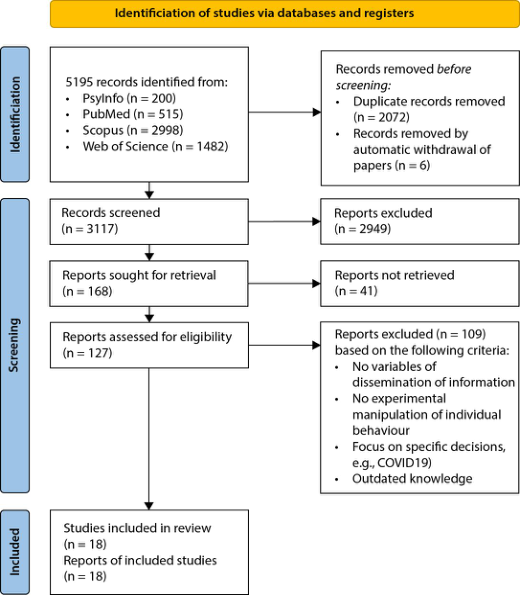
Figure 1: PRISMA flow chart.
The literature review aimed to identify variables, experimental designs and instruments used to investigate the decision-making process of individuals in relation to the spread of misinformation on social networks, with a focus on
empirical studies that conducted a behavioral experiment. Therefore, stud- ies were considered that focus on social media and the spread of fake news or misinformation, have an empirical design with an experiment conducted, and were published in English between 1990 and 2023 (for an overview, see Figure 1).
In total, 5195 results were retrieved on January 10th, 2024. After the exclusion of duplicates, 3117 articles remained. Through title and abstract screening, another 2949 studies were excluded from the list. Evaluating full-text studies, a further 114 papers were excluded, because they lacked an experimental design, or they did not meet the previously defined inclu- sion and exclusion criteria. The two researchers applied the specified critical appraisal criteria to align the articles assessed with the research objectives and to ensure that the included articles contained information related to the research question. Although a substantial number of studies exist on the dif- fusion of misinformation in social media with specific topics, the researchers carried out the study in a general context, offering a broader outlook rather than projecting issues relating to a single event, like COVID-19. Further research papers therefore were excluded because of a too narrow perspec- tive on the information dissemination process. A total of 18 articles were selected as constructs of these research papers were similar to the constructed objectives of the research.
From the 18 final articles, the experimental setups as well as the variables and tools used were extracted and categorized. Finally, the used variables and measurements were clustered based on the field theory by Kurt Lewin (Burnes & Cooke, 2012) to identify the different fields that influence the decision- making process regarding the dissemination of misinformation on SNS. The theory was used because it offers the possibility to organize the extracted vari- ables in a way that emulates the information dissemination process itself. This is done by categorizing possible influencing factors into an external or envi- ronmental domain, an internal or personal domain and a domain in which the two aspects interact. In this way, we can highlight focal points of the research and illustrate how the decision to focus on a particular part of the information dissemination process on the part of the researcher influences the way in which the research attempts to rationalize the process.
RESULTS
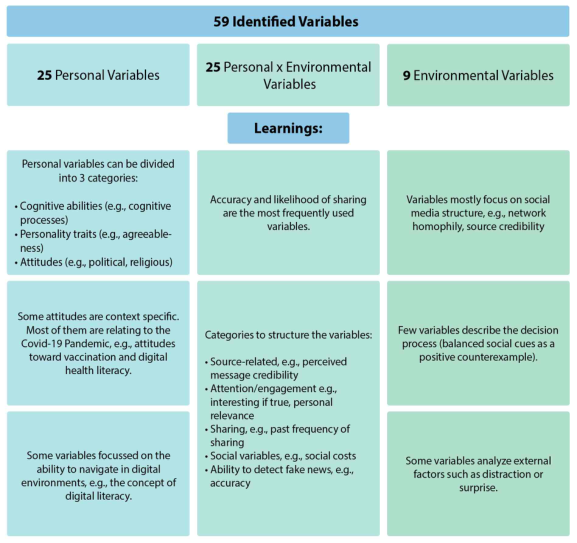
In order to report our results in a structured manner, the variables are first assigned to the previously described structures and then, in a second step, the resulting relations within the structures are discussed and presented. We were able to identify a total of 59 variables. Based on Lewin’s field theory model, we divided the variables into the areas P (person) and E (environ- ment), which form behavior B. Of the 59 identified variables, 9 fitted into the environment category, 25 into the person, and 25 into the mixed envi- ronment x person (ExP)category. This indicates a neglect of environmental variables when modelling context and a high focus on personal and person x environment variables in reviewed papers.
Quantifying Information Dissemination: Structured Review on Methods and Variables 5
The identified personal variables can be divided into three areas: 1. Vari- ables that focus on the cognitive abilities of the communication individual. Those include the analysis of cognitive processes (e.g., the measurement of Probabilistic Reversal Learning, optimistic bias, or cognitive judgement bias) (Piksa et al., 2022), or the examination of behavioral inhibition and activation systems (Piksa et al., 2022). 2. Variables that focus on the mea- surement of personality traits like the Big 5 (Piksa et al., 2022), agreeableness (Buchanan, 2020, 2021; Piksa et al., 2022), disgust (Ali et al., 2022), need for cognition (Ceylan et al., 2023; Pereira et al., 2023), or emotionality (Freiling et al., 2023; Rijo & Waldzus, 2023) among others. In particular, the Big 5 personality type variables were used in different variations in the different papers. 3. Variables focusing on the attitudes of the communicating individ- ual. These relate primarily to the individual’s political and religious attitude towards their environment and include conservatism (Buchanan, 2020; Cey- lan et al., 2023; Freiling et al., 2023), partisanship/ partisan bias (Ceylan et al., 2023; Freiling et al., 2023; Lawson et al., 2023; Pereira et al., 2023; Sirlin et al., 2021), or religiosity (Stefanone et al., 2019).
Figure 2: Field theory based research overview and learnings.
The environmental variables predominantly focus on the way the social media environment is shaped and how that social structuring influences where and how the participants disseminate information, e.g., network homophily (Ali et al., 2022; Jones et al., 2023; Stefanone et al., 2019) and structure of the source (source credibility (Ali et al., 2022), authority
(Buchanan, 2020)). The majority of papers focussed on the description of properties of the system but did not take into account how a specific situation for information sharing presents itself to an individual. That is, while network homophily contributes to a global understanding of SNS dynamics, it does not allow for conclusions about individual reactions to specific situations. In contrast to this, the balanced social cue (Jones et al., 2023) variable serves as a positive counterexample, where the individual is given concrete informa- tion on how part of its social circle or other people in general interacted with the system.
Finally, we identified 25 variables that fit into the ExP category. The most commonly used ones addressed the ability of the participants to identify if a piece of information is misinformation or not (accuracy (Altay, de Araujo, et al., 2022; Altay, Hacquin, et al., 2022; Ceylan et al., 2023; Freiling et al., 2023; Lawson et al., 2023; Rijo & Waldzus, 2023; Sirlin et al., 2021; Vellani et al., 2023)) and the likelihood that an individual would share a piece of information or not (likelihood of sharing (Buchanan, 2020, 2021; Rijo & Waldzus, 2023)). Both appear in a multitude of versions that basically apply to the same concept. For example, accuracy is also measured as headline judging accuracy (Sirlin et al., 2021) which is a specific version of the same concept, namely the ability to correctly identify false information in a given example. Another variant was perceived accuracy (Rijo & Waldzus, 2023), which also rated the ability of individuals to assess something as fake news or not. The ExP variables can be divided into categories of similar concepts: 1. Source-related: Those include Social endorsements (Ali et al., 2022) and Per- ceived message credibility (Ali et al., 2022) among others. The variables focus on the way individuals perceive different aspects of the information source and how that influences their decision process. 2. Attention and engagement: Variables like interesting if true (Altay, de Araujo, et al., 2022) or personal rel- evance (Shen et al., 2021) are used to examine the influence of how interesting or engaging a piece of information is for an individual and how relevant that is for the sharing process. 3. Sharing: This category includes all variables that deal with the sharing habit of the individual, either in the past with variables like news sharing habit (Ceylan et al., 2023) and past frequency of sharing (Ceylan et al., 2023) or by looking at intentions (message) sharing intention (Sirlin et al., 2021; Song et al., 2023) and sharing choice (Ceylan et al., 2023). 4. Social variables: The only social variable was the influence of social cost (Lawson et al., 2023). In other words, the negative repercussions associated with sharing or not sharing a piece of information as part of a social group. 5. The ability to detect fake news or misinformation: This category includes the aforementioned accuracy (see above) and discernment (see above), i.e., the ability to correctly identify true and false information in a given context.
DISCUSSION
As this paper was aimed at giving a methodological review of variables and tools used in the research of information dissemination decisions in SNS, we analyzed 18 papers in order to extract corresponding variables. The variables and tools then were structured based on field theory.
Quantifying Information Dissemination: Structured Review on Methods and Variables 7
We observed a focus on an individuals’ characteristics (e.g., religious beliefs) and their influence on information perception as well as social context (e.g., how polarized the users on the platform are) users encounter on different SNS. Furthermore, the general accuracy, e.g., how well a person cor- rectly identifies misinformation, was used as a predictor for sharing behavior. Looking at P and PxE, interventions and experimental manipulations tar- get an individual’s ability to detect misinformation content. Accordingly, the predominant approach in the reviewed articles is to identify individual char- acteristics as factors for the spread of misinformation. That is, most papers do not examine technological context factors, e.g., the way SNS are constructed and present information to the users. Unsurprisingly, a lot of the reviewed papers lacked experimental data (more than 250 were excluded due to lack- ing an experimental design) to support the development of countermeasures, but relied on the description of user characteristic to explain information dissemination. We therefore believe that approaching the problem of misin- formation spread in SNS by focussing on these disjointed variables, while having its merits, ultimately is not an efficient approach, to analyze the situ- ation in which the decision process actually happens. Only variables like the display of balanced social cues (Jones et al., 2023) or the measurement of sur- prise (Rijo & Waldzus, 2023; Song et al., 2023) and distraction (Stefanone et al., 2019) addressed the moment of decision-making itself, either through experimental manipulation or by measuring the reaction of the participants.
Accordingly, the current landscape of research activities on misinforma- tion in SNS has been coined by insights that follow from a very individual centered or (speaking in Lewins terms) person focused perspective, rather than an environmental one. The long-term goal of researchers must there- fore be to expand the variables currently used to include those that explicitly deal with the decision-making situation of individuals, in order to try to cre- ate a holistic picture of the decision-making process. This includes focussing on studies that use experimental manipulation of their participants to assess the differences in dissemination behavior, as was made clear by the applied exclusion criteria (e.g., non-empirical studies; no experimental design) that we established.
We are therefore in favor of not only letting users make theoretical deci- sions about the dissemination of misinformation, but also using scenarios that are as realistic as possible in which they have to make decisions and weigh up various factors such as credibility, alignment with their attitude, etc., in order to create results with sufficient validity. In addition, we are in favor of conducting long-term studies with these scenarios, that explore the relationship between how the decision-making processes can be mapped over time and what correlations can be analyzed that are not possible with singular surveys.
One way to avoid reducing the analysis of the information dissemination process to merely studying datasets or real-world data recordings is to utilize online tools for creating experimental environments. Looking at the experi- mental designs that were used by the analyzed papers, a multitude focussed on the presentation and rating of headlines or articles for the participants to rate (among others (Ali et al., 2022; Altay, de Araujo, et al., 2022; Ceylan
et al., 2023; Freiling et al., 2023; Rijo & Waldzus, 2023; Vellani et al., 2023)). Of the reviewed papers, only (Jones et al., 2023) modified the real and exist- ing social media feed of the participants to observe their interactions with misinformation. While we especially looked for experimental design utilizing digital tools to simulate an SNS environment, we found only few. While some like (Lees et al., 2023) were used educationally, offering the users the oppor- tunity to learn about misinformation and test their accuracy, almost none were used in the context of an experimental manipulation of the decision process of the participants. The only exception to this is the misinformation game from (Butler et al., 2023). An experimentally evaluated online envi- ronment that not only allows the creation of messages and headlines in an SNS feed, but also enables the manipulation of variables such as the user’s reach or credibility. They provide exactly the kind of “adaptable and ecolog- ically valid social media testing paradigm” (Butler et al., 2023) that enables a more decision environment driven approach to addressing the spread of misinformation on SNS.
LIMITATION By addressing explicitly experimental research, our work demonstrates a high demand for theory-driven design of empirical research on misinformation dissemination SNS. Due to a high focus on existing data sets, the presented results have been deducted from a few publications on empirical research. In combination with high divergence of variables and variability of examined constructs, we cannot estimate the replicability or statistical relevance of our results. Future research activities need to focus on variables by integrating psychological models of human action regulation in information spaces and SNS.
CONCLUSION
The conducted literature review showed that a high proportion of the reviewed articles focused on the detection or simulation of misinformation spread. Of the work that examined the information dissemination process as an individual decision influenced by psychological factors, most approached the topic via person related variables. To further understand individual sharing behavior, it is crucial to analyze the circumstances under which indi- viduals make their decisions. We assume that the identification of factors that influence individuals to share misinformation in their personal contexts can provide explanations for how misinformation spreads on social networks. Empirical, experiment-based testing of these variables is essential to develop a holistic picture. Further research should therefore aim to use realistic sce- narios to experimentally test precisely those variables that best describe the decision-making environment of individuals.
ACKNOWLEDGMENT
The authors would like to acknowledge Luisa Winzer for her support and patience.
Quantifying Information Dissemination: Structured Review on Methods and Variables 9
REFERENCES
Abdulameer, A. A., Salman, M. A., & Mahdi, M. A. (2022). Influencers detection algorithm to combat rumors in social networks. IICETA 2022 - 5th International Conference on Engineering Technology and Its Applications, 32–36. https://doi. org/10.1109/IICETA54559.2022.9888361 Ali, K., Li, C., Zain-ul-abdin, K., & Muqtadir, S. A. (2022). The effects of emotions,
individual attitudes towards vaccination, and social endorsements on perceived fake news credibility and sharing motivations. Computers in Human Behavior, 134. https://doi.org/10.1016/j.chb.2022.107307 Altay, S., de Araujo, E., & Mercier, H. (2022). “If this account is true, it is most enormously wonderful”: Interestingness-if-true and the sharing of true and false news. Digital Journalism, 10(3), 373–394. https://doi.org/10.1080/21670811. 2021.1941163 Altay, S., Hacquin, A.-S., & Mercier, H. (2022). Why do so few people share fake
news? It hurts their reputation. New Media and Society, 24(6), 1303–1324. https: //doi.org/10.1177/1461444820969893 Buchanan, T. (2020). Why do people spread false information online? The effects of message and viewer characteristics on self-reported likelihood of sharing social media disinformation. PloS One, 15(10), e0239666. https://doi.org/10.1371/jour nal.pone.0239666 Buchanan, T. (2021). Trust, personality, and belief as determinants of the organic
reach of political disinformation on social media. Social Science Journal. https: //doi.org/10.1080/03623319.2021.1975085 Burnes, B., & Cooke, B. (2012). kurt lewin’s field theory: A review and re-evaluation.
International Journal of Management Reviews, 15(4), 408–425. https://doi.org/ 10.1111/j.1468-2370.2012.00348.x Butler, L. H., Lamont, P., Wan, D. L. Y., Prike, T., Nasim, M., Walker, B., Fay, N., & Ecker, U. K. H. (2023). The (Mis) Information Game: A social media simulator. Behavior Research Methods. https://doi.org/10.3758/s13428-023-02153-x Ceylan, G., Anderson, I. A., & Wood, W. (2023). Sharing of misinformation is habit-
ual, not just lazy or biased. Proceedings of the National Academy of Sciences of the United States of America, 120(4), e2216614120. https://doi.org/10.1073/pn as.2216614120 Freiling, I., Krause, N. M., Scheufele, D. A., & Brossard, D. (2023). Believing and sharing misinformation, fact-checks, and accurate information on social media: The role of anxiety during COVID-19. New Media & Society, 25(1), 141–162. https://doi.org/10.1177/14614448211011451 Jones, C. M., Diethei, D., Schöning, J., Shrestha, R., Jahnel, T., & Schüz, B. (2023).
Impact of Social Reference Cues on Misinformation Sharing on Social Media: Series of Experimental Studies. Journal of Medical Internet Research, 25, e45583. https://doi.org/10.2196/45583 Lawson, M. A., Anand, S., & Kakkar, H. (2023). Tribalism and tribulations: The social costs of not sharing fake news. Journal of Experimental Psychology: General, 152(3), 611–631. https://doi.org/10.1037/xge0001374 Lees, J., Banas, J. A., Linvill, D., Meirick, P. C., & Warren, P. (2023). The Spot the
Troll Quiz game increases accuracy in discerning between real and inauthentic social media accounts. PNAS Nexus, 2(4), pgad094. https://doi.org/10.1093/pnas nexus/pgad094 Liu, D., & Campbell, W. K. (2017). The Big Five personality traits, Big Two metatraits and social media: A meta-analysis. Journal of Research in Personality, 70, 229–240. https://doi.org/10.1016/j.jrp.2017.08.004
Mario Haim, A. G., & Brosius, H.-B. (2018). Burst of the filter bubble? Digital Journalism, 6(3), 330–343. https://doi.org/10.1080/21670811.2017.1338145 Özgüven, N., & Mucan, B. (2013). The relationship between personality traits and
social media use. Social Behavior and Personality: An International Journal, 41(3), 517–528. Pereira, A., Harris, E., & Van Bavel, J. J. (2023). Identity concerns drive belief: The impact of partisan identity on the belief and dissemination of true and false news. Group Processes & Intergroup Relations, 26(1), 24–47. https://doi.org/10.1177/ 13684302211030004 Piksa, M., Noworyta, K., Piasecki, J., Gwiazdzinski, P., Gundersen, A. B., Kunst,
J., & Rygula, R. (2022). Cognitive processes and personality traits underlying four phenotypes of susceptibility to (Mis) information. Frontiers in Psychiatry, 13, 912397. https://doi.org/10.3389/fpsyt.2022.912397 Prandi, L., & Primiero, G. (2022). A logic for biassed information diffusion by paranoid agents in social networks. Journal of Logic and Computation, 32(6), 1292–1315. https://doi.org/10.1093/logcom/exac020 Rijo, A., & Waldzus, S. (2023). That’s interesting! The role of epistemic emotions
and perceived credibility in the relation between prior beliefs and susceptibility to fake-news. Computers in Human Behavior, 141. https://doi.org/10.1016/j.chb. 2022.107619 Shen, Y.-C., Lee, C. T., Pan, L.-Y., & Lee, C.-Y. (2021). Why people spread rumors on social media: Developing and validating a multi-attribute model of online rumor dissemination. Online Information Review, 45(7), 1227–1246. https://doi.org/10. 1108/OIR-08-2020-0374 Simonov, A., Sacher, S., Dubé, J.-P., & Biswas, S. (2022). Frontiers: The persuasive
effect of fox news: Noncompliance with social distancing during the COVID- 19 pandemic. Marketing Science, 41(2), 230–242. https://doi.org/10.1287/mksc .2021.1328 Sirlin, N., Epstein, Z., Arechar, A. A., & Rand, D. G. (2021). Digital literacy is associated with more discerning accuracy judgments but not sharing intentions. Harvard Kennedy School Misinformation Review, 2(6). https://doi.org/10.37016/ mr-2020-83 Song, H., So, J., Shim, M., Kim, J., Kim, E., & Lee, K. (2023). What message features
influence the intention to share misinformation about COVID-19 on social media? The role of efficacy and novelty. Computers in Human Behavior, 138, 107439. https://doi.org/10.1016/j.chb.2022.107439 Stefanone, M. A., Vollmer, M., & Covert, J. M. (2019). In news we trust?: Examining credibility and sharing behaviors of fake news. ACM International Conference Proceeding Series, 136–147. https://doi.org/10.1145/3328529.3328554 van der Linden, S. (2022). Misinformation: Susceptibility, spread, and interventions
to immunize the public. Nature Medicine, 28(3), 460–467. https://doi.org/10. 1038/s41591-022-01713-6 van der Linden, S., Roozenbeek, J., & Compton, J. (2020). Inoculating against fake news about COVID-19. Frontiers in Psychology, 11. https://doi.org/10.3389/fpsy g.2020.566790 Vellani, V., Zheng, S., Ercelik, D., & Sharot, T. (2023). The illusory truth effect
leads to the spread of misinformation. Cognition, 236, 105421. https://doi.org/ 10.1016/j.cognition.2023.105421 Wei, X., Zhang, Y., Fan, Y., & Nie, G. (2021). Online social network information dissemination integrating overconfidence and evolutionary game theory. IEEE Access, 9, 90061–90074. https://doi.org/10.1109/ACCESS.2021.3090783
LISTED IN THE AHFE DIGITAL BOOKSTORE CATALOGUE
Explore the complete digital volume
Human Dynamics, Product Evaluation and Quality
Read this individual research paper free through the original publisher, or explore the full digital proceedings book.
ISBN 978-1-964867-07-6
Explore this ISBN in the AHFE Bookstore ↗Listed in the July 2026 bookstore catalogue; search by ISBN to confirm current availability · Digital book purchase optional