Safa Elkefi, Dario Trapani, Congyu Wu (2026). Human Factors Influencing Trust in Healthcare Providers as Primary COVID-19 Information Sources Among Cancer Survivors: A Health Belief Model Analysis. In: Healthcare and Medical Devices. AHFE Open Access, vol. 211, pp. 299–309. https://doi.org/10.54941/ahfe1007493
Due to Covid-19 rapid escalation at the global level, a growing body of misinformation sources became available to patients. However, patterns and determinants of consulting unreliable sources are not well understood. Using the Health Belief Model, this study investigates the impactors of trust in healthcare providers as the main source of Covid-19 information-seeking patterns. Methods This retrospective study used restricted data from the 2021 Health Information National Trends Survey (HINTS SEER), which collected information from January 11, 2021, to August 20, 2021. We used the partial least squares structural equation modeling (PLS-SEM) method for data analysis. Missing data were handled using a multiple imputations method. Results A total of 1234 cancer survivors were included in the study. The goodness of fit of the structural model indicated an acceptable and satisfactory fit. SEM analysis showed that the "perceived severity" and the "cues to action" did not affect the behavior of the cancer survivors. By contrast, perceived self-efficacy (β=0.088, P<0.001), benefits (β=0.009, P<0.001), barriers (β=-0.064, P=0.001), and susceptibility (β=-0.089, P<0.001) were predictors of the behavior. Conclusions The findings of our study provide important insights into the factors that affect cancer survivors' trust in doctors as the main source of Covid-19 Information. Our results suggest that patient-centered authentic, reliable, and accurate communication centered around the cancer survivors' needs should be adopted to ensure patients continue to trust their providers. The study also suggests that it remains important to support patients' self-efficacy to know how to handle critical situations and their trust in their abilities.
In recent years, the cancer burden has increasingly grown to a proportion of a significant global public health problem with considerable population, social, and economic consequences, demanding more efforts to support the needs of patients (Bungay & Cappello, 2009). With growing support, a vast body
of research has been published to identify cancer patients’ information needs and the sources from which they receive relevant cancer information (Rutten et al., 2005). Well-informed patients are capable of greater involvement in decision-making, higher satisfaction with treatment choices, and improved coping across disease phases (Cadmus et al., 2009; Faller et al., 2016). The demonstrated benefits of cancer-related information seeking, coupled with increasing information availability, underscore the importance of monitoring patient information-seeking experiences over time (Finney Rutten et al., 2016). Because effective communication is key to optimal health outcomes, understanding where patients receive information during care is critical (Rutten et al., 2005).
In cancer care, healthcare providers are an important source of information about diagnosis, treatment, and prognosis (Roach et al., 2009). However, patients seek information from a variety of sources, including friends and family, print media, broadcast media, and the internet, including social networks (Dolce, 2011; Carlsson, 2009). Finney Rutten and colleagues found that despite the expansion of cancer information sources, patients continue to rely primarily on healthcare providers rather than uncertified sources (Finney Rutten et al., 2016). Supporting interpersonal trust between doctors and patients is therefore essential, as it plays a critical role in communication quality (Kaiser et al., 2011).
Amid the COVID-19 pandemic, unprecedented challenges were added to healthcare systems worldwide (Bergerot & Philip, 2021). Major disruptions affected cancer care delivery, including delays in diagnosis, treatment, and follow-up (Al-Quteimat & Amer, 2020; Ueda et al., 2020). Cancer patients experienced heightened uncertainty due to disrupted care continuity and increased vulnerability to severe COVID-19 outcomes (Bergerot & Philip, 2021). Many patients felt isolated, reporting interruptions in routine oncologic visits (Al-Quteimat & Amer, 2020). Accurate and timely information is critical for cancer patients to manage their health and treatment decisions (de Lusignan et al., 2020); however, the pandemic intensified information- seeking challenges and amplified anxiety caused by conflicting information (de Lusignan et al., 2020).
Additionally, healthcare system disruptions limited patients’ direct access to healthcare professionals due to physical distancing and reduced in-person visits, impairing opportunities for information exchange and emotional support (Kutikov et al., 2020). Concurrently, an overwhelming volume of COVID-19-related information of varying accuracy circulated across media channels, creating an “infodemic” (Czerniak et al., 2023; Mheidly & Fares, 2020). Distinguishing credible information from misinformation became increasingly difficult, exacerbating patient anxiety (Mheidly & Fares, 2020).
Given these challenges, ensuring that cancer survivors continue to trust healthcare providers as primary information sources remains essential. This study examines predictors of trust in healthcare providers for COVID-19
Human Factors Influencing Trust in Healthcare Providers as Primary COVID-19 301 information among cancer survivors, guided by the Health Belief Model (Hochbaum et al., 1952; Rosenstock, 1974).
METHODS
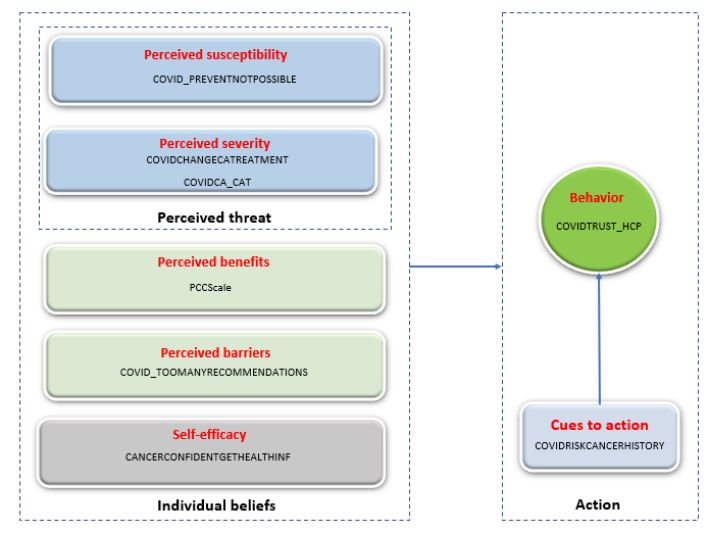
Data and Measures The pilot project, HINTS-SEER, was designed to provide a larger sample of cancer survivors for analysis. In the 2021 pilot program, the National Cancer Institute NCI administered this survey to oversample cancer survivors using 3 cancer registries from the SEER program (Surveillance, Epidemiology, and End Results). The data was collected between January 11, 2021, and August 20, 2021. According to HINTS data, 1234 respondents completed the survey. The HINTS service considers a questionnaire complete if at least 80% of the questions in each section are answered. To handle missing data, a multiple imputation method is used, the K-nearest-neighbor algorithm. We used the following observed variables from the HINTS-SEER survey to feed the HBM conceptual model’s constructs, as shown in Figure 1. For example, the perceived benefits were measured through the 0-100 Patient-centered communication scale (PCCScale). The other variables were measured through individual questions, as shown in Table 1.
Figure 1: Health Belief Model for trusting healthcare providers as a main source of information.Table 1: Characteristics of the sample.
DATA ANALYSIS For the descriptive statistics, Wald chi-square tests were used to determine the association between the behavior and the characteristics of the respondents. A P-value of less than 0.05 was considered significant. The partial least squares structural equation model (PLS-SEM) was used to test the theoretical
Human Factors Influencing Trust in Healthcare Providers as Primary COVID-19 303 assumptions of the Health Belief Model, consistent with prior research (Liu et al., 2022; Wong et al., 2020). Bootstrapping with 5,000 subsamples controlled for confounders including income, education, gender, and race. Bias-corrected and accelerated confidence intervals were estimated at 95% significance. Bias-corrected and accelerated (BCA) bootstrap methods were used to estimate nonparametric confidence intervals (CIs). Statistical significance was tested at 95% CI (2-tailed). P values of less than 0.05 were considered statistically significant. The fit of the measurement model was tested through Confirmatory Factor Analysis (CFA). Five indices were used in assessing the model fit: comparative fit index (CFI), goodness of fit index (GFI), root mean square error (RMSEA), Beetle-Browed NFI, and chi-square normalized by degrees of freedom (χ2/df). Analyses were performed using Python software, version 3.8 (Python, New Jersey, USA), using complex survey design procedures (researchpy, numpy, pandas, statsmodels, semopy, sklearn, etc.).
RESULTS
Descriptive Statistics A total of 1234 cancer survivors were included in the study; a majority of 74.64% were White, 47.33% had an annual income of $75000 or higher, and a majority (55.51%) were at least college graduates. Most of the population consisted of older adults (97.89%). Table 1 details the descriptive statistics. Gender, Education, Annual Income, and Race were significantly associated with the patients’ behavioral outcomes for this study (P < 0.05). Thus, the SEM model was adjusted for these factors.
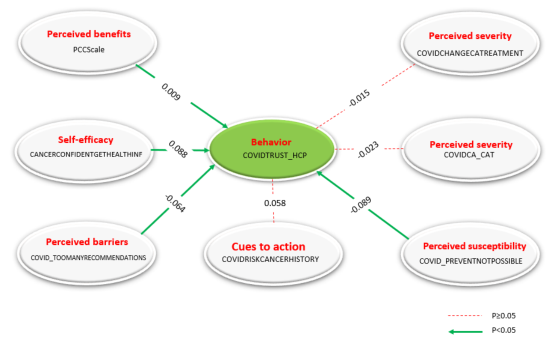
Structural Model Results In this study, the GFI, NFI, CFI, RMSEA, and χ2/df were 0.992 ( > 0.9), 1.012 ( > 0.9), 1.06 ( > 0.94), 0.001 ( < 0.09), 1.14 ( < 3). Thus, the goodness of fit of the structural model indicated an acceptable and satisfactory fit. SEM analysis showed that, as shown in Figure 2, the perceived severity and the cues to action had been rejected and did not affect the behavior of the respondents. By contrast, self-efficacy (β = 0.088, P < 0.001), perceived benefits (β = 0.009, P < 0.001), perceived barriers (β = -0.064, P = 0.001), and perceived susceptibility (β = -0.089, P < 0.001) were predictors of the information-seeking behavior.
In essence, the more cancer survivors thought there was nothing they could do to prevent Covid-19, the more they assumed that there were so many different recommendations about preventing Covid-19 that it would be hard for people to know which ones to follow, then the less they believed they could trust their doctors as a source of information related to Covid-19. The better the patients’ perceptions of the communication received by their doctors and the more they believed they could get advice or information
about cancer if needed, the more they trusted their doctors as a source of Information for Covid-19.
Figure 2: Structural equation model of the pathways. Dashed lines indicate non- significant effects.
DISCUSSION
This study uses nationally representative NCI data that explores cancer survivors’ behavior during Covid-19. Cancer survivors’ beliefs about Covid- 19 prevention and their trust in doctors as a source of information may play crucial roles in their health-seeking behaviors. Although many studies used the HBM to explore the behavior of patients, and some of them even used it to investigate preventive Covid-19-related behaviors, this is, to our knowledge, the first study that investigates a Covid-19-related behavior among cancer survivors using the HBM.
Despite studies have shown that cancer patients and survivors tend to trust online information more and more, as shown by Lange et al. in their review (Lange et al., 2019), a majority of 93.52% of the respondents trust their healthcare providers as a main source of information related to Covid-19. This finding is similar to Ren and colleagues’ study, which explored the changes in doctors’ trust before and after the pandemic and found that patients trusted their healthcare providers more during Covid-19 than before (Ren et al., 2023). Cancer survivors’ behavior (trust in their HCPs as a source of Covid- 19-related Information) was positively affected by perceived susceptibility as hypothesized by the HBM. This result is consistent with previous studies (Zhong et al., 2021). This may be explained by the fact that when cancer survivors were hopeful about reducing the risk of Covid-19, they would refer to their doctors to get more reliable information and build their Covid-19- related awareness. Awareness about the possibility of preventing Covid-19 can help support positive and preventive behaviors among patients (Zhong et al., 2021). For example, studies found that individuals who believed they could prevent COVID-19 through personal measures, such as wearing masks
Human Factors Influencing Trust in Healthcare Providers as Primary COVID-19 305 and practicing hand hygiene, were more likely to adopt preventive behaviors (Zhong et al., 2021). This behavior was also positively affected by the patients’ confusion about the available recommendations related to Covid-19. Access to excessive information from multiple sources relating to COVID-19 in a short span of time can have detrimental effects on individuals (EKİNCİ et al., 2023). The overload related to the excessive information available resulted in fear and confusion among cancer patients based on the literature (EKİNCİ et al., 2023).
Furthermore, studies have shown that cancer survivors’ self-efficacy has been associated with positive behavior (Liao et al., 2018). A study by Liao and colleagues found that health-information-related self-efficacy impacts cancer patients’ information-seeking behaviors (Liao et al., 2018). This finding supports our result as we found that cancer patients’ confidence that they can get Covid-19-related health information positively impacts their trust towards doctors as a main source. Lastly, patient-centered communication (PCC) was another predictor of the cancer survivors’ trust in Information about Covid-19 from doctors. PCC has long been considered an important pillar of cancer care as it helps patients cope with stressful situations and strengthens their trust in HCPs (Shields et al., 2009). Eliciting and validating patients’ concerns and attentiveness was associated with increased effectiveness in the discussions between physicians and cancer patients (Shields et al., 2009).
It is noteworthy that contrary to what was hypothesized, the healthcare disruptions caused by the pandemic did not impact patients’ trust in doctors as their source of information. This finding correlates with a study by Soriano and colleagues which shows that despite the disruptions and delays in treatment due to the pandemic, psychosocial difficulties among breast cancer survivors did not differ much (Soriano et al., 2021). The authors explained that cancer survivors’ needs for frequent visits are less important as they are going through the survivorship phase. This may also explain why the disruptions did not impact our study’s patients’ trust in their providers. Also, informing patients that they have more Covid-19-related risk due to their cancer history did not impact how much they trust them as their source of information. Studies investigating cancer patients’ trust in their doctors showed that to build a trust-based relationship, patients prefer their oncologists to be honest and straightforward with them as it makes them feel that they take their best interests at heart and are less willing to be vulnerable (Hillen et al., 2011). This may explain why providers’ honesty about the Covid-19 risk did not impact how much patients trust them as a source of information.
Pandemics can radically change healthcare systems, especially in sensitive settings like cancer. With the infodemics and the confusing misleading information available, it remains important to ensure that doctors are still trusted as the main go-to source of information when needing clarification. Trust in doctors as a source of information is critical, particularly during health crises, as it directly impacts individuals’ compliance with recommended preventive measures and treatment adherence. Therefore, it remains important to address cancer survivors’ perceptions of preventability as essential in
promoting trust and encouraging their engagement with reliable information sources. Clear, honest, and straightforward communication centered around the cancer survivors’ needs should be adopted to ensure patients continue to trust their providers. Finally, it is important to control the flow of information received by cancer patients to not add to their workload and to guide them through which recommendations make sense to them and which do not because it is important to make sure cancer patients and survivors’ relationships with their doctors do not get impact by the unusual crises and stressful situations.
Research on cultural competence and behavioral patterns for patient- reported outcomes in the survivorship care setting is limited. HBM has been shown to be particularly proficient in evaluating and defining health promotion strategies and improving therapeutic compliance. Of relevance, shaping mitigation strategies for the pandemic and other extraordinary occurrences in the tradeoff of safety, treatment delays, and best treatments has been the greatest challenge amidst COVID-19. Our data reports patients’ high confidence and trust in health providers and a tendency to confirm claims acquired from mass media and social networks –key to resulting in person-centric, consistent health policies to control unexpected, sudden, or major health system disruptions. An HBM approach can dissect priorities of population health vs. person-centric needs, addressing beliefs and patterns, thereby assuring the delivery of health policies that are comprehensive and impact-oriented. In addition, HBM research-informed policies could help strengthen culturally competent strategies oriented toward inclusiveness across a broad range of experiences and perceptions of the health systems.
Despite the importance of this study, it remains important to acknowledge its limitations. One potential limitation is that the data were collected through self-report measures subject to biases such as social desirability and self- presentation. Patients were commonly older, and data collection was based on one high-income country. In addition, the results may not be generalizable to the larger population of patients with cancer. It would be valuable to replicate this study with a larger sample to further examine the relationships among the variables. Although we acknowledge that the long-term relevance of our findings in non-pandemic contexts is uncertain, the findings of this study can be relevant in other settings of crises, such as extreme weather events where the healthcare system is challenged by the shortage of resources and the unpredictable changes, and war or humanitarian crisis.
CONCLUSION
In conclusion, we reported the results from a population-based survey for the first time based on a Health Belief Model on the determinants of information- seeking behavior in patients with cancer amidst the Covid-19 pandemic. We described the link between personal beliefs and preferred sources of information, highlighting potential paths to misinformation and infodemic. We believe that the results of our analysis can help better tailor patients’ needs through social-psychological research methodologies, especially in scenarios of rapid changes in living conditions, yielding disruptions of services and
Human Factors Influencing Trust in Healthcare Providers as Primary COVID-19 307 subversions of certainties, addressing the trade-off of population and person- centric healthcare, while delivering benefits to all.
REFERENCES
Al-Quteimat, O. M., & Amer, A. M. (2020). The impact of the COVID-19 pandemic on cancer patients. American Journal of Clinical Oncology, 43(6), 452–455. Alagili, D. E., & Bamashmous, M. (2021). The Health Belief Model as an explanatory
framework for COVID-19 prevention practices. Journal of Infection and Public Health, 14(10), 1398–1405. Arif, W., Mahmood, F., & Mughal, M. A. (2020). Information seeking through TV and Facebook and health belief model: A case of Punjab (Pakistan) during the COVID-19 pandemic. Journal of the Research Society of Pakistan, 57(2), 9–18. Bergerot, C. D., & Philip, E. J. (2021). Emotional burden associated with COVID-19:
Trust and communication in cancer care. Taylor & Francis, 1–2. Blanch-Hartigan, D., Chawla, N., Beckjord, E. I., Forsythe, L. P., de Moor, J. S., Hesse, B. W., et al. (2015). Cancer survivors’ receipt of treatment summaries and implications for patient-centered communication and quality of care. Patient Education and Counseling, 98(10), 1274–1279. Bungay, H., & Cappello, R. (2009). ‘As long as the doctors know what they are
doing’: Trust or ambivalence about patient information among elderly men with prostate cancer? European Journal of Cancer Care, 18(5), 470–476. Cadmus, L. A., Salovey, P., Yu, H., Chung, G., Kasl, S., & Irwin, M. L. (2009).
Exercise and quality of life during and after treatment for breast cancer: Results of two randomized controlled trials. Psycho-Oncology, 18(4), 343–352. Carlsson, M. (2009). Cancer patients seeking information from sources outside the health care system: Change over a decade. European Journal of Oncology Nursing, 13(4), 304–305. Consedine, N. S., Ladwig, I., Reddig, M. K., & Broadbent, E. A. (2011). The many faces
of colorectal cancer screening embarrassment: Preliminary psychometric development and links to screening outcome. British Journal of Health Psychology, 16(3), 559–579. Czerniak, K., Pillai, R., Parmar, A., Ramnath, K., Krocker, J., & Myneni, S. (2023).
A scoping review of digital health interventions for combating COVID-19 misinformation and disinformation. Journal of the American Medical Informatics Association, 30(4), 752–760. de Lusignan, S., Liyanage, H., McGagh, D., Jani, B. D., Bauwens, J., Byford, R., et al.
(2020). COVID-19 surveillance in a primary care sentinel network. JMIR Public Health and Surveillance, 6(4), e21434. Dolce, M. C. (2011). The Internet as a source of health information: Experiences of cancer survivors and caregivers with healthcare providers. Oncology Nursing Forum, 38(3), 353–359. EKİNCİ, F., ATEŞ, G. A., ERDOĞAN, A. P., ÇELİK, C., DİRİCAN, A., & GÖKSEL,
G. (2023). The confusion caused by the fear of COVID-19 in the future of cancer patients. Bangladesh Journal of Medical Science, 22(1), 68–76. Elkefi, S., & Asan, O. (2023). The impact of patient-centered care on cancer patients’ quality of care, self-efficacy, and trust toward doctors: Analysis of a national survey. Journal of Patient Experience, 10, 23743735231151533. Faller, H., Koch, U., Brähler, E., Härter, M., Keller, M., Schulz, H., et al. (2016).
Satisfaction with information and unmet information needs in men and women with cancer. Journal of Cancer Survivorship, 10, 62–70.
Finney Rutten, L. J., Agunwamba, A. A., Wilson, P., Chawla, N., Vieux, S., Blanch- Hartigan, D., et al. (2016). Cancer-related information seeking among cancer survivors: Trends over a decade (2003–2013). Journal of Cancer Education, 31, 348–357. Glanz, K., Rimer, B. K., & Viswanath, K. (2015). Health behavior: Theory, research,
and practice. John Wiley & Sons. Green, E. C., Murphy, E. M., & Gryboski, K. (2020). The health belief model. In The Wiley Encyclopedia of Health Psychology (pp. 211–214). Wiley. Hillen, M. A., de Haes, H. C. J. M., & Smets, E. M. A. (2011). Cancer patients’ trust
in their physician—A review. Psycho-Oncology, 20(3), 227–241. Hochbaum, G., Rosenstock, I., & Kegels, S. (1952). Health Belief Model. United States Public Health Service. Kaiser, K., Rauscher, G. H., Jacobs, E. A., Strenski, T. A., Estwing Ferrans, C., &
Warnecke, R. B. (2011). The import of trust in regular providers to trust in cancer physicians. Journal of General Internal Medicine, 26, 51–57. Kutikov, A., Weinberg, D. S., Edelman, M. J., Horwitz, E. M., Uzzo, R. G., & Fisher, R. I. (2020). A war on two fronts: Cancer care in the time of COVID-19. Annals of Internal Medicine, 172, 756–758. Laires, P. A., Dias, S., Gama, A., Moniz, M., Pedro, A. R., Soares, P., et al. (2021).
The association between chronic disease and serious COVID-19 outcomes. JMIR Public Health and Surveillance, 7(1), e22794. Lange, L., Peikert, M. L., Bleich, C., & Schulz, H. (2019). Trust in cancer-related online information. PeerJ, 7, e7634. Langford, A. T., Ellis, K. R., Orellana, K., France, B. M., & Buderer, N. (2023). Self-efficacy
to get cancer-related information or advice. Journal of Cancer Education, 1–8. Liao, Y., Jindal, G., & St. Jean, B. (2018). The role of self-efficacy in cancer information avoidance. In Proceedings of the iConference 2018 (pp. 272–283). Springer. Liu, H., Lai, G., Shi, G., & Zhong, X. (2022). Influencing factors of HIV-preventive
behavior based on HBM. International Journal of Environmental Research and Public Health, 19(16), 10185. Ren, M., Zhang, H., Meltzer, D., Arora, V. M., & Prochaska, M. (2023). Changes in patient trust during COVID-19. Journal of Patient Experience, 10, 23743735231166501. Roach, A. R., Lykins, E. L., Gochett, C. G., Brechting, E. H., Graue, L. O., & Andrykowski,
M. A. (2009). Cancer information-seeking behavior differences. Journal of Cancer Education, 24, 73–79. Rosenstock, I. M. (1974). Historical origins of the health belief model. Health Education Monographs, 2(4), 328–335. Rutten, L. J. F., Arora, N. K., Bakos, A. D., Aziz, N., & Rowland, J. (2005).
Information needs and sources among cancer patients. Patient Education and Counseling, 57(3), 250–261. Shields, C. G., Coker, C. J., Poulsen, S. S., Doyle, J. M., Fiscella, K., & Epstein, R.
M. (2009). Patient-centered communication and prognosis discussions. Patient Education and Counseling, 77(3), 437–442. Soriano, E. C., Perndorfer, C., Otto, A. K., Fenech, A. L., Siegel, S. D., Dickson-Witmer, D., ... & Laurenceau, J. P. (2021). Psychosocial impact of cancer care disruptions in women with breast cancer during the COVID-19 pandemic. Frontiers in psychology, 12, 662339. Swoboda, C. M., Fareed, N., Walker, D. M., & Huerta, T. R. (2020). Cancer treatment
summaries and patient-centered communication. Patient Education and Counseling, 103(2), 301–308.
Human Factors Influencing Trust in Healthcare Providers as Primary COVID-19 309 Trivedi, N., Moser, R. P., Breslau, E. S., & Chou, W.-Y. S. (2021). Predictors of patient-
centered communication. Journal of Health Communication, 26(1), 57–64. Ueda, M., Martins, R., Hendrie, P. C., McDonnell, T., Crews, J. R., Wong, T. L., et al. (2020). Managing cancer care during the COVID-19 pandemic. Journal of the National Comprehensive Cancer Network, 18(4), 366–369. Wong, L. P., Alias, H., Wong, P.-F., Lee, H. Y., & AbuBakar, S. (2020). Predictors of
intent to receive the COVID-19 vaccine. Human Vaccines & Immunotherapeutics, 16(9), 2204–2214. Zhao, Y. C., Zhao, M., & Song, S. (2022). Online health information seeking among patients with chronic conditions. Journal of Medical Internet Research, 24(11), e42447. Zhong, Y., Liu, W., Lee, T.-Y., Zhao, H., & Ji, J. (2021). Risk perception and emotional
states among COVID-19 patients. Nursing Outlook, 69(1), 13–21.
LISTED IN THE AHFE DIGITAL BOOKSTORE CATALOGUE
Explore the complete digital volume
Healthcare and Medical Devices
Read this individual research paper free through the original publisher, or explore the full digital proceedings book.
ISBN 978-1-964867-87-8
Explore this ISBN in the AHFE Bookstore ↗Listed in the July 2026 bookstore catalogue; search by ISBN to confirm current availability · Digital book purchase optional