Axel B. Classen, Martin Jung (2022). PANDEMIC SIM – Impact analysis and improvement potentials for airport security processes. In: Human Interaction & Emerging Technologies (IHIET 2022): Artificial Intelligence & Future Applications. AHFE Open Access, vol. 68, pp. 137–143. https://doi.org/10.54941/ahfe1002724
In the beginning of 2020, one of airports’ greatest concerns was how to provide sufficient capacity for traffic both on airside and on landside. However, since the COVID-19 pandemic affects worldwide the complete transport sector traffic numbers are significantly nosediving due to wide-ranging travel restrictions – especially as to passenger air transport (see IATA, 2020). In order to enable air transport to recover as soon as travel restrictions are lifted and to ensure that passengers as well as people working within the air transport sector will remain safe, the risk of spreading the COVID-19 virus via droplet, airborne or contact transmission during travel processes must obligatory be mitigated. A recent document, issued by the European Union Aviation Safety Agency (EASA) together with the European Centre for Disease Prevention and Control (ECDC), therefore provides “guidance for the management of air passengers and aviation personnel in relation to the COVID-19 pandemic” (EASA, ECDC, 2021). This document describes measures to minimize contamination risks along travel processes. The measures described are flanked by other documents and initiatives of the relevant actors in air transport, like the IATA, ICAO, ACI as well as governmental authorities. In our study we examine those measures that have an impact on airport-terminal’s passenger flow and capacity with emphasis on security checks (Airport Security Process – ASP) by dint of a new simulation model named Pandemic Simulation Model (Pandemic SiM), hereby namely Pandemic SiM ASP. For this purpose we advanced a recently developed baseline simulation model (SiM) reproducing the security check area of a medium sized European airport serving around 12 million passengers per year. SiM was originally developed during a former project under pre-COVID-19 conditions and validated together with experts of that airport. Pandemic SiM is now the enhanced version comprising pandemic guidelines for the purpose of process visualization, impact analysis and identification of improvement potentials and may even be adapted individually to any other airport environment.In order to examine the consequences resulting from changes in passenger management at airports we compare the results of simulation runs of the current baseline model SiM with those of our new model Pandemic SiM, updated according to the relevant measures prescribed by EASA and ECDC (EASA, ECDC, 2021). In a first step we examine the behaviour of Pandemic SiM by simulating the original baseline traffic scenario parallel in both models, SiM and Pandemic SiM. In a second step we compare the resulting figures of baseline SiM with those of Pandemic SiM COVID-19 model. This direct comparison of the simulation outputs with the same traffic scenario will show the consequences of the measures to stem the pandemia. In a third step, we will carve out an approximation of the operational capacity limits under pandemic conditions by varying traffic volume in further simulations.Based on the analysis of the simulation results we will not only be able to quantify the resulting capacity but also to develop suggestions to improve airport operations and capacity under COVID-19 conditions in the final section of our paper.
Two years ago only, one of airports’ greatest concerns was how to provide sufficient capacity for traffic both on airside and on landside. However, since the COVID-19 pandemic affects worldwide the complete transport sector traffic numbers are significantly nosediving due to wide-ranging travel restri- ctions – especially as to passenger air transport (see IATA, 2020). According to the European Commission Communication C (2020) 3139 (European Commission, 2020) transport services and connectivity are key enablers of the EU and global economy and, therefore, it is “important that they are progressively restored within the limits that the epidemiological conditions allow”.
As air travel starts to recover cautiously from the severe losses of traffic volumes over the pre-pandemic year 2019 and travel restrictions are relaxing, air transport providers have to ensure that passengers as well as people wor- king within the air transport sector will remain safe. The risk of spreading the COVID-19 virus via droplet, airborne or contact transmission during tra- vel processes must obligatory be mitigated. A recent document, issued by the European Union Aviation Safety Agency (EASA) together with the European Centre for Disease Prevention and Control (ECDC) in June 2021, therefore provides “guidelines for the management of air passengers and aviation per- sonnel in relation to the COVID-19 pandemic” (EASA, ECDC, 2021). This
document describes a bundle of measures to minimize contamination risks along travel processes when traffic picks up again. The measures described are flanked by other documents and initiatives of the relevant actors in air transport, like the IATA, ICAO, ACI as well as governmental authorities.
This will result in an adequate management of passenger flows by i.a. ensu- ring distancing as well as minimizing interhuman contacts and concentration of passengers at airports.
In our study we examine those measures that have an impact on airport- terminal’s passenger flow and capacity with emphasis on security checks (Airport Security Process – ASP) by dint of a new simulation model named Pandemic Simulation Model (Pandemic SiM), hereby namely Pandemic SiM ASP. For this purpose we advanced a recently developed baseline simula- tion model (SiM) reproducing the security check area of a medium sized European airport serving around 12 million passengers per year (in 2019). SiM was originally developed during a former project under pre-COVID- 19 conditions and validated together with experts of that airport. Pandemic SiM is now the enhanced version comprising pandemic guidelines for the purpose of process visualization, impact analysis and identification of impro- vement potentials by realistic operational scenario simulation and may even be adapted individually to any other airport environment.
METHODS
In order to examine the consequences resulting from changes in passenger management at airports we compare the results of simulation runs of the current baseline model SiM with those of our new model Pandemic SiM, updated according to the relevant measures prescribed by EASA and ECDC (EASA, ECDC, 2021). In a first step we examine the behaviour of Pande- mic SiM by simulating the original baseline traffic scenario parallel in both models, SiM and Pandemic SiM. In a second step we compare the resulting figures of baseline SiM with those of Pandemic SiM COVID-19 model. This direct comparison of the simulation outputs with the same traffic scenario will show the consequences of the measures to stem the pandemia. In a third step, we will carve out an approximation of the operational capacity limits under pandemic conditions by varying traffic volume in further simulations. In the following section we describe the baseline model as well as how we built Pandemic SiM in detail.
The Simulation Models - SiM The baseline simulation model (SiM) was elaborated and validated under pre-COVID-19 conditions in a former project (Jung et al., 2015) together with airport practitioners of an international medium sized European airport serving 12 million passengers p.a. (as of 2019). For modelling and simulating we use the simulation software Anylogic. It is a multi-methods simulation software supporting system dynamic, discrete events and agent-based model- ling. It is even capable of mixing these simulation methods within one model.
In SiM we tailored and extended the behaviour of the Anylogic pedestrian library in combination with agent-based modelling to fit both general and
Pandemic Sim - Impact Analysis and Improvement Potentials 139
local conditions of the airport security areas and process chain. Based on operational observations we developed a queue selection algorithm for the security lanes that matched the simulation with the real behaviour of pas- sengers in waiting queues and before the security checks. SiM maps the full ASP process chain from a passenger arriving in the terminal, entering security waiting area through boarding pass checkpoint, queuing and waiting before security checks, divesting at entrance of security check, the security check procedure as such with appropriate re-inspection rate, both for passenger and hand luggage, until leaving the security check area.
For the traffic scenario of the baseline model we selected a representative day of operations with well over 80% utilization of the airport infrastructure but with two peaks with a slight overload. Compared to actual flight numbers during the COVID-19 pandemic this is therefore a relatively high traffic sce- nario for the considered terminal. The traffic scenario represents a real day’s flight plan (16 March 2015) stating the schedule of the flights, the number of passengers booked on every flight, opening periods of every security lane and the process times per security lane to SiM. In sum the traffic scenario runs from 1:00 am in the morning to 15:30 pm – representing the critical operational times in terms of capacity and operational workload for the con- sidered terminal – and comprises 4,936 passengers booked on 54 flights. This input data was received from the European airport described above. Also, the terminal layout is based on this real airport. We aggregated the scena- rio inputs and parameters in an Excel table from where it is dynamically fed into the simulation. The arrival distribution of passengers per flight is based on passenger survey data and historical observed patterns. The process para- meters, e.g. details of the hand luggage handling, conveyer speed and also re-inspection rates, are based on Alers et al. (2013).
The Simulation Models - Pandemic SiM To represent the procedural changes resulting from the measures described in the “guidance for the management of air passengers and aviation personnel in relation to the COVID-19 pandemic” (EASA, ECDC, 2021) we elabora- ted a specific Pandemic Simulation Model (Pandemic SiM) that has SiM as a core but is modified in such way as to incorporate all relevant changes in the ASP process chain described above. To tailor the COVID-19 model we com- bine pedestrian social-force model simulation with the agent-based modelling approach to achieve dynamic and specific behaviour of simulated passengers and staff according to the requirements.
Above all, major challenges arise from social distancing prescriptions from EASA and ECDC (EASA, ECDC, 2021) along with procedural changes which will lead partially to longer process times. The social distancing necessity will definitely lead to different design of the queueing areas and higher space con- sumption per passenger. Distance must be ensured both longitudinal within waiting queues and lateral between different waiting queues to safeguard the minimum distance of 1.5 metres. By now in SiM a passenger has usually occupied a circle shaped area with a radius of 0.5m resulting in a space con- sumption of 0.2 m2 per simulated passenger. This approximates an elliptic
140 Classen and Jung
form with a diameter of 0.3 m for the flat side and 0.5 m for the wide side (Weidmann, 1993). As approximation in the baseline simulation model we used a circle with 0.5 m diameter. This is appropriate due to the rotationally symmetric dynamic behaviour of persons in the simulation. By implemen- ting the required safety clearance into Pandemic SiM this area needs to be increased to a circle shaped area with a diameter of 2.0 m. This results from the pure body radius of 0.25 m plus 0.75 m supplemental distance, which is half the required social distance of 1.5 m. This is sufficient provided that two persons “meeting” in the simulation will both have around themselves one half of the required distance which adds up to the full required mini- mum distance of 1.5 m. Therefore, in Pandemic SiM each simulated person occupies an area of well over 3.1 m2. This signifies an increase of 1600%. However, this applies only if a simulated person – passenger or staff – cros- ses or passes another person. On the other hand, the necessary distance can remain low as long as a simulated passenger approaches only infrastructure or objects like a wall or a desk. One difficulty is, therefore, to design the model smart enough to distinguish dynamically between person meeting person and person approaching object.
This is achieved by two algorithms. When two simulated persons meet, distancing is reproduced by a bubble around the passenger with above men- tioned radius of 0.75 m in addition to the physical size of 0.25 m radius. But this only applies in situations where two or more persons are coming toge- ther. With larger distances the bubble around the simulated traveller reduces to the basic 0.25 m radius. Moreover, infrastructure and building structures of the terminal are divided in several areas. Each area has a certain capacity limit and if the limit is exhausted the simulation model will not allow more persons to enter the respective area.
When incorporating social distancing in Pandemic SiM we also incorpo- rate persons who are allowed to stay closer to each other, e.g. families. For this purpose, we apply a passenger segmentation with real historic data from our baseline traffic scenario and we map passengers agent-based. Attributes of each passenger are assigned on an individual basis in our model as already demonstrated and validated in SiM. In this way exemptions of the distance rules are incorporated in Pandemic SiM on a realistic basis.
In Pandemic SiM extended social distance between persons is applied as described above throughout the terminal and especially in queueing and divesting areas before the security checks. Apart from this implementation of extended distance we also examine consequences of procedural changes prescribed by EASA and ECDC as well as by other relevant authorities to carve out impacts on airport security travel processes. These implications are mapped in Pandemic SiM as described in the following.
In the baseline model we considered a proportion of visitors and meters and greeters to the airport terminal and looked at inter-relations between passengers waiting before the boarding pass checkpoint and those visitors. Now, under COVID-19 conditions many European airports ask visitors – apart from travellers and necessary accompanying persons (e.g. for travellers with reduced mobility or unaccompanied minors) – to stay outside the ter- minal or at least outside the waiting areas to reduce crowding and resulting
Pandemic Sim - Impact Analysis and Improvement Potentials 141
risks of contagion (see ACI, IATA, 2020). Therefore, the traffic scenario of Pandemic SiM does not involve visitors.
Waiting queues in Pandemic SiM are managed by passenger preparation officers to make optimal use of the waiting space, to safeguard adherence to distance rules and to ensure that passengers properly divest so that they are less likely to cause false alarms as suggested in ICAO (2020). This leads to two further adaptations of Pandemic SiM. The reduced amount of false alarms leads to a slightly reduced re-inspection rate. Based on Alers et al. (2013) SiM applies a re-inspection rate of 39% for the body checks. The re-inspection rate of Pandemic SiM is therefore reduced to 30% to imple- ment the effect of the passenger officers. The second adaptation due to the queue management officers is that simulated passengers do not change wai- ting queues in Pandemic SiM which was possible and modelled in SiM due to operational observations. Another adjustment of Pandemic SiM is to safe space and to ensure fair handling by using only one access to the waiting area, whereas SiM provides access from two sides.
At the security check as such only one passenger at a time can put belon- gings on the belt in Pandemic SiM to maintain distancing (EASA, ECDC, 2021). In the pre-COVID model SiM this could be performed by two passen- gers at the same time. This leads to longer process times and a lower flow-rate in Pandemic SiM. On the other hand, Pandemic SiM does only allow for one hand luggage per passenger (see Zentek, 2020). This was higher in the baseline where a passenger can have up to two hand luggage parts.
When divesting at the belt small pieces of frequent handling (like smart phones etc.) shall be put in the jacket pocket or hand luggage according to Zentek (2020). This will result in a slightly longer process time with addi- tional 10 seconds in Pandemic SiM compared to the baseline model. Still in the divesting phase of the security checks shoes and belts do not have to be doffed in Pandemic SiM (see Zentek, 2020). By contrast this was needed in SiM which will save 10 seconds of process time in our actual model. As a result, however, the two measures neutralize.
Supplemental times for hygienic actions are required both for passengers and personnel (see EASA, ECDC, 2021 and ICAO, 2020). However, these additional routines as well as donning face masks etc. will in most cases be carried out independently from the airport security process and thus without prolonging this process significantly.
Simulation Runs In a first step we simulated the original baseline traffic scenario parallel in both models, SiM and Pandemic SiM. When simulating the baseline scenario with the Pandemic SiM model several areas had an overflow as too many persons tried to enter the areas, especially the waiting area before the security checks. This led to aborting simulation runs and showed that capacity limits of the terminal areas are not sufficient for a simple transfer of pre-pandemic rules and handling concepts. We therefore needed to adapt the operational concept and especially had to massively increase waiting areas to large parts of the terminal in order to meet capacity requirements.
142 Classen and Jung
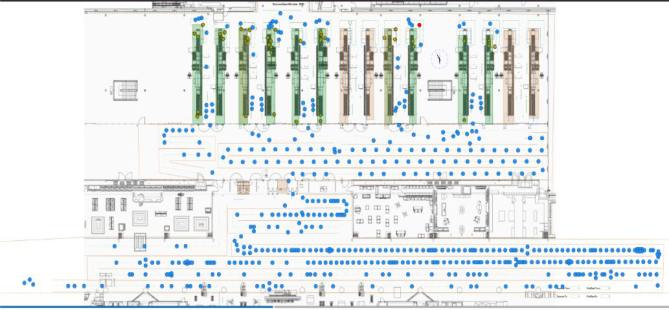
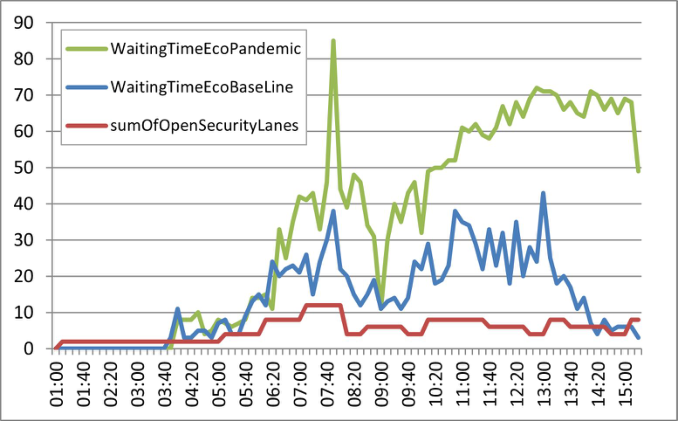
Figure 1: Screenshot of the simulation.Figure 2: Comparison of the total process times.
Figure 1 shows a screenshot of the simulation with the ground plan of the simulated security area and adjoining areas of the airport. The lower part of the figure depicts the increased waiting area upstream of the main security waiting area and the security check lines. Blue dots are representing simulated passengers. The waiting area needed to be extended by 90% from 950 m2 to 1800 m2 to be capable of handling the baseline traffic scenario. Figure 2 shows a comparison of the total process times – from entering the queue until leaving the security area – of the simulation runs of SiM vs. Pandemic SiM where we used the original baseline traffic scenario in both simulations. It illustrates the total average results of 30 Monte Carlo simula- tion runs with a rather small standard deviation of 1.6. The baseline scenario represented with the blue line shows the typical waiting time peaks between 5:00 - 7:30 and 9:30 – 11:00 and also around 13:00.
Pandemic Sim - Impact Analysis and Improvement Potentials 143
This matches well the real-world experiences of the airport employees during real operations of the simulated airport. Pandemic SiM simulation runs – depicted in green – also match the peaks but can not absorb the second peak so that the waiting times stay high until 14:20. As the red line shows, we kept the number of opened security lanes in this scenario on same levels for comparability reasons. The average waiting times of the simulated pas- sengers in the baseline scenario is 13.9 minutes and increases to 34.6 minutes in Pandemic SiM.
CONCLUSION
This simulation model is as young as the COVID-19 pandemic and thus still ongoing in development. However, the simulation results show significant higher waiting times for the pandemic scenario as average waiting times are 149% higher than in the baseline scenario. Also, the waiting areas in the simulated model need to increase by 90%. This will put airports under stress where space limits do not allow for the necessary enlargement of waiting areas and will also cause higher cost for airport operators. An improvement potential to reduce waiting times could be a higher number of opened security lanes which again results in higher cost.
One next step in our research and modelling therefore will be to involve the optimization software OptQuest in the model and to determine an optimum resource management by balancing waiting times and operating cost.
REFERENCES
ACI, IATA (2020) Safely Restarting Aviation – ACI and IATA Joint Approach, Geneva https://www.iata.org/contentassets/5c8786230ff34e2da406c72a52030e 95/safely-restart-aviation-joint-aci-iata-approach.pdf, accessed 17 July 2020 Alers, T., Classen, A.B., Kellner, S. (2013) More Input - Generic Data for Microscopic
Airport Simulation, AIAA Aviation, Los Angeles EASA, ECDC (2021) COVID-19 Aviation Health Safety Protocol - Operational guidelines for the management of air passengers and aviation personnel in relation to the COVID-19 pandemic, issue 3, Cologne / Solna, 17/06/2021 European Commission (2020) COVID-19: Guidelines on the progressive restoration
of transport services and connectivity; EC Communication C(2020) 3139 IATA (2020) Impact of COVID-19 on European Aviation (June 2020), Geneva https://www.iata.org/contentassets/2dc66fdff10d455a84535184d206d132/covid- europe-june2020.pdf, accessed 17 July 2020 ICAO (2020) Council Aviation Recovery Taskforce - Airport Module - Secu-
rity Screening, https://www.icao.int/covid/cart/Pages/Airport-Module—Security- Screening.aspx, accessed 17 July 2020 Jung, M., Classen, A.B., Rudolph, F. (2015). Creating and validating a microscopic pedestrian simulation to analyze an airport security checkpoint in: Proceedings of the 2015 Winter Simulation Conference L. Yilmaz et al.
Read this individual research paper free through the original publisher, or explore the full digital proceedings book.
ISBN 978-1-958651-44-5
Explore this ISBN in the AHFE Bookstore ↗Listed in the July 2026 bookstore catalogue; search by ISBN to confirm current availability · Digital book purchase optional