Indragus Pangestu, Achmad Nurmandi (2022). What is the Strategy of Cities in the World in Creating “City Resilience” in the Era of the COVID-19 Pandemic?. In: Human Interaction & Emerging Technologies (IHIET 2022): Artificial Intelligence & Future Applications. AHFE Open Access, vol. 68, pp. 196–202. https://doi.org/10.54941/ahfe1002732
This study aims to identify urban resilience during the COVID-19 pandemic in the United States, England, and China. The COVID-19 pandemic has had a terrible impact on the lives of many citizens, especially in urban areas. Cities are the central point of economic growth and governance, cities must continue the function even in conditions of crisis or disaster. So that it becomes interesting to review the strategies of big cities in dealing with the COVID-19 pandemic. This study used a simple statistical method, and bibliometric analysis was performed using VOSviewer software. Scientific literature data was taken from the Scopus database which was searched with the keywords urban resilience and covid 19 with a range of 2019 to 2022. limitations on authors or affiliations of the 3 countries in literature publications, namely the united states, England and China. This analysis includes a number of publications, citation analysis, and visualization of co-occurrence patterns of the most frequently occurring keywords. Bibliometric analysis shows the United States leading the way in article publication with 25 articles, followed by England and China with 15 articles each. The results of data analysis show that the initial strategy of urban resilience during the COVID-19 pandemic in the three countries was carried out by limiting community activities in public spaces to prevent the transmission of the COVID-19 disease. In addition, the urban resilience strategy is carried out by building integrated health services and digital infrastructure and carrying out transportation management. Another strategy is to build public spaces that can provide social distancing and provide easier access to information and communication technology for the entire citizens. In future research, it is hoped that we can discuss how to transform the strategy by adjusting to the style of the city and the needs of the citizens.
The COVID-19 pandemic has affected many sectors of human life, from health, and education to the economy. The Covid-19 virus which can be transmitted through the respiratory tract makes it spread so fast. The mas- sive transmission rate depends on the number of people moving, the denser an area or place is, the greater the possibility of spreading the virus. Unlike earthquakes, floods, and other disasters that can destroy infrastructure, the COVID-19 pandemic can destroy human relationships. Efforts to contain
What is the Strategy of Cities in the World in Creating “City Resilience” 197
the spread of the virus result in the severance of human and social contact (Liu et al., 2022) A city that is a bustling area raises the possibility of infection even higher because people are the easiest and most effective transmission medium in the proliferation of the covid-19 virus (AbouKorin, HanRole of urban planning characteristics in forming pandemic resilient cities – Case study of Covid-19 impacts on European cities within England, Germany and Italy and Mahran, 2021). Moreover, the city is a government and economic space, so it requires direct social interaction. Especially people who have a dependency on econo- mic income from informal work. Informal work is often the only option for the urban poor. However, those in the informal sector usually depend on low daily wages to make ends meet. The Covid-19 pandemic has illustrated the implications of disease transmission: residents of informal settlements often work throughout the city (for example, in urban transport, as domestic wor- kers, and as street vendors) and cannot work from home or stop working. The long-term impact of the Covid-19 pandemic creates threats to liveliho- ods, well-being, and health. For people who work in informal areas, which are the lifeblood of the city, livelihoods have been greatly impacted by the Covid-19 restrictions such as the provision of curfews, pushing many people into greater poverty (Kimani et al., 2021)
So it is important that there is a more modern planning effort and the invo- lvement of community groups to ensure city resilience (Scott, 2021) Various major cities in the world have developed temporary strategies to enable soci- ally distanced public life and some of them are also starting to think about steps to become more resilient against pandemics in the future (Sartorio et al., 2021). City governments need to prepare strategies to deal with cities that are resilient to pandemics or outbreaks. One of the concepts that must be applied is critical infrastructure, which is interpreted differently from time to time and across institutions. In general, critical infrastructure can be defined as a strategic component to provide basic public services as well as for natio- nal security (such as transportation, energy, telecommunications, water, and waste management) (Ferrari, 2020).
City resilience planning and strategy in dealing with the pandemic must really be prepared by city governments around the world. Short, medium, and long-term preparations and implementations need to be carried out to form cities that are resilient to pandemic disasters. For this reason, in this study, the author analyzes various strategies that have been carried out by big cities around the world in dealing with the COVID-19 pandemic. The goal is that the results of this paper can be used as material for the formation of a better strategy and be able to adapt to the style of urban society. Because the implementation of the strategy requires the role of initiatives from various groups (Fransen et al., 2022).
LITERATURE RIVIEW The COVID-19 pandemic creates major challenges for public health manage- ment and emergency systems in urban areas. Urban planners and policyma- kers involved in spatial planning and management should carefully consider
198 Pangestu and Nurmandi
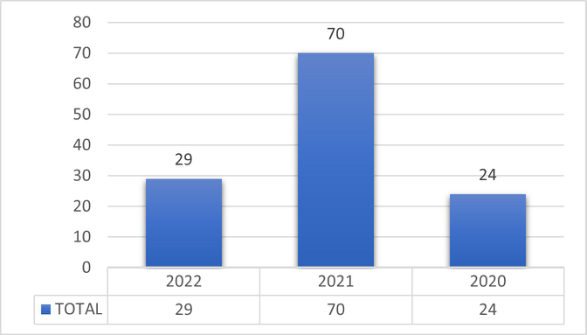
Figure 1: Year publication. Source: Scopus Database how “people-oriented” principles can be incorporated into spatial planning systems to reduce negative impacts on cities and communities (Song et al., 2021). The COVID-19 outbreak or pandemic is dangerous for many cities in the world because it has exacerbated existing challenges (Glaeser, 2022).
METHODS
Bibliometric Analysis approach. Data obtained from 125 high-cited jour- nals from the Scopus website with the keywords “urban resilience” and “covid-19” within the last three years with the limitation of article docu- ments, social science areas, and the three highest affiliated countries, United States 25 articles, United Kingdom 15 articles, China 15 articles. The aim is to ensure high-quality results that are objective and analyzed using VOSvi- ewer and NVivo12 software to visualize the co-occurrence with keywords, citations, co-citations, and a bibliography of published literature.
RESULTS
The search results yielded 125 articles related to “urban resilience” and “covid-19”. Articles searched for from the Scopus website are limited to the year 2020 to 2022.
In a period of three years, from 2020 to 2022, research on city resilience and COVID-19 has fluctuated. At the beginning of the COVID-19 pandemic, in 2020, it was the lowest, then increased rapidly in 2021 and decreased again in 2022 at this time.
Various countries conduct research and publications related to cities and the covid-19 pandemic. The 10 countries with the highest publications of journal articles include in Table 1.
The table above shows the 10 highest countries that publish articles with the theme of city resilience and covid-19. The United States, United Kingdom,
What is the Strategy of Cities in the World in Creating “City Resilience” 199
Table 1. Top 10 publications by country.
Table available in the original PDF paper.
Country Document United States 25 United Kingdom 15 China 15 Italy 10 India 7 Germany 6 Japan 6 Netherlands 6 South Africa 6 Spain 6
Source: Scopus Database
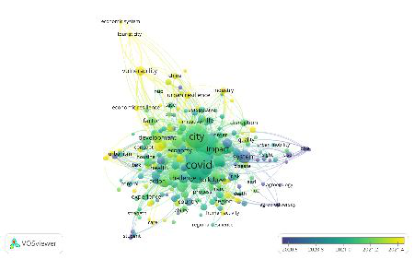
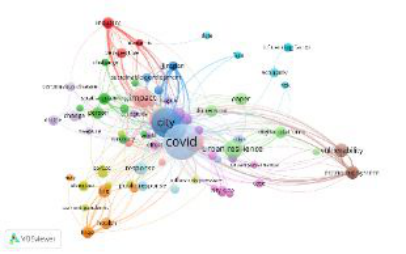
Figure 2: Co-occurrence of keyword in project of city resilience. Source: Processed by Researchers Using VOSviewer and China are the highest countries that publish. These various publications have different topics related to the theme of city resilience and covid-19.
The city resilience strategy against the COVID-19 pandemic is intercon- nected, especially in three countries, namely the United States, the United Kingdom, and China. Research on the COVID-19 pandemic began in 2020 or since the Covid-19 virus spread to many countries. If you observe co- occurrence, it shows that in 2020 many studies discuss the impact on people. Then in 2021, the research will be more diverse with regards to Access systems, Digital platforms, infrastructure, transportation, urban mobility, economy, and industry.
Then the three highest countries in research and publications regarding the strategy of the Tangguh city in dealing with the COVID-19 pandemic, namely the United States, the United Kingdom, and China. The three coun- tries have their own steps or methods that are interesting to study and can be recommendations for city resilience for other cities in the world.
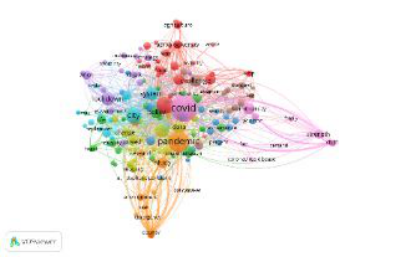
According to United States journal publication trends, the strategy used in dealing with the COVID-19 pandemic is the application of smart cities in several public policies, including breaking up public crowds and regulating public transportation. The threat of the COVID-19 pandemic needs to be handled smartly and intelligently. Smart cities require intelligent mobilization
200 Pangestu and Nurmandi
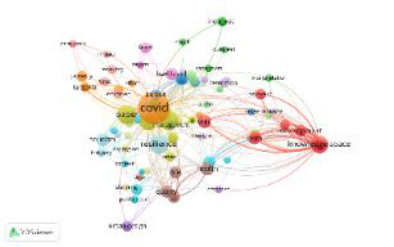
Figure 3: Network visualization of United States. Source: Processed by Researchers Using VOSviewerFigure 4: Network visualization of United Kingdom. Source: Processed by Researchers Using VOSviewer of available digital resources and urban knowledge and should generate rapid economic and social value, including during times of crisis. When implemen- ting smart cities, it is necessary to carry out, among others: Environmental and Health transitions, Resources and energy transitions, Cultural and com- munity transitions, Urban data analysis, and Online security procedures (Sassen and Kourtit, 2021).
In addition, carrying out the construction of a transportation system in the city area is important to break down crowds. Limiting population mobility is a good way to prevent the transmission of the coronavirus. Strengthening the establishment of information platforms and emergency response systems. Then with the development of massive big data, such as information on road congestion, e-mail, card swipe data on public transportation, and hot- spot data, the distribution of crowds is getting higher. With various kinds of information and basic data, the latest emergency response system that is also professional can be built for tasks such as distributing resources to pati- ents affected by the COVID-19 virus and implementing zone-based isolation. Such systems can also enable faster decision-making and real-time collabo- ration that can prevent incidents that would increase the spread of disease (Glaeser, 2022).
From the results of data visualization and journal analysis, the findings are that the United Kingdom has a focus on infrastructure development which is
What is the Strategy of Cities in the World in Creating “City Resilience” 201
Figure 5: Network visualization of United States. Source: Processed by Researchers Using VOSviewer the basic aspect of the pandemic. For the COVID-19 pandemic, this includes knowledge institutions such as universities, national health research, vaccine, and drug testing and approval agencies, funding entities, pharmaceutical companies, media, and the technology (infrastructure) that supports them. The same applies to care, such as hospitals and clinics, health institutions, health care systems, and the various infrastructures that can support them. This also applies to the role urbanism plays in adapting cities so that residents and employees can continue to live and do their jobs while limiting expo- sure to viruses or pandemics. Various approaches have been tried in different parts of the world. This includes increasing access to active travel because the use of public transportation has fallen drastically. Expanding access and also the quality of public spaces that are open for gathering and activities while maintaining a distance. Reorganizing streets and sidewalks so pubs, bars, cafes, restaurants, and similar customer service-oriented businesses can ope- rate. and work from home or alternative residential locations. Infrastructure is indeed very important to reduce or prevent exposure to infectious viruses so as to enable changes in human behavior during a pandemic, for testing, medical care, and vaccination (Neuman, Chelleri and Schuetze, 2021).
From the visualization of trends and journal findings, China has a strate- gic focus on controlling COVID-19 by building massive health facilities or infrastructure. The construction of health facilities is useful to contain the spread and make transmission shorter by providing adequate health services. The existence of city governance capacity can increase the time effectiveness of pandemic control and can also increase the city’s resilience to pandemics (Chen et al., 2021).
CONCLUSION
Analysis of the city resilience strategy in dealing with the COVID-19 pande- mic in three countries, namely the United States, the United Kingdom, and China, yielded mixed findings. Each publication from a country has a dif- ferent way or strategy. The United States focuses on the use of smart cities in public settings and public transportation arrangements to limit transmis- sion. The United Kingdom uses a strategy of building public infrastructure
202 Pangestu and Nurmandi
in the face of a pandemic that can also be used in the long term. Then China set up a public health room to deal with the COVID-19 pandemic. In short, cities around the world must be able to transform and build infrastructure and implement the strategies needed during a pandemic or crisis.
REFERENCES
AbouKorin, S.A.A., HanRole of urban planning characteristics in forming pandemic resilient cities – Case study of Covid-19 impacts on European cities within England, Germany and Italy, H. and Mahran, M.G.N. (2021) ‘Role of urban planning characteristics in forming pandemic resilient cities – Case study of Covid- 19 impacts on European cities within England, Germany and Italy’, Cities, 118. doi:10.1016/j.cities.2021.103324. Chen, J. et al. (2021) ‘What determines city’s resilience against epidemic outbreak:
evidence from China’s COVID-19 experience’, Sustainable Cities and Society, 70. doi:10.1016/j.scs.2021.102892. Ferrari, M. (2020) ‘Reflexive governance for infrastructure resilience and sustainability’, Sustainability (Switzerland), 12(23), pp. 1–8. doi:10.3390/su122310224. Fransen, J. et al. (2022) ‘The emergence of Urban Community Resilience Initiatives
During the COVID-19 Pandemic: An International Exploratory Study’, European Journal of Development Research, 34(1), pp. 432–454. doi:10.1057/s41287-020- 00348-y. Glaeser, E.L. (2022) ‘Urban resilience’, Urban Studies, 59(1), pp. 3–35. doi:10.1177/00420980211052230. Kimani, J. et al. (2021) ‘Building forward better: Inclusive livelihood sup- port in nairobi’s informal settlements*†’, IDS Bulletin, 52(1), pp. 37–44. doi:10.19088/1968-2021.104. Liu, G. et al. (2022) ‘A study on near real-time carbon emission of roads in urban agglomeration of China to improve sustainable development under the impact of COVID-19 pandemic’, Sustainability (Switzerland), 14(1). doi:10.3390/su14010385. Neuman, M., Chelleri, L. and Schuetze, T. (2021) ‘Post-pandemic urba- nism: Criteria for a new normal’, Sustainability (Switzerland), 13(19). doi:10.3390/su131910600. Sartorio, F.S. et al. (2021) ‘Towards an antifragile urban form: a research agenda for
advancing resilience in the built environment’, Urban Design International, 26(2), pp. 135–158. doi:10.1057/s41289-021-00157-7. Sassen, S. and Kourtit, K. (2021) ‘A post-corona perspective for smart cities: “should i stay or should i go?”‘, Sustainability (Switzerland), 13(17). doi:10.3390/su13179988. Scott, R.P. (2021) ‘Shared streets, park closures and environmental justice during a
pandemic emergency in Denver, Colorado’, Journal of Transport and Health, 21. doi:10.1016/j.jth.2021.101075. Song, X. et al. (2021) ‘The Effects of Spatial Planning, Well-Being, and Behavioural Changes During and After the COVID-19 Pandemic’, Frontiers in Sustainable Cities, 3. doi:10.3389/frsc.2021.686706.
Read this individual research paper free through the original publisher, or explore the full digital proceedings book.
ISBN 978-1-958651-44-5
Explore this ISBN in the AHFE Bookstore ↗Listed in the July 2026 bookstore catalogue; search by ISBN to confirm current availability · Digital book purchase optional