Wiyono Wiyono, Achmad Nurmandi (2022). Smart Transportation Development: Success Strategy in China, United States, United Kingdom, and India. In: Human Interaction & Emerging Technologies (IHIET 2022): Artificial Intelligence & Future Applications. AHFE Open Access, vol. 68, pp. 188–195. https://doi.org/10.54941/ahfe1002731
This study aims to analyze the development of “Smart Transportation” countries, China, the United States, the United Kingdom, and India. The country was chosen considering the high number of “Smart Transportation” research and the success of good transportation management. This study uses a qualitative data software analysis (QDSA) approach. The data source of this research uses 277 Scopus database articles that focus on "Smart Transportation" research. The research data search phase uses the keyword "Smart Transportation" from 2011-2022. Analysis of the research data using software tools VosViewer and NvivoPlus12 to visualize data based on cluster co-citation, and co-occurrence network. The results show that four countries have a "Smart Transportation" development strategy that focuses on planning, management, and security aspects. The planning aspect focuses on transportation planning, urban planning, and smart urban planning. Then the management aspect focuses on the management of transportation data, big data, and data management. Lastly, the transportation security aspect focuses on developing network security, management security systems, and technical security. The development of “Smart Transportation” in four countries has a different approach strategy. China is focused on developing transportation data management, big data, transportation planning, and focusing on security. The United States focuses on management and security, not on transportation development. The UK has in common with the United States which does not have a focus on developing transportation management and security, but has a focus on making transportation planning. The focus of transportation development in India has similarities with China, namely data management and transportation planning. So India does not focus on developing transportation on security. The development of Smart Transportation in countries in the world pays attention to management factors and aspects of sustainability in its development. Transportation security is an important part in the development of transportation in every country.
The city is a complex and organized system, then a collection of elements that act individually but manage to work together (Mora, Bolici, and Deakin, 2017). A city is also a place where inequality is getting stronger, so the city must be well managed with an innovative city model that leads to good city planning and management (Monzon, 2015). The process of developing a smart city must really be considered so that the public space desired by human needs is achieved (Angelidou, 2021).
Smart Transportation Development: Success Strategy in China, United States 189
The global population in 2018 (approximately 4.2 billion people) is alre- ady living in cities and will increase in proportion to an estimated 60% by 2050 (1, 1 and, Rajib Shaw 1,*, Sameer Deshkar 2, 2020). Cities have con- tributed 60% to 80% of greenhouse gas emissions, 50% of global waste, and 75% of natural resource consumption. The increasing number of urban populations around the world will certainly face various challenges (Kasznar et al., 2021). Transportation has also contributed to 27% of greenhouse gas emissions, air pollution, and noise caused by traffic certainly also affect the health and quality of life of citizens (Ministry of Urban Development, 2016).
The goal of smart cities in developed and developing countries is to rege- nerate urban areas and increase resilience (adaptation) to climate change, further improve the quality of life of citizens, and finally solve problems in urban areas due to rapid and massive urbanization (Kim and Yang, 2021). In this case, the author is interested in analyzing the development of smart cities in China, the United States, the United Kingdom, and India. It was found that the four countries were in the top position indexed in the Scopus search, followed by the limitation of the search for social science areas and article documents from 2012 to 2021.
LITERATURE RIVIEW The birth of the concept of smart mobility was then utilized into the tran- sportation network both in the field of urban planning and transportation development innovation (Battarra, R.; Gargiulo, C.; Tremiterra, M.R.; Zucaro, 2021). The increasing demands of transportation developments such as information, communication, computers, and other technologies in the transportation sector can build an integrated system among humans (An, Lee, and Shin, 2011). The transportation sector accounted for 19% of global final energy demand in 2015, most of which was supplied by fossil fuels (appro- ximately 31,080 TWh). To encourage the creation of affordable mobility, special bicycle lanes and public bicycle sharing systems should be provided (1, 1 dan , Rajib Shaw 1, *, Sameer Deshkar 2, 2020).
METHODS
This study uses a qualitative approach to software data analysis (QDSA). The data source of this research used 277 articles from the Scopus database, which focused on the “Smart Transportation” research. The research data search phase uses the keywords “smart”-“transportation” from 2012 to 2021.
RESULTS
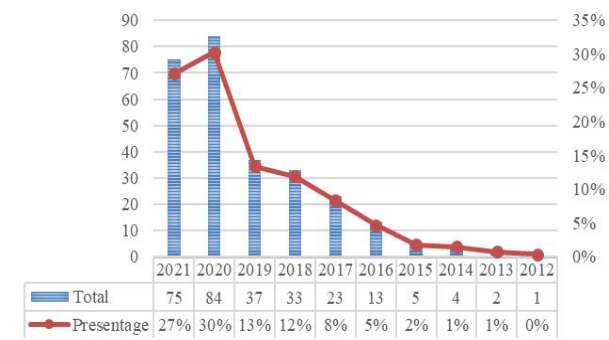
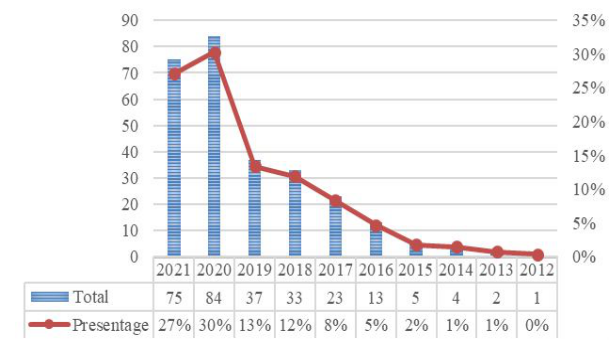
Research Trends in Smart Transportation Development in the World Document data is viewed by year with the theme of “Smart Transportation” development in countries, China, United States, United Kingdom, and India within ten years the last year, 2012 to 2021. The number of articles obtained from Scopus was 277 publications with the search keywords “smart” and “transportation.”
190 Wiyono and Nurmandi
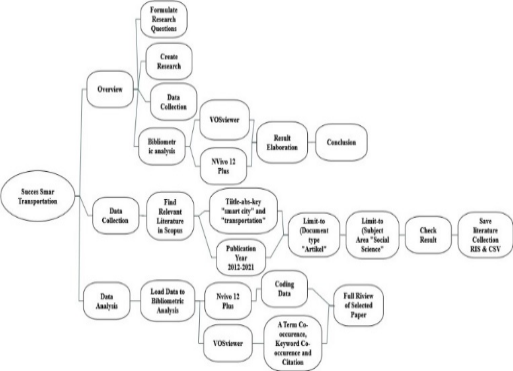
Figure 1: Overview, data collection, and data analysis stages.Figure 2: Year publication. Source: Scopus database.Figure 2. Explaining the development of smart city transportation in China, the United States, the United Kingdom, and India has increased in the last 9 years, meaning that from 2020 to 2021, it has decreased by 3%, namely 9 publications, the total publication of transportation development journals in smart cities has increased during period 2012–2021.
Table 1 explained that the four affiliates that published many research articles on transportation development in smart cities at Scopus during the period 2012 to 2021 were Beijing Jiaotong University with 53 articles, the second Southeast University with 51 articles, followed by University College London with 31 articles, and Recent Lovely Professional University India 26 articles.
Smart Transportation Development: Success Strategy in China, United States 191
Table 1. Country and affiliate publications.
Table available in the original PDF paper.
Negara Afiliasi Jumlah Dokumen
53
China Beijing Jiaotong University, Transportation System Engineering Committee of Systems Engineering Soci- ety of China, Southeast University
51
United States Southeast University, University of Electronic Science and Technology of China, Purdue University
31
Inited Kingdom University College London, University of Brighton, University of the West of England
26
India Lovely Professional University, Infinite Bullseye, Jamia Hamdard Source: Scopus Database
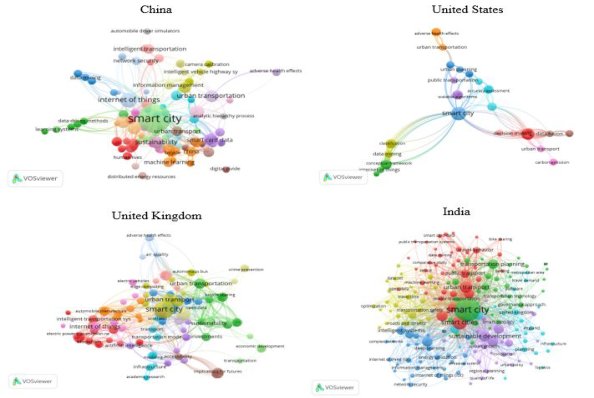
Figure 3: Network visualization of four countries. Source: processed by researchers using VOSviewer.
Network Visualization of Smart City Transportation Development Themes in Four Countries, China, United States, United Kingdom, and India This section describes the focus of interrelated research themes in case studies of smart city development in four countries sourced from 277 articles indexed by Scopus with an analysis of research data using VOSviewer software to visualize data based on cluster co-citation and co-occurrence network.
The latest information on the development of transportation research trends in smart cities by understanding the relationship in figure 4. explains that different colors mean differentiating the density of the cluster from every other cluster. Furthermore, it helps further researchers who will just start their research.
192 Wiyono and Nurmandi
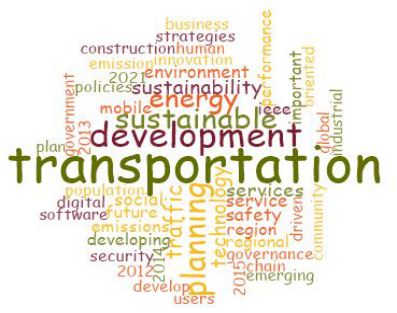
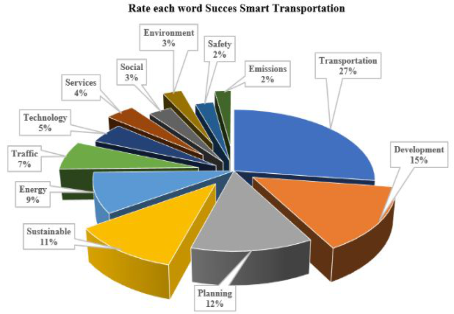
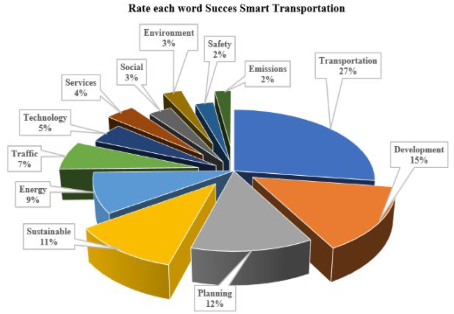
Figure 4: Dominant topic. Source: Processed by researchers using NVivo 12 plus.Figure 5: Categorization of themes and value of each word. Source: Processed by researchers using NVivo 12 plus.
Dominant Theme in the Study of Transportation Development in Smart City Based on Word Frequency Query on NVivo 12 plus software. I am using 277 Scopus indexed documents. To explore the frequently occurring words in the development of “Smart Transportation” from 2012 to 2021.
Figure 4. The most dominant and highly related word/topic in these docu- ments is “transportation.” Of the 70 words that emerged from NVivo12 plus, the authors identified that the number of documents 277 had discussed the most significant frequency words and their relationship to the development of smart transportation research.
Theme Categorization and Value of Each Word To analyze the categorization between themes and the value of each word in 277 documents with the keywords “smart city” and “transportation” from 2012 to 2021, sourced from the Scopus database (www.scopus.com).
Smart Transportation Development: Success Strategy in China, United States 193
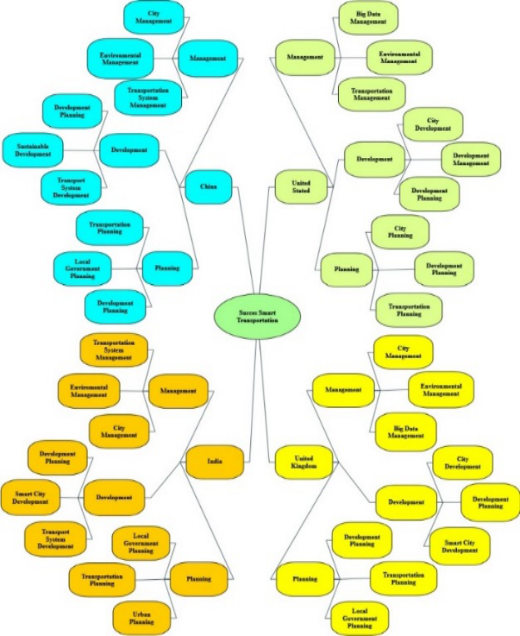
Figure 6: Mapping of transportation development in smart city. Source: Processed by researchers using NVivo 12 plus.
Figure 5 shows the 12 main topics in “smart transportation” from 2012 to 2021 to support the development of smart transportation in China, the United States, the United Kingdom, and India. Supporting aspects are needed, such as Figure 5, where each aspect has a presentation: transportation has a percentage of 26%, then development with a percentage of 14%, then there is planning at 12%, sustainability at 11%, energy at 9%, traffic 6%, technology 5%, service 4%, social 3%, environment 3%, safety 2%, emissions 2%.
Mapping Transportation Development in Smart City Cluster analysis mapping using NVivo 12 Plus software sourced from 277 articles indexed by Scopus. Based on the need and success to find the main focus. The author classifies, Planning, Management, and Development.
The visualization classification of figure 5. It has shown the successful findings of the main focus on developing smart transportation in China, the United States, the United Kingdom, and India. The explanation is that these four countries have some similarities in the classification of smart city development in the transportation sector. In China, the classification of the focus of development is that smart city development plays an important role
194 Wiyono and Nurmandi
in achieving city sustainability (Wu et al., 2020). Sustainable Development is, Smart city concept where Information Communication and Technology (ICT) is combined with existing traditional city infrastructure then coordina- ted and managed using digital technology. The core of the smart city lies in the sensors and actuators embedded in the smart device. (Ahad et al., 2020). There are four models for identifying the first smart city development plan, the essential service model, the smart transportation model, the broad spe- ctrum model, and the business ecosystem model (Tang et al., 2019). Transport system development, traffic volume, parking facilities, and use of public spa- ces can be drastically changed. The rise of bicycle-based vehicles, especially electric-assisted bicycles. These advances will have an important effect on traditional transport networks, as this evolution can be beneficial, but it can also be detrimental (Katona and Juhasz, 2020). Public transport is playing an increasingly important role in urban mobility with the need to move peo- ple and goods efficiently around cities; this has put pressure on the existing public transport system. Opportunities to use social media to more effectively engage with citizens and customers who use these services (Lock dan Pettit, 2020). To support a truly smart city must adopt a democratic approach toge- ther by involving the leadership of local institutions and by prioritizing local issues. To achieve the desired community engagement outcomes, the innova- tion district needs to ensure that the expectations of the wider community are met (Dowling et al., 2020).
CONCLUSION
In the development of transportation in Smart cities in China, the United Sta- tes, the United Kingdom, and India, researchers assess the success of smart city development in the transportation sector based on aspects, namely, deve- lopment, management, and planning. The success of developing smart cities in the transportation sector is considered to have increased every year, along with the demand for large numbers of people around the world. Government agencies must immediately have a smart transportation development project in the short term in order to minimize the amount of air pollution that affe- cts the environment and its citizens. Land preparation and policy innovations for pedestrians as well as citizen participation are important points to reduce the number of vehicles moving from one place to another. This study still has limited data sources and the limitations of researchers to see a comparison of the development of smart transportation using the Web of Science. Resea- rchers hope that there will be further research that discusses empirical testing explicitly of the conceptual framework for the development of smart tran- sportation developed by smart cities with Web of Science data. Furthermore, as an evaluation material for the government.
REFERENCES
1, V. S., 1, W. Y. dan , Rajib Shaw 1,* , Sameer Deshkar 2, B. K. M. 3 and (2020) “Role of smart cities in optimizing water-energy-food nexus: Opportunities in nagpur, India,” Smart Cities, 3(4), hal. 1266–1292. doi: 10.3390/smartcities3040062.
Smart Transportation Development: Success Strategy in China, United States 195
Ahad, M. A. et al. (2020) “Enabling technologies and sustainable smart cities,” Sustainable Cities and Society, 61. doi: 10.1016/j.scs.2020.102301. An, S. H., Lee, B. H. dan Shin, D. R. (2011) “A survey of intelligent transportation
systems,” Proceedings - 3rd International Conference on Computational Intel- ligence, Communication Systems and Networks, CICSyN 2011, hal. 332–337. doi: 10.1109/CICSyN.2011.76. Angelidou, M. (2021) “The implementation of the smart city process—researchers’ knowledge in detecting transport system defects,” Sustainability (Switzerland), 13(6). doi: 10.3390/su13063296. Battarra, R.; Gargiulo, C.; Tremiterra, M.R.; Zucaro, F. (2021) “Smart mobility in
Italian metropolitan cities: A comparative analysis through indicators and acti- ons,” Journal of Open Innovation: Technology, Market, and Complexity, 7(2), hal. 1–20. doi: 10.3390/joitmc7020146. Dowling, R. et al. (2020) “Affordable housing in innovation-led employment strategies,” AHURI Final Report, (333), hal. 1–50. doi: 10.18408/AHURI-7320401. Kasznar, A. P. P. et al. (2021) “Multiple dimensions of smart cities’ infrastructure: A
review,” Buildings, 11(2), hal. 1–27. doi: 10.3390/buildings11020073. Katona, G. dan Juhasz, J. (2020) “The history of the transport system development and future with sharing and autonomous systems,” Communica- tions - Scientific Letters of the University of Zilina, 22(1), hal. 25–34. doi: 10.26552/com.c.2020.1. 25–34. Kim, J. dan Yang, B. (2021) “A smart city service business model: Focu- sing on transportation services,” Sustainability (Switzerland), 13(19). doi: 10.3390/su131910832. Lock, O. dan Pettit, C. (2020) “Social media as passive geo-participation in tran-
sportation planning–how effective are topic modeling & sentiment analysis in comparison with citizen surveys?,” Geo-Spatial Information Science, 23(4), hal. 275–292. doi: 10.1080/10095020.2020.1815596. Ministry of Urban Development (2016) “The Smart City Challenge,” hal. 1–92. Monzon, A. (2015) “Smart cities concept and challenges: Bases for the assessment of smart city projects,” SMARTGREENS 2015 - 4th International Conference on Smart Cities and Green ICT Systems, Proceedings, hal. IS-11-IS-21. Mora, L., Bolici, R. dan Deakin, M. (2017) “The First Two Decades of Smart-City
Research: A Bibliometric Analysis,” Journal of Urban Technology, 24(1), hal. 3–27. doi: 10.1080/10630732.2017.1285123. Tang, Z. et al. (2019) “Identifying smart city archetypes from the bottom up: A content analysis of municipal plans,” Telecommunications Policy, 43(10). doi: 10.1016/j.telpol.2019.101834. Wu, Z. et al. (2020) “Mapping the Knowledge Domain of Smart City Development
to Urban Sustainability: A Scientometric Study,” Journal of Urban Technology, hal. 1–25. doi: 10.1080/10630732.2020.1777045.
Read this individual research paper free through the original publisher, or explore the full digital proceedings book.
ISBN 978-1-958651-44-5
Explore this ISBN in the AHFE Bookstore ↗Listed in the July 2026 bookstore catalogue; search by ISBN to confirm current availability · Digital book purchase optional