Beata Mrugalska, Brigita Gajsek (2025). A Framework for Sustainable Logistics 4.0: the Polish perspective. In: Human Aspects of Advanced Manufacturing, Production Management and Process Control. AHFE Open Access, vol. 184, pp. 27–36. https://doi.org/10.54941/ahfe1006447
In recent years, the concept of sustainable logistics 4.0 has gained importance and attracted significant attention among scholars and practitioners. Digitalization technologies allow us to guarantee that products are delivered to the appropriate location, at the right time, and in the right quantity, simultaneously minimizing waste. They facilitate the visualization of logistics operations and connect them by simulation and optimization tools, enhancing decision-making processes. Research that examines the role of sustainable logistics 4.0 shows that implementing such technologies can bridge the gap between the physical and digital worlds, and enhance process efficiency and flexibility. Their critical characteristics are autonomy, transparency, coordination, and collaboration amongst the supply chain processes.In this paper, we defined the capability of implementing the activities related to Industry 4.0, digitalization and sustainability in practice. To achieve it, the questionnaire survey was conducted in Poland. It was available for participants on 1KA OneClick Survey (www.1ka.si), an open-source application for online survey services. The questionnaire was based on a five-point Likert-type scale. The survey was conducted in 2023. The analysis covered data from the intended respondents in Poland who were representing the logistics sector. The data were statistically analyzed. Their results showed that optimisation of logistics processes/routes/supply chain to achieve sustainability goals and use of at least one optimisation tool on advanced level and behaviour following environmental ethics were the most often chosen activities in order to direct to sustainable logistics.
The European logistics market is expected to grow by USD 48.4 billion, with a compound annual growth rate (CAGR) of 3.4% from 2024 to 2029 (Technavio, 2025). In recent years, it has experienced consistent growth driven by the expansion of e-commerce and technological advancements. Innovations such as artificial intelligence and the Internet of Things (IoT) create opportunities to improve efficiency and visibility in logistics operations. Logistics monitoring systems provide real-time tracking and enhance the efficiency of inbound, outbound, reverse, and last-mile deliveries. Implications of augmented reality and route optimization transform the logistics, especially in defense manufacturing, the petroleum sector, and food products (Sullivan & Kern, 2021). Such solutions allow us to direct towards logistics 4.0, which uses digitalization to accelerate a connected, traceable, and resilient logistics system. The usage of digital technologies ensures that products are available at the right place, time, and quantity, what also reduces waste (Mrugalska & Stasiuk-Piekarska, 2020; Raji et al., 2021). Additionally, increasing consumer demand for prompt, dependable delivery supports companies to rethink their supply chains. Moreover, logistics companies enhance the value creation of the logistics functions by achieving sustainability goals. Such a direction results from the European Green Deal (EGD), which aims to make Europe climate-neutral by 2050, encompassing diverse sectors such as climate action, energy, agriculture, and more. It is a comprehensive environmental, social, and economic strategy designed to transform the EU into a sustainable society, ensuring economic growth and social equity (Koundouri et al., 2024).
Initially, sustainable logistics was focused on the environmental impacts to lower GHG emissions (Dekker et al., 2012) and energy consumption (Müller et al., 2014) in logistics activities. Reverse logistics and closed-loop supply chains (CLSC) have progressively gained attention in sustainable value re- creation from end-of-life (EOL) products (Solvang et al., 2007). Recently, the ecological footprint is minimized in both forward and reverse logistics (Wojciechowski & Doma´nski, 2024; Yu & Solvang, 2020). It is evident that improper hazardous waste disposal leads to risk exposure to the environment, but also to ecosystems, including all living things (Gelmez et al., 2024; Siddiqua et al., 2022). The attention is not only focused on the economic and environmental aspects, but also the social sustainability indicators, which encompass job creation and working environments (Waqas et al., 2024). Thus, sustainable logistics aims at the improvement of logistics and business performance where social, environmental, and economic growth are direct outcomes (Sopadang et al., 2014). In order to achieve it, there is a need to keep a balance between the socio-economic performance of a logistics system and its eco-environmental robustness in managing system activities (Sun et al., 2022).
Enhancing logistics activities through visualization, simulation, and optimization tools for better decision-making while adopting eco-friendly practices can lead us to sustainable logistics 4.0. Such a digital environment enhances employee skills and innovation (Huu, 2023), reduces transportation emissions through optimized usage (Dalewska & Mrugalska, 2025), and improves business performance, contributing to sustainability (Wagner & Schaltegger, 2003). Key characteristics of sustainable logistics 4.0 include autonomy, transparency, coordination, and collaboration within supply chain processes (De Souza et al., 2022).
In this paper, we aimed to define the future framework of sustainable logistics 4.0 based on the competencies of present and potential workers in the logistics sector. In this case, it was necessary to identify the possible activities that needed to be implemented, related to Industry 4.0, digitalization, and sustainability in logistics. The analysis covered data from the intended respondents in Poland. The data were statistically analyzed what allowed to reveal which solutions can be implemented to direct to sustainable logistics. On the basis of these data, we proposed a general framework for sustainable logistics 4.0.
RESEARCH METHODOLOGY In this paper, we defined the capability of implementing the activities related to Industry 4.0, digitalization and sustainability in practice in Poland. In order to achieve it, the questionnaire survey was conducted in four European countries such as Poland, Slovenia, Turkey, and Portugal. However, the presented data are only a part of the research carried out within the Erasmus+ project Sustainable Logistics 4.0: Digital and green skills for boosting innovation and sustainability of the logistics sector. The questionnaire survey was available for participants on 1KA OneClick Survey (www.1ka.si), an open-source application for online survey services. It was conducted from
A Framework for Sustainable Logistics 4.0: The Polish Perspective 29
May to August in 2023. The questionnaire was based on a five-point Likert- type scale where 1 means definitely not able to implement, 2 – probably not able to implement, 3 – probably able to implement, 4 – definitely able to implement and 5 – I cannot answer.
The original selection of surveyed respondents was based on purposive sampling (Hibberts et al., 2012), given the necessity to collect data only from the interested parties. We invited workers of the logistics companies and logistics students of the last semester of the master’s level from different universities. Finally, we managed to collect data from 185 participants. However, when we checked these data only 139 questionnaires were valid and accepted for further investigation. The practical expertise level of the respondents was measured using the four-level scale, where 0 means not willing to answer, 1 – never, 2 – once, and 3 – more than once. Its results are shown in Table 1.
*answers: once, and more than once Most of the respondents had experience introducing improvements or developing activities in logistics, what confirms the choice of the respondents’ group. They were rather not engaged in the tasks related to sustainability, smart technology, digitalization and Industry 4.0. About 30% of them practiced each of these activities. In the same time, they claimed that most of them (83%) were not familiar with the implementation of the circular economy. For each activity standard deviation was similar, which indicates that this dataset was comparably spread out from the mean of the data.
RESULTS
The results of our investigations are presented in three tables. In Table 2, we refer to the data collected about the respondents’ ability to implement activities related to Industry 4.0 in practice.
Table 2: Implementation of activities related to industry 4.0.
Table available in the original PDF paper.
Activity M SD Explain Industry 4.0 - definition, implementation in logistics, the role
3.00 1.05
of forecasting basis, challenges, and pitfalls Introduce Logistics 4.0 into the company’s logistics 2.88 1.09
Continued
30 Mrugalska and Gajšek
Table 2: Continued Activity M SD
Table available in the original PDF paper.
Assess the level of Industry 4.0 maturity of the logistics
2.91 1.12
department/company Adopt the Industrial Internet of Things (IIoT) in the operation of the
2.78 1.24
logistics department/company Introduce an autonomous warehouse equipment 2.92 1.16 Implement optimization of logistics processes/routes/supply chain to
3.09 1.12
achieve sustainability goals and use at least one optimization tool Plan warehouse automation on a scale from partial dark automation
2.89 1.17
to a warehouse based on economic feasibility Decide on the possibility and appropriateness of using drones to
2.83 1.26
approach Industry 4.0/green/digitization goals of the logistics department/company Decide on the possibility and appropriateness of using
2.78 1.16
virtual/augmented/mixed reality approach to Industry 4.0/green/digitization goals of the logistics department/company
2.75 1.18
Decide on the possibility and appropriateness of using machine learning to approach Industry 4.0/green/digitization goals of the logistics department/company
2.78 1.15
Decide on the possibility and appropriateness of using cloud computing technologies to approach Industry 4.0/green/digitalization goals of the logistics department/company
2.92 1.26
Decide on the possibility and appropriateness of using Digital twin to approach Industry 4.0/green/digitization goals of the logistics department/company
2.80 1.17
Decide on the possibility and appropriateness of using robots or collaborative robots to approach Industry 4.0/green/digitization goals of the logistics department/company
Carry out a logistics process simulation based on knowledge of at
2.92 1.16
least one process simulation tool Carry out an economic analysis of interventions achieve to
2.82 1.21
sustainability goals and Industry 4.0 goals
2.78 1.19
Understand the design and deployment of artificial intelligence based on knowledge of the theoretical background, real-life examples and impacts of deployment
In Table 3 we presented the assessment of the activities related to digitalization.
Table 3: Implementation of activities related to digitalization.
Table available in the original PDF paper.
Activity M SD Plan the digitization of logistics processes with the support of
2.73 1.06
information and communication technology Assess the level of digital maturity of the logistics
2.97 1.06
department/company Introduce the collection and analysis of big data 2.94 1.07 Plan and lead digitization of document flows and transition to
2.97 1.05
paperless operations in logistics
Continued
A Framework for Sustainable Logistics 4.0: The Polish Perspective 31
Table 3: Continued Activity M SD
Table available in the original PDF paper.
Advanced use of at least one data editing and analysis program (e.g.
3.22 0.98
Excel) Manage resources (vehicles, people, logistics units) in logistics based
3.11 1.13
on identification (bar code, QR code, RFID, coding according to the GS1/Odette standard) and tracking (in real-time or location) Plan and implement sustainable and information-supported urban
2.87 1.16
logistics and people’s mobility Assess the relevance of information and cybersecurity and the
2.78 1.15
potential for using blockchain in the logistics department/company In Table 4 the results of the research concerning the ability to implement sustainability to logistics are shown.
Table 4: Implementation of activities related to sustainability.
Table available in the original PDF paper.
Activity M SD Assess the level of green maturity of the logistics
2.89 1.05
department/company Manage economic sustainability of the logistics department/company 2.87 1.08 Manage social sustainability of the logistics department/company 2.95 0.99 Manage environmental sustainability of the logistics
2.89 0.98
department/company Solve a real green challenge in the logistics sector 2.86 1.02 Introduce green packaging materials/packaging in logistics 3.04 0.98 Calculate the carbon footprint for the logistics activity 2.96 1.02 Use the theory of reverse and green logistics in the logistics sector 2.91 1.14 Make warehousing green 3.04 1.12 Make transportation green 2.95 1.15 Make production logistics green 2.87 1.18 Manage waste in the logistics department/company 3.19 1.01 Implement circular economy concepts in the logistics
2.99 1.10
department/company Make purchasing green 3.08 1.09 Behave in accordance with environmental ethics 3.11 1.05 Check compliance of a logistics activity with international and
2.96 1.00
national legal regulations in environmental List and achieve 17 sustainable development goals in the logistics
2.85 1.06
department/company Motivate employees to introduce changes in order to achieve
2.94 0.95
sustainable goals and Industry 4.0 goals Guide logistics behavior in accordance with regulatory and policy
2.90 1.09
frameworks for sustainable logistics Choose sustainable, tangible fixed assets in logistics (land, buildings,
2.94 1.10
equipment and spare parts, small inventory) based on knowledge of their properties Reduce energy consumption, and environmental waste and protect
2.98 1.05
ecosystems in logistics
Continued
32 Mrugalska and Gajšek
Table 4: Continued Activity M SD
Table available in the original PDF paper.
Prepare the logistics department/company to implement the reporting
2.73 1.18
process on sustainable development in accordance with the GRI G4 guidelines Assess the energy efficiency of the logistics department/company 2.91 1.06 Choose ecological solutions for internal and external transport 2.98 1.00 Plan energy-saving lighting systems 3.09 1.03
As it can be noticed, most of the respondents claimed that they are probably able to implement the proposed solutions. Such a choice of the answers can result from the fact that they had a chance to be familiarized with the actions, but they did not practice it. It confirms the data obtained in the expert-level analysis. The mean calculated for all the activities was in the range from 2.75 up to 3.19. It indicates that participants generally held a neutral to moderately positive perception of their abilities, with the possibility for improvement, while also reflecting some level of competence. The standard deviation was more than 1.0, what shows the diverse of the participants’ responses.
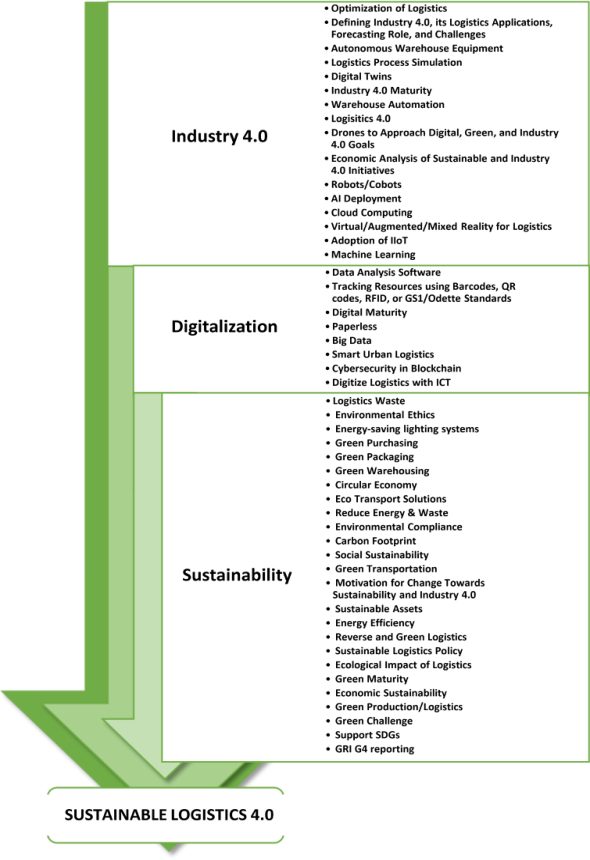
FRAMEWORK FOR SUSTAINABLE LOGISTICS 4.0 Considering the data gathered from the research and its statistical analysis, Figure 1 presents a general framework for Sustainable Logistics 4.0 adaptation. In this framework, the activities are presented in an order of their chance of implementation as they reflect the respondents’ capabilities.
To enable the successful implementation of sustainable logistics 4.0, companies should focus on optimization of logistics processes. Real-time decision making and reduction of manual intervention could be supported by autonomous warehouse equipment, robots/cobots, warehouse automation, and drones. Digital twins and logistics process simulations could allow for modeling, testing, and improving logistics operations before real implementation. All these actions could be supported by identifying the company’s Industry 4.0 maturity level and carrying out an economic analysis of interventions. However, adoption of AI, IIoT, machine learning, and cloud computing seems to be the most difficult activities to undertake.
Introducing digitalization seems to be the easiest using software for data analysis. Furthermore, tracking resources with barcodes, QR codes, RFID, or GS1/Odette standards, which enhance real-time visibility and control across the supply chain, are also known solutions. The assessment of the digital readiness of the logistics department/company can be effectively used to identify current capabilities, highlight technology gaps, and guide strategic investments. The transformation of document flow from paper to digital one is also possible to be introduced. This shift is especially important as it enhances data security and traceability. On the other hand, the most challenging tasks seem to be exactly the digitization of logistics processes with the support of information and communication technologies as well as assessment of the relevance of information and cybersecurity needs, and blockchain potential in logistics.
A Framework for Sustainable Logistics 4.0: The Polish Perspective 33
Figure 1: Framework for sustainable logistics 4.0.
Sustainable logistics encompasses a wide range of practices aimed at minimizing environmental impact. Reducing logistics waste, introducing green packaging, reverse logistics, and the circular economy supports resource efficiency and aligns with environmental ethics. Implementing energy-saving lighting systems, eco transport solutions, and energy-efficient equipment in warehouses can be implemented to reduce energy and lower the carbon footprint. A focus on green purchasing, sustainable assets, and green production/logistics can help to ensure company’s environmental goals. Promoting social sustainability, understanding the ecological impact of logistics, and assessing green maturity and economic sustainability provide a holistic view of performance. However, compliance with environmental
34 Mrugalska and Gajšek
regulations, policy, and measurement through GRI G4 reporting are not easy tasks to perform. Therefore, integrating and achieving all 17 Sustainable Development Goals requires not only practical knowledge but also high motivation for change.
CONCLUSION
The concept of sustainable logistics 4.0 has gained importance and attracted significant attention among scholars and practitioners. Digitalization technologies allow us to guarantee that products are delivered to the appropriate location, at the right time, and in the correct quantity, simultaneously minimizing waste. They facilitate the visualization of logistics operations and connect them by simulation and optimization tools, enhancing decision-making processes. The role of sustainable logistics 4.0 shows that implementing such technologies can bridge the gap between the physical and digital worlds and enhance process efficiency and flexibility while minimizing environmental impact.
In this paper, we focused on proposing a framework for adapting Sustainable Logistics 4.0 on the basis of the investigation. In our framework the importance of optimizing logistics processes through technology adoption was emphasized. In the near future, we can expect that the key implementations could include the use of autonomous warehouse equipment, drones, and logistics process simulations, alongside assessing Industry 4.0 maturity and conducting economic analyses. While digitalization and resource tracking through codes are feasible, the integration of AI, IIoT, and machine learning, as well as digitizing processes with ICT, pose challenges. Sustainable logistics may aim to minimize environmental impact through waste reduction, green packaging, and energy-efficient practices, aligning with environmental ethics. However, achieving comprehensive sustainability goals requires navigating regulatory compliance and GRI G4 reporting, alongside the commitment to integrate the SDGs which our respondents noticed to be the most challenging to be implemented.
ACKNOWLEDGMENT
Not applicable.
FUNDING The paper is co-funded by the Erasmus+ project no: 2022-1-PL01-KA220- HED-000086366 (Sustainable Logistics 4.0: Digital and green skills for boosting innovation and sustainability of the logistics sector).
REFERENCES
Dalewska, M., & Mrugalska, B. (2025). Innovative Transport: Environmental, Social, and Economic Aspects. In Human Perspectives of Industry 4.0 Organizations (pp. 224–235). CRC Press.
A Framework for Sustainable Logistics 4.0: The Polish Perspective 35
De Souza, E., Kerber, J., Bouzon, M., & Rodriguez, C. (2022). Performance evaluation of green logistics: Paving the way towards circular economy. Cleaner Logistics and Supply Chain, 3, 100019. Dekker, R., Bloemhof, J., & Mallidis, I. (2012). Operations Research for green
logistics–An overview of aspects, issues, contributions and challenges. European Journal of Operational Research, 219(3), 671–679. Gelmez, E., Özceylan, E., & Mrugalska, B. (2024). The Impact of Green Supply Chain Management on Green Innovation, Environmental Performance, and Competitive Advantage. Sustainability, 16(22), 9757. Hibberts, M., Burke Johnson, R., & Hudson, K. (2012). Common survey sampling
techniques. Handbook of Survey Methodology for the Social Sciences, 53–74. Huu, P. T. (2023). Impact of employee digital competence on the relationship between digital autonomy and innovative work behavior: A systematic review. Artificial Intelligence Review, 56(12), 14193–14222. Koundouri, P., Alamanos, A., Plataniotis, A., Stavridis, C., Perifanos, K., & Devves, S.
(2024). Assessing the sustainability of the European Green Deal and its interlin kages with the SDGs. Npj Climate Action, 3(1), 23. Mrugalska, B., & Stasiuk-Piekarska, A. (2020). Readiness and maturity of manufacturing enterprises for industry 4.0. 263–270. Müller, E., Stock, T., & Schillig, R. (2014). A method to generate energy value-
streams in production and logistics in respect of time-and energy-consumption. Production Engineering, 8, 243–251. Raji, I. O., Shevtshenko, E., Rossi, T., & Strozzi, F. (2021). Modelling the relationship of digital technologies with lean and agile strategies. 22(4), 323–346. Siddiqua, A., Hahladakis, J. N., & Al-Attiya, W. A. K. (2022). An overview of
the environmental pollution and health effects associated with waste landfilling and open dumping. Environmental Science and Pollution Research, 29(39), 58514–58536. Solvang, W., Deng, Z., & Solvang, B. (2007). A closed-loop supply chain model for managing overall optimization of eco-efficiency. POMS 18th Annual Conference. Dallas Texas, USA. Sopadang, A., Wichaisri, S., & Sekhari, A. (2014). The conceptual framework of
lean sustainable logistics. Materiały z konferencji, International Conference on Transportation and Logistics. Sullivan, M., & Kern, J. (2021). The digital transformation of logistics: Demystifying impacts of the Fourth Industrial Revolution. John Wiley & Sons. Sun, X., Yu, H., Solvang, W. D., Wang, Y., & Wang, K. (2022). The application of
Industry 4.0 technologies in sustainable logistics: A systematic literature review (2012–2020) to explore future research opportunities. Environmental Science and Pollution Research, 1–32. Technavio. (2025). Europe Logistics Market Analysis—Size and Forecast 2025–2029. https://www.technavio.com/report/logistics-market-in-europe- industry-analysis Wagner, M., & Schaltegger, S. (2003). Introduction: How does sustainability performance relate to business competitiveness? Greener Management International, 44, 5–16. Waqas, U., Umair, S., Mrugalska, B., Al Shamsi, I. R., & Bystrov, Ii. (2024).
Mediating role of green talent management between green strategic orientation and sustainable supply chain performance among SMEs of Oman. Annals of Operations Research, 340(2), 1063–1089.
36 Mrugalska and Gajšek
Wojciechowski, H., & Doma´nski, R. (2024). Assessment of the product carbon footprint of office equipment across the entire life cycle. Economics and Environment, 89(2), 757–757. Yu, H., & Solvang, W. D. (2020). A fuzzy-stochastic multi-objective model for
sustainable planning of a closed-loop supply chain considering mixed uncertainty and network flexibility. Journal of Cleaner Production, 266, 121702.
LISTED IN THE AHFE DIGITAL BOOKSTORE CATALOGUE
Explore the complete digital volume
Human Aspects of Advanced Manufacturing, Production Management and Process Control
Read this individual research paper free through the original publisher, or explore the full digital proceedings book.
ISBN 978-1-964867-60-1
Explore this ISBN in the AHFE Bookstore ↗Listed in the July 2026 bookstore catalogue; search by ISBN to confirm current availability · Digital book purchase optional