Armindo Frias, Mario Simões-Marques, Pedro Água, Anacleto Correia (2023). Logistics future trends and their transformative impact. In: Human Factors and Systems Interaction. AHFE Open Access, vol. 84, pp. 217–226. https://doi.org/10.54941/ahfe1003607
Autonomous vehicles, Artificial Intelligence (AI), IoT, drones, 3D Printing, green fuels or sustainable practices are presented as the Holy Grail for the logistics of the future. But, what are the implications of their adoption in people’s lives and in the society?The dynamism of knowledge creation and the adoption of new methodologies and technologies are increasing. Contrary to what happened in the past, there are no longer periods of stability after the emergence of new technologies, preventing societies to smoothly adapt to the new reality. Periods of change and uncertainty usually end up affecting people’s living conditions - e.g. the early days of the industrial revolution. Thus, it will be relevant to identify the new trends in logistics and their impacts on people. Anticipating potential problems, allows for mitigating measures.More agile organizations represents a competitive advantage in responding to environments of uncertainty and greater customer customization requirement, but may imply less job stability, making people nomadic. The globalization of markets and the existence of even longer supply chains, dependent on effective and efficient transportation and communication technologies, increase the risk of supply disruption being exposed both to natural and anthropogenic causes (such as ideological, cultural or resource conflicts), with economic and social consequences. Recent examples are the COVID-19 Pandemics, the cyberattack to Maersk shipping company, the grounding of the Evergreen container, in the Suez Canal, in 2021, or the current war in Ukraine. On the other hand, technological evolution has increased the automation and autonomy of systems and boosted the reduction of human involvement. The development of AI and IoT allows, among other impacts, the use of drones to perform last mile deliveries or the existence of autonomous vehicles, being ships, planes or trucks, to carry out long-haul transport. Their adoption allows cost reduction, but also anticipates the reduction of jobs. It is recognized that new technologies themselves create new jobs; but the pertinent doubt is if they will compensate for the lost jobs? The existence of more sustainable activities (e.g., environmentally friendly), while respecting ethical and social principles, brings better living conditions for current and future generations. However, it can be conflicting with the existing long supply chains or imply lower process efficiency, leading to increased costs for customers.The aim of this work is to systematize the main future trends in logistics, assessing possible impacts that these trends can have on the daily life of individuals and society. To achieve this objective, a literature review will be carried out and the opinion of professionals will be surveyed. The expected contributions of this work are to systemize of the main logistics’ future trends and helping to anticipate the human factor consequences arising from its adoption. As a result of this work, subsequent mitigating measures to avoid negative impacts on people’s lives and society can be identify, leading to a smoother and more sustainable change process, in line with the principles of green and circular economy, and the targets of UN SDG.
Logistics arise in classical antiquity, as knowledge related to the art of perfor- ming mathematical calculations, associated with the registration and control of the activities of the city-state of Athens (Borinshteyn, 2019). Since then, the military has adopted the term to designate the science of planning and sup- porting the execution of the movement and maintenance of forces (NATO, 2021). In the business and corporation realm, it is associated with the acti- vities of transport and storage of materials, being nowadays understood as the planning, implementation and control of the flows of materials, servi- ces and information that occur in the Supply Chain (CSCMP, 2013). As a comprehensive multidisciplinary science, Logistics has academic and pra- ctical relevance, given the complex problems raised to by activities such as planning, operation, management and control of material goods and services.
The importance of logistics in our society is recognized, whether in the economy, in the structuring and functioning of organizations, in the lives of each of us as individuals or in the organization of society itself. Regardless
of the scope of its application, logistics today faces major challenges, which, to a large extent, refer to the challenges of humankind and its share of the common home (Francis, 2015). As a rule, historical epochs associated with technological or social developments bring uncertainty and added challenges to those who experience them. If in the past these evolutionary leaps were interspersed by long periods of progress consolidation, currently, the different evolutionary waves succeed each other almost continuously, with no time to assimilate or stabilize the changes that have arisen. The constant evolutionary dynamics of society, in different technological and knowledge areas, applied both to daily livelihood and to crises situations, is the new standard.
The objective of this work is to systematize the main trends in logistics, identifying possible consequences and good practices to be adopted by orga- nizations to respond to the challenges and opportunities that they face. To achieve the objective, the logical-deductive method based on cause-effect reasoning is adopted. Based on the mega-trends of today’s society, such as globalization, sustainability or technological evolution, it is intended to mate- rialize the evolving trends and corresponding challenges and opportunities that arise for the functioning of organizations. These challenges and opportu- nities will be translated into consequences, in order to deduce good practices that should be adopted.
The expected contributions of this work are the systematization of the main future trends in society and their consequences for the operation of logistics activities, with a focus on corporate organizations. The advance knowledge of the challenges to the logistics activity and the best practices to be adopted, allows planning the change, smoothing the transition process and enhancing the achievement of a competitive advantage, and also of an effective and efficient logistics in support of the response to crises.
This work contains four sections. In addition to this introduction, section two identifies future trends in logistics and deduces potential challen- ges and opportunities, and their consequences for the logistics activity. Section three identifies possible best practices to adopt. It ends with the conclusions.
LOGISTICS FUTURE TRENDS A trend refers to a pattern of behavior, usually over a period of time, of one or more variables, factors or activities. The objective of identifying trends is related to the need to foresee the future, to identify events that are likely to occur, as well as their magnitude or quantification. Knowing future trends allows us to reduce uncertainty and better prepare to meet the challenges or opportunities that may arise. More comprehensive and multidisciplinary acti- vities, such as logistics, are more exposed to the changes that occur in society. The United Nations (UN, 2020) identified five mega-trends that have shaped society in recent decades and that will continue to be decisive in ensuring the sustainable development of humankind: (1) sustained population growth worldwide; (2) the concentration of people in increasingly extensive urban areas; (3) growing economic and social inequalities; (4) the emergence of new
Logistics Future Trends and Their Transformative Impact 219
technologies that favor efficiency and push organizations to digitize their pro- cesses; and (5) environmental concerns and preservation of existing natural resources. The transposition of these developments into the field of logistics can be translated into three major movements: globalization; sustainability; and technological evolution. To plan for future activities, it will be necessary to know the impacts of these trends on supply chains, logistics activities, and systems interaction.
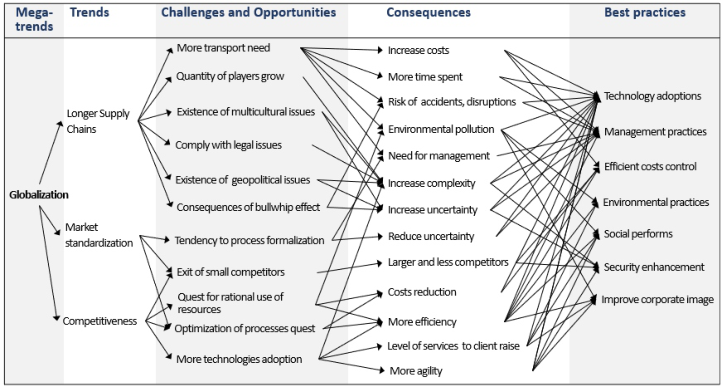
Population growth, improved transportation and concerns regarding envi- ronmental and social sustainability, as well as technological development, brought people together and have created a planetary society, where markets tend to grow in size, many of them becoming global. It is worth mentioning the case of commodity markets, small electronic equipment or pharmaceuti- cal products. This greater dimension of the markets and the number of players will generate greater competitiveness, greater extension of the supply chains, and the reduction of uncertainty motivated by the normalization of the mar- kets. There may be a reverse movement of increased uncertainty, motivated by inefficiencies in the control system or the occurrence of events at critical points in the process (e.g., the grounding of the container ship ‘Ever Given’ in the Suez Canal, in March 2021; or the emergence of disasters or conflicts). From an economic perspective, the higher level of competitiveness implies that the different actors, in order to survive in the market, need to become more efficient and/or provide a higher level of services that translate into value for the customer. Efficiency and the creation of new associated services can be obtained through the implementation of new technologies, in particu- lar those relating to the digitization of processes, the reduction of time and cost of transport or the possibility of monitoring the movement of cargo in real time. The implementation of these technologies also allows for greater control, transparency and visibility of the supply chain itself. The enlarge- ment of markets, by diversifying the sources of goods and the intervening operators, induces a standardization of processes and supplies, thus reducing the associated uncertainty.
The globalization of markets (Figure 1) creates longer supply chains, which requires a more extensive use of means of transport, with negative con- sequences in terms of environmental pollution. The mitigation of these consequences involves encouraging the existence of shorter supply chains and the use of technology that minimizes polluting emissions. On the other hand, the globalization contributes to the mobility of the means of production, the relocation of industries, and, ultimately, to the existence of social inequali- ties. The increase in the distance covered by the materials will correspond to an increase in the risks to which they are exposed, whether due to the occurrence of accidents of natural or human origin, or due to constraints of geopolitical origin. Let us remember the restrictions on movement between countries and regions that the ‘SARS COV 2’ virus (COVID-19) pandemic entailed, or the restrictions brought to international maritime trade by the already mentioned container ship ‘Ever Given’, or the limitations brought on the international cereals trade by the conflict between Russia and Ukraine. The increase in risks to the security of transported cargo creates uncertainty in the supply chain. One way of reducing uncertainty for operators and end
Figure 1: Logistics mega-trends: globalization.
customers will be through improving the visibility and transparency of the supply chain, for instance using radio-positioning technologies and making information available in real time via the internet.
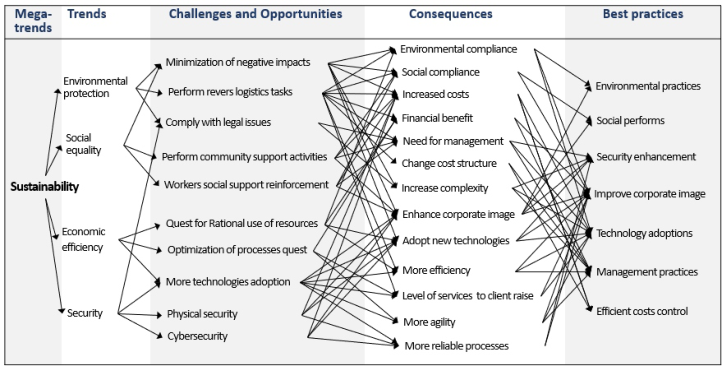
The need for environmental protection, the constant demographic growth, the growing urban concentration and the worsening of social inequalities lead us towards sustainability, considered, in particular, in its environmental and social pillars (Figure 2). The increasing awareness of customers regarding the need to respect the rules of sustainability and more restrictive legal regula- tions, require the reduction of negative impacts on the environment and the promotion of social protection measures by the logistics agents. Transforming business processes in order to include technologies that minimize social impa- cts, polluting emissions or the creation of waste can lead to increased costs for companies. When adopted by just a few market agents, it deprives them of competitiveness in relation to their competitors that do not; if imposed on all market agents, it translates into an increase in the cost of final products for customers. The adoption of measures that encourage the circular economy can translate into a business opportunity, by improving the corporate image with customers or by recovering value through waste collection and trea- tment. The implementation of new technologies can enhance the mitigation of the negative effects and take advantage of possible advantages.
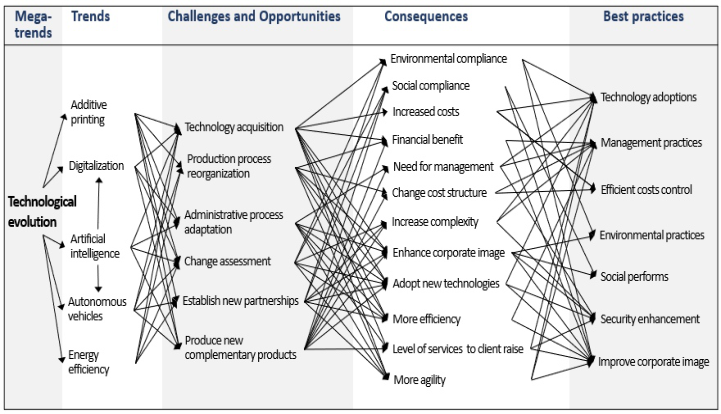
The emergence of new technologies (Figure 3) can be a factor for pro- moting competitiveness, environmental protection and reducing social ine- qualities, as well as reducing uncertainty and stimulating the resilience of organizations. In this sense, organizations, especially companies, will tend to specialize on market segments in order to focus on tasks that effectively have a competitive advantage. The adoption of emerging technologies, in particular those incorporating artificial intelligence, will reinforce proximity to customers, the agility to respond to market fluctuations and customers’ demand for customization, whether in the business sector or the government
Logistics Future Trends and Their Transformative Impact 221
relationship with its citizens. The emergence of disruptive technologies and the constant need to update them can dictate the closure of less agile orga- nizations or with less access to resources to invest in technology, specifically small and medium-sized enterprises (SMEs). The change in work processes can also correspond to a change in the workforce. Workers with less qualifi- cations or less adaptable may be dismissed due to changes or termination of their functions, being replaced by younger workers with skills in new techno- logical areas. In other words, the future will bring fewer but more specialized jobs. More agile and efficient organizations, that have human resources with adequate training, will be better able to respond to adversity and uncertainty.
Therefore, organizations that manage to keep up with technological evolu- tion will be more resilient and capable of responding to future challenges and opportunities.
Some of the emerging technologies or technological areas with potential impact on logistics activities are identified below.
Digitization – refers to the process of integrating different technologies to transpose data and procedures from the physical to the digital environ- ment, allowing access and sharing of data between different actors, regardless of their physical location, as long as they have internet access (Gray & Rumpe, 2015). The existence of long supply chains with global players and the need for effective control of their operation facilitates the sharing of documents electronically and the dematerialization of processes, impro- ving the quality of information available to decision-makers, the speed in obtaining and sharing, as well as the ability to control processes. Among the most prominent technologies associated with digitization are the Internet of Things (IoT), Blockchain, Internet based technology; Artificial Intellige- nce (AI), Radio Positioning System, Radio Frequency Identification (RFID) or Automatic optical identification (QR-code, barcode). Digitization is an opportunity to dematerialize documents and processes, creating greater effi- ciency and agility for the organization and value for the customer or user. For more detailed information refer to, e.g.: Kersten, Blecker and Ringle (2017), Korchagina, Kalinina, Burova and Ostrovskaya (2020) or Woschank, Kaiblinger and Miklautsch (2021).
Autonomous vehicles – there is a wide range of vehicle types and appli- cations, most of them still under development, whether in an underwater environment, surface (sea, land and confined spaces) or aerospace. With regard to logistics, the following are identified as major areas: (1) long- distance transportation, where automation will free up the human element, reduce the number of accidents, improve the predictability of deliveries in time and make the transport system more efficient; (2) last-mile delive- ries, using small specialized autonomous vehicles, bringing flexibility and speed in deliveries and decongesting car traffic in urban areas; (3) equi- pment for handling loads in confined spaces, within hospitals, offices or factories (Kato, et al., 2015; Faisal, Kamruzzaman, Yigitcanlar, & Currie, 2019; Martínez-Díaz & Soriguera, 2018; Wiseman, 2022). The development of these technologies is dependent on the evolution of Artificial Intelligence and the legal consequences it rises. Its adoption will bring greater efficiency and flexibility to supply chains.
Energy efficiency – energy consumption is a relevant factor for the effi- ciency of logistics activities and the environmental impact they cause. The existence of clean energy sources that are efficient will enable in the future the existence of more efficient and less polluting transport, whether by sea, land or air. If in short-distance transport, the electric motor is the most promi- sing, in long-haul transport, solutions based on hydrogen or nanotechnology arise alongside electric motors. (Jin, Zhang, Zhang, & Yang, 2019; Cullen, et al., 2021).
Additive printing – also known as 3D printing, refers to manufacturing by adding different layers to a given component. The full range of its application
Logistics Future Trends and Their Transformative Impact 223
is still unknown, with new uses emerging every day, from microelectronics, health, equipment maintenance or civil construction. The necessary require- ments are the availability of a digital model, raw materials and a printer. The materials most used as raw material are polyester (PET), different metallic alloys, ceramics and concrete. The main advantage lies in the cost of produ- ction (in some cases), manufacturing time and the possibility of customized production where and when needed (Bayraktar, 2022).
3D printing allows to: (1) influence the operation of logistics by intro- ducing new possibilities in the field of product design and prototyping; (2) reduce the complexity of the production process and of supply chains; (3) rationalize the existence of inventories; (4) encourage the digitization of part of the supply chain through the decentralization of manufacturing, bringing it closer to the customer; (5) allows for mass customization and reduction of delivery times; and (6) greater efficiency in resource utilization. Simplifying the production process and reducing the need for transportation has a positive impact on environmental preservation. The decentralization of production positively influences the reduction of social inequalities and environmental protection. Therefore, in general, 3D printing allows for grea- ter efficiency and flexibility in the supply chain, as well as reducing negative social and environmental impacts. In addition to the technical limitations still existing in some applications, there will be a need to adjust the international and national legal framework to meet the specificities of 3D printing (Mohr & Khan, 2015; Wieczorek, 2017).
Artificial Intelligence – Refers to attributing to machines the ability to auto- matically perform tasks similar to those associated with intelligent human reasoning (McCarthy, 2004). This capacity for machines to make decisi- ons and act autonomously is the basis for the technological development of many technological areas, such as autonomous vehicles, the digitization of processes or the use of bots to perform autonomous interaction with people.
BEST PRACTICES The best way to meet the challenges and opportunities ahead is to decide today what to do tomorrow. In other words, anticipating the challenges and opportunities that we will face in the future, planning the actions and deci- sions necessary to be prepared to respond to them. To do so, we need to know the current reality and foresee trends and future challenges. Logistics operators and other actors with responsibilities in activities related to logi- stics, either in common supply chains and on crises response operations, must adopt a set of good practices that allow them to respond to current and future challenges and to exploit the opportunities.
The cycles of technological evolution follow each other almost continu- ously. To respond to continuous evolution, organizations must have the ability and agility to timely adopt technologies that allow efficient perfor- mance, in order to achieve competitive advantage. The adoption of a new technology can have different effects, sometimes the opposite, depending on the context of its application. In addition to greater efficiency in produ- ction, it allows improving management and control processes, increasing the
level of services available, providing greater agility in responding to customer requests, promoting environmental protection, reducing social inequalities, or safeguarding the level of security. It can also have perverse effects, such as increased complexity, greater dependence on third parties or increased operating costs.
Respect for preserving the environment and encouraging the reduction of social inequalities are essential for the sustainability of any activity. The ado- ption of these practices may imply increasing production costs, the comple- xity of processes and a greater effort in administering and controlling tasks. However, the return obtained in terms of improving the corporate image with society and customers can offset the increased costs. Environmental and social sustainability can be achieved by improving the processes imple- mented in the supply chain, related to green logistics, the circular economy or the carrying out of complementary social responsibility activities that go beyond the organization’s normal activity. The adoption of new technologies that allow processes that are more environmentally friendly and respectful of the human condition can be a relevant factor in achieving sustainability goals.
Security, whether physical or cyber, is a major factor in today’s society. The ever-increasing capacity to process large amounts of data, the digitiza- tion of processes and the need to share information between partners, makes information increasingly valuable, and therefore the object of greed by third parties. The ability of organizations to provide secure goods and services and to ensure the protection of their customers’ data is fundamental and will tend to increase. Security is becoming the fourth pillar of sustainability, along with the environmental, social and economic aspects.
In addition to price, corporate image is one of the most relevant factors for the consumption of goods and services, especially in more evolved societies. The perception that consumers and society in general create in relation to organizations and their products is dependent on multiple factors. Respect for the environment, active participation in social development, the ability to keep assets safe and the adoption of new technologies will be key factors in shaping the corporate image (Gray & Balmer, 1998).
Despite the growing importance that societies attach to corporate image, the economic factor remains essential. No private company survives if it does not provide its shareholders with a positive financial return. To achi- eve positive results, it is not enough to act on the revenue side, it is necessary to ensure the efficient use of resources, through effective cost control. The implementation of new technologies and the digitization of business proces- ses allows for greater transparency and better tools to support the activity control.
Only by implementing the best practices, adjusted to each activity and context, can organizations respond to the challenges and opportunities that lie ahead in the near future, thus ensuring the maintenance of the competitive advantage and the continuity of its existence.
Logistics Future Trends and Their Transformative Impact 225
CONCLUSION
To ensure their sustainability over time, organizations have to plan their future activity with maximum accuracy and in advance. Planning, to be effective, needs to formulate the challenges and opportunities they will potentially face. In order to be able to realistically identify these challenges and opportunities, it is necessary to consider the trends in society and the consequences that these trends will have in the specific sector of activity.
Logistics, as a comprehensive multidisciplinary activity, is subject to multi- ple influences and constraints on its activity. Understanding the mega-trends of today’s society, such as the globalization of human activity, the need to address the factors that contribute to sustainability and to integrate technological developments, is essential to envision the future.
From the integration of these mega-trends into the logistics activity, is pos- sible, through logical reasoning, to deduce challenges and opportunities for the sector, as well as possible consequences. From this logical chain, some best practices can be identified. We believe that organizations that meet the elicited logistics’ best practices will better face challenges and take advantage of future opportunities of supply chain, particularly, when crises erupt. The sustainability of logistics is essentially based on its ability to effectively and realistically plan for the future.
ACKNOWLEDGMENT
The authors would like to acknowledge the EEA Grants and the Blue Gro- wth for their financial support, via project PT-INN-0066 – M4ML. The first author would also like to acknowledge the FCT, I.P., the Portuguese natio- nal funding agency for science, research and technology, under the Project UIDB/04521/2020.
REFERENCES
Bayraktar, A. N. (2022) “3D Printing and Logistics”, in: Logistics 4.0 and Future of Supply Chains. Accounting, Finance, Sustainability, Governance & Fraud: Theory and Application, ˙Iyigün, ˙I. and Görçün, Ö. F. (Eds.). pp. 63–82. doi: https://doi.or g/10.1007/978-981-16-5644-6_5. Borinshteyn, Y. R. (2019). Fundamental foundations of logistics philosophy. Em
Z. M. Atamaniuk, Y. R. Borinshtein, Y. A. Dobrolyubska, V. V. Okorokova, &..., Comprehension of the formation of the world in different philosophical approaches: Collective monograph (pp.24–47). Lviv, Ukraine: Liha-Pres. CSCMP. (2013). CSCMP Supply Chain Management Definitions and Glossary.
Lombard: Council of Supply Chain Management Professionals (CSCMP). Cullen, D. A., Neyerlin, K. C., Ahluwalia, R. K., Mukundan, R., More, K. L., Borup, R. L., Kusoglu, A. (2021). New roads and challenges for fuel cells in heavy-duty transportation. Nature energy, 6(5), pp. 462–474. doi: https://doi.org/10.1038/ s41560-021-00775-z. Faisal, A., Kamruzzaman, M., Yigitcanlar, T., and Currie, G. (2019). Understan-
ding autonomous vehicles. Journal of transport and land use, 12(1), pp. 45–72. doi: https://doi.org/10.5198/jtlu.2019.1405. Francis. (2015). Encyclical Letter Laudato Si’ of the Holy Father Francis on Care for Our Common Home. Roma: Vatican Press.
Gray, E. R., and Balmer, J. M. (1998). Managing corporate image and corporate reputation. Long range planning, 31(5), pp. 695–702. doi: https://doi.org/10.1016/S0024-6301(98)00074-0. Gray, J., and Rumpe, B.(2015). Models for digitalization. Software & Systems Modeling, 14(4), pp. 1319–1320. doi: https://doi.org/10.1007/s10270-015-0494-9. Jin, L., Zhang, B., Zhang, L., and Yang, W. (2019). Nanogenerator as new energy
technology for self-powered intelligent transportation system. Nano Energy, 66, 104086. doi: https://doi.org/10.1016/j.nanoen.2019.104086. Kato, S., Takeuchi, E., Ishiguro, Y., Ninomiya, Y., Takeda, K., and Hamada, T.
(2015). An open approach to autonomous vehicles. IEEE Micro, 35(6), pp. 60–68. doi: https://doi.org/10.1109/MM.2015.133. Kersten, W., Blecker, T., and Ringle, C. M. (Eds.). (2017). Digitalization in Supply Chain Management and Logistics: Smart and Digital Solutions for an Industry 4.0 Environment. Hamburg International Conference of Logistics (HICL). 23. Hamburg, Germany: Hamburg University of Technology (TUHH) & Institute of Business Logistics and General Management. doi: https://doi.org/10.15480/882. 1442. Korchagina, E., Kalinina, O., Burova, A., and Ostrovskaya, N. (2020). Main logi-
stics digitalization features for business. Topical Problems of Green Architecture, Civil and Environmental Engineering 2019 (TPACEE 2019). 164, p. 10023. Moscow, Russia: E3S Web of Conferences. doi: https://doi.org/10.1051/e3sconf /202016410023. Martínez-Díaz, M., and Soriguera, F. (2018). Autonomous vehicles: theoretical and practical challenges. Transportation Research Procedia, 33, pp. 275–282. doi: ht tps://doi.org/10.1016/j.trpro.2018.10.103. McCarthy, J. (2004). What is Artificial Intelligence? Stanford, CA, USA: Stanford
University. Mohr, S., and Khan, O. (2015). 3D printing and its disruptive impacts on supply chains of the future. Technology Innovation Management Review, 5(11), 20. NATO. (2021). AAP-6: NATO Glossary of Terms and Definitions (English and
French). Brussels, Belgium: North Atlantic Treaty Organization (NATO) Stan- dardization Office (NSO). UN. (2020). Report of the UN Economist Network for the UN 75th Anniversary: Shaping the Trends of Our Time. New York, NY, USA: United Nations (UN). Retrieved from https://www.un.org/en/desa/shaping-trends-shape-our-world. Wieczorek, A. (2017). Impact of 3D printing on logistics. Research in Logistics &
Production, 7(5), pp. 443–450. doi: https://doi.org/10.21008/j.2083-4950.2017. 7.5.5. Wiseman, Y. (2022) “Autonomous vehicles” in: Research Anthology on Cross- Disciplinary Designs and Applications of Automation, Management Association (Ed.), pp. 878–889. doi: https://doi.org/10.4018/978-1-6684-3694-3.ch043. Woschank, M., Kaiblinger, A., and Miklautsch, P. (2021). Digitalization in Industrial
Logistics: Contemporary Evidence and Future Directions. International Confere- nce on Industrial Engineering and Operations Management (IEOM) (pp. 1–12). Singapore: IEOM Society International.
LISTED IN THE AHFE DIGITAL BOOKSTORE CATALOGUE
Explore the complete digital volume
Human Factors and Systems Interaction
Read this individual research paper free through the original publisher, or explore the full digital proceedings book.
ISBN 978-1-958651-60-5
Explore this ISBN in the AHFE Bookstore ↗Listed in the July 2026 bookstore catalogue; search by ISBN to confirm current availability · Digital book purchase optional