Ana Martins, Isabel L. Nunes, Luís Velez Lapão, Ana Londral (2023). Conversational Agent Automation for patients after cardiothoracic surgery based on clinical team experience and behavior change theory. In: Human Factors and Systems Interaction. AHFE Open Access, vol. 84, pp. 123–133. https://doi.org/10.54941/ahfe1003597
Cardiovascular disease is a leading cause of death and decreased quality of life. Cardiothoracic surgery provides the chance to live longer with cardiovascular disease. Proper use of clinical protocols, regular clinical evaluation, medication review, improved modifiable risk factors, psychological support, and supervised physical exercise can enhance the longer-term effects of surgery. Additionally, a healthy lifestyle can improve modifiable risk factors and enhance longevity. Despite the great effort of the clinical teams to encourage patients towards healthy habits after surgery, one year after surgery some patients need to be readmitted to the hospital due to avoidable complications. This paper presents a digital conversational agent designed to reinforce the advice about protective behaviors provided by the clinical team, contributing to improving and sustaining health outcomes during the first year after surgery.A Design Science Research Methodology was used to integrate the clinical teams' experience and knowledge, and the patients' knowledge into the final artifact. A needs assessment was conducted to identify improvement opportunities in the cardiothoracic surgery service. A systematic literature review was used to characterize the dimensions of the solutions adopted in previous research, and an interdisciplinary team was assembled to address them comprehensively. Two semi-structured interviews were conducted with the relevant stakeholders (clinical team and patients). Additionally, a survey of theories that explain patient behavior change was done to support the personalization of content delivery. Afterward, a platform to provide the intervention was developed in accordance with stakeholders' requirements.Literature review and semi-structured interviews showed that physical activity and a healthy diet influence modifiable risk factors. Thus, these were the behaviors selected as targets of the intervention digital conversational agent, which is being designed based on the behavior change wheel framework.This work intends to incorporate a Behavior Change Theory into the algorithm definition to improve the comprehension of the intervention's effects and the patient's profile over time. The iterative research approach was chosen to continuously improve the artifact's robustness, sustainability, adoption, and usability by having all the stakeholders at the center of the design process.
The costs associated with cardiovascular disease (CVD) treatment make up the largest portion of healthcare expenses in 11 high-income European nati- ons in 2016 (Timmis et al. 2022). Social determinants, behavioral risk factors, and metabolic risk factors influence the incidence of heart attacks, stro- kes, heart failure, and kidney disease (WHO 2018). Social determinants include irreversible realities such as globalization, urbanization, and aging. Behavioral-risk factors include smoking, lack of physical activity (i.e., a mini- mum of 150 minutes of moderate physical activity or 75 minutes of intense physical activity per week), and an unbalanced diet characterized by the excessive consumption of trans fatty acids and sugar (WHO 2018, Timmis et al. 2022). These are affected directly by metabolic factors such as high blood pressure, obesity, high blood sugar, and cholesterol that directly influ- ence CVD. Thus, any strategy to reduce the costs associated with CVD should include the incentivization of a healthy lifestyle to prevent disease onset or complications (Timmis et al. 2022). These factors are also well-known for inducing other chronic diseases such as diabetes, chronic kidney disease, and cancer (CDC 2023). Protective behaviors should be reinforced in patients with chronic disease to improve their quality of life and long-term well-being (Bauer et al. 2014, Kontis et al. 2014). Therefore, patients can become active agents in their health and help reduce the burden associated with their chronic diseases.
Behavior change is a complex process that most often evolves in a non- linear way, in a series of iterative stages. The transtheoretical model states that an individual can change his behavior following six different stages: pre-contemplation, contemplation, determination, action, relapse, and main- tenance (Prochaska and Velicer, 1997). Processes involved in the change are rather difficult to measure and might include increased awareness about con- sequences and causes, emotional experiences associated with the behavior, self-reevaluation, effects of personal habits on the environment, the belief that the change is possible, counterconditioning, stimulus control, and helping relationships (Prochaska and Velicer, 1997). Some patients may have some of these processes facilitating the change process, while others are preventing it. It is important to understand these factors while designing an intervention to avoid relapses and increase its efficacy.
Behavior change interventions (BCI) have been used to guide the change process or help maintain a certain behavior (Grimmett et al. 2021). The beh- avior change wheel (BCW) is a framework that guides researchers during the design and evaluation phases of such intervention. This framework is con- stituted of three layers. At its core, there is the COM-B model that defines behavior as a function of capacity (physical and psychological), opportunity (social and physical), and motivation (reflective and automatic), where moti- vation is dependent on opportunity and capacity. The Theoretical Domains Framework was developed to understand the determinants of current and desired behaviors (Atkins et al. 2017). Each component of the Theoretical Domains Framework (TDF) can be mapped to this model (Michie, van Stra- len, and West, 2011) – these include 14 domains used as headers in Table 2.
Conversational Agent Automation for Patients After Cardiothoracic Surgery 125
The second layer of the BCW explains how the intervention will change the behavior and is characterized by nine intervention functions (education, persuasion, incentivization, coercion, training, enablement, modeling, envi- ronmental restructuring, and restrictions). These functions have been mapped to replicable behavior change techniques, which constitute the active ingre- dients of behavior change (Michie et al. 2013). The final layer specifies the policy categories to be used to support the delivery of the intervention functi- ons. Conversational agents have been employed to deliver such interventions (Chokshi et al. 2017, Horner et al. 2017, Polgreen et al. 2018, Kelly et al. 2019, Cadilhac et al. 2020, Mayberry et al. 2021, Thiengwittayaporn et al. 2021). Digital health has been increasingly shifting towards the implementation and use of ubiquitous devices and integrative data platforms that can enable personalized care (Nunes and Simões-Marques, 2015). In previous studies, conversational agents were built using data management platforms, a com- munication system, and algorithms to automate content delivery given the intended personalization features (Chokshi et al. 2017, Horner et al. 2017, Polgreen et al. 2018, Kelly et al. 2019, Cadilhac et al. 2020, Mayberry et al. 2021, Thiengwittayaporn et al. 2021). Additionally, appropriate metrics should be used to evaluate the conversational agent to better understand the value they offer to healthcare.
Nevertheless, there is an absence of solutions designed for patients who underwent cardiothoracic surgery. Cardiothoracic surgery can enable pati- ents to live longer and better, but behavior change can enhance the effects of surgery and improve quality of life and surgery outcomes in the medium to longer-term (Tadas and Coyle, 2020). The coming sections describe how the context of cardiothoracic surgery was initially characterized to understand what the target behaviors of the intervention are, by applying a questionnaire to the clinical team (six nurses and two cardiothoracic surgeons); followed by a behavior analysis based on the results of a semi-structured interview with 10 patients who underwent surgery; the identification of the needs of the cardiothoracic surgery service, of the main facilitators and barriers to performing the target behaviors, and the type of digital solutions that could be used to implement such an intervention. The final section presents some conclusions and future work directions.
CONTEXT ANALYSIS AND NEEDS ASSESSMENT Design science research methodology (DSRM) is used to ensure that succes- sful artifacts are developed (Hevner et al. 2004). The DSRM cycle starts by understanding what the context in which the artifact will be used to identify a problem to be solved.
In the current study, the context was defined through multiple meetings with the team of researchers involved in a previous study (Londral et al. 2022) and the cardiothoracic surgery clinical team from a Portuguese hospital.
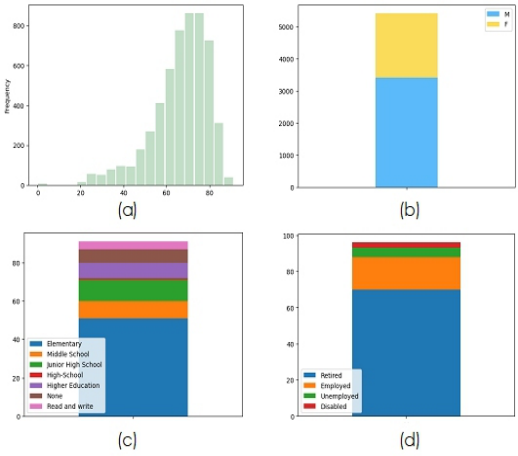
Electronic health records from 2010 until 2020 and the cardiothoracic sur- gery service of the Santa Marta Hospital were analyzed to characterize the patient population (N = 5419). It showed that only 1% of the patients had
Figure 1: The population characterization (a) age, (b) sex, (c) education, and (d) employment.
no preexistent condition before surgery (N = 54). Additionally, the analysis showed that the most common conditions prior to surgery were hyperten- sion, hypercholesterolemia, diabetes, persistent atrial fibrillation, previous myocardial infarction, and smoking.
Digital solutions and, in particular, mobile technology were found to have a positive impact as secondary prevention tools when personalized to specific groups (Gallagher et al. 2017). Digital solutions used to support patients after cardiothoracic surgery rely on the use of mobile apps, web apps, sensors, or a conjunction of those (Neubeck et al. 2009).
Since the present study is integrated into a bigger project and follows the telemonitoring project mentioned previously, which used wearables, electro- nic devices, a mobile app, and a management platform to monitor patients three months after surgery, it was a requirement to develop a different techno- logy given patient’s needs after this period. The solution implemented teaches the patient how to monitor vital parameters, sends recommendations about the first period after surgery, and helps the clinical team access the patient’s recovery (Londral et al. 2022).
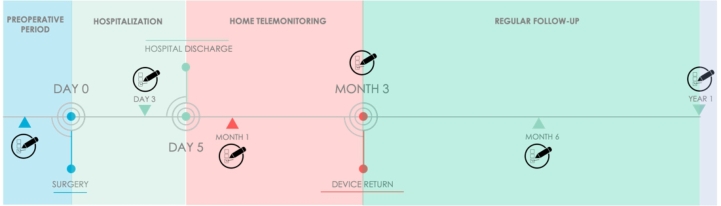
To identify the problem yet to be solved (step 1 of DSRM), a semi- structured interview was applied to eight healthcare professionals (six nurses and two cardiothoracic surgeons) in the cardiothoracic department to better understand the patient journey (illustrated in Figure 2), the perceived barri- ers and facilitators to performing a certain protective behavior to the patient, the most important protective behaviors to patients, and suggestions about a digital solution that could be used in their workplace. Suggestions inclu- ded a tool to improve patient recovery and secondary prevention, which could reduce the clinical team’s workload and that would be personalized
Conversational Agent Automation for Patients After Cardiothoracic Surgery 127
Figure 2: Patient journey at the cardiothoracic surgery service.
to the patient’s needs. A healthcare professional suggested that “the patient’s tendencies should be studied to understand the faults and help to change behavior”.
The objectives and motivation for the solution are the development of a system (digital conversational agent) that sends content to support patients in maintaining healthy behaviors for secondary prevention. This content should be personalized to patients’ needs using an intelligent system.
DEVELOPING A CONVERSATIONAL AGENT BASED ON THE BEHAVIOR CHANGE WHEEL After defining the objective for the solution, a systematic literature review (SLR) was performed following PRISMA (Page et al. 2021). The SLR aimed at learning about digital solutions that have been used to deliver tailored behavior change interventions in patients with chronic diseases. The selection criteria were designed using the PICO (Population - patients with chronic dis- eases, Intervention - behavior change intervention using automated systems to convey tailored content to patients, Comparison - any group without tai- lored messages, and Outcomes - clinical, and patient-reported outcomes) evidence-based process. The results from this SLR showed that these digital solutions are conversational agents that convey information using different communication channels, including SMS, email, voice records, and mobile apps (Chokshi et al. 2017, Horner et al. 2017, Polgreen et al. 2018, Kelly et al. 2019, Cadilhac et al. 2020, Mayberry et al. 2021, Thiengwittaya- porn et al. 2021); wearable devices have been used to assess physical activity (Chokshi et al. 2017, Polgreen et al. 2018, Kelly et al. 2020), or assess disease progression (Thiengwittayaporn et al. 2021); most automated mes- sage delivery systems use rule-based models; and most studies used theories to inform the design and evaluation of the intervention. As an example, Cadilhac and colleagues focused on the influence self-efficacy has on health behaviors, the types of goals the patient will set, and their ability on attai- ning them. The self-management program developed focused on facilitating self-efficacy to improve the type of goals the patient would pursue and their resilience when facing their failure. Messages were informed using behavior
Table 1. Description of a healthy diet and regular physical activity.
Table available in the original PDF paper.
Healthy Diet Regular Physical Activity (For patients) Adults (18-64 years old) >=150 minutes/week of moderate- intensity activity, such as walking. >=2 days/week of muscle-strengthening activities.
(For patients without food restrictions) Eat >5 meals/day, >= 2 fruits/day, >=2 vegetables/day, white meat, or fish Reduce salt consumption Drink water (1.5 – 2 L) Don’t drink more than 2dL of wine/meal or 1 beer/day
change theory (social cognitive theory, Information-motivation-behavior the- ory, and operant condition), and behavior change techniques (Cadilhac et al. 2020). BCW was selected as the framework to guide the design process of this artifact given its pragmatic nature and the fact that it synthetizes nineteen behavior change frameworks.
The process began by defining the target behaviors for this intervention. After analyzing the modifiable risk factors (Yusuf et al. 2020) of cardiovascu- lar disease patients and the analysis of the results from the semi-structured interview with the clinical team, a healthy diet, and physical activity were selected as target behaviors for the intervention.
After defining the target behaviors, the next step was to (1) understand the behaviors, (2) identify intervention options, and (3) identify contents and implementation options. To describe each behavior, the current instructi- ons provided by the clinical team were considered. Two examples of patient recommendations are shown in Table 1. To understand why the current beh- avior does not match the target behavior it was conducted a semi-structured interview with 10 patients by telephone and performed a content analysis using the TDF were to understand the themes associated with the barriers and facilitators to each domain (refer to Table 2). These themes were mapped into the COM-B model, it was found that it was only possible to act on Moti- vation and Capacity, which led to the definition of 4 out of the 9 intervention functions: education, persuasion, training, and enablement. It is recognized that enablement, training, and education can improve physical and psycholo- gical capacity. Persuasion can improve reflective and automatic motivation. Considering these intervention functions, it was selected behavior change techniques that could fit to envisaged intervention.
The theory explained served as the foundation to define the content to be delivered through the conversational agent under development. Subsequently, it initiated the implementation of the data platform to visualize the message plan of each patient, create new messages, map messages to behavior change techniques, and visualize answers from the patient. The implementation fol- lows a modular approach that potentially will allow the platform to be used for any behavior change intervention.
Conversational Agent Automation for Patients After Cardiothoracic Surgery 129
Role and Identity
Depression
practice exercise Spirituality
and Resources Social /Professio nal
cardiothoracic Family Role model
Decision Process Behavior Regulation Social Influences Environmental Context
Bad habits Self -management Assistive Devices Having a place to
Self -efficacy Bad habits Professional support Work Stress
Tiredness Memory Health surveillance Family Pets Work
certain behavior Accountability Self -management Target Setting Emotional conflict
Table 2. Themes associated with the barriers and facilitators to have a healthy diet and regular physical activity using the domains from TDF.
Table available in the original PDF paper.
Knowledge Skills Memory, Attention, and
Awareness Ability Professional Support Self-reevaluation People who underwent
Instruction Health Tiredness Tiredness ,Stress surgery Professional support Habits
Beliefs about
Capabilities Optimism Beliefs about
Self -confidence Belief about health Health outcomes Stage of Change Health outcomes Self -reward Uncertainty
Professional support outcomes from doing a
Ability Enjoyment Pain Anxiety
Self -efficacy Professional support
Pain Stress
CONCLUSION
DSRM is being used to develop a solution whose pilot will be used by the Santa Marta Hospital’s cardiothoracic surgery service’s healthcare providers and by a group of patients who underwent cardiothoracic surgery. This meth- odology was adopted to create a sustainable, robust, useful, and usable artifact by considering all stakeholders’ requirements in the design process.
This paper focused on describing the context and the service needs under- standing step and on explaining the behavioral foundations used to design the conversational agent. It was decided to use a pragmatic framework as the BCW to guide the design of the behavior change intervention.
Future work includes the conclusion of the implementation and the asses- sment of an intelligent conversational agent, which ensures bi-directional communication, allowing the interaction between patients and healthcare providers to influence modifiable risk factors in patients after cardiothoracic surgery.
ACKNOWLEDGMENT
The authors would like to acknowledge the clinical team of the Santa Marta Hospital for their support while conducting this study. The authors also acknowledge the Fundação para a Ciência e a Tecnologia for its financial support via projects DSAIPA/AI/0094/2020 and UIDB/00667/2020.
REFERENCES
Atkins, L., Francis, J., Islam, R., O’Connor, D., Patey, A., Ivers, N., Foy, R., Duncan, E. M., Colquhoun, H., Grimshaw, J. M., Lawton, R., and Michie, S. (2017) ‘A Guide to Using the Theoretical Domains Framework of Behaviour Change to Investigate Implementation Problems’. Implementation Science 12 (1), 77. Bauer, U. E., Briss, P. A., Goodman, R. A., and Bowman, B. A. (2014) ‘Prevention
of Chronic Disease in the 21st Century: Elimination of the Leading Preventable Causes of Premature Death and Disability in the USA’. The Lancet 384 (9937), 45–52. Cadilhac, D., Andrew, N., Busingye, D., Cameron, J., Thrift, A., Purvis, T., Li, J., Kneebone, I., Thijs, V., Hackett, M., and et al. (2020) ‘Pilot Randomised Clinical Trial of an EHealth, Self-Management Support Intervention (IVERVE) for Stroke: Feasibility Assessment in Survivors 12– 24 Months Post-Event’. Pilot and Feasibility Studies [online] 6 (1). avai- lable from <https://www.cochranelibrary.com/central/doi/10.1002/central/CN- 02200812/full>. CDC (2023) How You Can Prevent Chronic Diseases [online] available from <https://www.cdc.gov/chronicdisease/about/prevent/index.htm> [5 February 2023]. Chokshi, N., Adusumalli, S., Small, D., Morris, A., Feingold, J., Ha, Y., Rareshide, C., Hilbert, V., and Patel, M. (2017) ‘Loss-Framed Fina- ncial Incentives and Personalized Goal Setting Increase Physical Activity in Ischemic Heart Disease Patients Using Wearable Devices: The ACTIVE REWARD Randomized Clinical Trial’. Circulation [online] 136. avai- lable from <https://www.cochranelibrary.com/central/doi/10.1002/central/CN- 01441096/full>.
Conversational Agent Automation for Patients After Cardiothoracic Surgery 131
Gallagher, R., Roach, K., Sadler, L., Glinatsis, H., Belshaw, J., Kirkness, A., Zhang, L., Gallagher, P., Paull, G., Gao, Y., Partridge, S. R., Parker, H., and Neubeck, L. (2017) ‘Mobile Technology Use Across Age Groups in Patients Eligible for Cardiac Rehabilitation: Survey Study’. JMIR MHealth and UHealth 5 (10), e161. Grimmett, C., Bates, A., West, M., Leggett, S., Varkonyi-Sepp, J., Campbell, A.,
Davis, J., Wootton, S., Shaw, C., Barlow, R., and et al. (2021) ‘SafeFit Trial: Virtual Clinics to Deliver a Multimodal Intervention to Improve Psychologi- cal and Physical Well-Being in People with Cancer. Protocol of a COVID-19 Targeted Non-Randomised Phase III Trial’. BMJ Open [online] 11 (8). avai- lable from <https://www.cochranelibrary.com/central/doi/10.1002/central/CN- 02323562/full>. Hevner, March, Park, and Ram (2004) ‘Design Science in Information Systems Research’. MIS Quarterly 28 (1), 75. Horner, G. N., Agboola, S., Jethwani, K., Tan-McGrory, A., and Lopez, L. (2017)
‘Designing Patient-Centered Text Messaging Interventions for Increasing Physical Activity Among Participants With Type 2 Diabetes: Qualitative Results From the Text to Move Intervention.’ JMIR MHealth and UHealth 5 (4), e54. Kelly, J., Conley, M., Hoffmann, T., Craig, J., Tong, A., Reidlinger, D., Reeves, M., Howard, K., Krishnasamy, R., Kurtkoti, J., and et al. (2020) ‘A Coaching Program to Improve Dietary Intake of Patients with CKD: ENTICE-CKD’. Clinical Journal of the American Society of Nephrology 15 (3), 330–340. Kelly, J., Warner, M., Conley, M., Reidlinger, D., Hoffmann, T., Craig, J., Tong, A.,
Reeves, M., Johnson, D., Palmer, S., and et al. (2019) ‘Feasibility and Acceptability of Telehealth Coaching to Promote Healthy Eating in Chronic Kidney Disease: A Mixed-Methods Process Evaluation’. BMJ Open 9 (1), e024551. Kontis, V., Mathers, C. D., Rehm, J., Stevens, G. A., Shield, K. D., Bonita, R., Riley, L. M., Poznyak, V., Beaglehole, R., and Ezzati, M. (2014) ‘Contribution of Six Risk Factors to Achieving the 25×25 Non-Communicable Disease Mortality Reduction Target: A Modelling Study’. The Lancet 384 (9941), 427–437. Londral, A., Azevedo, S., Dias, P., Ramos, C., Santos, J., Martins, F., Silva,
R., Semedo, H., Vital, C., Gualdino, A., Falcão, J., Lapão, L. V., Coelho, P., and Fragata, J. G. (2022) ‘Developing and Validating High-Value Patient Digi- tal Follow-up Services: A Pilot Study in Cardiac Surgery’. BMC Health Services Research 22 (1), 680. Mayberry, L., Berg, C., Greevy, R., Nelson, L., Bergner, E., Wallston, K., Harper, K., and Elasy, T. (2021) ‘Mixed-Methods Randomized Evaluation of FAMS: A Mobile Phone-Delivered Intervention to Improve Family/Friend Involvement in Adults’ Type 2 Diabetes Self-Care’. Annals of Behavioral Medicine 55 (2), 165–178. Michie, S., Richardson, M., Johnston, M., Abraham, C., Francis, J., Hardeman, W.,
Eccles, M. P., Cane, J., and Wood, C. E. (2013) ‘The Behavior Change Technique Taxonomy (v1) of 93 Hierarchically Clustered Techniques: Building an Internati- onal Consensus for the Reporting of Behavior Change Interventions’. Annals of Behavioral Medicine 46 (1), 81–95. Michie, S., van Stralen, M. M., and West, R. (2011) ‘The Behaviour Change Wheel: A New Method for Characterising and Designing Behaviour Change Interventions’. Implementation Science 6 (1), 42. Neubeck, L., Redfern, J. ulie, Fernandez, R., Briffa, T., Bauman, A., and Freedman,
S. B. (2009) ‘Telehealth Interventions for the Secondary Prevention of Coro- nary Heart Disease: A Systematic Review’. European Journal of Cardiovascular Prevention & Rehabilitation 16 (3), 281–289.
Nunes, I. L. and Simões-Marques, M. J. (2015) ‘Exploiting the Potential and Facing the Challenges of Mobile Devices: Application Examples’. Procedia Manufactu- ring 3, 807–814. Page, M. J., McKenzie, J. E., Bossuyt, P. M., Boutron, I., Hoffmann, T. C., Mulrow,
C. D., Shamseer, L., Tetzlaff, J. M., Akl, E. A., Brennan, S. E., Chou, R., Gla- nville, J., Grimshaw, J. M., Hróbjartsson, A., Lalu, M. M., Li, T., Loder, E. W., Mayo-Wilson, E., McDonald, S., McGuinness, L. A., Stewart, L. A., Thomas, J., Tricco, A. C., Welch, V. A., Whiting, P., and Moher, D. (2021) ‘The PRISMA 2020 Statement: An Updated Guideline for Reporting Systematic Reviews’. BMJ n71. Polgreen, L., Anthony, C., Carr, L., Simmering, J., Evans, N., Foster, E., Segre, A., Cremer, J., and Polgreen, P. (2018) ‘The Effect of Automated Text Messaging and Goal Setting on Pedometer Adherence and Physical Activity in Patients with Diabetes: A Randomized Controlled Trial’. PloS One 13 (5), e0195797. Prochaska, J. O. and Velicer, W. F. (1997) ‘The Transtheoretical Model of Health
Behavior Change’. American Journal of Health Promotion 12 (1), 38–48 Tadas, S. and Coyle, D. (2020) ‘Barriers to and Facilitators of Technology in Cardiac Rehabilitation and Self-Management: Systematic Qualitative Grounded Theory Review.’ Journal of Medical Internet Research 22 (11), e18025. Thiengwittayaporn, S., Wattanapreechanon, P., Sakon, P., Peethong, A., Ratisoontorn, N., Charoenphandhu, N., and Charoensiriwath, S. (2021) ‘Development of a Mobile Application to Improve Exercise Accuracy and Quality of Life in Knee Osteoarthritis Patients: A Randomized Control- led Trial’. Archives of Orthopaedic and Trauma Surgery [online] avai- lable from <https://www.cochranelibrary.com/central/doi/10.1002/central/CN- 02325722/full>. Timmis, A., Vardas, P., Townsend, N., Torbica, A., Katus, H., De Smedt, D., Gale,
C. P., Maggioni, A. P., Petersen, S. E., Huculeci, R., Kazakiewicz, D., de Benito Rubio, V., Ignatiuk, B., Raisi-Estabragh, Z., Pawlak, A., Karagiannidis, E., Tre- skes, R., Gaita, D., Beltrame, J. F., McConnachie, A., Bardinet, I., Graham, I., Flather, M., Elliott, P., Mossialos, E. A., Weidinger, F., Achenbach, S., European Society of Cardiology, Mimoza, L., Artan, G., Aurel, D., Chettibi, M., Hammoudi, N., Vardanyan, K., Pepoyan, S., Sisakian, H., Scherr, D., Siostrzonek, P., Metzer, B., Mustafayev, I., Jahangirov, T., Rustamova, Y., Mitkovskaya, N., Shibeka, N., Stelmashok, V., De Pauw, M., Lancellotti, P., Claeys, M., Kušljugi´c, Z., Džubur, A., Smaji´c, E., Tokmakova, M., Traykov, V., Milicic, D., Pasalic, M., Pavasovic, S., Christodoulides, T., Papasavvas, I., Eftychiou, C., Linhart, A., Táborský, M., Hutyra, M., Sørensen, J. T., Andersen, M. J., Kristensen, S. D., Abdelhamid, M., Shokry, K., Kampus, P., Laine, M., Niemelä, M., Iung, B., Cohen, A., Leclercq, C., Trapaidze, D., Etsadashvili, K., Aladashvili, A., Bestehorn, K., Baldus, S., Zeiher, A. M., Kanakakis, J., Patrianakos, A., Chrysohoou, C., Csanádi, Z., Becker, D., Járai, Z., Hrafnkelsdóttir, P. J., Maher, V., Crowley, J., Dalton, B., Wolak, A., Assa, E. B., Zafrir, B., Murrone, A., Spaccarotella, C., Urbinati, S., Salim, B., Orazbek, S., Ayan, A., Bajraktari, G., Poniku, D. A., Erkin, M., Saamay, A., Kurban, K., Erglis, A., Jegere, S., Bajare, I., Mohammed, M., Sarkis, A., Saadeh, G., Šlapikas, R., Lapinskas, T., ˇCelutkien˙e, J., Ellafi, K., El Ghamari, F., Beissel, J., Banu, C., Felice, T., Xuereb, R., Popovici, M., Lisii, D., Rudi, V., Boskovic, A., Rabrenovic, M., Ztot, S., Abir-Khalil, S., Meeder, J. G., van Rossum, A. C., Elsendoorn, M., Kostov, J., Kostovska, E. S., Kedev, S., Angel, K., Mjølstad, O. C., Bleie, Ø., Gier- lotka, M., Da˛browski, R., Jankowski, P., Baptista, S. B., Ferreira, J., Gil, V., Badila, E., Gaita, D., Popescu, B. A., Shlyakhto, E., Zvartau, N., Kotova, E., Foscoli, M., Zavatta, M., Stojkovic, S., Tesic, M., Juricic, S., Kaliská, G., Hatala, R., Hlivák,
Conversational Agent Automation for Patients After Cardiothoracic Surgery 133
P., Fras, Z., Bunc, M., Pernat, A., Cequier, Á., Anguita, M., Muñiz, J., Johansson, B., Platonov, P., Carballo, D., Rüdiger-Stürchler, M., Tanner, F. C., Shebli, H. E., Kabbani, S., Abid, L., Faouzi, A., Abdessalem, S., Aytekin, V., Atar, I., Kovalenko, V., Nesukay, E., Archbold, A., Tayal, U., Wilkinson, C., Kurbanov, R., Fozilov, K., Mirmaksudov, M., Boateng, D., Daval, G., Momotyuk, G., and Sebastiao, D. (2022) ‘European Society of Cardiology: Cardiovascular Disease Statistics 2021’. European Heart Journal 43 (8), 716–799. WHO (2018) Technical Package for Cardiovascular Disease Management in Primary Health Care: Healthy-Lifestyle Counselling. World Health Organization. Yusuf, S., Joseph, P., Rangarajan, S., Islam, S., Mente, A., Hystad, P., Brauer, M.,
Kutty, V. R., Gupta, R., Wielgosz, A., AlHabib, K. F., Dans, A., Lopez-Jaramillo, P., Avezum, A., Lanas, F., Oguz, A., Kruger, I. M., Diaz, R., Yusoff, K., Mony, P., Chifamba, J., Yeates, K., Kelishadi, R., Yusufali, A., Khatib, R., Rahman, O., Zatonska, K., Iqbal, R., Wei, L., Bo, H., Rosengren, A., Kaur, M., Mohan, V., Lear, S. A., Teo, K. K., Leong, D., O’Donnell, M., McKee, M., and Dagenais, G. (2020) ‘Modifiable Risk Factors, Cardiovascular Disease, and Mortality in 155 722 Individuals from 21 High-Income, Middle-Income, and Low-Income Countries (PURE): A Prospective Cohort Study’. The Lancet 395 (10226), 795–808.
LISTED IN THE AHFE DIGITAL BOOKSTORE CATALOGUE
Explore the complete digital volume
Human Factors and Systems Interaction
Read this individual research paper free through the original publisher, or explore the full digital proceedings book.
ISBN 978-1-958651-60-5
Explore this ISBN in the AHFE Bookstore ↗Listed in the July 2026 bookstore catalogue; search by ISBN to confirm current availability · Digital book purchase optional