Mónica Gaboleiro, Isabel L. Nunes, Maria Isabel Gomes (2026). Enhancing Human–System Interaction in Order Picking through Ergonomics-Based Decision Support. In: Human Factors and Systems Interaction. AHFE Open Access, vol. 230, pp. 97–107. https://doi.org/10.54941/ahfe1007981
1 UNIDEMI – NOVA / Research & development Unit for Mechanical and Industrial Engineering, Caparica, Portugal; Center for Mathematics and Applications (NOVA Math) and Department of Mathematics NOVA School of Science and Technology (NOVA FCT), Caparica, Portugal ↗
2 UNIDEMI – NOVA / Research & development Unit for Mechanical and Industrial Engineering, Caparica, Portugal; Department of Mechanical and Industrial Engineering, NOVA School of Science and Technology, Caparica, Portugal ↗
3 Center for Mathematics and Applications (NOVA Math) and Department of Mathematics, NOVA School of Science and Technology (NOVA FCT), Caparica, Portugal ↗
Human-centered decision-making is becoming increasingly important in logistics systems where operational performance relies heavily on manual labor. In food distribution centers, for example, order picking is one of the most physically demanding activities. However, task allocation practices often neglect worker-related characteristics, which can lead to imbalances in manual handling demands, physical overload, and long-term fatigue. An industrial case study revealed significant variability among operators in daily load handling and item manipulation, underscoring the necessity of decision-support tools that consider ergonomic factors. This study proposes a human-centered framework for order-picking task allocation that incorporates measurable worker characteristics, such as handling exposure and manipulation counts, into planning processes. By moving beyond the assumption of homogeneous operators, the framework enables more transparent and balanced decision-making while maintaining productivity. From a human factors and systems interaction perspective, this work represents workers as key system components rather than interchangeable resources. Embedding ergonomics requirements in ex-ante planning enhances interpretability, trust, and the overall quality of operational decision-making. Grounded in a real-world application at a large food distribution center, the approach aims to promote sustainable interactions between planning systems, decision-makers, and frontline workers in physically demanding environments.
In contemporary logistics systems, human-centered decision-making has become critical. Despite advances in automation and digitalization, many intralogistics operations, particularly order picking, remain highly dependent on manual labor (Grosse et al., 2017; Sgarbossa et al., 2020). Consequently, system performance, productivity, and sustainability continue to depend heavily on human capabilities and limitations.
Order picking is widely recognized as one of the most physically demanding activities in distribution centers (Grosse et al., 2015; Cimini et al., 2019). When operational planning and task allocation decisions prioritize efficiency- based criteria alone, substantial imbalances in worker physical workload can arise. These imbalances may lead to cumulative physical exposure, fatigue, and reduced long-term sustainability of work systems (International Labour Organization; International Ergonomics Association, 2023).
The need to integrate ergonomics requirements into operational planning has been acknowledged for over two decades. Early research showed that failing to consider humans characteristics and capabilities in planning decisions can undermine performance and worker well-being (Boudreau et al., 2003). Since then, research at the intersection of ergonomics and operations management has grown, particularly through the development of optimization-based decision support approaches. However, existing research has largely focused on production and assembly systems, giving comparatively little attention to intralogistics and order picking operations. Furthermore, several review studies indicate that many proposed approaches are still in the conceptual stage or are validated using hypothetical data, which limits their applicability in real industrial contexts (Grosse et al., 2017; Sgarbossa et al., 2020). Recent reviews also emphasize the lack of practical frameworks that incorporate ergonomics requirements into planning and logistics systems while explicitly considering worker variability and cumulative workload exposure (Vijayakumar et al., 2022).
Against this backdrop, this paper addresses the gap between ergonomics knowledge and operational planning practices in order-picking systems. Using empirical data from a food distribution center, the study proposes a human-centered, decision-support framework for task allocation that incorporates simple, measurable indicators of physical workload, such as load handled (in kilograms) and number of boxes. By incorporating these indicators into ex-ante planning decisions, the framework reshapes how pickers interact with the logistics system throughout their shift. This contributes to more sustainable human–system interactions without compromising productivity.
The paper is organized as follows: Section 2 reviews relevant literature on ergonomics and decision support. Sections 3 and 4 describe the case study and the proposed framework, respectively. Section 5 discusses the results and implications for interaction, and Section 6 concludes the paper.
ERGONOMICS IN LOGISTICS DECISION-SUPPORT SYSTEMS: THEORETICAL AND CONCEPTUAL BACKGROUND Ergonomics is concerned with the design of work systems by adapting tasks, tools, and environments to human characteristics and capabilities (International Ergonomics Association, 2022). Ergonomics is defined by its dual focus on system performance and worker well-being. This recognizes that sustainable system performance cannot be achieved without considering human limitations (Dul & Weerdmeester, 2008; Dul et al., 2012). Ergonomics aims to optimize human well-being and overall system performance by
Enhancing Human–System Interaction in Order Picking 99 designing tasks, tools, and environments that fit people’s physical, cognitive, and organizational characteristics (IEA, s.d.).
Manual materials handling remains a significant source of physical strain in many work systems, particularly in logistics operations. Ergonomics literature identifies lower back pain as one of the most prevalent and costly work-related musculoskeletal problem. It is strongly associated with repetitive lifting, carrying, and exposure to cumulative loads (Dul & Weerdmeester, 2008). Prolonged exposure to manual handling activities in physically demanding tasks, such as order picking, increases the risk of fatigue and musculoskeletal disorders, especially when task design and work organization do not account for human variability.
International guidelines reinforce this systems-oriented view, stressing that work-related musculoskeletal disorders are largely preventable through appropriate task design and workload management (International Labour Organization; International Ergonomics Association, 2021; 2023). These guidelines emphasize that decisions made during work system design and planning have significant implications for workers’ long-term health and well-being. Therefore, ergonomics encompasses not only the assessment of individual tasks but also the way work is planned, allocated, and sequenced within operational systems.
How Ergonomics has Been Integrated into Decision-Support Models Over the past two decades, the integration of ergonomics requirements into optimization-based decision support models has been a growing topic of interest in literature, particularly at the intersection of operations management and ergonomics. Early contributions emphasized that operational planning decisions that focus solely on efficiency-related objectives may overlook human-related aspects, which could have negative consequences for worker well-being and system performance (Boudreau et al., 2003).
More recent review studies report an expanding body of work that explicitly incorporates ergonomic considerations into optimization and decision support models for production and logistics systems (Grosse et al., 2017; Sgarbossa et al., 2020; Vijayakumar et al., 2022). According to these reviews, most existing contributions focus on physical ergonomics, addressing factors such as energy expenditure, fatigue, cumulative physical load, and the risk of work- related musculoskeletal disorders. These factors are usually incorporated into decision-support models as either constraints that limit acceptable exposure levels or objectives in multi-objective formulations balancing productivity- related goals with ergonomic risk reduction.
The literature documents a wide range of approaches used to operationalize physical workload within optimization models. These range from simple indicators, such as handled weight or task frequency, to detailed ergonomic assessment methods and digital human modeling techniques (Grosse et al., 2017; Sgarbossa et al., 2020). However, review studies consistently report that the practical application of more detailed ergonomic models is often limited by data availability, modeling complexity, and computational requirements, especially in real industrial environments.
A smaller number of studies have explored the integration of cognitive and organizational aspects, such as learning and forgetting effects, mental workload, and workload balancing among workers, into planning and scheduling models beyond physical ergonomics. However, these contributions are limited and are often investigated through simulation-based approaches rather than optimization-oriented decision support tools (Vijayakumar et al., 2022).
Within logistics systems, particularly intralogistics, decision-support models aware of ergonomics are less prevalent than in production and assembly contexts. Despite the operational relevance and physical demands of order picking, few optimization-based approaches explicitly address ergonomic considerations in order picking task allocation (Grosse et al., 2015; Cimini et al., 2019; Sgarbossa et al., 2020). Consequently, many order picking planning approaches continue to prioritize efficiency-related criteria, addressing ergonomic aspects only indirectly or fragmentarily.
In addition to review-based contributions, individual studies have demonstrated the feasibility of incorporating ergonomic constraints into workforce planning and scheduling models. For instance, Rinaldi et al. (2022) propose a workforce scheduling approach that explicitly considers worker skills and ergonomic constraints. This illustrates how human-related factors can be embedded into optimization logic without compromising operational feasibility. These studies provide concrete evidence that planning aware of ergonomics can be implemented within decision support systems.
Research Gaps Identified in the Literature and Conceptual Framing of This Study A synthesis of existing review literature reveals several recurrent limitations that are particularly relevant to order picking task allocation. First, most optimization approaches that consider ergonomics focus predominantly on physical ergonomics, while cognitive, perceptual, and psychosocial factors remain under-explored within optimization-based decision-support models (Vijayakumar et al., 2022). Second, most contributions concentrate on production and assembly systems, with comparatively few addressing logistics operations, and even fewer focusing explicitly on order picking activities (Grosse et al., 2015; Cimini et al., 2019; Sgarbossa et al., 2020). Third, the use of real industrial data for validation is limited, as many proposed models rely on conceptual examples or hypothetical datasets rather than empirical operational data (Sgarbossa et al., 2020).
In addition to these thematic gaps, literature highlights challenges related to representing ergonomics in decision-support models. Workers are often modeled as homogeneous resources despite acknowledged variability in physical exposure and capacity. Ergonomics are not consistently embedded in the core logic of planning decisions (Grosse et al., 2017; Sgarbossa et al., 2020). Consequently, ergonomic considerations may remain peripheral to optimization outcomes rather than actively shaping task allocation and scheduling decisions.
From an ergonomics and systems perspective, several authors emphasize that decisions made during the planning stage influence cumulative physical
Enhancing Human–System Interaction in Order Picking 101 exposure over time, which affects performance and worker well-being. For example, Neumann and Dul (2010) argue that ergonomics should be considered in work system design and planning because organizational and planning decisions determine how physical demands accumulate throughout the workday.
In response to these observations, the present study adopts a human- centered, systems-based conceptual framework. Instead of modeling detailed physiological, biomechanical, or cognitive processes, the study focuses on the physical aspects of workload. It does so by integrating simple, measurable indicators of physical exposure-namely, cumulative handled load and manipulation intensity-into ex-ante task allocation decisions for order picking operations. This approach allows us to isolate and assess the effects of incorporating physical ergonomics into planning decisions, thereby establishing a baseline for future research that may extend the framework to include cognitive and psychosocial dimensions. This approach reflects the data typically available in real industrial contexts and recommendations based on reviews calling for quantifiable ergonomic metrics that can be incorporated into optimization models and validated in practice (Grosse et al., 2017; Vijayakumar et al., 2022).
By framing ex-ante task allocation as a mechanism through which human– system interaction is shaped over time, the study positions planning decisions as a key determinant of how physical workload is distributed among workers throughout a shift. Explicitly incorporating physical exposure into the planning process enhances transparency and interpretability for decision- makers, promoting more sustainable human-system interactions in order picking operations.
INDUSTRIAL CASE STUDY This work is based on a real-life case study of a large Portuguese food retailer that distributes its logistics operations among three warehouses serving over 270 stores. We analyzed the order picking system to gain an understanding of it and find solutions to a problem identified by the company. The company’s order picking system employs 251 pickers, who work across multiple shifts (morning, afternoon, and night) at the three warehouses. Order picking is done manually with the support of a voice picking system and electric pallet trucks with a maximum capacity of two pallets. Pickers can collect items from two orders at once in low-level picking, where item height can vary throughout the day depending on the replenishment level. Task allocation and the sequence of picking guides is determined by the availability of operators, with no consideration given to the cumulative workload. The company operates a productivity-based incentive program in which pickers are compensated according to their productivity levels, which are measured in boxes produced per line per hour. To be eligible for performance bonuses, operators must reach predefined productivity thresholds. Higher productivity rates are associated with greater financial compensation. This incentive
structure encourages operators to speed up their work to qualify for bonus payments.
The Problem Under Analysis The management department highlighted the excessive number of people with limited work capacity and is looking for solutions regarding these individuals. First, a statistical analysis of employees with limited work capacity was conducted to better understand the problem and define preventive strategies.
Of the 1,092 employees in the logistics system, 519 had limited work capacity between January 1, 2017, and December 31, 2024 (data provided by the company). Forty percent of these workers are pickers, and the most common reason for limited work capacity is lower back problems, which is consistent with the activity and physical demands of the job and with the literature findings. The management department was alarmed by the data showing that most incapacities appear within the first five years of operation. Of all the warehouses, Warehouse 2 had the highest number of incidents per worker in the analyzed period: 0.7 incidents per worker in the period under analysis. These results led us to analyze the company’s order picking operation in more detail.
Empirical Evidence of Workload Imbalance Data from a representative week of work was analyzed. Eighteen pickers from the three warehouses were included in the analysis. For clarity, the warehouses are referred to as Warehouse 1 (WH1), Warehouse 2 (WH2), and Warehouse 3 (WH3). A total of eighteen operators were selected, six from each warehouse. To ensure clarity and anonymity, the pickers were identified using a numerical code. The first digit indicates the warehouse, and the second digit identifies the individual picker. For example, Pickers 1.1 to 1.6 are from Warehouse 1, Pickers 2.1 to 2.6 are from Warehouse 2, and Pickers 3.1 to 3.6 are from Warehouse 3. Within each warehouse, the pickers were classified into three performance levels—low, medium, and high—with two pickers in each category. The company provided this classification based on internal productivity metrics, specifically the average number of boxes handled per line per hour.
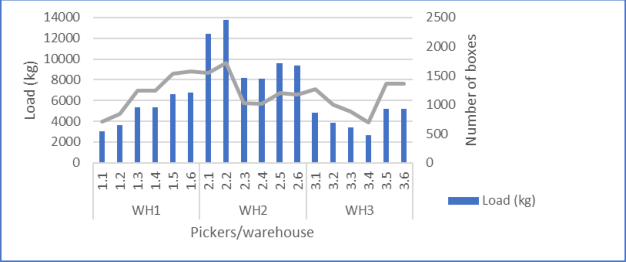
As can be seen in Figure 1, the analysis revealed significant variability in workload distribution. On average, pickers handled approximately 6500 kilograms per day, corresponding to about 1200 boxes. The minimum daily handled load was observed for picker 3.4 (2660 kg; 696 boxes), whereas the maximum exposure was recorded for picker 2.2 (13770 kg; 1726 boxes), exceeding the average daily handled load by a factor of more than two.
Figure 1: The average load (kg) and the number of boxes handled by each picker in each warehouse (source: own).
These disparities raise concerns about workload equity, accumulated fatigue, long-term injury risk, and the sustainability of the logistics system. As can be seen, Warehouse 2 is where pickers loaded the most weight, which aligns with the statistical analysis of work incapacity. It is also the place with the highest incidence rate per worker. The statistical analysis and real-week order picking analysis seem to demonstrate that these performance levels are not sustainable. This type of system interaction, which does not take into account any parameters related to workers (even accumulated loads), is not sustainable and has resulted in high levels of limited work capacity in the first years of activity. In a world where people have longer working lives (because retirement ages are increasing (Hess et al., 2021)), this is a real problem. We need people to be healthy and able to work for as long as possible. If the company’s workers have limited capacity within the first five years, something should be done immediately to solve this problem.
HUMAN-CENTERED DECISION-SUPPORT FRAMEWORK AND OPTIMISATION MODEL To address the observed imbalance, a human-centered decision-support framework was developed to assist with the automated allocation of tasks, considering the accumulated daily workload. This framework is the first approach modelled using data made available by the company. The aim was to find a quick and easy-to-implement solution to the problem of unsustainable interactions between workers and the order picking system that considers one of the company’s main concerns: maintaining performance levels. The intention was to create a decision support system that would help the company minimize extremely high levels of accumulated load (such as 12,000 kg) by distributing loads evenly among workers. Within this framework, a mixed-integer linear programming (MILP) model serves as the optimization engine, replacing the first-in, first-out (FIFO) assignment practice in place with a human-aware allocation policy that explicitly considers workload balance. At this stage, workload is operationalized through measurable, worker-related characteristics that could be addressed using the available data, namely, cumulative handled load and number of tasks assigned. These characteristics act as proxies for
physical exposure and manipulation intensity. Rather than modeling detailed physiological processes, aggregate exposure indicators are employed.
The model is formulated as a bi-objective optimization problem where the binary decision variables, xiw, indicate whether task i Є I, is assigned to worker w Є W. To ensure that productivity is not compromised when introducing ergonomics-based balancing criteria, a lexicographic solution approach is adopted. In the first stage, the objective is to maximize the total number of assigned tasks. Specifically, each task can be assigned at most once, and the total processing time for each worker cannot exceed their available working time. The optimal value obtained in this stage is denoted Z*. In the second stage, workload imbalance across workers is minimized while preserving Z*. Workload is measured as the cumulative handled load per worker and is computed as the sum of the weights of the tasks assigned to each worker. Workload imbalance is defined as the difference between the maximum and minimum workload levels across workers. This formulation allows for balanced task allocation while maintaining operational efficiency.
The optimization model presented in this study should be understood as an initial and intentionally simplified instantiation of a broader, human- centered decision-support framework. At this stage, the use of aggregate workload and manipulation-related metrics reflects both the availability of operational data and a deliberate design choice prioritizing transparency and planner understanding. Rather than aiming for maximal ergonomic fidelity, the objective is to establish a decision-support logic that can be incrementally extended. More advanced ergonomic models and additional human-related dimensions are explicitly considered as part of the framework’s ongoing development.
RESULTS AND INTERACTION IMPLICATIONS The model was tested using a computer-generated dataset based on an industrial case study. Although real operational data was available, the sample size was limited, which motivated the generation of synthetic instances. The synthetic instances were created based on the statistical properties of the original data, including the distribution and variability of task processing times and handled loads. This approach preserves the main characteristics of the real system while enabling a more comprehensive evaluation of the model. Given the available data, the model assumes a homogeneous warehouse context, considering ten pickers operating within the same warehouse. This allows the analysis to focus on the effects of task allocation and workload balancing. This model is the first implementation developed according to the level of detail and scope of the available data.
The model was implemented using the Gurobi 12.0.1 Solver for a set of 122 tasks and 10 pickers. Each picker had 450 minutes to execute the tasks. Using the lexicographic method, the number of tasks allocated was maximized in the first phase, subject to the constraints of the time available per picker and the number of pickers. The optimal solution was 111 out of 122 tasks, as the pickers’ available working time was fully utilized, no additional
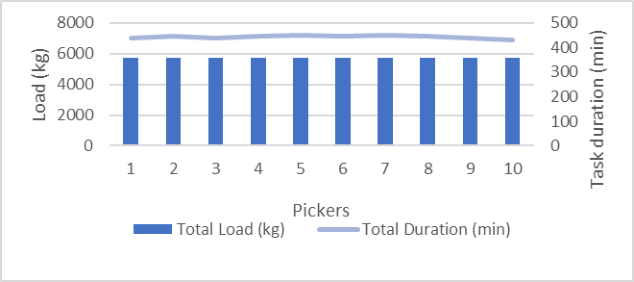
Enhancing Human–System Interaction in Order Picking 105 tasks could be assigned without exceeding the time capacity. In the second phase, the model distributed the load evenly among the ten pickers, achieving a highly balanced solution in terms of total load and total task duration. Although the number of tasks assigned to each picker ranged from 9 to 13, the maximum imbalance in total load was only 22 kg (approximately 0.4% of the average daily load per picker, or 5,738 kg). Additionally, the total task duration varied by only 20 minutes among pickers in one working day, as illustrated in Figure 2.
Figure 2: The total load handled per picker and the total task duration after model implementation (source: own).
Compared to the FIFO-based approach, the proposed method achieved a substantially more balanced workload distribution while maintaining a high level of task completion. The difference in the cumulative load handled by pickers was reduced to a few tens of kilograms, indicating a high degree of equity. From a human–system interaction perspective, the framework makes the human workload explicit within the planning process. This gives planners visibility of workload distribution and enables them to better anticipate physically demanding situations. Despite being a tool that helps operations managers plan the daily order picking operations better, allocating tasks to specific workers based on certain criteria, it seems to be the beginning of a new management philosophy for the company, opening the door to ergonomics-based operations management.
DISCUSSION: HUMAN FACTORS AND SYSTEM INTERACTION An analysis of a real industrial case confirms that high performance levels in physically demanding activities can result in an increased risk of injury if operations are not planned with ergonomics requirements in mind. Manual tasks such as order picking can lead to significant accumulated physical load over time when performed at a high level of intensity.
In Portugal, there is no legislation limiting accumulated loads per day; regulatory constraints focus only on weight per unit (25 kg). Without legal mandates addressing cumulative exposure, organizations must adopt management approaches that explicitly consider workers’ health and
well-being to promote sustainable work systems. This is particularly critical in order picking operations given the task’s inherent physical demands.
The results indicate that incorporating simple, work-related metrics into planning practice can substantially improve fairness and equity in workload distribution. Transitioning from first-in, first-out (FIFO)-based rules to a human-centered decision-support framework shifts the system away from a purely efficiency-driven paradigm toward one that considers worker health and well-being. The resulting reduction in workload imbalances suggests that this human-centered planning approach can efficiently redistribute physical demands among operators, promoting more sustainable interactions between workers and the logistics system, while keeping the company productivity levels. In this context, human-system interaction emerges through planning decisions that shape how physical demands are distributed and experienced by workers over time.
CONCLUSIONS AND FUTURE WORK The proposed framework enhances interpretability and fosters appropriate trust in automated recommendations, by explicitly incorporating information on workload distribution and physical exposure within the planning process. Implementing an order picking system with automated task allocation contributes to operational efficiency by providing workers with clearer task structures and daily objectives. This reduces situations in which productivity is constrained by ad hoc task assignment and supports a more equitable distribution of physical demands.
A central contribution of this work is the change in managerial mindset it supports. Although the company was aware of the large number of workers with limited work capacity, performance indicators traditionally dominated decision-making. This study demonstrated that prioritizing workers is compatible with performance and essential for long-term sustainability. Thus, this work represents a starting point for a management approach that fosters sustainable interactions between workers and the order picking system.
This paper presents a human-centered, decision-support framework for allocating order picking tasks that improves workload equity without compromising productivity. Based on ergonomics-aware optimization literature and real-world operational evidence, the framework shows how optimization models can support more sustainable logistics systems by explicitly representing human-related factors.
Future work will focus on further developing the framework by expanding worker-related metrics beyond aggregate load to include additional parameters that better estimate injury risk. These developments aim to strengthen interpretability and trust among decision-makers while promoting equity, fairness, and worker health and well-being to create sustainable logistics environments.
ACKNOWLEDGMENT
This work is supported by the doctoral Grant 2024.03036.BDANA financed by the Portuguese Foundation for Science and Technology (FCT). also under projects UID/00297/2025 and UID/PRR/00297/2025 (https:// doi.org/10.54499/UID/00297/2025 and https://doi.org/10.54499/UID/ PRR/00297/2025) (Center for Mathematics and Applications – NOVA Math) and UIDB/00667/2020 and UIDP/00667/2020.
REFERENCES
Boudreau, J. et al.. (2003). On the Interface Between Operations and Human Resources Management. Manufacturing & Service Operations Management, 5(3), pp. 179–202. Cimini, C. et al. (2019). Exploring human factors in Logistics 4.0: Empirical evidence
from a case study. IFAC-PapersOnLine, 52(13), 2183–2188. Dul, J., & Weerdmeester, B. (2008). Ergonomics for Beginners: A quick reference guide (Third Edition ed.). Boca Raton: CRC Press - Taylor & Francis Group. Dul, J. et al. (2012). A strategy for human factors/ergonomics: Developing the
discipline and profession. Ergonomics, 55(4), 377–395. Grosse, E. et al. (2015). Incorporating human factors in order picking planning models: Framework and research opportunities. International Journal of Production Research, 53(3), 695–717. Grosse, E. H. et al. (2017). Incorporating human factors into decision support models
for production and logistics: current state of research. IFAC PapersOnLine, 50–1, pp. 6900–6905. Hess, M. et al. (2021). Planned Retirement Timing in Europe: Are Europeans Adapting to the Policy of Extending Working Lives. Frontiers in Sociology, 6. IEA. (n.d.). What Is Ergonomics (HFE)? Retrieved february 18, 2024, from here International Ergonomics Association. (2022). Giving your business the human
factors edge. IEA Press Publication. Retrieved from here International Labour Organization; International Ergonomics Association. (2021).
Principles and guidelines for human factors/ergonomics (HFE) design and management of work systems. Retrieved janeiro 26, 2024, from here International Labour Organization; International Ergonomics Association. (2023).
Review report on laws and practice related to human factors/ergonomics and manual handling at the workplace. Occupational Safety and Health Series(75). Retrieved from here Neumann, W. P., & Dul, J. (2010). Human factors: spanning the gap between OM and HRM. International Journal of Operations & Production Management, 30(9), pp. 923–950. Rinaldi, M. et al. (2022). Workforce scheduling incorporating worker skills and
ergonomic constraints. Computers and Industrial Engineering, 168(July 2021), 108107. Sgarbossa, F. et al. (2020). Human factors in production and logistics systems of the future. Annual Reviews in Control, pp. 295–305. Vijayakumar, V. et al. (2022). Framework for incorporating human factors into
production and logistics systems. International Journal of Production Research, 60, pp. 402–419.
LISTED IN THE AHFE DIGITAL BOOKSTORE CATALOGUE
Explore the complete digital volume
Human Factors and Systems Interaction
Read this individual research paper free through the original publisher, or explore the full digital proceedings book.
ISBN 979-8-950676-06-2
Explore this ISBN in the AHFE Bookstore ↗Listed in the July 2026 bookstore catalogue; search by ISBN to confirm current availability · Digital book purchase optional