Mohammed Aminu Sanda (2026). The Mediating Classroom: How Digital Learning Ecosystems Shape Students’ Lived Experiences in Tertiary Online Education. In: Human Factors and Systems Interaction. AHFE Open Access, vol. 230, pp. 127–136. https://doi.org/10.54941/ahfe1007984
This study was premised on the notion that the success of any educational program depends not only on institutional backing but on its capacity to resonate with, and be shaped by, the narratives of learners. This is because, the rapid shift to online learning has moved the digital learning ecosystem—the integrated matrix of platforms, tools, pedagogies, and institutional supports—from a passive backdrop to the active environment of tertiary education. This ecosystem does not merely deliver content; it fundamentally mediates, constrains, and transforms students lived educational experiences. This study centers explicitly on this critical interaction, with the question: How do digital learning ecosystems impact the lived experiences of tertiary education students? Grounded in the systemic-structural theory of activity, which frames learning as a contextualized work activity, this research employs a cross-sectional quantitative design. Data was collected via questionnaire from six hundred and sixty-eight graduate students at the University of Ghana Business School, measuring perceptions of their digital ecosystem and its effects on their daily academic reality. The data was analyzed using structural equation modeling (SEM). The findings showed significant relationships between digital learning ecosystem and the facets of the students lived experience. it is concluded that positive enhancement of the pedagogical learning environment will positively enhance the student-system interaction, thus enriching their lived experiences in the digital learning ecosystem. This understanding is crucial for intentionally designing ecosystems that acknowledge and support diverse student lives, moving beyond technical implementation to foster genuinely human-centric online education.
Digital Learning and the Changing Educational Landscape In the evolving landscape of education, online learning has significantly changed how knowledge is delivered and altered the relationship between academic curricula and students’ experiences. Since the onset of the COVID-19 pandemic, educational systems have transitioned from onsite models to remote and hybrid models, with digital classrooms becoming a core
128 Sanda component of education at all levels (Means et al., 2010; Garrison, Anderson, and Archer, 2000; Sanda, 2020, 2022). Across the educational landscape, there are numerous examples of how thoughtful integration of online modalities, curriculum design, and student experience have yielded positive outcomes. For instance, universities that offer peer mentoring, online office hours, and culturally responsive materials tend to see higher levels of engagement and satisfaction among students from underrepresented backgrounds (Tinto, 2012). Similarly, online programs that prioritize flexibility and allow students to learn at their pace have enabled adult learners, caregivers, and working professionals to access education that might otherwise have been unreachable (Johnson, Becker, Cummins, Estrada, Freeman, and Hall, 2016, Sanda, 2022). When a curriculum is designed to be modular and adaptable, students can engage with content in ways that are personally meaningful and relevant (Johnson et al., 2016). Thus, the proliferation of digital technologies has positioned online education as a major force in the educational domain. Once viewed as an alternative or supplementary mode of instruction, online learning has become a primary, and occasionally the only, means of education for many worldwide (Means et al., 2010; Garrison et al., 2000; Sanda, 2020, 2022). This transformation, due to advancements in the digitization of information, influenced the socioeconomic development of numerous countries and contributed to the ongoing technological revolution (Sanda, 2020; 2022).
Digital Learning, Curriculum Viability, and Students’ Experience The relationship between online education, the viability of academic curricula, and students’ experiences is dynamic, characterized by mutual influence and ongoing adaptation. Online education can achieve its potential if curricula are designed, delivered, and continually adapted with an awareness of students’ diverse realities (Johnson et al., 2016, Sanda, 2022). Educational institutions and instructors can employ a range of strategies to bridge the gap between online curriculum and students’ lived experiences. This includes engaging students in the development and ongoing refinement of course content, which ensures greater relevance and buy-in (Bovill, Cook-Sather, and Felten., 2011). According to Meyer, Rose, and Gordon (2014), the principles of universal design for learning can be applied to help create flexible learning environments that accommodate various learning styles, abilities, and backgrounds. Similarly, formative assessments and reflective activities can be utilized by educators to adjust to students’ needs in real time (Black and Wiliam, 1998). Provision of technological, academic, and mental health support is essential for ensuring all students can fully participate in online learning (Cao et al., 2020), while the integration of real-world projects, internships, or community-based learning allows students to connect curricular content to their lives (Kolb, 1984). This, therefore, implies that by recognizing the importance of students’ voices and experiences, online education can be leveraged by committing to the continuous evolution of curriculum design (Bovill et al., 2011; Sanda, 2020; 2022). This will make education inclusive, effective, and capable of preparing learners for meaningful participation in a complex, interconnected world (Bovill et al., 2011; Sanda, 2020; 2022). It is crucial to understand how students, educators, and institutions co-create
The Mediating Classroom 129 online learning environments that are viable, relevant, and transformative. The success of any educational program depends not only on its theoretical soundness or institutional support but also on its capacity to resonate with and respond to the realities and narratives of learners. Understanding the connections between online education, curriculum viability, and students’ experiences is essential for nurturing a responsive, equitable, and effective educational system. Therefore, this study was premised on the notion that the success of any educational program depends not only on institutional backing but on its capacity to resonate with, and be shaped by, the narratives of learners. It investigated the core research question: Do digital learning ecosystems influence how student-system interactions affect their ’lived experiences within the context of tertiary online education and curriculum viability?
LITERATURE REVIEW
Facets of Students Lived Experience in Digital Spaces The modality of online learning can influence the way students experience their education. For instance, asynchronous learning can accommodate students with work or family responsibilities, while synchronous elements may foster community and real-time collaboration (Hrastinski, 2008). According to Sanda (2022), instructors’ ability to mediate their technological constraints will help improve the quality of course content they transmit to students virtually. This leads to students developing expository learning experiences (Sanda, 2022). Furthermore, students will have a higher degree of control over the content and orientation of the virtual learning activity provided by their instructors (Sanda, 2022). Thus, instructors will be able to provide a virtual platform that enables students to engage in active learning by engaging in collaborative and interactive learning activities (Sanda, 2022). Therefore, the choice of tools and platforms, the clarity of communication, and the availability of support systems all affect how students’ lived realities intersect with academic expectations (Hrastinski, 2008).
Students’ lived experiences are their subjective, embodied realities as they navigate the digital learning environment. In this wise, a curriculum that incorporates students’ voices and experiences is more likely to be relevant, engaging, and effective (Bovill et al., 2011; Sanda, 2020, 2022). Online education platforms provide avenues for greater personalization, allowing students to contribute to discussion forums, submit reflective assignments, and share their perspectives in ways that can inform curriculum development (Bovill et al., 2011; Sanda, 2020; 2022). This feedback loop enhances the adaptability and sustainability of curricula (Bovill et al., 2011). Students’ lived experiences encompass the rich tapestry of their backgrounds, cultures, aspirations, challenges, and day-to-day realities. In the context of online education, these experiences are both shaped by and shape the educational process (Hooks, 1994). Students from diverse socioeconomic backgrounds are known to face differing levels of access to devices, stable internet, and conducive learning environments at home. These factors deeply influence their engagement and success in online courses (van Dijk, 2020). Thus, the autonomy required in online learning can be empowering for some students, allowing them to tailor their educational pathways, but can also be overwhelming for others who
130 Sanda may struggle with self-direction or lack robust support systems (Ryan and Deci, 2000). As such, online learning can contribute to feelings of isolation, anxiety, and disengagement, especially when curricula fail to acknowledge and accommodate students’ mental health needs (Cao et al., 2020; Sanda 2022). In this way, the global reach of online education means that curricula must transcend local contexts and be sensitive to varying cultural and linguistic backgrounds (Wiitavaara and Widar, 2025). The viability of an academic curriculum refers to its relevance, effectiveness, adaptability, and sustainability in delivering learning outcomes (Johnson et al., 2016). In the context of online education, curriculum designers and educators must reconsider traditional paradigms to ensure that content is accessible, engaging, and meaningful in a virtual environment (Johnson et al., 2016). This requires considering several key facets, such as, agency, autonomy, and self-regulation, connectedness and isolation, cognitive and affective load, and context integration and negotiation (Johnson et al., 2016). Based on these reviews, the following hypothesis (H1) relative to the influence of digital learning ecosystems (DLE) on the lived experiences of tertiary education students is proposed.
H1: Student-system interaction in digital learning ecosystems will have a direct effect on their lived experiences.
Digital Learning Environment and Students Lived Experience Nexus A viable curriculum must align with both societal needs and students’ realities. Online platforms offer the potential for rapid updates, integration of real- world case studies, and the inclusion of contemporary issues. However, if curricula are not regularly adapted, they risk becoming obsolete (Beetham and Sharpe, 2013). Additionally, online education requires innovative pedagogical strategies. Active learning, multimedia resources, collaborative projects, and formative assessments become essential to maintaining student engagement and ensuring comprehension (Bates and Poole, 2003; Garrison and Vaughan, 2008). The digital environment enables more immediate feedback and diverse forms of assessment but also raises concerns around academic integrity and the genuine measurement of learning (Rowe, 2004). In this regard, viability is compromised if the curriculum does not account for varied student backgrounds, access to technology, and differing levels of digital literacy (Selwyn, 2021). Thus, the interplay between online education, curriculum viability, and lived experiences is dynamic and mutually influential. As such, the relationship between the digital learning environment and students’ lived experience is not deterministic but one of dynamic mediation. The same ecosystem feature can produce divergent systemic interactive experiences based on individual student characteristics (e.g., digital literacy, learning preferences, socioeconomic context). This aligns with the systemic-structural theory of activity (Bedny and Karwowski, 2007; Sanda, Johannson, Johansson and Abrahamsson, 2014). Using the systemic-structural theory of activity (SSTA), a student’s engagement with the digital learning environment is a goal-directed systemic activity (Bedny and Karwowski, 2007; Sanda et al., 2014). The digital learning environment provides the “tools” (technological and pedagogical), the ‘rules’ (policies and norms), and the ‘community’ (peers, instructors). Students’
The Mediating Classroom 131 lived experiences are the outcome of their functional actions within this system, influenced by their motives, competencies, and self-regulatory processes. This framework allows for a holistic analysis of how structural elements of the ecosystem (morphology) interact with functional, adaptive human processes to shape the subjective experience of learning. The digital learning environment is more than a delivery mechanism; it is an active participant in the educational experience. Based on these reviews, the following hypothesis (H2), relative to the influence of the pedagogical learning environment (classroom) on the effect that tertiary students’ interaction with the digital learning ecosystems (DLE) has on their lived experiences is proposed.
H2: The pedagogical learning environment of DLE will mediate the effect that the student-system interaction has on their lived experiences.
Relating hypotheses H1 and H2, the conceptual framework (Figure 1) below is developed to guide the study.
Figure 1: Conceptual framework highlighting the study variables.
Figure available in the original PDF paper.
METHODOLOGY
The study of teaching and learning as a systemic practice can benefit from the systemic-structural theory of activity (SSTA), which offers practical methods for analyzing human work (Bedny and Karwowski, 2007; Sanda et al., 2014). Key approaches include morphological analyses of activity, focusing on actions, and functional analyses of activity, centered on self-regulating systems and functional mechanisms (Bedny and Karwowski, 2007; Sanda et al., 2014). The study used a cross-sectional design, considering the quantified subjective opinions of the students involved. Quantitative data was collected from six hundred and sixty-eight graduate students at the University of Ghana Business using a questionnaire. The questionnaire entails a synopsis that explains the research purpose and objectives. The measurement scales for the study constructs in the Digital Learning Ecosystems, that is, “Student-System
132 Sanda Interaction” (SSI), “Students’ Lived Experience” (SLE), and “Pedagogical Learning Environment” (PLE), were developed from an extensive literature review, and the responses for all the items were rated using a five-point Likert scale. Being scales developed from the extant literature, their reliabilities were determined as analytical outcomes pursuant to further analysis. The data were analyzed inferentially using the SPSS and AMOS Graphics software programs. Structural equation modeling was conducted to test and establish the significance of the relationship between the SSI, SLE, and PLE.
RESULTS
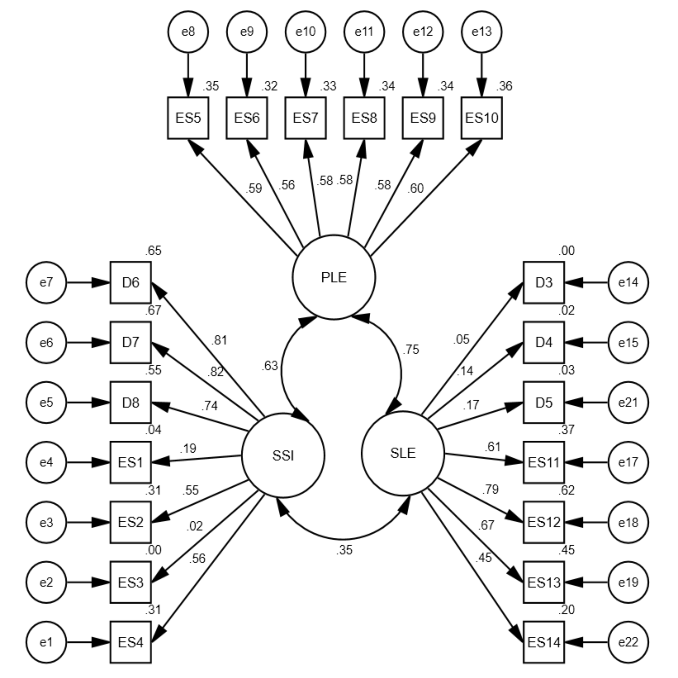
Structural Analysis The AMOS-generated standardized path diagram showing the standardized indicator loadings of the respective latent variables in the tested structural model is shown in Figure 2 below. Based on the goodness of fit statistics, the overall model fit appears quite good. This is because the estimated CMIN (χ2) value of 1483.787 (df = 167) has probability level of 0.00 which is lesser than the 0.05 used by convention. Therefore, the null hypothesis that the model fits the data is accepted.
Figure 2: AMOS-generated structural model showing standardized correlational loadings between study variables.
The Mediating Classroom 133 The strucutral model (Figure 2) shows a very signifcant positive correlation between PLE and SLE (α = 0.75). Furthermore, a significant positive correlation exists between PLE and SSI (α = 0.63). On the contrary, though, there is a positive correlation between SSI and SLE, it is not significant (α = 0.35). This implies that, in the digital learning ecosystem, while the the psychological learning environment has a strong relationship with both the student lived expereiences, and student-system interaction, the relation between the student- system interaction, and the student lived expereiences is weak.
The covariances showing how the enhancement of one variable affects the other are shown in Table 1 below.
Table 1: Covariances between the study variables.
Table available in the original PDF paper.
Covariances Estimates Standard Error (S.E) Critial Ratio (CR) P PLE ↔ SSI 0.279 0.035 7.996 ***
Fistly, the covariance estimate (Cov = 0.010; P = 0.258) for the direct effect of the student-system interaction (SSI) on students lived experience (SLE) in the digital learning ecosystems indicates that it is not significant (two-tailed). It shows that enhancement of SSI will not directly result in an equivalent enhancement of SLE. This in an alignment with the weak correlation between SSI and SLE, as previously established. this This means that the probability of getting a critical ratio as large as 1.132 in absolute value is 0.258, thus making the covariance between SSI and SLE not significantly different from zero at the 0.05 probability level (two-tailed). These statistical measures quantify the weak relationship between the student-system interaction and students lived experience, despite their positive interrelatedness. This implies that, in the digital learning ecosystem, the student-system interaction has weak direct capability in enhancing students lived experience. In this regard, therefore, the hypothesis (H1) “Student-system interaction in digital learning ecosystems will have a direct significant effect on their lived experiences” did not hold.
Secondly, The covariance estimate (Cov = 0.025; P = 0.253) for the effect of the pedagogical learning environment (PLE) on students lived experience (SLE) in the digital learning ecosystems, shows that enhancement of PLE does not directly result in an equivalent enhancement of SLE, despite the strong correlation between PLE and SLE, as previously established. This means that the probability of getting a critical ratio as large as 1.144 in absolute value is 0.253, thus making the covariance between PLE and SLE not significantly different from zero at the 0.05 probability level (two-tailed). These statistical measures quantify the direct incremental relationship between the pedagogical learning environment and students lived experience, indicating that they positively interrelate, but weakly affect each other. Furthermre, the covariance estimate (Cov = 0.279; P < 0.001) for the effect of the pedagogical
134 Sanda learning environment (PLE) on student-system interaction (SSI) in the digital learning ecosystems indicates that it is very, very significant, shows that enhancement of PLE directly result in an equivalent enhancement of SSI in an alignment with the very strong correlation between PLE and SSI, as previously established. This means that the probability of getting a critical ratio as large as 7.996 in absolute value is less than 0.001, thus making the covariance between PLE and SSI significantly different from zero at the 0.001 probability level (two-tailed). These statistical measures quantify the strong relationship between the pedagogical learning environment and student- system interaction, indicating that they positively and significatly affect each other. Thus, in the digital learning ecosystem, enhancing the pedagogical learning environment will have a significant and direct positive enhancement on the student-system interaction. In this regard, therefore, the hypothesis (H2) “the pedagogical learning environment (classroom) of DLE will mediate the effect that the student-system interaction has on their lived experiences holds.
The above analytical outcomes, therefore, provide an effective empirical framework (Figure 2 below) that delineates the specific mechanisms through which digital ecosystems shape student experiential reality. The framework provides a guide for the effective design of digital ecosystems that acknowledge and support diverse student lived experiences, moving beyond technical implementation to foster genuinely human-centric interaction.
integrated with curriculum design and online teaching-learning modalities
Figure 2: Framework for designing effective digital learning ecosystem to enhance students lived teaching-learning experiences.
Figure available in the original PDF paper.
CONCLUSION
Based on the findings, it is concluded that positive enhancement of the pedagogical learning environment (i.e. the virutal classroom) will result in the positive enhancement of the student-system interaction, and this will enrich the students’ lived experiences in the digital learning ecosystem.
The Mediating Classroom 135 By implication, if students lived educational experiences are integrated in the design of the curriculum and the online teaching-learning modalities in the digital ecosystem, the levels of their systemic engagement and satisfaction will increase, thus enhancing their lived experiences as learners in a virtual classroom.
ACKNOWLEDGMENT
The author would like to acknowledge the support of the University of Ghana Business School.
REFERENCES
Bates, Tony A.W. Poole, Gary. (2003). Effective teaching with technology in higher education: Foundations for success. Hoboken, NJ: Jossey-Bass. Bedny, Gregry Z. Karwowski, Waldemar. (2007). A systemic-structural theory of
activity: Applications to human performance and work design. Boca Raton, FL: Taylor and Francis. Beetham, Helen. Sharpe, Rhona. (2013). Rethinking pedagogy for a digital age: Designing for 21st century learning. Routledge. https://doi.org/10.4324/9780203078952 Black, Paul and Wiliam, Dylan. (1998) “Assessment and Classroom Learning.”
ASSESSMENT IN EDUCATION, Volume 5, Issue 1, pp. 7–74. https://doi. org/10.1080/0969595980050102 Bovill, Catherine, Cook-Sather, Alison and Felten, Peter. (2011) “Students as Co-Creators of Teaching Approaches, Course Design, and Curricula: Implications for Academic Developers.” International Journal for Academic Development, Volume 16, Issue 2, pp. 133–145. https://doi.org/10.1080/1360 144X.2011.568690 Cao, Wenjun. Fang, Ziwei and Hou, Guoqiang et al. (2020) “The Psychological
Impact of the COVID-19 Epidemic on College Students in China.” PSYCHIATRY RESEARCH, Volume 287, 112934. https://doi.org/10.1016/j. psychres.2020.112934 Garrison, D. Randy. Anderson, Terry and Archer, Walter. (2000) “Critical Inquiry in a Text-Based Environment: Computer Conferencing in Higher Education.” THE INTERNET AND HIGHER EDUCATION, Volume 2, Issue 2–3, pp. 87–105. https://doi.org/10.1016/S1096-7516(00)00016-6 Garrison, D. Randy. Vaughan, Norman D. (2008). Blended learning in higher
education: Framework, principles, and guidelines. Jossey-Bass. Hooks, Bell. (1994). Teaching to transgress: Education as the practice of freedom.
London: Routledge. Hrastinski, Stefan. (2008). “Asynchronous and Synchronous E-Learning.”
Freeman, Alex. Hall, Courtney. (2016). NMC Horizon Report: 2016 Higher Education Edition. Austin, Texas: The New Media Consortium. https://www. learntechlib.org/p/171478/. Kolb, David A. (1984). Experiential learning: Experience as the source of learning and development. Hoboken, NJ: Prentice Hall.
(2010), “Evaluation of Evidence-Based Practices in Online Learning: A Meta- Analysis and Review of Online Learning Studies.” U.S. Department of Education. Available at https://docs.edtechhub.org/lib/57ASU8B5 Meyer, Anne. Rose, David H. Gordon, David. (2014). Universal Design for Learning: Principles, framework, and practice, (3rd edn.). Lynnfield, MA: CAST Professional Publishing. Ryan, Richard M. and Deci, Edward L. (2000) “Intrinsic and extrinsic motivations:
Classic definitions and new directions.” Contemporary Educational Psychology, Volume 25, Issue 1, pp. 54–67. https://doi.org/10.1006/ceps.1999.1020 Sanda, M. A. (2022) “Students’ Quality Assessment of the Interactivenesses of Virtual Teaching and Learning Platforms.” Human Factors and Systems Interaction,’ Vol. 52, pp. 188–195. https://doi.org/10.54941/ahfe1002155 Sanda, Mohammed-Aminu. (2020), “Employees’ Perception of the Implementation
of Information Technology Systems in the Ghanaian Public Sector.” in: Advances in Human Factors and Systems Interaction. Nunes, Isabel. L. (Ed.), Cham: Springer, pp. 148–155. https://doi.org/10.1007/978-3-030-51369-6_20 Sanda, Mohammed-Aminu. Johansson, Jan. Johansson, Bo and Abrahamsson, Lena. (2014) “Using systemic structural activity approach in identifying strategies enhancing human performance in mining production drilling activity.” Theoretical Issues in Ergonomics Sciences, Volume 15, Issue 3, pp. 262–282. https://doi.org/10.1080/1463922X.2012.705916 Selwyn, Neil. (2021). Education and technology: Key issues and debates (3rd edn.).
Chicago: University of Chicago Press. van Dijk, J. (2020). The digital divide. Cambridge, UK: Polity Press. Wiitavaara, Birgitta and Widar, Linda. (2025) “Challenges And Opportunities Related to Online Studies in Higher Education.” EDUCATION AND INFORMATION TECHNOLOGIES. Volume 30, pp. 15001–15026. https:// doi.org/10.1007/s10639-025-13406-x
LISTED IN THE AHFE DIGITAL BOOKSTORE CATALOGUE
Explore the complete digital volume
Human Factors and Systems Interaction
Read this individual research paper free through the original publisher, or explore the full digital proceedings book.
ISBN 979-8-950676-06-2
Explore this ISBN in the AHFE Bookstore ↗Listed in the July 2026 bookstore catalogue; search by ISBN to confirm current availability · Digital book purchase optional