Dubesh Sai Mangam, Urmi R Salve (2026). Work Demands and the Impacts of Current Work Practices. In: Human Factors and Systems Interaction. AHFE Open Access, vol. 230, pp. 108–116. https://doi.org/10.54941/ahfe1007982
The work demands are defined as the fundamental human interactions expected from users when interacting with a product, service, or system in a workplace to perform the desired work. If the human interactions involved in meeting work demands are not managed, they may negatively impact users. In the current evolving society, characterized by technological advancements and changing fundamental needs, tracking human interaction is becoming increasingly complex. The traditional techniques developed to understand user performance are becoming outdated due to new work practices, technologies, digitalization, and customization. This study focuses on developing a concept that maps the user interactions needed to complete the required work with the product, service, or system, as well as the possible adverse reactions that may arise due to the demands of the work. This study involves developing the Work Demands and Impacts (WDI) concept by integrating existing work-demand concepts and relevant models from the literature. The WDI concept illustrates the potential demands and impacts a user may experience in any workplace. The proposed concept is tested on two commonly observed day-to-day tasks to assess its effectiveness in mapping potential demands and impacts in the workplace. The WDI concept can assist designers involved in workplace operations in better managing human interactions. This will provide a new perspective in developing a safe and effective workplace while tracking user performance.
In a daily work routine, individuals perform various types of work, each involving different requirements (Schaufeli & Bakker, 2004; Wollter Bergman et al., 2021a). In general, work comprises a set of tasks or activities performed to achieve a desired outcome, and these tasks are shaped by the interactions between the user and the work system (Kadir & Broberg, 2021; Norros, 2014). The role of a designer is to structure tasks and activities in a way that ensures positive outcomes for users (Gumasing et al., 2025). Performing the assigned task requires user involvement, referred to here as human interaction. These interactions can vary depending on the type of task or activity that is to be performed by the user (Wollter Bergman et al., 2021b). Furthermore, different users can adopt different interaction strategies to complete a similar task (Andersen et al., 2021). In the current, evolving
Work Demands and the Impacts of Current Work Practices 109 society with technological advancements and fundamental needs, tracking worker performance is becoming increasingly complex (Billing et al., 2025). The traditional techniques developed to evaluate worker performance are becoming insufficient due to the adoption of new work practices, automation, technologies, and digitalization. This introduces challenges in understanding workers’ performance, as they are influenced by numerous factors.
Several researchers have addressed the concepts of work demands in analysing workplace outcomes (Kaboth et al., 2024). However, the approaches differ depending on the nature of the work, results involved, and the degree of user engagement (Macdonald & Oakman, 2022). These variations create challenges when attempting to apply existing models to emerging or non- conventional work practices. As work patterns continue to evolve due to factors such as industrialization, user needs, and environmental conditions, numerous new cases arise that existing frameworks may not adequately address. Moreover, most of the proposed concepts will address only one or two adverse outcomes/effects faced by the user in that particular case. This intern eliminates the possibility of identifying the other adverse outcomes/ effects that can result in any given case (Cantley et al., 2016; Liu et al., 2025). There remains a lack of an integrative framework that systematically maps work demands to their adverse impacts from a Human Factors and Ergonomics (HFE) perspective.
The present study aimed to fill this gap by analyzing existing models in the literature that address adverse outcomes or effects experienced by a user involved in a specific case, expressed in terms of their work demands. The outcome of this study will be a Work Demands and Impacts (WDI) concept that can assist in representing work practices in terms of their respective demands required to perform the task and the potential adverse effects arising from those demands.
RQ1: What are the possible work demands and impacts that are predominantly occurring in the current work practices, and how can they be represented?
LITERATURE REVIEW
Although numerous studies have examined work practices, relatively few have explicitly conceptualized work demands in a structured manner. A systematic literature review was conducted to identify studies that define work demands and associated impacts. It also involved identifying models that define workplace requirements and the processes involved, which can be helpful in developing the WDI model. No integrative models were identified that comprehensively describe work practices in terms of their work demands and the associated negative impacts users may face from an HFE perspective. Most existing studies focus only on certain types of work practices and draw conclusions that are not directly applicable to others. The list of researchers who identified specific work demands and their overall impacts on particular fields is shown in Table 1.
Table 1: Literature that addresses work demands and associated impacts.
Table available in the original PDF paper.
Authors Field Work Demands Impacts Burnout (Demerouti et al., 2001) Teaching, psychology, and nursing Physical workload, time pressure, recipient contact, physical environment, and shift work
Stress and injuries
(Balk & Dormann, 2018) Sports Physical, cognitive, and emotional
Frustration and accidents
(Galy et al., 2018) Car driving Mental, physical, and temporal
Stress, productivity
(Roskams & Haynes, 2021)
Indore offices Physical and environmental Assembly work Cognitive, emotional, (Wollter Bergman et al., 2021b) organisational, social, individual preconditions and attitudes
Mental fatigue, strain, reduced motivation, impaired health, and performance
(Macdonald & Oakman, 2022)
Safety Physical and psychological
Musculoskeletal disorders (MSDs), injuries, and hazards
(Kaboth et al., 2024) Occupational health
Reduced work ability, burnout, poor mental health, and absenteeism
Work-life conflict, varied work, quantitative, physical working conditions, and work ability
It has been noted that most studies mainly focus on physical, cognitive, and environmental demands to understand a user’s performance in the workplace. Several elements are observed in these studies that relate to the users’ performance while completing an assigned task. This literature study confirmed that existing studies are applicable only to specific cases and cannot be generalized.
METHODOLOGY
Study Design This study employed a qualitative concept development approach, using secondary data and experts’ input as the primary sources for developing the required WDI concept. The key studies identified in the literature review were used to extract the main work-demand categories and their associated impacts. These elements served as the basis for concept development.
Concept Development Following the literature analysis, an initial set of work demands and potential negative impacts on work practices was compiled. To minimize repetition and clustering of these elements, three HFE professionals were consulted through a semi-structured interview (Wollter Bergman et al., 2021). The research questions and initial findings of the study were presented to them, and they were asked to provide feedback on the completeness of the identified demand categories, the
Work Demands and the Impacts of Current Work Practices 111 relevance of the proposed impact categories, and potential eliminations and additions based on their professional experience. These feedbacks were used to consolidate overlapping elements and redundancy, and to refine definitions. The final WDI concept combines work demands categorized by type with the potential impacts typical across various work practices.
Evaluation To assess the applicability of the WDI concept in general work conditions, two work cases were analyzed. The description of these cases used for this assessment is provided in Table 2. A total of thirteen participants with fundamental knowledge of HFE and who use it in their professional work were recruited using a purposive sampling method. These participants were primarily introduced to the WDI concept with its application and were asked to give their responses to a series of questions:
Identify work demands present in each case
Identify potential impacts and link them to corresponding demands
Rate the influence of each work demand on specific impacts using a ten- point Likert scale (0 = Not related; 9 = Highly important) Their responses were collected through physical or online forms based on their convenience and physical availability. The median values were calculated to determine the relative importance of individual demand-impact relationships.
Table 2: Example cases considered for the evaluation of WDI.
Table available in the original PDF paper.
Cases Considered Description
1. Car driving The work involves a driver operating a manual transmission vehicle to perform driving. It requires manually operating the vehicle’s controls while staying aware of the surrounding traffic.
2. Classroom teaching The work involves a teacher engaging with a group of young people to verbally explain specific topics. It also requires the user to maintain a standing posture for extended periods while delivering lectures.
RESULTS AND DISCUSSION
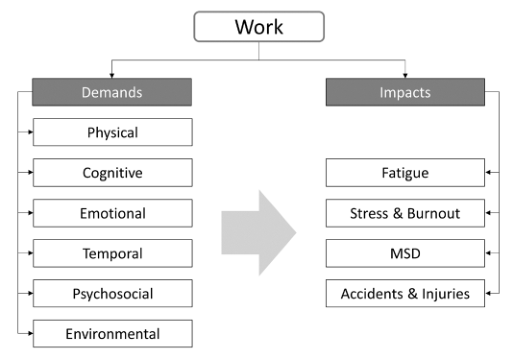
The analysis of the literature and expert input resulted in the consolidation of six primary work-demand clusters: physical, cognitive, emotional, temporal, psychosocial, and environmental. These clusters represent the essential human engagement needed to perform work within a system. While shown as separate categories for clarity, they are naturally interconnected in real work environments. The description of these demands is:
Physical demands involve bodily efforts, such as repetitive movement, exerting force, and maintaining specific postures during a task.
Cognitive demands encompass memory, decision-making, attention, and information processing.
Emotional demands involve managing feelings and maintaining emotional engagement.
Temporal demands refer to time constraints, pacing, and urgency of responses.
Psychosocial demands consist of role expectations, responsibilities, social interactions, and peer pressure.
Environmental demands arise from the physical and psychological surroundings, such as noise, lighting, and workspace constraints.
The adverse impacts identified in the literature were categorized into four main groups: fatigue, stress & burnout, musculoskeletal disorders (MSDs), and accidents & injuries. The description of these impacts is:
Fatigue indicates both physical and mental exhaustion.
MSDs reflect long-term physiological effects of repetitive or sustained physical loads.
Accidents & injuries are immediate safety-related outcomes.
Figure 1: Proposed work demand and impacts structure.
Together, these clusters form the structural basis of the WDI concept, as shown in Figure 1. It can be used to graphically represent a mapping structure that links work demands to potential adverse impacts. This representation is based on the Job Demands-Resources (JDR) model (Demerouti et al., 2001), which posits that job demands affect employee outcomes. However, unlike JDR, the WDI concept does not focus on motivational resources or positive engagement outcomes. Instead, it specifically emphasizes the structured mapping of human interaction demands and the negative consequences associated with them from an HFE perspective.
In the WDI representation, demands are placed on one side and impacts on the other, with directional links showing perceived influence. The strength of
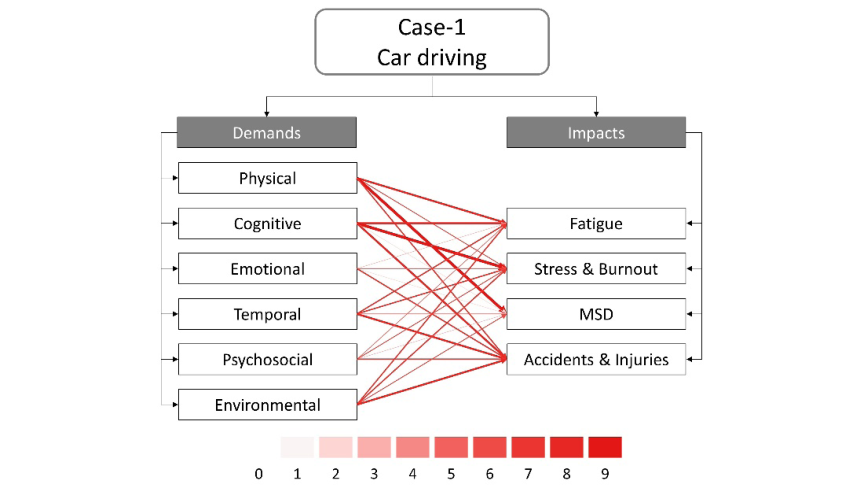
Work Demands and the Impacts of Current Work Practices 113 each demand-impact relationship is visually shown by graded arrow intensity, which is based on the median of participant ratings. A darker arrow signifies a stronger perceived influence, while a lighter arrow indicates a weaker connection. This visual mapping enables a holistic understanding of how multiple demand clusters jointly contribute to various adverse outcomes. Instead of focusing on a single dominant factor, the model highlights the networked nature of the work system.
Figure 2: WDI representation of Case 1 (car driving).
The mapping developed for Case-1 (car driving), shown in Figure 2, indicates that cognitive and temporal demands are closely tied to fatigue and accidents. This suggests that decision-making under time pressure and continuous attention are key factors in driving safety. Physical demands are clearly linked to fatigue and MSDs, reflecting the need to maintain posture and perform repetitive control actions. Environmental demands also show strong connections to accident-related effects, indicating that surrounding conditions increase cognitive and time pressures. Emotional and psychosocial demands appear less dominant in this case, with lighter links suggesting that the main risk factors for driving are influenced more by cognitive and temporal interactions than by sustained emotional and social burdens. The visual representation highlights that accidents result from the interaction of multiple demand clusters, including cognitive, temporal, and environmental factors.
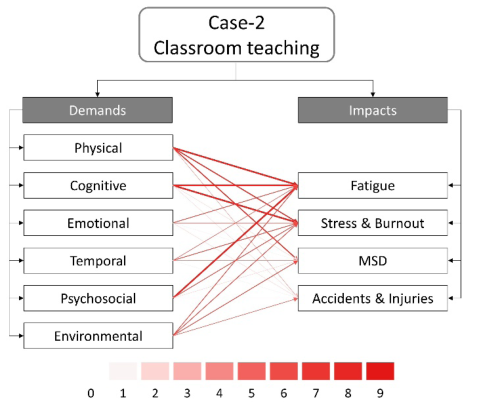
The mapping developed for Case-2 (classroom teaching), shown in Figure 3, reveals strong connections for fatigue, stress, and burnout. Sustained interpersonal interactions, emotional regulation, and
114 Sai and Salve responsibility for group management appear to strain psychological resources in this setting. Fatigue is linked to several demand groups, especially physical, cognitive, and emotional demands, indicating cumulative mental load. Compared to driving cases, the links to injuries and accidents tend to be weaker, suggesting that safety-related effects are less significant in teaching. Instead, the negative outcomes are more gradual and centered on psychological factors.
Figure 3: WDI representation of Case 2 (classroom teaching).
The comparison between the two cases underscores the WDI framework’s contextual sensitivity. Although both cases include all six demand clusters, the strength of their connections to impacts varies significantly. These observations show that the WDI concept effectively captures the multidimensional nature of work practices and reveals how different work systems create distinct demand-impact patterns.
The graphical evaluation shows that adverse impacts rarely come from isolated demands. Instead, they result from interacting cultures within the work system. By visualizing these interactions, the WDI concept offers a structured way to identify main pathways and focus on key intervention areas. From an HFE perspective, the framework helps inform early-stage design decisions by highlighting which demand groups are most influential in a given work setting. This allows for targeted adjustments to task structure, environmental factors, or organizational setups to reduce potential negative outcomes. The WDI concept can be further extended to computational models by assigning weights to individual clusters, which predict the likelihood of adverse effects users may encounter.
The main limitation of the study is a small sample size. The application of this concept can be broadened by implementing the WDI across a wider range of work practices, thereby providing deeper insights into present-day working conditions.
CONCLUSION
This study presents the Work Demands and Impacts (WDI) concept as a comprehensive framework for illustrating work practices in terms of demands and their possible negative effects. By synthesizing existing literature and incorporating experts’ insights, the WDI concept was created to overcome the limitations of domain-specific models. The framework comprises six demand categories and four impact categories. The assessment using the two specified work cases showed that the WDI concept effectively reflects the multidimensional nature of present day work practices. The case’s specific graphical representation highlights the interconnected relationship between demands and impacts, emphasizing the possibility of a unique outcome. The proposed concept contributes to HFE by providing a structured yet adaptable tool that can be used across various work practices. It facilitates early detection of critical demand impacts pathways and helps designers and practitioners create safer and more efficient work areas. The WDI concept offers a basis for this type of analysis and can be enhanced through empirical validation, industrial use, and integration with professional tools.
REFERENCES
Andersen, L. L., Vinstrup, J., Sundstrup, E., Skovlund, S. V., Villadsen, E., & Thorsen, S. V. (2021). Combined ergonomic exposures and development of musculoskeletal pain in the general working population: A prospective cohort study. Scandinavian Journal of Work, Environment & Health, 47(4), 287–295. https://doi.org/10.5271/ sjweh.3954 Balk, Y. A., & Dormann, C. (2018). Balancing Demands and Resources in Sport:
Adaptation and Validation of the Demand-Induced Strain Compensation Questionnaire for Use in Sport. Journal of Sports Science and Medicine. Billing, E., Fraboni, F., Gualtieri, L., Rosen, P. H., & Thorvald, P. (2025). Editorial: Human factors and cognitive ergonomics in advanced industrial human-robot interaction. Frontiers in Robotics and AI, 12, 1564948. https://doi.org/10.3389/ frobt.2025.1564948 Cantley, L. F., Tessier-Sherman, B., Slade, M. D., Galusha, D., & Cullen, M. R.
(2016). Expert ratings of job demand and job control as predictors of injury and musculoskeletal disorder risk in a manufacturing cohort. Occupational and Environmental Medicine, 73(4), 229–236. https://doi.org/10.1136/oemed-2015- 102831 Demerouti, E., Nachreiner, F., Bakker, A. B., & Schaufeli, W. B. (2001). The job demands-resources model of burnout. Journal of Applied Psychology, 86(3), 499–512. Scopus. https://doi.org/10.1037/0021-9010.86.3.499 Galy, E., Paxion, J., & Berthelon, C. (2018). Measuring mental workload with the
NASA-TLX needs to examine each dimension rather than relying on the global score: An example with driving. Ergonomics, 61(4), 517–527. https://doi.org/10. 1080/00140139.2017.1369583 Gumasing, Ma. J. J., Tangsoc, J. C., Bernardo, E. L., & Saflor, C. S. R. (2025).
The role of ergonomics in enhancing work motivation and performance of virtual assistants in e-commerce. Acta Psychologica, 259, 105379. https://doi. org/10.1016/j.actpsy.2025.105379
job demands and resources of employees in low-skilled jobs: A German cross- sectional study. Journal of Occupational Medicine and Toxicology, 19(1), 30. https://doi.org/10.1186/s12995-024-00429-2 Kadir, B. A., & Broberg, O. (2021). Human-centered design of work systems in the transition to industry 4.0. Applied Ergonomics, 92, 103334. https://doi. org/10.1016/j.apergo.2020.103334 Liu, F., Duan, Y., Wang, Z., Ling, R., Xu, Q., Sun, J., Liu, Y., Yang, Y., Li, G., Zhang,
H., Li, D., Wang, R., Liu, J., Li, T., Liu, J., Geng, X., Xiong, W., Li, Z., Jia, N., & Wu, C. (2025). Mixed adverse ergonomic factors exposure in relation to work- related musculoskeletal disorders: A multicenter cross-sectional study of Chinese medical personnel. Scientific Reports, 15(1), 14705. https://doi.org/10.1038/ s41598-025-99477-9 Macdonald, W., & Oakman, J. (2022). The problem with “ergonomics injuries”: What can ergonomists do? Applied Ergonomics, 103, 103774. https://doi. org/10.1016/j.apergo.2022.103774 Norros, L. (2014). Developing human factors/ergonomics as a design discipline.
Applied Ergonomics, 45(1), 61–71. https://doi.org/10.1016/j.apergo.2013.04.024 Roskams, M., & Haynes, B. (2021). Environmental demands and resources: A framework for understanding the physical environment for work. Facilities, 39(9/10), 652–666. https://doi.org/10.1108/F-07-2020-0090 Schaufeli, W. B., & Bakker, A. B. (2004). Job demands, job resources, and their
relationship with burnout and engagement: A multi-sample study. Journal of Organizational Behavior, 25(3), 293–315. https://doi.org/10.1002/job.248 Wollter Bergman, M., Berlin, C., Babapour Chafi, M., Falck, A.-C., & Örtengren, R. (2021a). Cognitive Ergonomics of Assembly Work from a Job Demands– Resources Perspective: Three Qualitative Case Studies. International Journal of Environmental Research and Public Health, 18(23), 12282. https://doi. org/10.3390/ijerph182312282 Wollter Bergman, M., Berlin, C., Babapour Chafi, M., Falck, A.-C., & Örtengren,
R. (2021b). Cognitive Ergonomics of Assembly Work from a Job Demands– Resources Perspective: Three Qualitative Case Studies. International Journal of Environmental Research and Public Health, 18(23), 12282. https://doi. org/10.3390/ijerph182312282
LISTED IN THE AHFE DIGITAL BOOKSTORE CATALOGUE
Explore the complete digital volume
Human Factors and Systems Interaction
Read this individual research paper free through the original publisher, or explore the full digital proceedings book.
ISBN 979-8-950676-06-2
Explore this ISBN in the AHFE Bookstore ↗Listed in the July 2026 bookstore catalogue; search by ISBN to confirm current availability · Digital book purchase optional