Nerilee Watts, Nektarios Karanikas (2024). Comparing different ergonomic interventions to influence shelving practices in libraries. In: Physical Ergonomics and Human Factors. AHFE Open Access, vol. 147, pp. 1–11. https://doi.org/10.54941/ahfe1005171
Since 2003, musculoskeletal disorders (MSDs) have been the second highest burden of disease in Australia. Considering that library duties often involve manual handling and repetitive tasks, in this study, ergonomic interventions were tested to improve shelving tasks in three public libraries in Queensland, Australia. An engineering intervention of raising the shelf heights was installed at one library, compared to an awareness presentation about MSDs at another. The third library implemented both interventions. The initial conditions were assessed and any changes in shelving task load and MSD-related issues through pre- and post-implementation cross-sectional surveys. After implementing the MSD risk controls, 36 observations were conducted 12 per library at three different time-points by using the Rapid Entire Body Assessments (REBA). The results revealed a significant improvement in the REBA scores two weeks after controls were implemented. However, seven weeks after the implementation, there was a lapse towards the pre-implementation baseline measurements for the library receiving only the awareness presentation, which is classified as an administrative risk control. The two libraries with the engineering intervention maintained their post-control implementation results. The findings from the surveys suggested there were no statistically different changes pre- and post-implementation. In conclusion, while all the interventions had a positive effect in the short term, the libraries that implemented engineering risk control measures experienced more long-lasting improvements.
There are more than 150 diseases and conditions that fall under muscu- loskeletal disorders (MSDs), which affect the muscles, bones, joints, and connective tissues (WHO, 2022). The incidence and prevalence rates of MSDs have been increasing since 2000 and have been higher in females (IHME, 2019). In Australia, MSDs have been the second highest burden of disease since 2003 and the leading burden of disease for females since 2015 (AIHW, 2022). MSDs affect upper or lower back, neck, shoulders, limbs, hands or feet and create pain or fatigue that limits physical capabilities (Motaqi & Ghanjal, 2019). Lower back pain is notably one of the most prevalent health condi- tions worldwide, with up to 84% of people in industrial countries suffering
from lower back pain at some stage in their life (Fourney et al., 2011). Back injuries are attributed to awkward, static and dynamic trunk postures, manual handling and exposure to whole body vibration (Village et al., 2009).
Musculoskeletal injuries relating to neck, shoulders and lower back are especially prevalent amongst service occupations (Trembearth & Crawford, 2021), such as librarians whose duties involve manual handling and repetitive tasks, with females accounting for 84% of librarians within Australia. Hence, the combination of worker gender and potentially hazardous manual task risk factors may create a higher prevalence of MSDs for librarians (Australian Government, 2021). Librarians often must kneel or squat while performing various tasks, which can increase the risk of knee disorders (Bridger, 2018). Similarly, repetitive movements infer a potentially higher prevalence of upper body injuries amongst library workers (Balogh et al., 2019). Awkward pos- tures and psychosocial hazards like high/low job demands, low job control, or violence and aggression also increase the risk of shoulder pain (Smith et al., 2009). Nonetheless, literature about ergonomics and improved work design in libraries is scarce. For instance, Atkins (2005) focused on safety risk assess- ments and training to reduce financial liabilities in cases of staff injuries. The study by Thomas & Holley (2012) examined the connection between moti- vation and productivity in repetitive library tasks. Strategies like the ones above are classified as administrative controls (Ruschena, 2019) and rely on influencing individual behaviours who, over time, can revert to their previous learned behaviours (Dewan et al., 2023; Gardner et al., 2012).
Following the above, the current study aimed at improving shelving task ergonomics through comparing various MSD risk controls and assessing their relative effectiveness. We hypothesised that using both higher and lower order controls together would be more effective than just using one type of ergonomic intervention.
METHODS
The researchers conducted the study for 11 weeks at three public libraries of the City of Gold Coast in Queensland, Australia, employing in total 45 librarians. The study involved implementing ergonomic interventions and collecting data through observations and online surveys. Following executive management’s permission, it was decided to focus on adult fiction sections of libraries because those have the highest book turnover and are the most uni- form in size. Ethics approval was granted by the committee of the Queensland University of Technology (Approval number 7293-HE09). The first author attended a dedicated meeting at each library to introduce the project, answer questions and distribute the participant information sheet stating the scope, involvement, benefits, risks, and privacy matters.
Ergonomic Interventions Initial observations suggested that the current shelf heights force library staff to bend over to access books on the bottom shelf. The combination of trunk, neck and/or leg flexion creates a higher risk of sustaining an
Comparing Different Ergonomic Interventions to Influence Shelving Practices in Libraries 3
injury as the body is in a constrained position, which reduces the anticipa- tory postural adjustments required for arm movement (Mok et al., 2007). Two ergonomic risk controls were designed with the aim of contributing to reduced exertion when shelving items to the lower shelves. The engineering intervention involved changing the height of the shelf by using in-house tech- nical capabilities, and the administrative control included a presentation to raise awareness. The former intervention was permanently integrated into the work design, whereas the presentation targeted behavioural changes of staff performing shelving tasks. The study implemented the engineering interven- tion at Library S (n = 13 librarians) and the administrative one at Library N (n = 14 librarians). Their combination was implemented at Library C (n = 18 librarians). The study did not consider psychosocial factors, assuming those would not change significantly during the 11-week timeframe of the study. The ergonomic risk controls above were implemented in weeks 3–4 of the project.
Regarding the engineering control, the ideal height for the lowest book- shelf would be positioned at knee height of the 95th percentile for males (595mm) (SAA, 1994). Unfortunately, we couldn’t achieve the ideal height due to the canopy and shelf clearance needed for adult fiction books. Hence, the height was adjusted to as close to the ideal one as possible. Changing the shelf heights would reduce the need to kneel or squat to place a book on the lowest shelf.
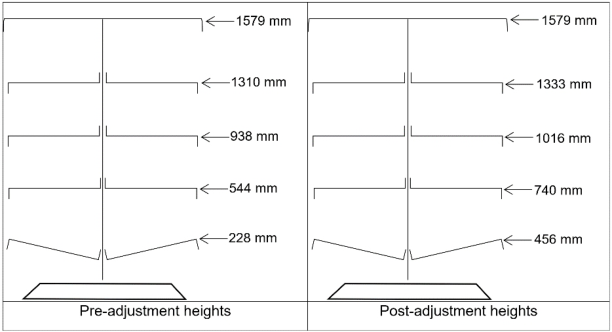
At Library S, the lowest shelf was raised from 228mm up to 456mm, with proper adjustments to the height of the other selves. Similarly, at Library C, the lowest shelf was raised from 222mm up to 382mm. The latter was lower than the change in Library S because the canopy was approximately 100mm lower. To illustrate the above, Figure 1 presents the changes at Library S. It was assumed that all librarians of Libraries C and S would have equal opportunities to get exposed to the specific engineering intervention.
Figure 1: Changes of shelf heights at library S.
The goal of the presentation distributed to Libraries N and C was to raise awareness of ideal practices to minimise potential MSD injuries when
4 Watts and Karanikas
undertaking shelving. It explained what musculoskeletal injuries are, dis- cussed how musculoskeletal injuries can relate to shelving and embedded a video demonstrating how manual handling principles apply to shelving. The content was based on the potential of sustaining an injury when undertak- ing any manual activity with high frequency, prolonged duration, awkward body position, excessive force and under psychological strains (Latifi & Kord, 2018). After peer-reviewing the content between the authors of this paper and revising the presentation, it was pre-recorded and distributed to the libraries’ staff. Although we cannot estimate the number of librarians who watched the presentation, the recording had only a 7-minute duration to account for the possibly limited available time. The introduction meeting at the beginning of the project could have motivated most of the targeted staff to access the presentation.
Surveys The purpose of the two surveys was to determine if there were any additional factors, aside from the implemented risk controls, that could explain differ- ences before and after the intervention. The pre-adjustment survey was open in weeks 1–2 of the project. It collected data about the height, weight, age, work exposure to shelving activities (i.e., daily duration of shelving tasks in hours), physical demanding tasks on a 1–5 Likert scale (i.e., ‘very little’ to ‘a great deal’), any past or current work-related MSDs (e.g., back, shoulders, neck), the frequency of feeling soreness (1-6 Likert scale from ‘almost never’ to ‘at least once daily’) and its recency (1-5 Likert scale from ‘yesterday’ to ‘more than a year ago’).
The pre-adjustment survey attracted 16 valid responses. This equated to an overall 35.6% participation rate, but with noticeable variations across libraries. There were ten answers from Library S (76.9% participation), four responses from Library C (22.2% participation) and only two respon- dents from Library N (14.2% participation). We used Kruskal-Wallis tests to explore significant differences across libraries regarding age, body mass index (BMI), hours of shelving, physical demands of shelving and frequency and recency of soreness. We also performed Spearman’s correlations between age, BMI and shelving hours and the rest task-related variables above.
The post-adjustment survey was administered in the last week of the project. It included questions about changes in the worktime for shelving duties, physical load demands and frequency of bodily soreness on a 1–5 Likert scale (i.e., ranging from lower/less to much/more) and one question about the body parts affected. Additionally, participants who declared they watched the pre-recorded presentation were asked about any attempts to change shelving task parameters, such as duration, frequency, postures, etc.
In this second survey, responses from Library S reduced to five (38.4% participation), with an increase of participants in both Library C (50% partic- ipation) and Library N (35.7% participation). We employed Kruskal Wallis tests to investigate significant variations across the three libraries and Spear- man’s correlations to investigate associations between the change parameters.
Comparing Different Ergonomic Interventions to Influence Shelving Practices in Libraries 5
The study also checked for statistically significant differences in the latter between librarians who watched or not the awareness presentation. In all statistical tests, we adopted a significance level of α=0.05.
Observations Observations were undertaken by the using Rapid Entire Body Assessment (REBA) instrument. This tool evaluates the risk of musculoskeletal injury by assessing static, dynamic, rapidly changing or unstable postures when under- taking a variety of tasks (Hignett & McAtameny, 2000). The lower the REBA score, the lower the risk of developing MSDs. The REBA observations were performed by the same researcher to minimise variances in the data collec- tion. With the permission of the respective staff member, apart from body posture data, each observation form identified the location and date, with no personal identifiable information recorded. To minimise information bias (Hignett & McAtameny, 2000), risk scores were calculated after all scheduled observations were completed.
We performed four observations at each library at three different periods of the project at random time-points within each stage. This totalled to 12 observations per library. The first observations in weeks 1–2 aimed to collect baseline data before the ergonomic interventions. Observation data was then collected in weeks 5–6, directly after implementing the controls, to identify any immediate observable benefits. The last set of observations were con- ducted in weeks 10–11 to evaluate any sustainable short-term effectiveness of the controls.
Each of the REBA scores were calculated and entered into a spreadsheet for comparisons amongst libraries and collection periods. We considered the medians, means and interquartile ranges to infer differences. The medi- ans and means were calculated for all four observations undertaken at each library and time-point. The interquartile range was calculated as the differ- ence from the upper quartile (quartile 3) to the lower quartile (quartile 1). It is considered as a better measure than the value range as it is not affected by outliers (ABS, nd).
RESULTS
In the pre-adjustment survey, the respondents were between 24 and 66 years of age (median = 43.5 years), with a median BMI of 20. The responses for physical demands of shelving, frequency of soreness and most recent feeling of soreness returned a median of 2 out of 5, corresponding to an average of 2.5 hours of shelving tasks per day. There were no statistically significant differences across any parameters among the libraries, and there were no significant associations between individual and task-related variables. Those findings suggest that the targeted sample was relatively homogeneous across all individual and work-related parameters.
The responses to the survey revealed that 43.75% of the participants had previously sustained a work-related MSD, with 28.6% of these attributing it specifically to the shelving task. Out of those surveyed, 68.75% some- times feel sore from library duties but don’t think it’s worth reporting as an
6 Watts and Karanikas
injury. Also, 62.5% of the respondents stated having felt sore during the last 12 months after undertaking library duties, with half of these results corre- sponding to the last month or more recently. The body areas mostly affected by MSDs included the shoulder, lower back and neck, with no references to wrist and hand injuries.
The post-adjustment survey data returned median values of 3 out of 5 (i.e., no change) for shelving hours, physical demands, and frequency of soreness. Out of the 19 participants, 13 had watched the awareness presentation. Of those, 69.2% attempted to reduce or manage awkward postures, with fewer repetitive movements, lower forces and less duration.
As shown in Table 1, the means and medians of REBA scores and data spread improved over the short term from the baseline results at all loca- tions. This suggests noticeable improvements in each library and in overall immediately after implementing the controls. Libraries C and N had over 50% reduction in their mean values, accompanied by a significant reduction in the quartile range that indicated more homogeneous and consistent shelv- ing practices across staff. Library S also had lower REBA scores, but these improvements were more conservative than the other two libraries.
The data collected seven weeks after implementing the interventions showed that Library S with the engineering risk control sustained its pre- vious scores and even increased the consistency of task performance across librarians as suggested by the lower interquartile range. On the other hand, Library N, where only the administrative intervention was deployed, reverted to the pre-adjustment scores. Library C with the combination of controls showed a slight increase in REBA scores compared to the first week after implementation, but this was still quite lower than the pre-adjustment scores.
Table 1. REBA score results.
Table available in the original PDF paper.
Pre-Control Implementation Median Mean Interquartile Range Library S 4 4.5 6.5 – 2.5 = 4 Library C 4 5.125 8 – 2.5 = 5.5 Library N 4 4.625 6 – 3.5 = 2.5 All libraries combined 4 4.75 6.5 – 3 = 3.5 Two (2) weeks after ergonomic control implementation Median Mean Interquartile Range Library S* 2.5 2.75 4 – 1 = 3 Library C*** 2 2.125 3 – 1 = 2 Library N** 2 2.125 3 – 1 = 2 All libraries combined 2 2.33 3 – 1 = 2 Seven (7) weeks after ergonomic control implementation Median Mean Interquartile Range Library S 2.5 2.75 4 – 1.5 = 2.5 Library C 2.5 2.625 4 – 1 = 3 Library N 4 4 5.5 – 2 = 3.5 All libraries combined 3 3.125 4.5 – 1.5 = 3
* Engineering intervention – change heights of shelves, ** Administrative intervention – awareness presentation, *** Combination of the ergonomic interventions above
DISCUSSION
Although 57.1% of all MSDs relate to lower back and neck (IHME, 2019), and lower back pain is the leading cause of disability worldwide and the
Comparing Different Ergonomic Interventions to Influence Shelving Practices in Libraries 7
most common MSD affecting 30–40% of adults (El-Tallaway et al., 2021; WHO, 2023), shoulder pain was the most common MSD result from pre- adjustment survey respondents. Nonetheless, lower back, neck and shoulder pain are jointly considered a major problem that limits work productivity and inflicts economic consequences for individuals, their family and com- munities (Micheletti et al., 2019). There is a causal relationship between neck and shoulder injuries with highly repetitive work, forceful exertions and extreme postures, to which library staff are potentially exposed during shelving tasks (Larsson et al., 2007). As such, the results of our study largely confirm previous research findings.
Notably, the aetiology of MSDs is multi-factorial, with several individ- ual, work-related, and environmental parameters contributing to pain. This means it is challenging to identify underlying drivers of pain consistently across individuals and occupational groups (Huang et al., 2023). Individ- uals with a high BMI are more likely to report lower back pain, with high BMI being linked to health and economic impacts (Chen et al., 2023; Heuch et al., 2010). In our sample, there was no correlation of individual demo- graphics and work design aspects with the frequency and recency of bodily soreness across librarians. This picture seemed consistent during the project as confirmed by the results of the post-adjustment survey. The slight and non- statistically significant differences between the two surveys suggest that the group of librarians remained consistent and stable throughout the 11-week project.
The pre-adjustment observations showed REBA results of medium risk on average, with no individual high-risk scores. This suggested ‘average’ initial conditions, meaning that there was an equal opportunity to record much lower or much higher scores post-implementation. The comparisons of the REBA scores at the end of the project suggest that the libraries with the engineering solution sustained the improvements they acquired immedi- ately after implementing the interventions. This confirms literature arguing that focusing on the physical aspects of the work by creating more efficient ergonomic designs, lowers the required human effort by reducing awkward body postures and the range of motions necessary (Alves et al., 2019; Pereira et al., 2023). Altering the work environment to influence human behaviours (Nilsen et al., 2012) yielded better and more consistent results than relying on sharing and recalling good practices though the awareness presentation.
Admittedly, this research included no participatory process for the iden- tification and implementation of the ergonomic controls. As such, without the participants having fully understood the need for initiating change, there was limited potential to affect behaviours and promote continuous improve- ment and learning (Lantz et al., 2015; Huang et al., 2011). Also, our reliance on individual perceptions on the importance of the awareness presentation’s content was not further supported or reinforced to ensure maintenance of its effects. As Raisbeck and Yamada (2019) showed, when persons focus more on the end results rather than tasks and processes, learned behaviours prevail over any techniques recently taught.
Hassan Sadeghi and Maryam (2019) state that without the balance between individual capabilities, available tools, work environment and
8 Watts and Karanikas
organisational requirements, there can be no sustainable ergonomic devel- opment. However, while our target population was relatively homogeneous, the library with the combined interventions showed less sustainable REBA scores than the library with only the engineering risk control. This could be attributed to the lower shelving height than the library exposed solely to the engineering control, as explained in the methods section above.
Study Limitations This study was subject to several limitations. First, despite the significant differences in the REBA scores between the three time-points, the 11-week timeframe of the project was relatively short to evaluate with high confi- dence the ongoing effectiveness of the implemented controls. Second, the study introduced the awareness presentation only once. This did not promote habitual changes through the multiple intervention opportunities necessary to influence human behaviours (Yamada & Toda, 2023) or randomly scheduled reinforcements of the presentation content (Lerner, 2020).
Third, the awareness presentation, although specific to shelving, did not cater to individual variances such as anthropometric characteristics, previous conditions, etc. Also, although psychosocial work stress is associated with musculoskeletal pain (Carroll et al., 2004), respective stressors were assumed constant during the project and were not assessed. Fourth, as shelving duties are only a portion of a librarian’s duties and our project studied only one book section, additional confounding factors might have also affected the results (e.g., change of task load demands or allocation across library sections). Last, the limited number of observations, despite offering persuasive evidence, does not allow to generalise the results.
CONCLUSION
In this short prospective cohort study, the comparison of three ergonomic adjustments, targeting to lower MSD risks, identified that each of the imple- mented solutions had an immediately positive result in reducing risk scores when undertaking shelving. The two libraries exposed to the engineering con- trol of raised shelf heights had a more sustainable improvement than the library exposed solely to the administrative control of an MSD awareness presentation. The findings of our research confirm previous literature sug- gesting that integrating engineering interventions in the work environment offers more sustainable benefits than controls of an administrative nature (e.g., training, procedures).
However, the results of our research do not intend to discount the value of training and education. All staff must be aware of manual handling prin- ciples specific to their tasks, supported by follow-up sessions in random or scheduled intervals and individual coaching as required. Also, regarding librarians specifically, further studies into psychosocial stressors are needed to acquire a more holistic picture of work conditions and the associated risks. Moreover, as shelving is only one task out of the many undertaken within libraries, future research should focus on the entire role, duties and workplace exposures of librarians more inclusively.
Comparing Different Ergonomic Interventions to Influence Shelving Practices in Libraries 9
ACKNOWLEDGMENT
The authors would like to acknowledge the Executive Management of the City of Gold Coast City Libraries for the permission and opportunity to undertake this project within their facilities. Thanks, is also given to Broad- beach Library, Burleigh Waters Library and Helensvale Library for their participation in shelving activity observations and the surveys.
REFERENCES
Atkins, S. A. 2005. The Pain in Storage: Work Safety in a High-Density Shelving Facility. Portal (Baltimore, Md.), 5, 483–496. ABS (nd.). Statistical terms and concepts. Measures of central tendency. Measures of
central tendency | Australian Bureau of Statistics (abs.gov.au). Australian Government, (September, 2021). Labour Market Insights, Librarians.
Librarians | Labour Market Insights. AIHW (December 2022). Australian Burden of Disease Study 2022. Leading causes of disease burden. Australian Burden of Disease Study 2022, Leading causes of disease burden - Australian Institute of Health and Welfare (aihw.gov.au). Balogh, I., Ardvidsson, I., Björk, J., Hansson, G.-Å., Ohlsson, K., Skerfving, S.
& Nordander, C. 2019. Work-related neck and upper limb disorders - Quanti- tative exposure-response relationships adjusted for personal characteristics and psychosocial conditions. BMC musculoskeletal disorders, 20, 139–139. Bridger, R. S. 2018. Introduction to human factors and ergonomics, Boca Raton, FL, CRC Press, Taylor & Francis Group. Carroll, L. J., Cassidy, J. D. & Côté, P. 2004. Depression as a risk factor for onset
of an episode of troublesome neck and low back pain. Pain (Amsterdam), 107, 134–139. Carvalho Alves, A., Ferreira, A. C., Costa Maia, L., P. Costa Maia, C. & Carneiro, P.
2019. A symbiotic relationship between Lean Production and Ergonomics: insights from Industrial Engineering final year projects. IJIEM. International Journal of Industrial Engineering and Management (Online), 10, 243–256. Chen, N., Fong, D. Y. T. & Wong, J. Y. H. 2023. Health and Economic Outcomes Associated with Musculoskeletal Disorders Attributable to High Body Mass Index in 192 Countries and Territories in 2019. JAMA network open, 6, E2250674- e2250674. Dewan, R., Jose, J., Kumar, A. & Nayyar, A. A review on behavioral based safety
implementation and safety performance in firework manufacturing industries. 2023 Melville. American Institute of Physics. El-Tallawy, S. N., Nalamasu, R., Salem, G. I., Lequang, J. A. K., Pergolizzi, J. V.
& Christo, P. J. 2021. Management of Musculoskeletal Pain: An Update with Emphasis on Chronic Musculoskeletal Pain. Pain and Therapy, 10, 181–209. Fourney, D. R., Andersson, G., Arnold, P. M., Dettori, J., Cahana, A., Fehlings, M. G., Norvell, D., Samartzis, D. & Chapman, J. R. 2011. Chronic low back pain: A heterogeneous condition with challenges for an evidence-based approach. Spine (Philadelphia, Pa. 1976), 36, S1–S9. Gardner, B., Lally, P. & Wardle, J. 2012. Making health habitual: the psychology
of ‘habit-formation’ and general practice. British Journal of General Practice, 62, 664–666. Hassan Sadeghi, N. & Maryam, A. 2019. Occupational Health promotion throughout the synergy between ergonomics and sustainable development aspects. Bihd¯asht va ¯ıman¯ı-i k¯ar, 9, 113–120.
10 Watts and Karanikas
Heuch, I., Hagen, K., Heuch, I., Nygaard, Ø. & Zwart, J. A. 2010. The impact of body mass index on the prevalence of low back pain: The HUNT study. Spine (Philadelphia, Pa. 1976), 35, 764–768. Hignett, S. & McAtamney, L. 2000. Rapid Entire Body Assessment (REBA). Applied
ergonomics, 31, 201–205. Huang, X., Rode, J. C. & Schroeder, R. G. 2011. Organizational structure and continuous improvement and learning: Moderating effects of cultural endorse- ment of participative leadership. Journal of International Business Studies, 42, 1103–1120. Huang, Z., Guo, W. & Martin, J. T. 2023. Socioeconomic status, mental health, and
nutrition are the principal traits for low back pain phenotyping: Data from the osteoarthritis initiative. JOR SPINE, 6. IHME (2019). GBD Results. Institute for Health Metrics and Evaluation. VizHub - GBD Results (healthdata.org). Kirsch Micheletti, J., Bláfoss, R., Sundstrup, E., Bay, H., Pastre, C. M. &
Andersen, L. L. 2019. Association between lifestyle and musculoskeletal pain: Cross-sectional study among 10, 000 adults from the general working population. BMC musculoskeletal disorders, 20, 609–609. Lantz, A., Hansen, N. & Antoni, C. 2015. Participative work design in lean production. Journal of Workplace Learning, 27, 19–33. Larsson, B. M. D. P., Søgaard, K. M. P. & Rosendal, L. M. P. 2007. Work related neck–
shoulder pain: a review on magnitude, risk factors, biochemical characteristics, clinical picture and preventive interventions. Best practice & research. Clinical rheumatology, 21, 447–463. Latifi, M. & Kord, S. 2018. The effect of trunk flexion angle and anthropometric dimensions on the accuracy of the allowable weight limits in pilot study. Iran Occupational Health, 14, 78–87. Lerner, T. N. 2020. Interfacing behavioral and neural circuit models for habit
formation. Journal of neuroscience research, 98, 1031–1045. Mok, N. W., Brauer, S. G. & Hodges, P. W. 2007. Failure to use movement in postural strategies leads to increased spinal displacement in low back pain. Spine (Philadelphia, Pa. 1976), 32, E537–E543. Motaqi, M. & Ghanjal, A. 2019. Musculoskeletal Disorders (Definition, Causes,
Risk Factors, and Prevention): Part I. International journal of musculoskeletal pain prevention, 4, 127–131. Nilsen, P., Roback, K., Broström, A. & Ellström, P.-E. 2012. Creatures of habit: accounting for the role of habit in implementation research on clinical behaviour change. Implementation science: IS, 7, 53–53. Pereira, A. C., Alves, A. C. & Arezes, P. 2023. Augmented Reality in a Lean
Workplace at Smart Factories: A Case Study. Applied sciences, 13, 9120. Raisbeck, L. D. & Yamada, M. 2019. The effects of instructional cues on performance and mechanics during a gross motor movement. Human movement science, 66, 149–156. Ruschena, L. (2019). Prevention and Intervention. In The Core Body of Knowledge
for Generalist OHS Professionals. Tullamarine, VIC: Australian Institute of Health and Safety. Smith, C. K., Silverstein, B. A., Fan, Z. J., Bao, S. & Johnson, P. W. 2009. Psychosocial factors and shoulder symptom development among workers. American Journal of Industrial Medicine, 52, 57–68. SAA (1994). Handbook. Ergonomics The human factor. A practical approach to
work systems design. SAA HB59-1994. Standards Association of Australia.
Comparing Different Ergonomic Interventions to Influence Shelving Practices in Libraries 11
Thomas, J. R. & Holley, R. P. 2012. Management versus repetitive tasks - avoiding “working for the weekend”: A crash course in motivating library staff faced with seemingly endless tasks. New library world, 113, 462–473. Trembearth, D. & Crawford, J. (2021). The OHS Body of Knowledge, Work-
related Musculoskeletal Disorders. Chapter 16: Work-related Musculoskeletal Disorders – The OHS Body of Knowledge (ohsbok.org.au). Village, J., Trask, C., Luong, N., Chow, Y., Johnson, P., Koehoorn, M. & Teschke, K.
2009. Development and evaluation of an observational Back-Exposure Sampling Tool (Back-EST) for work-related back injury risk factors. Applied ergonomics, 40, 538–544. WHO (July 2022). Musculoskeletal Health. World Health Organization. Musculoskeletal health (who.int). WHO (June 2023). Fact Sheet. Lower Back Pain. World Health Organization. Low
back pain (who.int). Yamada, K. & Toda, K. 2023. Habit formation viewed as structural change in the behavioral network. Communications biology, 6, 303.
LISTED IN THE AHFE DIGITAL BOOKSTORE CATALOGUE
Explore the complete digital volume
Physical Ergonomics and Human Factors
Read this individual research paper free through the original publisher, or explore the full digital proceedings book.
ISBN 978-1-964867-23-6
Explore this ISBN in the AHFE Bookstore ↗Listed in the July 2026 bookstore catalogue; search by ISBN to confirm current availability · Digital book purchase optional