Sheikh Fuzael Rahman, Md Shahnur Alam, Safaul Islam Rohan, Yueqing Li (2025). Influence of Computer Keyboard Slope and Wrist Support Height on Users’ Discomfort. In: Physical Ergonomics and Human Factors. AHFE Open Access, vol. 185, pp. 122–130. https://doi.org/10.54941/ahfe1006472
Modern workplaces rely highly on computers, making ergonomic setups essential to prevent musculoskeletal disorders like carpal tunnel syndrome. This study examined the effects of keyboard slope (0° vs. -13°) and wrist support height (9.8 cm vs. 15 cm) on wrist comfort during typing. Ten university participants took part in the experiment.The study found that a flat keyboard slope of 0° with a wrist support height of 9.8 cm provides the most comfort for wrists and forearms. However, increasing the wrist support height to 15 cm significantly increases discomfort, particularly in the neck and shoulder. The negative slope of the keyboard reduces the extension of the wrist and increases pressure on the carpal tunnel, which is beneficial.These results indicated the necessity of individually adapted ergonomic settings regarding keyboard slope and wrist support height for optimal comfort while minimizing health risks. Such adjustments may help the user to reduce discomfort and minimize the possibility of MSDs. Further research might be directed toward investigating other slope and height combinations with effects calculated both based on surveys and EMG data, which would help create better ergonomic solutions for a variety of typing styles and working environments.
The benefit of work-from-home has made computers an essential tool, but bad typing posture and misaligned forearms and wrists can induce musculoskeletal disorders (MSDs) such as carpal tunnel syndrome and tendonitis. In the USA, MSDs are a prominent cause of adult disability. Nearly 83 million adults aged 15–64 years had MSDs in 2019 and comprised two- thirds of all the prevalent cases in those aged 10–74 years. It was highest in adults aged 60–64 with over 13.4 million cases (Nguyena et al., 2024). Long- term computer keyboard use with inadequate ergonomics has been linked with MSDs affecting the wrist and forearm. Research noted that changing keyboard slope has a large effect on wrist extension angles and forearm muscle activity. This study explores the impact of different keyboard slopes
Influence of Computer Keyboard Slope and Wrist Support Height on Users’ Discomfort 123
and wrist support heights on wrist comfort to provide more clear evidence of effective ergonomic solutions.
LITERATURE REVIEW
Previous research has extensively examined the effect of computer keyboard design on wrist posture and musculoskeletal stress. Hedge & Powers (Wrist postures while keyboarding: Effects of a negative slope keyboard system and full motion forearm supports, 1995) reported that most users prefer near-flat keyboards to reduce strain. Miller and Suther III (1983) found that user preferred keyboard slope angles ranged from 14
to 25
(average of 18
), contrary to ergonomic recommendations, while Hedge et al. (1995) showed that the downward-sloped keyboards reduced wrist extension but did not report on the ideal angle. Hedge and Shaw (Effects of a Chair-Mounted Split Keyboard on Performance, Posture and Comfort, 1996) demonstrated that a split keyboard attached to a chair reduced ulnar deviation and improved posture but was linked with higher muscular work.
Albin (Albin, 1997) reported the benefits of adjustable keyboard platforms to accommodate user preferences, and Park et al. (2000) created a VDT workstation chair with integral keyboard-mouse support to enhance comfort and reduce strain. Marklin and Simoneau (2001) found that split keyboards reduced wrist ulnar deviation to facilitate a more neutral position for the wrist. However, Simoneau et al. (2003) found that negatively sloped keyboards reduced wrist extension but augmented ulnar deviation, which may eliminate ergonomic benefits.
The concept of the split keyboard was initially introduced in 1926 and gained traction with Kroemer’s research in 1972 (Kroemer, 1972), which eventually led to adoption by leading manufacturers like Apple and Microsoft (Rempel, 2008). McLoone et al. (2009) suggested a curved ergonomic keyboard with an opening angle of 12
and a “stepped” key layout, reducing ulnar deviation while maintaining typing efficiency. Despite advancements, there are few studies examining the interaction between keyboard slope and wrist support height, and additional studies are required to optimize ergonomic configurations.
While some studies have explored the impact of keyboard slope angles and a few keyboards have been designed for better comfort, no research has specifically examined how wrist support height, combined with keyboard slope, affects the wrist during typing.
This study investigates the factors contributing to discomfort in the carpal region after prolonged keyboard use. Specifically, it examines how keyboard slope angle and wrist support height influence user comfort and musculoskeletal strain. The research aims to identify the most ergonomic slope angle and support height combination that minimizes wrist discomfort and enhances typing posture, providing insights for optimal keyboard station design.
METHODOLOGY
Participants Ten healthy individuals (five male, and five female) participated in this study. Participants had no physical disability in experimenting while sitting in a chair. Participants engaged in a preliminary trial session to familiarize themselves with the typing tasks before the commencement of data collection.
Table 1: Participant information.
Table available in the original PDF paper.
Group Age (Years) Height (cm) Weight (lbs) Avg. Typing Speed (WPM)
Equation reproduced from the original PDF.
Equipment A standard QWERTY keyboard was placed at two different slope angles (0
and –13
) and combined with wrist support heights of 9.8 cm and 15 cm above the table surface. Participants performed typing tasks in each configuration.
Discomfort levels were assessed using a subjective rating scale from 1 (no discomfort) to 10 (severe discomfort). Data was collected under four test conditions:
0
keyboard slope with 9.8 cm wrist support.
0
keyboard slope with 15 cm wrist support.
–13
keyboard slope with 9.8 cm wrist support.
–13
keyboard slope with 15 cm wrist support.
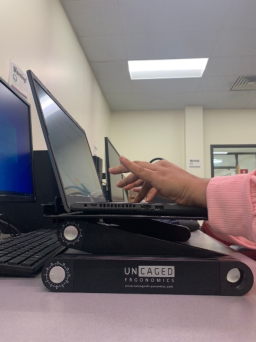
Figure 1: Typing at a 0-degree keyboard slope angle with 9.8 cm wrist support height.
Influence of Computer Keyboard Slope and Wrist Support Height on Users’ Discomfort 125
Figure 2: Typing at a 0-degree keyboard slope angle with 15 cm wrist support height.
Independent Variables This study employed a 2 × 2 factorial design. There were two independent variables, the angle of the keyboard (0 degrees, –13 degrees), and the height of the wrist support (9.8 cm, 15 cm).
Dependent Variables After the experiment, participants were asked about discomfort levels in various body parts (shoulder, upper arm, lower back, forearm, wrist, etc.) using a scale from 0 to 10, stating 0 to be the least discomfort level and gradually increasing to a maximum discomfort level of 10. The gathered discomfort data was analyzed for further insights and processing.
Experimental Task and Procedure Each participant completed four typing tasks, comprising a combination of two keyboard slope angles (0 degrees and –13 degrees), two different wrist support heights (9.8 cm and 15 cm). The typing tasks were performed on a laptop keyboard in a realistic classroom setting (Figures 1 & 2).
Participants performed each typing task in a randomized order during the experiment. To minimize carryover effects, a 5-minute rest break was provided between consecutive tasks. Participants were instructed to type for 10 minutes while following a script at their preferred speeds for a given condition.
RESULTS
A detailed study looked at how the keyboard slope angle and wrist support height affect user discomfort while typing. To analyze the results, an ANOVA test was used with a 0.05 error level. Below are the discomfort levels reported for different body parts.
Wrist The results showed a significant main effect of angle on the discomfort of the wrist (F1,9 = 40.09, p = 0.0001). The post hoc Tukey test indicated that the mean of wrist discomfort with an angle of –13 degrees (M = 6.30, SD = 2.34) was significantly higher than that with an angle of 0 degrees (M = 2.10, SD = 0.79).
The results also showed a significant main effect of height on wrist discomfort (F1,9 = 22.50, p = 0.0011). The post hoc Tukey test indicated that the mean of wrist discomfort with a height of 15 cm (M = 4.70, SD = 2.89) was significantly higher than that with a height of 9.8 cm (M = 3.70, SD = 2.56).
The results didn’t reveal a significant interaction effect between angle and height on the wrist discomfort (F1,9 = 0.78, p = 0.3994).
Forearm The results showed a significant main effect of height on forearm discomfort (F1,9 = 43.35, p = 0.0001). The post hoc Tukey test indicated that the mean of forearm discomfort with a height of 15 cm (M = 7.35, SD = 2.32) was significantly higher than that with a height of 9.8 cm (M = 5.30, SD = 1.72).
The results didn’t reveal a significant main effect of angle on the forearm discomfort (F1,9 = 4.46, p = 0.0639).
The results didn’t reveal a significant interaction effect between angle and height on the forearm discomfort (F1,9 = 1.36, p = 0.2729).
Upper Arm The results showed a significant main effect of height on upper arm discomfort (F1,9 = 39.74, p = 0.0001). The post hoc Tukey test indicated that the mean of upper arm discomfort with a height of 15 cm (M = 6.55, SD = 2.24) was significantly higher than that with a height of 9.8 cm (M = 4.00, SD = 1.62).
The results didn’t reveal a significant main effect of angle on the upper arm discomfort (F1,9 = 0.37, p = 0.5599).
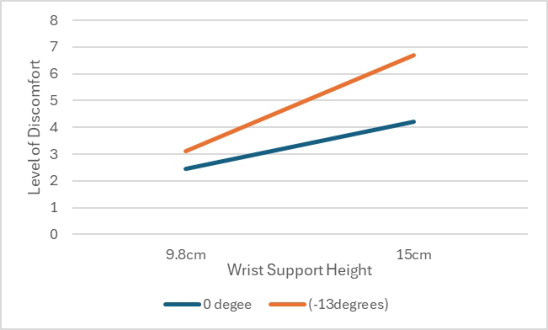
The results further revealed a significant interaction effect between angle and height on the upper arm discomfort (F1,9 = 12.08, p = 0.0070). As height increases from 9.8 cm to 15 cm, upper arm discomfort has a bigger increase with an angle of –13 degrees than an angle of 0 degrees (Figure 3).
Shoulder The results showed a significant main effect of angle on the discomfort of the shoulder (F1,9 = 6.64, p = 0.0299). The post hoc Tukey test indicated that the mean of shoulder discomfort with an angle of –13 degrees (M = 4.85, SD = 2.46) was significantly higher than that with an angle of 0 degrees (M = 4.10, SD = 1.59).
The results also showed a significant main effect of height on shoulder discomfort (F1,9 = 37.73, p = 0.0002). The post hoc Tukey test indicated that the mean of shoulder discomfort with a height of 15 cm (M = 5.55,
Influence of Computer Keyboard Slope and Wrist Support Height on Users’ Discomfort 127
Equation reproduced from the original PDF.
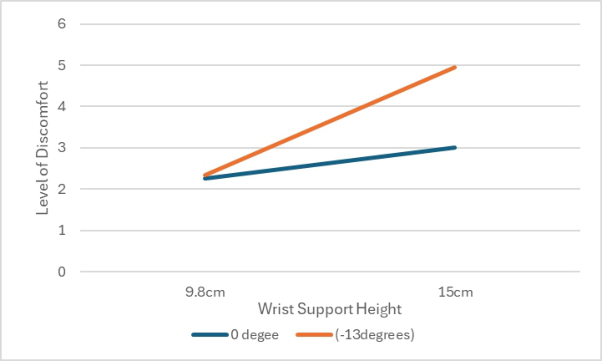
The results further revealed a significant interaction effect between angle and height on the shoulder discomfort (F1,9 = 7.92, p = 0.0202). As height increases from 9.8 cm to 15 cm, shoulder discomfort has a bigger increase with an angle of –13 degrees than an angle of 0 degrees (Figure 4).
Figure 3: Upper Arm discomfort in terms of angle and height interaction.Figure 4: Shoulder discomfort in terms of angle and height interaction.
Neck The results showed a significant main effect of angle on the discomfort of the neck (F1,9 = 14.72, p = 0.0040). The post hoc Tukey test indicated that the mean of neck discomfort with an angle of –13 degrees (M = 1.25, SD = 0.97)
Equation reproduced from the original PDF.
The results didn’t reveal a significant main effect of height on the neck discomfort (F1,9 = 3.69, p = 0.0868).
The results didn’t reveal a significant interaction effect between angle and height on the neck discomfort (F1,9 = 1.45, p = 0.2598).
Upper Back The results showed a significant main effect of height on upper back discomfort (F1,9 = 9.88, p = 0.0119). The post hoc Tukey test indicated that the mean of upper back discomfort with a height of 15 cm (M = 1.60, SD = 2.06) was significantly higher than that with a height of 9.8 cm (M = 0.10, SD = 0.31).
The results didn’t reveal a significant main effect of angle on the upper back discomfort (F1,9 = 2.58, p = 0.1428).
The results didn’t reveal a significant interaction effect between angle and height on the upper back discomfort (F1,9 = 2.58, p = 0.1428).
Lower Back The results showed a significant main effect of height on lower back discomfort (F1,9 = 36.00, p = 0.0002). The post hoc Tukey test indicated that the mean of lower back discomfort with a height of 15 cm (M = 1.25, SD = 1.21) was significantly higher than that with a height of 9.8 cm (M = 0.05, SD = 0.22).
The results didn’t reveal a significant main effect of angle on the lower back discomfort (F1,9 = 3.86, p = 0.0811).
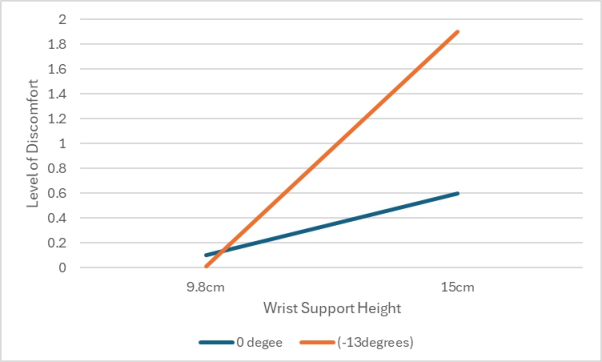
The results further revealed a significant interaction effect between angle and height on the lower back discomfort (F1,9 = 8.65, p = 0.0165). As height increases from 9.8 cm to 15 cm, lower back discomfort has a bigger increase with an angle of –13 degrees than an angle of 0 degrees (Figure 5).
Figure 5: Lower Back discomfort in terms of angle and height interaction.
Influence of Computer Keyboard Slope and Wrist Support Height on Users’ Discomfort 129
DISCUSSION
This research provides important information regarding the effect of keyboard slope angle and wrist support height on user discomfort. The findings reveal that a less inclined keyboard slope (0
) and lower wrist support height (9.8 cm) tend to result in lower levels of discomfort in various body regions, specifically the wrist and forearm.
A slope of –13
raised discomfort in the wrist and neck significantly, most likely due to greater wrist extension and misaligned posture. A higher level of wrist support (15 cm) also created more wrist, forearm, upper arm, and shoulder discomfort, suggesting excessive elevation stretches these areas.
Interaction effects were also observed for the upper arm, shoulder, and lower back, where discomfort was increased when higher wrist support (15 cm) and a bigger angle (–13 degrees) were used together. For the forearm and upper back, no interaction was observed, indicating that height has a greater impact on these regions compared to the angle.
These findings highlight the importance of ergonomic design principles for keyboards to minimize musculoskeletal strain. The most supportive placement for prolonged computer usage appears to be a neutral wrist alignment with decreased wrist support height. Long-term consequences and possible interventions must be addressed in subsequent studies to further refine keyboard ergonomics.
CONCLUSION
This research demonstrates that a flat laptop keyboard tilt (0 degrees) with a lower wrist rest height (9.8 cm) minimizes user discomfort during typing over configurations where a negative tilt (–13 degrees) or higher wrist rest (15 cm) is used. Though the negative slope is theoretically beneficial to reducing wrist extension, our findings reveal that it leads to increased overall discomfort, particularly in the upper back and shoulder region with the increase in wrist support height. The results encourage ergonomic workstation designs with a neutral keyboard slope and lower wrist support to reduce musculoskeletal disorder risk. Further studies with objective biomechanical measures are recommended to further validate these findings and optimize ergonomic interventions in a range of occupational environments.
As a limitation, only two levels of keyboard slopes (0
and –13
) and wrist support height (0 cm and 9.8 cm) were evaluated in the study. Future studies should examine more levels to determine the optimal ergonomic settings.
ACKNOWLEDGMENT
This study was inspired by the course “Occupational Ergonomics”, and we thank Dr. Yueqing Li for his valuable guidance throughout the entire duration of the project.
REFERENCES
Albin, T. (1997). Effect of wrist rest use and keyboard tilt on wrist angle while keying.
International Ergonomics Association, 16–18.
Hedge, A., & Powers, J. (1995). Wrist postures while keyboarding: Effects of a negative slope keyboard system and full motion forearm supports. Ergonomics, 38(3), 508–517. doi: https://doi.org/10.1080/00140139508925122. Hedge, A., & Shaw, G. (1996). Effects of a Chair-Mounted Split Keyboard on
Performance, Posture and Comfort. Human Factors and Ergonomics Society 40th Annual Meeting, 40, pp. 624–628. Philadelphia, PA. doi: https://doi.org/10.1177/ 154193129604001309. Hedge, A., McCrobie, D., Land, B., Morimoto, S., & Rodriguez, s. (1995). Healthy Keyboarding: Effects of Wrist Rests, Keyboard Trays, and a Preset Tiltdown System on Wrist Posture, Seated Posture, and Musculoskeletal Discomfort. Human Factors and Ergonomics Society, 39, pp. 630–634. doi: https://doi.org/ 10.1177/154193129503901019. Kroemer, K. (1972, February). Human Engineering the Keyboard. Human Factors,
14(1), 51–63. doi: https://doi.org/10.1177/001872087201400110. Marklin, R., & Simoneau, G. (2001, April 1). Effect of Setup Configurations of Split Computer Keyboards on Wrist Angle. Physical Therapy, 81(4), 1038–1048. doi: https://doi.org/10.1093/ptj/81.4.1038. McLoone, H., Jacobson, M., Clark, P., Opina, R., Hegg, C., & Johnson, P.
(2009, November 24). Design and evaluation of a curved computer keyboard. Ergonomics, 52(12), 1529–1539. doi: https://doi.org/10.1080/ 00140130903215321 Miller, W., & Suther III, T. (1983, August). Display Station Anthropometrics: Preferred Height and Angle Settings of CRT and Keyboard. Human Factors, 25(4), 401–408. doi: https://doi.org/10.1177/001872088302500405. Nguyena, A., Arisc, I., Snydera, B., Harrisa, M., Kanga, J., Murraya, M.,...
Nazarian, A. (2024, January 08). Musculoskeletal health: an ecological study assessing disease burden and research funding. The Lancet Regional Health, 29, 2024. doi: https://doi.org/10.1016/j.lana.2023.100661. Park, M., Kim, J., & Shin, J. (2000, May 03). Ergonomic design and evaluation of a new VDT workstation chair with keyboard–mouse support. International Journal of Industrial Ergonomics, 26(5), 537–548. doi: https://doi.org/10.1016/ S0169-8141(00)00027-5. Rempel, D. (2008). The Split Keyboard: An Ergonomics Success Story. Human
Factors, 50(3), 385–392. doi: https://doi.org/10.1518/001872008X312215. Simoneau, G., Marklin, R., & Berman, J. (2003, September 1). Effect of Computer Keyboard Slope on Wrist Position and Forearm Electromyography of Typists Without Musculoskeletal Disorders. Physical Therapy, 83(9), 816–830. doi: https://doi.org/10.1093/ptj/83.9.816.
LISTED IN THE AHFE DIGITAL BOOKSTORE CATALOGUE
Explore the complete digital volume
Physical Ergonomics and Human Factors
Read this individual research paper free through the original publisher, or explore the full digital proceedings book.
ISBN 978-1-964867-61-8
Explore this ISBN in the AHFE Bookstore ↗Listed in the July 2026 bookstore catalogue; search by ISBN to confirm current availability · Digital book purchase optional