Lilia R. Prado León, John A. Rey Galindo (2022). Ergonomics and Design for Musicians. In: Advances in Ergonomics In Design, Usability & Special Populations: Part III. AHFE Open Access, vol. 20. https://doi.org/10.54941/ahfe1001320
This research aimed to identify the potential problems or symptoms related to musculoskeletal disorders in a music students’ population, as well as the risk factors, musicians’ perceptions about the risks in their activities, ailments suffered, music practice habits, and the instruments and objects with which they interact. We carried out a comparative cross-sectional study. We used a questionnaire with 31 multiple choice and open questions. According to the results, the percentage of injuries in this research is 14%; which is less than what Shields and Dockrell (2000) found in similar population. The back and the neck are the areas, most affected by musculoskeletal medical conditions - 60 % of music students report problems in these areas, while 36% of the population is affected in their wrists and shoulders. Surprisingly, 59.1 % answered that their activities are as risky as other professions. 64% of subjects don’t perceive a need for auxiliary objects. , Based on this finding, we identify four routes for design and ergonomics for musicians.
Ergonomics is broadly conceived as the study of the relationship between humans and an object or product in a specific environment. Design, on the other hand, can be understood as the adaptation of products to the physical and psychological needs of users (Löbach, 1981). Therefore, any human activity that is carried out with an object is a potential scene for the study of ergonomics and design. These areas cannot be held separately, on the contrary, they should be understood as complementary fields of study that seek to improve the individuals’ wellbeing . Based on this, the context of music seems to be a good object of study for ergonomics and design.
Our interest in the field of music isn’t just limited to its plausibility as an object of study, however. The physical and mental aspects of musical performance practice create high demand for this kind of research. Musicians are very likely to develop health problems, particularly ones, connected with musculoskeletal disorders (MSDs). Nowadays, there is data that show that musicians are a vulnerable population. Zaza (1998) for example, reported prevalence in adult musicians of between 39 % and 87 %. Brandfonbrener (1997) reports that 76 % of a sample of 4000 American orchestra members had MSDs. According to Shields and Dockrell (2000) 25% of music students suffered pain during one academic year.
This information isn’t surprising. If we analyze the musicians’ activities, we can identify many of the known risk factors for the development of Musculoskeletal Disorders (MDs):
1. Stress positions. Awkward postures are common in musical performance, such as wrist flexion- extension in the case of guitar or violin interpretations. 2. Overexertion. Pianists need to make pressure to press the piano keys to emphasize certain beats. 3. Overuse. Repetition and long duration is an inherent characteristic of the successful musical performance. The apprentice requires many hours of rehearsing with repetitive movements. For example, a pianist can make 760 finger movements per minute (Fourie, 2010), compared with a keyboarder who realizes 300 finger movements per minute. 4. Static load on the muscles. For example the seating position during rehearsals and concerts, and unequally or asymmetrically maintained loads in a fiddler’s neck. 5. Contact stress. The pulsation of the strings against a guitar-player’s fingers is a good example of this factor.
Another important aspect of research in the field of music has to do with understanding whether the type of instrument plays a significant role in the development of a disease or discomfort. In this sense, some studies argue that certain musicians, like pianists, whose performance involves frequent movements of the wrist, fingers and feet, tend to be prone to dystonia (Shields & Dockrell, 2000; Shafer -Crane, 2006). The playing of string instruments, such as guitar and harp, is also reported as high-risk (Cayea, 1998). For example, the position of bending the thumb to play string instruments is associated with development of Quervain’s Disease (Shafer-Crane, 2006). These same authors mention that the facial dystonia is common among trumpeters; Carpal Tunnel is common in performers of string instruments; and the thoracic outlet syndrome and neck pain is associated with the specific neck posture of violinists.
From all this we can draw the idea that the field of music presents ergonomic risks to the health of the performers. Along with ergonomics, design also plays an essential role in evaluating some auxiliary objects, such as furniture, music stands and even the instruments themselves; all these can have a direct impact on performers’ health. On the other side, design helps us develop proposals about how to improve negative circumstances that have been detected. Therefore, ergonomically designed objects could help minimize the prevalence of MSDs in musicians. In the Mexican context, these objects are not often used and the musicians are not aware of the risk their activities pose to their health. However, the findings in the present study highlight how important it is to look for improvements in the design of these settings. .
With the purpose to identify more clearly the situation in the Mexican context, and in the context of music students in Guadalajara, Jalisco, in particular, the present research is focused on the development of a situational diagnosis, from the identification of the prevalence of musculoskeletal symptom disorders, risk perception by musicians, types of auxiliary objects used and the requirements related to them. After that, several design proposals will be suggested.
METHODS
Subjects The study was conducted with 312 subjects between the ages of 15 and 59. Their average age is 22.6. 74 women (23.5 %) and 238 men (76.5 %) participated, all of them students of the School of Music at the University of Guadalajara at basic, intermediate and advanced levels.
Materials and Procedure The tool used was a questionnaire, which focused on the habits of practice, injury symptoms, use of ergonomic furniture and/or accessories, knowledge about musculoskeletal disorders risk factors, and awareness of any preventive education. The auto-administered questionnaire had 31 multiple choice and open questions. The content was established based on the proposed by Williamon and Thompson (2006) and Roset- Llobet, Rosinés-Cubells, and Saló-Orfila, (2000). regarding the analysis of risk perception, from Furuya, et al. (2006) respect to length of practice and from Knapik, et al. (2007) and Leaver, Harris and Palmer (2011) on the issue of anatomical sites affected and the played instrument.
Statistical Analysis The statistical data analysis was done using SPSS. At first, we analyzed frequencies related to age, played instruments, pain reports, preventive habits as warm-ups and stretching, objects or devices used, and perception of the main risk factors. On the other hand, the relation between the reported medical conditions and the kind of instrument played were analyzed using the Chi square test.
RESULTS
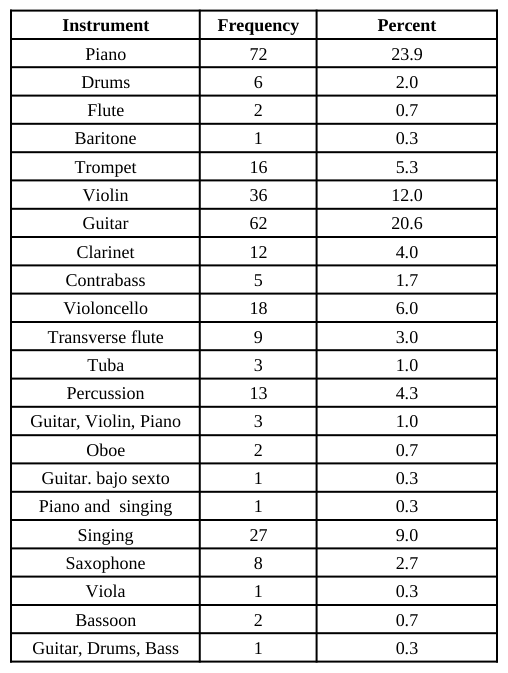
Instruments 21 musical instruments were reported (see Table 1), among which the most frequently played instruments are piano (23.9%) and guitar (20.6). 9% of students study singing.
Table 1. Musical instruments that execute music students Instrument Frequency Percent
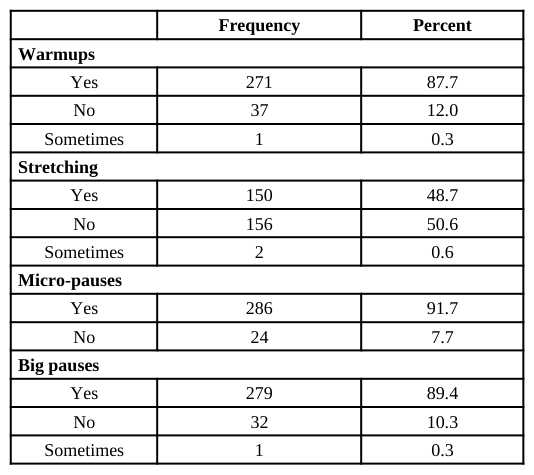
Practice Habits Regarding practice habits (Table 2), almost 90% of students warm up; however, only about half of them stretch. Almost all of them take micro-pauses (close to 30 seconds) and longer pauses, which last between 1 minute and 21 minutes. The most common longer pauses last between 11 and 15 minutes (24.9%). During rest, approximately half of the students (58.1%) do other activities that apparently do not involve fine motor movements with the fingers; nevertheless some of them play the piano (1.2%) or use the computer (8.7%).
The most reported activity is reading and doing homework, in a little more than a third of the cases (35.5%). Concerning duration of continuous practice, a little over half of the students play for one hour (57.5%) and 26.8% of them play for two continuous hours.
Regarding stage anxiety, almost half reported that they sometimes experienced it (48.9%), and nearly a fifth has experienced it frequently (18.8%). It is important to note that only 7.8% said they have never experienced it.
Table 2. Habits of musical performance practice of music students Frequency Percent
MDs Symptoms The symptoms of pain or discomfort that music students feel in the main parts of their bodies are mentioned below. Students reported the neck as the most problematic area (56.5%), with frequency ranging from "always" to "very often", then follows the back with about 54.1%, very similar percentages for the wrists and shoulders - 36.3% and 36.35 % respectively; fingers are reported with lower frequency (29.9%) compared with the previously mentioned corporal segments.
Pain and discomfort are reported in the mouth, throat and ears with rates slightly above 10% (15.9%, 12.8%, 11.8% respectively); and in the case of legs, knees, ankles the percentage of prevalence is less than 10%, (9.4%, 8.7%, 5.1% and 3.4% respectively).
Pain caused by the musicians’ activities
The respondents answered questions about injuries or ailments caused by playing. Only 14% of the students perceive that their injuries are related to their musical activities. The most affected corporal segments are the back - 24% and the wrist - 9.5%. Regarding the time suffering pain, 17% of respondents reported one year and other 17% reported that they have suffered for two years.
Risk Perception Concerning the perception of risk, related to suffering musculoskeletal disorders (Table 3), more than half of the students (59,1%) said that they face the same risk as other professions, almost 24% of respondents think that musicians face less risk, and only 17.2 % of students considered that they are more exposed to health problems because of their activities.
Information level Almost half of the respondents (48%) received little information about how to prevent injuries, 22% considered that they have half of the information and 30% of them think that they are well-informed (Table 3).
Tabla 3. Musicians' perception about the risk to suffer musculoskeletal disorders because of their activities Musicians’ risk perception of their specific activities as
Perceived Factors for MDs One of the key aspects in this research is the identification of potential areas for design as a profession that could help improve these predicaments. In that sense, it was important to identify the auxiliary objects that musicians commonly use in their activities, and the importance of these objects in their practice. We wanted to see if the musicians could recognize the need of any devices that would help avoid some of their health problems. 72 % of the interviewed students reported no use of auxiliary or support objects and only 28 % mentioned that they used some, particularly seats with varying heights -37.2% and foot supports - 19.8 %. The foot supports are essential for performers of classical guitar. Regarding the perception of the need for auxiliary objects, 64% of subjects said that they didn’t need them, which suggests little awareness about the particular needs of their activities and the necessary requirement of specific supports or auxiliary objects.
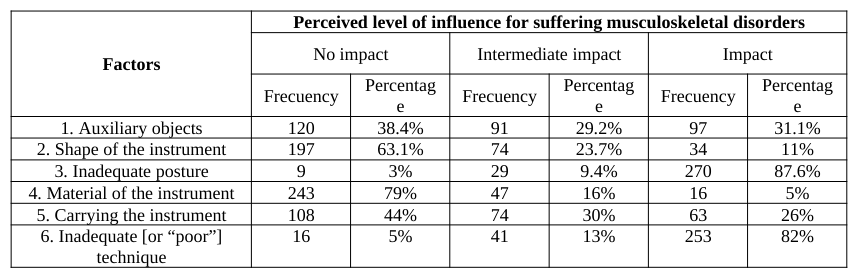
Another point in the poll referred to the perception of the impact of some factors in the development of musculoskeletal disorders. Table 4 presents some of the findings, emphasizing the elements, most relevant to design.
Table 4. Musicians’ perception of musculoskeletal disorders regarding different factors Perceived level of influence for suffering musculoskeletal disorders
Instrument and MDs Symptoms Regarding the location of diseases and its relation to the type of instrument played, we found significant differences (p<0.0001) between piano-fingers, violin – fingers, violin – neck, guitar-back and guitar-wrist. The results of the chi-square analysis were: (.028) piano – fingers; (.002) violin – Fingers; (.005) violin – neck; (.008) guitar – back and (.000) guitar - wrist. This relation between the location of pain and violin and guitar, coincides with findings by Zaza and Farewell (1997). In the case of piano, our findings about fingers’ diseases coincide with De Smet, Ghyselen and R. Lysens’ research (1998).
DISCUSSION
An important finding in practice habits is the little relevance of stretching. This is interesting because the stretch is a common recommendation to prevent or reduce musculoskeletal disease symptoms. Blackie, Stone and Kiernan (1999), for example, report effective techniques to decrease pain and discomfort warming down when ending practice, taking breaks, stretching, applying heat or ice, taking aspirin, exercise, massage, reviewing practice habits and correcting high -risk behaviors, reducing playing time, and increasing gradually the frequency of practice sessions. In addition, Potter and Jones (1995) mention that passive stretching at 30 second intervals is important and used ultrasound for deep heating to address restricted movement. In their longest breaks some respondents reported using the computer keyboard. This activity is characterized by a significant number of movements, similar to playing musical instruments. Therefore this kind of activity does not really constitute a pause or a break.
There are several parallels between the results of this study and previously published findings about this population. Regarding practice time, the 1-2 hour practice reported by Blackie, Stone and Kiernan, (1999), is similar, although slightly lower than the data of the present research; the average time, reported by them, was 117 minutes. Matching results were also found regarding anxiety. Most students reported problems with anxiety, which is similar to findings by Williamon and Thompson (2006) in their study. This is an important aspect because there are findings that suggest that anxiety and stress appear to delay recovery and lead to chronic LBP (Holmstrom et al 1992; Smedley et al 1995; Feuerstein et al 1999; Elders & Burdorf 2001).
Concerning anatomical areas reported with symptoms of musculoskeletal disorders, Salmaso et al. (2004) found highest prevalence in the following body segments: shoulders, neck, spine, hands and wrists. This coincides with the findings of the present research, except in the case of hands. We did not include “hands” as category in our questionnaire, we used “fingers”. If fingers and hands were considered equivalents, our results would be very similar, because these anatomical areas have the highest percentages.
Regarding the aspect of the use and need for special furniture, it is relevant that most students do not use it and feel they do not need it. This can be explained by two main factors: One relates to the philosophy of many musicians, "no pain, no gain" (Blackie, Stone & Kiernan, 1999), and another to their ignorance about existing furniture and accessories that can help them prevent or lessen the discomfort and pain during their practice.
Besides their ignorance about furniture and accessories, the students have little awareness of the risk that their profession entails; three quarters of respondents think that the risk is the same as in other professions and even lower. These data have already been reported in countries such as England (Williamon & Thompson 2006). Consistent with these results, we found that the information regarding prevention is considerably less. This situation has serious implications for the designer's work in this area. The development of a product for musicians should consider a comprehensive review of the epidemiological aspect of musculoskeletal disorders, and the musicians’ perceptions about the connection between pain and their activities. In our study only 14% of respondents reported injuries, which it is inferior to 25% of students with medical conditions found by Shields and Dockrell (2000). It is striking that 60% of respondents reported pain in the back and neck and only 14% of them related these symptoms to their activities. In that sense most of the students don’t recognize the risk coming from their musical practice.
As mentioned previously, in addition to the diagnosis of music context from an ergonomic point of view, in this research we aimed to define a set of possibilities for design. In table 4 a set of relevant data about the possible routes for design is shown. Firstly, the respondents believe that the factors and the way they practice, are more important than the factors, related to objects. For example, students identify that bad posture (3) and poor technique (6) have high impact on pain and discomfort (up to 80%) compared, for example, with the shape of the instrument (2) or the material of the instrument (4), and even with the auxiliary objects (1). Another important point is the lack of awareness of the connection between inadequate posture (3) (with a high percentage of perceived impact) and the auxiliary objects (1) (low percentage of perceived impact). The latter are very important in defining the positions assumed by the musicians when playing their instruments. It is worth noting that music students didn’t recognize any risk in the features of their instruments. This makes the design of the instruments a complex route for design, on one hand, because of the technical challenges, and on the other hand, because of the possible resistance from musicians to accept new features of their instruments. However, in the background check various shape changes to musical instruments based on ergonomic principles were found, demonstrating the possibility of design intervention, based on knowledge about health care.
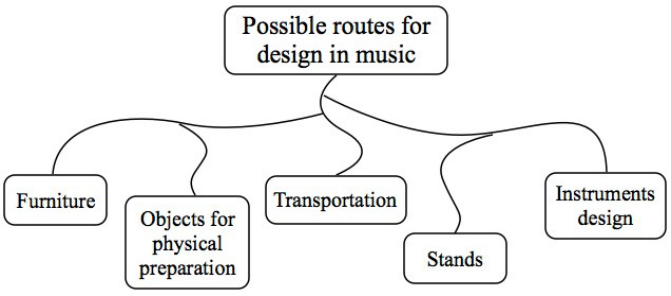
Below (Figure 1) we present some of the possible paths that could be followed by design and ergonomics in their connection with music.
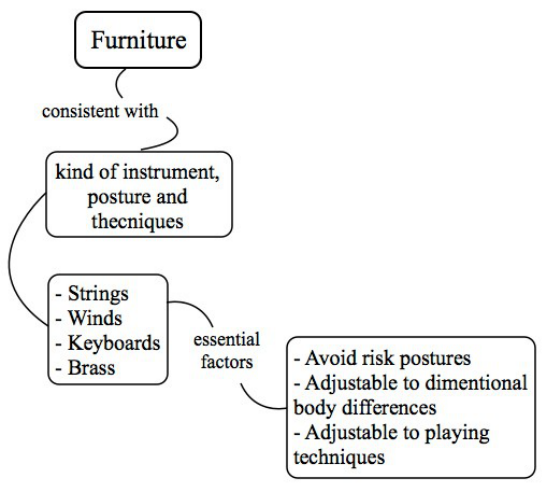
Figure 1. Five possible routes for design in music In route one (Figure 2) specific furniture for musicians could contribute to decreasing the musculoskeletal disorders, identified in that population; many risk postures could be intensified by inadequate furniture In that
sense, designers need to research the technique requirements and the healthiest postures (B. Paull & C. Harrison, 1997).
Figure 2. The first possible route for ergonomics and design in the context of music
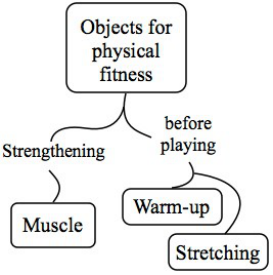
Route two (Figure 3) has to do with physical preparation; it is a very important aspect for a musician. As mentioned earlier, effective techniques to decrease pain and discomfort included, taking breaks, stretching, warm ups and ending practice (Blackie, Stone & Kiernan, 1999), (Paull B. & Harrison C. 1997). Nevertheless, it is necessary to make an analysis about the most useful techniques to improve the physical capabilities, and design coherent proposals regarding the specific requirements of musicians.
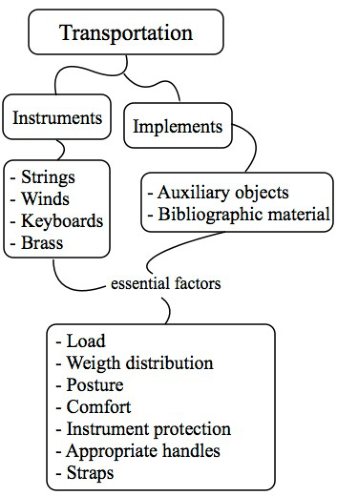
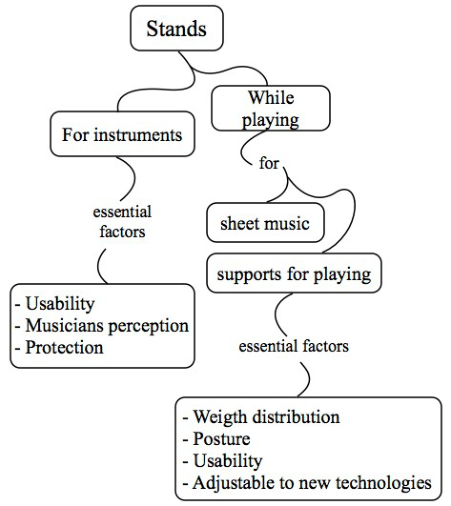
Figure 3. Physical preparation is the second route, identified for design and ergonomics in music In route three (Figure 4) we considered that the musicians generally carry their instruments and other elements for their activities. Many products, which help transport instruments, exist on the market. However, these objects mainly aim at protecting the instruments, while other aspects like weight distribution or comfort are mostly overlooked. Ideas about essential factors like handles, load and weight distribution are taken from W. Cushman and D. Rosemberg (1991) in their proposals about transportable products.Figure 4. Transportation is the third route for design and ergonomics in music In route four (Figure 5) the stands are mentioned; these are essential for musicians, but in many cases, their characteristics could bring on problems, related to pain or diseases in different corporal segments; for example, many musicians develop neck problems because their stands are too low and they must sit with a flexed-neck position (Paull B. & Harrison C. 1997, 105).Figure 5. The stands are the fourth route for ergonomics and design in music
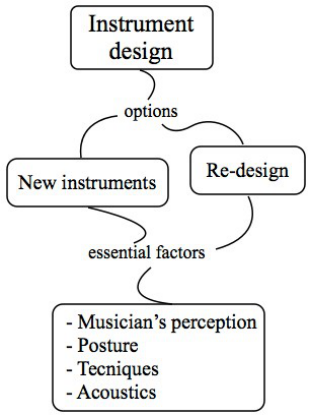
Finally, route five (Figure 6) is about instrument design. This is one of the most complex routes, especially because many musicians think that the form of instruments is untouchable (Horvath J., 2010) as this may affect acoustics or playing techniques; nevertheless, some possibilities exist to modify some parts in the instruments and improve the postures of the musicians without modifying the sound or the technique (Horvarth J., 2010). A second option is to design entirely new instruments; in this case, the requirements will be different, and perhaps the resistance from the musicians will be less.
Figure 6. Instrument design, one of the most difficult routes for design and ergonomics
CONCLUSIONS
The present research aimed to examine the impact that the activities of music students have on their health. We have determined some aspects of music practice that are relevant to design and ergonomics. We found similarities with research carried out in other contexts, particularly in reports of medical conditions, as in Zaza (1998). This reinforces the idea that musicians are especially vulnerable to musculoskeletal problems because of the particular conditions of their activities. It is striking that there is little awareness on the part of the musicians about the specific characteristics of their activities and in that sense the particular requirements that the products with which they interact have.
The results showed that music students do not have extensive awareness of the risk factors in their profession and thus fail to carry out all those practices or habits that would allow them to prevent musculoskeletal disorders as Williamson and Thompson (2006) observe.
It is important to note that the students do not consider the use of auxiliary objects relevant, or helpful in improving their body posture during the long hours of rehearsal. The high incidence of medical conditions,, however, is an indicator of the need to design specific ergonomic objects for their activities.
Even though the present research has given a general idea about the conditions in which music students practice, there is still data that needs to be clarified and confirmed. We recognize the importance of focusing on some aspects; particularly those related to developing design proposals.
REFERENCES
Elsevier Science Publishers. De Smet L., Ghyselen H. & Lysens R. (1998) Incidence of overuse syndromes of the upper limb in young pianists and its correlation with hand size, hypermobility and playing habits. Societé d’Enseignement Médical des Hópitaux de Paris, 17(4), 309-313. Elders, L. A. M., & Burdorf, A. (2001). Interrelations of risk factors and low back pain in
http://www.wayforward.co.za/downloads/MakingMusic_A-pain-in-the-Neck2.pdf Furuya S., Nakahara H., Aoki T., & Kinoshita H.(2006) Prevalence and Causal Factors of Playing-Related Musculoskeletal Disorders of the Upper Extremity and Trunk among Japanese Pianists and Piano Students. Medical Problems of Performing Artists.21 (3) 112-117. Holmström, E. B., Lindell, J., & Moritz, U. (1992). Low back and neck/shoulder pain in construction
workers: occupational workload and psychosocial risk factors. Spine, 17(6), 663-671. Horvarth Janet. (2010) Playing (Less) Hurt. An injury prevention guide for musicians. Milwaukee, U.E. Hal Leonard Books Knapik,J.J., Jones, S. B., Darakjy, S.Keith G. Hauret, K. G., Nevin, R., Grier, T. MS, & Jones, B.H. (2007).
Injuries and Injury Risk Factors Among Membersof the United States Army Band. American Journal of Industrial Medicine 50, 951–961. Leaver R., Harris E. C. & Palmer K.T.(2011) Musculoskeletal pain in elite professional musicians from British symphony orchestras. Occupational Medicine. 61, 549 - 555 Löbach Bernd. (1981) Diseño Industrial. Bases para la configuración de productos industriales. Barcelona
España, Gustavo Gili, S.A. Paull Barbara & Harrison Christine. (1997). The Athletic Musician. A guide to playing without pain. London England. Scarecrow Press, Inc Potter, P. J., & Jones, I. C. (1995). Medical problems affecting musicians.Canadian Family Physician, 41,
Zaza C. & Farewell V.T. (1997) Musicians’ Playing-Related Musculoskeletal Disorders: An Examination of Risk Factors. American Journal Of Industrial Medicine, 32, 292 – 300
LISTED IN THE AHFE DIGITAL BOOKSTORE CATALOGUE
Explore the complete digital volume
Advances in Ergonomics In Design, Usability & Special Populations: Part III
Read this individual research paper free through the original publisher, or explore the full digital proceedings book.
ISBN 978-1-4951-2108-1
Explore this ISBN in the AHFE Bookstore ↗Listed in the July 2026 bookstore catalogue; search by ISBN to confirm current availability · Digital book purchase optional