Gabriel Henrique Cruz Bonfim, Luiz Carlos Paschoarelli (2022). Comparison Between Two Child-Resistant Packages (CRPs) Through a Usability Test With Elderly People. In: Advances in Ergonomics In Design, Usability & Special Populations: Part III. AHFE Open Access, vol. 20. https://doi.org/10.54941/ahfe1001335
The present study aimed to conduct a usability test with elderly users, using two Child Resistant Packages (CRPs): one of them is the "Squeeze-and-turn" type and the other is the "Push-down-and-turn" type, in order to identify differences between genders and propose improvements in the design of the caps. The proposed task was to open and close the two packages. The results show that subjects had difficulties with both packages, however the push-down-and-turn package seems to be easier to open, but the satisfaction of use was higher for the squeeze-and-turn package.
Despite the great monetary value generated by packages, it is very important to take into account their interface with the consumer. The use of a package should be efficient, comfortable and safe. However, despite technological advances, it is still common the occurrence of accidents involving such products, and it may cause a lot of of injuries. The packaging design should be aware and consider the skills and abilities of users to ensure reliable and safe products that are easy to access by users with limited capabilities (elderly) or difficult to access by children who should not have contact with the product.
The Child Resistant Packages (CRPs) have emerged as a solution to avoid accidents of poisoning with children because they naturally lead objects into their mouths. According to Zunjic (2011) the opening of a CPR needs the expertise and skill of an adult. However, as shown by some studies, such packages are presented as difficult to open for youth, adults and the elderly.
The aim of this study was to evaluate the usability of two different CRPs, one is the squeeze-and-turn type and the other is the push-down-and-turn type. The study was conducted only with elderly users (all over 60), so with the results of research, improvements could be established.
CHILD RESISTANT PACKAGING (CRP) Over 35,000 children from 0 to 14 years old die every year as a result of unintentional poisoning. The use of CRP for medicines and household products is a way to limit the access of children to toxic substances (Gordon et al., 2004).
The CRPs became mandatory in the United States in 1970, because of the large number of accidents due to intoxication with children under 5 years old. For this reason, the Poison Prevention Packaging Act was enacted.
Currently, the international standard ISO 8317:2004 " Child-resistant packaging – Requirements and testing procedures for reclosable packages" was reference to European standards and is also followed by Japan, Argentina, Brazil, Paraguay, Uruguay and Venezuela (De La Fuente, 2006). That standard specifies requirements and test methods for CRPs. Such methods provide measures of effectiveness for packages that restrict the access of children and ensure accessibility for adults between 50 and 70 years (ISO, 2003).
PROBLEMS WITH CHILD RESISTANT PACKAGING Despite their importance to the reduction of accidents with children under 5 years old, in many cases CRPs have presented certain problems of accessibility, especially for the elderly. Because of the difficulty of opening, users end up doing different things such as transfer the content from the CRP to a container that is easier to open, leave the CRP open, or simply empty the medicine into a bag or drawer (Winder, 2009).
Zunjic (2011) could list a variety of different types of mechanisms for opening CRPs such as: random push down while turning; localized push in while turning (force must be applied to designated place on closure); localized squeeze force while turning; turn top cap until stops and then push down and turn; align two points then push up on tab or lip; press to release and then lift hinged tab (dispensing cap); remove a portion (tab), rotate the blister to orient, push through; hold fitment while turning; turn closure until stops, then lift and continue trying to open; push up to release; pull up to release and lift hinged lid (dispensing cap); squeeze two points simultaneously to open; requires key device or fingernail or coin or other tool to open; localized squeeze while lifting removes overcap (actuates normally); localized press down then pull up at arrow; line-up arrows on the overcap and ring to remove; push out; remove a portion (tab) and push out; push tab while rotating directional pump to spray position, then pump with finger; press down on a point to release lock, rotate orifice to spray position, and squeeze trigger; localized squeeze while lifting up, then pressing two tabs while lifting lid to open; squeeze two specific points simultaneously, lift zipper tab and pull to open; localized push up to remove; press hold, pull out (parts remain together), push out; pull trigger, lift flap, push out; press then flex and lift to open; push in, squeeze and hold, hold and pull.
Therefore, the main reasons for the difficulty in opening CRPs are: lack of information, the existence of a large number of methods for opening, insufficient strength of the users, or the decline of mental and physical abilities of individuals with advanced age (Winder, 2009; Zunjic, 2011).
Since the mandatory use of CRPs in the United States, many studies have been conducted to evaluate those types of packages.
Lane et al. (1971) conducted a study with 134 outpatients from 22 to 87 years old divided into 2 groups: one group would be tested with a package without child-protection cap and the other would be tested with a palm-n'-turn cap. For this study, there was no significant difference between people who could open the CRP (87%) and people who could open the conventional package (95%). However, 44 people said they had difficulty in opening the CRP and as a result, many of them transfered the content from the CRP to a container that is easier to open.
In a telephone survey conducted in 1976 with 636 people in the metropolis of Omaha (United States), some questions related to CRPs were made. Eighty-nine percent of the families interviewed had CRPs at home. The difficulty of use or misuse of the packages was 14% for subjects with less than 30 years old and 33% for those over 60. The consequences for the difficulty of use were: change the product container (41%), leave the package open (25%) and stop using the product (3%) (McIntire et al. 1977).
Thien and Rogmans (1984) evaluated four types of CRPs: two of them were the press-and-turn type and the others were the squeeze-and-turn types. The subjects were divided into 5 groups by age: 24-41 months; 42-51 months; 18- 45 years old; 60-75 years old; and over 75 years old. The results show that the squeeze-and-turn package, with the smaller diameter cap, failed the test with children, because 27% of the younger ones and 77% of the older ones could open the package, moreover, this package lost its protection after a few attempts at opening. However in the test with adults and the elderly, the effect of age was statistically significant for all CRPs, but the results suggest that none of the packages is accessible by older adults.
Ward et al. (2010) observed the use of three CRPs: push down and turn; squeeze and turn; and blisters. That was the order of the hardest to the easiest to open, with almost 50% frustrated opening attempts for the first two CRPs. As a consequence of the difficulty of opening, the subjects: used scissors or other tools to cut the packages, they transferred the product to another package or they did not closed the package. The authors also report that 1 in every 5 individuals over 75 years old cannot open the push-down-and-turn packages.
Another study which used a push-down-and-turn package, was carried out by Nayak (2002). The participants were 103 people from 60 to 80 years old, 37 males and 66 females. Eithy percent of all participants were able to open the package without instructions within the first 3 minutes of testing, 17% needed verbal instructions and were able to perform the task within 6 minutes. Verbal instructions were necessary for 1% of the participants, and the number of individuals who failed to open the CPR (even after the demonstration) was 2%.
Bix and de la Fuente (2012) conducted a survey with a group of individuals over 70 years old and with a group of people with cognitive, physical and perceptual disabilities. Eight CRPs with different opening systems were tested, those CRPs were evaluated by participants on a scale from 0 to 4 (0 means the hardest to open and 4 means the easiest to open). Overall, the packages received negative scores, but the individuals with disabilities qualified the packages with fewer score than the elderly.
A more recent study of Yoxall et al. (2013) took into account that, for many people, the product considered the most difficult to open was the recipients of bleach with the squeeze-and-turn caps. They know that the comprehension of pain and comfort is a difficult task, so they tried to evaluated the stress on joints during the actions of squeeze and turn, because it would allow them some sort of comparison. The results showed that there was a significant increase in the maximum stress average at the joints when the turn force is applied on the cap, where the index finger joints experienced larger increases in stress. By applying the squeeze force alone, the thumb and index finger are very stable. However, the application of the turn force causes the fingers to accelerate quickly, meaning that it is no longer a stable structure for supporting the squeeze force, where the index finger tends to hyperextension at its joints, the thumb tends to flexion. That can explain why the combination of "squeeze and turn" is considered difficult, because a small increase in strength at the fingertips needed to produce the turn motion results in a large stress increase in the joints, causing a likely increase in pain and/or discomfort.
Considering the aforementioned problems, the design of safe packages that meets all design requirements and are child proof and at the same time are accessible by the elderly, has been a difficult task. What can be observed is that the smaller the degree of complexity of the opening system, the greater is the public acceptance, however, such packages can be easily accessible by children. According to Winder (2009), the solution to the problem can be given by making CRPs that are not physically, but cognitively difficult to open.
One factor that can minimize the problems related to CRPs is the evaluation of Usability, which seeks to develop products that are efficient and effective; and bring satisfaction to the users.
USABILITY According to ISO 9241-11:1998, for measurement or specification of usability, we need to identify the goals and decompose effectiveness, efficiency, satisfaction and the components of the context of use into subcomponents that can be measured and verified. The context of use includes the users, tasks, equipment and environment of use. The description of each one is very important for the evaluation of the usability.
Measures of usability are effectiveness, efficiency and satisfaction. A measure for each of them is usually provided, however there is no general rule on how the measures are selected or combined. However, if objective measures are not possible to be obtained, subjective measures based on perceptions of users can provide an indication of effectiveness and efficiency.
The effectiveness is related to the user goals regarding the accuracy and completeness that these goals can be achieved. The efficiency relates the level of efficacy to the consumption of resources, such as physical or mental effort, time, material or financial costs. The satisfaction measures the extension in which users are free from discomfort and their attitudes towards the use of the product. It is the most difficult to assess because it is subjective.
MATERIAL AND METHOD Ethical issues
The present study was characterized as descriptive, because it verified the relation among variables; and quantitative, because it used quantification in the collection and analysis of data. As this is a research involving human beings, ethical aspects have been met, with the application of an Informed Consent Form (ICF), which was approved by an Ethics Committee.
Subjects The study included 10 elderly subjects (over 60 years old), where 5 (50%) were male and 5 (50%) were female. The mean age was 70.3 years old (SD 9.04 years old). This sample was based on Nielsen (1993) in which samples of 6 to 12 people are sufficient; and on Tullis and Albert (2008), who show that "[...] five participants per significantly different class of user is usually enough to uncover the most important usability issues".
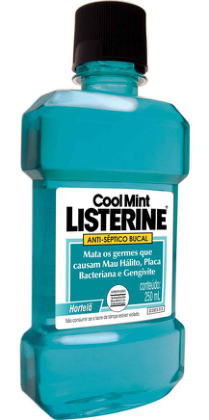
Selected packages For the present study two Child Resistant Packages (figure 1) with different opening systems have been selected. Package 1 is a mouthwash with the squeeze-and-turn system of opening. Package 2 is a multivitamin with 100 tablets whose cap is the push-down-and-turn type. Both require two simultaneous movements to be opened.
Figure 1. Child Resistant Packages
Other materials An identification protocol was developed and some information was collected such as name, date of birth, gender, handedness and possible musculoskeletal symptoms in the upper limbs.
To assess the degree of satisfaction it was also elaborated a System Usability Scale (SUS) Protocol divided into two columns according Tullis and Albert (2008). The left column was composed of 10 statements, of which 50% are negatively worded, and 50% are positively worded. Those statements are related to the product. The right column consisted of a 5-point scale shown next to each one of the 10 statements. At the extreme left of this scale it was written "Strongly Disagree", while at the extreme right was written "Strongly Agree", ie, after reading each statement, the subject should agree or disagree with each one, positioning itself on the 5-point scale.
It was also used a digital camera to record the subjects while performing the task, so that, through further analysis, the time of each step could be accounted, as well as the expressions and reactions of each subject before the products.
Places of test application The usability tests occurred in the residence of each subject, more specifically in the kitchen or in the dining room.
Proceedings After the approach and the explanation of the research objectives, as well as the procedures to be adopted, the subjects read the ICF and, if they agreed to participate, they filled and signed the document. After that, they filled the Identification Protocol. Next, the procedure begins to be recorded with a digital camera. The packages were randomly selected and presented in different orders for each subject. Thus, the first product was displayed and asked if the subjects already knew it; if they had opened that packaging type; and whether they thought it seemed easy and practical to be opened. After those questions, the usability test was carried out, in which the subjects should perform a task divided into two steps: open and close the package. After the interaction with the product, the subjects answered four more questions (Do you believe that it was easier to open that package than expected? Did you feel any discomfort when trying to open the product? If you could not open the package, what would you do in your house to open it? Do you have any suggestions for improvement to the package?). Then, participants filled the SUS Protocol, according to their experience with the product. After that, the second product was introduced and the same procedure performed with the first one was repeated. After the tests, with the help of the recordings, the time was accounted and activities, deviations and errors were reported.
Data analysis After the tests, with the help of the videos, the time was recorded and the activities, deviations and mistakes were described in tables such as Table 1. Deviation is to perform the task differently from the pattern.
Table 1: Table of task, time and mistake Task step Time (seconds) Deviation Mistake Comments
For the final analysis of usability the following measures were used: effectiveness, efficiency and satisfaction. For the effectiveness analysis it was considered the task completed successfully (open and close the packages). For the efficiency analysis, it was considered the total execution time of the task in relation to the time of the evaluator (expert). For the satisfaction analysis, the SUS Protocol was analyzed according to the procedures described by Tullis and Albert (2008).
The rest of the data was tabulated and analyzed. Tables and graphics were developed to ascertain whether there was influence of gender.
RESULTS
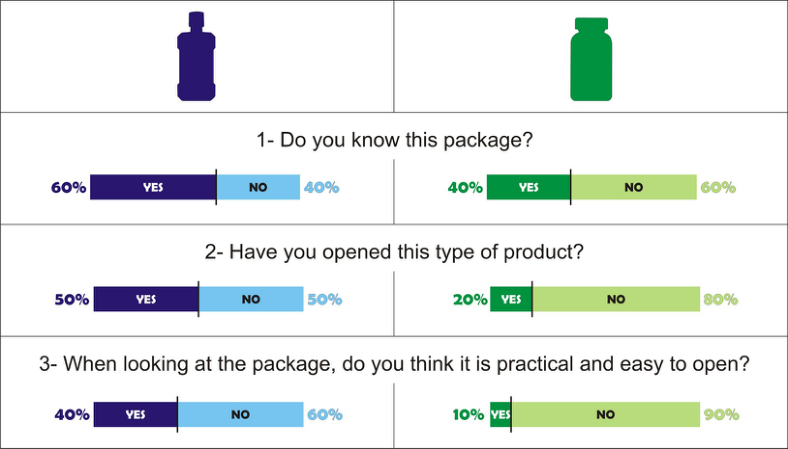
Before the subjects perform the task, three questions were asked in order to find out if they knew and/or had any contact with the product. The infographic below (figure 2) shows the responses of the subjects.
Figure 2. Questions asked before the subjects perform the task
Through those responses it can be noted that the package 1 is better known than the package 2, but not everyone that knew the packages had been in contact with the products, and users had less contact with the package 2. And for most users, the package 2 seems to be more difficult to open.
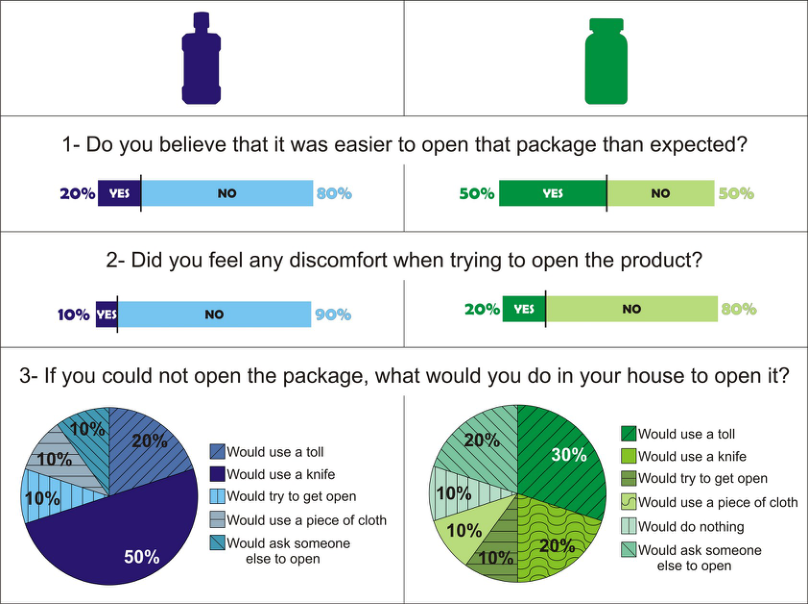
After being asked the questions mentioned above, the subjects performed the task proposed. After they have performed the task, three new questions were asked to obtain information about the use of the product. The results are shown in figure 3.
Figure 3. Questions asked after the subjects perform the task
Regarding the expectation of use (question 1), it was noted that the majority of users found the package 1 more difficult to open than expected.
In relation to discomfort in opening the product (question 2), only one subject (10%) said she felt discomfort when opening the package 1, more specifically in the fingers that she had contact with the cap. For the package 2, there were 2 subjects (20%) who complained of discomfort, the first because he could not open the product and the second complained of pain in the fingers. However, when watching the recordings again, it was found that other users have also complained of discomfort when trying to unscrew the caps, but even so, when asked, they said they did not feel any discomfort in opening the packages. This fact is common with the elderly users, even when they encounter any problem or difficulty with a product interface, they end up suppressing such information.
The third question asked after the use of the products, questioned the subjects what they would do if they could not open the package. The presence of tools and sharp objects is perceived in most responses, and the use of the knife is higher for the package 1, which can cause serious accidents and injury to the user if he/she cannot open the product by the manner for which it was designed, especially for elderly users, as they seek to solve problems by themselves, without worrying about bothering or asking anyone to help them.
Finally, some suggestions were requested to improve the products. Despite having some difficulty handling the packages, some users could not think of any improvements, because they knew the importance of CRPs. However, for package 1 one user gave the idea to make the cap of some material that is more flexible, ie, that is not so hard to squeeze the cap to unlock it. Only one subject said it would be better to take off the safety latches of the product. For the package 2, the improvement suggestions were to change the opening instructions to the vernacular language. Only one subject said it would be better to take off the safety latches of the product.
The measures of usability are: effectiveness, efficiency and satisfaction. Each one will be presented individually below.
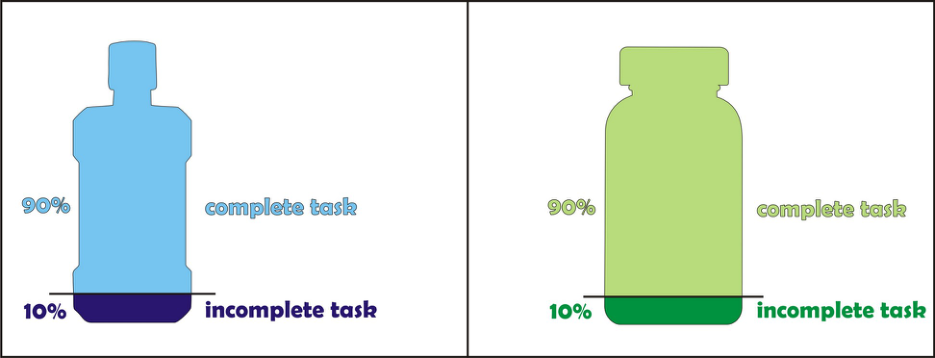
Effectiveness As previously stated, measures of effectiveness are those related to the accuracy and completeness that the goals of the subject are achieved. It is important to remember that the goals of the task of this experiment were: open and close the package. Figure 4 shows the completeness of the task.
Figure 4. Complete and incomplete task
It was noticed that only 1 user could not complete the task because he did not open the product. However some deviations were observed while performing the steps, showing that not all steps were performed accurately.
For package 1, at the opening of the product, only 2 users (20%) correctly squeezed the tabs of the cap to unlock it. All others had to make a greater effort to be able to unscrew the cap, damaging the latches of the product. At the final step of closing the package, 2 users (20%) pushed the cap against the body of the product too hard until they realized that they needed only to turn the cap. One user (10%) thought it would also be necessary to squeeze the tabs on the cap to close and did so, unaware that she just needed turn the cap. The others performed the step correctly.
For package 2, at the opening step, two users (20%) first attempted to pull the cap instead of pushing. At the same step, other 2 users (20%) were able to detach the cap off the internal protection system then they unscrew the protection of the package to open. The others could open normally. At the step of closing the package, one user (10%) pushed the cap against the body of the product too hard until he realized that he needed only to turn the cap. The 2 users who detached the cap off the internal protection system, first positioned the protection system on the body of the package and then they put the cap on the top, then they pushed the cap hardly against the body of the product, so that it could fit back into the protection system and they could screw the cap and close the product.
Efficiency Efficiency measures relate the level of effectiveness achieved to the consumption of resources such as mental or physical effort, and time.
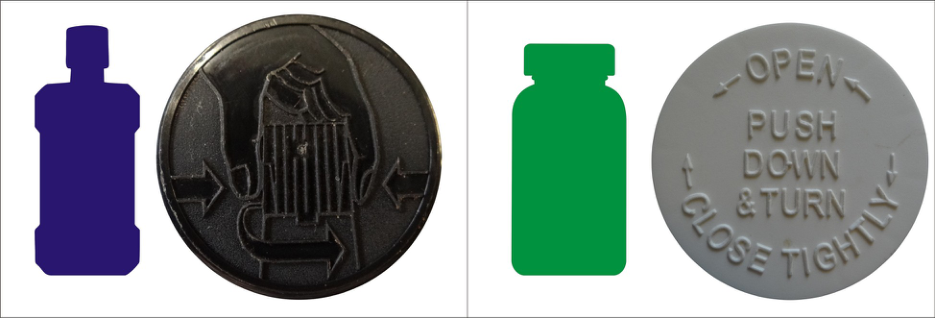
One of the difficulties reported by users, was that they were unable to understand what was the information contained on the caps of the products (figure 5). In package 1, many users observed the picture, but they did not understand what was that and they did not open the product the right way, only one subject could understand the instructions, however she spent a lot of time to observe the picture and finally open the cap, this subject took a lot of time to open the product. Users had more difficulties with the instructions on package 2, because they were not in the vernacular language. In both caps, figure and background are exactly the same color, that made it more difficult to visualize, because the elderly typically have more severe vision problems.
Figure 5. Opening instructions on the caps of the products
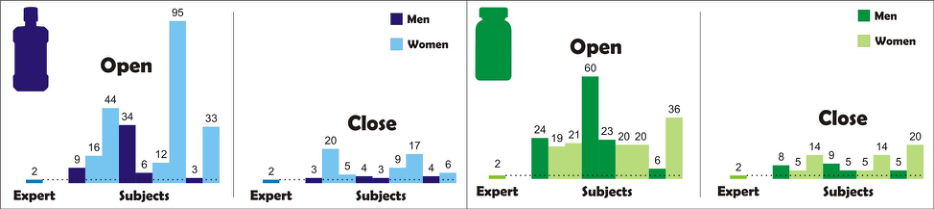
The graphics (figure 6) of each task step will be presented, comparing the time (in seconds) of the expert with time of the subjects. Expert is someone who knows the technical aspects of the product being tested. In this study, the expert was the researcher.
Figure 6. Comparison of time (seconds) to open and close the packages
Through the graphcs shown, it can be seen that the step that subjects took longer to achieve was to open the product.
It is important to emphasize that one of the subjects could not open the packages, so his time was not registered in any of the graphics.
For package 1, the average time of men was lower than the time of women both in opening and in closing the product. For package 2, the average time of men was higher than women in the opening step, but the opposite occurs when closing the product.
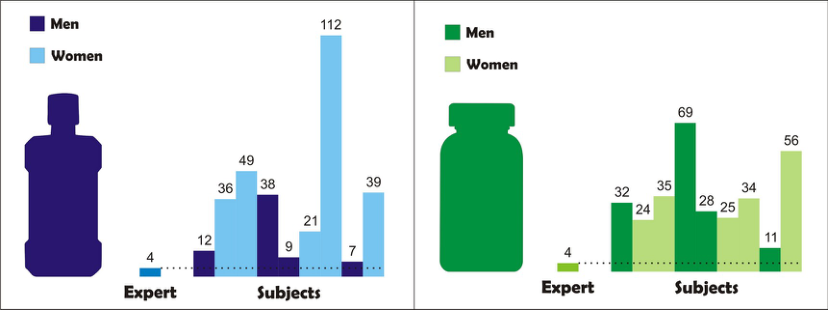
In general, the average total time of the subjects was about 9 times higher than the time of the expert for both packages. Figure 7 shows the graphic with the total time of the task performed by the expert compared to subjects.
Figure 7. Comparison of total time (seconds) to complete the task
It is also worth noting that, for package 1, the average time of women was approximately 3 times higher than the average time of men. For the package 2, the average time of women and men were the same.
Satisfaction Satisfaction is related to the absence of discomfort and user attitudes towards the product. Because it is a subjective measure, it was adopted the SUS Protocol to assess the satisfaction. The calculation of this protocol is done according to Tullis and Albert (2008), the result is given in percentage and indicates the level of user's satisfaction.
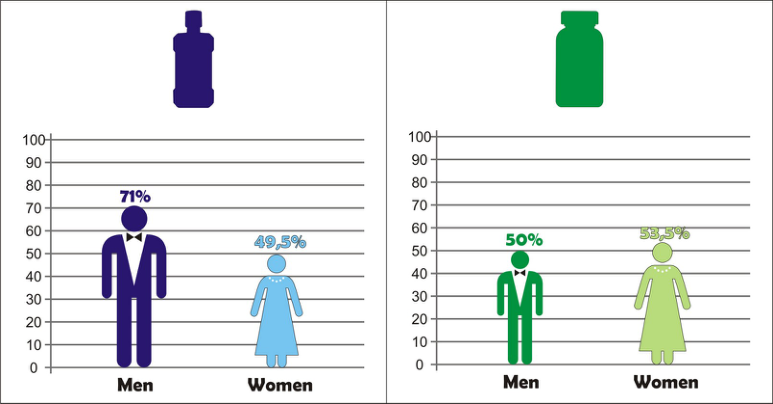
After the analysis of SUS protocol, it was obtained an overall average of 53.5% satisfaction for package 1, and 51.75% for package 2. However, it was noted that the average satisfaction is different for the genders. Figure 8 shows an infographic with the average satisfaction of genders.
Figure 8. Level of satisfaction by gender
It was noticed that men felt more satisfied after using the package 1. That can be explained by the fact that not all users opened the product correctly, many of them had to make a greater effort when opening, and how on average men have more strength than women, they may have found it easier to open product.
But for the package 2, men's satisfaction was lower than women's, since applying excessive force to open the product is irrelevant, because if the cap is not pushed down correctly it does not open. This may have caused some frustration in men.
CONCLUSIONS
Child Resistant Packages are very important, because they provide greater security and less risk of accidents, especially by poisoning, however it is observed that they can be a hindrance to the older population. Therefore, studies like this show the importance of an ergonomic analysis of packages, seeking the best agreement among user, interface and task. Through the test of interaction with the product it can be observed how the user behaves, thinks and performs a task, and so it is possible to adapt it to him, providing usability.
The present study showed that most people know more the Squeeze-And-Turn (SAT) type. However, before the interaction with the product, the subjects thought that the Push-Down-And-Turn (PDAT) type seemed easier to open. During the usability test, only 1 subject was unable to open any of the packages. After the test, the subjects considered the SAT packing more difficult to use. However, there was more complaint about discomfort with the PDAT packaging. If subjects were unable to open the packages by hand, the use of knife or tool was higher in the SAT packaging. In relation to the opening, the total time was shorter for the PDAT packing, however in the comparison of gender, time of men was shorter than the time of women in the SAT packaging, the opposite occurred with the PDAT packaging. In relation to the closure, the total time was shorter for SAT packing and in the comparison of gender, time of men was shorter than women's time for both packages. The overall satisfaction of the SAT package was higher than the PDAT, but when comparing genders, men's satisfaction was higher than women's for the SAT package, the opposite occurs with the PDAT package.
It was also observed that the most committed step was to open the packages, since most users have not noted the opening instructions on the caps. However, those instructions do not seem to be clear and objective to users, and the instructions are difficult to be noticed. Thus, it is noted the need for greater availability of easily perceptible information, as well as the maximization of the clarity of the opening instructions, which in most cases are imperceptible and difficult to be interpreted. For this, it is suggested that the safe caps are light-colored, preferably white, while the opening instructions must have a written part (in the vernacular language) and another part drawn, and these parts should be brief and direct. These instructions should also be embossed and black, to create contrast with the cap.
REFERENCES
Bix, L., De La Fuente, J. (2012), "Perceptions and Attitudes of People with Disabilities and Older Adults about Child-resistant Drug Packaging", JOURNAL FOR PATIENT COMPLIANCE, Volume 2 No. 2. De La Fuente, C.J. (2006), "The use of a universal design methodology for developing child-resistant drug packaging", master's
thesis, Michigan State University, East Lansing, United States. Gordon, B., Mackay, R., Rehfuess, E. (2004), "Poisoning: Hidden Peril for Children", in: Inheriting the World: The Atlas of Children's Health and the Environment. World Health Organization: Myriad Editions Limited. ISO. (2003), "ISO 8317 - CR packaging. Requirements and testing procedures for reclosable packages", Genebra: International
Organization for Standardization. Lane, M.F., Barbarite, R.V., Bergner, L., Harris, D. (1971), "Child-resistant medicine containers: experience in the home", AMERICAN JOURNAL OF PUBLIC HEALTH, Volume 61 No. 9. McIntire, M.S., Angle, C.R., Sathees, K., Lee, P.S.T. (1977), "Safety Packaging - What Does the Public Think?", AMERICAN
JOURNAL OF PUBLIC HEALTH, Volume 67 No. 2. Nayak, L.U.S. (2002), "Can Older Adults use Child Resistant Bottle Closures?", GERONTECHNOLOGY JOURNAL, Volume 2 No. 2. Nielsen, J. (1993), "Usability Engineering", Boston: Academic Press. Thien, W.M.A., Rogmans, W.H.J. (1984), "Testing child Resistant Packaging for Access by Infants and the Elderly",
ACCIDENT ANALYSES & PREVENTION, Volume 16 No. 3. Tullis, T., Albert, B. (2008), "Measuring the user experience: collecting, analyzing, and presenting usability metrics", Burlington: Morgan Kauffman. Ward, J., Buckle, P., Clarkson, P.J. (2010), "Designing packaging to support the safe use of medicines at home", APPLIED
ERGONOMICS, Volume 41. Winder, B. (2009) "The design of packaging closures", in: Packaging Closures and Sealing Systems, Theobald, N.; Winder, B.
(Ed). pp. 36-67 Yoxall, A., Rodriguez-Falcon, E.M., Luxmoore, J. (2013), "Carpe diem, Carpe ampulla: A numerical model as an aid to the design of child-resistant closures", APPLIED ERGONOMICS, Volume 44, No. 1. Zunjic, A. (2011), "Ergonomics of Packaging", in: Human factors and ergonomics in consumer product design: uses and
applications, Karwowski, W., Soares, M.M., Stanton, N.A. (Org.). pp. 101-123
LISTED IN THE AHFE DIGITAL BOOKSTORE CATALOGUE
Explore the complete digital volume
Advances in Ergonomics In Design, Usability & Special Populations: Part III
Read this individual research paper free through the original publisher, or explore the full digital proceedings book.
ISBN 978-1-4951-2108-1
Explore this ISBN in the AHFE Bookstore ↗Listed in the July 2026 bookstore catalogue; search by ISBN to confirm current availability · Digital book purchase optional