Fausto O. Medola, Suzana Gamac, Valeria M.C.Eluic, Luis C. Paschoarelliab, Carlos A. Fortuland (2022). Users’ Perceptions on Mobility, Comfort and Usability of Manual Wheelchairs. In: Advances in Ergonomics In Design, Usability & Special Populations: Part III. AHFE Open Access, vol. 20. https://doi.org/10.54941/ahfe1001337
1 Department Neuroscience and Behavioral Sciences, Faculty of Medicine of Ribeirao Preto, University of Sao Paulo, Ribeirao Preto, SP, 14049-900, Brazil ↗
2 Department of Mechanical Engineering, School of Engineering of Sao Carlos, University of Sao Paulo, Sao Carlos, SP, 13560-000, Brazil ↗
The objective of this study was to assess the users’ perceptions on the extent to which the wheelchair meet their mobility needs and overall satisfaction. Fifteen manual wheelchair users were interviewed with a questionnaire comprising questions about their perceptions on aspects of the daily wheelchair usage such as comfort and mobility. The results show that, in general, users experience seating and mobility problems related to their wheelchair. Participants reported problems to move independently in ramps, steps and with wheelchair transfers. Moreover, discomfort and pain were also reported as problems resulting from the prolonged use of wheelchairs. For the majority of the subjects, their wheelchairs are not ideally suitable to them, suggesting problems in the wheelchair prescription and provision. The results demonstrate that, from the users’ point of view, both mobility and comfort problems affect users’ experience with the wheelchair in daily usage. Such problems evidence the existing problems with the current design of manual wheelchairs. Designers and manufacturers may benefit from this knowledge when designing and producing wheelchairs that are most suitable to users’ characteristics, needs and expectations.
Technological advances of equipment for users with special needs have targeted enhancing function, social participation and quality of life. As a widely used assistive technology, the wheelchair aims to promote and/or enhance an essential human need: mobility. Because the user interacts with the chair during most of the day (Sonemblum et al., 2012), the seating function plays an important role on the user-device interaction.
Controversially, many wheelchair users point the chair itself as the main factor limiting their community participation (Chaves et al., 2004). Therefore, investigating how users perceive different aspects of their daily interaction with the wheelchair is important in order to identify usability problems, which may be helpful for designers and manufacturers to produce equipment most suitable to users’ needs and expectations.
Although the users occupy the wheelchair during most part of the day, in only 10% of the time they are in movement (Sonemblum et al., 2012). From this finding, the wheelchair may be seen as a body support interface in a variety of activities of daily life: working, sports, leisure and meals, among others. In these cases, comfort, stability and safety are important aspects contributing to users’ satisfaction with the equipment. Studies have shown the close relationship between seating and mobility in user’s interaction with the wheelchair: user’s posture and position related to the chair influences manual propulsion biomechanics (Cherubini and Melchiorri, 2012; Maurer and Sprigle, 2004; Macphee et al., 2001). In addition, changes in seat and backrest configuration affect user’s posture and seat interface pressure, thus influencing comfort and safety (in terms of skin protection) (Cherubini and Malchiorri, 2012).
Many undesired consequences have been related to the long term use of wheelchairs. According to Samuelsson et al. (2001), discomfort in seated posture and back pain are two problems highly prevalent among wheelchair users. When moving with a manual wheelchair, the user has to apply forces on the handrims in a repetitive motion that may cause upper limb injuries in long term. Many studies have shown high incidence of pain in shoulder and wrist among manual wheelchair users (Curtis et al., 1999; Subbarao et al., 1995). For this population, upper limbs pain can have a devastating effect on the independence in performing the vast majority of daily activities. Indeed, the incidence of pain among wheelchair users has been related to poor quality of life and dependency of caregivers (Dalyan et al., 1999; Lundqvist et al., 1991).
When compared to normal walkers, wheelchair users have an important limitation in their mobility. Studies have evidenced the existing gap between walking and moving with wheelchairs: while the daily distance travelled of the first is around 6 – 7.5 km (Bohannon, 2007), wheelchair users move 1.5 – 2.5 km daily (Karmarkar et al., 2010; Levy et al., 2010; Tolerico et al., 2007). While quantifying daily distance travelled evidences the existing gap between walking and moving with wheelchair, investigating users’ subjective perceptions may reveal seating and mobility interface problems experienced during wheelchair usage. The aim of this study was to assess the users’ perceptions on mobility, comfort and usability of manual wheelchairs.
MATERIALS AND METHODS
Participants A sample of convenience of 15 participants was recruited from the Rehabilitation Center of the Faculty of Medicine of Ribeirao Preto, University of Sao Paulo, Ribeirao Preto, SP, Brazil. All subjects were manual wheelchair users (14 men and 1 woman) with mean age of 43+ 11 years, and 9+11 years of wheelchair usage, and voluntarily participated in this study. Participants met the following inclusion criteria: (1) 18 years or older, (2) diagnosis of paraplegia or tetraplegia due to spinal cord injury, and (3) independence in manual wheelchair usage. Users of powered chairs were excluded from this study.
Procedures The participants were interviewed and answered questions regarding their perceptions on how the wheelchair mobility, comfort and usability. Questionnaire comprised questions with objective (multiple choices) and subjective (descriptive) answers. Prior to the interview, all participants were informed on the purposes and procedures of the study, and signed and informed consent approved by the Ethics Committee of the Clinical Hospital of the Faculty of Medicine of Ribeirao Preto (University of Sao Paulo, Ribeirao Preto, SP, Brazil). All the data is presented descriptively.
RESULTS
The average age of respondents was 43.2 + 11.5 years with a range of 23–60 years. The majority of the subjects were men (93.3%), the main cause of being in a wheelchair was paraplegia (80%), and the most common cause of injury were vehicular collisions (60%). Median time from injury was 4 years (interquartile range 0.4 – 41 years).
The most common problems reported by the users during daily wheelchair usage refers to ramps and steps (33.3%), transfers (20%), outside mobility (13.3%) and wheelchair transporting (13.3%). Twenty percent of the subjects reported no difficulty during wheelchair usage. Furthermore, 60% found their own wheelchair not suitable for themselves, and 73.3% stated that there is a more suitable wheelchair, while only one subject found his wheelchair as properly fit to him (20% of the respondents said they didn´t know). Notably, all the subjects who said that there is a better wheelchair for them indicate the high cost as the main reason for not having it.
When asked how they perceive their daily mobility, the majority (66.7%) of the subjects reported some degree of restriction: 46.7% said “a little restricted”, 33.3% reported “normal” daily mobility, 13.3% reported “very restricted” mobility and one subject (6.7%) said “totally restricted”. Curiously, architectural barriers (20%) and instability and fear of falling from the chair (20%) were the most common factors limiting the ability to move independently reported by the users. Other factors reported were insufficient equipment disassembling (13.3%), discomfort (13.3%) and size and weight of the chair, while 26.7% said that they don´t know or that there is no problem with the wheelchair that affect their mobility.
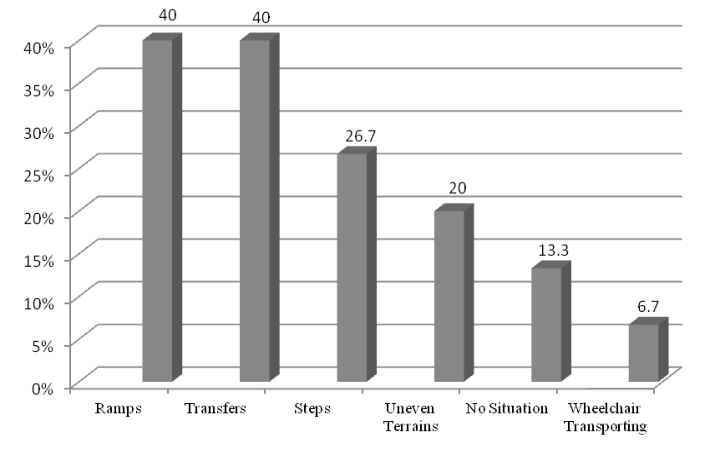
The most common situation reported as requiring other’s assistance with the wheelchair were ramp ascent (40%) and transfers (40%), as shown in Figure 1.
Figure 1. Situations requiring assistance of someone else. Values in percentage.
Comfort in the seated posture was reported to be affected by the majority of the respondents (80%), as only three of them (20%) reported wheelchair seated posture as totally comfortable. A little discomfort was reported by 46.7%, while 26.7% said that the seated posture on their wheelchair is a little comfortable, and only one subject selected “totally uncomfortable”.
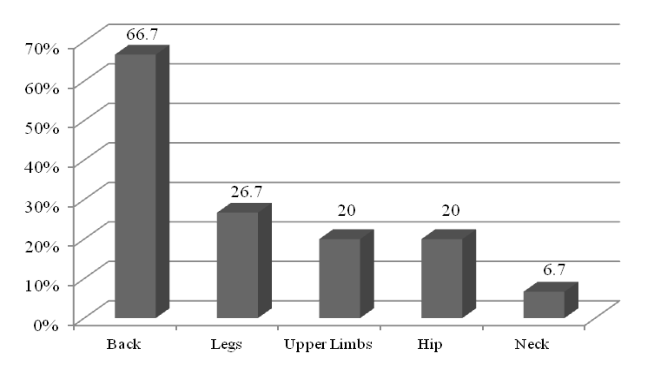
The vast majority of the respondents reported feeling pain (93.3%). The body areas most affected were back 66.7%)and legs (26.7%), as shown in Figure 2. Interestingly, for the majority (57.1%) of the participants that reported feeling pain, the long term wheelchair seated posture was reported as the cause of the pain, while handrim propulsion was reported by only one subject. Hip ossification (14.3%) was also pointed as causing pain, and 21.4% did not indicate any possible cause of pain.
Figure 2. Body areas where pain was most commonly reported. Values in percentage.
DISCUSSION
Because of the intense interaction between the user and the wheelchair and the problems experienced by the users during daily routine, it is important to assess user’s perceptions on the most important aspects of the user-device interaction: mobility, comfort and usability. Thus, this knowledge may be of interest for designers, manufacturers and health professionals who prescribe mobility assistive devices.
As the majority of the subjects reported perceiving their mobility as restricted, it was important to assess the main difficulties users experience when moving with their wheelchairs. The most common problems reported by the users during daily mobility were ramps, steps and transfers. This finding suggests that the inability to independently move in such situations and transfer from the chair may contribute to the restricted mobility among manual wheelchair users. Therefore, in order to improve manual wheelchair mobility, the improvement of both environmental accessibility and mobility performance of manual wheelchairs (mainly in ramps and uphill) should be targeted.
The fact that most of the respondents (60%) have considered their own wheelchair as not suitable for themselves may reflect problems with wheelchair prescription and/or provision. Similar results were presented by the study of Cherubini and Melchiorri (2012), who found 68% of the wheelchairs as not suitable for their users. It is noteworthy that, for all the subjects (73.3%) who stated that there is a most appropriate commercially available wheelchair for them, other than their own equipment, the reason for not having it is, ultimately, financial (high costs). Based on these results, wheelchair provision policies should be improved, in order to make it possible for the users to have the most appropriate equipment for their needs and expectations.
The high prevalence of pain (93%) and discomfort (80%) in seated posture among the respondents highlights and immediate need for improving the ergonomics of the seat and backrest interface, since the wheelchair is occupied by the user during most part of the day (Sonemblum et al.,2012). The most common complaint was back pain (66.7%), which demonstrates the problems with the seat and backrest interface. These findings are consistent with the study of Samuelsson et al. (2001), which found similar complaints of discomfort (87%) in seated posture and back pain (63%) among wheelchair users.
The long period seated in the wheelchair was indicated as the cause of pain for the majority of the respondents, suggesting some degree of dissatisfaction with the equipment. Also, it reveals the need for innovative solutions for the design of seat and backrest interface, in order to improve safety, comfort and satisfaction with long term wheelchair usage. The consequences of a non-suitable wheelchair are harmful enough to justify improvements in the product design. Although it might be argued that architectural barriers and individual’s physical and functional features contribute to the limited mobility among wheelchair users, the current findings indicate that the wheelchair itself play an important role on the restriction of users’ mobility. Previous study highlighted the need to pay more attention to wheelchair prescription in terms of equipment ergonomics and users’ individual characteristics (Cherubini; Melchiorri, 2012).
Although the current findings contribute to the knowledge on users’ perceptions on daily wheelchair usage, this study has limitations that need to be noted. First, the small sample size limits the extent of the current findings. Additionally, this study was conducted at a rehabilitation center of a single hospital with only spinal cord injured subjects (paraplegia and tetraplegia), thus, the findings may not be representative of wheelchair users from other services and with other diagnosis. Future study should include subjects with different diagnosis and also users of motorized wheelchairs.
CONCLUSIONS
This study assessed the users’ perceptions on how manual wheelchairs affect their comfort and mobility in daily usage. The results of this study indicate that, in daily routine, wheelchair users’ experience a number of problems that, ultimately, impact their ability to move independently. In addition, a high prevalence of discomfort and pain was reported, which was related by the users to the prolonged seated posture in their wheelchairs. For the majority of the users, their wheelchairs are not ideally suitable to them. Such problems evidence the existing gap between the wheelchairs current design and the optimal equipment concept. Improving the usability of manual wheelchairs requires designers and manufacturers to address the problems with the current design of the product, in order to improve comfort, mobility and usability and, as a result, benefit users’ functionality, independence and satisfaction with the equipment.
REFERENCES
Bohannon, R.W (2007), “Number of pedometer-assessed steps taken per day by adults: a descriptive meta-analysis”. Physical Therapy, Volume 87, No.12, pp. 1642–1650. Chaves, E.S., Boninger, M.L., Cooper, R., Fitzgerald, S.G., Gray, D.B., Cooper, R.A. (2004), “Assessing the influence of
wheelchair technology on perception of participation in spinal cord injury”. Archives of Physical Medicine Rehabilitation, Volume 85, pp.1854-1858. Cherubini, M., Melchiorri, G. (2012), “Descriptive study about congruence in wheelchair prescription”. European Journal of Physical Rehabilitation Medicine, Volume 48, pp. 217-222. Curtis, K.A., Drysdale, G.A., Lanza, R. D., Kolber, M., Vitolo, R.S., West, R. (1999), “Shoulder pain in wheelchair users with
tetraplegia and paraplegia”. Archives of Physical Medicine and Rehabilitation, Volume 80, No. 4, pp. 453–457. Dalyan, M., Cardenas, D.D., Gerard, B. (1999), “Upper extremity pain after spinal cord injury”. Spinal Cord, Volume 37, pp.191-195. Karmarkar, A.M., Collins, D.M., Kelleher, A., Ding, D., Oyster, M., Cooper, R.A. (2010), “Manual wheelchair-related mobility
characteristics of older adults in nursing homes”. Disability and Rehabilitation, Volume 5, No.6, pp. 428–437. Levy, C.E., Buman, M. P., Chow, J.W., Tillman, M.D., Fournier, K.A., Giacobbi, P. (2010), “Use of power assist wheels results in increased distance traveled compared with conventional manual wheeling”. American Journal of Physical Medicine and Rehabilitation, Volume 89, No. 8, pp. 625–634. Lundqvist, C., Siosteen, A., Blomstrand, C., Lind, B., Sullivan, M. (1991), “Spinal cord injuries. clinical, functional, and
emotional status”. Spine, Volume 16, pp. 78-83. Macphee, A.H., Kirby, R.L., Bell, A.C., Macleod, D.A. (2001), “The effect of knee-flexion angle on wheelchair turning”. Medical Engineering & Physics, Volume 23, pp. 275-283. Maurer, C.L., Sprigle, S. (2004), “Effect of seat inclination on seated pressures of individuals with spinal cord injury”. Physical
Therapy, Volume 84, pp. 255-261. Samuelsson, K., Larsson, H., Thyberg, M., Gerdle, B. (2001), “Wheelchair seating intervention: Results from a client-centred approach”. Disability and Rehabilitation, Volume 23, pp.677-682. Sonenblum, S.E., Sprigle, S., Lopez, R.A. (2012), “Manual Wheelchair Use: Bouts of Mobility in Everyday Life”. Rehabilitation
Research Practice, Epub 2012 Jul 15. Subbarao, J.V., Klopfstein, M.D., Turpin, R. (1995), “Prevalence and impact of wrist and shoulder pain in patients with spinal cord injury”. Journal of Spinal Cord Medicine, Volume 18, No. 1, pp. 9–13. Tolerico, M.L., Ding, D., Cooper, R.A., Spaeth, D.M., Fitzgerald, S.G., Cooper, R., Kelleher, A., Boninger, M.L. (2007),
“Assessing mobility characteristics and activity levels of manual wheelchair users”. Journal of Rehabilitation Research and Development, Volume 44, No. 4, pp.561–571.
LISTED IN THE AHFE DIGITAL BOOKSTORE CATALOGUE
Explore the complete digital volume
Advances in Ergonomics In Design, Usability & Special Populations: Part III
Read this individual research paper free through the original publisher, or explore the full digital proceedings book.
ISBN 978-1-4951-2108-1
Explore this ISBN in the AHFE Bookstore ↗Listed in the July 2026 bookstore catalogue; search by ISBN to confirm current availability · Digital book purchase optional