Larissa Batista, Ana Carolina Lacorte De Assis, Michelle Nascimento Costa, José Alberto Barroso Castañon (2025). Smart Cities: are they really accessible and truly smart?. In: Artificial Intelligence and Social Computing. AHFE Open Access, vol. 163, pp. 44–52. https://doi.org/10.54941/ahfe1006034
Population growth associated with urbanization without adequate planning causes several social and infrastructure problems in cities. In contrast, the desire to become “smart” has increasingly become the focus among municipalities, which adopt new technologies often without an in-depth analysis of the consequences and without adequately considering the impact on individuals. In this context, this article addresses accessibility in smart cities, focusing on the integration of ergonomics and urban design. The main objective is to map and analyze, based on the basic principles of ergonomics of the built environment in conjunction with NBR ISO 37120 (ABNT, 2017), with regard to aspects of urban accessibility, whether accessibility indicators are present as established by these guidelines in the city of Curitiba-PR, in order to demonstrate whether there is effective accessibility in the pioneering “smart city” in Brazil and to identify areas of good practices, to assist other cities in this transition, prioritizing accessibility for all citizens, especially for people with disabilities and low mobility, in line with the Sustainable Development Goals (SDGs). The methodology used combines exploratory and descriptive research, based on a literature review and applied qualitative analysis. The SWOT method helped in the discussion of the data obtained and revealed important strengths in Curitiba-PR, such as its well-structured public transportation system, with adapted buses and accessible terminals, in addition to public policies focused on inclusion, such as the “Accessible Curitiba” program. The city also stands out for its adapted urban infrastructure, which contributes positively to mobility and quality of life. However, the study identified significant weaknesses, such as the inequality in the distribution of accessible infrastructure, especially in peripheral areas, and the lack of adequacy in many private spaces, such as commercial and leisure establishments. Opportunities include expanding the system and using assistive technologies. In addition, the city can expand its accessible cultural and leisure infrastructure, promoting social inclusion. Inclusive public policies can also be strengthened, addressing issues such as employability, education, and health for people with disabilities. On the other hand, the study highlighted threats that can hinder the advancement of accessibility, such as: resistance to cultural and organizational change and economic challenges that can compromise investments in accessible infrastructure. These limitations are especially critical given the need to prioritize projects that promote universal accessibility. The results indicate that the combination of the fundamental principles of ergonomics of the built environment and NBR ISO 37120 (ABNT 2017) are effective tools for assessing and identifying accessibility gaps in smart cities. Its application can guide public policies and investments, promoting the continuous improvement of urban infrastructure and ensuring that cities like Curitiba-PR adapt and advance towards universal and truly smart accessibility. The study concludes that, although Curitiba already demonstrates exemplary practices, there is still room for significant improvements, especially in studies to enable a balance between central and peripheral areas. However, it is already possible to map good practices in six areas, which serve as indicators, based on the EAC and NBR principles present in Curitiba, which demonstrate that it is aligned with accessibility and seeks to be “smart” for all.
Smart Cities: Are They Really Accessible and Truly Smart? 45
INTRODUCTION
Population growth associated with urbanization without adequate planning causes several social and infrastructure problems in cities. In contrast, the desire to become a “smart” city has increasingly become the focus among municipalities, which often adopt new technologies without an in- depth analysis of the consequences and without adequately considering the impact on individuals (Paludo and Guimaraes, 2024). In this scenario, Mendes (2020) and From (2022) highlight that technologies and artificial intelligence can generate benefits, both for municipal administration and for the provision of services and the lives of citizens. However, as cities are spaces that house people from different economic and social classes, it is essential that any innovation takes these realities into account. As a result, according to Beck (2020), cities have prioritized technology to the detriment of social aspects, while, according to Rampazzo and Vasconcelos (2019), people end up taking a back seat. Thus, the suitability of the title “smart city” becomes questionable given the increase in poverty and exclusion in various areas.
It is therefore essential to look at individuals. An important fact is that the number of people with some type of disability who face physical or behavioral barriers has increased around the world (Who, 2020). The World Health Organization points out that more than 15% of the global population has some type of disability or reduced mobility (Who, 2020). These individuals often face disadvantages, as they are subject to physical, emotional and, in some cases, socioeconomic barriers, which limit access to services in society (Beniuk; Ward; Clarkson, 2011).
From this perspective, design is seen as a mean to promote accessibility and inclusion, as it seeks to solve problems in the interaction between products and users, as well as between services and customers (Gomes; Stamato; Santos, 2015). Furthermore, design has the potential to drive innovation by identifying and proposing solutions to various problems (Tsekleves, 2017). In this context, it is hypothesized that integrating the concept of ergonomics of the built environment into urban design for “smart cities” helps projects, making them more effective in resolving issues related to accessibility.
Considering the context presented, the study will investigate whether smart cities prioritize aspects that guarantee accessibility to their citizens. To this end, the case of Curitiba-PR, recognized as a pioneering “smart city”in Brazil, will be analyzed. According to the City Hall of Curitiba (2023), the city was elected the smartest in the world during the “World Smart City Awards 2023” in Barcelona, in recognition of its innovative and sustainable public policies.
Thus, the object of the question to be answered is: Is Curitiba truly accessible and smart? The general objective of this study is to map and analyze, based on the basic principles of ergonomics of the built environment in conjunction with NBR ISO 37120 (ABNT, 2017), with regard to aspects of urban accessibility, whether there are accessibility indicators as established by these guidelines in the city of Curitiba, in order to highlight areas of good practices for other cities in this transition, in line with the Sustainable Development Goals (SDGs). According to Gil (2022), the research is qualitative, with an exploratory and descriptive approach, carried out
through bibliographic and documentary research, with SWOT analysis of content. Therefore, the justification for this research is based on the growing need for accessibility solutions, and the study is relevant because it addresses a gap in the literature, which is the difficulty of applying and analyzing indicators, proposing measurable indicators that can be applied globally to make cities more inclusive and accessible.
The structure of this work is divided into six parts. The first part addresses the introduction, which presents the contextualization of the topic, the research problem, the justification and the objectives. Then, the second part presents a brief bibliographic review on the topics addressed in the research. The third section highlights the methodology. The fourth section presents the analysis and discussion, relating the findings of the bibliographic survey and the applied SWOT analysis. The fifth section presents the results and, finally, the conclusion summarizes the main points of the work, final considerations and the answer to the proposed question.
BIBLIOGRAPHICAL REVIEW Smart Cities
According to Hall (2000), smart cities seek to integrate and monitor their essential infrastructures in order to optimize resources, perform preventive maintenance and ensure security, in addition to offering strategic and effective services. For Rios Neto and Gimenez (2018), these cities prioritize advances in economy, governance, quality of life and environmental sustainability. Freire et al. (2021) highlight that the main difference between a smart city and a traditional one is the use of technology and innovation to promote quality of life, improve resources and achieve sustainability. In this line, according to Zanella et al. (2014), the fundamental purpose of a “smart city” is to optimize public resources, increase the efficiency of services offered to citizens and reduce the operational costs of public administrations. In this context, smart and human cities create spaces that favor citizen participation and have a social focus, using Information and Communication Technologies (ICTs) in conjunction with citizen collaboration to strengthen partnerships and improve local public services, in addition to promoting the well-being of the population (Gomyde, 2017; Rampazzo & Vasconcelos, 2019; Fernandes, 2023). The contemporary concept of smart cities, on the other hand, encompasses those that, aligned with the UN Sustainable Development Goals, have a forward-looking vision, focused on the economy, people and improving the quality of life of their populations (Fernandes, 2023).
Although smart cities have great potential, Zanella et al. (2014) identify challenges in several areas: in the political field, in the technical aspect and in the financial aspect. Therefore, despite the obstacles, it is essential to invest in solutions that guarantee the effectiveness of these technological cities, especially for the user.
Regardless of the approach adopted by each author, there is a consensus on the importance of technological innovations in qualifying cities as smart.
Smart Cities: Are They Really Accessible and Truly Smart? 47
However, for these cities to be truly efficient and inclusive, it is essential that technology be combined with accessibility actions for all citizens.
Ergonomics in Urban Design for Accessibility and NBR ISO 37120 (ABNT, 2017) Since the 1980s, accessibility in the built environment has attracted the interest of researchers and professionals from various fields, such as Design, Ergonomics, and Architecture. In this context, concepts such as Universal Design, Social Inclusion, and Accessibility have gained prominence in discussions aimed at improving the quality of human circulation spaces (Moraes; Montalvão, 2000). Araújo (2016) notes that these reflections sought to promote a more just and inclusive society, emphasizing the need to adapt urban environments and buildings to include people with disabilities.
That said, according to NBR 9050 (ABNT, 2015), accessibility refers to the right of people with disabilities or reduced mobility to interact fully with the sociocultural environment, promoting autonomy and quality of life (Ely and Silva, 2009). In this context, Sarmento and Villarouco (2020) highlight that Ergonomics of the Built Environment seeks to meet the physical, emotional, and psychological needs of users, promoting environmental comfort. Furthermore, they emphasize the importance of studying the specificities of spaces and including users in the design process.
In this way, Oliveira (2020) highlights that Ergonomics of the Built Environment (EBE) broadens the scope of Ergonomics by considering not only the user, the task and the objects, but also the environment as a whole. This approach emphasizes the interaction between these elements within the same system, highlighting the importance of analyzing them in an integrated manner, since they influence each other.
Oliveira (2020) presents five fundamental principles of EBE, which include user interaction with the environment, usability, systemic approach, user focus and ensuring environmental comfort. These principles guide the development of more functional, accessible and appropriate spaces to the needs of individuals.
Regarding technical standards that help formulate more effective public policies, there is NBR ISO 37120:2017, which establishes indicators to assess the sustainable development of cities, covering areas such as governance, mobility and the environment (ABNT, 2017). It highlights urban accessibility as an essential factor for sustainable and smart cities, by establishing indicators that guarantee inclusive infrastructure, accessible mobility and quality of life for all, especially for people with disabilities or reduced mobility (ABNT, 2017).
Therefore, the integration of ergonomics into urban design and accessibility concepts are fundamental to creating more inclusive and sustainable cities. NBR reinforces the importance of urban accessibility, promoting inclusive infrastructure and mobility, aligned with the principles of sustainable development and fairer and more autonomous urban environments.
METHODOLOGY
This study will be conducted using an exploratory and descriptive approach, with an emphasis on literature review and theoretical development of the analysis of indicators for evaluating urban design. The analysis is qualitative, and the data sources include the Brazilian standard NBR ISO 37120 (ABNT, 2017) and academic articles also make up the data set. Regarding the data collection methods, a literature review will be carried out on the key concepts: smart cities, accessibility and ergonomics. Based on the review, an analysis will be carried out that relates the indicators of NBR ISO 37120 (accessibility to transport, accessibility to basic infrastructure, physical and functional accessibility) and the five fundamental principles of ergonomics of the built environment, in the context of data on accessibility practices in Curitiba. The comparative analysis will be performed using the SWOT (Strengths, Weaknesses, Opportunities, Threats) tool, which will identify strengths, weaknesses, opportunities, and threats, with the aim of understanding the challenges and success factors in implementing accessible management models. Artificial Intelligence (AI), from the company OPEN AI (2025), was used as a device for reading selected articles from the Capes journal and to assist in analyzing the data for developing the SWOT analysis. Based on the comparative analysis, a mapping of the areas that stand out in terms of accessibility aspects will be developed. This mapping will focus on urban accessibility, identifying possible indicators of good practices that can be strengthened and/or replicated in Brazilian cities.
ANALYSIS SWOT analysis was chosen in this research as an analysis tool to identify and relate the indicators present in the NBR with the fundamental principles of the EBE applied to the practices of the city of Curitiba. Due to its method of identifying strengths, weaknesses, opportunities and threats, it enables a comprehensive strategic vision that assists in decision-making, prioritizing actions that maximize opportunities and minimize risks (Oliveira et al., 2024). Three files describing actions established by the city were used as a basis for the SWOT analysis. Therefore, the results contribute in an initial and significant way to understanding actions in the strategic planning of a smart city, with regard to accessibility aspects, guiding short, medium and long-term procedures.
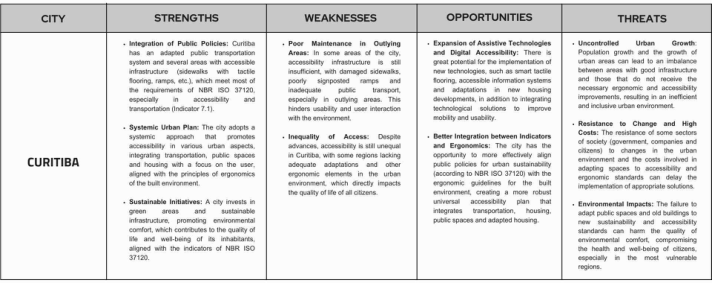
The SWOT method helped in the discussion of the data obtained and revealed in summary: important strengths in Curitiba-PR, such as its well- structured public transportation system, with adapted buses and accessible terminals, in addition to public policies focused on inclusion, such as the “Accessible Curitiba” program. The city also stands out for its adapted urban infrastructure, with accessible sidewalks, sound-activated traffic lights and tactile signage, which contribute positively to the mobility and quality of life of people with disabilities or reduced mobility. However, the study identified significant weaknesses, such as the inequality in the distribution of accessible infrastructure, especially in peripheral areas, and the lack of adequacy in many private spaces, such as commercial and leisure
Smart Cities: Are They Really Accessible and Truly Smart? 49
establishments. Opportunities for Curitiba include the expansion of the accessible public transport system, focusing on peripheral neighborhoods, and the use of assistive technologies, such as apps to guide people with visual impairments in public spaces. In addition, the city can expand its accessible cultural and leisure infrastructure, promoting broader social and cultural inclusion. Inclusive public policies can also be strengthened, addressing issues such as employability, education and health for people with disabilities. On the other hand, the study highlighted threats that can hinder the advancement of accessibility, such as: resistance to cultural and organizational change can limit the adoption of inclusive policies, while budgetary constraints and economic challenges can compromise investments in accessible infrastructure. These limitations are especially critical given the need to prioritize projects that promote universal accessibility. The complete analysis is presented in Figure 1 below.
Figure 1: SWOT analysis of the city of Curitiba (authors, 2025).
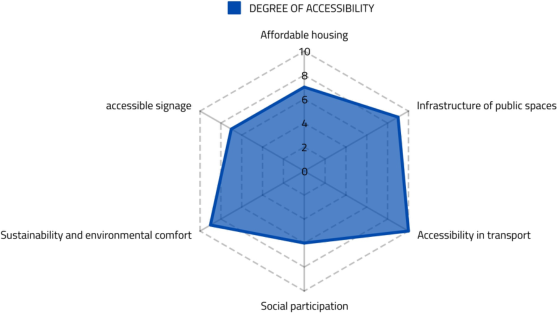
Based on the indicators, a radar map was developed, Figure 2 below, with the help of the OPEN AI (2025) tool, which mapped the areas that can serve as indicators of good practices, in the city of Curitiba-PR, related to urban accessibility for other Brazilian cities. It illustrates the degree of relevance in accessibility, in line with the EBE principles and NBR ISO 37120:2017, and in summary, there are six areas of predominance of practices that have some level of accessibility and respectively the degree that each indicator has, with HIGH being the highest degree of accessibility, GOOD, the area that has adequate levels and GREATER ATTENTION, the area that needs a more in-depth analysis to meet the accessibility requirements.
1. Transport Accessibility - High 2. Public Space Infrastructure - Good 3. Affordable Housing - Average 4. Accessible Signage - Average 5. Environmental Sustainability and Comfort - Good 6. Social Participation - Greater attention
Figure 2: Radar chart showing areas with more accessible practices in the city of Curitiba (authors, 2025).
RESULTS AND DISCUSSIONS The results indicate that the combination of the fundamental principles of built environment ergonomics and NBR ISO 37120 (ABNT 2017) are effective tools for assessing and identifying accessibility gaps in smart cities. Their application can guide public policies and investments, promoting the continuous improvement of urban infrastructure and ensuring that cities like Curitiba-PR adapt and advance towards universal and truly smart accessibility.
The SWOT analysis revealed that Curitiba has several strengths and opportunities to improve accessibility and ergonomics in the urban environment, with a solid foundation in public policies and sustainable infrastructure. However, weaknesses such as insufficient maintenance and inequality of access can limit progress, in addition to the threats associated with disorderly growth and resistance to change. To ensure a more accessible and ergonomic future, it is necessary to integrate policies, expand assistive technologies and focus on inclusive and sustainable urban planning, and this can be done by aligning NBR ISO 37120 with the principles of ergonomics.
CONCLUSION
The study concludes that, although Curitiba already demonstrates exemplary practices, there is still room for significant improvements, especially in studies to enable a balance between central and peripheral areas. However, it is already possible to map good practices in six areas, which serve as indicators, based on the EBE and NBR principles present in Curitiba, which demonstrate that it is aligned with accessibility and seeks to be “smart” for everyone. Accessibility should be seen as a key point in urban planning, involving infrastructure, signage, housing and social participation, and to ensure that all people, regardless of their needs, can access and use urban spaces in a comfortable and efficient manner.
Smart Cities: Are They Really Accessible and Truly Smart? 51
ACKNOWLEDGMENT
The authors would like to thank the Federal University of Juiz de Fora (UFJF) for its academic and institutional support during the development of this study. We also express our gratitude to the Coordination for the Improvement of Higher Education Personnel (CAPES) for the financial support, which was essential for the realization of this research.
REFERENCES
ABNT. (2017). ABNT NBR ISO 37120:2017 - Desenvolvimento sustentável de comunidades – Indicadores para serviços urbanos e qualidade de vida. Rio de Janeiro: ABNT. ABNT. (2020). NBR 9050: Acessibilidade a edificações, mobiliário, espaços e
equipamentos urbanos (4a ed.). Araújo, E. H. S. (2016). Acessibilidade e inclusão de pessoas com deficiência na Faculdade de Direito da UFBA [Trabalho de conclusão de curso, Universidade Federal da Bahia]. Beck, D. F., Silva Neto, W. L. B., Bezerra, A. J. R., Araújo, V. M., & Távora, C. G. R.
(2020). Um framework teórico sobre a dimensão social da inteligência das cidades inteligentes. IMED, Passo Fundo. Beniuk, C., Ward, J., & Clarkson, P. J. (2011). Applying inclusive design principles in the assessment of healthcare services. Proceedings of Conference on Design, 22–36. Ely, V. H. M. B., & Silva, C. S. da. (2009). Unidades habitacionais hoteleiras na
Ilha de Santa Catarina: um estudo sobre acessibilidade espacial. Production, 19, 489–501. Fernandes, P. M. (2023). As cidades inteligentes são humanas e inclusivas? Revista de Geografia e Ordenamento do Território, Coimbra, Portugal. Foster, A., Souza, R. S., & Igari, A. T. (2016). Economia circular e resíduos sólidos:
Uma revisão sistemática sobre a eficiência ambiental e econômica. Anais do Encontro Internacional Sobre Gestão Empresarial e Meio Ambiente, São Paulo. Freire, F. de S., et al. (2021). Cidade inteligente: Diagnóstico dos aspectos econômicos e da força produtiva do Distrito Federal. Revista de Gestão Ambiental e Sustentabilidade, 12(1). https://doi.org/10.5585/geas.v11i1.20383 From, D. A. (2022). Modelo de prestação de serviços públicos municipais conectados
por meio da internet das coisas no contexto da cidade digital estratégica [Tese de Doutorado, PUC-PR]. Gil, A. C. (2022). Como elaborar projetos de pesquisa (7a ed.). Barueri, SP: Atlas. Gomes, D., Stamato, C., & Santos, L. C. B. (2015). A inclusão social por meio do design e da ergonomia: Dispositivo de input de informação para pessoas com deficiência nos membros superiores. In ERGODESIGN, 15., Rio de Janeiro. Gomyde, A. (2017). Cidades inteligentes e humanas. Boletim Energético, FGV. Guldbrandsen, M. (2017). Design innovation. In E. Tsekleves & R. Cooper (Eds.),
Design for Health (pp. 279–281). New York: Routledge. Hall, P. (2000). Creative cities and economic development. Urban Studies, 37(4), 639–649. Mendes, T. C. M. (2020). Smart Cities: Iniciativas em oposição à visão neoliberal
(TD Observatório das Metrópoles 013/2020). Instituto Nacional de Ciência e Tecnologia. Moraes, A. M. de, & Mont’Alvão, C. (2007). Ergonomia: Conceitos e aplicações (3a ed.). Rio de Janeiro: 2AB.
Oliveira, G. R. de. (2020). O método de avaliação e percepção de atributos para projetos: Uma contribuição à ergonomia do ambiente construído [Dissertação de mestrado, PUC-Rio]. Disponível em: https://www.maxwell.vrac.puc-rio.br/ 21739/21739_3. PDF. Oliveira, R. B. de., Machado, H. O., Feitosa, A. S., Ferreira, A. V. O., Ribeiro,
I. I., Araújo, M. Z., Nascimento, A. L., & Sousa, E. A. de. (2024). Análise SWOT como ferramenta de gestão estratégica: Caso em uma granja de suínos na cidade de Teresina – Piauí. Revista de Gestão e Secretariado – GeSec, 5, 1–15. https:// doi.org/10.7769/gesec.v15i5.3735 OpenAI. (2025). ChatGPT: Modelo de linguagem de inteligência artificial desenvolvido pela OpenAI. Disponível em: https://www.openai.com/chatgpt Paludo, A. V., Silva, C. L. da, & Guimarães, I. A. (2024). Curitiba, cidade inteligente, para quem? Revista de Gestão e Secretariado, 15(7), e3841. https://doi.org/ 10.7769/gesec.v15i7.3841 Prefeitura Municipal de Curitiba. (2025). Curitiba é eleita a cidade mais inteligente do mundo em premiação na Espanha. Disponível em: https:// www.curitiba.pr.gov.br/noticias/curitiba-e-eleita-a-cidade-mais-inteligente-do- mundo-em-premiacao-na-espanha/71094. Rampazzo, R. F., & Vasconcelos, F. N. (2019). Cidades inteligentes e (quase)
humanas. Revista Políticas Públicas & Cidades. Rios Neto, J. V. R., & Gimenez, E. J. C. (2018). Cidades inteligentes: Sua contribuição para o desenvolvimento urbano sustentável. Instituto Nacional de Telecomunicações – INATEL. Disponível em: https://www.inatel.br/ biblioteca/todo-docman/pos-seminarios/seminario-de-redes-e-sistemas-de- telecomunicacoes/2018-1/9933-cidades-inteligentes-sua-contribuicao-para-o- desenvolvimento-urbano-sustentavel/file. Sarmento, T. S., & Villarouco, V. (2020). Projetar o ambiente construído com base
em princípios ergonômicos. Ambiente Construído, 20(3), 121–140. WHO. (2020). Disability. Disponível em: https://www.who.int/publications/i/item/ disability. Zanella, A., et al. (2024). Internet das coisas para cidades inteligentes. Jornal IEEE
Internet das Coisas. Disponível em: https://ieeexplor.eu.org/documento/674.
LISTED IN THE AHFE DIGITAL BOOKSTORE CATALOGUE
Explore the complete digital volume
Artificial Intelligence and Social Computing
Read this individual research paper free through the original publisher, or explore the full digital proceedings book.
ISBN 978-1-964867-39-7
Explore this ISBN in the AHFE Bookstore ↗Listed in the July 2026 bookstore catalogue; search by ISBN to confirm current availability · Digital book purchase optional